Taepodong-2
| Taepodong-2 | |
|---|---|
| Type | Space launcher technology development, possibly ballistic missile |
| Service history | |
| In service | 2006 (only test) |
| Production history | |
| Manufacturer | North Korea |
| Specifications | |
| Mass | ~80 tonnes |
| Length | ~30 m |
| Diameter | 2.0–2.2 m |
| Engine | Liquid |
Operational range | 4,000–6,700 km (est.)[1][2] |
| Maximum speed | 690–800 m/s |
Guidance system | Inertial |
Launch platform | Launch pad |
| Korean name | |
| Chosŏn'gŭl | 대포동 2호 |
|---|---|
| Hancha | 大浦洞 2號 |
| Revised Romanization | Daepodong 2ho |
| McCune–Reischauer | Taep'odong 2ho |
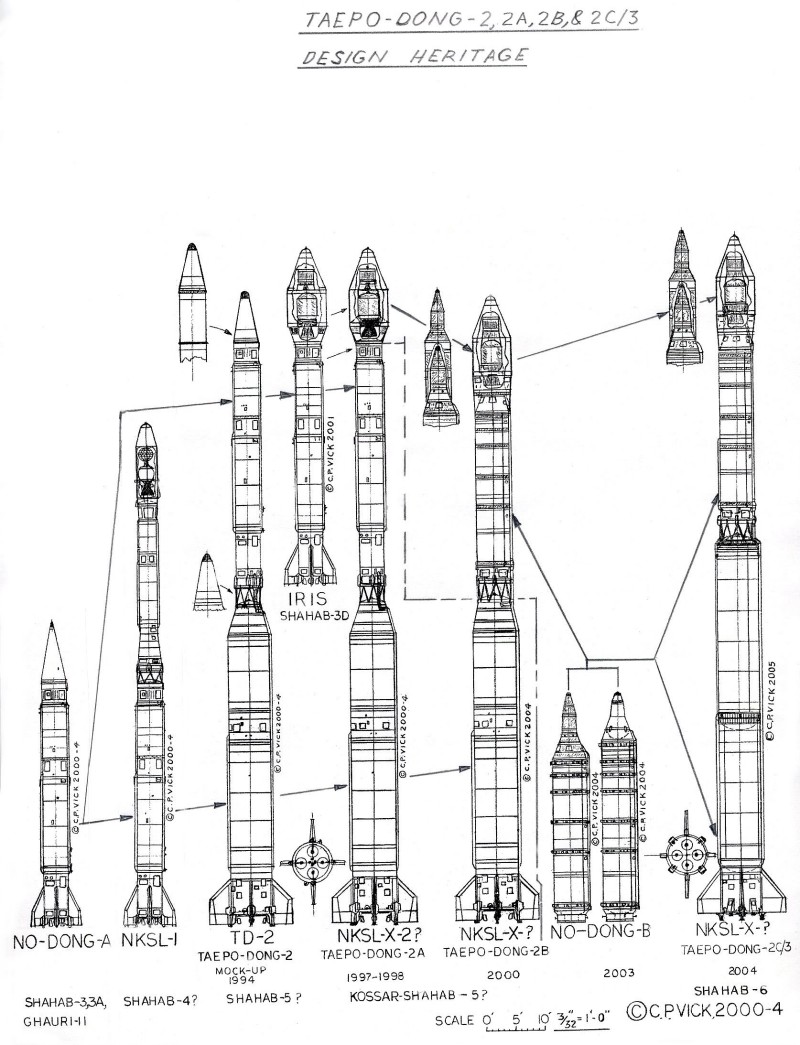
The Taepodong-2 (TD-2, also spelled as Taep'o-dong 2)[3] (Korean: 대포동 2호) is a designation used to indicate what was initially believed to be a North Korean two- or three-stage ballistic missile[4] design that is the successor to the Taepodong-1 technology demonstrator. In 2012, the U.S. Department of Defense assessed that the Taepodong-2 had not been deployed as a missile.[5] The Taepodong-2 is the technology base for the Unha space launch vehicle, and was likely not intended as ICBM technology.[6][7]
Details[edit]
As there is no publicly available imagery of the only Taepodong-2 launch in 2006, all estimates of technical parameters are approximate.[7]
Based on the size of the missile, the fuel composition, and the likely fuel capacity, it is estimated that a two-stage variant would have a range of around 4,000 km (2,500 statute miles) and a three-stage variant would be capable of reaching as far away as 4,500 km (2,800 statute miles), giving it potentially the longest range in the North Korean missile arsenal.[3] The burn time of each stage is a little over 100 seconds, thus allowing the missile to burn for 5 or 6 minutes. Speculative variants of the missile could be capable of a range of approximately 9,000 km (5,600 statute miles).[8] At maximum range, the Taepodong-2 is estimated to have a payload capacity of less than 500 kg (~1,100 lbs).[3]
According to a former worker in the publications department of one of North Korea's top research centres, who defected to South Korea, North Korea began development of the missile in 1987.[9]
Very few details concerning the technical specifications of the rocket are public information; even the name "Taepodong-2" is a designation applied by agencies outside North Korea to what is presumed to be a successor to the Taepodong-1. The TD-2 first stage likely uses a liquid propellant (TM-185 fuel and AK-27I oxidizer) driven engine and the second stage likely utilises the Rodong short-range missile.[10] Depending on the range, the estimated payload capacity could be as high as 700–1,000 kg (~1,550 - 2,200 lbs) at short range, making it potentially suitable for conventional weapons payloads, NBC payloads as well as Earth orbit satellite delivery. At maximum range, the Taepodong-2 is estimated to have a payload capacity of less than 500 kg (~1,100 lbs).[3] North Korea has yet to demonstrate the ability to produce a re-entry vehicle, without which North Korea cannot deliver a weapon from an ICBM.[5]
In 2015, aerospace engineer and North Korea missile program analyst John Schilling stated that North Korea did not seem to be planning to create an operational ICBM from the Taepodong-2 technology, and that the Taepodong-2 had been mistakenly identified as an ICBM development, whereas in reality it was a space launch development vehicle.[6]
Structure[edit]
First stage[edit]
Taepodong-2's first stage consists of four Rodong motors.
Second and third stages[edit]
Little is known about the Taepodong-2 design beyond the first stage. Most likely the second stage is one of the Scud-derived North Korean ballistic missiles (either Rodong-1 or Hwasong-6), and the third stage most likely uses Chinese solid-fuel engines.[8]
Launches[edit]
2006 test[edit]
A Taepodong-2 was test fired on 5 July 2006 from the Tonghae test facility. According to reports, the missile failed in mid-flight about 40 seconds after launch.[11]
Subsequent Unha launches[edit]
Subsequent launches were intended to launch satellites, using a Taepodong-2 development called the Unha rocket. After two failures in April 2009 and April 2012, its first successful flight, Unha-3, occurred in December 2012 with the launch of the second version of Kwangmyŏngsŏng-3 satellite.[12]
This successful flight was repeated on 7 February 2016 (UTC) with the successful launch of Kwangmyŏngsŏng-4 using a similar rocket as Unha-3 even though the rocket is officially named as Kwangmyŏngsŏng (not to be confused with the satellite with the same name).
See also[edit]

References[edit]
- ^ "A look at North Korea's missile arsenal". NDTV.com.
- ^ "How Terrible the Taepo?". Bulletin of the Atomic Scientists. March–April 2003. Retrieved 2009-04-08.
- ^ a b c d North Korea’s Taepodong and Unha Missiles, Federation of American Scientists, May 30, 2008
- ^ Kim, Jack (2009-03-25). "FACTBOX: North Korea's Taepodong-2 long-range missile". Reuters. Retrieved 2009-04-08.
- ^ a b Military and Security Developments Involving the Democratic People's Republic of Korea (PDF) (Report). U.S. Department of Defense. 2012. Retrieved 23 May 2013.
- ^ a b John Schilling (12 March 2015). "Where's That North Korean ICBM Everyone Was Talking About?". 38 North. U.S.-Korea Institute, Johns Hopkins University School of Advanced International Studies. Retrieved 15 March 2015.
- ^ a b Markus Schiller (2012). Characterizing the North Korean Nuclear Missile Threat (Report). RAND Corporation. ISBN 978-0-8330-7621-2. TR-1268-TSF. Retrieved 19 January 2013.
- ^ a b Taepodong-2 specs, globalsecurity.org
- ^ Pike, John. "Taep'o-dong 2 (TD-2) - North Korea".
- ^ "North Korea | Countries | NTI". www.nti.org.
- ^ "CNN.com - U.S. officials: North Korea tests long-range missile - Jul 4, 2006". CNN. Retrieved May 24, 2010.
- ^ "Fact Sheet: North Korea's Nuclear and Ballistic Missile Programs". Center for Arms Control and Non-Proliferation. August 2012. Archived from the original on 20 October 2012.
External links[edit]

- CSIS Missile Threat - Taepodong-2 (Unha-3)
- The Best U.S. Response to North Korea's Failed Missile Test NOW on PBS, July 7, 2006
- Nuclear Threat Initiative profile
- Federation of American Scientists profile
- GlobalSecurity.org Background
- Taepodong-2 Design Heritage Imagery @ GlobalSecurity.org
- USA Today piece from 6-20-2006
- NKorea may be set for long-range missile launch: reports, February 2, 2009