


Talk:Flag of the Philippines
 | This article is written in Philippine English, which has its own spelling conventions (color, realize, center, travelled) and some terms that are used in it (including jeepney and cyberlibel) may be different or absent from other varieties of English. According to the relevant style guide, this should not be changed without broad consensus. |
 | Flag of the Philippines was one of the History good articles, but it has been removed from the list. There are suggestions below for improving the article to meet the good article criteria. Once these issues have been addressed, the article can be renominated. Editors may also seek a reassessment of the decision if they believe there was a mistake. | |||||||||||||||||||||
| ||||||||||||||||||||||
 | This  level-5 vital article is rated B-class on Wikipedia's content assessment scale. level-5 vital article is rated B-class on Wikipedia's content assessment scale.It is of interest to the following WikiProjects: | ||||||||||||||||||||
| |||||||||||||||||||||


HSL[edit]
May I know the HSL colors of the Philippine flag? I tried converting from HEX but the conversion was not exact. Maybe there is a way to get a best approximation from the Cable No.? — Preceding unsigned comment added by 135.180.109.120 (talk) 08:53, 21 September 2022 (UTC)
Request[edit]
Can somebody upload a vertical version of the flag? My computer programs are crap. --Howard the Duck 13:48, 8 July 2006 (UTC)
- Sure, about 11 months later after your request :P User:Zscout370 (Return Fire) 09:27, 15 June 2007 (UTC)
That's because modern Filipinos doesn't care about their own country. -- (Unsigned) —Preceding unsigned comment added by 203.167.31.130 (talk) 13:36, 28 June 2008 (UTC)
- My ego was hurt. (😂) Khamer Jun Manalo (chat) 07:28, 24 November 2021 (UTC)
GA nomination hold[edit]
Overall its very good, but a few small points I'd like to see addressed. It's well written but perhaps you could look at usage and see if you can turn the lists into prose, I'm thinking mainly of the second list, why does that need bullet points? Could you try to blue those two red links you have? One last point, "It was displayed in battle on 28 May 1898" - it would be good to know more on the battle, is there a page on that?
Your sources seem to back most of it up but are displayed mid paragraph, as a result it seems as though there is insufficient citation. Either more citation or display your current ones better. Second, is there a slightly more academic source that FOTW? Okay if there isn't but I've never entirely trusted it as a main source. Everything else seems okay but it would be good to have an image of a real flag flying. - J Logan t/c: 09:28, 23 June 2007 (UTC)
- I'll look on Flickr for a photo of the flag. Pretty much for the Philippines flag, there is a lot of unknowns about it. I can try and fact check it eventually. User:Zscout370 (Return Fire) 20:53, 23 June 2007 (UTC)
- I have a nice free image of a flag. I'll upload it and address other concerns soon (within 24 hours). TheCoffee 17:08, 24 June 2007 (UTC)
GA nomination success[edit]
Okay, well done all, I'm happy to give thumbs up to this as a good article (as of 23rd June 2007). This is how it compares to the six criteria.
It is well written; The text appears to be clear and well written, no grammar problems I can see. Overall it follows standards with appropriate size and coverage of sections.
It is factually accurate; No original research. The majority of the article is covered by inline citations which link to reliable sources, but greater coverage would be welcome.
It is broad in its coverage; It covers all the appropriate areas while sticking to the subject. Nothing is longer than it ought to be or significantly lacking in detail. It is
neutral; The whole thing appears technical without any kind of bias that I can see. I am not aware of any particular viewpoints that may be missing from this.
It is stable; There has been some minor vandalism but nothing very recent or worrying. Large sections have been changed and added but mainly in the improvement of the article to its current state. Aside from those improvements I don't see any major instability, nothing that looks like a future problem at least. Also, only a few anonymous edits, work is mainly by committed project editors. '
images'; All images completely illustrate the topic and have appropriate captions, although "section 10" may be too much detail. All are public domain.
Yes, so I've pointed out a few things but they are no problem to GA as far as I can see, but things you may want to consider. Good work everyone. - J Logan t/c: 12:21, 28 June 2007 (UTC)
- Thanks! Sorry I haven't been able to devote myself as much as I hope to addressing all the issues brought up, but most of the bigger issues were corrected. TheCoffee 03:39, 29 June 2007 (UTC)
Other flags[edit]
-
 The position of the sun and stars seems to be wrong as compared with...
 -
 ...this.
 -

.svg)
.svg)
Also we'd need to know to find out the exact dates these flags were used so we can modify the country data templates. --Howard the Duck 09:02, 3 July 2007 (UTC)
- Unless the sun and start positions changed, I tried to keep the positions the same with the SVG images I did. User:Zscout370 (Return Fire) 19:26, 3 July 2007 (UTC)
- If you'll use the tabbed features of Firefox, and have a pseudo-slide show of the three flags, the current one has bigger sun and stars. --Howard the Duck 02:33, 4 July 2007 (UTC)
- I have the browser, but I barely see the changes. However, what I was getting at with my last comment is this: was there a different way the sun and stars were official displayed on the flag of they stayed the same since the 1930's when MLQ made the Philippines flag law? User:Zscout370 (Return Fire) 04:06, 4 July 2007 (UTC)
- That's odd, I can swear the middle pic's sun and stars are slightly bigger than those at the left and right. I suppose the sun and stars were pretty much the same throughout history, only the colors of the blue (and perhaps the red) changed. I dunno though about minute details like the apex of the stars pointing to the corner and equator, etc. --Howard the Duck 04:24, 4 July 2007 (UTC)
- I still can't see anything huge, unless it is a mediawiki/monitor issue. But I can see if I can try and fix it asap. User:Zscout370 (Return Fire) 04:32, 4 July 2007 (UTC)
- That's odd, I can swear the middle pic's sun and stars are slightly bigger than those at the left and right. I suppose the sun and stars were pretty much the same throughout history, only the colors of the blue (and perhaps the red) changed. I dunno though about minute details like the apex of the stars pointing to the corner and equator, etc. --Howard the Duck 04:24, 4 July 2007 (UTC)
- I have the browser, but I barely see the changes. However, what I was getting at with my last comment is this: was there a different way the sun and stars were official displayed on the flag of they stayed the same since the 1930's when MLQ made the Philippines flag law? User:Zscout370 (Return Fire) 04:06, 4 July 2007 (UTC)
- If you'll use the tabbed features of Firefox, and have a pseudo-slide show of the three flags, the current one has bigger sun and stars. --Howard the Duck 02:33, 4 July 2007 (UTC)
I've noticed the red on the center flag is darker. Can the other flags also have a darker shade of red? --Howard the Duck 04:09, 8 August 2007 (UTC)
- No. I had the SVG looked at by MLQ3 and said that was legit to use. I took my colors from the Philippines Government websites. User:Zscout370 (Return Fire) 05:49, 8 August 2007 (UTC)
- I actually edited the flag country data template for the Philippines so I'd be doing (mass) changes. So does that mean that the red color that is used now was different from the earlier flags? You can check it out for mistakes. And I'll be adding these two flags at the article too. --Howard the Duck 12:36, 8 August 2007 (UTC)
Hello Guys! The Flag and Heraldic Code of the Philippines gave the precise specifications of the Flag. It's in sections 27 to 33 of the Republic Act 8491. The following goes:
- Sec. 27. The flag shall have the following proportions.
- The width of the flag, 1;
- the length of the flag, 2;
- and the sides of the white triangle, 1.
- Sec. 28. The technical specifications shall be as follows:
- The blue color shall bear Cable No. 80173;
- the white color, Cable No. 80001;
- the red color, Cable No. 80108;
- and the golden yellow, Cable No. 80068.
- Sec. 29. In order to establish uniform criteria in the making of our national flag and to guarantee its durability by the use of quality materials, the following standards and procedures shall be observed:
- a) All requisitions for the purchase of the Philippine National Flag must be based on strict compliance with the design, color, craftsmanship and material requirements of the Government;
- b) All submitted samples of flags by accredited suppliers offered for purchase for government use shall be evaluated as to design, color and craftsmanship specifications by the Institute, through its Heraldry and Display Sec., which shall stamp its approval or disapproval on the canvass reinforcement of the flag sample submitted. The samples shall be sent to the Institute by the requisitioning office, not by the flag supplier; and
- c) The Industrial Technology Development Institute (ITDI) or the Philippine Textile Research Institute (PTRI) of the Department of Science and Technology (DOST) shall evaluate the quality of material of all flag samples and certify whether the fabric for the blue, white, red and golden yellow colors, including the canvas submitted, conforms to government requirement as to quality of the material. The samples shall be sent annually to the ITDI/PTRI by the manufacturer. The laboratory test results shall be submitted by the said office to the Institute.
- Sec. 30. All deliveries of the flags requisitioned by the government shall be inspected by the requisitioning agency's internal inspector and by the Commission on Audit (COA) using the flag stamped approved by the Institute as reference.
- Sec. 31. In carrying out its responsibilities under Sec. 4 hereof, the Institute, COA, the ITDI/PTRI shall prepare guidelines to be approved by the Office of the President.
- Sec. 32. All government agencies and instrumentalities shall ensure that the requirements under this Act with respect to the standards, requisitions and delivery of the national flag are strictly complied with.
- Sec. 33. All departments, agencies, offices, and instrumentalities of the government, government-owned or controlled corporations, local government units, including barangays, shall include in their annual budgets the necessary outlay for the purchase of the national flag.
This means that the colour blue in the Flag is not Navy Blue but Royal Blue. Nasugbu batangas (talk) 06:41, 8 May 2009 (UTC)
[edit]

Shouldn't the Philippine naval jack deserve mention in this article? (or if not, it's own article?) —Preceding unsigned comment added by 125.60.243.115 (talk) 03:36, 2 September 2007 (UTC)
Marcela's daughter[edit]
Lorenza, Marcela's eldest daughter wrote something about the flag, I think the original description of the flag. See Marcela de Agoncillo and browse on the images or go here. --βritand&βeyonce (talk•contribs) 06:34, 13 November 2007 (UTC)
"Flag used from 1908 to 1919"[edit]
The U.S. flag actually changed again in 1912... AnonMoos (talk) 23:57, 29 November 2007 (UTC)
Folding?[edit]
Is not the Filipino flag folded in a triangle (like the US flag? Paul, in Saudi (talk) 13:10, 26 February 2008 (UTC)
I agree, I remember back in grade school that our scout master taught us on how to fold the flag and how to carry it(and yes it was similar to how the American Flag was folded). Sadly, I can't remember the details. If anyone knows how, post the instruction here and I can make an animated image of it(.gif) Chiricko27 (talk) 11:57, 2 July 2008 (UTC)
- You can see instructions in folding the Philippine Flag in [1] and [2] 121.54.2.91 (talk) 12:36, 30 April 2011 (UTC)
Display on wall in peace and in war[edit]
There seems to be some confusion about the orientation of the flag when hanging on a wall. A flag is not simply rotated from horizontal 90 degrees for vertical display, but also flipped. The "top" part when displayed horizontally is in the more important part vertically, which is the *LEFT* from the viewer's perspective. See Flag protocol#Hanging and [3] for examples. (When a flag may be viewed from either side, the chief part would be placed to the north or east.) Thus Image:Flag of the Philippines (vertical display).svg (BLUE TO THE LEFT) says it is a "Rotation of Image:Flag of the Philippines.svg into a vertical display", and that's a flag with BLUE ON TOP. It may be confusing that heraldry refers to directions opposite of the viewer, but that's why act 8491 specifies exactly how it looks to an observer, saying quite clearly "if in a hanging position, the blue field shall be to the right (left of the observer) in time of peace". The hanging image used here has BLUE TO THE LEFT, and a drawing is typically made from the perspective of the observer. Gimmetrow 21:46, 2 April 2008 (UTC)
- The image used in the article referring to how the flag is displayed on a wall is correct; the blue field is on the observer's left. — • Kurt Guirnela • ‡ Feedback 06:34, 3 April 2008 (UTC)
Biggest Baguio Flag[edit]
The largest (P 30 million) Philippine flag (180 meters x 92 meters, 3.8 tons) was first unfurled on June 12, 2008, Philippine Declaration of Independence day at the Baguio Athletic Bowl. The Hallelujah Prophetic Global Foundation of Grace Galindez Gupana Gupana made it from14,000 yards of taffeta nylon and 1,250 yards of satin (for the stars and sun).gmanews.tv, Largest Philippine flag unfurled in Baguio--Florentino floro (talk) 09:30, 13 June 2008 (UTC)
- This is the 3rd largest in the world, next to Gupana’s (Largest according to the Guiness Institution) Masada, Israel Flag, 66,000 sq.m. and Palestine Flag (Damascus, Syria)’s 27,000 sq.m.[4]
Image[edit]
At last we can now see this image, the 3rd biggest flag in the world:*abs-cbnnews.com/images, Picture of the Philippine’s largest Flag in Baguio city--Florentino floro (talk) 11:29, 13 June 2008 (UTC)
Need Volunteers[edit]

Tagalog Wikipedia is campaigning for your participation in writing, editing, assessing and translating articles!
The purpose of this campaign is to expand and improve articles at Tagalog Wikipedia.
Your participation will be highly appreciated by the community.
There are over 36,000 articles to view, read, review, edit, and expand, so please visit the Wikipedia Café and the WikiProject Philippines at Tagalog Wikipedia to help out!
The campaign includes seeking your assistance in:
- Providing requested pages
- Providing requested articles
- Providing articles required for all language Wikipedias
- Starting or improving pages that need translation
Or just anything you can do to help us just like what you are doing there at the English Wikipedia.
Thank you in advance and regards, Tagalog Wikipedia Community--The Wandering Traveler (talk) 05:38, 22 March 2009 (UTC)
What are the eight provinces represented in the sun's rays?[edit]
The eight as stated in the article are: Manila, Cavite, Laguna, Batangas, Bulacan, Tarlac, Pampanga, and Nueva Ecija. This is based on the NHI's take of which provinces were put under martial law by Gov. Blanco following the San Juan del Monte battle. This contrasts directly with the text of the Philippine Declaration of Independence where Bataan takes Tarlac's place. --seav (talk) 09:38, 5 April 2009 (UTC)
British vs. American English[edit]
I've boldly placed an {{American English}} template on this talk page and changed a couple of instances of British-english spelling ("valour" and "colour") to American-english spellings. I believe that consensus would support the position that American-english is more appropriate for this article than British-english. Wtmitchell (talk) (earlier Boracay Bill) 02:48, 26 November 2009 (UTC)
- When I wrote the content for the article, I use American English. User:Zscout370 (Return Fire) 04:02, 26 November 2009 (UTC)
Unable to parse image caption[edit]
I couldn't parse the image caption which read, "Flag used from 1981 to 1986. The shade of Blue used here is Light Blue, in suit with the Cuban Flag, which rebelled against the Spanish at the time of Independence and when under Cuba."
The Cuban flag rebelled against Spain? At the time of independence of what? What was under Cuba—the Cuban flag?
I've changed this to read, "Flag used from 1981 to 1986. The shade of Blue used here is Light Blue, similar to the shade used in Cuban Flag at the time of the proclamation of the Philippine Declaration of Independence.", which I'm guessing is close to what was intended. Incidentally, I note that this image and caption appear to be in in conflict with info here. Wtmitchell (talk) (earlier Boracay Bill) 01:20, 13 December 2009 (UTC)
- That change was done by an IP, I was confused about it too. User:Zscout370 (Return Fire) 04:54, 13 December 2009 (UTC)
Shade of blue on the 1981-1986 flag[edit]
The remarks for this flag say that the color is Light Blue, similar to the shade used in Cuban Flag at the time of the proclamation of the Philippine Declaration of Independence. As far as I can find, the color of the Cuban flag is considerably darker than the light blue color shown. This cubaflags.com web page shows one depiction of the Cuban flag which it says became official in 1902, and also shows a number of older flags. The shade of blue on all of the flags shown is considerably darker than the blue in the 1981-1986 Philippine flag. This source says that the design of the Cuban flag dates from 1850, and shows a flag with a shade of blue similar to the shade shown on the cubaflags.com web page. The Flag of Cuba article says that the current Cuba flag was designed in 1848 and adopted in 1902, and shows a flag with a darker blue that the 1981-1986 Philippine flag. The CIA Factbook info on the flags of Cuba and The Philippines (current flag) show very similar shades of blue—much darker than the 1981-1986 flag. Unless it can be supported by a cited source, I suggest that the assertion that the blue in the 1981-1986 flag is similar to the shade used in the Cuban Flag at the time of the proclamation of the Philippine Declaration of Independence (which it apparently is not) be removed. Wtmitchell (talk) (earlier Boracay Bill) 04:26, 18 December 2009 (UTC)
GA reassessment[edit]
I'm reading through this article for WP:GA Sweeps. After reading through the article, I feel that it no longer meets the GA criteria for the following reasons:
- WP:LEAD needs expansion.
- Refs #1 and #9 are deadlinks.
- Ref 1 is a problem being gone since it's so often used in the article.
- There should be a cite for each paragraph at least.
- Prohibited acts unref'd, as is most of half-mast.
- There's a lot of one and two second paragraphs strewn about, and as such the article has no structure.
The article can always be renominated at GAN after everything's fixed, but since it needs a lot of work to be a GA in 2010, I am failing it instead of putting it on hold. Wizardman Operation Big Bear 04:40, 12 January 2010 (UTC)
Symbolism section[edit]
The first paragraph of this section begins with, "Official sources state" and cites a .gov.ph source (for which I've just fixed a dead link), but then goes on to make assertions supported not by that source but by other cited sources not official. Also, some assertions in this section do not agree fully with the sources cited to support them.
The article places Refs for some sources which do not list the eight provinces after the province list — making it seem that the asserted list is supported by the Ref'd sources when they actually do not provide support support. That asserted list is contradicted by one of the the sources cited to support it.
Regarding the makeup of the list of provinces, available sources appear to agree on seven of the eight, but there is disagreement not reflected in this article between available sources about which of Tarlac or Bataan should be named in the list (Tarlac: [5], [6], [7], [8], [9][10], [11], others; Bataan: [12] quoting one Ambrosio Rianzares from the translated Philippine Insurgent Records, [13], [14], others). (This NHI documents credits one Ambrosio Rianzares Bautista as the author of the Declaration of Philippine Independence)
I would redo the section to address these issues, but I'm not Filipino and I think that this might be better be done by someone who is Filipino. Wtmitchell (talk) (earlier Boracay Bill) 19:37, 16 July 2010 (UTC)
Inverted Philippine Flag[edit]
There is a claim that if the flag is inverted it means the Philippines is at war or something similar. Is this true, and is there a Philippine government source of this? Geo8rge (talk) 13:50, 27 September 2010 (UTC)
- It is true, just did a quick search, according to [15] "Section 10 of Republic Act No. 8491, also known as the Flag and Heraldic Code of the Philippines," states this. Chipmunkdavis (talk) 14:07, 27 September 2010 (UTC)
- Yes. See this, referenced in the article and cited in the Usage as war ensign section of the article (thanks to Chipmunkdavis for adding a <Ref> there). Wtmitchell (talk) (earlier Boracay Bill) 00:01, 28 September 2010 (UTC)
I also believed that inverted Philippine Flag is a symbol of war, but every time i change the infobox from National flag and ensign to War Flag, User:Fry1989 always undid revision, I also warned him/her several times in his talk page, but he/she always delete what i wrote. You can see us in article history, how we compete in this page. What can i do to stop him/her spreading wrong information? 121.54.2.91 (talk) 16:57, 2 June 2011 (UTC)
- First of all, you have NEVER contacted me about the issue. Second, you mis-understand the FIAV symbolism. The flag of the Philippines can be used, inverted during a state of war, for all purposes. That means the people, the government, the military, on land and sea. By editing the FIAV symbol as you are, you are saying that the inverted flag can be used ONLY by the Philippine Armed Forces, and ONLY on Land. That is why I keep reverting you, because you are wrong. Leave the FIAV symbols alone. It explains quite clearly that the flag is used inverted only during a state of war, but that use is not restricted to the Military alone, and only on land. Fry1989 (talk) 21:00, 25 July 2011 (UTC)
- I suggest you search for furthermore reliable sources that will prove your statements, As of now i will also search more sources too, i will not also revert you're edit but soon i found enough sources you're edit will be change.
- According to my research i found in Flag and Heraldic Code of the Philippines (R.A. 8491) Chapter I-A Section 10 that The flag, if flown from a flagpole, shall have its blue field on top in time of peace and the red field on top in time of war; if in a hanging position, the blue field shall be to the right (left of the observer) in time of peace, and the red field to the right (left of the observer) in time of war.,please clarify these source...-121.54.2.91 (talk) 07:56, 26 July 2011 (UTC)
- Again, nowhere in that sentence says that it can only be used inverted by the Military. You and I are not debating whether or not the flag is inverted during a state of war, we're debating the FIAV symbol, which you don't understand. Having the 3rd top section marked only, means that the flag is for use only by the military on land. having all 6 sections means the inverted flag is used during a state of war by everyone in the whole nation, the people on land and sea, the government on land and sea, and the military on land and sea. You need to study the FIAV symbol's meanings, and then you will understand why I have reverted you numerous times. Fry1989 (talk) 18:31, 26 July 2011 (UTC)
- I also have RA 8491 saved on my computer and it made no specific rules for use on military bases; if the Philippines is at a time of war, everyone must fly the flag with the red stripe up (or to the right if flat on a wall). User:Zscout370 (Return Fire) 19:50, 26 July 2011 (UTC)
- I already understand what you mean. i search for source and i found the FIAV flag information code and found out what you want me to understand. At first i don't believe in you because you don't give any sources. Sorry if i misinterpret you, i know that i you are a Vexillologist and you know a lot about flags, I will not argue with you anymore. So for now i suggest both of us do a lot of research in order to build better conclusion, i also want to clarify dissonant sources between Flag and Heraldic Code of the Philippines (R.A. 8491) and the FIAV flag information code, I hope you and other users cooperate with me to improve this article, Thanks for you're time...-121.54.2.91 (talk) 13:55, 27 July 2011 (UTC)
New proposed revison[edit]
I noticed that the flag should be inverted during war times, as it was stated in the Executive Order No. 321 and Executive Order No. 23, therefore the flag in the chronology section should be revised, especially the flag during 1898–1901 because the country is at war during the Philippine Revolution and the flag on October 14, 1943, because the Philippines is at state of war durig World War II. Could someone revise this section? the main purpose is to avoid the confusion on the use of inverted flag as a war symbol ...-121.54.2.91 (talk) 15:09, 27 March 2015 (UTC)
The Original Blue of the Flag[edit]
The "Colour" section in the main article describes the original blue of the Flag as "azul oscura" and goes on to say that this was a light blue. I think this is a mistake because oscuro is Spanish for "dark" and azul oscuro is a particularly dark blue that is almost black. This should be reflected in the pictures as well.
Dax2276 (talk) 04:01, 25 July 2011 (UTC)Dax2276
1998-Present flag[edit]
The colors shown on this version of the flag were described as "Shade of blue used here is Royal Blue and Shade of red used here is Cardinal Red, as a compromise between earlier versions. Introduced for the Philippine Centennial Celebrations." I have requested the help of another editor in reviewing and possibly correcting the colors used in the flag graphic (see here). I've also redone the description here and cited supporting sources for the redone description.
If anyone has the time, the related Standard Color Reference of America article could use a rework and expansion -- I'm only able to work with online sources, and online sources on this are hard to find. Wtmitchell (talk) (earlier Boracay Bill) 12:44, 31 May 2012 (UTC)
Three Stars-Wrong Representation[edit]
The article erroneously states the three stars represents "the country's 3 main islands - Luzon, Visayas and Mindanao."
Visayas is not an island.
It may be true that Luzon and Mindanao are islands. However, they are also geographical regions. Which is what the three stars represent.
Therefore encompassing all of the Philippines. Not just three islands. — Preceding unsigned comment added by 121.54.2.92 (talk) 17:48, 9 June 2012 (UTC)

Symbolism, etc.[edit]
The article says, "The symbolism given in the 1898 Proclamation of Philippine Independence differs from the current official explanation. It says that the white triangle signifies the emblem of the Katipunan, the secret society that opposed Spanish rule. It says ..."
The it there, seems to refer to the symbolism given in the 1898 proclamation. OK, but it's not clear what parts of "the current official explanation" it differs with. Also, "current" flouts WP:DATED. I would have tried to fix this, but I'm not sure what the current official explanation might be. Wtmitchell (talk) (earlier Boracay Bill) 11:40, 28 July 2012 (UTC)
Bold changes to the Construction section[edit]
I've made some bold changes to the 'Construction section of the article, as follows:
- I've removed "but may be smaller up to 1:" re the width of the flag, added here and here. I didn't find support for that in the source cited in support.
- I've removed the remark (added here, and tweaked elsewhere) about the golden sun not being centered but being "shifted about 1/14 to the right." No supporting source was cited for that, and I'm not sure what measurement the 1/14 referred to. I pushed some numbers around, based on information from this NHI document, cited elsewhere in the article, and came up with the following:

- (I infer this from info inside the golden sun on the diagram thererein, where the equals sign seems to have been omitted)
- The center of the golden sun is at , or about since
- Each side of the white equilateral triangle has a length of . or
- The height of that equilateral triangle is , or about .
- The center of that equilateral triangle is at about .
- The center of the golden sun is to the right of the center of the equilateral triangle by , or
- or about ( being the height of the equilateral triangle)
- or about ( being the width of the flag)



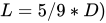








.svg)

I've tweaked the assertion about the location of the golden sun to just say that it is placed slightly to the right of the center of the equilateral triangle, and cited that NHI document in support of that.
It is entirely possible that I screwed up the arithmetic I did above, and I'm not sure where that arithmetic would stand in relation to WP:CALC. Feel free to correct any errors I made. Wtmitchell (talk) (earlier Boracay Bill) 02:14, 16 October 2012 (UTC)
New Section for National Flag Day in the Philippines[edit]
The new section will be look like this :
National Flag Day[edit]
The National Flag Day in the Philippines is celebrated every 28th of May. The National Flag week starts from May 28 and ends on June 12 every year.
Similar flags[edit]
The flag of the state of Texas seems more similar than the flag of the Czech republic. Is it just that state flags do not have as much weight here as nation flags? I would think that the Texas flag is more widely recognizable than the Czech flag (sorry Czechs!) Kluto (talk) 08:21, 23 August 2014 (UTC)
The open question is what is meant here by the terms Similar and flags
- flags: one (or maybe more than one) of
- current national flags
- current flags of states, provinces, or similar subnational entities
- current municipal or other sub-governmental flags
- current governmental flags other than the above (e.g., battle flags, jacks, pennants, etc.)
- current nongovernmental flags of some organizations (e.g., units of the U.N., large multinational organizations, organizations significant internationally such as ISIS or some (or all?) religious organizations, Boy/Girl Scouts and similar, International Red Cross/Crescent and similar, etc.
- include MNLF & MILF, provided other inclusion criteria are met? exclude them even if other inclusion criteria are met?
- perhaps historical flags are allowed to be considered as well as current ones; perhaps not.
- others?
- Similar: one or more (perhaps with several similarities being required) of
- general geometry (e.g., a rectangle; possibly with an aspect ratio of around 1:2 being required; are other geometries allowed to be considered?)
- general size (about 90x180cm; is this a consideration?)
- dominant colors include white (white-ish?)
- dominant colors include a red (of similar vividness and shade?)
- dominant colors include blue (of similar vividness and shade?)
- dominant colors include yellow (of similar vividness and shade?)
- perhaps all dominant colors need be included, perhaps yellow is optional, perhaps yellow and white, perhaps some other color selection criteria
- perhaps arrangement of colors are a consideration (blue and red in stripes?)
- perhaps proportion of colors is a consideration
- perhaps there are other or alternative color selection criteria
This link might be useful. I had to retry searches several times to make them work (I'm guessing due to net-slowness). Try searching for flags with designs based on two horizontal stripes which include white or gray, red, and any blue; try any design which includes those colors; try other criteria.
Perhaps the section might include several subsections with different inclusion criteria for each.
I suggest that the section ought to be eliminated if the inclusion criteria cannot be stated with some degree of clarity. Wtmitchell (talk) (earlier Boracay Bill) 22:48, 23 August 2014 (UTC)
War flag[edit]
Who's idea was it to have the red stripe on top during wartime? Did Aguinaldo intend that or was it Quezon (via his Executive Order)? –HTD 17:03, 6 April 2015 (UTC)
Flag rays vs. Provinces revisited yet again[edit]
This edit caught my eye. Seeing that this is still going on after some years (see this from 2009 and this from 2010), I've edited the article in an attempt to supply a WP:NPOV on this. Please improve this as needed, but please observe WP:DUE and WP:NOR, and please try to avoid leaving contradictory assertions sprinkled around the article. Wtmitchell (talk) (earlier Boracay Bill) 04:41, 23 April 2015 (UTC)
Stars are Wrong[edit]
Article states:
"At each vertex of the triangle is a five-pointed, golden-yellow star, each of which representing one of the country's three main island groups - Luzon, the Visayas, and Mindanao."
They actually refer to the three main islands of the revolution: Luzon, Panay, and Mindano. cf: http://malacanang.gov.ph/3846-origin-of-the-symbols-of-our-national-flag/
Should be changed.24.117.62.13 (talk) 04:33, 6 June 2015 (UTC)
- This is already explained in the Symbolism section of the article. —seav (talk) 06:44, 6 June 2015 (UTC)
Cuban flag influence; shade of blue[edit]
I see that I have remarked about this in earlier talk page sections. I just stumbled on it yet again, and this time I have placed a {{cn}} tag after the initial sentence of the Color section. I did this after looking at the Flag of Cuba article and seeing that the shade of dark blue on that flag came into use in 1902. The Cuban flag used a much lighter shade of blue between 1869 and 1902 -- sky blue. The flag flown at the Philippine Declaration of Independence ceremony on June 12, 1898 had a shade of blue much darker than the sky blue shade used bu the Cuban flag of that time. Wtmitchell (talk) (earlier Boracay Bill) 06:02, 16 January 2016 (UTC)
The lead[edit]
This edit caught my eye, and put me in mind of WP:LEAD.
- I don't see how a comment about the location of Iloilo belongs in the lead section of an article on this topic
- Re the mention of "recent interpretations", please see WP:DATED
The content of the lead section from ", albeit" to the end of that paragraph seems to duplicate and to give undue emphasis to information which is covered in the Symbolism section. I propose its expungement. Wtmitchell (talk) (earlier Boracay Bill) 00:09, 4 February 2016 (UTC)
External links modified[edit]
Hello fellow Wikipedians,
I have just modified one external link on Flag of the Philippines. Please take a moment to review my edit. If you have any questions, or need the bot to ignore the links, or the page altogether, please visit this simple FaQ for additional information. I made the following changes:
- Added archive https://web.archive.org/web/20071205235342/http://www.gov.ph/aboutphil/RA8491.asp to http://www.gov.ph/aboutphil/RA8491.asp
When you have finished reviewing my changes, please set the checked parameter below to true or failed to let others know (documentation at {{Sourcecheck}}).
This message was posted before February 2018. After February 2018, "External links modified" talk page sections are no longer generated or monitored by InternetArchiveBot. No special action is required regarding these talk page notices, other than regular verification using the archive tool instructions below. Editors have permission to delete these "External links modified" talk page sections if they want to de-clutter talk pages, but see the RfC before doing mass systematic removals. This message is updated dynamically through the template {{source check}} (last update: 18 January 2022).
- If you have discovered URLs which were erroneously considered dead by the bot, you can report them with this tool.
- If you found an error with any archives or the URLs themselves, you can fix them with this tool.
Cheers.—InternetArchiveBot (Report bug) 16:05, 21 July 2016 (UTC)
Flags of Lakandula, Dagohoy, etc[edit]
I reverted recent edits that inserted flags of ancient principalities that had nothing to do with the evolution of the Philippine Flag which is the topic of this article. See http://malacanang.gov.ph/history-of-the-philippine-flag/ and http://www.gov.ph/the-philippine-flag/ for the official historical Flags of the Philippines.--RioHondo (talk) 03:15, 4 September 2016 (UTC)
Colors[edit]
Hello, this article has the colors of the flag almost completely wrong. The source cited (http://www.vexilla-mundi.com/philippines_flag.html) lists the pantone colors as 286, 193, white, and 122. This Wikipedia article lists 286, 186, white, and 116. Additionally, while the blue Pantone color is correct, the blue CMYK, rgb and hex values are not even close to correct (and naturally, the same for red and gold.)
BLUE Pantone 286: CMYK should be 100, 84, 11, 3, RGB should be 01, 51, 161, hex should be 0033a1
RED Pantone 193: CMYK 16, 10, 76, 5 - RGB should be 197, 31, 63 - hex c51f3f
Gold Pantone 122: CMYK 0, 22, 83, 0 - RGB 255, 200 70 - Hex ffc846
Thanks.96.9.69.245 (talk) 23:24, 18 February 2017 (UTC)Anthony
External links modified[edit]
Hello fellow Wikipedians,
I have just modified 3 external links on Flag of the Philippines. Please take a moment to review my edit. If you have any questions, or need the bot to ignore the links, or the page altogether, please visit this simple FaQ for additional information. I made the following changes:
- Added archive https://web.archive.org/web/20130426153938/http://www.nhcp.gov.ph/index2.php?option=com_content&do_pdf=1&id=760 to http://www.nhcp.gov.ph/index2.php?option=com_content&do_pdf=1&id=760
- Added archive https://web.archive.org/web/20120127205908/http://www.ncca.gov.ph/downloads/flag.pdf to http://www.ncca.gov.ph/downloads/flag.pdf
- Added archive https://web.archive.org/web/20090927052216/http://newsinfo.inquirer.net/inquirerheadlines/nation/view/20090924-226635/RP-flag-to-have-9th-ray-to-the-sun to http://newsinfo.inquirer.net/inquirerheadlines/nation/view/20090924-226635/RP-flag-to-have-9th-ray-to-the-sun
When you have finished reviewing my changes, you may follow the instructions on the template below to fix any issues with the URLs.
This message was posted before February 2018. After February 2018, "External links modified" talk page sections are no longer generated or monitored by InternetArchiveBot. No special action is required regarding these talk page notices, other than regular verification using the archive tool instructions below. Editors have permission to delete these "External links modified" talk page sections if they want to de-clutter talk pages, but see the RfC before doing mass systematic removals. This message is updated dynamically through the template {{source check}} (last update: 18 January 2022).
- If you have discovered URLs which were erroneously considered dead by the bot, you can report them with this tool.
- If you found an error with any archives or the URLs themselves, you can fix them with this tool.
Cheers.—InternetArchiveBot (Report bug) 00:51, 2 October 2017 (UTC)
External links modified[edit]
Hello fellow Wikipedians,
I have just modified 3 external links on Flag of the Philippines. Please take a moment to review my edit. If you have any questions, or need the bot to ignore the links, or the page altogether, please visit this simple FaQ for additional information. I made the following changes:
- Added archive https://web.archive.org/web/20100930115234/http://globalnation.inquirer.net/news/breakingnews/view/20100927-294642/RP-flag-blooper-in-New-York-not-intentionalUS-embassy to http://globalnation.inquirer.net/news/breakingnews/view/20100927-294642/RP-flag-blooper-in-New-York-not-intentionalUS-embassy
- Added archive https://web.archive.org/web/20160510045843/http://tumblr.malacanang.gov.ph/post/65498286244/above-the-philippine-flag-as-used-from to http://tumblr.malacanang.gov.ph/post/65498286244/above-the-philippine-flag-as-used-from
- Added archive https://web.archive.org/web/20080627224822/http://www.fotw.us/Flags/ph-hist2.html to http://www.fotw.us/flags/ph-hist2.html
When you have finished reviewing my changes, you may follow the instructions on the template below to fix any issues with the URLs.
This message was posted before February 2018. After February 2018, "External links modified" talk page sections are no longer generated or monitored by InternetArchiveBot. No special action is required regarding these talk page notices, other than regular verification using the archive tool instructions below. Editors have permission to delete these "External links modified" talk page sections if they want to de-clutter talk pages, but see the RfC before doing mass systematic removals. This message is updated dynamically through the template {{source check}} (last update: 18 January 2022).
- If you have discovered URLs which were erroneously considered dead by the bot, you can report them with this tool.
- If you found an error with any archives or the URLs themselves, you can fix them with this tool.
Cheers.—InternetArchiveBot (Report bug) 14:21, 9 December 2017 (UTC)
Commons files used on this page or its Wikidata item have been nominated for deletion[edit]
The following Wikimedia Commons files used on this page or its Wikidata item have been nominated for deletion:
- Batasang Pambansa Complex Main Building.jpg (discussion)
- Facade of the Senate of the Philippines.jpg (discussion)


Participate in the deletion discussions at the nomination pages linked above. —Community Tech bot (talk) 19:42, 5 September 2020 (UTC)
A Commons file used on this page or its Wikidata item has been nominated for deletion[edit]
The following Wikimedia Commons file used on this page or its Wikidata item has been nominated for deletion:
.jpg)
Participate in the deletion discussion at the nomination page. —Community Tech bot (talk) 16:28, 24 September 2020 (UTC)
A Commons file used on this page or its Wikidata item has been nominated for deletion[edit]
The following Wikimedia Commons file used on this page or its Wikidata item has been nominated for deletion:

Participate in the deletion discussion at the nomination page. —Community Tech bot (talk) 04:47, 18 February 2021 (UTC)

Previous flags but with red on top[edit]
The red stripe on top is a feature ever since Aguinaldo was president. We do have a file with the red stripe on top, but for the current version. I suppose that was never used, at least legally.
Presumably, the Philippines was at war with the Americans, and probably with Spanish stragglers at this time period. Is there a file with the red stripe on top, using File:Flag of the Philippines (1898–1901).svg as a template? For example, the Siege of Baler and battlers of the Philippine-American War articles all have the blue stripe on top when presumably, the red stripe should be on top.
.svg)
This is also the case during World War II. so File:Flag of the Philippines (1936–1985, 1986–1998).svg should be created with the red stripe on top. Howard the Duck (talk) 21:23, 12 July 2022 (UTC)
.svg)
True designer and creator of the Philippine Flag[edit]
The one who created, conceived and designed the Philippine National Flag is President Emilio Aguinaldo, every scholar and the general public knows this, some people especially those who wants to discredit Aguinaldo are changing and twisting history based on Mabini and Ricarte's claims, these two are known to be critics and haters of Aguinaldo and will discredit him in anyway they can, but it is already tested and proven by historians and scholars alike, with the recognition of the government and the people, that Emilio Aguinaldo is indeed the one who designed the Philippine National Flag and is credited as such
http://www.isdpe.com.pk/history.htm
https://www.officialgazette.gov.ph/the-philippine-flag/
https://nhcp.gov.ph/the-philippine-flag-symbol-of-our-sovereignty-and-solidarity/
https://ling-app.com/fil/filipino-flag/
https://flagmakers.co.uk/buy-flags/philippines/
https://www.edarabia.com/philippines/flag/
There are more many sources out there referring to Aguinaldo as the sole undisputed designer and creator of the Philippine National Flag, please read them all so you won't be misinformed, and always lean to the truth. RA9Markus (talk) 19:55, 26 September 2022 (UTC)
- Wikipedia articles that use Philippine English
- Delisted good articles
- Old requests for peer review
- B-Class vital articles
- Wikipedia level-5 vital articles
- Wikipedia vital articles in History
- B-Class level-5 vital articles
- Wikipedia level-5 vital articles in History
- B-Class vital articles in History
- B-Class heraldry and vexillology articles
- Heraldry portal selected articles
- WikiProject Heraldry and vexillology articles
- B-Class Philippine-related articles
- Top-importance Philippine-related articles
- WikiProject Philippines articles