


Yabucoa, Puerto Rico
Yabucoa
Municipio Autónomo de Yabucoa | |
|---|---|
Town and Municipality | |
 Statue representing Puerto Rican soldier who fought in Vietnam / Korea, in front of a government building | |
 Flag  Coat of arms | |
| Nicknames: "Ciudad del Azúcar", "El Pueblo de Yuca", "Los Bebe Leche" | |
| Anthem: "Yabucoa es mi Pueblo" | |
 Map of Puerto Rico highlighting Yabucoa Municipality | |
| Coordinates: 18°03′02″N 65°52′46″W / 18.05056°N 65.87944°W | |
| Sovereign state |  United States United States |
| Commonwealth |  Puerto Rico Puerto Rico |
| Founded | October 3, 1793 |
| Founded by | Carlos Morales |
| Barrios | |
| Government | |
| • Mayor | Rafael "Raffy" Surillo (PPD) |
| • Senatorial dist. | 7 - Humacao |
| • Representative dist. | 34 Ramón Luis Cruz |
| Area | |
• Total | 83.26 sq mi (215.65 km2) |
| • Land | 55.26 sq mi (143.11 km2) |
| • Water | 28.01 sq mi (72.55 km2) |
| Population (2020)[1] | |
• Total | 30,426 |
| • Rank | 40th in Puerto Rico |
| • Density | 370/sq mi (140/km2) |
| Demonym | Yabucoeños |
| Racial groups | |
| • White | 68.5% |
| • Black | 8.6% |
| • American Indian/AN | 0.6% |
| • Asian | 0.3% |
| • Other Two or more races | 13.6% 8.2% |
| Time zone | UTC−4 (AST) |
| ZIP Code | 00767 |
| Area code | 787/939 |
| Major routes |       |
Yabucoa (Spanish pronunciation: [ʝaβuˈkoa]) is a town and municipality in Puerto Rico located in the eastern region, north of Maunabo; south of San Lorenzo, Las Piedras and Humacao; and east of Patillas. Yabucoa is spread over 9 barrios and Yabucoa Pueblo (the downtown area and the administrative center of the city). It is part of the San Juan-Caguas-Guaynabo Metropolitan Statistical Area.
Etymology and nicknames
[edit]The name Yabucoa is said to come from the Taíno name Guaroca, both a toponymic and personal name meaning "where water [is found]". However this is considered a folk etymology and other linguists suggest the name is most likely a Spanish interpretation of the Taíno word yaucoa (similar to the name Yauco) which means "cassava plantation".[3]
Some nicknames of the city are "Sugar City", after the numerous sugarcane plantations of the Yabucoa Valley, and Pueblo de Yuca ("Yuca Town") which references the Taíno origin of the name of the town. The locals are also known as the Bebe Leches ("milk drinkers") after the numerous dairy farms located in the region.[3]
History
[edit]The region of what is now Yabucoa belonged to the Taíno region of Guayaney, which covered a portion of the southeast region of Puerto Rico.[4] The region was led by cacique Guaraca. After the Spanish colonization, the region of Yabucoa belonged to Humacao, and its territory was mostly used for cattle and farming. Yabucoa, as a town, was founded on October 3, 1793, when Don Manuel Colón de Bonilla and his wife, Doña Catalina Morales Pacheco, donated the lands to the people.[5][6]


Hurricane Maria struck the island of Puerto Rico on September 20, 2017, as a high-end, category 4 hurricane, knocking out power to the entire island and also affected access to clean water. The hurricane made landfall in Camino Nuevo, Yabucoa[7] and triggered numerous landslides, caused widespread flooding and damaged critical infrastructure.[8][9][10][11] Yabucoa's municipal buildings sustained mayor damages, and up to 2500 other structures in Yabucoa were affected.[12]
Elderly were especially affected[13] because many homes were completely destroyed.[14] Many elderly living in Yabucoa died as a result of Hurricane Maria. People on oxygen machines died with the lack of electrical power. In June, 2018 the administrators of the municipality stated that they noticed an uptick in mortality rates (deaths) and were relaying the information since February, of 2018 but the government of Puerto Rico was not interested in hearing about it. Many more deaths were occurring than expected. An entire new section to the cemetery was built following the hurricane and the deaths that followed.[15]
As of June 12, 2018, eight months after the hurricane, more than 30% of Yabucoa homes were still without electrical power, stated the mayor of Yabucoa, Rafael Surillo. He stated there were 4,000 residences with between 12,000 and 15,000 residents without electrical power, of 36,000 residents. Large swaths of Yabucoa municipality including Guayabota, Tejas, Juan Martín, Calabazas, Limones and Aguacate barrios, and 100% of Jácanas were without electrical power for nine months, some since Hurricane Irma had hit a week prior to Hurricane Maria.[15][16]
Geography
[edit]The municipality of Yabucoa is located in the south-eastern coast of Puerto Rico. The Valley of Yabucoa is surrounded by the hills of the San Lorenzo Batholith on three sides and by the Caribbean Sea on the fourth. The hills surrounding the Yabucoa Valley as well as the bedrock underlying the alluvium in the valley are composed of the San Lorenzo Batholith, a large, igneous intrusive body emplaced during the Late Cretaceous (Rogers, 1977; Rogers and others, 1979). The San Lorenzo Batholith is a composite body that is composed of gabbro (Kd), diorite, tonalite, granodiorite, and quartz monzonite. The Cuchillas de Panduras, a fork of the Sierra de Cayey in the Cordillera Central runs through its south. Santa Elena is one of its most prominent peaks with an altitude of 1,870 feet (570 meters). Santa Elena is located in Juan Martin ward. Pandura Peak rises 1,693 feet (516 meters) above sea level. Pandura is located in the Calabazas ward. The altitude of the hills surrounding the Valley of Yabucoa reaches a maximum of about 2,130 feet (650 meters) at the head of the Río Guayanés basin. The land surface in the Yabucoa Valley slopes gently from an altitude of about 98 feet (30 meters) above mean sea level, at the western edge of the valley, to sea level where the valley meets the Caribbean Sea.[17]
Barrios
[edit]
Like all municipalities of Puerto Rico, Yabucoa is subdivided into barrios. The municipal buildings, central square and large Catholic church are located in a barrio referred to as "el pueblo".[18][19][20][21]
Sectors
[edit]Barrios (which are, in contemporary times, roughly comparable to minor civil divisions)[22] are further subdivided into smaller areas called sectores (sectors in English). The types of sectores may vary, from normally sector to urbanización to reparto to barriada to residencial, among others.[23][24][25]
Special Communities
[edit]Comunidades Especiales de Puerto Rico (Special Communities of Puerto Rico) are marginalized communities whose citizens are experiencing a certain amount of social exclusion. A map shows these communities occur in nearly every municipality of the commonwealth. Of the 742 places that were on the list in 2014, the following barrios, communities, sectors, or neighborhoods were in Yabucoa: Ingenio, Jacanas Granja, Playa Guayanés, Tejas Trinidad, and Urbanización Jaime C. Rodríguez.[26][27]
Demographics
[edit]| Census | Pop. | Note | %± |
|---|---|---|---|
| 1900 | 13,905 | — | |
| 1910 | 17,338 | 24.7% | |
| 1920 | 19,623 | 13.2% | |
| 1930 | 21,914 | 11.7% | |
| 1940 | 27,438 | 25.2% | |
| 1950 | 28,810 | 5.0% | |
| 1960 | 29,782 | 3.4% | |
| 1970 | 30,165 | 1.3% | |
| 1980 | 31,425 | 4.2% | |
| 1990 | 36,483 | 16.1% | |
| 2000 | 39,246 | 7.6% | |
| 2010 | 37,941 | −3.3% | |
| 2020 | 30,426 | −19.8% | |
| U.S. Decennial Census[28] 1899 (shown as 1900)[29] 1910-1930[30] 1930-1950[31] 1960-2000[32] 2010[20] 2020[33] | |||
Tourism
[edit]Landmarks and places of interest
[edit]- Guayanés Beach and pier[35]
- Kyle Rembis beach
- Hacienda Santa Lucía Ruins
- La Casa de la Cultura (House of Culture)
- Roig Refinery
- El Cocal Beach, also known as El Guano Beach
- Public skatepark
- Playa Lucia (Dead Dog Beach)
- Petroleum Refinery[36]
- Punta Yeguas (and Inés María Mendoza Nature Reserve)
Economy
[edit]Agriculture
[edit]
Yabucoa is known for its agricultural prowess because of the surrounding fertile valley that produces most of the island's plantains and bananas. Yabucoeños are known as "sugar people" because most of the valley was used for sugar cane growth. In addition, one of the most visible landmarks when entering the municipality is the old Hacienda Roig sugar mill, one of the last mills that produced sugar in Puerto Rico.[37]
There's an oil recycling company, the only one in the Caribbean, called Olein Recovery Corp. operating in Yabucoa.[38][39] During the COVID-19 pandemic Olein began manufacturing hand sanitizer.[40]
Culture
[edit]
Festivals and events
[edit]Yabucoa celebrates its patron saint festival in September / October. The Fiestas Patronales de los Santos Angeles Custodios is a religious and cultural celebration that generally features parades, games, artisans, amusement rides, regional food, and live entertainment.[41]
Other festivals and events celebrated in Yabucoa include:
- Sugar Cane Festival - May
- Beach Festival - May
- Festival del Carmen – July
- Campesino Festival – October
- Jíbaro de Martorell Festival – December
Community events are held at the Concha Acústica Toño Márquez.[42]
Sports
[edit]
Azucareros de Yabucoa are the Double-A (baseball) team of Yabucoa and have won 4 championships. They won the 1994 championship playing against the Toritos de Cayey. In 1995 they won against Cidra and in 1996 they won against Cabo Rojo.[44] In 2020, Azucareros de Yabucoa was the eighth Puerto Rico Double-A baseball team to have won 900 games.[45][46]
The Estadio Félix "Nacho" Millán where the Azucareros played sustained significant damage from Hurricane Maria in 2017 and as of 2020 the stadium remains in disrepair.[43]
Government
[edit]Like all municipalities in Puerto Rico, Yabucoa is administered by a mayor. The current mayor is Rafael Surillo Ruiz, from the Popular Democratic Party (PPD). Surillo was elected at the 2012 general election and won reelected for his third term in 2020 with 65% of the vote.[47]
The city belongs to the Puerto Rico Senatorial district VII, which is represented by two Senators. In 2012, Jorge Suárez and José Luis Dalmau were elected as District Senators. A native of Yabucoa Ramón Luis Cruz Burgos was elected to represent the city in those elections.[48]
Symbols
[edit]The municipio has an official flag and coat of arms.[49]
Flag
[edit]The design of the flag of Yabucoa is abstract, inspired by the colors of the municipal shield; green, white and violet.[50]
Coat of arms
[edit]In the shield appear two angels the Santos Angeles Custodios, patron saints of Yabucoa. The color purple (violet) field of the shield represents the highest dignity of the angels. The walking sticks are attributes of the traveller, and refer to the holy office of the Angels as guides and companions in man's journey in his earthly life. The canes are adorned with guajana flowers, representing the wealth of the sugar cane. The green land where the angels stand symbolizes the fertile valley in which Yabucoa is located.[50]
Transportation
[edit]One of the main roads to Yabucoa is the PR-3, which borders the east side of the island. Distance from the capital is approximately 1 hour.[51]
In 2008, a tunnel connecting the town of Yabucoa with the town of Maunabo was completed.[52][53] It is currently the longest on the island.
There are 41 bridges in Yabucoa.[54]
Notable Yabucoeños
[edit]- Nydia Velasquez - United States congresswoman
- Carmen Delgado Votaw (1935–2017) - Civil rights activist
- Christian Pagán - Winner of Idol Puerto Rico
- Santiago Vidarte (1828–1848) - Poet
- Antonio Ayuso Valdivieso (1899–1969) - Politician, lawyer, educator
- Jose Facundo Cintrón - Advocated in 1872 and 1873 for the end of slavery.
- Emilio Diaz Colon - member of the military
- Luis Diaz Colon -Politician, mayor of Yabucoa
- Jordan A. Caraballo-Vega - Computer Engineer, NASA
Many residents of Yabucoa have served in the US military service and fought in US wars.[55]
Gallery
[edit]-
 Sugarcane field in Yabucoa in 1941
 -
 Seagrape shrub at Playa Lucia in 2015
 -
 National Guard clearing debris in Yabucoa after Hurricane Maria in 2017
 -
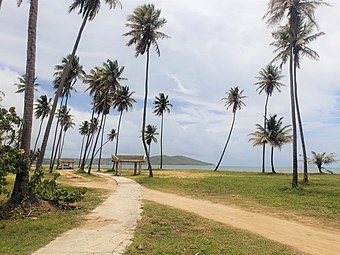 Playa Lucia in Yabucoa in 2020

_shrub_at_Playa_Lucia,_Yabucoa,_Puerto_Rico.jpg)
.jpg)

See also
[edit]

References
[edit]- ^ "PUERTO RICO: 2020 Census". The United States Census Bureau. Retrieved August 25, 2021.
- ^ "Demographics/Ethnic U.S. 2000 census" (PDF). Archived (PDF) from the original on February 16, 2008. Retrieved June 22, 2019.
- ^ a b "Yabucoa" (in Spanish). Retrieved October 11, 2021.
- ^ "Gobierno Tribal del Pueblo Jatibonicu Taíno de Puerto Rico". Archived from the original on October 5, 2013. Retrieved February 3, 2013.
- ^ "Municipios: Yabucoa". Enciclopedia de Puerto Rico. Archived from the original on October 5, 2013. Retrieved May 7, 2013.
- ^ Manuel Ubeda y Delgado (1878). Isla de Puerto Rico: estudio histórico, geográfico y estadístico de la misma (in Spanish). Academia Puertorriqueńa de la Historia. pp. 275–.
- ^ "Yabucoa, el primer pueblo impactado por María, lucha por salir de la depresión". El Nuevo Día (in Spanish). September 18, 2018. Retrieved July 8, 2021.
- ^ "Map data showing concentration of landslides caused by Hurricane Maria in Puerto Rico". USGS Landslide Hazards Program. USGS. Archived from the original on May 8, 2019. Retrieved July 18, 2019.
- ^ "Preliminary Locations of Landslide Impacts from Hurricane Maria, Puerto Rico". USGS Landslide Hazards Program. USGS. Archived from the original on March 3, 2019. Retrieved March 3, 2019.
- ^ "Preliminary Locations of Landslide Impacts from Hurricane Maria, Puerto Rico" (PDF). USGS Landslide Hazards Program. USGS. Archived (PDF) from the original on March 3, 2019. Retrieved March 3, 2019.
- ^ Vicens, A. J.; Meléndez, Eduardo. "Portraits of suffering and resilience in Puerto Rico six months after Hurricane Maria". Archived from the original on September 28, 2019. Retrieved September 28, 2019.
- ^ "María, un nombre que no vamos a olvidar. Devastación total en Yabucoa" [Maria, a name we will never forget. Total devastation in Yabucoa]. El Nuevo Día (in Spanish). June 13, 2019. Retrieved September 11, 2022.
- ^ "Amid new hurricane season, Maria still taking a toll on Puerto Rico's elderly". PBS NewsHour. July 11, 2018. Archived from the original on July 31, 2019. Retrieved July 31, 2019.
- ^ "Photos: Scenes of devastation in Puerto Rico after Maria". WTOP. September 26, 2017. Archived from the original on June 24, 2019. Retrieved June 24, 2019.
- ^ a b "YABUCOA: Enfermos y viejos sin servicio eléctrico". Periodísmo Investigativo (in Spanish). CPI.
- ^ Jervis, Rick (March 11, 2018). "'This city has been ignored': Yabucoa, ground zero for Hurricane Maria in Puerto Rico, still reeling". USA TODAY. Retrieved July 4, 2020.
- ^ "Yabucoa Municipality". enciclopediapr.org. Fundación Puertorriqueña de las Humanidades (FPH). Archived from the original on November 5, 2019. Retrieved March 20, 2019.
- ^ Picó, Rafael; Buitrago de Santiago, Zayda; Berrios, Hector H. Nueva geografía de Puerto Rico: física, económica, y social, por Rafael Picó. Con la colaboración de Zayda Buitrago de Santiago y Héctor H. Berrios. San Juan Editorial Universitaria, Universidad de Puerto Rico,1969. Archived from the original on December 26, 2018. Retrieved January 1, 2019.
- ^ Gwillim Law (May 20, 2015). Administrative Subdivisions of Countries: A Comprehensive World Reference, 1900 through 1998. McFarland. p. 300. ISBN 978-1-4766-0447-3. Retrieved December 25, 2018.
- ^ a b Puerto Rico:2010:population and housing unit counts.pdf (PDF). U.S. Dept. of Commerce Economics and Statistics Administration U.S. Census Bureau. 2010. Archived (PDF) from the original on February 20, 2017. Retrieved December 26, 2018.
- ^ "Map of Yabucoa at the Wayback Machine" (PDF). Archived from the original (PDF) on March 24, 2018. Retrieved December 29, 2018.
- ^ "US Census Barrio-Pueblo definition". factfinder.com. US Census. Archived from the original on May 13, 2017. Retrieved January 5, 2019.
- ^ "Agencia: Oficina del Coordinador General para el Financiamiento Socioeconómico y la Autogestión (Proposed 2016 Budget)". Puerto Rico Budgets (in Spanish). Retrieved June 28, 2019.
- ^ Rivera Quintero, Marcia (2014), El vuelo de la esperanza: Proyecto de las Comunidades Especiales Puerto Rico, 1997-2004 (first ed.), San Juan, Puerto Rico Fundación Sila M. Calderón, ISBN 978-0-9820806-1-0
- ^ "Leyes del 2001". Lex Juris Puerto Rico (in Spanish). Retrieved June 24, 2020.
- ^ Rivera Quintero, Marcia (2014), El vuelo de la esperanza:Proyecto de las Comunidades Especiales Puerto Rico, 1997-2004 (1st ed.), San Juan, Puerto Rico Fundación Sila M. Calderón, p. 273, ISBN 978-0-9820806-1-0
- ^ "Comunidades Especiales de Puerto Rico" (in Spanish). August 8, 2011. Archived from the original on June 24, 2019. Retrieved June 24, 2019.
- ^ "U.S. Decennial Census". United States Census Bureau. Archived from the original on February 13, 2020. Retrieved September 21, 2017.
- ^ "Report of the Census of Porto Rico 1899". War Department Office Director Census of Porto Rico. Archived from the original on July 16, 2017. Retrieved September 21, 2017.
- ^ "Table 3-Population of Municipalities: 1930 1920 and 1910" (PDF). United States Census Bureau. Archived (PDF) from the original on August 17, 2017. Retrieved September 21, 2017.
- ^ "Table 4-Area and Population of Municipalities Urban and Rural: 1930 to 1950" (PDF). United States Census Bureau. Archived (PDF) from the original on August 30, 2015. Retrieved September 21, 2014.
- ^ "Table 2 Population and Housing Units: 1960 to 2000" (PDF). United States Census Bureau. Archived (PDF) from the original on July 24, 2017. Retrieved September 21, 2017.
- ^ "PUERTO RICO: 2020 Census". The United States Census Bureau. Retrieved August 25, 2021.
- ^ "Population and Housing Unit Estimates". United States Census Bureau. Retrieved September 21, 2017.
- ^ "Inauguran muelle de Villa Pesquera en Playa Guayanés". Victoria840 (in Spanish). April 13, 2019. Retrieved November 1, 2020.
- ^ "Shell completes purchase of Sunoco Puerto Rico refinery". chem europe. Archived from the original on May 1, 2012. Retrieved January 1, 2012.
- ^ "Remains of Central Roig Sugar Mill in Yabucoa". Archived from the original on November 23, 2011. Retrieved January 1, 2012.
- ^ "About Olein Refinery & Lubricants". www.oleinrefinery.com. Archived from the original on June 22, 2019. Retrieved June 22, 2019.
- ^ Figueroa, Cecilia. "Crece el interés por expansión comercial entre Puerto Rico y Orlando" (in Spanish). La Prensa. Archived from the original on June 22, 2019. Retrieved June 22, 2019.
- ^ "Olein Refinery se transforma para producir 'hand sanitizer'". El Nuevo Dia (in Spanish). April 6, 2020. Retrieved June 26, 2020.
- ^ "Puerto Rico Festivales, Eventos y Actividades en Puerto Rico". Puerto Rico Hoteles y Paradores (in Spanish). Retrieved July 17, 2020.
- ^ "Suministros para sectores de Yabucoa y pasadía para niños pacientes de cáncer". Walo Radio 1240 AM (in Spanish). July 19, 2018. Retrieved July 8, 2020.
- ^ a b "Los Azucareros de Yabucoa no se escapan del huracán María". El Nuevo Día (in Spanish). September 20, 2019. Retrieved July 18, 2020.
- ^ "Una serie final para la historia en el Béisbol Doble A". El Nuevo Día (in Spanish). October 29, 2018. Retrieved July 18, 2020.
- ^ "Los Azucareros de Yabucoa consiguen la victoria número 900". El Nuevo Día (in Spanish). February 24, 2020. Retrieved July 18, 2020.
- ^ "Ruina del estadio Félix Millán deja un vacío deportivo en Yabucoa". El Nuevo Día (in Spanish). April 12, 2018. Retrieved July 18, 2020.
- ^ "CEE Event MAPA MUNICIPIOS ALCALDES". elecciones2020.ceepur.org (in Spanish). Retrieved June 19, 2021.
- ^ Elecciones Generales 2012: Escrutinio General Archived 2012-12-03 at the Wayback Machine on CEEPUR
- ^ "Ley Núm. 70 de 2006 -Ley para disponer la oficialidad de la bandera y el escudo de los setenta y ocho (78) municipios". LexJuris de Puerto Rico (in Spanish). Retrieved June 15, 2021.
- ^ a b "Yabocoa". LexJuris (Leyes y Jurisprudencia) de Puerto Rico (in Spanish). February 19, 2020. Archived from the original on February 19, 2020. Retrieved September 17, 2020.
- ^ "Yabucoa... La Ciudad del Azúcar". Proyecto Salón Hogar. Archived from the original on November 22, 2014. Retrieved May 9, 2013.
- ^ Morales, Sandra (February 2, 2008). "Se acorta la distancia en el sureste". El Nuevo Día. Archived from the original on February 6, 2008. Retrieved May 10, 2013.
- ^ Del Valle, Sara and David Toucet. "Un túnel, dos pueblos" (PDF). El Nuevo Día. Retrieved May 9, 2013.
- ^ "Yabucoa Bridges". National Bridge Inventory Data. US Dept. of Transportation. Archived from the original on February 20, 2019. Retrieved February 19, 2019.
- ^ "Veterans Buried in Local Puerto Rico Cemeteries" (PDF). interment.net. US Dept of Veterans Affairs. November 6, 2019. Retrieved July 28, 2020.
External links
[edit]- Yabucoa and its barrios, United States Census Bureau
- Yabucoa, Puerto Rico on Facebook
- Puerto Rico Government Directory - Yabucoa
- News of Yabucoa on WALO Radio
Places adjacent to Yabucoa, Puerto Rico | |
|---|---|


| International | |
|---|---|
| National | |
| Geographic | |
