


San Germán, Puerto Rico
San Germán
Municipio Antónomo de San Germán | |
|---|---|
 Flag  Coat of arms | |
| Nickname: City Founder of towns (Ciudad Fundadora de Pueblos) | |
| Anthem: "San Germán es mi pueblo querido" | |
 Map of Puerto Rico highlighting San Germán Municipality | |
| Coordinates: 18°N 67°W / 18°N 67°W | |
| Sovereign state |  United States United States |
| Commonwealth |  Puerto Rico Puerto Rico |
| Founded | 1511 1512 (on 2nd site) |
| Named for | Germanus of Auxerre |
| Barrios | |
| Government | |
| • Type | Mayor–council government |
| • Mayor | Virgilio Olivera Olivera (PNP) |
| • Senatorial dist. | Mayagüez |
| • Representative dist. | 20 |
| Area | |
| • Municipality | 54.51 sq mi (141.18 km2) |
| • Land | 54.51 sq mi (141.18 km2) |
| • Water | 0.0 sq mi (0 km2) |
| Elevation | 528 ft (161 m) |
| Population (2020[1]) | |
| • Municipality | 31,879 |
| • Rank | 15th in Puerto Rico |
| • Density | 580/sq mi (230/km2) |
| • Metro | 136,212 |
| • CSA | 251,260 |
| Demonym | Sangermeños |
| Time zone | UTC−4 (AST) |
| ZIP Codes | 00683, 00636 |
| Area code | 787/939 |
| Major routes |          |
.jpg)


San Germán (Spanish pronunciation: [saŋ xeɾˈman]) is a historic town and municipality located in the Sabana Grande Valley of southwestern region of Puerto Rico, south of Mayagüez and Maricao, north of Lajas, east of Hormigueros and Cabo Rojo, and west of Sabana Grande. San Germán is spread over eighteen barrios plus San Germán Pueblo (the downtown area and the administrative center of the city). It is both a principal city of the San Germán–Cabo Rojo Metropolitan Statistical Area and the Mayagüez–San Germán–Cabo Rojo Combined Statistical Area. San Germán is the second oldest city of Puerto Rico, after San Juan, and its historic downtown is preserved as the San Germán Historic District.[2]
Puerto Rico was, at one time, divided administratively between the San Juan and the San Germán municipalities. The latter covered the western half of Puerto Rico and extended from the western shores of the island to Arecibo in the north and Ponce in the south.[3]
History[edit]

The population of San Germán when Alonso Manso was named the first bishop of Puerto Rico in 1511 was "about 50 residents".[4] Outside of San Juan, Puerto Rico, San Germán was one of the largest settlements in the 16th century, as well as Coamo and Aguada.[5]
Spanish settlement in San Germán occurred early in the conquest and colonization of Puerto Rico. After the destruction of a small early settlement of the same name near modern-day Añasco during a Taíno uprising which started in February 1511, in 1512[6] the new settlement was built by Miguel Díaz at Guayanilla[7] and was named after Germaine of Foix, the second wife of King Fernando II, and in reference of Saint Germanus of Auxerre.[8][9] This town was attacked by French corsairs in August 1528, May 1538 and 1554. The construction of a small fort began in 1540, but work stopped in 1546 when the population of the town began moving inland to the current modern location.[citation needed]
On May 12, 1571, the Royal Audience (Real Audiencia) of Santo Domingo authorized that both the populations of San Germán and Santa María de Guadianilla be merged into a single city due to the constant French attacks.[10] The new city was built on the Hills of Santa Marta, next to the Guanajibo River in 1573. Its official name was Nueva Villa de Salamanca, named after the city of Salamanca in Spain. However, the population called the city San Germán el Nuevo (New San Germán) and, eventually, the Villa de San Germán (City of San Germán).
San Germán is also known as the "founder of towns", given the fact that in 1514 the Spanish Crown separated the island into two administrative territories (Partidos). The borders of the two partidos were established as the Camuy River to the north and the Jacagua River to the south. They were named the San Juan Partition and the San Germán Partition.[citation needed]
Hurricane Maria on September 20, 2017, triggered numerous landslides in San Germán with the significant amount of rainfall.[11][12]
Geography[edit]
San Germán is in the southwest region of the island. The town is located on the Sabana Grande valley which is bound by the Cordillera Central to the north and the Santa Marta Hills and the Lajas Valley to the south. Mountains in San Germán include Alto del Descanso (2,520 ft; 770 m) and Tetas de Cerro Gordo (2,897 ft; 883 m). San Germán has a number of rivers: Río Caín, Río Duey, Río Rosario, Río Guanajibo (Estero), Río Hoconuco, Guamá River and Rio El Brujo.[13]
Barrios[edit]

Like all municipalities of Puerto Rico, San Germán is subdivided into barrios. The municipal buildings, central square and large Catholic church are located in a barrio referred to as "el pueblo".[14][15]
Sectors[edit]
Barrios (which are, in contemporary times, roughly comparable to minor civil divisions)[16] and subbarrios,[17] are further subdivided into smaller areas called sectores (sectors in English). The types of sectores may vary, from normally sector to urbanización to reparto to barriada to residencial, among others.[18][19][20]
Special Communities[edit]
Comunidades Especiales de Puerto Rico (Special Communities of Puerto Rico) are marginalized communities whose citizens are experiencing a certain amount of social exclusion. A map shows these communities occur in nearly every municipality of the commonwealth. Of the 742 places that were on the list in 2014, the following barrios, communities, sectors, or neighborhoods were in San Germán: Ancones, Comunidad El Retiro, Comunidad Las Quebradas, La Tea, Parcelas Las Carolinas, Parcelas Minillas en Barrio Minillas, Parcelas Sabana Eneas, and Rosario Peñón.[21]
Climate[edit]
| Month | Jan | Feb | Mar | Apr | May | Jun | Jul | Aug | Sep | Oct | Nov | Dec | Year |
|---|---|---|---|---|---|---|---|---|---|---|---|---|---|
| Record high °C (°F) | 32.8 (91.0) |
33.3 (91.9) |
35 (95) |
35 (95) |
35 (95) |
37.2 (99.0) |
37.2 (99.0) |
36.1 (97.0) |
36.7 (98.1) |
36.1 (97.0) |
36.7 (98.1) |
36.7 (98.1) |
37.2 (99.0) |
| Mean daily maximum °C (°F) | 30.6 (87.1) |
30.6 (87.1) |
31.1 (88.0) |
31.7 (89.1) |
32.2 (90.0) |
32.8 (91.0) |
33.3 (91.9) |
33.3 (91.9) |
32.8 (91.0) |
32.2 (90.0) |
31.7 (89.1) |
31.1 (88.0) |
32.0 (89.5) |
| Daily mean °C (°F) | 23.9 (75.0) |
23.9 (75.0) |
24.4 (75.9) |
25.6 (78.1) |
26.7 (80.1) |
27.2 (81.0) |
27.2 (81.0) |
27.2 (81.0) |
27.2 (81.0) |
26.7 (80.1) |
25.6 (78.1) |
24.4 (75.9) |
25.8 (78.5) |
| Mean daily minimum °C (°F) | 16.7 (62.1) |
16.7 (62.1) |
17.8 (64.0) |
18.9 (66.0) |
20.6 (69.1) |
21.7 (71.1) |
21.1 (70.0) |
21.1 (70.0) |
21.1 (70.0) |
20.6 (69.1) |
19.4 (66.9) |
17.2 (63.0) |
19.4 (67.0) |
| Record low °C (°F) | 6.7 (44.1) |
10.6 (51.1) |
10.0 (50.0) |
10.0 (50.0) |
13.3 (55.9) |
14.4 (57.9) |
11.7 (53.1) |
14.4 (57.9) |
15.6 (60.1) |
13.3 (55.9) |
11.7 (53.1) |
9.4 (48.9) |
6.7 (44.1) |
| Average rainfall mm (inches) | 63.8 (2.51) |
55.6 (2.19) |
55.6 (2.19) |
87.1 (3.43) |
130.6 (5.14) |
68.6 (2.70) |
79.5 (3.13) |
132.8 (5.23) |
157.5 (6.20) |
185.2 (7.29) |
145.0 (5.71) |
59.2 (2.33) |
1,220.5 (48.05) |
| Source: The Weather Channel[22] | |||||||||||||
Tourism[edit]

San Germán's historic downtown is the site of the Porta Coeli church, one of the earliest Spanish churches built in the Americas. Porta Coeli is still a major historical attraction that attracts both domestic and international tourists every year.[citation needed]
Landmarks and places of interest[edit]

- Puente de Bolas (Bridge of Balls)
- Museo Farmacia La Botica
- Museo de la Historia de San Germán (San Germán history museum)
- Casa Morales
- Ceiba de la Libertad
- San Germán Historic Gallery
- Lola Rodríguez de Tió Museum
- Casa Cruz de la Luna
- Ramírez de Arrellano y Rossell Museum
- Santo Domingo Plazuela
- Three Races and One Culture Mural
- San Germán Historic District
- Porta Coeli
- Inter-American University of Puerto Rico
- Church San Germán de Auxerre
- Russian Orthodox Church Saint John Climacus (Only Russian Orthodox Church in Puerto Rico)
The urban center of San Germán is mainly composed of Spanish colonial houses. Many have been restored and conserve their Spanish look while other houses are somewhat abandoned and in poor condition. There are ongoing projects employing public and private funding to preserve and restore many houses and monuments and to maintain San Germán's colonial era look.[citation needed]
Culture[edit]

Festivals and events[edit]
San Germán celebrates its patron saint festival in late July / early August. The Fiestas Patronales de San German Euserre is a religious and cultural celebration that generally features parades, games, artisans, amusement rides, regional food, and live entertainment.[23][13]
Other festivals and events celebrated in San Germán include:
- Festival de la Pana – July
- Anón Festival – September
- Christmas Festival – December
- Christmas Parade – Early December
- Patron Celebrations (The Virgin of the Rosary)—Celebrated in San Germán's Rosario Poblado, which borders the municipality of Mayagüez.
Sports[edit]
San Germán is home to one of Puerto Rico's oldest basketball franchises, dating back to the 1930s, the San Germán Athletics (los Atléticos de San Germán), nicknamed "The Orange Monster". Many glories of Puerto Rican basketball have played in San Germán, a city that is also known as "The Cradle of Puerto Rican Basketball". Some of those players are Arquelio Torres, José "Piculín" Ortiz, Eddie Casiano, Nelson Quiñones, Elías "Larry" Ayuso, Christian Dalmau, and so many others. Their home court is The Arquelio Torres Ramírez Court, which houses approximately 5,000 fans.
The Athletic's fan base is most commonly referred to as their sixth man, or "The Orange Monster". This is because for a visiting team it's extremely hard to win in San Germán due to how vigorous and "into" the game the fans are.
The Athletics have been to 26 National Superior Basketball (BSN) Finals, of which one was cancelled (1953) due to confiscation because of a fight between players from San Germán and the Ponce Lions, giving birth to Puerto Rican basketball's most intense rivalry.
Championships (14): 1932, 1936, 1939, 1941, 1942, 1943, 1947, 1948, 1949, 1950, 1985, 1991, 1994, 1997 Sub-Championships (11): 1931, 1933, 1936, 1938, 1940, 1954, 1955, 1956, 1957, 1965, 1986
Economy[edit]
Agriculture[edit]
The area around San Germán grows fruits (banana, pineapple) and sugarcane on mid-scale. Dairy farms are also present in small scale. Some locals grow other produce on a small scale.
Business[edit]
Most businesses are located in or near the downtown area (San Germán Pueblo). Plaza del Oeste is the main shopping center.[citation needed]
Industry[edit]
Major employers of the city include Fresenius Kabi, CCL, Wallace International, Baxter Serum Mfg., Cordis, Insertco (print shop for medical instructions inserts), Wallace Silversmiths de Puerto Rico, General Electric (production of circuit breakers) and several other companies in the service industry.[citation needed]
Motion pictures filmed in San Germán[edit]
- Act of Valor (2012) Which follows a Navy Seal squad on a covert mission to recover a kidnapped CIA Agent Morales (Roselyn Sánchez).[citation needed]
- Dinero Sangre (1986) In a banana republic a ruthless mercenary waits to make a killing in gold. Only two people stand in his way (Guy Ecker)[citation needed]
Demographics[edit]
| Census | Pop. | Note | %± |
|---|---|---|---|
| 1900 | 20,246 | — | |
| 1910 | 22,143 | 9.4% | |
| 1920 | 23,848 | 7.7% | |
| 1930 | 23,768 | −0.3% | |
| 1940 | 26,473 | 11.4% | |
| 1950 | 29,553 | 11.6% | |
| 1960 | 27,667 | −6.4% | |
| 1970 | 27,990 | 1.2% | |
| 1980 | 32,922 | 17.6% | |
| 1990 | 34,962 | 6.2% | |
| 2000 | 37,105 | 6.1% | |
| 2010 | 35,527 | −4.3% | |
| 2020 | 31,879 | −10.3% | |
| U.S. Decennial Census[24] 1899 (shown as 1900)[25] 1910–1930[26] 1930–1950[27] 1960–2000[28] 2010[15] 2020[29] | |||
| Racial – (self-defined) San Germán, Puerto Rico – 2010 Census[31] | ||
|---|---|---|
| Race | Population | % of Total |
| White | 29,614 | 83.4% |
| Black/African American | 1,989 | 5.6% |
| American Indian and Alaska Native |
129 | 0.4% |
| Asian | 41 | 0.1% |
| Native Hawaiian Pacific Islander |
5 | 0.0% |
| Some other race | 2,992 | 8.4% |
| Two or more races | 727 | 2.1% |
Government[edit]

Like all municipalities in Puerto Rico, San Germán is administered by a mayor. The current mayor is Virgilio Olivera Olivera from the New Progressive Party. Olivera was elected in the 2020 general election.
The city belongs to the Puerto Rico Senatorial district IV, which is represented by two Senators.
Transportation[edit]
By the 16th century there was a rough road called Camino de Puerto Rico (Camino Real) connecting San Germán (which was located near the mouth of the Añasco River) to other areas of Puerto Rico, including San Sebastián, Arecibo, Toa Alta, and Caparra.[5]
In 2019, there were 44 bridges in San Germán.[32]
Symbols[edit]
The municipio has an official flag and coat of arms.[33]
Flag[edit]
Green – The Episcopal dignity and also the color of the Shield of Christopher Columbus and his son, don Diego Colón, Viceroy of the Indies, who named the city in honor of Germane de Foix.[34]
White – The purity of the blood of the great families who colonized San Germán, according to a history book by Fray Íñigo Abbad y Lasierra, a Spanish Benedictine monk.[34]
Purple – Color of the Shield of Juan Ponce de León, first governor of Puerto Rico.[34]
Coat of arms[edit]
First Quarter: The Mitre and the Staff in a green field represent St. Germain of Auxerre, the Patron Saint of the city.[34]
Second Quarter: The second quarter exhibits the arms of the Kingdoms of Aragón and Sicily, where don Fernando the Catholic reigned.[34]
Third Quarter: In this quarter the arms combine with the County of Foix and the Kingdom of France, which constitute the family shields of Germaine de Foix whose name is perpetuated as the name of the city of San Germán.[34]
Fourth Quarter: Is Ponce de León's shield.
The Crown: Is a civic or municipal standard and is used as a stamp for towns and cities; San Germán was assigned five towers to denote that this population formally obtained the title of city from the Spanish crown in the nineteenth century.[34]
Education[edit]
The following schools are in San Germán:[35]
- Bartolome de Las Casas: PK-6
- Georgina Alvarado: PK-5
- Henry W. Longfellow: PK-5
- Herminia C. Ramirez: PK-5
- Julio Victor Guzman: KG-8
- Laura Mercado: 6–12
- Lola Rodriguez de Tio: 9–10
- Mariano Abril: PK-6
- (Second Unit) Francisco Maria Quinones: KG-8
The main campus of the Inter-American University of Puerto Rico is located adjacent to the downtown area of San Germán. It was founded in 1912 as the Polytechnical Institute of Puerto Rico, the first private university on the island. The Colegio San José, was a private school which was established in San Germán in 1930 and closed in 2017.
Puerto Ricans from San Germán[edit]
- PFC Joseph R. (José) Martínez destroyed a German infantry unit and tank in Tunisia, during World War II, by providing heavy artillery fire, saving his platoon from being attacked in the process. He was awarded the Distinguished Service Cross, second only to the Medal of Honor, by General George S. Patton, thus becoming the first Puerto Rican recipient of said military decoration.[36]
- Ubaldino Ramírez de Arellano—Senator
- Lola Rodríguez de Tió—poet, author of the original lyrics of Puerto Rico's national anthem, La Borinqueña, and pro-independence advocate
- Benjamín Marcantoni – opera singer
- Benicio del Toro—Award-winning actor
- Francisco Mariano Quiñones—Abolitionist and politician
- Samuel R. Quiñones—Longest-serving President of the Puerto Rico Senate, serving for twenty years.
Gallery[edit]
-
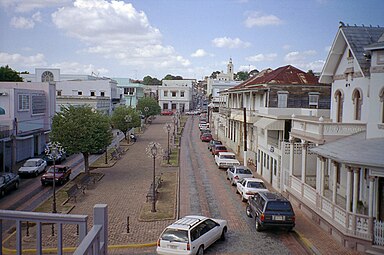 San Germán
 -
 Street in San Germán
 -
 Pharmacy Museum
 -
 Residential building in San Germán

See also[edit]


- List of Puerto Ricans
- History of Puerto Rico
- National Register of Historic Places listings in San Germán, Puerto Rico
- Did you know-Puerto Rico?
References[edit]
- ^ "PUERTO RICO: 2020 Census". The United States Census Bureau. Retrieved August 25, 2021.
- ^ "Página Oficial de Municipio Autónomo de San Germán, Puerto Rico". Archived from the original on June 5, 2008. Retrieved July 23, 2008.
- ^ "San Germán". Discover Puerto Rico. Retrieved January 10, 2022.
- ^ Historia general y natural de las Indias, islas y tierra-firme del mar oceano (in Spanish). Madrid, Impr. de la Real academia de la historia. October 23, 1851. p. 466. Archived from the original on May 23, 2017. Retrieved November 6, 2019 – via Internet Archive.
- ^ a b Luis F. Pumarada O'Neill (July 31, 1994). "National Register of Historic Places Multiple Property Documentation: Historic Bridges of Puerto Rico, c. 1840 – 1950" (PDF). National Park Service. Retrieved June 7, 2018.
- ^ "History of Puerto Rico – XV Century – 1599". Archived from the original on March 3, 2020. Retrieved May 8, 2020.
- ^ Fuson, Robert (2000). Juan Ponce De Leon and the Spanish Discovery of Puerto Rico and Florida. Blacksburg, Virginia: McDonald & Woodward. p. 79. ISBN 0-939923-82-3.
- ^ Thomas, Hugh (2003). Rivers of Gold: The Rise of the Spanish Empire. London: Weidenfeld & Nicolson. p. 231. ISBN 0-297-64563-3.
- ^ Floyd, Troy (1973). The Columbus Dynasty in the Caribbean, 1492-1526. Albuquerque: University of New Mexico Press. p. 139.
- ^ "Revista/review Interamericana (San German, Puerto Rico)" (in Spanish). VII. Inter American University Press. January 1, 1957: 640. Archived from the original on August 22, 2020. Retrieved December 24, 2019.
{{cite journal}}: Cite journal requires|journal=(help) - ^ "Preliminary Locations of Landslide Impacts from Hurricane Maria, Puerto Rico". USGS Landslide Hazards Program. USGS. Archived from the original on March 3, 2019. Retrieved March 3, 2019.
- ^ "Preliminary Locations of Landslide Impacts from Hurricane Maria, Puerto Rico" (PDF). USGS Landslide Hazards Program. USGS. Archived (PDF) from the original on March 3, 2019. Retrieved March 3, 2019.
- ^ a b "San Germán Municipality". enciclopediapr.org. Fundación Puertorriqueña de las Humanidades (FPH). Archived from the original on April 4, 2019. Retrieved March 20, 2019.
- ^ Gwillim Law (May 20, 2015). Administrative Subdivisions of Countries: A Comprehensive World Reference, 1900 through 1998. McFarland. p. 300. ISBN 978-1-4766-0447-3. Retrieved December 25, 2018.
- ^ a b Puerto Rico:2010:population and housing unit counts.pdf (PDF). U.S. Dept. of Commerce Economics and Statistics Administration U.S. Census Bureau. 2010. Archived (PDF) from the original on February 20, 2017. Retrieved December 26, 2018.
- ^ a b "US Census Barrio-Pueblo definition". Fact Finder. US Census. Archived from the original on May 13, 2017. Retrieved January 5, 2019.
- ^ "P.L. 94-171 VTD/SLD Reference Map (2010 Census): San Germán Municipio, PR" (PDF). www2.census.gov. U.S. DEPARTMENT OF COMMERCE Economics and Statistics Administration U.S. Census Bureau. Archived (PDF) from the original on August 22, 2020. Retrieved August 22, 2020.
- ^ "Agencia: Oficina del Coordinador General para el Financiamiento Socioeconómico y la Autogestión (Proposed 2016 Budget)". Puerto Rico Budgets (in Spanish). Archived from the original on June 28, 2019. Retrieved June 28, 2019.
- ^ Rivera Quintero, Marcia (2014), El vuelo de la esperanza: Proyecto de las Comunidades Especiales Puerto Rico, 1997–2004 (first ed.), San Juan, Puerto Rico Fundación Sila M. Calderón, ISBN 978-0-9820806-1-0
- ^ "Leyes del 2001". Lex Juris Puerto Rico (in Spanish). Archived from the original on September 14, 2018. Retrieved June 24, 2020.
- ^ Rivera Quintero, Marcia (2014), El vuelo de la esperanza:Proyecto de las Comunidades Especiales Puerto Rico, 1997–2004 (Primera edición ed.), San Juan, Puerto Rico Fundación Sila M. Calderón, p. 273, ISBN 978-0-9820806-1-0
- ^ [1] Archived 2014-01-08 at the Wayback Machine, The Weather Channel accessed 8 January 2014.
- ^ "Puerto Rico Festivales, Eventos y Actividades en Puerto Rico". Puerto Rico Hoteles y Paradores (in Spanish). Archived from the original on February 26, 2020. Retrieved July 17, 2020.
- ^ "U.S. Decennial Census". United States Census Bureau. Archived from the original on February 13, 2020. Retrieved September 21, 2017.
- ^ "Report of the Census of Porto Rico 1899". War Department Office Director Census of Porto Rico. Archived from the original on July 16, 2017. Retrieved September 21, 2017.
- ^ "Table 3-Population of Municipalities: 1930 1920 and 1910" (PDF). United States Census Bureau. Archived (PDF) from the original on August 17, 2017. Retrieved September 21, 2017.
- ^ "Table 4-Area and Population of Municipalities Urban and Rural: 1930 to 1950" (PDF). United States Census Bureau. Archived (PDF) from the original on August 30, 2015. Retrieved September 21, 2014.
- ^ "Table 2 Population and Housing Units: 1960 to 2000" (PDF). United States Census Bureau. Archived (PDF) from the original on July 24, 2017. Retrieved September 21, 2017.
- ^ "PUERTO RICO: 2020 Census". The United States Census Bureau. Retrieved August 25, 2021.
- ^ "Population and Housing Unit Estimates". United States Census Bureau. Archived from the original on December 27, 1996. Retrieved September 21, 2017.
- ^ "American FactFinder – Results". Fact Finder. Archived from the original on November 20, 2015. Retrieved March 2, 2019.
- ^ "San Germán Bridges". National Bridge Inventory Data. US Dept. of Transportation. Archived from the original on February 21, 2019. Retrieved February 20, 2019.
- ^ "Ley Núm. 70 de 2006 -Ley para disponer la oficialidad de la bandera y el escudo de los setenta y ocho (78) municipios". LexJuris de Puerto Rico (in Spanish). Retrieved June 15, 2021.
- ^ a b c d e f g "SAN GERMAN". LexJuris (Leyes y Jurisprudencia) de Puerto Rico (in Spanish). February 23, 2007. Archived from the original on February 19, 2020. Retrieved September 16, 2020.
- ^ "Search For Schools and Colleges". National Center for Education Statistics (NCES) Home Page, a part of the U.S. Department of Education. Retrieved October 3, 2020.
- ^ "Log In ‹ Home of Heroes—WordPress". Home of Heroes. Archived from the original on March 5, 2019. Retrieved March 2, 2019.
External links[edit]
- San German, Puerto Rico
- San Germán and its barrios, United States Census Bureau
- Official Webpage of the San German Atleticos
- Welcome to Puerto Rico! San German Map
- Welcome to Puerto Rico! San Germán
- San German Municipality on Facebook
Places adjacent to San Germán, Puerto Rico | ||||||||||||||||
|---|---|---|---|---|---|---|---|---|---|---|---|---|---|---|---|---|
| ||||||||||||||||


