


Yerba mate
 |
| Yerba mate | |
|---|---|

| |
Scientific classification 
| |
| Kingdom: | Plantae |
| Clade: | Tracheophytes |
| Clade: | Angiosperms |
| Clade: | Eudicots |
| Clade: | Asterids |
| Order: | Aquifoliales |
| Family: | Aquifoliaceae |
| Genus: | Ilex |
| Species: | I. paraguariensis
|
| Binomial name | |
| Ilex paraguariensis | |

| |
| Native range of Ilex paraguaiensis | |
Yerba mate or yerba-maté[2] (Ilex paraguariensis; from Spanish [ˈɟʝeɾβa ˈmate]; Portuguese: erva-mate, Portuguese pronunciation: [ˈɛɾvɐ ˈmatɨ] or [ˈɛʁvɐ ˈmatʃi]; Guarani: ka'a, IPA: [kaʔa]) is a plant species of the holly genus Ilex native to South America.[3] It was named by the French botanist Augustin Saint-Hilaire.[4] The leaves of the plant can be steeped in hot water to make a beverage known as mate. Brewed cold, it is used to make tereré. Both the plant and the beverage contain caffeine.
The indigenous Guaraní and some Tupi communities (whose territory covered present-day Paraguay) first cultivated and consumed yerba mate prior to European colonization of the Americas. Its consumption was exclusive to the natives of only two regions of the territory that today is Paraguay, more specifically the departments of Amambay and Alto Paraná.[5][6] After the Jesuits discovered its commercialization potential, yerba mate became widespread throughout the province and even elsewhere in the Spanish Crown.[6]
Mate is traditionally consumed in central and southern regions of South America, primarily in Paraguay, as well as in Argentina, Uruguay, Southern Brazil, the Gran Chaco of Bolivia, and Southern Chile .[7] It has also become popular in the Druze and Alawite community in the Levant, especially in Syria and Lebanon, where it is imported from Paraguay and Argentina, thanks to 19th-century Syrian immigrants to Argentina.[8] Yerba mate can now be found worldwide in various energy drinks as well as being sold as a bottled or canned iced tea.
Name and pronunciation[edit]
The name given to the plant in the Guaraní language (of the indigenous people who first used mate) is ka'a, which has the same meaning as 'herb'.[9][10] Congonha, in Portuguese, a term describing several herb species,[11] is derived from the Tupí expression kõ'gõi, meaning something like 'what keeps us alive', but is rarely used nowadays.[12] Mate is from the Quechua mati,[13] a word that means 'container for a drink' and 'infusion of an herb', as well as 'gourd'.[14] The word mate is used in modern Portuguese and Spanish.
The pronunciation of yerba mate in Spanish is [ˈɟʝeɾβa ˈmate].[13] The stress on the word mAte falls on the first syllable.[13] The word hierba is Spanish for 'herb'; yerba is the variant spelling of hierba used throughout Latin America.[15] Yerba may be understood as 'herb', but also as 'grass' or 'weed'. It may also be used in reference to marijuana (Cannabis sativa). In Argentina, yerba refers exclusively to the yerba mate plant.[15] Yerba mate, therefore, originally translated as literally the 'gourd herb'; i.e., the herb one drinks from a gourd.
The Portuguese name for the plant is pronounced variously as [ˈɛɾvɐ ˈmate, -tʃi], in the areas of traditional consumption. The drinks are usually called chimarrão [ʃimaˈʁɐ̃w] (hot; traditionally served in a gourd), tereré [teɾeˈɾɛ] (cold; traditionally served in a bull horn), or chá mate [ˈʃa ˈmate] (hot or cold; lit. 'mate tea', served in cups or glasses). While chá mate is made with roasted leaves, the other drinks are made with raw or lightly toasted green leaves, and are very popular in the south and center-west of the country. Most people, colloquially, call both the plant and the beverage by the word mate.[16]
In English, both the spellings mate and maté are used to refer to the plant or the beverage. The latter spelling is unfaithful to both Spanish and Portuguese, where the accent would incorrectly move the stress from the first syllable to the second.[17] The acute accent over the final '-e' in the English spelling was likely added by analogy with words of French origin like café, not to mark stress but to indicate that the '-e' is not silent as in mate (partner or friend);[18][19] indeed French also uses the spelling with the accent.[20] Spanish meanwhile has an unrelated word maté, meaning 'I killed', part of the verb matar.[21]
Description[edit]
Ilex paraguariensis begins as a shrub and then matures to a tree, growing up to 15 meters (49 ft) tall. The leaves are evergreen, 7–110 millimeters (0.3–4.3 in) long and 30–55 millimeters (1.2–2.2 in) wide, with serrated margins. The leaves are often called yerba (Spanish) or erva (Portuguese), both of which mean "herb". They contain caffeine (known in some parts of the world as mateine) and related xanthine alkaloids, and are harvested commercially.
The flowers are small and greenish-white with four petals. The fruit is a red drupe 4–6 millimeters (0.16–0.24 in) in diameter.
History[edit]

Mate was first consumed by the indigenous Guaraní people and also spread in the Tupí people that lived in the departments of Amambay and Alto Paraná[5] the territory of Paraguay.[6] Its consumption became widespread during European colonization,[22] particularly in the Spanish colony of Paraguay in the late 16th century, among both Spanish settlers and indigenous Guaraní, who had, to some extent before the Spanish arrival, consumed it.[22] This widespread consumption turned it into Paraguay's main commodity above other wares, such as tobacco, and the labour of indigenous peoples was used to harvest wild stands.[citation needed]
In the mid-17th century, Jesuits managed to domesticate the plant and establish plantations in their Indian reductions[22] in Misiones, Argentina, sparking severe competition with the Paraguayan harvesters of wild stands. [citation needed] It is here when the plant began its incursion into other non-Paraguayan territories. After their expulsion in the 1770s, their plantations fell into decay, as did their domestication secrets.[citation needed] The industry continued to be of prime importance for the Paraguayan economy after independence, but development in benefit of the Paraguayan state halted after the War of the Triple Alliance (1864–1870) that devastated the country both economically and demographically.[citation needed] Some regions with mate plantations in Paraguay became Argentine territory.[23]
Brazil then became the largest producer of mate.[24] In Brazilian and Argentine projects in the late 19th and early 20th centuries, the plant was domesticated once again, opening the way for plantation systems.[citation needed] When Brazilian entrepreneurs turned their attention to coffee in the 1930s, Argentina, which had long been the prime consumer,[25] took over as the largest producer, resurrecting the economy in Misiones Province, where the Jesuits had once had most of their plantations. For years, the status of largest producer shifted between Brazil and Argentina.[25] Today, Brazil is the largest producer, with 53%, followed by Argentina, 37%, and Paraguay, 10%.[26][27]
In the city of Campo Largo, state of Paraná, Brazil, there is a Mate Historic Park (Portuguese: Parque Histórico do Mate), funded by the state government to educate people on the sustainable harvesting methods needed to maintain the integrity and vitality of the oldest wild forests of mate in the world. As of June 2014, however, the park is closed to public visitation.[28]
Cultivation[edit]

The yerba mate plant is grown and processed in its native regions of South America, specifically in Paraguay, some parts of northern Argentina (Misiones), Uruguay, and southern Brazil (Rio Grande do Sul, Santa Catarina, Paraná, and Mato Grosso do Sul). Cultivators are known as yerbateros (Spanish) or ervateiros (Brazilian Portuguese).
Seeds used to germinate new plants are harvested after they have turned dark purple, typically from January to April. After harvest, they are submerged in water in order to eliminate floating non-viable seeds and detritus like twigs, leaves, etc. New plants are started between March and May. For plants established in pots, transplanting takes place April through September. Plants with bare roots are transplanted only during the months of June and July.[29]
Many of the natural enemies of yerba mate are difficult to control in plantation settings. Insect pests include Gyropsylla spegazziniana, a true bug that lays eggs in the branches; Hedyphates betulinus, a type of beetle that weakens the tree and makes it more susceptible to mold and mildew; Perigonia lusca,[29][30] a moth whose larvae eat the leaves; and several species of mites.[29] P. lusca may be controlled with a nuclear polyhedrosis virus used as a biopesticide. This was first applied in 1992.[30]
When I. paraguariensis is harvested, the branches are often dried by a wood fire, imparting a smoky flavor. The strength of the flavor, caffeine levels, and other nutrients can vary depending on whether it is a male or female plant. Female plants tend to be milder in flavor and lower in caffeine. They are also relatively scarce in the areas where yerba mate is planted and cultivated.[31]
According to Food and Agriculture Organization in 2012, Brazil is the biggest producer of mate in the world with 513,256 metric tonnes (MT) (58%), followed by Argentina with 290,000 MT (32%) and Paraguay with 85,490 MT (10%).[26]
Use as a beverage[edit]

The infusion, called mate in Spanish-speaking countries or chimarrão in Brazil, is prepared by filling a container, traditionally a small, hollowed-out gourd (described below), up to three-quarters full with dry leaves (and twigs) of I. paraguariensis, and filling it up with water at a temperature of 70–80 °C (158–176 °F), hot but not boiling. Sugar may or may not be added. The infusion may also be prepared with cold water, in which case it is known as tereré.[32]
Drinking mate is a common social practice in Paraguay, Uruguay, Argentina, Southern Brazil among people of all ages, and is often a communal ritual following customary rules. Friends and family members share from the same container, traditionally a hollow gourd (also called a guampa, porongo, or simply mate in Spanish, a cabaça or cuia in Portuguese, or a zucca in Italian), and drink through the same wooden or metal straw (a bombilla in Spanish or bomba in Portuguese). The gourd is given by the brewer to each person, often in a circle, in turns. The recipient drinks the few mouthfuls in the container, and then returns the mate to the brewer, who refills it and passes it to the next person in clockwise order. The recipient is not supposed to give thanks until they are done drinking the beverage, and if they do, they will not be served any more mates. Although traditionally made from a hollowed calabash gourd, these days mate "gourds" are produced from a variety of materials including wood, glass, bull horns, ceramic, and silicone.[33]
In the same way as people meet for tea or coffee, friends often gather and drink mate (matear) in Paraguay, Argentina, Southern Brazil, and Uruguay. In warm weather the hot water is sometimes replaced by lemonade. Paraguayans typically drink yerba mate with cold water during hot days and hot water in the morning and during cooler temperatures.
Yerba mate is most popular in Paraguay and Uruguay, where people are seen walking the streets carrying the mate and often a termo (thermal vacuum flask) in their arms. In Argentina, 5 kg (11 lb) of yerba mate is consumed annually per capita; in Uruguay, the largest consumer, consumption is 10 kg (22 lb).[34] The amount of herb used to prepare the infusion is much greater than that used for tea and other beverages, which accounts for the large weights.
The flavor of brewed mate resembles an infusion of vegetables, herbs, and grass and is reminiscent of some varieties of green tea. Some consider the flavor to be very agreeable, but it is generally bitter if steeped in hot water. Sweetened and flavored mate is also sold, in which the mate leaves are blended with other herbs (such as peppermint) or citrus rind.[35]

In Paraguay, Brazil, and Argentina, a version of mate known as mate cocido (or just mate or cocido) in Paraguay and chá mate in Brazil is sold in teabags and in a loose-leaf form. It is often served sweetened in specialized shops or on the street, either hot or iced, pure or with fruit juice (especially lime, known in Brazil as limão) or milk. In Paraguay, Argentina, and Southern Brazil, this is commonly consumed for breakfast or in a café for afternoon tea, often with a selection of sweet pastries (facturas).
An iced, sweetened version of mate cocido is sold as an uncarbonated soft drink, with or without fruit flavoring. In Brazil, this cold version of chá mate is especially popular in the south and southeast regions, and can easily be found in retail stores in the same cooler as other soft drinks.[16] Mate batido, which is toasted, has less of a bitter flavor and more of a spicy fragrance. Mate batido becomes creamy when shaken and is more popular in the coastal cities of Brazil, as opposed to the far southern states, where it is more commonly consumed in the traditional way (green, with a silver straw from a shared gourd), and called chimarrão (cimarrón in Spanish, particularly Argentine Spanish).[36]
In Paraguay, Southern Brazil (Mato Grosso do Sul, west of São Paulo and Paraná), and the Argentine littoral, a mate infusion, called tereré in Spanish and Portuguese or sometimes tererê in Gaúcho, Caipira and Sulista Portuguese, is also consumed as a cold or iced beverage, usually sucked out of a horn cup called a guampa with a bombilla. The Guarani used to drink it in this format, but without the ice as they did not have the technology for it, reason why, it is accredited to be the first and original way of consumption.[6] Tereré can be prepared with cold water (the most common way in Paraguay and Brazil) or fruit juice (the most common way in Argentina). The version with water is more bitter; fruit juice acts as a sweetener (in Brazil, this is usually avoided with the addition of table sugar). Medicinal or culinary herbs, known as yuyos (weeds), may be crushed with a pestle and mortar and added to the water for taste or medicinal reasons.[37]

Paraguayans have a tradition of mixing mate with crushed leaves, stems, and flowers of the plant known as flor de agosto[38] (the flower of August, plants of the genus Senecio, particularly Senecio grisebachii), which contain pyrrolizidine alkaloids. Modifying mate in this fashion is potentially toxic, as these alkaloids can cause veno-occlusive disease, a rare condition of the liver which results in liver failure due to progressive occlusion of the small venous channels.[39]
Mate has also become popular outside of South America. In the tiny hamlet of Groot Marico, North West Province, South Africa, mate was introduced to the local tourism office by the returning descendants of the Boers, who in 1902 had emigrated to Patagonia in Argentina after losing the Anglo Boer War. It is also commonly consumed in Lebanon, Syria, and some other parts of the Middle East, mainly by Druze and Alawite people. Most of its popularity outside South America is a result of historical emigration to South America and subsequent return. It is consumed worldwide by expatriates from the Southern Cone.[40][41]
Materva is a sweet, carbonated soft drink based on yerba mate. Developed in Cuba in 1920, and produced since the 1960s in Miami, Florida, it is a staple of the Cuban culture in Miami.[42][43]
Chemical composition and properties[edit]

Yerba mate contains a variety of polyphenols, such as the flavonoids, quercetin and rutin.[44]
Yerba mate contains three xanthines: caffeine, theobromine, and theophylline, with caffeine content varying between 0.7% and 1.7% of dry weight[45] (compared with 0.4–9.3% for tea leaves, 2.5–7.6% in guarana, and up to 3.2% for ground coffee).[46][47] Theobromine content varies from 0.3% to 0.9%; theophylline is typically present only in small quantities or sometimes completely absent.[48] Caffeine in yerba mate may be called guaranine in guarana.[49] Yerba mate also contains minerals, such as potassium, magnesium, and manganese.[50]
Weight loss[edit]
There has been no good evidence for yerba mate having an effect on body weight in humans[51][52] although a later study suggested there can be positive effects.[53]
Cancer[edit]
The consumption of hot mate tea is associated with oral cancer,[54] esophageal cancer,[55] cancer of the larynx,[55] and squamous cell cancers of the head and neck.[56][57] Studies show a correlation between tea temperature and likelihood of cancer, making it unclear how much of a role mate itself plays as a carcinogen.[55] However, studies also note that incidents of cancer overlap with the use of alcohol, tobacco, the presence of nutritional deficiencies, and poor oral hygiene – not mate use alone.[55]
See also[edit]

- Black drink
- Club-Mate
- Matte Leão
- Ilex guayusa, known as guayusa, another caffeine-containing holly species of the Ilex genus, native to the Ecuadorian Amazon rainforest
- Ilex vomitoria, a caffeine-containing species of the Ilex genus native to North America
- Kuding, Ilex kudingcha
- Materva
- Nativa
- Guayaki
- Yerba Mate Playadito
References[edit]
- ^ World Conservation Monitoring Centre (1998). "Ilex paraguariensis". IUCN Red List of Threatened Species. 1998: e.T32982A9740718. doi:10.2305/IUCN.UK.1998.RLTS.T32982A9740718.en. Retrieved 19 November 2021.
- ^ "yerba". Oxford English Dictionary (Online ed.). Oxford University Press. (Subscription or participating institution membership required.)
"yerba". Lexico UK English Dictionary. Oxford University Press. Archived from the original on 9 March 2021.
"yerba maté". Merriam-Webster.com Dictionary.
"yerba maté". CollinsDictionary.com. HarperCollins.
"yerba maté". Dictionary.com Unabridged (Online). n.d. - ^ "ITIS Report". itis.gov. Retrieved 26 February 2015.
- ^ "Index of Botanists". harvard.edu. Retrieved 4 March 2015.
- ^ a b Del Techo, Ximénez, Dobrizhoffer. p. 40., Nicolás; Bartolomé, Martín (1967). Tres encuentros con América. Editorial del Centenario.
{{cite book}}: CS1 maint: multiple names: authors list (link) CS1 maint: numeric names: authors list (link) - ^ a b c d Cervantes, Biblioteca Virtual Miguel de. "En busca del hueso perdido : (tratado de paraguayología) / Helio Vera". Biblioteca Virtual Miguel de Cervantes (in Spanish). Retrieved 25 March 2021.
- ^ World Conservation Monitoring Centre (1998). "Ilex paraguariensis". IUCN Red List of Threatened Species. 1998: e.T32982A9740718. doi:10.2305/IUCN.UK.1998.RLTS.T32982A9740718.en.
- ^ "Argentina's 'yerba mate' crunch". globalpost.com. Retrieved 30 April 2015.
- ^ Lemos Barbosa, Antônio (1956). Curso de Tupi Antigo. Rio de Janeiro: Livraria São José.
- ^ de Almeida Navarro, Eduardo (2013). Dicionário do Tupi Antigo: a língua indígena clássica do Brasil. São Paulo: Global Editora. ISBN 9788526019331.
- ^ "Congonha - Arca del Gusto". Slow Food Foundation. Retrieved 29 October 2022.
- ^ FERREIRA, A. B. H. Novo Dicionário da Língua Portuguesa. Segunda edição. Rio de Janeiro: Nova Fronteira, 1986. p.453
- ^ a b c Real Academia Española. "Mate". Retrieved 23 May 2013.
- ^ AULEX, "Online Quechua-Spanish Dictionary". Retrieved 23 May 2013.
- ^ a b Real Academia Española. "Yerba". Retrieved 23 May 2013.
- ^ a b "Mate: o chá da hora". Retrieved 4 September 2012.
- ^ "San Fernando HS Spanish: Acentuación". Retrieved 2 December 2020.
- ^ "Merriam-Webster's Online Dictionary". M-w.com. 13 August 2010. Retrieved 5 June 2011.
- ^ "mate - beverage". Encyclopædia Britannica. Retrieved 8 October 2015.
- ^ "maté - traduction - Dictionnaire Français-Anglais WordReference.com". www.wordreference.com (in French). Retrieved 29 December 2023.
- ^ "Word Magic Spanish Dictionary". Retrieved 23 May 2013.
- ^ a b c Chisholm, Hugh, ed. (1911). . Encyclopædia Britannica. Vol. 17 (11th ed.). Cambridge University Press. pp. 877–878.
- ^ Reber, Vera Blinn (July 1985). "Commerce and Industry in Nineteenth Century Paraguay: The Example of". The Americas. 42 (1): 29–53. doi:10.2307/1006706. ISSN 0003-1615. JSTOR 1006706. S2CID 147135625.
- ^ "Erva-mate - o ouro verde do Paraná". Retrieved 10 July 2013.
- ^ a b "History of Mate". Establecimiento Las Marías. Retrieved 8 November 2011.
- ^ a b "FAOSTAT". Food and Agriculture Organization of the United Nations. Retrieved 5 April 2015.
- ^ "List of Goods Produced by Child Labor or Forced Labor". dol.gov. Retrieved 28 March 2021.
- ^ "Parque Histórico do Mate" [Mate Historic Park] (in Portuguese). Paraná State Secretariat for Culture. Retrieved 3 June 2014.
- ^ a b c Burtnik, Oscar José, "Yerba Mate Production", 3rd Edition, 2006. Retrieved 24 May 2013.
- ^ a b Moscardi, Flávio (1999). "Assessment of the Application of Baculoviruses for Control of Lepidoptera". Annual Review of Entomology. 44 (1). Annual Reviews: 257–289. doi:10.1146/annurev.ento.44.1.257. ISSN 0066-4170. PMID 15012374.
- ^ "Nativa Yerba Mate". Native Yerba Mate. Retrieved 18 July 2011.
- ^ "Cómo hacer un buen Mate | Ruta de la Yerba Mate". www.rutadelayerbamate.org.ar. Retrieved 9 January 2022.
- ^ "Guide to Yerba Mate Gourds". Native Leaf. 12 February 2016. Retrieved 28 March 2021.
- ^ "Mate: The Bitter Tea South Americans Love to Drink". Retrieved 30 May 2013.
- ^ "Flavored Yerba Mate". Ma Tea. Retrieved 30 May 2013.
- ^ "Significado de 'cimarrón'". Retrieved 5 July 2013.
- ^ "Terere". Ma Tea. Retrieved 30 May 2013.
- ^ "Flor de agosto". Retrieved 9 January 2022.
- ^ McGee, J; Patrick, R S; Wood, C B; Blumgart, L H (1976). "A case of veno-occlusive disease of the liver in Britain associated with herbal tea consumption". Journal of Clinical Pathology. 29 (9): 788–94. doi:10.1136/jcp.29.9.788. PMC 476180. PMID 977780.
- ^ Folch, C. (2009). "Stimulating Consumption: Yerba Mate Myths, Markets, and Meanings from Conquest to Present". Comparative Studies in Society and History. 52: 6–36. doi:10.1017/S0010417509990314. S2CID 145175412.
- ^ ""Mate" tea a long-time Lebanese hit". Your Middle East. Retrieved 6 January 2017.
- ^ Wong, Samantha. "Materva: Un Buchito de Cuba" (PDF). Johnson and Wales: Student Food Writing. p. 8 (PDF p. 11). Archived from the original (PDF) on 13 January 2014. Retrieved 10 September 2020.
- ^ Roque, Raquel Rábade (2011). The Cuban Kitchen (1st ed.). Alfred A. Knopf. p. 6. ISBN 9780375711961. Retrieved 10 September 2020.
- ^ Gambero A, Ribeiro ML (January 2015). "The positive effects of yerba maté (Ilex paraguariensis) in obesity". Nutrients. 7 (2): 730–50. doi:10.3390/nu7020730. PMC 4344557. PMID 25621503.
- ^ Dellacassa, Cesio et al. Departamento de Farmacognosia, Facultad de Química, Universidad de la República, Uruguay, Noviembre: 2007, pp. 1–15
- ^ "Activities of a Specific Chemical Query". Ars-grin.gov. Retrieved 5 June 2011.
- ^ Pichersky, Eran; Lewinsohn, Efraim (2 June 2011). "Convergent Evolution in Plant Specialized Metabolism". Annual Review of Plant Biology. 62 (1): 549–566. doi:10.1146/annurev-arplant-042110-103814. ISSN 1543-5008. PMID 21275647.
- ^ Vázquez, A; Moyna, P (1986). "Studies on mate drinking". Journal of Ethnopharmacology. 18 (3): 267–72. doi:10.1016/0378-8741(86)90005-x. PMID 3821141.
- ^ Scully, Crispian. Medical Problems in Dentistry. p. 693.
- ^ Valduga, Eunice; de Freitas, Renato João Sossela; Reissmann, Carlos B.; Nakashima, Tomoe (1997). "Caracterização química da folha de Ilex paraguariensis St. Hil. (erva-mate) e de outras espécies utilizadas na adulteração do mate". Boletim do Centro de Pesquisa de Processamento de Alimentos (in Portuguese). 15 (1): 25–36. doi:10.5380/cep.v15i1.14033.
- ^ Pittler MH, Ernst E (April 2004). "Dietary supplements for body-weight reduction: a systematic review". Am J Clin Nutr. 79 (4): 529–36. doi:10.1093/ajcn/79.4.529. PMID 15051593.
- ^ Pittler MH, Schmidt K, Ernst E (May 2005). "Adverse events of herbal food supplements for body weight reduction: systematic review". Obes Rev. 6 (2): 93–111. doi:10.1111/j.1467-789X.2005.00169.x. PMID 15836459. S2CID 25448193.
- ^ Gambero A, Ribeiro ML (22 January 2015). "The Positive Effects of Yerba Maté (Ilex paraguariensis) in Obesity". Nutrients. 7 (2): 730–50. doi:10.3390/nu7020730. PMC 4344557. PMID 25621503.
- ^ Dasanayake, Ananda P.; Silverman, Amanda J.; Warnakulasuriya, Saman (2010). "Maté drinking and oral and oro-pharyngeal cancer: A systematic review and meta-analysis". Oral Oncology. 46 (2): 82–86. doi:10.1016/j.oraloncology.2009.07.006. PMID 20036605.
- ^ a b c d Loria, Dora; Barrios, Enrique; Zanetti, Roberto (2009). "Cancer and yerba mate consumption: A review of possible associations". Revista Panamericana de Salud Pública. 25 (6): 530–9. doi:10.1590/S1020-49892009000600010. PMID 19695149.
- ^ Goldenberg, D; Lee, J; Koch, W; Kim, M; Trink, B; Sidransky, D; Moon, C (2004). "Habitual risk factors for head and neck cancer". Otolaryngology–Head and Neck Surgery. 131 (6): 986–93. doi:10.1016/j.otohns.2004.02.035. PMID 15577802. S2CID 34356067.
- ^ Goldenberg, David; Golz, Avishay; Joachims, Henry Zvi (2003). "The beverage maté: A risk factor for cancer of the head and neck". Head & Neck. 25 (7): 595–601. doi:10.1002/hed.10288. PMID 12808663. S2CID 22789119.
External links[edit]
- Plant of the Month: Yerba Mate at JSTOR Daily. January 5, 2023

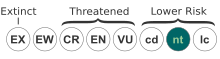
- IUCN Red List near threatened species
- Yerba mate
- Ilex
- Flora of Argentina
- Flora of Brazil
- Trees of Brazil
- Flora of Paraguay
- Flora of Uruguay
- Flora of the Atlantic Forest
- Flora of the Cerrado
- Latin American cuisine
- Caffeine
- Herbal and fungal stimulants
- Herbal tea
- Medicinal plants
- Crops originating from the Americas
- Crops originating from Brazil
- Crops originating from Argentina
- Crops originating from Uruguay
- Crops originating from Paraguay
- Near threatened plants
- Agriculture in Brazil
- Agriculture in Argentina
- Agriculture in Paraguay
- Symbols of Rio Grande do Sul