


Anglo-Celtic Australians
 | This article needs additional citations for verification. (July 2023) |
| Total population | |
|---|---|
| |
| Regions with significant populations | |
| All parts of Australia including urban, rural and regional Australia | |
| Languages | |
| Predominantly Australian English Welsh • Irish • Scottish Gaelic • Cornish | |
| Religion | |
| Predominantly Christian | |
| Related ethnic groups | |
| European New Zealanders |
Anglo-Celtic Australians is an ancestral grouping of Australians whose ancestors originate wholly or partially in the British Isles - predominantly in England (including Cornish), Ireland, Scotland and Wales, as well as the Isle of Man and Channel Islands.[5]
While Anglo-Celtic Australians do not form an official ethnic grouping in the Australian Bureau of Statistics' Australian Standard Classification of Cultural and Ethnic Groups, due to the long historical dominance and intermixture of Australians with ancestries from the British Isles, it is commonly used as an informal ethnic identifier.[2]
The term has received criticism for erasing historical distinctions between English and Celtic settlers. In particular, it does not account for the political and social segregation of English and Irish Australians which some scholars have labelled an apartheid[6] or the fact that while many English arrived in Australia as willing immigrants, many Irish were forcibly transported as prisoners or refugees.[7]
At the 2021 census, the number of ancestry responses from the following groups as a proportion of the total Australian population amounted to 51.7%: English Australian, Irish Australian, Scottish Australian, Welsh Australian, Cornish Australians, British Australian (so described), Manx Australian, Channel Islander Australian.[1][C] The precise number of Anglo-Celtic Australians is unknown due to the way in which ancestry data is collected in Australia. For instance, many census recipients nominated two Anglo-Celtic ancestries due to the long history of these ancestries in Australia, tending towards an overcount. Conversely, the Australian Bureau of Statistics has stated that most people nominating "Australian" ancestry have at least partial Anglo-Celtic European ancestry despite "Australian" ancestry being classified as part of the Oceanian ancestry group,[4] tending towards an undercount.
History[edit]
Pre-Federation[edit]
The British Government initiated European settlement of the Australian continent by establishing a penal settlement at Sydney Cove in 1788. Between then and 1852, about 100,000 convicts (mostly tried in England) were transported to eastern Australia. Scotland and Wales contributed relatively few convicts.[citation needed]
Native-born Australians of British and Irish descent were approximately a quarter of the population of the colony of New South Wales in both 1817 and 1828.[8]: 17 There were slightly more native-born than free settlers in 1850.[8] They were nearly half of the population in 1868.[9] Their proportion of the population decreased during the times of the rapid population growth brought on by the goldrushes.[8]: 17 The convicts were augmented by free settlers, including large numbers who arrived during the gold-rush in the 1850s. As late as 1861, people born in England, Wales, Scotland and Ireland outnumbered even the Australia-born population. The number of settlers in Australia who were born in the United Kingdom (UK) peaked at 825,000 in 1891, from which point the proportion of British among all immigrants to Australia steadily declined.[clarification needed]
Until 1859, 2.2 million (73%) of the free settlers who immigrated were British.[10]

Post-Federation[edit]
From the beginning of the colonial era until the mid-20th century, the vast majority of settlers to Australia were from Britain and Ireland, with the English being the dominant group, followed by the Irish and Scottish. Among the leading ancestries, increases in Australian, Irish, and German ancestries and decreases in English, Scottish, and Welsh ancestries appear to reflect such shifts in perception or reporting. These reporting shifts at least partly resulted from changes in the design of the census question, in particular the introduction of a tick box format in 2001.[11]
Those born in the United Kingdom were the largest foreign group throughout the 20th century. Prior to the last quarter of the century, the United Kingdom was strongly favoured as a source country by immigrant selection policies and remained the largest single component of the annual immigration intake until 1995–96, when immigrants from New Zealand surpassed it in number. However, their share of the total immigrant population is in decline. Those from the United Kingdom comprised 58 per cent of the total overseas-born population in 1901, compared to 27 per cent in 1996. An even greater decline has occurred for those born in Ireland. In 1901, those born in Ireland comprised 22 per cent of all immigrants, while in 1996 the Ireland-born represented just 1 per cent of the immigrant population.[12]
While those born in England have formed the largest component of the British immigrant population, Australia has also received significant numbers of immigrants from Ireland, Scotland, and Wales. Up until the First World War the Irish were, in their own right, the second largest immigrant population.[12]
The most dramatic increase in the British immigrant population occurred between 1961 and 1971. The number of British-born people living in Australia exceeded one million at the 1971 Census and has remained above one million to this day. The United Kingdom-born population in Australia reached a peak of 1,107,119 in 1991.[citation needed]
Demographics[edit]
| Anglo-Celtic Australian 1846 - 2021 | ||||
|---|---|---|---|---|
| Year | % of total population | |||
| 1846 | 57.2 | |||
| 1861 | 78.1 | |||
| 1891 | 86.8 | |||
| 1947 | 89.7 | |||
| 1988 | 74.6 | |||
| 1996 | 71.45 | |||
| 1999 | 69.9 | |||
| 2016 | 58 | |||
| 2021 | 51.7 | |||
| Source: 1846,[13] 1996,[14] 1999,[15] 2016,[16] 2021[1] | ||||
Anglo-Celtic is not an official ancestry category in the Australian census.[2] Census respondents may nominate up to two ancestries. The number of ancestry responses from the following groups as a proportion of the total Australian population amounted to 51.7% at the 2021 census: English Australian, Irish Australian, Scottish Australian, Cornish Australians, Welsh Australian, British Australian (so described), Manx Australian, Channel Islander Australian.[1][D] The precise number of Anglo-Celtic Australians is unknown due to the way in which ancestry data is collected in Australia. For instance, many census recipients nominated two Anglo-Celtic ancestries due to the long history of these ancestries in Australia, tending towards an overcount. Conversely, the Australian Bureau of Statistics has stated that most people nominating "Australian" ancestry have at least partial Anglo-Celtic European ancestry despite "Australian" ancestry being classified as part of the Oceanian ancestry group,[4] tending towards an undercount.
At the 2021 census, the most commonly nominated Anglo-Celtic ancestries were:[1]
- English Australian: 8,395,928
- Irish Australian: 2,410,833
- Scottish Australian: 2,176,777
- Cornish Australians: 768,100
- Welsh Australians: 683,700
- British Australians (so described): 13,150
- Manx Australians: 2,424
- Channel Islander Australians: 1,273
The United Kingdom remains a significant source of immigrants to Australia. In 2005–06, 22,143 persons born in the United Kingdom settled in Australia, representing 21.4% of all migrants. At the 2006 Census (excluding overseas visitors)[17] 1,038,165 persons identified themselves as having been born in the United Kingdom (5.2% of the Australian population), while 50,251 identified themselves as Irish born.
Melbourne and Sydney have the lowest rates of Anglo-Celtic Australians, particularly in certain regions of each city (such as Western Sydney). Tasmania could have the nation's highest proportion of citizens of Anglo-Celtic origin, possibly as high as 85 percent. On the evidence of statistics of ethnic derivation Tasmania could also be considered more British than New Zealand (where the Anglo-Celtic majority has fallen below 75 percent).[18]
Historical demographics[edit]
British and Irish population per census[edit]
The following table shows the British and Irish-born population for every national Australian census as a proportion of the total foreign-born population at various points.
| UK and Ireland-born population of Australia % of all overseas born | ||||||||
|---|---|---|---|---|---|---|---|---|
| Year | Anglo-Celtic / % | United Kingdom % of overseas-born |
Ireland % of overseas-born |
Ref(s) | ||||
| 1881 | 689,642 | - | - | - | - | - | [19] | |
| 1901 | 679,159 | 79.2 | 495 074 | 57.7 | 184,085 | 21.5 | [20][21] | |
| 1911 | 590,722 | 78.0 | 451,288 | 59.6 | 139,434 | 18.4 | [20] | |
| 1921 | 673,403 | 80.2 | 568,370 | 67.7 | 105,033 | 12.5 | [20][22] | |
| 1933 | 712,458 | 78.9 | 633,806 | 70.2 | 78,652 | 8.7 | [20] | |
| 1947 | 541,267 | 72.7 | 496,454 | 66.7 | 44,813 | 6.0 | [20][21] | |
| 1954 | 661,205 | 51.6 | 616,532 | 47.9 | 44,673 | 3.5 | [20][21] | |
| 1961 | 755,402 | 42.6 | 718,345 | 40.4 | 37,057 | 2.1 | [20][21] | |
| 1966 | 908,664 | - | 870,548 | 38,116 | [22] | |||
| 1971 | 1,088,210 | 42.2 | 1,046,356 | 40.6 | 41,854 | 1.6 | [20][23] | |
| 1976 | 1,117,599 | - | 1,070,233 | 47,361 | [24] | |||
| 1981 | 1,132,601 | 41.1 | 1,086,625 | 36.5 | [21][25] | |||
| 1986 | 1,127,196 | 34.7 | [21][25] | |||||
| 1991 | 1,174,860 | 31.17 | 1,107,119 | 30.0 | 51,642 | 1.17 | [21][26][27][28] | |
| 1996 | ,124,031 | - | 1,072,562 | 28.7 | 51,469 | - | [23][27][29] | |
| 2001 | 1,086,496 | - | 1,036,261 | 25.2 | 50,235 | [30] | ||
| 2006 | 1,088,416 | - | 1,038,162 | 23.5 | 50,255 | - | [30][31][32] | |
| 2011 | 1,168,398 | 20.8 | 1,101,082 | 20.8 | 67,318 | 0.0 | [20][30][32][33] | |
| 2016 | 1,162,654 | - | 1,087,759 | 17.7 | 74,895 | - | [34][35] | |
| 2021 | TBA | TBA | TBA | TBA | TBA | - | ||
Notes: From 1954 onwards people from "Northern Ireland" and "Ulster" were recorded separately from the people of "Ireland".[36] The 1966 census (is Republic of Ireland & Ireland (undefined).
Self-identified census data[edit]
The following table shows various Anglo-Celtic ancestries since 1986, the first census to include as a question on ancestry. The aim of the question was to measure the ethnic composition of the population as a whole. Very little use was made of the ancestry data from the 1986 Census. As a consequence, ancestry was not included in either the 1991 or 1996 Censuses. Between 1987 and 1999, the Anglo-Celtic component of Australia's population declined from 75 per cent to 70 per cent.[37] In 1999, the Anglo-Celtic share of the Australian population was calculated as 69.9%.[38]
| Ancestry | 1986 | % | 2001 | % | 2006 | % | 2011 | % | % Change 2006–2011 | |
|---|---|---|---|---|---|---|---|---|---|---|

|
English | 6,607,228[39] | 42.4 | 6,358,880 | 33.9 | 6,283,647 | 31.6 | 7,238,533 | 36.1%[40] | +15.2% |

|
Irish | 902,679 | 5.8 | 1,919,727 | 10.2 | 1,803,736 | 9.1 | 2,087,800 | 10.4 | +15.7% |

|
Scottish | 740,522 | 4.7 | 540,046 | 2.9 | 1,501,200 | 7.6[41][42] | 1,792,622 | 8.3 | +19.4% |

|
Welsh | no data | no data | 84,246 | no data | 113,244 | 0.6 | 125,597 | 0.6 | +10.9% |
| Total | 8,250,429 | 52.9 | 8,902,899 | 47.0 | 9,701,827 | 48.9 | 11,244,552 | 53.0% – 55.4% | ||
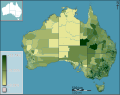
Maps[edit]
-
 English ancestry
 -
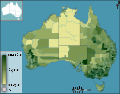 Scottish ancestry
 -
 Welsh ancestry
 -
-
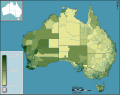 People born in the UK, Channel Islands and Isle of Man


Controversy and criticism[edit]
Some have argued that the term is entirely a product of multiculturalism that ignores the history of sectarianism in Australia. For example, historian John Hirst wrote in 1994: "Mainstream Australian society was reduced to an ethnic group and given an ethnic name: Anglo-Celt."[43]
According to Hirst:
In the eyes of multiculturalists, Australian society of the 1940s, 150 years after first settlement, is adequately described as Anglo-Celtic. At least this acknowledges that the people of Australia were Irish and Scots as well as English, but it has nothing more substantial than a hyphen joining them. In fact a distinct new culture had been formed. English, Scots and Irish had formed a common identity – first of all British and then gradually Australian as well. In the 1930s the historian W. K. Hancock could aptly describe them as Independent Australian Britons.[44]
The Irish-Australian journalist Siobhán McHugh has argued that the term "Anglo-Celtic" is "an insidious distortion of our past and a galling denial of the struggle by an earlier minority group", Irish Australians, "against oppression and demonisation... In what we now cosily term "Anglo-Celtic" Australia, a virtual social apartheid existed at times between [Irish] Catholics and [British] Protestants", which did not end until the 1960s.
The term was also criticised by the historian Patrick O'Farrell as "a grossly misleading, false, and patronising convenience, one crassly present-oriented. Its use removes from consciousness and recognition a major conflict fundamental to any comprehension not only of Australian history but of our present core culture."[6]
Culture[edit]
Streams of migration from the United Kingdom and the Republic of Ireland to Australia played a key role in Australia's cultural development, despite the last substantial scheme for preferential migration from Britain to Australia ending in 1972. There is a long history of cultural exchange between the countries and many Australians have used Britain as a stepping-stone to international success, e.g., Nellie Melba, Peter Dawson, Clive James, Robert Hughes. In 1967, British migrants in Australia formed an association to represent their special interests: the United Kingdom Settlers' Association, which subsequently became the British Australian Community.
On 10 July 2017, at a press conference in London, Australian Prime Minister Malcolm Turnbull said:
"Australians feel at home in the United Kingdom and Britons feel at home in Australia. Most Australians have some of their ancestry at least from the United Kingdom and five per cent of Australians were actually born in the United Kingdom. The culture, the laws the traditions of Britain were brought to Australia with the European settlement, British settlement that were brought as part of the heritage of the men and women, including my forebears, that founded what we know today as modern Australia". . . There are no two nations in the world that trust each other more than the United Kingdom and Australia. We are family in a historical sense. We're family in a genetic sense. But we are so close and that trust is getting stronger all the time.[45]
Place names of British origin[edit]

.jpg)
There are many places in Australia named after people and places in the United Kingdom as a result of the many British settlers and explorers; in addition, some places were named after the British royal family.[citation needed]
New South Wales[edit]
New South Wales – Cook first named the land "New Wales", named after Wales. However, in the copy held by the Admiralty, he "revised the wording" to "New South Wales".[46]
- Hyde Park – was named after the original Hyde Park in London, England and is the oldest public parkland in Australia[citation needed]
- Newcastle, New South Wales – is named after Newcastle, England[citation needed]
- The state capital city of Sydney is named in honour of English politician Thomas Townshend, 1st Viscount Sydney.[47]
Northern Territory[edit]
- The state capital city of Darwin. A Scottish naval officer named the region "Port Darwin" in honour of English naturalist Charles Darwin.[citation needed]
Queensland[edit]
Queensland – The state was named in honour of Queen Victoria,[48][49] who on 6 June 1859 signed Letters Patent separating the colony from New South Wales.[50]
- Brisbane – is named after Scotsman Thomas Brisbane.[51]
South Australia[edit]
- The state capital city of Adelaide founded in 1836, is named in honour of Adelaide of Saxe-Meiningen, queen consort to King William IV.[52]
Tasmania[edit]
- Hobart – city named after the English politician Robert Hobart 4th Earl of Buckinghamshire who was British Secretary of State for War and the Colonies in 1804 at the time of its settlement.[53]
- Launceston – was named in honour of the New South Wales Governor Captain Philip Gidley King, who was born in Launceston, Cornwall, England.[54]
Victoria[edit]
Victoria – like Queensland, was named after Queen Victoria, who had been on the British throne for 14 years when the colony was established in 1851.[55]
- Melbourne – was named in honour of William Lamb, 2nd Viscount Melbourne, Queen Victoria's first Prime Minister, and thus indirectly takes its name from the village of Melbourne, Derbyshire, England.[56]
Western Australia[edit]
- Perth – The city is named after Perth, Scotland, by influence of Sir George Murray, then British Secretary of State for War and the Colonies.[57] in Murray's honour.[58][59][60]
External territories[edit]
- Norfolk Island - Captain James Cook named it after Mary Howard, Duchess of Norfolk (c. 1712 – 1773).[61]
See also[edit]


- Anglo-Celtic
- Anglo
- Demographics of Australia
- European Australians
- Europeans in Oceania
- Irish Australians
- Scottish Australians
- Cornish Australians
- English Australians
- Welsh Australians
- British diaspora
Notes[edit]
- ^ Number of "English", "Irish", "Scottish", "Welsh", "Cornish", "British", "Channel Islander" and "Manx" ancestry responses as a proportion of the total population.[2] Ancestry figures do not amount to 100% as the Australian Bureau of Statistics allows up to two ancestry responses per person.[3]
- ^ Does not include those nominating their ancestry as "Australian", who are categorised within the Oceanian group. The Australian Bureau of Statistics has stated that most people nominating "Australian" ancestry have at least partial Anglo-Celtic European ancestry.[4]
- ^ Ancestry figures do not amount to 100% as the Australian Bureau of Statistics allows up to two ancestry responses per person.[3]
- ^ Ancestry figures do not amount to 100% as the Australian Bureau of Statistics allows up to two ancestry responses per person.[3]
References[edit]
- ^ a b c d e "Census of Population and Housing: Cultural diversity data summary, 2021" (XLSX). Abs.gov.au. Retrieved 28 July 2022.
- ^ a b c "Australian Standard Classification of Cultural and Ethnic Groups (ASCCEG), 2019 | Australian Bureau of Statistics". 18 December 2019.
- ^ a b c "Understanding and using Ancestry data | Australian Bureau of Statistics". 28 June 2022.
- ^ a b c "Feature Article – Ethnic and Cultural Diversity in Australia (Feature Article)". 1301.0 – Year Book Australia, 1995. Commonwealth of Australia. Australian Bureau of Statistics.
- ^ Australian Bureau of Statistics (January 1995). "Feature Article – Ethnic and Cultural Diversity in Australia (Feature Article)". Retrieved 11 December 2016.
- ^ a b "How the Irish rose above Australia's social apartheid – The Sydney Morning Herald". The Sydney Morning Herald. 14 October 2009.
- ^ "Remembering and Commemorating the Great Famine and Emigration to Australia // Articles // breac // University of Notre Dame". breac.nd.edu. Retrieved 25 November 2022.
- ^ a b c Molony, John Neylon (2000). The Native-born: The First White Australians. Melbourne University Press. ISBN 978-0-522-84903-5.
- ^ "NATIVE-BORN AUSTRALIANS". The Empire. No. 5108. New South Wales, Australia. 4 April 1868. p. 5. Retrieved 14 July 2020 – via National Library of Australia.
- ^ "Ancestry Information Operations Unlimited Company – Press Releases". Archived from the original on 25 May 2017. Retrieved 11 December 2016.
- ^ "Chapter - Population characteristics: Ancestry of Australia's population". Abs.gov.au. 3 June 2003. Retrieved 28 July 2022.
- ^ a b Immigration and Population History of Selected Countries of Birth 'United Kingdom – A Short Immigration History', S3.amazonaws.com
- ^ "Australia today – Department of Social Services, Australian Government". Archived from the original on 20 June 2017. Retrieved 11 December 2016.
- ^ The Australian People: An Encyclopedia of the Nation, Its People and Their ... – By James Jupp
- ^ The Transformation of Australia's Population: 1970–2030 (Page 166) – edited by Siew-An Khoo, Peter F. McDonald, Siew-Ean Khoo
- ^ "Leading for Change ; A blueprint for cultural diversity and inclusive leadership revisited" (PDF). Humanrights.gov.au. April 2018. Retrieved 28 July 2022.
- ^ "T08 Country of Birth of Person by Sex: 2011 Census". Stat.abs.gov.au. Archived from the original on 25 August 2014.
- ^ "Britishness". Retrieved 11 December 2016.
- ^ "Year Book Australia, 1989 No. 72". Aust. Bureau of Statistics. 1988.
- ^ a b c d e f g h i Top 10 countries of birth for the overseas‐born population since 1901 Top 10 countries of overseas-born
- ^ a b c d e f g Composition: Changing links with Europe, Australian Bureau of Statistics
- ^ a b CENSUS OF POPULATION AND HOUSING, 30 JUNE 1966 COMMONWEALTH OF AUSTRALIA BIRTHPLACE (Page: 13)
- ^ a b Australia's 15 Largest Birthplace Groups, 1947, 1971, and 1996 Source: Australian censuses of 1947, 1971, and 1996
- ^ CENSUS OF POPULATION AND HOUSING, 30 JUNE 1976 COMMONWEALTH OF AUSTRALIA Population by Birthplace (Pages: 1–2)
- ^ a b MAIN BIRTHPLACES OF OVERSEAS BORN POPULATION, 1986 CENSUS OF POPULATION AND HOUSING (Page: 7)
- ^ Year Book Australia 1995 abs.gov.au
- ^ a b Birthplace by Region, 1996 Source: Australian Bureau of Statistics, 1996 Census of Population and Housing, Australia
- ^ Dimensions of Australian Society By Brian Graetz, Ian McAllister
- ^ OVERSEAS-BORN POPULATION: TOP 12 BIRTHPLACE GROUPS, Australian Bureau of Statistics
- ^ a b c THE IRELAND-BORN COMMUNITY IN VICTORIA and Australia 2011 Census, Multicultural.vic.gov.au
- ^ "The Top Sending Regions of Immigrants in Australia, Canada, and the United States". 20 August 2013. Retrieved 11 December 2016.
- ^ a b The People of Australia Statistics from the 2011 Census Archived 17 April 2017 at the Wayback Machine Australia: 2011 and 2006 Census
- ^ TOP 10 COUNTRIES OF BIRTH FOR THE OVERSEAS-BORN POPULATION, Australian Bureau of Statistics
- ^ "United Kingdom-born Community Information Summary" (PDF). Homeaffairs.gov.au. 2018. Retrieved 6 April 2022.
- ^ "2016 Census QuickStats, People in Australia who were born in Ireland". Censusdata.abs.gov.au. 2016. Retrieved 6 April 2022.
- ^ Alan James (2012). New Britannia: The rise and decline of Anglo-Australia. Renewal Publications, University of Melbourne. p. 51. ISBN 978-1-300-54292-6.
- ^ Khoo, Siew-An, Peter McDonald, and Siew-Ean Khoo, eds. The Transformation of Australia's Population: 1970–2030. UNSW Press, 2003, p. 165.
- ^ Price, Charles A. (1999). "Australian Population: Ethnic Origins" (PDF). People and Place. 7 (4). Monash University: 12–16. ISSN 1039-4788. Archived from the original (PDF) on 19 July 2011. Retrieved 11 December 2016.
- ^ The Transformation of Australia's Population: 1970–2030 edited by Siew-An Khoo, Peter F. McDonald, Siew-Ean Khoo (Page: 164)
- ^ "2011 Census data shows more than 300 ancestries". Australian Bureau of Statistics. Retrieved 11 December 2016.
- ^ The people of Australia: Statistics from the 2011 census (PDF). Canberra: Department of Immigration and Border Protection. 2014. p. 55. ISBN 978-1-920996-23-9. Archived from the original (PDF) on 29 May 2014.
- ^ The People of Australia – Statistics from the 2006 Census Archived 19 April 2018 at the Wayback Machine(Page 50)
- ^ "Multiculturalism becomes poison for social capital". The Australian. 26 September 2007. Archived from the original on 5 September 2008. Retrieved 26 October 2007.
- ^ John Hirst, Sense and Nonsense in Australian History, Black Inc. Agenda, Melbourne (ISBN 978-0-9775949-3-1), page 12
- ^ "Speech PM press conference with Australian PM Malcolm Turnbull". Gov.uk. 10 July 2017. Retrieved 7 November 2023.
- ^ See Captain W. J. L. Wharton's preface to his 1893 transcription of Cook's journal. Available online in the University of Adelaide Library's Electronic Texts Collection.
- ^ "History of Sydney, Australia - Tours and Info". int.sydney.com. Retrieved 21 November 2021.
- ^ "Place Names". Archived from the original on 13 October 2007. Retrieved 13 October 2007.
- ^ "Where Did Australia's States Get Their Names? « Manly Bunkhouse". Retrieved 21 November 2021.
- ^ "Documenting Democracy". Foundingdocs.gov.au. Retrieved 21 November 2021.
- ^ "Council history". Brisbane.qld.gov.au. Retrieved 21 November 2021.
- ^ "How well do you know our Queen?". Adelaidenow.com.au. 3 May 2013. Archived from the original on 7 August 2019. Retrieved 29 December 2019.
- ^ Paige, Fiona. "Hobart, TAS". Aussie Towns. Retrieved 21 November 2021.
- ^ "A Timeline of Launceston | Launceston Historical Society Inc". Launcestonhistory.org. 25 June 2012. Retrieved 21 November 2021.
- ^ "Colony of Victoria - Concept - Find & Connect - Victoria". Findandconnect.gov.au.
- ^ "History of Melbourne". Onlymelbourne.com.au.
- ^ Kimberly, W. B. (1897). . Melbourne: F. W. Niven & Co. p. 44.
- ^ Uren, Malcolm J. L. (1948). Land Looking West. London: Oxford University Press.
- ^ Crowley, Francis K. (1960). Australia's Western Third. London: Macmillan & Co.
- ^ Statham, Pamela (1981). "Swan River Colony". In Stannage, Tom (ed.). A New History of Western Australia. Nedlands: University of Western Australia Press. ISBN 0-85564-181-9.
- ^ Channers On Norfolk Island Info Archived 3 November 2021 at the Wayback Machine. Channersonnorfolk.com (15 March 2013). Retrieved on 16 July 2013.
Ancestral background of Australian citizens | ||
| Indigenous |  | |
| Africa | ||
| Americas | ||
| Asia | ||
| Europe |
| |
| Middle East and North Africa | ||
| Oceania | ||