


Portal:Australia

 Welcome to the Australia portal!
| Showcase | Content | Interesting facts | Contributing |
Introduction

.svg)
Australia, officially the Commonwealth of Australia, is a sovereign country comprising the mainland of the Australian continent, the island of Tasmania, and numerous smaller islands. Australia is the largest country by area in Oceania and the world's sixth-largest country. Australia is the oldest, flattest, and driest inhabited continent, with the least fertile soils. It is a megadiverse country, and its size gives it a wide variety of landscapes and climates, with deserts in the centre, tropical rainforests in the north-east, tropical savannas in the north, and mountain ranges in the south-east.
The ancestors of Aboriginal Australians began arriving from south-east Asia 50,000 to 65,000 years ago, during the last glacial period. They settled the continent and had formed approximately 250 distinct language groups by the time of European settlement, maintaining some of the longest known continuing artistic and religious traditions in the world. Australia's written history commenced with European maritime exploration. The Dutch were the first known Europeans to reach Australia, in 1606. British colonisation began in 1788 with the establishment of the penal colony of New South Wales. By the mid-19th century, most of the continent had been explored by European settlers and five additional self-governing British colonies were established, each gaining responsible government by 1890. The colonies federated in 1901, forming the Commonwealth of Australia. This continued a process of increasing autonomy from the United Kingdom, highlighted by the Statute of Westminster Adoption Act 1942, and culminating in the Australia Acts of 1986.
Australia is a federal parliamentary constitutional monarchy comprising six states and ten territories: the states of New South Wales, Victoria, Queensland, Tasmania, South Australia and Western Australia; the major mainland Australian Capital Territory and Northern Territory; and other minor or external territories. Its population of nearly 27 million is highly urbanised and heavily concentrated on the eastern seaboard. Canberra is the nation's capital, while its most populous cities are Sydney, Melbourne, Brisbane, Perth and Adelaide. Australian governments have promoted multiculturalism since the 1970s. Australia is culturally diverse and has one of the highest foreign-born populations in the world. Its abundant natural resources and well-developed international trade relations are crucial to the country's economy, which generates its income from various sources: predominantly services (including banking, real estate and international education) as well as mining, manufacturing and agriculture. It ranks highly for quality of life, health, education, economic freedom, civil liberties and political rights.
Featured article -
 Featured articles are displayed here, which represent some of the best content on English Wikipedia.
Selected biography -
Phillip Davey, VC, MM (10 October 1896 – 21 December 1953) was an Australian recipient of the Victoria Cross (VC), the highest award for gallantry in battle that could be awarded to a member of the Australian armed forces at the time. Davey enlisted in the Australian Imperial Force in December 1914 for service in World War I, and joined his unit, the 10th Battalion, on the island of Lemnos on 10 April 1915. Along with his battalion, he landed at Anzac Cove, Gallipoli, on 25 April. He fought at Anzac until he was evacuated sick in early November, returning to Australia the following January. (Full article...)

Did you know (auto-generated) -
- ... that Tom Eastick was the first Australian artillery officer to use survey procedures to accurately engage targets without ranging?
- ... that Lowe Kong Meng imported goods for Chinese miners during the Victorian gold rush and became one of the wealthiest men in Victoria?
- ... that Australian official Jack Emanuel was awarded the George Cross in 1971 after being stabbed to death whilst trying to resolve a land dispute with the Tolai people of New Guinea?
- ... that Jack Critchley, state parliamentarian then senator for South Australia, was invalided home from the Western Front with "wry neck"?
- ... that Baillieu Myer and his siblings were born in California because their father's prior divorce was not recognised under Australian law?
- ... that indigenous Australian artist Daniel Boyd has depicted colonial figures including Captain James Cook and Governor Arthur Phillip as pirates?
- ... that Gil Kim played professional baseball in the Netherlands, China, Australia, Spain, and Venezuela, scouted in Mexico and the Dominican Republic, and coaches in Canada?
- ... that Paddy Morgan conceded the final of the 1976 Australian Professional Championship rather than play with Eddie Charlton's balls?
In the news

- 19 April 2024 – 2024 Iran–Israel conflict
- The Australian Department of Foreign Affairs and Trade tells its citizens to leave Israel, citing a high threat of military reprisals and terrorist attacks. (Times of Israel)
- 16 April 2024 – 2024 Wakeley church stabbing
- Australian police say that the stabbing attack at an Assyrian church in Sydney was an Islamic terrorist act. (Reuters)
- 15 April 2024 – 2021 Australian Parliament House sexual misconduct allegations
- Former Australian political staffer Bruce Lehrmann loses his defamation case against Network 10 and journalist Lisa Wilkinson for broadcasting an interview with Lehrmann's former coworker Brittany Higgins in which she claimed that Lehrmann raped her. (The Guardian)
- 15 April 2024 – 2024 Wakeley church stabbing
- Four people are injured, including bishop Mar Mari Emmanuel, in a mass stabbing at a church in Sydney, Australia. The perpetrator is arrested. A mob clashes with police outside the church while trying to attack the detained suspect. (Sky News Australia)
- 13 April 2024 – 2024 Bondi Junction stabbings
- Six people are killed and seven others are injured in a mass stabbing at a shopping center in Sydney, Australia. The perpetrator is shot and killed by police. (The Guardian) (The Sydney Morning Herald)
- 13 April 2024 – 2024 Cook by-election
- Simon Kennedy of the Liberal Party of Australia wins the by-election in the seat of Cook, succeeding former Prime Minister Scott Morrison. (ABC News Australia)
Selected pictures -
-
 Photo credit: LiquidGhoulThe head of a Coastal Carpet Python, the largest subspecies of Morelia spilota, a non-venomous Australian python, showing its forked tongue, a feature common to many reptiles, who smell using the tip of their tongue. Having a forked tongue allows them to tell which direction a smell is coming from.
 -
 Photo: JJ HarrisonThe Metallic Ringtail (Austrolestes cingulatus) is an Australian species of damselfly, so named because of its glossy metallic colouration and the "rings" on each abdominal segment. It is widely distributed in Tasmania, Victoria, eastern New South Wales and south eastern Queensland.
 -


Aerial view of Happy Valley Reservoir
The Happy Valley Reservoir is a water reservoir located in Adelaide, Australia. Constructed when the total population of Adelaide numbered 315,200 (1893 census), the Happy Valley Reservoir now supplies over a half a million people, from Adelaide's southern extent to the city-centre.
Photo credit: Ctbolt -
 Photo credit: Fir0002The Common bluetail (Ischnura heterosticta) is a small Australian damselfly of the family Coenagrionidae. Most males have blue eyes, blue thorax and a blue ringed tail. The females are green or light brown.
 -

The notice reads "£8000 Reward - Robbery and Murder."
A notice of an £8000 pound reward for the capture of the Kelly gang, which included Ned Kelly, Dan Kelly, Joe Byrne, Steve Hart, Kate Kelly.
Source: National Archives -
 Photo credit: James Francis HurleySoldiers of an Australian 4th Division field artillery brigade on a duckboard track passing through Chateau Wood, near Hooge in the Ypres salient, October 29, 1917. The photo was taken in the vicinity of the Battle of Passchendaele, also known as the Third Battle of Ypres, which was one of the major battles of World War I.
 -

A Fig-lined avenue in Hyde Park.
Hyde Park is a large park in the New South Wales capital of Sydney. Named after the original Hyde Park in London, it is the southernmost of a chain of parkland that extends north to the shore. It takes the form of an approximate rectangle. Around the park's boundaries lie the Supreme Court of New South Wales, Hyde Park Barracks and Sydney Hospital to the north, St Mary's Cathedral to the east and the central business district to the west. The centrepiece of Hyde Park is the majestic Archibald Fountain, unveiled in 1932 in honour of Australia's contribution to the Great War in France.
Photo credit: Greg O'Beirne -
 Photo: Steven Rasmussen; edit: KeraunoscopiaAustralian artistic gymnast Lauren Mitchell (b. 1991) performing a layout step-out on the balance beam during the 41st World Artistic Gymnastics Championships in London, United Kingdom, on 14 October 2009; at the Championships, Mitchell won two silver medals, one for the balance beam and another for floor exercises. Since her first medal in 2007, Mitchell has placed in the World Championships, World Cup, and Commonwealth Games, and competed in two Olympic Games.
 -
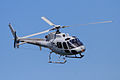 Photo: Fir0002A Eurocopter AS350 "Squirrel" helicopter flown by 723 Squadron of the Fleet Air Arm (FAA), the section of the Royal Australian Navy responsible for the operation of aircraft. The FAA is currently an all-helicopter force, operating four separate models in the anti-submarine warfare and maritime support roles.
 -
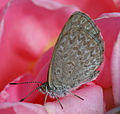 Photo credit: John O'NeillA Common Grass Blue (Zizina labradus), a small Australian butterfly. This specimen, perched on a rose, is approximately 10 millimetres (0.4 in) in size. Females generally have a larger wingspan compared to males (23 and 20 mm or 0.9 and 0.8 in respectively).
 -
 Photo: Benjamint444The Tawny Frogmouth (Podargus strigoides) is a large species of frogmouth found throughout the Australian mainland, Tasmania, and southern New Guinea. Unlike the owl for which it is often mistaken, the Tawny Frogmouth is not a bird of prey. Instead, it is almost exclusively insectivorous. For defense, it relies on cryptic camouflage, standing still to appear part of a branch.
 -
 Photo: Sport the LibraryJeremy Doyle (1983–2011) was an Australian wheelchair basketball player. Left paraplegic after a car accident, he was classified as a 1 point player. While representing his country Doyle won two gold medals, first at the 2009 Paralympic World Cup and again at the 2010 Wheelchair Basketball World Championship.
 -
 Photo credit: Fir0002A female Metallic Ringtail (Austrolestes cingulatus), an Australian damselfly, eating its prey. Each abdominal segment is marked by a pale "ring"; this combined with its glossy metallic coloration give the insect its common name.
 -

End of Skyshow 2006 seen from golf course, corner of Ward Street and Mills Terrace, North Adelaide
Skyshow is an annual fireworks event held in the South Australian capital of Adelaide since 1985. The half-hour fireworks display is synchronised to pop music and presented by local commercial radio station SAFM. Originating as an Australia Day celebration, the event was subsequently moved to late summer, usually February. Although beset with serious financial difficulties in the late 1990s until rescued by the South Australian Government, it is estimated some 150,000 people attend the main festivities in Bonython Park, whilst many more watch from vantage points along the Adelaide Hills.
Photo credit: Alex Sims -
 Photo credit: Fir0002Two whole Cripps Pink apples and a cross-section of a third. More commonly known by the trademarked name "Pink Lady", this apple cultivar was originally bred by John Cripps by crossing the Australian apple Lady Williams with a Golden Delicious. The apple shape is ellipsoid, it has a distinctive pink hue mixed with a green "background," and taste is tart.
 -

The Great Ocean Road winds along the coastline of Victoria, offering spectacular views of the Bass Strait and Southern Ocean
The Great Ocean Road stretches along the South Eastern coast of Australia between the Victorian cities of Geelong and Warrnambool. It was built during the Great Depression, between World War I and World War II by returned servicemen as part of a government-funded job creation scheme. The Road hugs tightly to the coast and passes some of the most photogenic coastline in the world. -
 Photo credit: John O'NeillA panoramic view across the interior of the Australian Synchrotron (a subatomic particle accelerator) in Clayton, Victoria. Dominating the image is the storage ring, showing the optical diagnostic beamline at front right. In the middle of the storage ring is the booster synchrotron and linac. The yellow, green and red magnets on the trolley (front left) are a demonstration of the bending and focusing magnets used in the storage ring to produce the synchrotron radiation and maintain the electron beam.
 -

Ninety Mile Beach, Victoria, is believed to the longest un-interrupted beach in the world.
The Ninety Mile Beach is a sandy stretch of south-eastern coastline of Victoria, Australia which separates the Gippsland Lakes region from Bass Strait.It is believed to be the longest un-interrupted beach in the world — just over 151 kilometres (94 miles) running northeastward from a spit near Port Albert to the man-made channel at Lakes Entrance. For the northern part of its route the beach runs along a sandbar on what amounts to a series of tidal islands and behind which are several large lakes and numerous shallow littoral lagoons. The area comprises the Gippsland Lakes Coastal Park. -
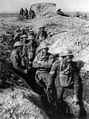 Photo credit: Frank HurleyA group of Australian infantry wearing Small Box Respirators (SBRs) at the Third Battle of Ypres in September 1917. After the introduction of poison gas in World War I, countermeasures were developed. SBRs represented the pinnacle of gas mask development during the war, a mouthpiece connected via a hose to a box filter (hanging around the wearer's neck in this picture), which in turn contained granules of chemicals that neutralised the gas. The SBR was the prized possession of the ordinary infantryman; when the British were forced to retreat during the German Spring Offensive of 1918, it was found that while some troops had discarded their rifles, hardly any had left behind their respirators.
 -
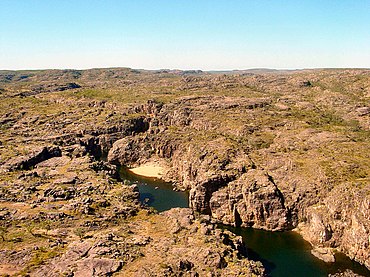
Nitmiluk National Park from the air.
Nitmiluk National Park is a protected area in the Northern Territory of Australia. It is located 244 kilometres southeast of Darwin. Established around a series of gorges on the Katherine River and Edith Falls, the park has great ceremonial significance to the local Jawoyn people, who are custodians of Nitmiluk National Park. In Jawoyn, Nitmiluk means place of the cicada dreaming.
Photo credit: Brian Voon Yee Yap -
 Photo: John O'NeillAn officer of the Victoria Police, the primary law enforcement agency of the Australian state of Victoria. The agency was founded in 1835 from an existing colonial police force of 875 men. As of 2011, the Victoria Police has over 12,190 sworn members, and over 2,900 civilian staff across 393 police stations.
 -
 Photo: John O'Neill; edit: JJ HarrisonBrian Nankervis (b. 1956), an Australian comedian and writer, shown here during a live performance. Nankervis rose to popularity while playing Raymond J. Bartholomeuz on Hey Hey It's Saturday; since 2005 he has been a host of the gameshow RocKwiz.


.jpg)


On this day

- 1804 – Explorer Matthew Flinders climbs Arthurs Seat, on the Mornington Peninsula in present-day Victoria.
- 1896 – Sir Henry Parkes (pictured), known as the "Father of Federation", dies in Annandale, New South Wales, at the age of 80.
- 1904 – Alfred Deakin resigns as Prime Minister of Australia due to the Protectionist Party's inability to pass legislation, and is succeeded by Chris Watson, the leader of the Labor Party.
- 1964 – Sir Garfield Barwick is appointed Chief Justice of Australia, succeeding Sir Owen Dixon.
- 1971 – Relics from the wreck of the Dutch East India Company ship Batavia are recovered off the coast of the Houtman Abrolhos in Western Australia.
- 2014 – Three former Country Liberal MPs join the Palmer United Party, becoming the party's first representatives in the Northern Territory Legislative Assembly.
General images
-
-
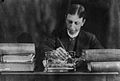
 A swagman in bushman's apparel, wearing a brimmed hat and carrying swag, and billy can. (from Culture of Australia)
 -
 Singer-songwriter Paul Kelly (from Culture of Australia)
 -
 Cover of Old Bush Songs, Banjo Paterson's 1905 collection of bush ballads (from Culture of Australia)
 -
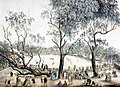 Cricket match at the Melbourne Cricket Ground, 1860s (from Culture of Australia)
 -
-

-
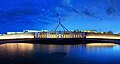 Parliament House, Canberra (from Culture of Australia)
 -
 The Wiggles performing in the United States in 2007 (from Culture of Australia)
 -
 Skiing in Australia began in Kiandra, a goldmining town in the Snowy Mountains of New South Wales, in the 1860s. (from Culture of Australia)
 -
 Governor Arthur Phillip hoists the British flag over the new colony at Sydney Cove in 1788. (from Culture of Australia)
 -
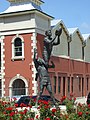 Statue in Fremantle of an Australian rules footballer taking a spectacular mark (from Culture of Australia)
 -
 The University of Sydney (from Culture of Australia)
 -
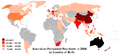 Countries of birth of Australian estimated resident population, 2006 (from Culture of Australia)
 -
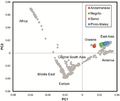 PCA of Orang Asli (Semang) and Andamanese, with worldwide populations in HGDP. (from Aboriginal Australians)
 -
 A commemorative statue of John Simpson Kirkpatrick, a famous stretcher bearer who was killed in the Gallipoli Campaign. (from Culture of Australia)
 -
 A group of Australian men wearing speedos. (from Culture of Australia)
 -
 William Wentworth was among the first advocates for Australian nationhood, supporting the rights of emancipists and leading the creation of Australia's first parliament (from Culture of Australia)
 -
 South Australian suffragette Catherine Helen Spence (1825–1910). The Australian colonies established democratic parliaments from the 1850s and began to grant women the vote in the 1890s. (from Culture of Australia)
 -
 Didgeridoo performers (from Culture of Australia)
 -
 The SBS building in Melbourne's Federation Square. SBS is Australia's multicultural broadcaster. (from Culture of Australia)
 -
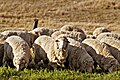 Sheep grazing in rural Australia. Early British settlers introduced Western stock and crops and Australian agriculture now produces an abundance of fresh produce. (from Culture of Australia)
 -
 Founded in 1993, Sydney's Tropfest is the world's largest short film festival. (from Culture of Australia)
 -
 Hyde Park Barracks, Sydney (from Culture of Australia)
 -

-
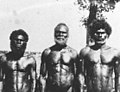 Men from Bathurst Island, 1939 (from Aboriginal Australians)
 -
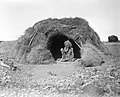 An Eastern Arrernte man of the Arltunga district, Northern Territory, in 1923. His hut is decked with porcupine grass. (from Aboriginal Australians)
 -
 House in Killara, New South Wales (from Culture of Australia)
 -
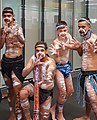 Noongar traditional dancers in Perth (from Aboriginal Australians)
 -
 The initial human settlement of Oceania is estimated to have been between 60,000 and 40,000 years ago. Archaeogenetic results indicate a colonisation of southern Sahul (Australia) before 37,000 years ago and an incubation period in northern Sahul (Papua New Guinea) followed by westward expansions within Australia after about 28,000 years ago. (from Aboriginal Australians)
 -
 Actor playing the bushranger Ned Kelly in The Story of the Kelly Gang (1906), the world's first feature film (from Culture of Australia)
 -
 Golden Wattle, Australia's floral emblem and the source of Australia's national colours, green and gold (from Culture of Australia)
 -
 St Mary Mackillop established an extensive network of schools and is Australia's first canonised saint of the Catholic Church. (from Culture of Australia)
 -
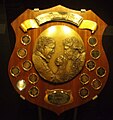 The first State of Origin shield (from Culture of Australia)
 -
 Kylie Minogue is hailed as one of Australia's most successful pop musicians (from Culture of Australia)
 -
 A Luritja man demonstrating method of attack with boomerang under cover of shield (1920) (from Culture of Australia)
 -
 The Princess Theatre in Melbourne (from Culture of Australia)
 -
 Convict architecture at Port Arthur, Tasmania (from Culture of Australia)
 -
 Historical image of Aboriginal Australian women and children, Maloga, New South Wales around 1900 (in European dress) (from Aboriginal Australians)
 -
 An Aboriginal encampment near the Adelaide foothills in an 1854 painting by Alexander Schramm (from Aboriginal Australians)
 -
 Portrait of Madame Melba by Rupert Bunny (from Culture of Australia)
 -
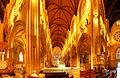 Interior of St Mary's Cathedral, Sydney (from Culture of Australia)
 -
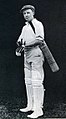 Donald Bradman is often cited as statistically the greatest sportsman of any major sport. (from Culture of Australia)
 -
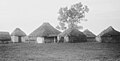 Dwellings accommodating Aboriginal families at Hermannsburg Mission, Northern Territory, 1923 (from Aboriginal Australians)
 -
 The Royal Exhibition Building, Melbourne (from Culture of Australia)
 -
 A typical Queenslander house in Brisbane (from Culture of Australia)
 -
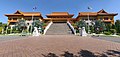 Nan Tien Temple, a Buddhist temple in Wollongong. Multicultural immigration has increased Australia's religious diversity. (from Culture of Australia)
 -
-
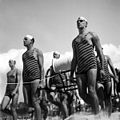 The surf lifesaving movement originated in Australia. (Pictured: surf lifesavers, Bondi Beach, 1930s). (from Culture of Australia)
 -
 The Bulletin, founded by J. F. Archibald (left), nurtured bush poets such as Henry Lawson (right). (from Culture of Australia)
 -
 The Matildas, Australia's national women's football team (from Culture of Australia)
 -

-
 Corroboree at Newcastle by convict artist Joseph Lycett, ca. 1818. Aboriginal Australian religious practices associated with the Dreamtime have been practised for tens of thousands of years. (from Culture of Australia)
 -
 A billycan used for heating water (from Culture of Australia)
 -
 Anzac Day dawn services are held throughout Australia every April. (from Culture of Australia)
 -

-


.jpg)
.jpg)


.jpg)


Killara_house_023.jpg)


.jpg)


.jpg)
.jpg)


Topics
Sub-portals

(Northern Territory) Australian Capital Territory |
Categories

More portals


WikiProject
|
 |

| |
Consider joining WikiProject Australia, a WikiProject dedicated to improving Wikipedia's coverage of topics related to Australia. The project page and its subpages contain suggestions on formatting and style of articles, which can be discussed at the project's notice board. To participate, simply add your name to the project members page.
As of 27 April 2024, there are 202,686 articles within the scope of WikiProject Australia, of which 593 are featured and 881 are good articles. This makes up 2.97% of the articles on Wikipedia, 5.49% of all featured articles and lists, and 2.23% of all good articles (see WP:AUSFG). Including non-article pages, such as talk pages, redirects, categories, etcetera, there are 517,154 pages in the project.
Associated Wikimedia
The following Wikimedia Foundation sister projects provide more on this subject:
-
 Commons
Free media repository -
 Wikibooks
Free textbooks and manuals -
 Wikidata
Free knowledge base -
 Wikinews
Free-content news -
 Wikiquote
Collection of quotations -
 Wikisource
Free-content library -
 Wikiversity
Free learning tools -
 Wikivoyage
Free travel guide -
 Wiktionary
Dictionary and thesaurus


