


Biel/Bienne
Biel/Bienne | |
|---|---|
.jpg) City Hall in the Old Town of Biel/Bienne | |
 Flag  Coat of arms | |
Location of Biel/Bienne  | |
  Biel/Bienne  Biel/Bienne | |
| Coordinates: 47°08′N 7°15′E / 47.133°N 7.250°E | |
| Country | Switzerland |
| Canton | Bern |
| District | Biel/Bienne |
| Government | |
| • Executive | Gemeinderat/Conseil municipal with 5 members |
| • Mayor | Stadtpräsident/le Maire (list) Erich Fehr SPS/PSS (as of February 2011) |
| • Parliament | Stadtrat/Conseil de ville with 60 members |
| Area | |
• Total | 21.21 km2 (8.19 sq mi) |
| Elevation (Railway station) | 437 m (1,434 ft) |
| Population (31 December 2018)[2] | |
• Total | 55,159 |
| • Density | 2,600/km2 (6,700/sq mi) |
| Demonym(s) | German: Bieler/in, French: Biennois(e) |
| Time zone | UTC+01:00 (Central European Time) |
| • Summer (DST) | UTC+02:00 (Central European Summer Time) |
| Postal code(s) | 2500–2510 |
| SFOS number | 0371 |
| ISO 3166 code | CH-BE |
| Surrounded by | Brügg, Ipsach, Leubringen/Magglingen (Evilard/Macolin), Nidau, Orpund, Orvin, Pieterlen, Port, Safnern, Tüscherz-Alfermée, Vauffelin |
| Twin towns | Iserlohn (Germany) |
| Website | www SFSO statistics |

Biel/Bienne (official bilingual wording; German: Biel [biːl] ; French: Bienne [bjɛn]; locally Alemannic German: [ˈb̥iˑəu]; Italian: Bienna; Romansh: Bienna; Latin: Belna) is a bilingual city in the canton of Bern in Switzerland. With over 55,000 residents, it is the country's tenth-largest city by population. The Biel urban area has a population of around 100,000 inhabitants.[3] Biel/Bienne is the capital of the Biel/Bienne administrative district. The city has been an industrial and watchmaking heart of Switzerland since the 19th century. With world-famous watch brands such as Rolex, Omega and Swatch based in Biel/Bienne, the city is one of the main centres of the Swiss watch industry and is also referred to as the "world capital of watchmaking".[4][5]
Biel/Bienne lies on the language boundary between the French-speaking and German-speaking parts of Switzerland, and is bilingual throughout. Biel is the German name for the city whereas Bienne is its French counterpart. The city is often referred to in both languages simultaneously. Since 1 January 2005, the official name has been "Biel/Bienne". Until then, the town was officially named Biel or Bienne.[6]
The city lies at the foot of the first mountain range of the Jura Mountains area, guarding the only practical connection to Jura, on the northeastern shores of Lake Biel (Bielersee, Lac de Bienne), sharing the eastern tip of the lake with its sister town, Nidau. The cities of Neuchâtel, Solothurn, and Bern (the capital of Switzerland) lie southwest, northeast and southeast of Biel/Bienne. They all can be reached within about 30 minutes by train or car. The cities of Zurich, Basel and Lausanne can each be reached in about one hour by car or train.
History
[edit]Prehistoric settlements
[edit]
The shoreline of Lake Biel has been inhabited since at least the Neolithic age. The remains of two neolithic settlements were found at Vingelz in 1874. The remains of the settlements became the Vingelz / Hafen archaeological site, which is now part of a UNESCO World Heritage Site. East of the Vingelz site, a late Bronze Age settlement was also discovered.[7] After the Roman conquest, the region was part of Germania Superior. During the Roman era the Roman road from Petinesca to Pierre Pertuis or Salodurum (now Solothurn) passed through the village of Mett, which is now part of Biel/Bienne. The foundations of buildings and a 4th-century cemetery in Mett come from a late Roman or an early medieval military guard station.[8]
A theory holds that the toponym is derived from the name of Belenus, probably from a Roman era sanctuary of that deity at a sacred spring nearby. However, no surviving records or inscriptions confirm this theory. Another theory states that the town grew up around a late Roman fortress. While no trace of the fortress has been found, the foundations of several Roman buildings have been found east of the medieval town.[9]
The town is mentioned in 1142 as Apud Belnam,[9] which is taken as evidence for its derivation from Belenus. In popular etymology, the name has been connected with the German name for axe (Bernese German bieli), reflected in the two crossed axes in the town's coat of arms.
Foundation
[edit]

In the 5th century, the area was invaded by the Burgundians, and by the medieval period became part of Upper Burgundy. During the 6th or 7th century, the Germanic speaking Alamanni moved into the area around Lake Biel, creating the language boundary that exists today. By the 8th century, the German-speaking population became the majority on the east end of the lake. In 999 Rudolph III of Burgundy granted lands around Lake Biel to the Bishopric of Basel, during the formative period of the Holy Roman Empire. Through the Bishop of Basel, the Counts of Neuchâtel and later the Counts of Neuchâtel-Nidau began to exercise their power in the foothills of the Jura Mountains. In 1140 the counts built Nidau Castle in the neighboring village of Nidau to help secure their land on the eastern end of the lake. The town was probably built by the Bishop of Basel, Heinrich II von Thun, between 1225 (mention of domum de Bilne) and 1230 (mention of in urbe mea de Beuna). Biel Castle was built either shortly before or shortly after the foundation of the town, to help support Nidau Castle.[9]
Officially, Biel remained under the jurisdiction of the Bishop of Basel throughout the 11th to 18th centuries. However, the early history of the town is filled with conflict between the town council and the Bishop's representative. In 1252, the town council partly succeeded in becoming a free imperial city. In 1275 King of Germany Rudolph of Habsburg granted Biel a town charter. The town's legal position was strengthened in 1296 when Bishop Peter Reich von Reichenstein signed an agreement with the town. This original agreement was strengthened in 1352 and remained in force until 1798.
The town's church, the Church of St. Benedict, was first mentioned in 1228. The current church was built in 1451–70 and is regarded, after Bern Cathedral, as the second most important late gothic building in the Canton of Bern.[9]
An associate of the Swiss Confederation
[edit]While it officially remained part of the lands of the Prince-Bishopric of Basel, starting in the 13th century Biel began making alliances with neighboring nobles and cities. In 1279 it allied with Bern. This first alliance was followed in 1311 by an alliance with Fribourg, a 1334 alliance with Solothurn, 1342 with Murten and 1395 with La Neuveville. The alliance with Bern became an eternal alliance in 1352, as Bern itself joined the Old Swiss Confederacy. Contradictory obligations to the Bishop of Basel, Jean de Vienne, and to the Imperial City of Bern led to a war in 1367. During the war, Biel was burned and the Bishop's castle was destroyed. After the extinction of the Counts of Neuchâtel-Nidau in 1375 the Bishop's power around the lake began to wane. In 1388, Bern gained control of Nidau Castle and the town of Nidau. However, the Bishop retained nominal power and influence in Biel. The two competing powers struggled for power in Biel for over 400 years and prevented the town from becoming completely independent from either powerful neighbor.[9]
Biel was considered an associate of the Swiss Confederacy during the 15th century, and after its participation in the Burgundy Wars even came to be recognized as a full member by 1494.
Even though Biel remained nominally under the control of the Catholic Bishops of Basel, in 1528 it converted to the new Protestant faith.
From the French invasion to modern Biel/Bienne
[edit]

The French Revolution changed the political situation in Biel/Bienne. In 1793, the French Revolutionary Army captured the Bishopric of Basel and brought the French into the lands near Biel. When they conquered the Moutier valley and Erguel in 1797 it brought the French practically to the gates of Biel/Bienne. On 6 February 1798, French troops marched through the open city gate while the population celebrated their arrival. Bienne and its neighboring communities were incorporated as the "Canton de Bienne" into the département du Mont-Terrible of the First French Republic. Two years later, in 1800, it went to the Département du Haut-Rhin. Under Mayor Sigmund Wildermeth (1765–1847) Biel strictly followed every dictate from Paris.
After the collapse of the French Empire, Biel sent Georg Friedrich Heilmann to the Congress of Vienna in 1814 to push for the creation of an independent Canton of Biel. However, he was unsuccessful and the Congress granted most of the territory of the Bishopric to the canton of Bern. Biel was able to resist unification until Bern agreed to retain some of Biel's historic privileges and rights. In 1815 Biel finally joined the Canton of Bern as part of the Oberamt of Nidau. The city council of Biel struggled to make it the capital of its own district. Finally in 1832 the Biel Amtsbezirk was created and Biel became the district capital. The democratic reforms of the Regeneration era helped the citizens of Biel to identify with and feel a part of the Canton of Bern.[9]

By the beginning of the 20th century anarcho-syndicalist groups, which saw strikes and sabotage as legitimate means to bring about reform, began to influence the labor movement in Biel/Bienne. The first large scale strike was the construction workers strike of 1902. The following years were marked with bitterly fought labor disputes. The largest strike was the journeymen carpenters strike of 1907, which lasted almost a year. Also in 1907 labor secretary Gottfried Reimann from the Social Democratic Party was elected mayor. His election marked the first time that a Social Democrat was elected to such a powerful office in Switzerland.
The First World War meant a setback for the labor movement, even though Switzerland was not directly involved in the war. Wages were reduced significantly when the war started while inflation made everything more expensive. In July 1918, a demonstration of starving workers erupted into street riots that required military action to suppress.
In 1919 a Communist Party was founded in Biel, but it remained a minor party in the town. In 1921, the Social Democrats won a slim majority in the city councils. Under the leadership of the Social Democratic Mayor Guido Müller "Red Biel" began a series of socialist community experiments. During the 1930s the entire neighborhood around the train station was redeveloped according to the social planning theories of the era. The Volkshaus (People's House), built under the direction of Edward Lanz between 1928 and 1932, is an example of the "new building" style and a symbol of the Social Democratic era of the city.
In the years leading up to the Second World War, the Social Democrats began to lose power in the city. In the last year of the war, the Swiss Party of Labour gained nine seats on the city council and ended the Social Democrat majority. With the resignation of Mayor Müller in 1947, it would be almost thirty years (1976) before the Social Democrats had another mayor in Biel.[9]
On the occasion of the secession of the canton of Jura in 1978, Biel had been asked to become its capital, but it remained with the canton of Bern.
The town was officially named Biel or Bienne until 2004, even though the bilingual Biel-Bienne was in common use. Since 2005, the official name has been Biel/Bienne, with forward slash.[10]
At the beginning of the 20th century, the town's population was at 30,000 people. It doubled over the next 60 years, peaking at 65,000 in the mid-1960s. It declined gradually over the 1970s to 1990s, to below 49,000 in 2000, again rising slightly to just over 50,000 during the 2000s. Another 89,000 people live in the immediately surrounding urban agglomeration.
Geography and climate
[edit]Topology
[edit]
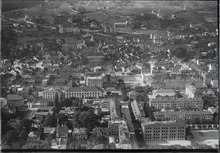
Biel/Bienne has an area of 21.19 km2 (8.18 sq mi).[11] Of this area, 1.7 km2 (0.66 sq mi) or 8.0% is used for agricultural purposes, while 9.63 km2 (3.72 sq mi) or 45.4% is forested. Of the rest of the land, 9.65 km2 (3.73 sq mi) or 45.5% is settled (buildings or roads), 0.13 km2 (32 acres) or 0.6% is either rivers or lakes and 0.14 km2 (35 acres) or 0.7% is unproductive land.[12]
Of the built up area, industrial buildings made up 5.1% of the total area while housing and buildings made up 21.9% and transportation infrastructure made up 12.6%. Power and water infrastructure as well as other special developed areas made up 1.7% of the area while parks, green belts and sports fields made up 4.1%. Out of the forested land, all of the forested land area is covered with heavy forests. Of the agricultural land, 4.7% is used for growing crops and 2.0% is pastures. All the water in the municipality is flowing water.[12]
The municipality is at the southeastern foot of the Jura Mountains on the northeast end of Lake Biel. It consists of the village of Biel/Bienne, Vingelz (since 1900), Bözingen (since 1917), Madretsch and Mett (both since 1920).
On 31 December 2009 Amtsbezirk Biel, the municipality's former district, was dissolved. On the following day, 1 January 2010, it joined the newly created Verwaltungskreis Biel/Bienne. It remained the capital of the new Verwaltungskreis.[6]
Climate
[edit]| Climate data for Biel/Bienne (1981–2010) | |||||||||||||
|---|---|---|---|---|---|---|---|---|---|---|---|---|---|
| Month | Jan | Feb | Mar | Apr | May | Jun | Jul | Aug | Sep | Oct | Nov | Dec | Year |
| Mean daily maximum °C (°F) | 3.7 (38.7) |
5.6 (42.1) |
10.7 (51.3) |
14.9 (58.8) |
19.6 (67.3) |
22.9 (73.2) |
25.6 (78.1) |
25.0 (77.0) |
20.5 (68.9) |
14.7 (58.5) |
8.0 (46.4) |
4.7 (40.5) |
14.7 (58.5) |
| Daily mean °C (°F) | 0.7 (33.3) |
1.6 (34.9) |
5.5 (41.9) |
9.5 (49.1) |
14.0 (57.2) |
17.4 (63.3) |
19.7 (67.5) |
18.9 (66.0) |
14.8 (58.6) |
10.3 (50.5) |
4.8 (40.6) |
1.8 (35.2) |
9.9 (49.8) |
| Mean daily minimum °C (°F) | −1.5 (29.3) |
−1.4 (29.5) |
1.6 (34.9) |
4.7 (40.5) |
9.1 (48.4) |
12.4 (54.3) |
14.4 (57.9) |
14.0 (57.2) |
10.6 (51.1) |
7.1 (44.8) |
2.2 (36.0) |
−0.4 (31.3) |
6.1 (43.0) |
| Average precipitation mm (inches) | 101 (4.0) |
88 (3.5) |
89 (3.5) |
79 (3.1) |
100 (3.9) |
100 (3.9) |
102 (4.0) |
113 (4.4) |
97 (3.8) |
104 (4.1) |
98 (3.9) |
117 (4.6) |
1,187 (46.7) |
| Average snowfall cm (inches) | 14.8 (5.8) |
13.2 (5.2) |
5.6 (2.2) |
0.8 (0.3) |
0 (0) |
0 (0) |
0 (0) |
0 (0) |
0 (0) |
0 (0) |
3.7 (1.5) |
13.6 (5.4) |
51.7 (20.4) |
| Average precipitation days (≥ 1.0 mm) | 10.7 | 10.0 | 10.7 | 10.2 | 12.2 | 10.8 | 10.6 | 10.6 | 8.8 | 10.8 | 10.5 | 11.5 | 127.4 |
| Average snowy days (≥ 1.0 cm) | 4.1 | 3.4 | 1.8 | 0.3 | 0 | 0 | 0 | 0 | 0 | 0 | 1 | 2.9 | 13.5 |
| Average relative humidity (%) | 85 | 80 | 73 | 69 | 70 | 69 | 67 | 71 | 76 | 83 | 84 | 85 | 76 |
| Source: MeteoSwiss[13] | |||||||||||||
Politics
[edit]Coat of arms
[edit]The blazon of the municipal coat of arms is Gules two Axes Argent in saltire.[14]
Subdivisions
[edit]Government
[edit]The Municipal Council (fr: Conseil municipal, de: Gemeinderat) constitutes the executive government of the City of Biel/Bienne and operates as a collegiate authority. It is composed of five councilors (French: Conseiller municipal/ Conseillère municipale, German: Gemeinderat/ Gemeinderätin), each presiding over a directorate. The president of the presidential directorate acts as mayor (fr: Maire, de: Stadtpräsident). In the mandate period 2021–2024 (législature, Legislatur) the Municipal Council is presided by Maire/ Stadtpräsident Erich Fehr. Departmental tasks, coordination measures and implementation of laws decreed by the City Council (parliament) are carried by the Municipal Council. The regular election of the Municipal Council by any inhabitant valid to vote is held every four years. Any resident of Biel/Bienne allowed to vote can be elected as a member of the Municipal Council. The current mandate period is from 1 January 2021 to 31 December 2024. The mayor is elected as such by public election by means of a system of Majorz, while the heads of the other directorates are assigned by the collegiate. The delegates are selected by means of a system of Proporz.[15]
As of 2021[update], Biel/Bienne's Municipal Council is made up of two representatives of the PS/SP (Social Democratic Party, of whom one is also the mayor), one member of the Grünes Bündnis (GB) (Green Party), one of the PRR (Les Radicaux Romands), and one of the UDC/SVP (Swiss People's Party), giving the left parties a majority of three out of five seats. The last regular election was held on 27 September 2020. The mayor has been reelected with 6889 votes (57.16%) and the voter turnout was 39.4%.[16]
| Municipal Councillor (Conseiller communal/ Conseillère communale, Stadtrat/ Stadträtin) |
Party | Head of Directorate (Directeur/Directrice de, Direktor/Direktorin, since) of |
elected since | Native language |
|---|---|---|---|---|
| Erich Fehr[CC 1] | PS | Mayor's Office (mairie/ Präsidialdirektion, 2011) | 2010 | DE |
| Silvia Steidle[CC 2] | PRR | Finance (Direction des finances/ Finanzdirektion, 2009) | 2008 | FR |
| Beat Feurer | SVP | Social Services and Security (Direction de l'action sociale et de la sécurité/ Direktion Soziales und Sicherheit, 2013) | 2012 | DE |
| Glenda Gonzalez Bassi | PSR | Education, Culture, and Sports (Direction de la formation, de la culture et du sport/ Direktion Bildung, Kultur und Sport, 2021) | 2020 | FR |
| Lena Frank | GB | Civil Engineering and Construction, Energy, and Environmental Sustainability (Direction des travaux publics, de l'énergie et de l'environnement/ Direktion Bau, Energie und Umwelt, 2021) | 2020 | DE |
Barbara Labbé is Town Chancellor (chancelière municipale/ Stadtschreiberin) since , and Bertrand Cottier is Deputy Town Chancellor (vice-chancelier/ Vize-Stadtschreiber) since for the Municipal Council.
Parliament
[edit]The Conseil de ville/Stadtrat of Biel/Bienne for the mandate period of 2021–2024
The City Council (fr: Conseil de ville, de: Stadtrat), the city parliament, holds legislative power. It is made up of 60 members, with elections held every four years. The City Council decrees regulations and by-laws that are executed by the Municipal Council and the administration. The delegates are selected by means of a system of proportional representation.
The sessions of the City Council are public. Unlike members of the Municipal Council, members of the City Council are not politicians by profession, and they are paid a fee based on their attendance. Any resident of Biel/Bienne allowed to vote can be elected as a member of the City Council. The Parliament holds its meetings in the Stadtratssaal.[18]
The last regular election of the City Council was held on 27 September 2020 for the mandate period (la législature) from 2021 to 2024. The voter turnout was 39.23%.[16]
Currently the City Council consist of 18 members of the Social Democratic Party (PSR/SP) including 6 members of the French branch Parti Socialiste Romand (PSR) and 2 members of its junior parties JUSO/JS, 11 members of the Liberals (PRR/FDP) including 4 members of its French branch Parti Radical Romand (PRR), 11 members of the Swiss People's Party (UDC/SVP), 8 members of the Green Party (LV/Grüne), 4 Green Liberal Party (PVL/GLP), 2 members of the alliance called Passarelle, 2 members of the Evangelical People's Party (PEV/EVP), 2 members for the alliance of the two parties Conservative Democratic Party (PBD/BDP) from Biel/Bienne (BLB) and Christian Democratic People's Party (PDC/CVP), one member of the Swiss Party of Labour (POP/PdA), and one member of the Federal Democratic Union (UDF/EDU).[16]
Elections
[edit]National Council
[edit]In the 2019 federal election for the Swiss National Council the most popular party was the SP/PS which received 26.4% (-5.7) of the vote. The next five most popular parties were the Green Party (24.1%, +10.2), the SVP/UDC (15.4%, -6.6), the glp/pvl (8.9%, +3.3), PLR (7.9%, -1.5), and the BDP/PBD (3.9%, -3.1).[19] In the federal election a total of 11,096 votes were cast, and the voter turnout was 35.9%.[20]
In the 2015 federal election the most popular party was the SP/PS which received 32.0% (+0.8) of the vote. The next five most popular parties were the SVP/UDC (22.0%, +2.1), the Green Party (13.9%, -0.8), PLR/FDP (9.4%, +1.4), the glp/pvl (8.9%, +3.3), and the BDP/PBD (7.0%).[19] In the federal election a total of xxx votes were cast, and the voter turnout was 36.9%.[20]
In the 2011 federal election the most popular party was the SP/PS which received 31.2% of the vote. The next three most popular parties were the SVP/UDC (19.9%), the Green Party (14.7%) and the PLR/FDP (8.8%). In the federal election, a total of 12,363 votes were cast, and the voter turnout was 39.0%.[21]
International relations
[edit]Biel/Bienne is twinned with:[citation needed]
 Iserlohn, Germany (since 1959)

Demographics
[edit]Population
[edit]

Biel/Bienne has a population (as of December 2020[update]) of 55,206.[22] As of 2010[update], 28.1% of the population are resident foreign nationals. Over the last 10 years (2000–2010) the population has changed at a rate of 3.8%. Migration accounted for 7.8%, while births and deaths accounted for −1.4%.[23]
Of the population in the municipality, 15,339 or about 31.5% were born in Biel/Bienne and lived there in 2000. There were 8,990 or 18.5% who were born in the same canton, while 9,170 or 18.8% were born somewhere else in Switzerland, and 12,244 or 25.2% were born outside of Switzerland.[24]
As of 2010[update], children and teenagers (0–19 years old) make up 18.8% of the population, while adults (20–64 years old) make up 61.9% and seniors (over 64 years old) make up 19.3%.[23]
As of 2000[update], there were 19,980 people who were single and never married in the municipality. There were 21,188 married individuals, 3,727 widows or widowers and 3,760 individuals who are divorced.[24]
As of 2000[update], there were 11,014 households that consist of only one person and 797 households with five or more people. In 2000[update], a total of 23,367 apartments (86.8% of the total) were permanently occupied, while 2,169 apartments (8.1%) were seasonally occupied and 1,398 apartments (5.2%) were empty.[25] As of 2010[update], the construction rate of new housing units was 3.2 new units per 1000 residents.[23]
As of 2003[update] the average price to rent an average apartment in Biel/Bienne was 935.83 Swiss francs (CHF) per month. The average rate for a one-room apartment was 463.73 CHF, a two-room apartment was about 706.49 CHF, a three-room apartment was about 846.98 CHF and a six or more room apartment cost an average of 1749.16 CHF. The average apartment price in Biel/Bienne was 83.9% of the national average of 1116 CHF.[26] The vacancy rate for the municipality, in 2011[update], was 2%.
Historic population
[edit]The historical population is given in the following chart:[9]

| Historic Population Data[9] | |||||||||||
|---|---|---|---|---|---|---|---|---|---|---|---|
| Year | Total Population | German Speaking | French Speaking | Catholic | Protestant | Christian Catholic | Jewish | Other religions | No religion given | Swiss | Non-Swiss |
| 1770 | 1,698 | ||||||||||
| 1818 | 3,589 | ||||||||||
| 1850 | 5,609 | 5,268 | 341 | ||||||||
| 1880 | 16,579 | 13,253 | 3,207 | 1,675 | 14,620 | 240 | 77 | 15,323 | 1,289 | ||
| 1910 | 32,136 | 22,017 | 9,209 | 4,840 | 26,366 | 413 | 517 | 28,723 | 3,413 | ||
| 1930 | 37,726 | 24,946 | 11,673 | 6,031 | 30,750 | 310 | 635 | 35,588 | 2,338 | ||
| 1950 | 48,342 | 32,188 | 14,598 | 8,659 | 38,314 | 572 | 268 | 529 | 46,232 | 2,110 | |
| 1970 | 64,333 | 36,354 | 17,396 | 22,745 | 40,032 | 282 | 178 | 1,096 | 52,148 | 12,185 | |
| 1990 | 51,893 | 27,510 | 15,906 | 17,857 | 26,123 | 116 | 69 | 7,728 | 3,959 | 40,576 | 11,317 |
Language
[edit]
In 2000, a majority of the population spoke German (26,957 or 55.4%) as their first language. French was the second most common (13,695 or 28.1%) and Italian was third (2,925 or 6.0%). There were 37 people who spoke Romansh.[24] German and French are both official languages of Biel/Bienne, which is the largest bilingual city in Switzerland.
In 2020, when asked specifically about the two official languages, 32,154 residents (56.8% of the population) mentioned German as their principal language, while 24,376 (43.2%) mentioned French.[27]
In recent years the city has used its linguistic assets as an economic advantage, becoming the Swiss City of Communication. Several call centres have been created in or around Biel, in addition to the traditional businesses established in the city and surrounding area, which have always exported most of their production worldwide.
Religion
[edit]According to the 2000 census[update], 19,191 people or 39.4% of the total population, belonged to the Swiss Reformed Church, while 14,241 or 29.3% were Roman Catholic. Of the rest of the population, there were 613 members of an Orthodox church (or about 1.26% of the population), there were 87 individuals (or about 0.18% of the population) who belonged to the Christian Catholic Church, and there were 2,870 individuals (or about 5.90% of the population) who belonged to another Christian church. There were 61 individuals (or about 0.13% of the population) who were Jewish, and 3,156 (or about 6.49% of the population) who were Muslim. There were 329 individuals who were Buddhist, 235 individuals who were Hindu and 68 individuals who belonged to another church. 6,012 (or about 12.36% of the population) belonged to no church, are agnostic or atheist, and 3,180 individuals (or about 6.54% of the population) did not answer the question.[24]
Tourism
[edit]
Biel/Bienne is located near the watch-making cities of La Chaux-de-Fonds and Le Locle, which together form a UNESCO World Heritage Site. The city is home to numerous watchmaking factories. The Swatch Group has its worldwide headquarters in the old ASUAG building. The old city of Biel/Bienne includes a 15th-century Gothic church, guild halls, and fountains. Outside the old city, the Biel "Cultural Quarter" is home to the Neuhaus and Schwab Museums and the CentrePasquArt.
The Jura mountains are north of the town and two funicular railways, the Bienne–Evilard Funicular and the Biel–Magglingen Funicular, link the city with the foothills. North-east of the town, the steep gorge of Taubenloch is a popular place to visit. West of the city is Lake Biel which is lined with parks and the town's harbor.
In 2016 a total of 50,646 visitors spent 87,937 lodging nights in Biel/Bienne.[28]
Heritage sites of national significance
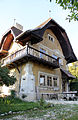
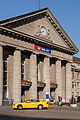
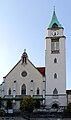
[edit]The Alte Krone/La vieille Couronne, the artist's studio Atelier Robert, the former Rockhall Manor, the main train station, the Jordi-Kocher House, the Catholic parish Church of St. Maria Immaculata, the Kongresshaus/Palais des Congrès (Convention Center), the Kontrollgebäude at Zentralstrasse 49 / Oberer Quai 2, the Neuhaus Museum with the Robert Foundation Collection, the Schwab Museum, the Swiss Reformed City Church, the administration building and montage hall for General Motors, the Volkshaus Building and the Waldleute Zunft Building are listed as Swiss heritage site of national significance. The entire town of Biel/Bienne and the Taubenlochschlucht canyon are both part of the Inventory of Swiss Heritage Sites.[29]
-
 Alte Krone, Vieille Couronne
 -
 Atelier Robert
 -
 The former Rockhall Manor building
 -
 Main Train Station
 -
 Jordi-Kocher House
 -
 Catholic parish church of St. Maria Immaculata
 -
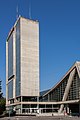 Kongresshaus, Palais des congrès, (Convention Center)
 -
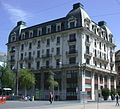 Kontrollgebäude at Zentralstrasse 49 / Oberer Quai 2
 -
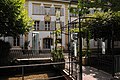 Museum Neuhaus
 -
 Museum Schwab
 -
 Swiss Reformed City Church
 -
 Administration Building and Montage Hall for General Motors
 -
 Volkshaus, Maison du Peuple Building
 -
 Waldleute Zunft Building
 -
 Bridge in Taubenlochschlucht


.jpg)


World Heritage Site
[edit]It is home to the Vingelz / Hafen archaeological site. Vingelz / Hafen is a prehistoric pile-dwelling (or stilt house) settlements that is part of the Prehistoric Pile dwellings around the Alps UNESCO World Heritage Site.[30]
The Vingelz / Hafen site is buried under mud near the shore of Lake Biel. It is one of the best preserved sites on the lake and has had minimal research. Based on the limited studies done on the village, it was occupied around 2970–2820 BC and again in 2780–2695 BC. About 60 wood samples have been dendrochronologically dated. The site was discovered in 1874 by Eduard von Fellenberg while he was excavating a dug-out canoe. In 1985 a series of test borings identified the two archaeological layers with a total thickness of about 90 cm (2 ft 11 in). A text excavation in 1998 found textile remains and a complete axe handle and blade.[31]
Business
[edit]
The city and surrounding area are home to companies that design and manufacture specialised machinery and precision tools. Between 1936 and 1975 General Motors Suisse SA assembled over 300,000 General Motors automobiles here, mainly for the Swiss domestic market but also for export to neighboring countries and Yugoslavia.[32]
- Rolex produces movement and technical parts in the city.
- Swatch Group has several of its brand headquarters here, especially Omega SA and Swatch.
- The Federation of the Swiss Watch Industry FH is located in this city.
- Glycine Watch SA manufacturing and administration are located here.
As of 2011[update], Biel/Bienne had an unemployment rate of 3.95%. As of 2008[update], there were a total of 33,799 people employed in the municipality. Of these, there were 56 people employed in the primary economic sector and about 10 businesses involved in this sector. 9,421 people were employed in the secondary sector and there were 451 businesses in this sector. 24,322 people were employed in the tertiary sector, with 2,267 businesses in this sector.[23]
In 2008[update] there were a total of 28,144 full-time equivalent jobs. The number of jobs in the primary sector was 43, of which 21 were in agriculture and 22 were in forestry or lumber production. The number of jobs in the secondary sector was 8,945 of which 7,405 or (82.8%) were in manufacturing and 1,388 (15.5%) were in construction. The number of jobs in the tertiary sector was 19,156. In the tertiary sector; 4,371 or 22.8% were in wholesale or retail sales or the repair of motor vehicles, 1,745 or 9.1% were in the movement and storage of goods, 1,092 or 5.7% were in a hotel or restaurant, 812 or 4.2% were in the information industry, 648 or 3.4% were the insurance or financial industry, 1,708 or 8.9% were technical professionals or scientists, 1,293 or 6.7% were in education and 3,591 or 18.7% were in health care.[33]
In 2000[update], there were 17,680 workers who commuted into the municipality and 7,990 workers who commuted away. The municipality is a net importer of workers, with about 2.2 workers entering the municipality for every one leaving.[34] Of the working population, 31.2% used public transportation to get to work, and 37.8% used a private car.[23]
Education
[edit]
In Biel/Bienne about 17,768 or (36.5%) of the population have completed non-mandatory upper secondary education, and 5,492 or (11.3%) have completed additional higher education (either university or a Fachhochschule). Of the 5,492 who completed tertiary schooling, 56.6% were Swiss men, 26.4% were Swiss women, 10.5% were non-Swiss men and 6.5% were non-Swiss women.[24]
The Canton of Bern school system provides one year of non-obligatory Kindergarten, followed by six years of Primary school. This is followed by three years of obligatory lower Secondary school where the students are separated according to ability and aptitude. Following the lower Secondary students may attend additional schooling or they may enter an apprenticeship.[35]
During the 2009–10 school year, there were a total of 5,733 students attending classes in Biel/Bienne. There were 27 kindergarten classes with a total of 497 students in the municipality. Of the kindergarten students, 36.2% were permanent or temporary residents of Switzerland (not citizens) and 66.0% have a different mother language than the classroom language. The municipality had 79 primary classes and 1,470 students. Of the primary students, 32.9% were permanent or temporary residents of Switzerland (not citizens) and 53.4% have a different mother language than the classroom language. During the same year, there were 53 lower secondary classes with a total of 981 students. There were 23.6% who were permanent or temporary residents of Switzerland (not citizens) and 29.6% have a different mother language than the classroom language.[36]
As of 2000[update], there were 3,008 students in Biel/Bienne who came from another municipality, while 517 residents attended schools outside the municipality.[34]
Biel/Bienne is home to 3 libraries. The Stadtbibliothek Biel, the BFH Technik und Informatik TI Biel and the BFH Architektur, Holz und Bau AHB Biel. There was a combined total (as of 2008[update]) of 233,171 books or other media in the libraries, and in the same year a total of 501,646 items were loaned out.[37]
Culture
[edit]
The newspapers Bieler Tagblatt and Journal du Jura as well as the only totally bilingual German/French newspaper Biel-Bienne with its large free distribution within the greater area, are published in Biel.
The domicile of the Theater Biel Solothurn is situated in the old town.
The town is also known for its annual International Chess Festival.
The town of Biel/Bienne received the Wakker Prize in 2004.
Each June since 1959, Biel has hosted a 100 km Ultramarathon race, which is among the biggest races of its kind worldwide and forms a part of the European Ultramarathon Cup.
Transport
[edit]
Biel/Bienne is very well connected to its region and to Switzerland as well.
The public transport in and around Biel/Bienne is operated by Verkehrsbetriebe Biel/Transports publics biennois, which is integrated into the fare network libero with coordinated timetables, which in itself covers the area of canton of Bern and Solothurn.
The fare network includes any mode of public transport, such as any kind of train (including the urban S-Bahn), PostAuto buses, trams, buses (either trolleybuses or motorized buses) and others. Fares are based on the number of zones crossed during a specified time and are independent of the mode of transport or the number of connections. Most part of Biel/Bienne and including Nidau belong to fare zone 300, including Vingelz/Vigneules in the southwest at the lake, but excluding Hohfluh on the Magglingen funicular and the Bözigerfeld/Champs-de-Boujean in the northeast, which belong to zone 301.
The circle fare zone 301 around Biel/Bienne also includes Tüscherz in the southwest, Hohfluh, Evilard, and Frinvillier (German: Friedliswart, through the Taubenlochschlucht) in the west, and Orpund, Scheuren, Schwadernau, Brügg, Aegerten, and Studen in the east, and Port, Ipsach, Bellmund, Jens, Merzligen, and Hermrigen in the south of the municipality.
Biel/Bienne railway station is not only the central network nucleus of Biel/Bienne, but also of the whole urban and inter-regional region. It connects the town to the regional, national and international railways network (Neuchâtel – Lausanne - Geneva, La Chaux-de-Fonds, Bern, Grenchen – Delémont – Basel, Solothurn – Olten – Luzern/Zürich – St. Gallen, and the canton of Jura). It is a central railway junction on the fast east–(south-)west line and on the Basel–Bern line. The station is Switzerland's thirteenth most busy railway station (about 52,0000 passengers per working day in 2016).
One funicular railways leads to the national sports center of Magglingen/Macolin on the 500 metres (1,600 ft) higher Jura mountain in the west, and the other, the Bienne-Evilard Funicular, to the city hospital and to neighbouring municipality Evilard to northwest, both above the town on the eastern range of the Jura Mountains. The high, flat pastures and wood of Magglingen/Macolin span about 7 kilometres (4.3 mi) from northeast to southwest at an altitude between 800 and 1,031 metres (2,625 and 3,383 ft). The Magglingen/Macolin Funicular often leads to sunshine while Biel/Bienne is covered by low hanging clouds.
The port at the north-eastern end of Lake Biel is a starting point for leisurely journeys to the three lakes of Biel, Neuchâtel, and Murten/Morat through the Three-Lakes Landscape, which are all connected by navigable channels and rivers. The port is situated on the west side of the main railway station between the exit of the river Schüss/La Suze arriving from the Jura in the west through the Taubenlochschlucht (Swiss German for pigeon hole gorge) and the navigable Nidau-Büren Canal with connections as far as Solothurn.
Several bridges over the Nidau-Büren Canal connect the town to its south/eastern suburbs.
Biel/Bienne is well connected to other Swiss cities by several motorways (A6 to Bern, and via A5 to both, the Jura and Basel, Luzern, Zurich, St. Gallen).
The town is very well connected to all Swiss international airports: Geneva Airport (1:40h), EuroAirport Basel Mulhouse Freiburg (1:30h), and Zurich Airport (1:30h), also serve as international gateways, all reachable within about the same time by direct train from Biel/Bienne.
Sport
[edit]- EHC Biel, the professional ice hockey team
- FC Biel-Bienne, the football club.
Notable people
[edit]Honoured citizen
[edit]- Nicolas Hayek (1928–2010) a Lebanese-American Swiss businessman, co-founder, CEO and Chairman of the Board of The Swatch Group. Promoted to honourable citizenship in 2004, official ceremony held on 19 February 2005[38]


.jpg)


Nemo Mettler (known as Nemo) won Eurovision 2024 for Switzerland. Biel/Bienne submitted a joint entry to host the 2025 contest with Bern but was not approved.
Born in Biel/Bienne
[edit]- Middle Ages
- Thomas Wyttenbach (c. 1472–1526), one of the reformers of the city of Biel during the Protestant Reformation.
- Emanuel Witz (1717–1797), a Swiss painter
- Eduard Blösch (1807–1866), a Swiss politician, President of the Swiss National Council 1855–1856
- Léo-Paul Robert (1851–1923), Swiss painter
- 19th C
- Karl Walser (1877–1943), a Swiss painter, stage designer, illustrator, muralist and artist
- Robert Walser (1878–1956), a German-speaking Swiss writer
- Ernst Dubach (1881–1982), a Swiss racing cyclist, the Swiss National Road Race champion in 1902
- Louis Rivier (1885–1963), a Swiss painter, writer, and stained glass artist
- Hans Zulliger (1893–1965), a Swiss teacher, child psychoanalyst and author
- Anna Renfer (1896-1984), a Swiss composer
- 20th C
- Jean-Louis Jeanmaire (1910–1992), a brigadier in the Swiss army who passed highly classified Swiss military secrets to the Soviet Union from 1962 until he retired in 1975
- Roland Kuhn (1912–2005), a Swiss psychiatrist who discovered that the drug imipramine had antidepressant properties
- Walter Kistler (1918–2015), a physicist, inventor and philanthropist
- Maurice Edmond Müller (1918–2009), orthopedic surgeon, developed internal fixation techniques to fix bone fractures
- Géo Voumard (1920–2008), a Swiss jazz pianist and composer, co-founded the Montreux Jazz Festival
- Felix Villars (1921–2002), American professor of physics at MIT, worked in quantum field theory, emigrated in 1949
- Henriette Grindat (1923–1986), a Swiss photographer, contributed to artistic photography, taking a Surrealist approach
- René Felber (1933–2020), a Swiss politician, member of the Swiss Federal Council 1987–1993
- Raymond Bruckert (born 1935) – writer of novels and educational books
- Ernst Thomke (born 1939), businessman, a corporate saviour by interventions
- Franz Hohler (born 1943), author of one-man and satirical programs for TV and radio, and cabaret artist.[39]
- Christian Philipp Müller (born 1957), a Swiss artist
- Thomas Jordan (born 1963), chairman of the Swiss National Bank
- Ian Christe (born 1970), an author, disc jockey and the publisher of Bazillion Points Books
- Denis Simonet (born 1985), a Swiss Pirate Party politician
- Nemo Mettler (born 1999), singer and rapper. Swiss representative and winner of the Eurovision Song Contest 2024
- Sport
- Nicolas Bührer (born 1944), a Swiss entrepreneur and former racing driver
- Enzo Calderari (born 1952), a Swiss entrepreneur and former racing driver
- Robert Lüthi (born 1958), a retired Swiss footballer, played 291 games for Neuchâtel Xamax
- Étienne Dagon (born 1960), a former breaststroke swimmer, bronze medallist at the 1984 Summer Olympics
- Sven Christ (born 1973), a Swiss football manager and former football player with 427 games
- Andréa Zimmermann (born 1976), a Swiss ski mountaineer and mountain runner
- Yannick Pelletier (born 1976), a Swiss chess player who lives in Paris
- Marcel Fischer (born 1978), a Swiss fencer, gold medallist in the Men's Épée Individual at the 2004 Summer Olympics
- Ares (Marco Jaggi) (born 1980), a Swiss professional wrestler and wrestling trainer
- Raphael Nuzzolo (born 1983), a Swiss professional footballer, played over 475 games
- Martina Kocher (born 1985), a Swiss luger, competed in the 2006 and 2010 Winter Olympics
- Pietro Di Nardo (born 1990), a Swiss professional footballer, played over 250 games
- Gregory Hofmann (born 1992), a professional ice hockey player
- Nicola Todeschini (born 1997), a Swiss figure skater
- Music
- Nemo Mettler (born 1999), Swiss rapper and winner of the 2024 Eurovision Song Contest
Lived in Biel/Bienne
[edit]
- Paul Käser (1904–??), a Swiss rower active in the 1920s and 1930s
- Henri Dubuis (1906–2003), a Swiss architect, designed and built the Volkshaus in Biel/Bienne in 1932
- Daniel Gisiger (born 1954), a retired Swiss road and track cyclist
- Jonas Kocher (born 1977), a musician, accordionist and composer
- Arno Camenisch (born 1978), a Swiss writer in German and Romansh
- Henri Laaksonen (born 1992), a Swiss-Finnish tennis player
- Oliver Hegi (born 1993), a Swiss male artistic gymnast and member of the national team
- Jil Teichmann (born 1997), a Spanish-born Swiss tennis player
Gallery
[edit]-
 Lake Bienne
 -
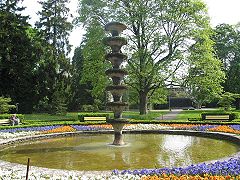 town's park
 -
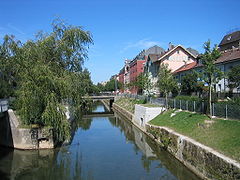 the river Suze
 -
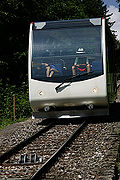
-
 Place du Ring
 -
 old town
 -
 old town
 -
 old town


.jpg)


See also
[edit]References
[edit]- ^ a b "Arealstatistik Standard - Gemeinden nach 4 Hauptbereichen". Federal Statistical Office. Retrieved 13 January 2019.
- ^ . Federal Statistical Office https://www.pxweb.bfs.admin.ch/pxweb/de/. Retrieved 15 June 2020.
{{cite web}}: Missing or empty|title=(help) - ^ Swiss Federal Statistical Office (FSO) (ed.). "Räumliche Gliederungen". www.bfs.admin.ch (in German). Retrieved 13 March 2024.
- ^ "Living in Switzerland's largest bilingual city". City of Biel/Bienne. Retrieved 13 March 2024.
- ^ Swiss Institute of Bioinformatics. "SIB Days 2016". sibdays.sib.swiss. Retrieved 13 March 2024.
- ^ a b "Amtliches Gemeindeverzeichnis der Schweiz" (Official site) (in German, French, and Italian). Neuchâtel, Switzerland: Federal Statistical Office, Swiss Confederation. Retrieved 21 August 2023.
- ^ Vingelz in German, French and Italian in the online Historical Dictionary of Switzerland.
- ^ Mett in German, French and Italian in the online Historical Dictionary of Switzerland.
- ^ a b c d e f g h i Biel/Bienne in German, French and Italian in the online Historical Dictionary of Switzerland.
- ^ Amtliches Gemeindeverzeichnis der Schweiz, Ausgabe 2006 Archived 18 July 2011 at the Wayback Machine, S. 271
- ^ Arealstatistik Standard - Gemeindedaten nach 4 Hauptbereichen
- ^ a b Swiss Federal Statistical Office-Land Use Statistics 2009 data (in German) accessed 25 March 2010
- ^ "Climate Norm Value Tables". Climate diagrams and normals from Swiss measuring stations. Federal Office of Meteorology and Climatology (MeteoSwiss). Archived from the original on 14 May 2013. Retrieved 30 January 2013. The weather station elevation is 433 meters above sea level.
- ^ Flags of the World.com accessed 12-August-2012
- ^ "Rechtssammlung: 14 Politische Rechte" (official site) (in French and German). Biel/Bienne, Switzerland: Biel/Bienne. 9 June 2013. Retrieved 9 January 2021.
- ^ a b c "Bieler Wahlen 2020" (official site) (in French and German). Biel/Bienne, Switzerland: Biel/Bienne. 27 September 2020. Retrieved 9 January 2021.
- ^ "Der Gemeinderat: die Stadtregierung" (official site) (in French and German). Biel/Bienne, Switzerland: Biel/Bienne. 1 January 2021. Retrieved 9 January 2021.
- ^ "Conseil de ville" (official site) (in French and German). Biel/Bienne, Switzerland: Stadt Biel/ Ville de Bienne. Secrétariat du Conseil général. Retrieved 17 November 2016.
- ^ a b Swiss Federal Statistical Office, FSO, ed. (28 November 2019). "NR - Ergebnisse Parteien (Gemeinden) (INT1)" (CSV) (official statistics) (in German, French, and Italian). Neuchâtel, Switzerland: Swiss Federal Statistical Office, FSO. Retrieved 18 May 2020 – via opendata.swiss.
- ^ a b Swiss Federal Statistical Office, FSO, ed. (28 November 2019). "NR - Wahlbeteiligung (Gemeinden) (INT1)" (CSV) (official statistics) (in German, French, and Italian). Neuchâtel, Switzerland: Swiss Federal Statistical Office, FSO. Retrieved 18 May 2020 – via opendata.swiss.
- ^ Swiss Federal Statistical Office 2011 Election Archived 14 November 2013 at the Wayback Machine (in German) accessed 8 May 2012
- ^ "Ständige und nichtständige Wohnbevölkerung nach institutionellen Gliederungen, Geburtsort und Staatsangehörigkeit". bfs.admin.ch (in German). Swiss Federal Statistical Office - STAT-TAB. 31 December 2020. Retrieved 21 September 2021.
- ^ a b c d e Swiss Federal Statistical Office Archived 5 January 2016 at the Wayback Machine accessed 12-August-2012
- ^ a b c d e STAT-TAB Datenwürfel für Thema 40.3 – 2000 Archived 9 August 2013 at the Wayback Machine (in German) accessed 2 February 2011
- ^ Swiss Federal Statistical Office STAT-TAB – Datenwürfel für Thema 09.2 – Gebäude und Wohnungen Archived 7 September 2014 at the Wayback Machine (in German) accessed 28 January 2011
- ^ Swiss Federal Statistical Office-Rental prices Archived 23 April 2010 at the Wayback Machine 2003 data (in German) accessed 26 May 2010
- ^ Stat Fact Sheet biel-bienne.ch
- ^ "Hotellerie: Angebot und Nachfrage der geöffneten Betriebe in 100 Gemeinden nach Jahr, Monat und Gemeinde". Swiss Federal Statistical Office. 13 November 2017. Retrieved 13 November 2017.
- ^ "Kantonsliste A-Objekte". KGS Inventar (in German). Federal Office of Civil Protection. 2009. Archived from the original on 18 September 2020. Retrieved 13 November 2017.
- ^ Centre, UNESCO World Heritage. "Prehistoric Pile Dwellings around the Alps". whc.unesco.org.
- ^ palafittes.org UNESCO nomination files-Volume II: Id-files of the component parts of the serial, Sites Switzerland (2) Archived 25 April 2012 at the Wayback Machine accessed 12-August-2012
- ^ "1935 – 1975: 40 Jahre Montage Suisse" [1935 - 1975: 40 years of Swiss assembly] (in German). General Motors Suisse SA. 16 December 2009. Archived from the original on 12 April 2014.
- ^ Swiss Federal Statistical Office STAT-TAB Betriebszählung: Arbeitsstätten nach Gemeinde und NOGA 2008 (Abschnitte), Sektoren 1–3 Archived 25 December 2014 at the Wayback Machine (in German) accessed 28 January 2011
- ^ a b Swiss Federal Statistical Office – Statweb (in German) accessed 24 June 2010
- ^ EDK/CDIP/IDES (2010). Kantonale Schulstrukturen in der Schweiz und im Fürstentum Liechtenstein / Structures Scolaires Cantonales en Suisse et Dans la Principauté du Liechtenstein (PDF) (Report). Retrieved 24 June 2010.
- ^ Schuljahr 2010/11 pdf document Archived 2 June 2012 at the Wayback Machine(in German) accessed 4 January 2012
- ^ Swiss Federal Statistical Office, list of libraries Archived 6 July 2015 at the Wayback Machine (in German) accessed 14 May 2010
- ^ "Ville de Bienne — Bienne Accueil". www.biel-bienne.ch.
- ^ IMDb Database retrieved 29 November 2018
External links
[edit]
- Official website of Biel/Bienne
- Tourism Biel Seeland
- Biel/Bienne in German, French and Italian in the online Historical Dictionary of Switzerland.
- Coolidge, William Augustus Brevoort (1911). . Encyclopædia Britannica. Vol. 3 (11th ed.). pp. 920–921.
- Biel International Chess Festival
- Federation of the Swiss Watch Industry FH
- Chamber of economy Biel-Seeland
 | ||
| International | |
|---|---|
| National | |
| Geographic | |
| Other | |

- Municipalities of the canton of Bern
- Biel/Bienne
- Cities in Switzerland
- Associates of the Old Swiss Confederacy
- Populated places on Lake Biel
- Cultural property of national significance in the canton of Bern
- 5th-century establishments
- 14th-century establishments in the Old Swiss Confederacy
- 1350s establishments in the Holy Roman Empire
- 1352 establishments in Europe