


California Academy of Sciences
 | |
.jpg) | |
  Location within San Francisco County  California Academy of Sciences (California)  California Academy of Sciences (the United States) | |
| Established | 1853 |
|---|---|
| Location | Golden Gate Park San Francisco, California, United States |
| Coordinates | 37°46′12″N 122°27′59″W / 37.7701°N 122.466407°W |
| Type | Natural history |
| Accreditation | AAM ASTC |
| Visitors | 1.34 million (2016)[1] |
| Director | Scott D. Sampson (2020)[2] |
| Architect | Renzo Piano |
| Employees | 504 (May 2020)[2] |
| Public transit access |
|
| Website | calacademy.org |
  | |


The California Academy of Sciences is a research institute and natural history museum in San Francisco, California, that is among the largest museums of natural history in the world, housing over 46 million specimens.[3] The academy began in 1853 as a learned society and still carries out a large amount of original research.[4] The institution is located at the Golden Gate Park in San Francisco.
Completely rebuilt in 2008, the academy's primary building in Golden Gate Park covers 400,000 square feet (37,000 m2).[3][5] In early 2020, before the COVID-19 pandemic, the California Academy of Sciences had around 500 employees and an annual revenue of about $33 million.[2]
The museum is accessible via public transit on the N Judah Metro line. The westbound 9th Avenue and Irving station is located about 0.5 miles from the Academy of Sciences.[6] Three Muni bus lines also serve the museum, including the 44, 5, and 7 lines.[6]
Governance[edit]
The California Academy of Sciences, California's oldest operating museum and research institution for the natural sciences, is governed by a 41-member board of trustees[7] who are nominated and chosen by the California Academy of Sciences Fellows. The Academy Fellows[8] are, in turn, "[n]ominated by their colleagues and appointed by the Board of Trustees...the Fellows remain members of the Fellowship for life."[9] The board of trustees are then responsible for appointing the executive management of the academy,[10] who in turn are responsible for overseeing the academy's overall operation and the hiring of its other managers and employees.
Institute for Biodiversity Science and Sustainability (IBSS)[edit]
Besides its function as source of public science education through its museum, the California Academy of Sciences also operates the Institute for Biodiversity Science and Sustainability (IBSS)[11] as its research arm, conducting research in the fields of taxonomy, phylogenetics, and biodiversity studies. Although one aspect of the IBSS is available for view by museum patrons at the science "project lab" exhibit, most of the research happens in laboratories and facilities "behind the scenes" and not observable by the public. In fact, unbeknownst to most patrons, research and administrative facilities occupy nearly 50% of the Academy's physical structure.[citation needed]
Exhibits[edit]


The main thrust of the exhibits is natural history. The venues of the museum include the following:[13]
- Kimball Natural History Museum – generally encompasses the entire museum outside the planetarium, rainforest, and aquarium, and includes Africa Hall (the Academy's oldest running exhibit), the East Wing (which includes a Foucault pendulum, also a carry-over exhibit from the older, pre-2008 renovation of the Academy), the West Wing (which as of 2020[update] housed several geophysical exhibits), as well as several smaller exhibits distributed throughout the remainder of the Academy building.
- Morrison Planetarium – features a digitally controlled planetarium dome measuring 90 feet (27 m) in diameter with a 75 feet (23 m) diameter screen.
- Rainforests of the World – rainforest exhibit enclosed in a 90-foot (27 m) glass dome.
- Steinhart Aquarium – includes exhibits of coral reefs, tide pools, and swamp habitats.


- Penguin Habitat – features a colony of African penguins.
Besides its museum programs, the California Academy of Sciences offers many educational and community outreach programs[14] to members of the public at large.
Research[edit]
Academy scientists, under the Academy's Institute for Biodiversity Science and Sustainability,[15] conduct systematic and conservation research in several different fields, including anthropology, marine biology, botany, entomology, herpetology, ichthyology, invertebrate zoology, mammalogy, ornithology, geology, and paleontology.[3] There also is a strong emphasis on environmental concerns, with all the various departments collaborating closely to focus on systematic biology and biodiversity.[15] Academy researchers study life around the world: a 2011 expedition to the Philippines discovered an estimated 300 species new to science.[16] The Academy publishes the peer-reviewed journal Proceedings of the California Academy of Sciences, as well as Occasional Papers, Memoirs, and Special Publications.[17]
History[edit]
 | This section needs additional citations for verification. (May 2012) |
Early years[edit]
The California Academy of Natural Sciences was founded in 1853, only three years after California joined the United States, becoming the first society of its kind in the Western US. Its stated aim was to undertake "a thorough systematic survey of every portion of the State and the collection of a cabinet of her rare and rich productions."[citation needed] It was renamed as the more inclusive California Academy of Sciences in 1868.
The academy had a forward-thinking view towards women in science, passing a resolution in its first year of existence that the members "highly approve of the aid of females in every department of natural science, and invite their cooperation."[citation needed] This policy led to several women being hired into professional positions as botanists, entomologists, and other occupations during the 19th century, when opportunities for women in the sciences were limited, and often, those that existed were restricted to menial cataloging and calculation work. In 1892, Alice Eastwood, a botanist, was hired by the academy and worked there until she retired in 1949. She created the collection of rare plants, which was saved when the academy was destroyed in the 1906 San Francisco earthquake[18]
The academy's first official museum opened in 1874 at the corner of California and Dupont Streets (now Grant Avenue) in what is now Chinatown, and drew up to 80,000 visitors a year.[citation needed] To accommodate its increasing popularity, the academy moved to a new and larger building on Market Street in 1891, funded by the legacy of James Lick, a 19th-century San Francisco real estate mogul, entrepreneur, and philanthropist.[citation needed]
However, only fifteen years later, the Market Street facility fell victim to the 1906 San Francisco earthquake and three days of fire, which also wiped out all but a wheelbarrow full of the academy's library and specimen collections.[citation needed] In the widespread destruction occurring in the aftermath of the quake, academy curators and staffers only were able to retrieve a single cart of materials, including academy minute books, membership records, and 2,000 type specimens.[citation needed] The 1905-1906 scientific collecting expedition to the Galápagos Islands (the first of several sponsored by the academy to the archipelago) already was underway, and it returned seven months later, providing replacement collections for those lost.[19][20]
Golden Gate Park site[edit]
In 1916, the Academy moved to the North American Hall of Birds and Mammals in Golden Gate Park, the first building on the site that was to become its permanent home.[citation needed] In 1923, the Steinhart Aquarium was added, followed in 1934 by the Simson African Hall.[citation needed]
During World War II, the Academy contributed to the American war effort by using its workshop facilities to repair optical and navigational equipment for United States Navy ships; San Francisco was a major port for the Pacific War arena.
The post-war years saw a flurry of new construction on the site; the Science Hall was added in 1951, followed by the Morrison Planetarium in 1952. The Morrison Planetarium was the seventh major planetarium to open in the United States and featured a one-of-a-kind star projector, built by Academy staff members (in part using the expertise gained doing the optical work for the US Navy during World War II). The Academy Projector projected irregularly shaped stars, rather than the circular stars projected by many optical star projectors. The irregular shapes were created by placing variously sized grains of silicon carbide onto the glass star plates by hand, then aluminizing the plates, and brushing away the silicon carbide grains.[citation needed]
In 1959, the Malliard Library, Eastwood Hall of Botany, and Livermore Room all were added. Throughout the 1960s, universities concentrating on the new field of molecular biology divested themselves of their traditional specimen collections, entrusting them to the academy and leading to a rapid growth of the Academy's holdings.
In 1969, another new building, Cowell Hall, was added to the site. In 1976, several new galleries were opened, and the following year, in 1977, the "fish roundabout" was constructed.[citation needed]
Prior to the old building being torn down in 2005, there was a Life through Time gallery, housing a large display on evolution and paleontology. There was a Gem and Mineral Hall, a section on Earthquakes, and a Gary Larson exhibit.
Earthquake damage and new building[edit]

The academy buildings were damaged significantly in the 1989 Loma Prieta earthquake. Subsequently, the Bird Hall building was closed to ensure public safety. The inadequately engineered Steinhart Aquarium suffered dramatic seismic damage from the 1989 earthquake, as well.[21]
As plans were made to repair the damage and make the buildings seismically stable, it was realized that a considerable amount of work would be needed to bring the buildings up to modern standards. This led to the idea of giving the academy a complete overhaul, thus motivating the closing of the main site.[citation needed]
Construction began on the new $500 million building on September 12, 2005, while the exhibits were moved to 875 Howard Street for a temporary museum.[22]
The academy reopened with a free day on September 27, 2008. For most of the day the line for admittance was over a mile (nearly two kilometers) long, and although over 15,000 people were admitted, several thousands more had to be turned away.[23]
In May 2020, during the COVID-19 pandemic, the Academy announced that it would lay off 105 of its then 504 employees, furlough 96 others, and enact pay cuts among part of the rest.[2] Due to the COVID-19 lockdown's effect on ticket sales, the organization was expecting its revenue to decrease by around $12 million (36%) in the next fiscal year.[2]
Environmental design of new building[edit]

The design architect for the museum replacement project was Renzo Piano. His design was awarded the Urban Land Institute (ULI) Award for Excellence for the Americas region in 2008,[24] as well as the Holcim Award Silver for sustainable construction projects in the North America region in 2005.[25] One critic praised the building as a "blazingly uncynical embrace of the Enlightenment values of truth and reason", and a "comforting reminder of the civilizing function of great art in a barbaric age".[26]
The new building emphasizes environmentally friendly design, in keeping with the academy's focus on ecological concerns and environmental sustainability. It received Platinum certification under the LEED program.[27] This project was featured on the Discovery Channel Extreme Engineering series in 2006,[28] the National Geographic Channel Man-Made series in July 2008,[29] and Smithsonian Channel's How Do They Build That? in August 2022.
The new building includes an array of environmentally friendly features:[30][31]
- Produces 50 percent less waste water than previously
- Recycles rainwater for irrigation
- Uses 60,000 photovoltaic cells
- Supports a green roof with an area of 2.5 acres (1.0 hectare)
- Uses natural lighting in 90 percent of occupied spaces
- Was constructed of over 20,000 cubic yards (15,000 m3) of recycled concrete
- Construction includes 11 million pounds (5,000 t) of recycled steel
- Wall insulation made from scraps of recycled denim
Green roof[edit]

The California Academy of Science green roof has several environmentally friendly features, as well as sustainable design. Renzo Piano was inspired by seven major hills of San Francisco, which typically refers to: Telegraph Hill, Nob Hill, Russian Hill, Rincon Hill, Mount Sutro, Twin Peaks and Mount Davidson. The living green roof was planted with 1.7 million California native plants. The museum's central piazza lies beneath a massive glass ceiling in the roof, which opens to allow cool night air to flow into the building below; by using this kind of natural ventilation instead of air conditioning to regulate interior temperature, the building becomes more energy efficient. Renzo Piano and SWA Group won the American Society of Landscape Architects (ASLA) Award in design in 2009.[citation needed]
Gallery[edit]


-
 Main entry
 -
 Entrance lobby lit from skylights
 -
 Skeleton of Tyrannosaurus rex
 -
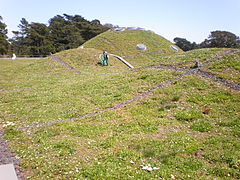 Gardener reveals scale of the roof landscape
 -
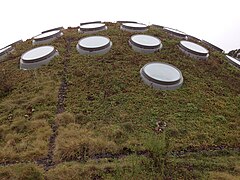 Native vegetation, during the dry season
 -
 Roofscape resembles a hilly meadow
 -
 Overhead solar cells shade the entry facade
 -
 Solar cells, viewed from outdoors visitor waiting area
 -
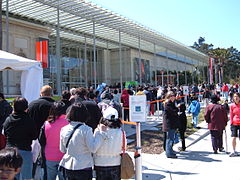 Visitor line on a monthly free admission day
 -
 Rainforests of the World enclosure
 -
 Interior of Rainforests of the World
 -
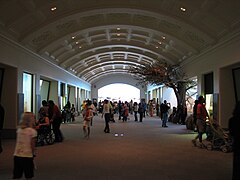 African Hall
 -
 Exhibits on climate change
 -
 Exhibit about evolution
 -
 Nature resource center
 -
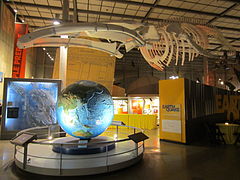 Whale skeleton above large raised relief globe
 -
 Nature Hacking Playshop
 -
 Steinhart Aquarium
 -
 Philippine coral reef tank
 -
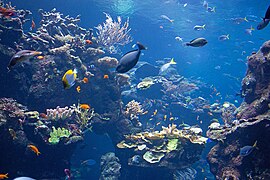 Part of the Philippine coral reef
 -
 Giant clams in reef shallows

.jpg)


.jpg)


_-_22.JPG)
_-_32.JPG)
.jpg)


.jpg)
See also[edit]

References[edit]
- ^ "Largest Bay Area Museums". San Francisco Business Times. 25 August 2017. Archived from the original on 20 March 2023. Retrieved 23 March 2018.
- ^ a b c d e DiFeliciantonio, Chase (2020-05-27). "California Academy of Sciences announces layoffs, furloughs, pay cuts affecting hundreds". SFChronicle.com. Archived from the original on 2020-05-29. Retrieved 2020-05-30.
- ^ a b c "Institute of Biodiversity and Sustainability Science". California Academy of Sciences. Archived from the original on March 24, 2019. Retrieved Mar 25, 2019.
- ^ "Academy History". California Academy of Sciences. Archived from the original on January 16, 2013. Retrieved May 6, 2013.
- ^ Wollan, Maria (September 24, 2008). "Academy of Sciences reopens with green theme". NBC News. Associated Press. Archived from the original on May 6, 2013. Retrieved May 6, 2013.
- ^ a b "Getting Here". California Academy of Sciences. Archived from the original on 8 September 2023. Retrieved 8 September 2023.
- ^ "Board of Trustees". Archived from the original on 2017-07-27. Retrieved 2015-04-23.
- ^ "The Academy Fellows" (PDF). Archived (PDF) from the original on 2017-09-23. Retrieved 2015-04-23.
- ^ Fellows of the California Academy of Sciences Archived 2017-07-05 at the Wayback Machine.
- ^ "Academy Leadership". Archived from the original on 2017-07-27. Retrieved 2015-04-23.
- ^ "Institute for Biodiversity Science and Sustainability". Archived from the original on 2017-07-12. Retrieved 2015-04-23.
- ^ "Rainforest of the World Species List" (PDF). California Academy of Sciences. 2010. Archived from the original (PDF) on 2016-03-04. Retrieved 2014-02-21.
- ^ "Exhibits". California Academy of Sciences. Archived from the original on April 3, 2013. Retrieved May 6, 2013.
- ^ "California Academy of Sciences community education programs". Archived from the original on 2017-07-05. Retrieved 2015-04-23.
- ^ a b "Institute for Biodiversity Science and Sustainability". California Academy of Sciences. Archived from the original on 5 February 2019. Retrieved 30 December 2013.
- ^ Olney, Jennifer (June 23, 2011). "Academy researchers make underwater discoveries". KGO-TV. Archived from the original on 31 December 2013. Retrieved 30 December 2013.
- ^ "Scientific Publications". California Academy of Sciences. Archived from the original on 15 October 2013. Retrieved 30 December 2013.
- ^ Bernstein, Leonard; Winkler, Alan; Zierdt-Warshaw, Linda (1996-01-01). Multicultural women of science: three centuries of contributions : with hands-on activities and exercises for the school year. Maywood, NJ.: Peoples Pub. Group. ISBN 1562567020. OCLC 34735963.
- ^ James, Matthew J. (September 15, 2010). "Collecting Evolution: The Vindication of Charles Darwin by the 1905-06 Galapagos Expedition of the California Academy of Sciences" (PDF). Proceedings of the California Academy of Sciences. 61 (Supplement II): 197–210. Archived from the original (PDF) on March 20, 2014. Retrieved May 6, 2013.
- ^ James, Matthew J. "The boat, the bay, and the museum" (PDF). Routledge, London. Archived (PDF) from the original on March 30, 2014. Retrieved March 30, 2014.
- ^ "What is the California Academy of Sciences?". Wisegeek.net. 2013-10-29. Archived from the original on 2018-11-06. Retrieved 2013-11-06.
- ^ "A Bridge Between: California Academy of Sciences and Steinhart Aquarium Transition Facility by Melander Architects". ArchNewsNow. Archived from the original on 4 March 2016. Retrieved 17 December 2015.
- ^ Perlman, David (September 28, 2008). "Mile-long line for Academy of Sciences opening". San Francisco Chronicle. Archived from the original on June 19, 2012. Retrieved May 6, 2013.
{{cite news}}: CS1 maint: bot: original URL status unknown (link) - ^ Lobo, Daniel. "ULI awards for excellence: winners through the years". Urban Land Institute. Archived from the original on April 1, 2013. Retrieved May 6, 2013.
- ^ Rochon, Lisa (October 6, 2005). "Quelle surprise! Uber-building shutout; A low-income housing project in Montreal has won a prestigious prize". The Globe and Mail. Toronto. p. R3.
- ^ Ouroussoff, Nicolai (September 23, 2008). "A building that blooms and grows, balancing nature and civilization". The New York Times. Archived from the original on March 22, 2012. Retrieved May 6, 2013.
- ^ "New California Academy of Sciences receives highest possible rating from U.S. Green Building Council: LEED Platinum". California Academy of Sciences (Press release). October 8, 2008. Archived from the original on January 16, 2013. Retrieved May 6, 2013.
- ^ "California Academy of Sciences". Extreme Engineering. Season 5. Episode 5. November 8, 2006. Discovery Channel. Archived from the original on April 18, 2016. Retrieved May 6, 2013.
- ^ "Hi-Tech Museum". Man-Made. Season 1. Episode 11. July 17, 2008. National Geographic Channel. Archived from the original on July 25, 2008.
- ^ Simons, Eric (September–October 2008). "Concrete and strawberries". California Magazine. University of California Alumni Association: 52–53. Archived from the original on February 29, 2012. Retrieved May 6, 2013.
- ^ Chino, Mike (September 22, 2008). "The new green California Academy of Sciences unveiled!". inhabit: design will save the world. Archived from the original on April 2, 2013. Retrieved May 6, 2013.
Further reading[edit]
- "Natural Phenomenon", by Matt Tyrnauer, Vanity Fair, May 2008
- Cutting Edge Construction—National Geographic Channel
- "Concrete and Strawberries" Archived 2008-09-14 at the Wayback Machine, California magazine, September 2008
- "Beyond Green", California Home + Design, September 2008
- "A Look at the Cal Academy of Sciences of 1891–1906". Bearings (blog). 16 July 2009. Retrieved 2009-07-19.
External links[edit]
 Media related to California Academy of Sciences at Wikimedia Commons
 California Academy of Sciences travel guide from Wikivoyage
- Official website
- Calacademy.org: PDFs on national media reports of Academy's construction
- California Academy of Sciences at Google Cultural Institute
- ASLA 2009 Design Award


| International | |
|---|---|
| National | |
| Geographic | |
| Other | |

- California Academy of Sciences
- 1853 establishments in California
- 2000s architecture in the United States
- Association of Science-Technology Centers member institutions
- Buildings and structures burned in the 1906 San Francisco earthquake
- Buildings and structures completed in 2008
- Expressionist architecture
- Futurist architecture
- Golden Gate Park
- Institutions accredited by the American Alliance of Museums
- Museums in San Francisco
- Natural history museums in California
- Organizations established in 1853
- Ove Arup buildings and structures
- Planetaria in the United States
- Postmodern architecture in California
- Renzo Piano buildings
- Science and technology in the San Francisco Bay Area
- Science museums in California