


Kütahya
Kütahya | |
|---|---|
 Kütahya view | |
 Logo | |
  Kütahya Location in Turkey  Kütahya Kütahya (Turkey Aegean) | |
| Coordinates: 39°25′N 29°59′E / 39.417°N 29.983°E | |
| Country | Turkey |
| Province | Kütahya |
| District | Kütahya |
| Government | |
| • Mayor | Eyüp Kahveci[1] (CHP) |
| Elevation | 970 m (3,180 ft) |
| Population (2022)[2] | 263,863 |
| Time zone | UTC+3 (TRT) |
| Postal code | 43000 |
| Area code | 0274 |
| Website | www |
Kütahya (Turkish pronunciation: [cyˈtahja]; historically, Cotyaeum or Kotyaion; Greek: Κοτύαιον) is a city in western Turkey which lies on the Porsuk River, at 969 metres above sea level. It is the seat of Kütahya Province and Kütahya District.[3] Its population is 263,863 (2022).[2] The region of Kütahya has large areas of gentle slopes with agricultural land culminating in high mountain ridges to the north and west.
History[edit]
Ancient Greece, Rome, and Byzantium[edit]


The ancient world knew present-day Kütahya as Cotyaeum (Κοτύαιον). It became part of the Roman province of Phrygia Salutaris,[4] but in about 820 became the capital of the new province of Phrygia Salutaris III.
Church history[edit]
Its bishopric thus changed from being a suffragan of Synnada to a metropolitan see, although with only three suffragan sees according to the Notitia Episcopatuum of Byzantine Emperor Leo VI the Wise (886-912), which is dated to around 901–902.[5] According to the 6th-century historian John Malalas, Cyrus of Panopolis, who had been prefect of the city of Constantinople, was sent there as bishop by Emperor Theodosius II (408-50), after four bishops of the city had been killed. (Two other sources make Cyrus bishop of Smyrna instead.[citation needed]) The bishopric of Cotyaeum was headed in 431 by Domnius, who attended the Council of Ephesus, and in 451 by Marcianus, who was at the Council of Chalcedon. A source cited by Le Quien says that a bishop of Cotyaeum named Eusebius was at the Second Council of Constantinople in 553. Cosmas was at the Third Council of Constantinople in 680–681. Ioannes, a deacon, represented an unnamed bishop of Cotyaeum at the Trullan Council in 692. Bishop Constantinus was at the Second Council of Nicaea in 692, and Bishop Anthimus at the Photian Council of Constantinople (879),[6][7][8] No longer a residential bishopric, Cotyaeum is today listed by the Catholic Church as a titular see.[9]
Justinian fortifications[edit]
Under the reign of Byzantine Emperor Justinian I the town was fortified with a double-line of walls and citadel.
Seljuk, Crusader and Ottoman periods[edit]
Political history, 11th century-1867[edit]
In 1071 Cotyaeum (or Kotyaion) briefly fell to the Seljuk Turks, later being recaptured by the Byzantine’s. It was again captured by the Seljuks in the 1180’s and changed hands several more times, being captured by the Germiyanids, Timur-Leng (Tamerlane), until finally being incorporated into the Ottoman Empire in 1428.[10] It was initially the center of Anatolia Eyalet till 1827, when the Hüdavendigâr Eyalet was formed. It was later center of the sancak within the borders of the Hüdavendigâr Vilayet in 1867. Troops of Ibrahim Pasha of Egypt briefly occupied it in 1833.
Armenian ceramics[edit]
During this time a large number of Christian Armenians settled in Kotyaion/Kütahya, where they came to dominate the tile-making and ceramic-ware production.[11] Kütahya emerged as a renowned center for the Ottoman ceramic industry, producing tiles and faience for mosques, churches, and official buildings in places all over the Middle East.[12] The craft industry of Armenian ceramics in Jerusalem was started by Armenian ceramicist David Ohannessian, master of a Kütahya workshop between 1907 and 1915, who was deported from Kütahya in early 1916, during the Armenian genocide, and rediscovered, living as a refugee in Aleppo in 1918, by Sir Mark Sykes, a former patron. Sykes connected him to the new military governor of Jerusalem, Sir Ronald Storrs, and arranged for Ohannessian to travel to Jerusalem to participate in a planned British restoration of the Dome of the Rock.[13]
Today two families originating from Kutahya, the Balian and Karakashian families continue the tradition of Armenian Ceramics in East Jerusalem. The Balian studio is known underthe name the Armenian Ceramics -Balian adn that is where the late Marie Balian transformed the art of ceramic tile murals to a muchh higher level of art than imagined.
Fortifications[edit]
The fortifications of the city and its environs, which were vital to the security and economic prosperity of the region, were built and rebuilt from antiquity through the Ottoman period.[14] However, the dates assigned to the many periods of construction and the assessment of the military architecture are open to various interpretations.[15]
Late 19th-early 20th century history[edit]
At the end of the nineteenth century the population of the kaza of Kütahya numbered 120,333, of which 4,050 were Greeks, 2,533 Armenians, 754 Catholics, and the remainder Turks and other Muslim ethnicities.[16] Kütahya and the district itself were spared the ravages of the Armenian genocide of 1915, when the Ottoman governor, Faruk Ali Bey, went to extreme lengths to protect the Armenian population from being uprooted and sent away on death marches.[16] However, Faruk Ali Bey was removed from office in March 1916, and the city's Armenian community suffered in the aftermath under the rule of his successor, Ahmet Mufti Bey. Kütahya was occupied by the Greek Army on 17 July 1921 after Battle of Kütahya–Eskişehir during the Turkish War of Independence and was then captured in ruins by the Turkish Army after the Battle of Dumlupınar during the Great Offensive on 30 August 1922.[17][18]
Economy[edit]

.jpg)

The industries of Kütahya have long traditions, going back to ancient times.
Kütahya is famous for its kiln products, such as tiles and pottery, which are glazed and multicoloured.[19] Modern industries are sugar refining, tanning, nitrate processing and different products of meerschaum, which is extracted nearby.
In the Ottoman period, Kütahya was a major cotton production center of the empire.[20] Modern local agricultural industry produces cereals, fruits and sugar beet. In addition stock raising is of much importance. Not far from Kütahya there are important mines extracting lignite.
Kütahya is linked by rail and road with Balıkesir 250 km (155 mi) to the west, İstanbul 360km to the northwest, Konya 450 km (280 mi) to the southeast, Eskişehir 70 km (43 mi) northeast and Ankara 300 km (186 mi) east.
Traditional ceramics[edit]
A small ewer, now in the British Museum, gave its name to a category of similar blue and white fritware pottery known as 'Abraham of Kütahya ware'. It has an inscription in Armenian script under the glaze on its base stating that it commemorated Abraham of Kütahya with a date of 1510.[21] In 1957 Arthur Lane published an influential article in which he reviewed the history of pottery production in the region and proposed that 'Abraham of Kütahya' ware was produced from 1490 until around 1525, 'Damascus' and 'Golden Horn' ware were produced from 1525 until 1555 and 'Rhodian' ware from around 1555 until the demise of the İznik pottery industry at the beginning of the 18th century. This chronology has been generally accepted.[22]
Climate[edit]
Kütahya has a warm-summer Mediterranean climate (Köppen climate classification: Csb), or a temperate continental climate (Trewartha climate classification: Dc), with chilly, wet, often snowy winters and warm, dry summers. Precipitation occurs mostly during the winter and spring, but can be observed throughout the year.
| Climate data for Kütahya (1991–2020, extremes 1929–2020) | |||||||||||||
|---|---|---|---|---|---|---|---|---|---|---|---|---|---|
| Month | Jan | Feb | Mar | Apr | May | Jun | Jul | Aug | Sep | Oct | Nov | Dec | Year |
| Record high °C (°F) | 17.1 (62.8) |
24.2 (75.6) |
27.0 (80.6) |
30.2 (86.4) |
34.3 (93.7) |
36.2 (97.2) |
39.5 (103.1) |
38.8 (101.8) |
38.4 (101.1) |
31.9 (89.4) |
25.4 (77.7) |
21.7 (71.1) |
39.5 (103.1) |
| Mean daily maximum °C (°F) | 5.1 (41.2) |
7.7 (45.9) |
11.8 (53.2) |
16.8 (62.2) |
21.9 (71.4) |
25.9 (78.6) |
29.2 (84.6) |
29.4 (84.9) |
25.4 (77.7) |
19.7 (67.5) |
13.2 (55.8) |
6.8 (44.2) |
17.7 (63.9) |
| Daily mean °C (°F) | 0.6 (33.1) |
2.3 (36.1) |
5.8 (42.4) |
10.2 (50.4) |
15.0 (59.0) |
18.8 (65.8) |
21.6 (70.9) |
21.6 (70.9) |
17.4 (63.3) |
12.4 (54.3) |
6.6 (43.9) |
2.4 (36.3) |
11.2 (52.2) |
| Mean daily minimum °C (°F) | −2.7 (27.1) |
−1.8 (28.8) |
0.8 (33.4) |
4.4 (39.9) |
8.6 (47.5) |
12.0 (53.6) |
14.5 (58.1) |
14.7 (58.5) |
10.4 (50.7) |
6.7 (44.1) |
2.0 (35.6) |
−0.7 (30.7) |
5.7 (42.3) |
| Record low °C (°F) | −26.3 (−15.3) |
−27.4 (−17.3) |
−16.6 (2.1) |
−7.8 (18.0) |
−2.8 (27.0) |
0.5 (32.9) |
2.6 (36.7) |
−0.2 (31.6) |
−3.9 (25.0) |
−6.9 (19.6) |
−11.0 (12.2) |
−28.1 (−18.6) |
−28.1 (−18.6) |
| Average precipitation mm (inches) | 64.2 (2.53) |
53.3 (2.10) |
53.0 (2.09) |
52.8 (2.08) |
57.5 (2.26) |
43.6 (1.72) |
19.2 (0.76) |
24.6 (0.97) |
26.7 (1.05) |
43.2 (1.70) |
45.3 (1.78) |
67.2 (2.65) |
550.6 (21.68) |
| Average precipitation days | 12.47 | 11.30 | 11.67 | 12.30 | 12.73 | 8.90 | 3.83 | 4.57 | 6.00 | 8.80 | 8.70 | 11.80 | 113.1 |
| Mean monthly sunshine hours | 68.2 | 98.9 | 145.7 | 189.0 | 229.4 | 273.0 | 319.3 | 297.6 | 225.0 | 161.2 | 114.0 | 65.1 | 2,186.4 |
| Mean daily sunshine hours | 2.2 | 3.5 | 4.7 | 6.3 | 7.4 | 9.1 | 10.3 | 9.6 | 7.5 | 5.2 | 3.8 | 2.1 | 6.0 |
| Source: Turkish State Meteorological Service[23] | |||||||||||||
Culture[edit]
Kütahya's old neighbourhoods are dominated by traditional Ottoman houses made of wood and stucco, some of the best examples being found along Germiyan Caddesi. It has many historical mosques such as Ulu Camii, Cinili Camii, Balikli Camii and Donenler Camii. The Şengül Hamamı is a famous Turkish bath located in the city
The town preserves some ancient ruins, a Byzantine castle and church. During late centuries Kütahya has been renowned for its Turkish earthenware, of which fine specimens may be seen at the national capital. The Kütahya Museum has a fine collection of arts and cultural artifacts from the area, the house where Hungarian statesman Lajos Kossuth lived in exile between 1850 and 1851 is preserved as a museum.[1] Archived 2011-07-21 at the Wayback Machine
-
 Kütahya Old houses in Sultanbağı region
 -
 Kütahya Old houses in Sultanbağı region
 -
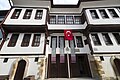 Kütahya City Museum
 -
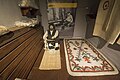 Kütahya City Museum Felt maker
 -
 Kütahya City Museum Saddle maker
 -
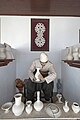 Kütahya City Museum Biscuit maker
 -
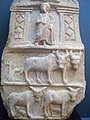 Kütahya archaeological museum Stele
 -
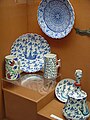 Kutahya Ceramics museum
 -
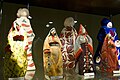 Kutahya Ceramics museum Figurines
 -
 Kütahya Lajos Kossuth house
 -
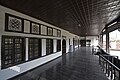 Kütahya Lajos Kossuth house
 -
 Kütahya Ulu Cami
 -
 Kutahya Dönenler Mosque
 -
 Kütahya Dönenler Mosque
 -
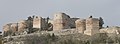 Kütahya Castle Hill


Education[edit]

The Main Campus and the Germiyan Campus of the Kütahya Dumlupınar University are located in the city.
Transport[edit]
.JPG)
The main bus station has bus links to most major Turkish cities. Zafer Airport is active. Kütahya is also the main railroad endpoint for the Aegean region.
International relations[edit]
Kütahya is twinned with:


Notable people[edit]
- Alexander of Cotiaeum (c.70-80CE – c.150CE), Greek grammarian
- Evliya Çelebi (1611–1682), traveler and author.
- Komitas (1869–1935), Armenian composer, musicologist
- Âsım Gündüz (1889–1970), military officer in Ottoman and Turkish armies
- Hisarlı Ahmet (1908–1984), ashik (folk poet-singer)
- Mustafa Kalemli (born 1943), politician
- Ayla Dikmen (1944–1970), singer
- Abdullah Aymaz (born 1949), writer, journalist
- Aydilge Sarp (born 1979), singer
- Halil Akkaş (born 1983), middle-distance runner
- Özge Kırdar (born 1985), volleyball player
- Veli Kızılkaya (born 1985), football player
- Danla Bilic (born 1994), internet personality
- Hande Baladın (born 1997), volleyball player
See also[edit]
- Aizanoi, nearby ancient city
- Anatolian Tigers
- Evliya Çelebi Way
- Iznik pottery, ceramics style known from Iznik and Kütahya
- Kumari (Kutahya)
Gallery[edit]
-
 Rüstem Pasha Madrasa
 -
 Tiled Mosque
 -

-
 Mother Sultan
 -
 Kütahya Castle
 -
 Government House
 -
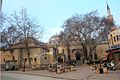 Grand Mosque


References[edit]
- ^ "Kütahya Seçim Sonuçları: 31 Mart 2024". Sözcü (in Turkish). Retrieved 9 April 2024.
- ^ a b "Address-based population registration system (ADNKS) results dated 31 December 2022, Favorite Reports" (XLS). TÜİK. Retrieved 22 May 2023.
- ^ İl Belediyesi, Turkey Civil Administration Departments Inventory. Retrieved 22 May 2023.
- ^ Heinrich Gelzer, Ungedruckte und ungenügend veröffentlichte Texte der Notitiae episcopatuum, in: Abhandlungen der philosophisch-historische classe der bayerische Akademie der Wissenschaften, 1901, p. 540, nº 338.
- ^ Gelzer, op. cit., p. 559, nnº 650-653.
- ^ Le Quien, Michel (1740). Oriens Christianus, in quatuor Patriarchatus digestus: quo exhibentur ecclesiæ, patriarchæ, cæterique præsules totius Orientis. Tomus primus: tres magnas complectens diœceses Ponti, Asiæ & Thraciæ, Patriarchatui Constantinopolitano subjectas (in Latin). Paris: Ex Typographia Regia. coll. 851-852. OCLC 955922585.
- ^ Raymond Janin, v. Cotyaeum, in Dictionnaire d'Histoire et de Géographie ecclésiastiques, vol. 13, Paris 1956, coll. 938-940
- ^ Pius Bonifacius Gams, Series episcoporum Ecclesiae Catholicae, Leipzig 1931, p. 447
- ^ Annuario Pontificio 2013 (Libreria Editrice Vaticana 2013 ISBN 978-88-209-9070-1), p. 875.
- ^ "History of Kutahya".
- ^ Hovannisian, Richard G. and Armen Manuk-Khaloyan, "The Armenian Communities of Asia Minor," in Armenian Communities of Asia Minor, ed. Richard G. Hovannisian. UCLA Armenian History and Culture Series: Historic Armenian Cities and Provinces, 13. Costa Mesa, CA: Mazda Publishers, 2014, pp. 32-34.
- ^ See Dickran Kouymjian, "The Role of Armenian Potters of Kutahia in the Ottoman Ceramic Industry," in Armenian Communities of Asia Minor, pp. 107-30.
- ^ Moughalian, Sato. Feast of Ashes: The Life and Art of David Ohannessian. Stanford, CA: Redwood Press, 2019.
- ^ Foss, Clive (1985). Survey of the Medieval Castles of Anatolia: Kütahya. Oxford, U.K.: BAR. pp. 12ff.
- ^ Edwards, Robert W., “Medieval Castles of Anatolia: Kütahya,” Speculum 62 (1987): pp. 675-680.
- ^ a b Hovannisian and Manuk-Khaloyan, "The Armenian Communities of Asia Minor," p. 34.
- ^ "Gamblers on Turkish Brink" (PDF).
- ^ "Kütahya". 11 January 2022.
- ^ Henry Glassie, Turkish Traditional Art Today Bloomington: Indiana University Press, 1993, pp. 435 ff.
- ^ Chen, Yuan Julian (11 October 2021). "Between the Islamic and Chinese Universal Empires: The Ottoman Empire, Ming Dynasty, and Global Age of Explorations". Journal of Early Modern History. 25 (5): 422–456. doi:10.1163/15700658-bja10030. ISSN 1385-3783. S2CID 244587800.
- ^ 'Abraham of Kütahya' ewer, British Museum Accession Code: G.1
- ^ Nurhan Atasoy; Julian Raby (1989). Yanni Petsopoulos (ed.). Iznik: The Pottery of Ottoman Turkey. London: Alexandria Press. ISBN 978-1-85669-054-6.
- ^ "Resmi İstatistikler: İllerimize Ait Mevism Normalleri (1991–2020)" (in Turkish). Turkish State Meteorological Service. Retrieved 1 May 2021.
Sources[edit]
 This article incorporates text from a publication now in the public domain: Herbermann, Charles, ed. (1913). "Cotiæum". Catholic Encyclopedia. New York: Robert Appleton Company.
External links[edit]


- The Government of Kütahya
- Province Culture And Tourism Directorate
- City of Tiles
- Pictures from Kütahya
- Kütahya weather forecast information
- Photos of ancient Roman city of Aizanoi in Kütahya
- Photos from another source of ancient Roman city of Aizanoi in Kütahya province
- A website about a nitrate processing factory in Kütahya
- A website about the sugar refinery facility in Kütahya
- Official website of Kütahya Ceramic Company
- Kütahya Photo Forum
| Municipalities | |
|---|---|
| Villages |
|


| International | |
|---|---|
| National | |
| Geographic | |
