


Goitered gazelle
 | This article needs additional citations for verification. (April 2017) |
| Goitered gazelle | |
|---|---|

| |
| Male of the Persian subspecies (G. s. subgutturosa) at Korkeasaari Zoo in Helsinki | |

| |
| Female goitered gazelle at the Shirvan National Park, Azerbaijan | |
Scientific classification 
| |
| Domain: | Eukaryota |
| Kingdom: | Animalia |
| Phylum: | Chordata |
| Class: | Mammalia |
| Order: | Artiodactyla |
| Family: | Bovidae |
| Subfamily: | Antilopinae |
| Tribe: | Antilopini |
| Genus: | Gazella |
| Species: | G. subgutturosa
|
| Binomial name | |
| Gazella subgutturosa (Güldenstädt, 1780)
| |
| Subspecies | |

| |
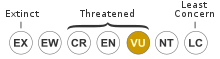
The goitered gazelle (Gazella subgutturosa) or black-tailed gazelle is a gazelle native to Turkey, Georgia, Azerbaijan, Iran, parts of Iraq and Pakistan, Afghanistan, Tajikistan, Kyrgyzstan, Uzbekistan, Turkmenistan, Kazakhstan and in northwestern China and Mongolia.[1] The specific name, meaning "full below the throat", refers to the male having an enlargement of the neck and throat during the mating season.
Distribution and habitat
[edit]The goitered gazelle inhabits sands and gravel plains and limestone plateau. Large herds were also present in the Near East. Some 6,000 years ago, they were captured and killed with the help of desert kites.[2] Rock art found in Jordan suggests that it was slaughtered ritually.[3]
Behaviour and ecology
[edit]Its mating behaviour is polygynous and usually occurs in the early winter.[4] It runs at high speed, without the leaping, bounding gait seen in other gazelle species. Throughout much of its range, the goitered gazelle migrates seasonally.[1] Herds cover 10–30 km (6.2–18.6 mi) per day in the winter, with these distances being reduced to about 1–3 km (0.62–1.86 mi) in summer.
Taxonomy
[edit]Several subspecies have been described, and four forms are distinguished, which used to be treated as separate monotypic species.[5] Gazella marica was traditionally recognised as a subspecies, but has been identified as a species in 2011.[6][1]
- Persian gazelle (Gazella (subgutturosa) subgutturosa) - southeastern Turkey, Azerbaijan, Georgia, Syria, northern and eastern Iraq, Iran, southern Afghanistan, western Pakistan
- Turkmen gazelle (Gazella (subgutturosa) gracilicornis) - Kazakhstan (Buzachi) in the east to about Lake Balkash, Turkmenistan, Tajikistan
- Yarkand gazelle (Gazella (subgutturosa) yarkandensis) - northern and northwestern China (Xinjiang, Qinghai, Shaanxi, Gansu, Nei Monggol), Mongolia; includes subspecies hilleriana.
Former subspecies
[edit].jpg)
- The Arabian sand gazelle (Gazella marica)[1] occurs in Saudi Arabia, southern Syria, southwestern Iraq, United Arab Emirates, Oman, offshore Persian Gulf islands.
Until recently, goitered gazelles were considered to represent a single, albeit polymorphic, species. However, recent genetic studies show one of the subspecies, G. s. marica, is paraphyletic in respect to the other populations of goitered gazelles,[6][7]
References
[edit]- ^ a b c d e IUCN SSC Antelope Specialist Group (2017). "Gazella subgutturosa". IUCN Red List of Threatened Species. 2017: e.T8976A50187422. doi:10.2305/IUCN.UK.2017-2.RLTS.T8976A50187422.en. Retrieved 19 November 2021.
- ^ Bar-Oz, G.; Zeder, M. & Hole, F. (2010). "Role of mass-kill hunting strategies in the extirpation of Persian gazelle (Gazella subgutturosa) in the northern Levant". Proceedings of the National Academy of Sciences. 108 (18): 7345–7350. doi:10.1073/pnas.1017647108. PMC 3088574. PMID 21502520.
- ^ Amos, J. (2011). "Gazelles caught in ancient Syrian 'killing zones'". BBC News. Retrieved 19 April 2011.
- ^ Xia, C.; Liu, W.; Xu, W.; Yang, W.; Xu, F. & Blank, D. (2014). "The energy-maintenance strategy of goitered gazelles Gazella subgutturosa during rut". Behavioural Processes. 103: 5–8. doi:10.1016/j.beproc.2013.10.009. PMID 24220795. S2CID 12173688.
- ^ Groves, C.P. & Leslie, D.M. Jr. (2011). "Family Bovidae (Hollow-horned Ruminants)". In Wilson, D.E. & Mittermeier, R.A. (eds.). Handbook of the Mammals of the World. Vol. Volume 2: Hooved Mammals. Lynx Edicions. pp. 585–588. ISBN 978-84-96553-77-4.
{{cite book}}: CS1 maint: location missing publisher (link) - ^ a b Wacher, T.; Wronski, T.; Hammond, R.L.; Winney, B.; Blacket, M.J.; Hundertmark, K.J.; Mohammed, O.B.; Omer, S.A.; Macasero, W.; Lerp, H.; Plath, M. & Bleidor, C. (2011). "Phylogenetic analysis of mitochondrial DNA sequences reveals polyphyly in the goitered gazelle (Gazella subgutturosa) although gene introgression is observed in the contact zone between the two species" (PDF). Conservation Genetics. 12: 827–831. doi:10.1007/s10592-010-0169-6. S2CID 40678328. Archived from the original (PDF) on 9 January 2012. Retrieved 17 February 2019.
- ^ Murtskhvaladze, M.; Gurielidze, Z.; Kopaliani, N. & Tarkhnishvili, D. (2012). "Gene introgression between Gazella subguturrosa and G. marica: limitations of maternal inheritance analysis for species identification with conservation purposes". Acta Theriologica. 12 (4): 827–831. doi:10.1007/s13364-012-0079-8. S2CID 17324903.
External links
[edit]

- Blank, David (2006), "Goitered gazelle (Gazella subgutturosa)", Wildscreen, archived from the original on 11 November 2013