


Bharal
| Bharal | |
|---|---|

| |
| Male bharal in Spiti Valley | |

| |
| Female bharal in North Sikkim | |
Scientific classification 
| |
| Domain: | Eukaryota |
| Kingdom: | Animalia |
| Phylum: | Chordata |
| Class: | Mammalia |
| Order: | Artiodactyla |
| Family: | Bovidae |
| Subfamily: | Caprinae |
| Tribe: | Caprini |
| Genus: | Pseudois Hodgson, 1846 |
| Species: | P. nayaur
|
| Binomial name | |
| Pseudois nayaur (Hodgson, 1833)
| |
.png)
| |
| Distribution of blue sheep; dwarf blue sheep range in darker blue | |
| Synonyms | |
|
Pseudois schaeferi Haltenorth, 1963 Pseudois nayaur schaeferi | |
The bharal (Pseudois nayaur), also called the blue sheep, is a caprine native to the high Himalayas. It is the only member of the genus Pseudois.[3] It occurs in India, Bhutan, China (in Gansu, Ningxia, Sichuan, Tibet, and Inner Mongolia), Myanmar, Nepal, and Pakistan.[1] The Helan Mountains of Ningxia have the highest concentration of bharal in the world, with 15 bharals per km2 and 30,000 in total.
Its native names include yanyang (岩羊) in Mandarin, bharal, barhal, bharar, and bharut in Hindi, na or sna in Tibetan and Ladakh, nabo in Spitian, naur in Nepali and na or gnao in Bhutan.[4] The bharal was also the focus of George Schaller and Peter Matthiessen's expedition to Nepal in 1973. Their personal experiences are well documented by Matthiessen in his book, The Snow Leopard. The bharal is a major prey of the snow leopard.
Description[edit]
These medium-sized caprids are 115 to 165 cm (45 to 65 in) long along the head-and-body, with a tail of 10 to 20 cm (3.9 to 7.9 in). They stand 69 to 91 cm (27 to 36 in) high at the shoulder. Body mass can range from 35 to 75 kg (77 to 165 lb). Males are slightly larger than females. Dense coat is slate grey in colour, sometimes with a bluish sheen. The underparts and backs of the legs are white, while the chest and fronts of the legs are black. Separating the grey back and white belly is a charcoal-colored stripe. The ears are small, and the bridge of the nose is dark. The horns are found in both sexes and are ridged on the upper surface. In males, they grow upwards, then turn sideways and curve backward, looking somewhat like an upside-down mustache. They may grow to a length of 80 cm (31 in). In females, the horns are much shorter and straighter, growing up to 20 cm (7.9 in) long.[5][6]
Taxonomy and evolution[edit]
- Chinese blue sheep, Pseudois nayaur szechuanensis
- Himalayan blue sheep, P. n. nayaur
- Helan Shan blue sheep, P. n. ssp.
Dwarf blue sheep[edit]

The dwarf blue sheep or dwarf bharal (formerly described as Pseudois schaeferi), also known as rong-na in Tibetan, was an alleged species of Pseudois endemic to Sichuan-Tibet in China. It apparently inhabited low, arid, grassy slopes of the upper Yangtze gorge in Batang County of the Sichuan Province, and a small part of the Tibet Autonomous Region. It was recorded as differing from the bharal primarily in size, with adult males weighing around 35 kg (77 lb) (half as much as the bharal), less sexual dimorphism occurring in the species, and females of the two species being very similar. Its coat was described as a steely grey with a silvery sheen, with darker general colouration than the bharal, and the horns of the male were smaller, thinner and more upright, with no inward curl. There were only 200 individuals estimated to be alive in 2000, which prompted the IUCN (classifying it as a subspecies of P. nayaur, as P. n. schaeferi) classified it as Endangered.[7][8]
However, a 2012 genetic analysis of Chinese bharal found no indication that it was either a distinct species or subspecies, instead finding to be a morphologically distinct variant of P. n. szechuanensis. The American Society of Mammalogists also follows these results, considering P. schaeferi to be conspecific with P. nayaur.[3][7]
Behaviour and ecology[edit]


.JPG)
Bharal are active throughout the day, alternating between feeding and resting on the grassy mountain slopes. Due to their excellent camouflage and the absence of cover in their environment, bharal remain motionless when approached. Once they have been noticed, however, they scamper up to the precipitous cliffs, where they once again freeze, using camouflage to blend into the rock face. Population densities in Nepal were found to be 0.9–2.7 animals per km2, increasing to a maximum of 10 animals in the winter, as herds congregate in valleys.[5] Bharal are mainly grazers, but during times of scarcity of grass, they switch to browsers, eating herbs and shrubs.[9] A high degree of diet overlap between livestock (especially donkeys) and bharal, together with density-dependent forage limitation, results in resource competition and a decline in bharal density.[10] Where they overlap, they are the favored prey of snow leopards, Himalayan wolves, and leopards, with a few lambs falling prey to foxes or eagles.[5]
Rutting behaviour[edit]
The rutting of the bharal starts towards late November and continues until mid-January. During the rut, male bharal use multiple strategies for mating, namely tending, blocking, and coursing.[11] Their lambs are born in late June and July.[citation needed]
Threats[edit]
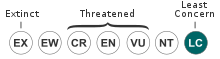
The bharal is categorised as Least Concern by the International Union for Conservation of Nature. The population faces threats - poaching for meat and competition with livestock. Poaching, however, is uncommon due to the unsuitable conditions of its habitat. Similarly, livestock do not generally frequent the mountainous regions where bharal occur; even if they do coexist, no notable detrimental effect on the bharal has been observed.[1]
Relationship with humans[edit]
Many Buddhist monasteries protect the bharal found around them, but lately,[when?] issues of crop damage caused by bharal have started to arise in areas such as the Spiti Valley.[citation needed]
References[edit]
- ^ a b c Harris, R.B. (2014). "Pseudois nayaur". IUCN Red List of Threatened Species. 2014: e.T61513537A64313015. doi:10.2305/IUCN.UK.2014-3.RLTS.T61513537A64313015.en. Retrieved 19 November 2021.
- ^ Wang, X.M.; Hoffmann, R.S. (1987). "Pseudois nayaur and Pseudois schaeferi". Mammalian Species (278): 1–6. doi:10.2307/3503993. JSTOR 3503993.
- ^ a b "Pseudois nayaur (Hodgson, 1833)". ASM Mammal Diversity Database. American Society of Mammalogists. Retrieved 2021-08-28.
- ^ Lydekker, R. (1900). The great and small game of India, Burma and Tibet, p 93,
- ^ a b c Bharal, Himalayan blue sheep Archived 2015-04-06 at the Wayback Machine. Ultimateungulate.com. Retrieved on 2012-08-23.
- ^ Smith, A. T., Xie, Y. (eds.) (2008) A Guide to the Mammals of China. Princeton University Press, Princeton Oxfordshire ISBN 0691099847.
- ^ a b Tan, Shuai; Zou, Dandan; Tang, Lei; Wang, Gaochao; Peng, Quekun; Zeng, Bo; Zhang, Chen; Zou, Fangdong (2012-06-01). "Molecular evidence for the subspecific differentiation of blue sheep (Pseudois nayaur) and polyphyletic origin of dwarf blue sheep (Pseudois schaeferi)". Genetica. 140 (4): 159–167. doi:10.1007/s10709-012-9667-4. ISSN 1573-6857. PMID 22821360. S2CID 17673293.
- ^ Huffman, B. & Harris, R. (2014). "Pseudois nayaur ssp. schaeferi". IUCN Red List of Threatened Species. 2014: e.T18535A64313668. doi:10.2305/IUCN.UK.2014-3.RLTS.T18535A64313668.en. Retrieved 19 January 2024.
- ^ Suryawanshi, K.; Bhatnagar, Y.V.; Mishra, C. (2010). "Why Should a Grazer Browse? Livestock impact on winter resource use by bharal Pseudois nayaur". Oecologia. 162 (2): 453–462. Bibcode:2010Oecol.162..453S. doi:10.1007/s00442-009-1467-x. PMID 19784849. S2CID 1486413.
- ^ Mishra, C.; Van Wieren, S. E.; Ketner, Pieter; Heitkonig, Ignas M. A.; Prins, Herbert H. T. (2004). "Competition between domestic livestock and wild bharal Pseudois nayaur in the Indian Trans-Himalaya". Journal of Applied Ecology. 41 (2): 344–354. Bibcode:2004JApEc..41..344M. doi:10.1111/j.0021-8901.2004.00885.x.
- ^ Lovari, Sandro; Som Ale (2001). "Are there multiple mating strategies in the blue sheep?". Behavioural Processes. 53 (1–2): 131–135. doi:10.1016/S0376-6357(00)00134-0. PMID 11255000. S2CID 7587862.
Further reading[edit]
- Namgail, Tsewang; Fox, Joseph L.; Bhatnagar, Yash Veer (2004). "Habitat segregation between sympatric Tibetan argali Ovis ammon hodgsoni and blue sheep Pseudois nayaur in the Indian Trans-Himalaya". Journal of Zoology. 262: 57–63. doi:10.1017/S0952836903004394. S2CID 59067250.
- Namgail, T., van Wieren, S.E., Mishra, C. & Prins, H.H.T. (2010). Multi-spatial co-distribution of the endangered Ladakh urial and blue sheep in the arid Trans-Himalayan Mountains. Journal of Arid Environments, 74:1162-1169.
- Namgail, T., Mishra, C., de Jong, C. B., van Wieren, S.E. & Prins, H.H.T. (2009). Effects of herbivore species richness on blue sheep niche dynamics and distribution in the Indian Trans-Himalaya. Diversity and Distributions, 15:940-947.
- Namgail, Tsewang (December 2001). Habitat selection and ecological separation between sympatric Tibetan argali and blue sheep in northern India (PDF) (Thesis). University of Tromso. hdl:10535/3567.
- Namgail, Tsewang (January 2006). "Winter Habitat Partitioning between Asiatic Ibex and Blue Sheep in Ladakh, Northern India". Journal of Mountain Ecology. 8: 7–13. S2CID 54699112.
- Shrestha, Rinjan; Wegge, PER (2008). "Wild sheep and livestock in Nepal Trans-Himalaya: Coexistence or competition?". Environmental Conservation. 35 (2): 125–136. Bibcode:2008EnvCo..35..125S. doi:10.1017/S0376892908004724. JSTOR 44521948. S2CID 58913300.
- Shrestha, Rinjan; Wegge, Per (June 2008). "Habitat relationships between wild and domestic ungulates in Nepalese Trans-Himalaya". Journal of Arid Environments. 72 (6): 914–925. Bibcode:2008JArEn..72..914S. doi:10.1016/j.jaridenv.2007.12.002.
- Shrestha, R., Wegge, P. & Koirala, R. A. (2005). Summer diets of wild and domestic ungulates in Nepal Himalaya. Journal of Zoology (London), 266: 111 – 119.
External links[edit]
 Media related to Pseudois nayaur at Wikimedia Commons
- Photos and further information
- Bharal at Animal Diversity Web
