


Maypole

A maypole is a tall wooden pole erected as a part of various European folk festivals, around which a maypole dance often takes place.
The festivals may occur on 1 May or Pentecost (Whitsun), although in some countries it is instead erected at Midsummer (20–26 June). In some cases, the maypole is a permanent feature that is only utilized during the festival, although in other cases it is erected specifically for the purpose before being taken down again.
Primarily found within the nations of Germanic Europe and the neighboring areas which they have influenced, its origins remain unknown. It has often been speculated that the maypole originally had some importance in the Germanic paganism of Iron Age and early Medieval cultures and that the tradition survived Christianisation, albeit losing any original meaning that it had. It has been a recorded practice in many parts of Europe throughout the Medieval and Early Modern periods, although it became less popular in the 18th and 19th centuries.[citation needed] Today, the tradition is still observed in some parts of Europe and among European communities in the Americas.
Symbolism[edit]

English historian Ronald Hutton concurs with Swedish scholar Carl Wilhelm von Sydow who stated that maypoles were erected "simply" as "signs that the happy season of warmth and comfort had returned."[1] Their shape allowed for garlands to be hung from them and were first seen, at least in the British Isles, between AD 1350 and 1400 within the context of medieval Christian European culture.[1] In 1588, at Holy Trinity Church in Exeter, villagers gathered around the 'summer rod' for feasting and drinking.[1] Chaucer mentions that a particularly large maypole stood at St Andrew Undershaft, which was collectively erected by church parishioners annually due to its large shape.[1]

The symbolism of the maypole has been continuously debated by folklorists for centuries, although no definitive answer has been found. Some scholars classify maypoles as symbols of the world axis (axis mundi). The fact that they were found primarily in areas of Germanic Europe, where, prior to Christianisation, Germanic paganism was followed in various forms, has led to speculation by some that the maypoles were in some way a relic of a Germanic pagan tradition. One theory holds that they were a remnant of the Germanic reverence for sacred trees, as there is evidence for various sacred trees and wooden pillars that were venerated by the pagans across much of Germanic Europe, including Thor's Oak and the Irminsul.[2] Ronald Hutton, however, states that "there is absolutely no evidence that the maypole was regarded as a reflection of it."[1] It is also known that, in Norse paganism, cosmological views held that the universe was a world tree, known as Yggdrasil.[3][4][5][6][7]
Some observers have proposed phallic symbolism, an idea which was expressed by Thomas Hobbes, who erroneously believed that the poles dated back to the Roman worship of the god Priapus. This notion has been supported by various figures since, including the psychoanalyst Sigmund Freud. Phallic symbolism has been attributed to the maypole in the later Early Modern period, as one sexual reference is in John Cleland's controversial novel Fanny Hill:
... and now, disengaged from the shirt, I saw, with wonder and surprise, what? not the plaything of a boy, not the weapon of a man, but a maypole of so enormous a standard, that had have proportions been observed, it must have belonged to a young giant.[8]
Ronald Hutton has stated, however, that "there is no historical basis for his claim and no sign that the people who used maypoles thought that they were phallic" and that "they were not carved to appear so."[1]
The anthropologist Mircea Eliade theorizes that the maypoles were simply a part of the general rejoicing at the return of summer, and the growth of new vegetation. In this way, they bore similarities with the May Day garlands which were also a common festival practice in Britain and Ireland.[9]
Regional traditions[edit]
Malta[edit]

Grand Master Marc'Antonio Zondadari introduced the game of cockaigne (with the use of the maypole) to Maltese Carnival in 1721: on a given signal, the crowd assembled in Palace Square converged on a collection of hams, sausages and live animals hidden beneath leafy branches outside the Main Guard. The provisions became the property of those who, having seized them, were able to carry them off.[10]
Germany and the former Austria-Hungary[edit]
_Maibaum.jpg)

In Germany and the formal Austro-Hungarian countries, the maypole (or Maibaum) is a tradition going back to the 16th century.[11] It is a decorated tree or tree trunk that is usually erected either on 1 May – in Baden and Swabia – or on the evening before, for example, in East Frisia. In most areas, especially in Baden-Württemberg, Bavaria, and Austria, it is usual to have a ceremony to erect the maypole on the village green. The custom of combining it with a village or town fete, which usually takes place on 30 April 1 May or at Pentecost (Whitsun), is widespread. This tradition is especially strong in the villages of the Bavarian Alps where the raising of the traditional maypole on 1 May in the village square is a cause for much celebration. The pole is usually painted in the Bavarian colors of white and blue and decorated with emblems depicting local crafts and industry. [citation needed] In Bavaria, the Maibaum is erected several weeks before 1 May. The young men from the villages try to steal the Maibaum from each other, which is why the men of each village or city take turns in watching over the Maibaum. If a village manages to steal a Maibaum, then the village the Maibaum has been stolen from has to invite the whole village of the thieves to free beer and a festivity, which then takes place on 1 May.
Just before the Maibaum is erected, depending on the region, there may be a procession through the village, usually ending up at a central place and/or restaurant and usually watched by crowds of spectators and accompanied by a brass band. The actual installation of the tree then takes place in the afternoon or evening. While the crowds usually while away the time drinking beer and eating sausages, the young men busy themselves with decorating the maypole to get the symbols of various trades representing the region into the right position. While the maypole is traditionally set up with the help of long poles, today it may sometime also be done using tractors, forklifts, or even cranes. In Lower Austria ropes and ladders are used.
In the Rhineland in and around Cologne, there exists a somewhat different maypole tradition. During the night before 1 May, unmarried men erect young birch trees in front of the houses of their sweethearts. These trees, which may reach five meters of height or more, are sold beforehand by local foresters. The men usually decorate them with multicolored crepe paper and often with a red heart of wood with the name of the girl written on it. During the month of May, many house-front gardens have such maypoles.
If the tree is erected on the eve of 1 May, then the event is usually followed by a May dance or Tanz in den Mai. Depending on local custom, the Maibaum may remain in place all year round or may be taken down at the end of May. The trunk may then be stored until the following year.
Hungary[edit]

In Hungary these were called Májusfa. They were danced around, usually decorated with a full bottle of wine, with hímestojás, flowers and ribbons. May Poles and similar decorated branches, collectively called Zöld ágak were believed to have magical properties. All of them were often put up as an ornament to bring good luck and protect against witches' witches, since it was generally believed by the Hungarians that they can be protected against with different types of weed and herbs.
The base was a tall tree stripped of its bark, with the foliage left only at the top(usually 12-15 meters), but it could also be a smaller tree or a large flowering, greenish branch. They also tried to personalise the trees, decorating them with small gifts, combs, mirrors but also thorny branches and rags, reflecting negative qualities.
Often it was only in front of the priest and judge's house that a tall May Pole was erected, but every girl had to have at least one branch. Usually each suitor would put one in the girl's garden. Often they would carve it out and write the boy's name on it. The cutting and wood delivery had to be done in secret, under the cover of night, so that the lady in question would not suspect anything. When the family saw the boys, if the girl liked the suitor, they invited them in to dinner and proudly left the tree in the garden.
In the morning, they compare who got the longer May Pole, try to guess who gave it to them and often, which envious lover has plucked the tree. Unlike other May Poles, in Hungary it was the length of the tree that mattered, which would ultimately convince the girls to go out with the men. This was a common form of rural flirting, similar to the Hajnalfa.
The lovers were always assisted by a (often drunken) courting team of similar boys. If two boys liked the same girl, after one team had erected the maypole, the other would secretly take it away and dig his own in its place.
On the last Sunday of May májusfa-kitáncolás, when they tore the pole down, while dancing one last time. The máj-kerék was placed on it that day, a wagon wheel on the end of a high pole, decorated with ribbons, wine bottles and linen scarves. Its placement was a metaphor for the fulfilment of a love affair. If the kitáncolás didn't happen that meant, the boy has abandoned his courtship. The ornaments of the wheel were raced to be taken down by the men climbing up the pole. Often, however, they would play tricks on each other by putting water with paprika in a bottle on top of the tree instead of wine. The winner was declared the King of Pentecost, the Judge Stag or the First Stag. During the demolition, young people dressed merely in green branches collected a "ransom", all around the village.
In addition to the love May Poles, there were also community May Poles in front of churches and pubs, around which they had fun until the evening.[12][13]
Nordic countries[edit]
 |
In Denmark, the maypole tradition is almost extinct but is still observed on the islands of Avernakø and Strynø south of Funen and in a few villages in southern Himmerland in eastern Jutland. The Maypole is generally referred to as a majtræ, meaning "May tree".[citation needed]

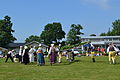
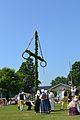
In Sweden and Swedish-speaking parts of Finland, the maypole is usually called a midsummer pole, (midsommarstång), as it appears at the Midsummer celebrations, although the literal translation majstång also occurs, where the word maj refers to the Old Swedish word maja which means dress, and not the month of May. The traditions surrounding the maypoles vary locally, as does the design of the poles, although the design featuring a cross and two rings is most common nowadays. A perhaps more original incarnation is the one still in use in the Swedish landscape of Småland, where the pole carries a large horizontally suspended ring around it, hanging from ropes attached at the top of the pole. This perhaps more original form of course strongly reinforces the procreation symbolism. The cross-arm may be a latter-day attempt to Christianize the pagan symbol into the semblance of a cross, although not completely successful. [citation needed] Common in all of Sweden are traditional ring dances, mostly in the form of dances where participants alternate dancing and making movements and gestures based on the songs, such as pretending to scrub laundry while singing about washing, or jumping as frogs during the song Små grodorna ("The little frogs"). Ring dancing is mostly popular with small children. The central part played by young children in the celebration emphasizes the procreation aspect of the celebration. Yet another pointer in this direction is the custom that young maidens expect to dream of their future mate if they pick seven different flowers and place them under their pillow when they go to bed on this day only.[citation needed]
- Erection of midsommarstång, Sölvesborg 2013
-
-

-

-

-


Belgium[edit]

In Belgium, the Maypole is called Meiboom or Meyboom in Dutch. Hasselt erects its Meiboom on 30 April. In Brussels and Leuven, the Meyboom is traditionally erected on 9 August before 5 pm. The planting of the Meyboom is the cause of a friendly rivalry between the two cities, dating back to 1213. In that year, a brawl broke out between Leuven and Brussels which saw the latter victorious. To commemorate this event, the city of Brussels was granted, almost 100 years later, the eternal right by John III, Duke of Brabant to erect a Meyboom, but only if they managed to do this every year on 9 August before 5 pm.
The first attempt by Leuven to steal the tree in 1939 was stopped by the police.[14] In 1974 however, a group of Leuven men found out which tree was chosen by Brussels as that year's Meyboom. During the night of 8 August, the tree was cut down and transported to Leuven where it was erected in front of the City Hall. Ever since Leuven claims ownership of the only official Meyboom.[15] Brussels, however, denies having lost the right, as another tree was cut down and put up before 5 pm on 9 August.
It is also customary, mostly in the Dutch-speaking region of Belgium, to place a branch (also called a Meiboom) on the highest point of a building under construction.[16] The erection of the branch is often cause for celebration by both the workmen and the neighbors.
United Kingdom[edit]
.jpg)
In the United Kingdom, the maypole was found primarily in England and in areas of the Scottish Lowlands and Wales which were under English influence. However, the earliest recorded evidence comes from a Welsh poem written by Gryffydd ap Adda ap Dafydd in the mid-14th century, in which he described how people used a tall birch pole at Llanidloes, central Wales.[17] Literary evidence for maypole use across much of Britain increases in later decades, and "by the period 1350–1400 the custom was well established across southern Britain, in town and country and in both Welsh-speaking and English-speaking areas."[17]

The practice became increasingly popular throughout the ensuing centuries, with the maypoles becoming "communal symbols" that brought the local community together – in some cases, poorer parishes would join up with neighboring ones in order to obtain and erect one, whilst in other cases, such as in Hertfordshire in 1602 and Warwickshire in 1639, people stole the poles of neighboring communities, leading to violence. In some cases the wood for the pole was obtained illegally, for instance in 1603, the earl of Huntingdon was angered when trees were removed from his estates for use as maypoles without his permission.[18]

The rise of Protestantism in the 16th century led to increasing disapproval of maypoles and other May Day practices from various Protestants who viewed them as idolatry and therefore immoral. Under the reign of Edward VI in England and Wales, Protestant Anglicanism was declared to be the state religion, and under the Reformation many maypoles, such as the famous Cornhill maypole of London, were destroyed; however when Mary I ascended the throne after Edward's death, she reinstated Roman Catholicism as the state faith, and the practice of maypoles was reinstated. Under later English monarchs, the practice was sporadic, being banned in certain areas, such as Doncaster, Canterbury, and Bristol, but continuing in many others, according to the wishes of the local governors. In Scotland meanwhile, which at this time was still an independent state, Protestantism, in the form of Presbyterianism, had taken a more powerful hold, and largely wiped out the practice of maypoles across the country.[19]
Royal support contributed to the outlawing of maypole displays and dancing during the English Interregnum. The Long Parliament's ordinance of 1644 described maypoles as "a Heathenish vanity, generally abused to superstition and wickedness."[20] The only recorded breach of the Long Parliament's prohibition was in 1655 in Henley-in-Arden, where local officials stopped the erection of maypoles for traditional games. Scholars suspect but have no way to prove, that the lack of such records indicates official connivance in the flouting of the prohibition. However, they are certain that the prohibition turned maypole dancing into a symbol of resistance to the Long Parliament and to the republic that followed it.[21]

The church of St Andrew Undershaft in the City of London is named after the maypole that was kept under its eaves and set up each spring until 1517 when student riots put an end to the custom. The maypole itself survived until 1547 when a Puritan mob seized and destroyed it as a "pagan idol".[citation needed]

When the Restoration occurred in 1660, common people in London, in particular, put up maypoles "at every crossway", according to John Aubrey. The largest was the Maypole in the Strand, near the current St Mary-le-Strand church. The maypole there was the tallest by far, reaching over 130 feet (40 m), and it stood until being blown over by a high wind in 1672 when it was moved to Wanstead in Essex and served as a mount for the telescope of Sir Isaac Newton.[21][22]
In the countryside, may dances and maypoles appeared sporadically even during the Interregnum, but the practice was revived substantially after the Restoration. By the 19th century, the maypole had been subsumed into the symbology of "Merry England". The addition of intertwining ribbons seems to have been influenced by a combination of 19th-century theatrical fashion[a] and visionary individuals such as John Ruskin in the 19th century. However, the maypole remained an anti-religious symbol to some theologians, as shown by "The Two Babylons", an anti-Catholic conspiracist pamphlet that first appeared in 1853.
As revived, the dance is performed by pairs of boys and girls (or men and women) who stand alternately around the base of the pole, each holding the end of a ribbon. They weave in and around each other, boys going one way and girls going the other and the ribbons are woven together around the pole until they meet at the base. There are also more complex dances for set numbers of (practiced) dancers (the May Queen dancing troupes) involving complicated weaves and unweaves, but they are not well known today. However, such dances are performed every Mayday around the permanent Maypole at Offenham, in Worcestershire. Temporary Maypoles are usually erected on village greens and events are often supervised by local Morris dancing groups.[citation needed]
In some regions, a somewhat different Maypole tradition existed: the carrying of highly decorated sticks. The sticks had hoops or cross-sticks or swags attached, covered with flowers, greenery, or artificial materials such as crepe paper. Children would take these hand-held poles to school on May Day morning and prizes may be awarded for the most impressive. This tradition is known as garlanding and was a central feature of Mayday celebrations in central and southern England until the mid-19th century. After that time, it began to be replaced by formally organized school-centered celebrations. It still occurs from place to place but is invariably a reinstatement of a local custom that had lapsed decades earlier.[citation needed]
In 1780, Kilmarnock Council, now in East Ayrshire, paid Robert Fraser 2s. 6d. for "dressing a Maypole", one of the last recorded examples of the rural festival of the first of May in Scotland, having been put down by Act of Parliament immediately after the Reformation in 1560.[25]
The tallest maypoles in Britain may be found in the villages of Nun Monkton, North Yorkshire (27 metres or 88 feet 5+1⁄4 inches),[26] Barwick-in-Elmet, West Yorkshire (26 metres or 86 feet),[27] Welford-on-Avon, Warwickshire (20 metres or 65 feet)[28] and Paganhill, Gloucestershire (18 metres or 60 feet; although a taller, post-WWI 'Memorial Pole' of 29.5m or 97 ft was previously erected in 1919, making it one of the tallest on record).[29]
Holywood in County Down, Northern Ireland has a maypole situated at the crossroads of Main Street and Shore Road/Church Road in the center of the town. It is the only Maypole in Ireland. Although the origin is uncertain, it is thought that the original maypole dates from the 18th century, when a Dutch ship ran aground offshore. The latest maypole was damaged and removed after a storm in February 2021. The remains were removed by Ards and North Down Borough Council and a replacement pole was ordered.[30]
United States[edit]


While not celebrated among the general public in the United States today, a Maypole dance nearly identical to that celebrated in the United Kingdom is an important part of May Day celebrations in local schools and communities.[31] Often the Maypole dance will be accompanied by other dances as part of a presentation to the public.
The earliest use of the Maypole in America occurred in 1628, when William Bradford, governor of New Plymouth, wrote of an incident where a number of servants, together with the aid of an agent, broke free from their indentured service to create their own colony, setting up a maypole in the center of the settlement, and behaving in such a way as to receive the scorn and disapproval of the nearby colonies, as well as an officer of the king, bearing patent for the state of Massachusetts. Bradford writes:
They also set up a May-pole, drinking and dancing about it many days together, inviting the Indian women, for their consorts, dancing and frisking together, (like so many fairies, or furies rather,) and worse practices. As if they had a new revived & celebrated the feasts of the Roman Goddess Flora, or the beastly practices of the madd Bacchinalians. Morton likewise (to shew his poetry) composed sundry rimes & verses, some tending to lasciviousness, and others to the detraction & scandal of some persons, which he affixed to this idle or idol May-pole. They changed also the name of their place, and instead of calling it Mount Wollaston, they call it Merie-mounted, as if this jollity would have lasted ever. But this continued not long, for after Morton was sent for England, shortly after came over that worthy gentleman, Mr. John Indecott, who brought a patent under the broad seal, for the government of Massachusetts, who visiting those parts caused the May-pole to be cutt downe, and rebuked them for their profanes, and admonished them to look there should be better walking; so they now, or others, changed the name of their place again, and called it Mount-Dagon.[32]

Governor Bradford's censure of the Maypole tradition played a central role in Nathaniel Hawthorne's fictional story "The Maypole of Merry Mount", published in 1837.
Italy[edit]
_-_Italy.jpg)
Maypole traditions can be found in some parts of Italy, such as in Veneto,[33] Friuli,[34] Umbria,[35] and Marche. In the last of these regions, the tradition dates back to the Napoleonic campaigns, when the arbre de la liberté (Liberty tree), the symbol of the French Revolution, arrived in Italy. Liberty trees were erected in the southern part of the region in Ripatransone and Ascoli Piceno. In 1889, the first congress of the Second International, met in Paris for the centennial of the French Revolution and the Exposition Universelle. A proposal by Raymond Lavigne, called for international demonstrations on the 1890 anniversary of the Chicago protests. After the institution of the International Workers' Day the maypole rite in the southern part of the March became a socialist ritual. At the top of the tree (poplar) appeared the red flag. In the second half of the 20th century, the rite of the maypole around Ascoli remained a rite of celebration of spring but it became also a political symbol of the peasant movement (mezzadri) that struggled against the landowners to have decent living conditions. Every year, even today, on the night of 30 April, in many villages of the zone like Appignano del Tronto, Arquata del Tronto, Ascoli Piceno, Castorano, Castignano, Castel di Lama, Colli del Tronto, Grottammare, Monsampolo del Tronto, Porchia (Montalto Marche), Monteprandone, Offida, Rotella, Spinetoli, San Benedetto del Tronto, citizens cut a poplar on which they put-up a red flag and the tree is erected in village squares or at crossroads.[36]
After we've gone to get the pole in thirty or forty people, we placed it like a six-month child. We walked in procession with this tree and not even a single leaf had to touch the ground. We had to raise it without making it touch the ground, holding it in our arms like a child. For us it was the saint of the 1st of May
— Quirino Marchetti (ancient peasant of San Benedetto del Tronto), [36]
The same ritual is known from Lamon, a village in the Dolomites in Veneto, which likely predates the Napoleonic period. Here, a number of quarters and hamlets erect a maypole in the form of a larch whose branches and bark are almost completely removed. Only the top branches are left. A red flag is normally attached, although Italian flags or flags of other countries (Colombia, Bolivia for example) or artists (Bob Marley) are also attested.[37] Around the maypole, quarters and hamlets give feasts with music, food, and alcohol which usually last until the dawn of 1 May. The Maypole is locally called 'Majo' (May in the local dialect).
Canada[edit]

In Canada, maypole dances are sometimes done as part of Victoria Day celebrations which occur in May.[38] In New Westminster, British Columbia, dancing around the maypole and May Day celebrations have been held for 149 years.[39]
In literature[edit]
Poet Jonathan Swift in his poem "A Maypole"[40] describes a maypole as:
Deprived of root, and branch, and rind,
Yet flowers I bear of every kind:
And such is my prolific power,
They bloom in less than half an hour;
"The May-Pole of Merry Mount" is a short story by Nathaniel Hawthorne.[41] It first appeared in The Token and Atlantic Souvenir in 1832. The story revolves around a young couple feeling the influence of nature who get betrothed in the presence of a Maypole and face Puritan ire.[42] Hawthorne based his story on events in colonial New England history, borrowing from a story of Thomas Mortan whose settlement opposed the rigid cultural and religious standards of the Plymouth colony Puritans.[43]
See also[edit]
- Axis Mundi
- Beltane
- Ceremonial pole
- Sacred trees and groves in Germanic paganism and mythology
- Walpurgis night
Notes[edit]
References[edit]
- ^ a b c d e f Hutton 1996, pp. 233–235
- ^ Jones, Prudence; Pennick, Nigel (1997). A History of Pagan Europe. Routledge. p. 119. ISBN 978-0-415-15804-6.
- ^ Foster, Theodore (July 1863). "Article VII: Sacred Trees and Flowers". Quarterly Review. 114 (227). John Murray: 224.
- ^ Washburn, Hopkins Edward (1928). The History of Religions. The MacMillan Company. p. 166. OCLC 22206140.
- ^ Dowden, Ken (2000). European Paganism. Routledge. p. 119. ISBN 978-0-415-12034-0.
- ^ Colarusso, John (2002). Nart sagas from the Caucasus: myths and legends from the Circassians, Abazas, Abkhaz, and Ubykhs. Princeton University Press. p. 102. ISBN 978-0-691-02647-3.
- ^ Fort, George Franklin (1881). The early history and antiquities of Freemasonry: as connected with ancient Norse guilds, and the oriental and mediæval building fraternities. Bradley. p. 361. OCLC 4894059.
- ^ Cleland, John (1985). Fanny Hill, or, Memoirs of a Woman of Pleasure. New York: Penguin Classics. ISBN 0-14-043249-3.
- ^ Hutton 1996, p. 234
- ^ Cilia, George (2012). "L-Arblu ta' Mejju". L-Imnara (in Maltese). 10 (1): 27, 28.
- ^ Steves, Rick (2008). Rick Steves' Germany and Austria 2008. Avalon Travel. p. 45. ISBN 978-1-59880-135-4.
- ^ "Májusfa, zöldfarsang, jakabág - tavaszi népszokásaink". kultura.hu (in Hungarian). 30 April 2020. Retrieved 29 March 2024.
- ^ "májusfa, májfa | Magyar néprajzi lexikon | Kézikönyvtár". www.arcanum.com (in Hungarian). Retrieved 29 March 2024.
- ^ "Meyboom". Brussels Tourism office. Retrieved 29 July 2018.
- ^ "De Meyboom stunt van 1974". Het Nieuwsblad (in Dutch). 8 August 2012. Archived from the original on 29 July 2018. Retrieved 29 July 2018.
- ^ "Meiboom op dak nieuw provinciehuis". Het Laatste Nieuws (in Dutch). 29 August 2017. Retrieved 29 July 2018.
- ^ a b Hutton 1996, p. 233
- ^ Hutton 1996, p. 235
- ^ Hutton 1996, p. 236
- ^ "An Ordinance for the better observation of the Lords-Day". 8 April 1644. Archived from the original on 28 September 2007. Retrieved 3 May 2007.
- ^ a b Hutton 1996, pp. 235–236
- ^ Harvey, Paul; Eagle, Dorothy, eds. (1967). "Maypole in the Strand". The Oxford Companion to English Literature. Oxford: Oxford University Press. pp. 528–529.
- ^ The Times (London, England), 4 February 1995, p. 19.
- ^ The Times (London, England), 29 November 1836, p. 3
- ^ Paterson, James (1863–1866). History of the Counties of Ayr and Wigton. Edinburgh: J. Stillie. p. 395.
- ^ "Nun Monkton Conservation Area Character Appraisal" (PDF). Harrogate Borough Council. p. 3. Archived from the original (PDF) on 19 October 2020. Retrieved 17 April 2020.
- ^ Smith, Harold. "Maypole Raising 30th May 2005". Barwick-in-Elmet Historical Society.
- ^ "Welford-Upon-Avon Maypole". 13 March 2023. Retrieved 13 March 2023.
- ^ "2004 Stroud 700th Anniversary Maypole". 13 March 2023. Retrieved 13 March 2023.
- ^ Beattie, Jilly (23 February 2021). "Holywood's maypole severely damaged in high winds".
- ^ Smith, Rick (2002). "A Decade of Maypole Dancing".
- ^ Bradford, William (1856). History of Plymouth Plantation. Boston: Little, Brown and Company. pp. 237–238.
- ^ "Sull'altopiano di Lamon torna l'antico rituale del Majo". Corriere delle Alpi (in Italian). 28 April 2017.
- ^ "Festa del Palo di Maggio" (in Italian). Regional Government of Friuli Venezia Giulia. Retrieved 3 May 2014.
- ^ "Alzata del palo di Maggio a San Pellegrino". Gira Italia (in Italian). InItalia.it Srl. Retrieved 3 May 2014.
- ^ a b Vagnarelli, Gianluca (2012). L'albero di maggio. Memoria e simbolismo politico di un rito laico (in Italian). ISML Ascoli Piceno.
- ^ "A Lamon l'antica tradizione del Majo". Corriere delle Alpi (in Italian). 2 May 2017.
- ^ "Victoria Day Maypole Dancers". Burnaby Village Museum. Archived from the original on 12 September 2014. Retrieved 11 September 2014.
- ^ "New Westminster's 149th May Day Celebration". City of New Westminster. Archived from the original on 25 May 2019.
- ^ – via Wikisource.
- ^ Bloom, Harold, ed. (2001). Nathaniel Hawthorne. Chelesea House Publishers. pp. 37–47. ISBN 0-7910-5949-9. Retrieved 2 May 2017.
- ^ Person, Leland S. (2007). The Cambridge Introduction to Nathaniel Hawthorne. Cambridge University Press. p. 9. ISBN 978-0-511-61099-8. Retrieved 2 May 2017.
the maypole of merry mount.
- ^ Joshua, Matthews (June 2013). Encyclopedia of American Literature (Third ed.). EPUB 2–3. ISBN 9781438140773. Retrieved 2 May 2017.
Sources[edit]
- Hutton, Ronald (1996). Stations of the Sun: A History of the Ritual Year in Britain. Oxford University Press. ISBN 9780198205708.
External links[edit]

- Barwick-in-Elmet Maypole Trust A triennial maypole festival held in the village of Barwick-in-Elmet, West Yorkshire.
- Maypole Dancing FAQ Frequently Asked Questions
- Traditional Maypole music and dances with references
- The tradition of the "red" maypole in Piceno (PDF)
- The fall and rise of the Barwick Maypole (film) Archived 8 March 2014 at the Wayback Machine
| Folk music by era | |
|---|---|
| Subgenres and fusions | |
| Dance forms |
|
| Song forms | |
| Instruments | |
| Regional traditions | |
| Related articles |
|

Anglo-Saxon paganism and mythology | |
|---|---|
| Gods and divine figures | |
| Heroic figures | |
| Other beings | |
| Locations | |
| Sources | |
| Society and culture | |
| Modern pagan revival | |

| International | |
|---|---|
| National | |
| Other | |
