


Ghost pepper
| Ghost pepper | |
|---|---|
 Red (ripe) and green ghost pepper fruits | |
| Hybrid parentage | Capsicum chinense × Capsicum frutescens |
| Origin | Bangladesh and India
|
| Heat |  Exceptionally hot Exceptionally hot |
| Scoville scale | 1,001,304 SHU |
The ghost pepper,[2][3] also known as bhut jolokia (lit. 'ghost pepper' in Bangla and Assamese[4]), is an interspecific hybrid chili pepper cultivated in Northeast India.[5][6] It is a hybrid of Capsicum chinense and Capsicum frutescens.[7]
In 2007, Guinness World Records certified that the ghost pepper was the world's hottest chili pepper, 170 times hotter than Tabasco sauce. The ghost chili is rated at more than one million Scoville Heat Units (SHUs) and far surpasses the amount of a cayenne pepper. However, in the race to grow the hottest chili pepper, the ghost chili was superseded by the Trinidad Scorpion Butch T pepper in 2011, the Carolina Reaper in 2013 and Pepper X in 2023.[8]
Terminology and regional names[edit]
The name bhüt jolokia (ভুট জলকীয়া) means 'Bhutanese pepper' in Assamese; the first element bhüt, meaning 'Bhutan', was mistakenly confused for a near-homonym bhut (ভুত) meaning 'ghost'.[9][10][11][12]
In Assam,[13] the pepper is also known as bih zôlôkia (বিহ জলকীয়া) meaning 'poison chili', from Assamese bih meaning 'poison' and zôlôkia meaning 'chili pepper', denoting the plant's heat.[14]
Similarly, in Nagaland, one of the regions of cultivation, the chili is called naga jolokia ('Naga chili'; also romanized nôga zôlôkia) and bhut jolokia (also romanized bhût zôlôkiya).[14] This name is especially common in other regions where it is grown, such as Assam and Manipur.[14] Other usages on the subcontinent are saga jolokia, 'Indian mystery chili' and 'Indian rough chili'.[14]
It has also been called the Tezpur chili after the Assamese city of Tezpur.[15] In Manipur, the chili is called umorok[16] or oo-morok or 'tree chili'.
In Northeast India, bhut jolokia is also known as the "king chili" or "king cobra chilli'".[17]
Scoville rating[edit]
In 2000, India's Defence Research Laboratory (DRL) reported a Scoville rating for the ghost pepper of 855,000 SHUs,[18] and in 2004 a rating of 1,041,427 SHUs was made using HPLC analysis.[19] For comparison, Tabasco red pepper sauce rates at 2,500–5,000, and pure capsaicin (the chemical responsible for the pungency of pepper plants) rates at 16,000,000 SHUs. In 2005, New Mexico State University's Chile Pepper Institute in Las Cruces, New Mexico,[20] found ghost peppers grown from seed in southern New Mexico to have a Scoville rating of 1,001,304 SHUs by HPLC.[5] Unlike most peppers, ghost peppers produce capsaicin in vesicles not only in the placenta around the seeds but also throughout the fruit.[21]
Characteristics[edit]
Ripe peppers measure 60 to 85 mm (2.4 to 3.3 in) in length and 25 to 30 mm (1.0 to 1.2 in) in width with a red, yellow, orange, or chocolate color. The unselected strain of ghost peppers from India is an extremely variable plant, with a wide range in fruit sizes and fruit production per plant. Ghost pepper pods are unique among peppers because of their characteristic shape and very thin skin.[22] However, the red fruit variety has two different types: the rough, dented fruit and the smooth fruit. The rough fruit plants are taller, with more fragile branches, while the smooth fruit plants yield more fruit and are compact with sturdier branches.[23] It takes about 7–12 days to germinate at 32–38 °C.
|
|
Uses[edit]
Culinary[edit]
.jpg)
Ghost peppers are used as a food and a spice.[6] It is used in both fresh and dried forms to heat up curries, pickles and chutneys. It is popularly used in combination with pork or dried or fermented fish. The pepper's intense heat makes it a fixture in competitive chili pepper eating.[24]
Animal control[edit]
In northeastern India, the peppers are smeared on fences or incorporated in smoke bombs as a safety precaution to keep wild elephants at a distance.[25][26]
Chili grenades[edit]
In 2009, scientists at India's Defence Research and Development Organisation (DRDO) announced plans to use the peppers in hand grenades as a nonlethal method to control rioters with pepper sprays or in self-defence.[27][28] The DRDO said that ghost pepper-based aerosol sprays could be used as a "safety device", and "civil variants" of chili grenades could be used to control and disperse mobs.[29] Chili grenades made from ghost peppers were successfully used by the Indian Army in August 2015 to flush out a terrorist hiding in a cave.[30]
Gallery[edit]
-
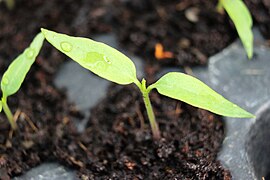 Ghost pepper leaf, about 10-day-old plant
 -
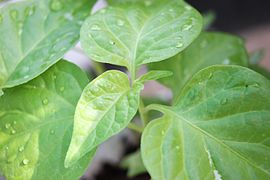 Ghost pepper leaf, about 30-day-old plant
 -
 Ghost pepper plant, 40 days old, grown in coco peat
 -
 Peach ghost pepper
 -
 Yellow ghost pepper
 -
 Chocolate ghost pepper
 -
 Purple ghost pepper
 -
 Red ghost pepper
 -
 Ripe, harvested bhut jolokia
 -
 Bhut jolokia/ghost pepper plant


See also[edit]
References[edit]
- ^ It is extensively cultivated in northeastern India, especially in the states of Assam, Nagaland, Manipur. https://www.frontalagritech.com/chillies-peppers-herbs
- ^ Gamillo, Elizabeth (3 August 2018). "Ghost peppers are saving U.S. grasslands—by scaring off hungry mice". Science. Retrieved 25 June 2019.
- ^ Deepak, Sharanya (1 January 2019). "The Incredible Story of Bhut Jolokia: From Rural India to Dumb YouTube Stunts". Taste. Retrieved 25 June 2019.
- ^ "Definition of BHUT JOLOKIA". www.merriam-webster.com. Retrieved 26 October 2020.
- ^ a b Shaline L. Lopez (2007). "NMSU is home to the world's hottest chile pepper". Archived from the original on 19 February 2007. Retrieved 21 February 2007.
- ^ a b "'Ghost chile' burns away stomach ills - Diet & Nutrition - NBC News". Associated Press. 2007. Retrieved 5 August 2007.
- ^ Paul W. Bosland; Jit B. Baral (2007). "'Bhut Jolokia'—The World's Hottest Known Chile Pepper is a Putative Naturally Occurring Interspecific Hybrid" (PDF). Horticultural Science. 42 (2): 222–4. Archived from the original (PDF) on 23 September 2015. Retrieved 11 July 2014.
- ^ "Hottest Chili". Guinness World Records. Retrieved 11 November 2023.
- ^ "Definition of BHUT JOLOKIA". www.merriam-webster.com. Retrieved 26 October 2020.
- ^ "India's 'ghost pepper' is one of the hottest chillies. Can Britain handle it?". 16 September 2021.
- ^ "MasterChef Australia features eight of the hottest chillies on the planet; have you tried any?". The Indian Express. 2 June 2021. Retrieved 4 November 2021.
- ^ "Can Ghost Peppers Kill You?". HowStuffWorks. 11 August 2015. Retrieved 17 August 2022.
- ^ "The origin of the Chili lies in the north-eastern of India, in the region of Assam." https://chili-plant.com/chilli-varieties/bhut-jolokia-chili/
- ^ a b c d Raktim Ranjan Bhagowati; et al. (2009). "Genetic Variability and Traditional Practices in Naga King Chili Landraces of Nagaland" (PDF). Asian Agri-History. 13 (3): 171–180. Archived from the original (PDF) on 20 July 2011.
- ^ Dave DeWitt; Paul W. Bosland (2009). The Complete Chile Pepper Book. Timber Press. p. 158. ISBN 978-0-88192-920-1.
- ^ Sanatombi K.; G. J. Sharma (2008). "Capsaicin Content and Pungency of Different Capsicum spp. Cultivars". Not. Bot. Hort. Agrobot. Cluj. 36 (2): 89–90. ISSN 1842-4309. Archived from the original (PDF) on 23 August 2011. Retrieved 2 March 2011.
- ^ "Bhut Jolokia / Naga Chilli / King Chilli". August 2021.
- ^ Mathur R; et al. (2000). "The hottest chili variety in India" (PDF). Current Science. 79 (3): 287–8.
- ^ "Bih jolokia". 2006. Retrieved 12 December 2006.
- ^ "NMSU: The Chile Pepper Institute - Home". The Chile Pepper Institute. Archived from the original on 20 November 2016. Retrieved 20 July 2012.
- ^ Bosland, Paul; Coon, Danise; Cooke, Peter H. (June 2015). "Novel Formation of Ectopic (Nonplacental) Capsaicinoid Secreting Vesicles on Fruit Walls Explains the Morphological Mechanism for Super-hot Chile Peppers". Journal of the American Society for Horticultural Science. 140 (3): 253–256. doi:10.21273/JASHS.140.3.253.
- ^ Barker, Catherine L. (2007). "Hot Pod: World's Hottest". National Geographic Magazine. Vol. 2007, no. May. p. 21.
- ^ Dremann, Craig Carlton. 2011. Redwood City Seed Company, Observations on the variations in the Bhut Jolokia pepper from seed reproduction growouts.
- ^ Mary Roach (June 2013). "The Gut-Wrenching Science Behind the World's Hottest Peppers". Smithsonian Magazine. Archived from the original on 27 December 2013. Retrieved 4 December 2013.
- ^ Hussain, Wasbir (20 November 2007). "World's Hottest Chile Used as Elephant Repellent". National Geographic. Archived from the original on 22 November 2007. Retrieved 21 November 2007.
- ^ "Ghost Chile Scares Off Elephants". National Geographic News website. National Geographic. 20 November 2007. Archived from the original on 24 November 2007. Retrieved 18 August 2008.
- ^ "Army's new weapon: world's hottest chili - Trends News - IBNLive". Ibnlive.in.com. 24 March 2010. Archived from the original on 27 March 2010. Retrieved 6 November 2012.
- ^ "South Asia | India plans hot chilli grenades". BBC News. 25 June 2009. Retrieved 11 April 2010.
- ^ Bhaumik, Subir (24 March 2010). "India scientists hail 'multi-purpose' chillis". BBC News. City of Westminster, England. Retrieved 24 April 2012.
- ^ "Army used 'chilly grenades' to flush out Pak terrorist Sajjad Ahmed from a cave". The Indian Express.


| C. annuum var. annuum |
|
|---|---|
| C. annuum var. glabriusculum | |
| C. chinense | |
| C. frutescens | |
| C. baccatum | |
| C. pubescens | |