


National Geographic
 | |
 March 2017 cover | |
| Editor | Nathan Lump[1] |
|---|---|
| Categories | Geography, history, nature, science, world culture |
| Frequency | Monthly |
| Total circulation (2022) | 1.8 million (United States)[2] |
| Founded | January 13, 1888 |
| First issue | September 22, 1888 |
| Company | |
| Country | United States |
| Based in | Washington, D.C. |
| Language | English and various other languages |
| Website | nationalgeographic |
| ISSN | 0027-9358 |
| OCLC | 643483454 |
National Geographic (formerly The National Geographic Magazine,[3] sometimes branded as NAT GEO[4]) is an American monthly magazine published by National Geographic Partners.[5] The magazine was founded in 1888 as a scholarly journal, nine months after the establishment of the society, but is now a popular magazine. In 1905, it began including pictures, a style for which it became well-known. Its first color photos appeared in the 1910s. During the Cold War, the magazine committed itself to present a balanced view of the physical and human geography of countries beyond the Iron Curtain. Later, the magazine became outspoken on environmental issues.
Until 2015, the magazine was completely owned and managed by the National Geographic Society. Since 2015, controlling interest has been held by National Geographic Partners.
Topics of features generally concern geography, history, nature, science, and world culture. The magazine is well known for its distinctive appearance: a thick square-bound glossy format with a yellow rectangular border. Map supplements from National Geographic Maps are included with subscriptions, and it is available in a traditional printed edition and an interactive online edition.
As of 1995[update], the magazine was circulated worldwide in nearly forty local-language editions and had a global circulation of at least 6.5 million per month including 3.5 million within the U.S.[6][7], down from about 12 million in the late 1980s. As of 2015[update], the magazine had won 25 National Magazine Awards.[8]
As of October 2022[update], its Instagram page has 243 million followers, the most of any account not belonging to an individual celebrity.[9] The magazine's circulation as of December 31, 2023 was about 570,000.[10]
In 2023, National Geographic laid off all staff writers and will stop US newsstand sales in the next year.[11][12][13]
History[edit]

The first issue of the National Geographic Magazine was published on September 22, 1888, nine months after the Society was founded. In the first issue, Gardiner Greene Hubbard writes,
The "National Geographic Society" has been organized to "increase and defuse geographic knowledge", and the publication of a Magazine has been determined upon as one means accomplishing these purposes.[14]
It was initially a scholarly journal sent to 165 charter members; in 2010, it reached the hands of 40 million people each month.[15] Starting with its January 1905 publication of several full-page pictures of Tibet in 1900–01, the magazine began to transition from being a text-oriented publication to featuring extensive pictorial content. By 1908 more than half of the magazine's pages were photographs. The June 1985 cover portrait of a 12-year-old Afghan girl Sharbat Gula, shot by photographer Steve McCurry, became one of the magazine's most recognizable images.[16]
National Geographic Kids, the children's version of the magazine, was launched in 1975 under the name National Geographic World.
At its peak in the late 1980s, the magazine had 12 million subscribers in the United States, and millions more outside of the U.S.[2]
In the late 1990s, the magazine began publishing The Complete National Geographic, an electronic collection of every past issue of the magazine. It was then sued over copyright of the magazine as a collective work in Greenberg v. National Geographic and other cases, and temporarily withdrew the compilation. The magazine eventually prevailed in the dispute, and in July 2009 resumed publishing all past issues through December 2008. More recent issues were later added to the collection; the archive and electronic edition of the magazine are available online to the magazine's subscribers.[17]
In September 2015, the National Geographic Society moved the magazine to a new owner, National Geographic Partners, giving 21st Century Fox a 73% controlling interest[18] in exchange for $725 million. In December 2017, a deal was announced for Disney to acquire 21st Century Fox, including the controlling interest in National Geographic Partners.[19] The acquisition was completed in March 2019.[20] NG Media publishing unit was operationally transferred into Disney Publishing Worldwide.[21]
In September 2022, the magazine laid off six of its top editors.[22] In June 2023, the magazine laid off all of its staff writers, shifting to an entirely freelance-based writing model, and announced that beginning in 2024 it would no longer offer newsstand purchases.[2]
Administration[edit]
Editors-in-chief[edit]
The magazine had a single "editor" from 1888 to 1920. From 1920 to 1967, the chief editorship was held by the president of the National Geographic Society. Since 1967, the magazine has been overseen by its own "editor" and/or "editor-in-chief". The list of editors-in-chief includes three generations of the Grosvenor family between 1903 and 1980.[23]
- Gilbert Hovey Grosvenor (1875–1966): (Editor-in-Chief: February 1903– January 1920; Managing Editor: September 1900 – February 1903; Assistant Editor: May 1899 – September 1900)
- John Oliver La Gorce (1879–1959): (May 1954 – January 1957) (president of the society at the same time)
- Melville Bell Grosvenor (1901–1982): (January 1957 – August 1967) (president of the society at the same time) (thereafter editor-in-chief to 1977)
- Frederick Vosburgh (1905–2005): (August 1967 – October 1970)
- Gilbert Melville Grosvenor (born 1931): (October 1970 – July 1980) (then became president of the society)
- Wilbur E. Garrett: (July 1980 – April 1990)
- William Graves: (April 1990 – December 1994)
- William L. Allen: (January 1995 – January 2005)
- Chris Johns: (January 2005 – April 2014) (first "editor-in-chief" since MBG)
- Susan Goldberg: (April 2014 – April 2022)[1][24][25]
- Nathan Lump: (May 2022 – present)[26]
Articles[edit]

During the Cold War, the magazine committed itself to present a balanced view of the physical and human geography of countries beyond the Iron Curtain. The magazine printed articles on Berlin, de-occupied Austria, the Soviet Union, and Communist China that deliberately downplayed politics to focus on culture. In its coverage of the Space Race, National Geographic focused on the scientific achievement while largely avoiding reference to the race's connection to nuclear arms buildup. There were also many articles in the 1930s, 1940s and 1950s about the individual states and their resources, along with supplementary maps of each state. Many of these articles were written by longtime staff such as Frederick Simpich.[27]
After 21st Century Fox acquired controlling interest in the magazine, articles became outspoken on topics such as environmental issues, deforestation, chemical pollution, global warming, and endangered species. Series of articles were included focusing on the history and varied uses of specific products such as a single metal, gem, food crop, or agricultural product, or an archaeological discovery. Occasionally an entire month's issue would be devoted to a single country, past civilization, a natural resource whose future is endangered, or other themes. In recent decades, the National Geographic Society has unveiled other magazines with different focuses. Whereas the magazine featured lengthy expositions in the past, recent issues have shorter articles.[28]
Photography[edit]

In addition to being well known for articles about scenery, history, and the most distant corners of the world, the magazine has been recognized for its book-like quality and the high standard of its photography. It was during the tenure of Society President Alexander Graham Bell and editor Gilbert H. Grosvenor (GHG) that the significance of illustration was first emphasized, in spite of criticism from some of the Board of Managers who considered the many illustrations an indicator of an "unscientific" conception of geography. By 1910, photographs had become the magazine's trademark and Grosvenor was constantly on the search for "dynamical pictures" as Graham Bell called them, particularly those that provided a sense of motion in a still image. In 1915, GHG began building the group of staff photographers and providing them with advanced tools including the latest darkroom.[29]
The magazine began to feature some pages of color photography in the early 1930s, when this technology was still in its early development. During the mid-1930s, Luis Marden (1913–2003), a writer and photographer for National Geographic, convinced the magazine to allow its photographers to use the so-called "miniature" 35 mm Leica cameras loaded with Kodachrome film over bulkier cameras with heavy glass plates that required the use of tripods.[29] In 1959, the magazine started publishing small photographs on its covers, later becoming larger photographs. National Geographic photography quickly shifted to digital photography for both its printed magazine and its website. In subsequent years, the cover, while keeping its yellow border, shed its oak leaf trim and bare table of contents, to allow for a full-page photograph taken for one of the month's articles. Issues of National Geographic are often kept by subscribers for years and re-sold at thrift stores as collectibles. The standard for photography has remained high over the subsequent decades and the magazine is still illustrated with some of the highest-quality photojournalism in the world.[30] In 2006, National Geographic began an international photography competition, with over eighteen countries participating.[31]
Gallery[edit]
-
 Srirangam Temple, India (National Geographic Magazine November 1909)
 -
 Pyramid of the Niches, El Tajín (National Geographic Magazine February 1913)
 -

-
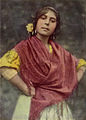 Spanish Gypsy (National Geographic Magazine March 1917)
 -
 Kathmandu Market (National Geographic Magazine October 1920)
 -
 A photo of a glacier taken on an expedition to the North Pole (National Geographic Magazine January 1910)


Map supplements[edit]
A map is the greatest of all epic poems. Its lines and colors show the realization of great dreams.
Supplementing the articles, the magazine sometimes provides maps of the regions visited.[33] National Geographic Maps (originally the Cartographic Division) became a division of the National Geographic Society in 1915. The first supplement map, which appeared in the May 1918 issue of the magazine, titled The Western Theatre of War, served as a reference for overseas military personnel and soldiers' families alike.[34] On some occasions, the Society's map archives have been used by the United States government in instances where its own cartographic resources were limited.[35] President Franklin D. Roosevelt's White House map room was filled with National Geographic maps. A National Geographic map of Europe is featured in the displays of the Winston Churchill museum in London showing Churchill's markings at the Yalta Conference where the Allied leaders divided post-war Europe.[36]
In 2001, National Geographic released an eight-CD-ROM set containing all its maps from 1888 to December 2000. Printed versions are also available from the National Geographic website.[37]
Language editions[edit]
Active[edit]
In April 1995, National Geographic began publishing in Japanese, its first local language edition.[38] The magazine is currently published in 29 local editions around the world.[39][27]


Discontinued[edit]
The following local-language editions have been discontinued.[27]
| Language | Country | Website | First issue | Last issue | # |
|---|---|---|---|---|---|
| Mongolian | Mongolia | nationalgeographic.mn | October 2012
|
June 2014
|
21
|
| Greek | Greece | nationalgeographic.gr | October 1998
|
December 2014
|
194
|
| Ukrainian | Ukraine |
|
|
57
| |
| Azerbaijani | Azerbaijan | nationalgeographic.az | September 2014
|
December 2015
|
16
|
| Latvian | Latvia | nationalgeographic.lv | October 2012
|
March 2016
|
42
|
| Farsi | Iran | www.ngmfarsi.com |
|
|
69
|
| Portuguese | Brazil | nationalgeographicbrasil.com | May 2000
|
November 2019
|
235
|
| Danish | Denmark | natgeo.dk | September 2000
|
December 2020
|
267
|
| Norwegian | Norway | natgeo.no | September 2000
|
December 2020
|
267
|
| Swedish | Sweden | natgeo.se | September 2000
|
December 2020
|
267
|
| Finnish | Finland | natgeo.se | January 2001
|
December 2020
|
263
|
| Romanian[40] | Romania | natgeo.ro | May 2003
|
December 2021
|
224
|
| Estonian | Estonia | nationalgeographic.ee | October 2011
|
December 2021
|
123
|
| English | India | August 2013
|
December 2021
|
105
| |
| Russian | Russia | nat-geo.ru | October 2003
|
April 2022
|
259
|
| Turkish | Turkey | nationalgeographic.com.tr | May 2001
|
June 2022
|
254
|
| Croatian | Croatia | nationalgeographic.com.hr | November 2003
|
January 2023
|
230
|
| Serbian | Serbia | nationalgeographic.rs/ | November 2006
|
December 2023
|
206
|

In association with Trends Publications in Beijing and IDG Asia, National Geographic has been authorized for "copyright cooperation" in China to publish the yellow-border magazine, which launched with the July 2007 issue of the magazine with an event in Beijing on July 10, 2007, and another event on December 6, 2007, in Beijing also celebrating the 29th anniversary of normalization of U.S.–China relations featuring former President Jimmy Carter. The mainland China version is one of the two local-language editions that bump the National Geographic logo off its header in favor of a local-language logo; the other one is the Persian version published under the name Gita Nama.[41]
Following the Russian invasion of Ukraine, the Russian version of National Geographic was discontinued effective April 2022. Its publication team then launched the Russian Traveler, which is not associated with the National Geographic brand.[42][43]
Distribution[edit]
In the United States, National Geographic is available only to subscribers beginning with the January 2024 issue. For the first 110 years of the magazine's existence, membership in the National Geographic Society was the only way to receive it.[44] Newsstand sales, which began in 1998, ceased in 2023, following a year of layoffs and a shift in focus to digital formats amid the decline of the print media industry.[45][46]
Worldwide editions are sold on newsstands in addition to regular subscriptions. In several countries, such as Hungary, Slovenia, Croatia, Turkey and Ukraine, National Geographic paved the way for a subscription model in addition to traditional newsstand sales.
Awards[edit]
On May 1, 2008, National Geographic won three National Magazine Awards—an award solely for its written content—in the reporting category for an article by Peter Hessler on the Chinese economy; an award in the photojournalism category for work by John Stanmeyer on malaria in the Third World; and a prestigious award for general excellence.[47]
Between 1980 and 2011, the magazine has won a total of 24 National Magazine Awards.[48]
In May 2006, 2007, and 2011, National Geographic magazine won the American Society of Magazine Editors' General Excellence Award in the over two million circulation category. In 2010, National Geographic Magazine received the top ASME awards for photojournalism and essay. In 2011, National Geographic Magazine received the top-award from ASME—the Magazine of the Year Award.
In April 2014, National Geographic received the National Magazine Award ("Ellie") for best tablet edition for its multimedia presentation of Robert Draper's story "The Last Chase," about the final days of a tornado researcher who was killed in the line of duty.[49]
In February 2017, National Geographic received the National Magazine Award ("Ellie") for best website.[50] National Geographic won the 2020 Webby Award for News & Magazines in the category Apps, Mobile & Voice.[51] National Geographic won the 2020 Webby Award and Webby People's Voice Award for Magazine in the category Web.[51]
Controversies[edit]
On the magazine's February 1982 cover, the pyramids of Giza were altered, resulting in the first major scandal of the digital photography age and contributing to photography's "waning credibility".[52]
The cover of the October 1988 issue featured a photo of a large ivory portrait of a male, whose authenticity, particularly the alleged ice age provenance, has been questioned.[53]
In 1999, the magazine was embroiled in the Archaeoraptor scandal, in which it purported to have a fossil linking birds to dinosaurs. The fossil was a forgery.[54]
In 2010, the magazine's Your Shot competition was awarded to American filmmaker and photographer William Lascelles for a photograph presented as a portrait of a dog with fighter jets flying over its shoulder. Lascelles had in reality created the image using photo editing software.[55]
After the annexation of Crimea by the Russian Federation in 2014, National Geographic published maps with the Crimean peninsula marked as "contested", contrary to international norms.[56][57]
In March 2018, the editor of National Geographic, Susan Goldberg, said that historically the magazine's coverage of people around the world had been racist. Goldberg stated that the magazine ignored non-white Americans and showed different groups as exotic, thereby promoting racial clichés.[58]
List of National Geographic milestones[edit]
This is a list of National Geographic milestones featuring turning points in the magazine's history including writing and photography assignments, design aspects, cartography and sponsored expeditions.[59][16][60]
| Writing and photography | Cartography | Sponsored expeditions | Design | Social / other |
Writing and photography[edit]
| Year | Milestone | Notes | Ref | |
|---|---|---|---|---|
| 1888 | First publication | The first issue of The National Geographic Magazinea was published in October 1888 for the cost of fifty cents (USD), with an introductory address by the President of the magazine, Gardiner G. Hubbard. | ||
| 1890 | First photograph of a natural scene | The first photograph of a natural scene was that of Herald Island in the Arctic, photographed by Assistant Paymaster J. Q. Lovell (USN) aboard the USS Thetis in the July issue of 1890. | ||
| 1908 | Photography | More than half of the magazine's pages are photographs | ||
| 1914 | First color photograph | The first color photograph to appear in the magazine (Autochrome) was in the July 1914 issue, that of a flower garden in Ghent, Belgium photographed by Paul G. Guillumette. | ||
| 1914 | First article written by a female author | The first article written by a female was published in the July 1914 issue by Eliza R. Scidmore, an account of Japan's youth titled Young Japan. | ||
| 1914 | First photograph by a female | The first image photographed (only the second in color, the first being in the same issue) by a female was in the July 1914 issue by Eliza R. Scidmore, that of a young Japanese boy gazing at a chicken and her newborn hatchlings. | ||
| 1926 | First natural photos underwater | The first natural underwater photograph was published in the January 1927 issue depicting a Hogfish in the Florida Keys. The pictures were photographed by Charles Martin and W. H. Longley.e | ||
| 1930 | First natural-color Aerial photographs | Melville Bell Grosvenor captures the first published natural-color aerial photographs. The photo was taken aboard a Detroit ZMC-2 U.S. Navy airship and featured the Statue of Liberty in New York City. The publication was in the September 1930 issue of the magazine. | ||
| 1938 | Use of 35mm film | The first use of 35 mm film, produced by Kodak under the brand Kodachrome, was published in the April 1938 issue. The photographs were captured by Bob Moore, that of Austrian dancers and would be the preferred film stock for decades. | ||
| 1959 | First photo on the cover | The first photograph on the magazine cover was on the July 1959 issue, a depiction of the 49-star flag of the United States after Alaska's induction into the United States, taken by B. Anthony Stewart. | ||
| 1960 | 1,750,000 years old discovery | Louis and Mary Leakey report on the discovery of Zinjanthropus, a more than 1,750,000 years old man-like species in the Hominin family. Published in the September issue of the magazine. | ||
| 1970 | Stronger photojournalism | After astronauts took one of the first color full-disk photos of Earth from space in 1968, Gordon Young wrote an article highlighting the state of pollution on the planet. The article was published in the December 1970 issue, photographed by James P. Blair and marked a shift away from attractive photos and towards photo-journalistically stronger images. | ||
| 1985 | Afghan Girl | Steve McCurry took the photo that was featured on the June 1985 issue of the magazine, that of Afghan Girl, a twelve year old Afghan refugee in Pakistan named Sharbat Gula. She had green eyes and her picture would become the most recognized photo from National Geographic. | ||
| 1985 | RMS Titanic | After the Titanic was found in the Atlantic Ocean by Robert Ballard, he wrote the cover story for the December 1985 issue of the magazine titled "How we found the Titanic", documenting his experience. | ||
| 2002 | Afghan Girl found | Seventeen years after her portrait appeared on the cover, Sharbat Gula, the Afghan Girl, was found at the age of twenty nine in the mountains of Afghanistan. Her name was not known until this time. | ||
| 2003 | First all digital photography in an article | The first all-digital photography within an article was titled "The Future of Flying", published in the December 2003 issue by Michael Klesius and photographed by Joe McNally. The cover story showcased the F/A-22 Raptor. | ||
Cartography[edit]
| Year | Milestone | Notes | Ref | |
|---|---|---|---|---|
| 1889 | First photograph and first map | The first photograph was in the second ever published issue, depicting a topographic relief map of Africa, in the April 1889 issue by Herbert G. Ogden. | ||
| 1889 | First fold out map | The first fold-out map was published in the October 1889 issue depicting the Meadow Creek Mountains in Tennessee along the French Broad River to Asheville, North Carolina. | ||
| 1890 | First map of a hurricane | The first map of a hurricane was a drawing published in the May 1890 issue. It was a depiction of the September 1888 Atlantic hurricanes.d | ||
| 1891 | First color map | The first color map was a reproduction of South America by Dodd, Mead & Company, Publishers. | ||
Sponsored expeditions[edit]
| Year | Milestone | Notes | Ref | |
|---|---|---|---|---|
| 1890 | First sponsored scientific expedition | The first sponsored scientific expedition started in 1890 and was published in the July 1902 issue. The expedition was led by Geologist Dr. Israel Russell who surveyed and mapped the Mount Saint Elias region in North America. During the voyage, Canada's highest peak, Mount Logan was discovered. | ||
| 1909 | Robert E. Peary discovers the North Pole | In a society sponsored expedition to the North Pole, explorer Robert E. Peary was the first to discover the region on April 6, 1909. The article featured accolades that were received and published in the January 1910 issue of the magazine. | ||
| 1929 | First flight to the South Pole | The first flight to the South Pole was a National Geographic Societyg sponsored expedition. On November 29, 1929 Richard E. Byrd flew over the South Pole photographing more than 60,000 square miles of Antarctica from the air, which was featured in the August 1930 issue of the magazine. | ||
| 1952 | First publication by underwater pioneer Jacques Cousteau | The magazine publishes first of many undersea articles by Jacques-Yves Cousteau. The name of the article was called "Fish Men Explore a New World Underwater" and was published in the October issue of 1952. | ||
| 1961 | Jane Goodall's research on Chimpanzees | Jane Goodall starts her expedition and research on chimpanzees in Tanzania, Africa's Gombe Stream Park using funds from National Geographic.g Her findings were published throughout the later half of the 20th century. | ||
| 1963 | First Americans conquer Mt. Everest | In a National Geographic Society supported expeditiong mountaineer Jim Whittaker, was the first American to conquer Mount Everest | ||
| 1967 | Dian Fossey studies gorillas | Dian Fossey begins a long-term Society-funded study of mountain gorillas in Rwanda, Africa. | ||
| 1978 | Koko the gorilla learns sign-language | Sign-language skills of Koko the gorilla, following six years of National Geographic Society-funded training by Francine Patterson, was reported in the October 1978 issue of the magazine. | ||
| 2012 | James Cameron and the Mariana Trench | James Cameron, becomes first person to dive solo to the Mariana Trench in the Deepsea Challenger, a joint scientific expedition to conduct deep-ocean research. | ||
Design[edit]
| Year | Milestone | Notes | Ref | |
|---|---|---|---|---|
| 1896 | Monthly magazine and design change | In January 1896 the magazine started featuring titles of articles on the front cover and began publishing the magazine on a monthly basis. | ||
| 1910 | Front cover design change | In the February 1910 issue, the design of the front cover changed to a yellow oak leaf border illustration featuring a yellow border; with the exception of a few background color and font changes, this would be the primary design through June 1959. | ||
| 1959 | Small images on the front cover | In the July 1959 issue, the magazine started including small photos on the front cover. | ||
| 1959 | Exclusion of the word "Magazine" | In the December 1959 issue, the word "Magazine" was excluded from the title. In January and February 1960 the publication was called "The National Geographic". By March 1960 the name of the magazine was simply titled National Geographic. | ||
| 1962 | Large images on the front cover | In the January 1962 issue, the magazine started including large photos, enveloping the entire cover. | ||
| 1979 | No more oak leaf on the cover | The September 1979 was the first time the magazine dropped the oak leaf border from the cover, making the yellow border more visibly noticeable. | ||
Social / other[edit]
| Year | Milestone | Notes | Ref | |
|---|---|---|---|---|
| 1941 | Efforts of WWII | National Geographic Society gives access of photographs, maps, and cartographic details to U.S. President Franklin D. Roosevelt to help with the war efforts of WWII. | ||
| 1962 | The Society's flag in space. | John Glenn transports the National Geographic Society's flag on first U.S. orbital space flight aboard NASA's Mercury-Atlas 6. | ||
| 1969 | The Society's flag on the moon | Apollo 11 astronauts transport the National Geographic Society's flag to the moon. | ||
| 1996 | Website launch | nationalgeographic.com is launched on the World Wide Web | ||
| 2018 | Racism acknowledgment | Editor-in-chief Susan Goldberg admitted publicly, "For decades, our coverage was racist. To rise above our past, we must acknowledge it". | ||
| 2023 | Discontinuance of newstand sales | As of June 2023[update] parent company Disney announced that they will be discontinuing sales of their publication on newsstands in the United States. | ||
Further reading[edit]
- Stephanie L. Hawkins, American Iconographic: "National Geographic," Global Culture, and the Visual Imagination, University of Virginia Press, 2010, 264 pages. A scholarly study of the magazine's rise as a cultural institution that uses the letters of its founders and its readers; argues that National Geographic encouraged readers to question Western values and identify with others. ISBN 978-0-8139-2966-8
- Catherine A. Lutz and Jane L. Collins. Reading National Geographic. Chicago: The University of Chicago Press, 1993. A foundational work in the field of visual anthropology. In 1915, Gilbert Hovey Grosvenor announced seven principles which would guide National Geographic. These included a call for absolute accuracy and objective reporting of important issues. Nothing controversial or partisan would be included. The emphasis would be on the photographs themselves.
- Robert M. Poole, Explorers House: National Geographic and the World it Made, 2004; reprint, Penguin Press, 2006. ISBN 978-0-14-303593-0
See also[edit]
Notes[edit]
- a.^ The National Geographic Magazine was the publication's name until December 1959, after which it was simply called "National Geographic".[98]
- b.^ Photograph not credited in the magazine, but is at the preceding reference[105]
- c.^ Multiple articles, multiple authors
- d.^ Uncredited image
- e.^ Two photographers credited, it is not stated which one took the photo
- f.^
 This article incorporates text from this source, which is in the public domain.
 - g.^ As well as other sponsors

References[edit]
- ^ a b "Masthead: National Geographic Magazine". National Geographic. July 27, 2022. Archived from the original on August 9, 2022. Retrieved August 9, 2022.
- ^ a b c d Farhi, Paul (June 28, 2023). "National Geographic lays off its last remaining staff writers". The Washington Post. Archived from the original on June 28, 2023. Retrieved June 28, 2023.
- ^ "The National Geographic Magazine". National Geographic Magazine. Vol. 1, no. 1. Washington D.C.: National Geographic Society. October 1888. p. Front cover. Retrieved March 15, 2023.
- ^ Beatty, Luke (January 2018). "Evolving one of the world's most iconic, recognizable brands: National Geographic". brandfolder.com. Archived from the original on March 15, 2023. Retrieved March 15, 2023.
Our formal brand name is National Geographic and that is what we use. Of course, we recognize that a lot of our consumers call us "Nat Geo," and that's fine. We use "Nat Geo" primarily in the digital space, where character count is at a premium.
- ^ "National Geographic Magazine". Encyclopedia Britannica. Washington, D.C. March 28, 2020. Retrieved March 15, 2023.
{{cite encyclopedia}}: CS1 maint: location missing publisher (link) - ^ Farhi, Paul (September 9, 2014). "National Geographic gives Fox control of media assets in $725 million deal". The Washington Post. Washington, DC. Archived from the original on May 15, 2019. Retrieved July 8, 2016.
- ^ "National Geographic Boilerplates". National Geographic Press Room. National Geographic Society. April 2015. Archived from the original on March 4, 2016. Retrieved July 8, 2016.
Published in English and nearly 40 local-language editions, National Geographic magazine has a global circulation of around 6.7 million.
- ^ Howard, Brian Clark (February 3, 2015). "National Geographic Wins National Magazine Awards". National Geographic. Archived from the original on November 19, 2021. Retrieved November 19, 2021.
- ^ "Top 100 Instagrammers". Archived from the original on May 16, 2021. Retrieved May 26, 2021.
- ^ "Magazine media – Circulation averages". Alliance for Audited Media. Retrieved June 26, 2023.
- ^ Nair, Deepthi (June 29, 2023). "National Geographic lays off all staff writers and will stop US newsstand sales". The National. Retrieved July 10, 2023.
- ^ Clayton, Abené (June 29, 2023). "National Geographic reportedly lays off its last staff writers". The Guardian. ISSN 0261-3077. Retrieved July 10, 2023.
- ^ "My new National Geographic just arrived, which includes my latest feature—my 16th, and my last as a senior writer. NatGeo is laying off all of its staff writers. I've been so lucky. I got to work w/incredible journalists and tell important, global stories. It's been an honor". Twitter. Retrieved July 10, 2023.
- ^ Hubbard, Gardiner G. (October 1888). "Announcement". The National Geographic Magazine. Vol. 1, no. 1. p. i.
- ^ amyatwired (January 27, 2010). "Jan. 27, 1888: National Geographic Society Gets Going". Wired. Archived from the original on October 22, 2018. Retrieved September 8, 2017.
- ^ a b c d e f g h i j k l m Dukehart, Coburn (October 1, 2013). "'National Geographic' Celebrates 125 Years Of Photography". NPR. Washington, D.C. Archived from the original on November 1, 2018. Retrieved April 12, 2023.
- ^ "Greenberg v. National Geographic Enterprises Inc". American Psychological Association. Archived from the original on January 8, 2018. Retrieved June 2, 2023.
- ^ Parker, Laura (September 9, 2015). "National Geographic and 21st Century Fox Expand Media Partnership". Archived from the original on July 13, 2018. Retrieved September 9, 2015.
- ^ Goldman, David (December 14, 2017). "Disney buys 21st Century Fox: Who gets what". CNNMoney. Archived from the original on December 14, 2017. Retrieved December 14, 2017.
- ^ Szalai, Georg; Bond, Paul (March 20, 2019). "Disney Closes $71.3 Billion Fox Deal, Creating Global Content Powerhouse". The Hollywood Reporter. Archived from the original on March 20, 2019. Retrieved March 20, 2019.
- ^ Steinberg, Brian (August 29, 2019). "Disney Layoffs Affect National Geographic". Variety. Archived from the original on November 11, 2019. Retrieved November 13, 2019.
- ^ Farhi, Paul (September 6, 2022). "National Geographic magazine lays off six of its top editors". The Washington Post. ISSN 0190-8286. Archived from the original on December 15, 2022. Retrieved June 29, 2023.
- ^ Grosvenor, Gilbert M. (March 1988). "A Hundred Years of the National Geographic Society". The Geographical Journal. 154 (1). United Kingdom: Royal Geographical Society: 87–92. Bibcode:1988GeogJ.154...87G. doi:10.2307/633478. JSTOR 633478. Archived from the original on June 4, 2023. Retrieved April 20, 2023 – via JSTOR.
- ^ Bryan, C.D.B (1997). The National Geographic Society, 100 Years of Adventure and Discovery. New York, New York: Abrams Inc. ISBN 978-0-81093-696-6. Archived from the original on June 29, 2023. Retrieved June 12, 2023 – via Google Books.
- ^ "Evolution of National Geographic Magazine" (PDF). Archived from the original (PDF) on November 14, 2012. Retrieved July 13, 2014.
- ^ "National Geographic announces Nathan Lump as Editor In Chief". May 5, 2022. Archived from the original on June 29, 2023. Retrieved June 1, 2022.
- ^ a b c The Complete National Geographic. Washington, D.C.: National Geographic Society. 2008. ISBN 978-1-4262-9635-2. Archived from the original on June 29, 2023. Retrieved June 12, 2023 – via Google Books.
- ^ "National Geographic, Volume 8, No. 4, 2002; Official Journal of the National Geographic Society". abebooks.com. Nikkei National Geographic Inc. 2002. Archived from the original on June 2, 2023. Retrieved June 2, 2023.
- ^ a b Wentzel, Volmar K (1998). "GILBERT HOVEY GROSVENOR, FATHER OF PHOTOJOURNALISM". Cosmos Club. Archived from the original on February 24, 2015. Retrieved January 18, 2015.
Photographs had unquestionably become the Magazine's trademark. They confirmed GHG's conviction, "If the National Geographic Magazine is to progress, it must constantly improve the quality of its illustrations..." At first he borrowed, then bought and probably would have stolen "dynamical" photographs, if in 1915 he had not engaged Franklin L. Fisher as his Chief of Illustrations.
- ^ "Milestone Photos". Photo Galleries - Celebrating 125 Years. National Geographic Society. 2013. Archived from the original on June 29, 2023. Retrieved January 18, 2016.
- ^ "Named The Best Travel Photos Of The Year, And They Are Stunning". Digg.com. June 28, 2018. Archived from the original on June 29, 2023. Retrieved June 29, 2018.
- ^ a b Valdés, Juan José. "About National Geographic Maps". National Geographic. Archived from the original on May 31, 2023. Retrieved May 31, 2023.
- ^ Boyer, David S. (May 1967). "Micronesia-The Americanization of Eden". National Geographic. Vol. 131, no. 5. p. 714. Retrieved March 13, 2023.
- ^ "Maps of the News". December 2009. Archived from the original on July 8, 2011. Retrieved June 4, 2023.
- ^ Grosvenor, Gilbert M. (1950). Map Services of the National Geographic Society. Washington, D.C.: National Geographic Society. Archived from the original on June 29, 2023. Retrieved June 12, 2023 – via Google Books.
- ^ "National Geographic". apollostrategiccomms.com. Apollo Strategic communications agency. Archived from the original on June 2, 2023. Retrieved June 2, 2023.
- ^ "Maps". nationalgeographic.com. National Geographic. Archived from the original on June 29, 2023. Retrieved October 8, 2022.
- ^ "National Geographic Japanese Edition". nikkeibp.co.jp. April 1995. Archived from the original on June 4, 2023. Retrieved June 4, 2023.
- ^ "February Magazine Covers from Around the World". February 16, 2021. Archived from the original on April 17, 2021. Retrieved April 2, 2021.
- ^ "Cel puțin deocamdată, revista National Geographic nu va mai apărea în țara noastră – Revista National Geographic Romania". Archived from the original on June 29, 2023. Retrieved February 2, 2022.
- ^ wolf.admin (August 15, 2022). "National Geographic Magazine: History". The Wolf. U.K. Retrieved June 2, 2023.
- ^ "Russian-language website National Geographic announces closure". April 14, 2022. Archived from the original on April 10, 2024. Retrieved April 10, 2024.
- ^ "40 tourism industry representatives presented with the All-Russian tourist award Russian Traveler Awards 2022". December 5, 2022. Retrieved April 10, 2024.
- ^ "National Geographic Society". Encyclopedia.com. Boston: Cengage. June 11, 2018. Retrieved June 2, 2023.
- ^ "National Geographic will end newsstand sales of magazine next year, focus on subscriptions, digital". June 30, 2023. Archived from the original on April 10, 2024. Retrieved April 10, 2024.
- ^ "National Geographic will stop selling its regular printed issues on newsstands". December 21, 2023. Archived from the original on April 10, 2024. Retrieved April 10, 2024.
- ^ Pérez-Peña, Richard (May 2, 2008). "National Geographic Wins 3 Awards, Honored Beyond Photography". New York Times. Archived from the original on July 1, 2017. Retrieved January 8, 2010.
- ^ "American Society of Magazine Editors database". Magazine.org. Archived from the original on May 26, 2011. Retrieved July 13, 2014.
- ^ Howard, Brian Clark (May 1, 2014). "National Geographic Wins National Magazine Awards". NGS. National Geographic Society. Archived from the original on June 29, 2023. Retrieved January 18, 2016.
The annual National Magazine Awards are considered the premier awards for magazine journalism and are administered by the American Society of Magazine Editors in association with the Columbia University Graduate School of Journalism. Winners were announced at a dinner in New York.
- ^ "Ellie Awards 2017 Winners Announced | ASME". www.magazine.org. Archived from the original on March 8, 2017. Retrieved March 7, 2017.
- ^ a b Kastrenakes, Jacob (May 20, 2020). "Here are all the winners of the 2020 Webby Awards". The Verge. Archived from the original on May 21, 2020. Retrieved May 22, 2020.
- ^ "Faking it: Manipulated Photography Before Photoshop" Archived April 15, 2023, at the Wayback Machine, Mia Fineman. Metropolitan Museum of Art, 2012. pp. 38–39. Retrieved 28 Jan 2017.
- ^ Paul G. Bahn (1998). The Cambridge Illustrated History of Prehistoric Art. Cambridge University Press. p. 154. ISBN 978-0521454735.
- ^ Rowe, Timothy; Ketcham, Richard A.; Denison, Cambria; Colbert, Matthew; Xu, Xing; Currie, Philip J. (March 29, 2001). "The Archaeoraptor forgery". Nature. 410 (6828): 539–540. doi:10.1038/35069145. ISSN 1476-4687. PMID 11279483. S2CID 205015615. Archived from the original on December 26, 2009. Retrieved October 8, 2022.
- ^ Jedrzejczak, Antonina (June 11, 2010). "National Geographic Admits Photo Fraud (Plus: 10 Major Photoshopping Scandals)". businessinsider.com. Archived from the original on February 2, 2017. Retrieved January 28, 2017.
- ^ "Запорожье и Херсон – «спорные территории»? Откуда на европейских полках карты, какими их хотят видеть в Кремле". BBC News Русская служба (in Russian). Retrieved August 31, 2023.
- ^ "Крым на картах мира: украинский или российский?". BBC News Україна (in Russian). October 19, 2015. Retrieved August 31, 2023.
- ^ "National Geographic admits 'racist' past". BBC News. March 13, 2018. Archived from the original on April 16, 2018. Retrieved March 13, 2018.
- ^ Braverman, Sandra (September 23, 1990). "A Photographic Odyssey". The Boston Globe. Boston. p. West 9. Archived from the original on April 22, 2023. Retrieved April 22, 2023 – via newspapers.com.
- ^ a b c d e f g h i j k l m n o p q "National Geographic". National Postal Museum. Washington, D.C.: Smithsonian Institution. Archived from the original on April 19, 2023. Retrieved April 19, 2023.
- ^ Hubbard, Gardiner G. (October 1888). "Introductory Address by the President". The National Geographic Magazine. Vol. 1, no. 1. p. 3.
- ^ Stockton, Chas W. (July 1890). "The Arctic Cruise of the U.S.S. Thetis". The National Geographic Magazine. Vol. 2, no. 3. p. 194.
- ^ Howard, L. O. (July 1914). "Explorers of a New Kind". The National Geographic Magazine. Vol. 26, no. 1. p. 48.
- ^ a b Scidmore, Eliza R. (July 1914). "Young Japan". The National Geographic Magazine. Vol. 26, no. 1.
- ^ Martin, Charles; Longley, W. H. (January 1927). "The First Autochromes From the Ocean Bottom". The National Geographic Magazine. Vol. 51, no. 1. p. 56.
- ^ "A Biography of Melville Bell Grosvenor". onlinesafetytrainer.com. Nevada Technical Associates, Inc. Archived from the original on June 2, 2023. Retrieved June 2, 2023.
- ^ "Firsts and Frontiers". fieldnotes.nationalgeographic.org. National Geographic. April 23, 2018. Archived from the original on April 23, 2023. Retrieved April 23, 2023.
- ^ a b Aikman, Lonnelle (July 1959). "New Stars for Old Glory". National Geographic. Vol. 116, no. 1. p. 86. b
- ^ Onyango-Abuje, J. C. (1975). "L.S.B. Leakey: The man and his contribution to the understanding of the evolution of man in Africa". Journal of Eastern African Research & Development. 5 (2): 123–136. JSTOR 43663913. Archived from the original on June 2, 2023. Retrieved June 2, 2023.
- ^ Young, Gordon (December 1970). "Pollution, Threat to Man's Only Home". National Geographic. Vol. 138, no. 6. p. 738.
- ^ a b c d e f g h "National Geographic Society Celebrates 125 Years Of World Exploration And Stunning Photography". huffingtonpost.co.uk.com. HuffPost. Archived from the original on June 2, 2023. Retrieved June 2, 2023.
- ^ Strochlic, Nina (December 12, 2017). "Famed 'Afghan Girl' Finally Gets a Home". nationalgeographic.com. National Geographic. Archived from the original on June 4, 2023. Retrieved June 3, 2023.
- ^ Denker, Debra (June 1985). "Along Afghanistan's War-torn Frontier". National Geographic. Vol. 167, no. 6. p. 772.
- ^ Gross, Jenny (November 26, 2021). "Famed 'Afghan Girl' Finally Gets a Home". New York Times. Archived from the original on December 12, 2021. Retrieved June 3, 2023.
- ^ Harris, Mark Edward (April 4, 2019). "Master Storyteller: Photographer Joe McNally". digitalphotopro.com. Digital Photo Pro. Archived from the original on April 24, 2023. Retrieved April 24, 2023.
- ^ Klesius, Michael (December 2003). "The Future of Flying". National Geographic. Vol. 204, no. 6. p. 2.
- ^ Ogden, Herbert G. (April 1889). "Africa, Its Past and Future". The National Geographic Magazine. Vol. 1, no. 2. p. 125. Illustration by Herbert G. Ogden
- ^ "National Geographic Maps". The New York Times. September 30, 1999. Archived from the original on April 23, 2023. Retrieved April 19, 2023.
- ^ Willis, Bailey (October 1889). "Roundabout Asheville". The National Geographic Magazine. Vol. 1, no. 4. p. 291. Illustration by Herbert G. Ogden
- ^ Hayden, Everett (July 1890). "The Law of Storms, Considered with Special Reference to the North Atlantic". The National Geographic Magazine. Vol. 2, no. 3. p. 208.
- ^ Dempsey, Caitlin (March 9, 2022). "First Maps". geographyrealm.com. Archived from the original on April 19, 2023. Retrieved April 19, 2023.
- ^ Hubbard, Gardiner G. (March 28, 1891). "South America. Annual Address by the President". The National Geographic Magazine. Vol. 3, no. 1. p. 1.
- ^ "Expedition to Martinique". Science. 15 (386): 836–837. 1902. doi:10.1126/science.15.386.836.b. JSTOR 1628081. S2CID 239849503. Archived from the original on February 21, 2023. Retrieved June 4, 2023.
- ^ Russell, Israel (July 1902). "Martinique Number". The National Geographic Magazine. Vol. 13, no. 7. p. Cover. c
- ^ Staff writer (January 1910). "Discovery of the North Pole". The National Geographic Magazine. Vol. 21, no. 1. p. 63.
- ^ Byrd, Richard Evelyn (August 1930). "The Conquest of Antarctica by Air". National Geographic. Vol. 58, no. 2. p. 127.
- ^ Breyer, Robert Byrd. "Second Byrd Antarctic Expedition". admiralbyrd.com. Archived from the original on April 23, 2023. Retrieved April 23, 2023.
- ^ LaRochelle, Ed. "How the Public Came to Embrace Scuba Diving in the 1950s". Journal of Diving History. 17 (2): 30–32. ISSN 1946-4770. Archived from the original on June 29, 2023. Retrieved June 2, 2023.
- ^ Wilson, ML; Lonsdorf, EV; Mjungu, DC; et al. (December 12, 2020). "Goodall J. Research and Conservation in the Greater Gombe Ecosystem: Challenges and Opportunities". Biological Conservation. 252. Conservation biology. doi:10.1016/j.biocon.2020.108853. PMC 7743041. PMID 33343005. S2CID 228875021.
- ^ Shnayerson, Michael (March 15, 2012). "1963 American Summit: Jim Whittaker - Back on Earth". nationalgeographic.com. National Geographic. Archived from the original on June 3, 2023. Retrieved June 3, 2023.
- ^ "Dian Fossey Biography". Dian Fossey Gorilla Fund International. Archived from the original on June 4, 2023. Retrieved June 3, 2023.
- ^ Patterson, Francine (October 1978). "Conversations with a Gorilla". National Geographic. Vol. 154, no. 4. p. 438.
- ^ Beatty, Luke (January 2018). "Evolving one of the world's most iconic, recognizable brands: National Geographic". brandfolder.com. Archived from the original on March 22, 2023. Retrieved April 19, 2023.
- ^ "The National Geographic Magazine". The National Geographic Magazine. Vol. 7, no. 1. January 1896. p. Cover. c
- ^ Rosanes, Kerby. "National Geographic". ucreative.com. Archived from the original on April 19, 2023. Retrieved April 19, 2023.
- ^ "The National Geographic Magazine". The National Geographic Magazine. Vol. 21, no. 2. February 1910. p. Cover. c
- ^ "National Geographic". National Geographic. Vol. 116, no. 6. December 1959. p. Cover. c
- ^ a b Leming, Tal. "National Geographic Nameplate". typesupply.com. Archived from the original on April 18, 2023. Retrieved April 18, 2023.
- ^ "Various titles". National Geographic. Vol. 121, no. 1. January 1962. p. Cover.
- ^ "Various titles". National Geographic. Vol. 156, no. 3. September 1979. p. Cover.
- ^ Kratz, Jessie (October 19, 2017). "FDR's White House Map Room". National Archives and Records Administration. Archived from the original on June 2, 2023. Retrieved June 2, 2023.
- ^ "Nat Geo at 125: Travel Touchstones". nationalgeographic.com. National Geographic. Archived from the original on June 2, 2023. Retrieved June 2, 2023.
- ^ Goldberg, Susan (March 12, 2018). "For Decades, Our Coverage Was Racist. To Rise Above Our Past, We Must Acknowledge It". nationalgeographic.com. National Geographic. Archived from the original on April 21, 2023. Retrieved April 21, 2023.
- ^ Daniel, Victor (March 13, 2018). "National Geographic Acknowledges Its Racist Past Coverage". The New York Times. Archived from the original on December 21, 2020. Retrieved April 21, 2023.
- ^ "July 1959-First Photograph Appears on the Cover". nationalgeographic.com. National Geographic. Archived from the original on April 2, 2023. Retrieved April 12, 2023.
External links[edit]


- Official website
- All the magazine's covers published since 1888 until the year 2000
- Archived National Geographic magazines on the Internet Archive
| |||||||||||||||
| People | | ||||||||||||||
| Media assets |
| ||||||||||||||
| Other |
| ||||||||||||||
| Decade |  | |
|---|---|---|
| Related | ||
| Disney Publishing Worldwide |
|
|---|---|
| Games and interactive experiences |
|
| Other | |


- 1888 establishments in Washington, D.C.
- Cultural magazines published in the United States
- History magazines published in the United States
- Magazines established in 1888
- Magazines published in Washington, D.C.
- Monthly magazines published in the United States
- Multilingual magazines
- National Geographic Partners
- National Geographic Society magazines
- Science and technology magazines published in the United States
- National Geographic photographers
- National Geographic people
- Disney Publishing Worldwide