


Overseas France
Overseas France France d'outre-mer (French) | |
|---|---|
| Motto: "Liberté, égalité, fraternité" "Liberty, Equality, Fraternity" | |
| Anthem: La Marseillaise ("The Marseillaise") | |
Great Seal: .svg) | |
.svg) Territory of the French Republic (red) Overseas territories (circled) Claimed territory (Adélie Land; hatched) | |
 | |
| Capital | Paris |
| Largest settlements | Fort-de-France (Martinique), Pointe-à-Pitre (Guadeloupe), Saint Denis (La Réunion), Saint Pierre (La Réunion), Nouméa (New Caledonia) |
| Languages | French, Antillean Creole, Guianan Creole, Reunionese Creole, Shimaore, Tahitian, Marquesan, 'Uvean, Futunan, Drehu, Nengone, Paicî, Ajië, Javanese, and 35 other native languages of New Caledonia |
| Demonym(s) | French |
| Territories | |
| Leaders | |
| Emmanuel Macron | |
• Minister | Marie Guévenoux |
| Area | |
• Total | 120,396[note 2] km2 (46,485 sq mi) |
| Population | |
• Estimate | 2,834,000 (Jan. 2024) |
| Currency | Euro CFP Franc |
| Date format | dd/mm/yyyy (AD) |
| This article is part of a series on the |
| Administrative divisions of France |
|---|
 |
| Administrative divisions |
| Intercommunality |
| Communes |
| Overseas France |
| Geocodes of France |
|
|
 France portal France portal |
Overseas France (French: France d'outre-mer, also France ultramarine)[note 3] consists of 13 French territories outside Europe, mostly the remnants of the French colonial empire that remained a part of the French state under various statuses after decolonisation. Most, but not all, are part of the European Union.
"Overseas France" is a collective name; while used in everyday life in France, it is not an administrative designation in its own right. Instead, the five overseas regions have exactly the same administrative status as the thirteen metropolitan regions; the five overseas collectivities are semi-autonomous; and New Caledonia is an autonomous territory. Overseas France includes island territories in the Atlantic, Pacific and Indian Oceans, French Guiana on the South American continent, and several peri-Antarctic islands as well as a claim in Antarctica. Excluding the district of Adélie Land, where French sovereignty is effective de jure by French law, but where the French exclusive claim on this part of Antarctica is frozen by the Antarctic Treaty (signed in 1959), overseas France covers a land area of 120,396 km2 (46,485 sq mi)[3] and accounts for 18.0% of the French Republic's land territory.[4] Its exclusive economic zone (EEZ) of 9,825,538 km2 (3,793,661 sq mi) accounts for 96.7% of the EEZ of the French Republic.[5]
Outside Europe, four broad classes of overseas French territorial administration currently exist: overseas departments/regions, overseas collectivities, the sui generis territory of New Caledonia, and uninhabited territories. From a legal and administrative standpoint, these four classes have varying legal status and levels of autonomy, although all permanently inhabited territories have representation in both France's National Assembly and Senate, which together make up the French Parliament.
2,834,000 people lived in overseas France in January 2024.[6] Most of these residents are citizens of France and citizens of the European Union. This makes them able to vote in French and European elections.
Varying constitutional statuses
[edit]Overseas regions and departments
[edit]| Year | Pop. | ±% |
|---|---|---|
| 1950 | 847,000 | — |
| 1960 | 1,103,000 | +30.2% |
| 1970 | 1,388,000 | +25.8% |
| 1980 | 1,582,000 | +14.0% |
| 1990 | 1,921,000 | +21.4% |
| 2000 | 2,295,000 | +19.5% |
| 2010 | 2,622,000 | +14.2% |
| 2020 | 2,782,000 | +6.1% |
| 2024 | 2,834,000 | +1.9% |
| January 2024: Total population of all overseas departments and collectivities: 2,834,000. Total population of five overseas departments: 2,230,000.[7] Total population of five overseas collectivities and New Caledonia: 604,000. Sources: French Polynesia,[8] New Caledonia,[9] Saint Barthélemy,[10] Saint Martin,[10] Saint Pierre and Miquelon,[10] Wallis et Futuna[11] | ||
Overseas regions have exactly the same status as France's mainland regions. The French Constitution provides that, in general, French laws and regulations (France's civil code, penal code, administrative law, social laws, tax laws, etc.) apply to French overseas regions just as in metropolitan France, but can be adapted as needed to suit the region's particular needs. Hence, the local administrations of French overseas regions cannot themselves pass new laws.
- French Guiana (since 1946)
- Guadeloupe (since 1946)
- Martinique (since 1946)
- Mayotte (since 2011)
- 1976–2003: sui generis overseas territory
- 2001–2003: with the designation departmental community
- 2003–2011: overseas community.
- In the 2009 Mahoran status referendum, Mahorans voted to become an overseas department in 2011, which occurred on 31 March 2011.
- 1976–2003: sui generis overseas territory
- Réunion (since 1946)
Overseas collectivities
[edit]The category of "overseas collectivity" (French: collectivité d'outre-mer or COM) was created by France's constitutional reform of 28 March 2003. Each overseas collectivity has its own statutory laws.
In contrast to overseas departments/regions, the overseas collectivities are empowered to make their own laws, except in certain areas reserved to the French national government (such as defense, international relations, trade and currency, and judicial and administrative law). The overseas collectivities are governed by local elected assemblies and by the French Parliament and French Government, with a cabinet member, the Minister of the Overseas, in charge of issues related to the overseas territories.
- French Polynesia (1946–2003: overseas territory; since 2003: overseas collectivity): In 2004 it was given the designation of "overseas country" (French: pays d'outre-mer), but the Constitutional Council of France has ruled that this designation did not create a new political category.
- Saint Barthélemy: In 2003, Saint-Barthélemy voted to become an overseas collectivity of France. Saint-Barthélemy is not part of the European Union, having changed the status to an overseas country or territory associated with the European Union in 2012.
- Saint Martin: In a 2003 referendum, Saint Martin voted in favour of secession from Guadeloupe to become separate overseas collectivity of France.[12] On 7 February 2007, the French Parliament passed a bill granting COM status to both jurisdictions.[13] The new status took effect on 22 February 2007, when the law was published in the Journal Officiel.[14] Saint Martin remains part of the European Union, as stated in the Treaty of Lisbon.[15]
- Saint Pierre and Miquelon (1976–85: overseas department; 1985–2003: sui generis overseas territory; since 2003: overseas collectivity): Despite being given the political status of "overseas collectivity", Saint Pierre et Miquelon is called collectivité territoriale de Saint-Pierre-et-Miquelon, literally "territorial collectivity".
- Wallis and Futuna (1961–2003: overseas territory; since 2003: overseas collectivity): It is still commonly referred to as a territoire (Territoire des îles Wallis et Futuna).
Sui generis collectivity
[edit]- New Caledonia had the status of an overseas territory from 1946 to 1998, but as of the 1998 Nouméa Accord it gained a special status (statut particulier or sui generis) in 1999. A New Caledonian citizenship was established (in addition to the French citizenship which is kept in parallel, along with the European citizenship), and a gradual transfer of power from the French state to New Caledonia itself was begun, to last from 15 to 20 years.[16]
However, this process was subject to approval in a referendum. Three independence referendums have been held, in 2018, 2020 and 2021. In the first two referendums, the "yes" vote was 43.3% and 46.7% respectively. In the third referendum of December 2021, massively boycotted by the native Kanak community, which represent 42% of the population, the "yes" vote was 3.5%, with a turnout of 43.9%.[17][18]
Overseas territory
[edit]- French Southern and Antarctic Lands (Terres Australes et Antarctiques Françaises or TAAF); overseas territory of France (since 1956). It is currently the only overseas territory. According to law 2007-224 of 21 February 2007, the Scattered Islands in the Indian Ocean constitute the 5th district of TAAF.
Special status
[edit]- Clipperton Island (French: Île de Clipperton or Île de la Passion; Spanish: Isla de la Pasión) is a 9 km2 (3.5 sq mi) uninhabited coral atoll located 1,280 km (800 miles) south-west of Acapulco, Mexico in the Pacific Ocean. It is held as an overseas "state private property" under the direct authority of the French government, and is administered by France's Minister of the Overseas ("private" in this context refers to official restrictions on access, rather than private ownership per se).
Political representation in legislatures
[edit]
With 2,834,000 inhabitants in 2024, overseas France accounts for 4.1% of the population of the French Republic.[6] They enjoy a corresponding representation in the two chambers of the French Parliament and, in the 16th legislature of the French Fifth Republic (2022–2027), overseas France is represented by 27 deputies in the French National Assembly, accounting for 4.7% of the 577 deputies in the National Assembly:
- Réunion: 7
- Guadeloupe: 4
- Martinique: 4
- French Polynesia: 3
- French Guiana: 2
- Mayotte: 2
- New Caledonia: 2
- Saint Barthélemy and Saint Martin: 1
- Saint Pierre and Miquelon: 1
- Wallis and Futuna: 1
 Senate (France)
[edit]
Since September 2011, overseas France has been represented by 21 senators in the French Senate, accounting for 6.0% of the 348 senators in the Senate:
- Réunion: 4
- Guadeloupe: 3
- French Guiana: 2
- French Polynesia: 2
- Martinique: 2
- Mayotte: 2
- New Caledonia: 2
- Saint Barthélemy: 1
- Saint Martin: 1
- Saint Pierre and Miquelon: 1
- Wallis and Futuna: 1
 European Parliament (European Union)
[edit]
The territories used to be collectively represented in the European Parliament by the Overseas Territories of France constituency. Since the 2019 European elections, France decided to switch to a single constituency, putting an end to all regional constituencies, including the Overseas Territories constituency.[citation needed]
Council (European Union)
[edit]The special territories of EU member states are not separately represented in the EU Council. Every member state represents all its citizens in the council.
Overview
[edit]Inhabited collectivities and departments/regions
[edit]The eleven inhabited French overseas territories are:


_variant.svg)

.svg)

.svg)
.svg)


Uninhabited overseas territories
[edit]Several of these territories are generally only transiently inhabited by researchers in scientific stations.
| Flag | Name | TAAF District | Island | Capital | Area (km2) | Status | Location | Notes |
|---|---|---|---|---|---|---|---|---|

|
Clipperton Island | – | – | – | 2[26] | Overseas state private property | North Pacific Ocean | |

|
French Southern and Antarctic Lands | Adélie Land | Dumont d'Urville Station | 432,000[27] | Overseas territory | Antarctica | Under the terms of the Antarctic Treaty. | |
| Crozet Islands | Alfred Faure | 340[27] | Indian Ocean | |||||
| Kerguelen Islands | Port-aux-Français | 7,215[27] | Population: 45 researchers in winter, 110 in summer. | |||||
| Saint Paul and Amsterdam Islands | Amsterdam Island | Martin-de-Viviès | 66[27] | |||||
| Saint Paul Island | ||||||||
| Scattered Islands in the Indian Ocean | Banc du Geyser | Saint Pierre, Réunion | 0 | Mozambique Channel | Claimed by the Comoros and Madagascar. | |||
| Bassas da India | 1[27] | Claimed by Madagascar. | ||||||
| Europa Island | 30[27] | |||||||
| Glorioso Islands | 7[27] | Indian Ocean | Claimed by the Comoros and Madagascar. | |||||
| Juan de Nova Island | 5[27] | Mozambique Channel | Claimed by Madagascar. | |||||
| Tromelin Island | 1[27] | Indian Ocean | Claimed by Mauritius. |
Map
[edit]
Photo gallery
[edit]-
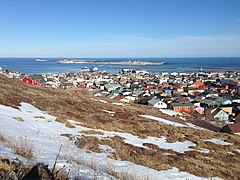 Saint-Pierre, Saint Pierre and Miquelon
 -
 Cayenne, French Guiana
 -
 Marigot, Saint Martin
 -
 Guadeloupe
 -
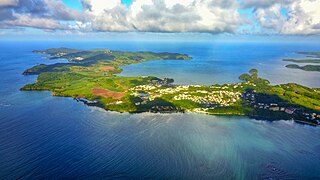 Martinique
 -
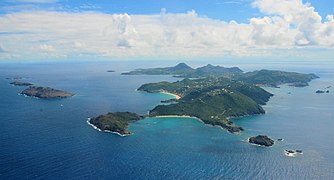 Saint Barthélemy
 -
 Mont Choungui, Mayotte
 -
 Réunion
 -
 Île de l'Est, Crozet Islands, French Southern and Antarctic Lands
 -
 New Caledonia
 -
 Wallis Island, Wallis and Futuna
 -
 Bora Bora, French Polynesia
 -
 Clipperton Island

.jpg)


_-_panoramio.jpg)


Largest cities in overseas France
[edit]Ranked by population in the metropolitan area:
- Fort-de-France (Martinique): 347,170 inhabitants (in 2020)
- Saint Denis (Réunion): 315,080 (in 2020)
- Pointe-à-Pitre–Les Abymes (Guadeloupe): 312,630 (in 2020)
- Saint Pierre–Le Tampon (Réunion): 222,614 (in 2020)
- Nouméa (New Caledonia): 182,341 (in 2019)
- Saint Paul (Réunion): 171,109 (in 2020)
- Cayenne (French Guiana): 151,887 (in 2020)
- Papeete (French Polynesia): 138,861 (in 2022)
See also
[edit]
- 2009 Mahoran status referendum
- Administrative divisions of France
- Communes of France
- French colonial empire
- Government of France
- List of French possessions and colonies
- List of islands administered by France in the Indian and Pacific oceans
- Metropolitan France
- Organisation internationale de la Francophonie
- Outre-mer
- Overseas collectivity
- Overseas department and region
- Overseas military bases of France
- Overseas Territories of France (European Parliament constituency)
- Overseas territory
- Special member state territories and the European Union
- Volontaire Civil à l'Aide Technique
- French claims in Jerusalem:
Notes
[edit]- ^ The current Constitution of France does not specify a national emblem.[1] This emblem is used by the President, Ministry for Europe and Foreign Affairs,[2] and is on the cover of French passports. For other symbols, see National symbols of France.
- ^ Excluding Adélie Land.
- ^ Also les Outre-mer, les outre-mers, or, colloquially, les DOM-TOM (départements d'outre-mer et territoires d'outre-mer) or les DROM-COM (départements et régions d'outre-mer et collectivités d'outre-mer).
- ^ Article 2 of the French Constitution states that the French Flag is the only legal flag of France. Only French Polynesia, an overseas country, and New Caledonia, a sui generis collectivity, are allowed to have their official flags. This right was granted to French Polynesia by a 6 September 1984, law and to New Caledonia by the Nouméa Accord. The Administrator of French Antarctica is also granted his own flag through a 23 February 2007 ordinance. Historical flags are sometimes used but have no basis in law. Many territories use unofficial flags to represent the territories. The unofficial flags are shown in this table.
- ^ 25 km² including the outlying uninhabited islets. 21 km² without the outlying islets.
References
[edit]- ^ Article II of the Constitution of France (1958)
- ^ "The lictor's fasces". elysee.fr. 20 November 2012.
- ^ Larousse, Éditions. "Encyclopédie Larousse en ligne – France d'outre-mer". larousse.fr (in French). Retrieved 2 October 2022.
- ^ Land area of the four old overseas departments ([1]), Mayotte, the overseas collectivities, and New Caledonia (page 21), the French Southern and Antarctic Lands and the Scattered Islands ([2] Archived 19 June 2018 at the Wayback Machine), and Clipperton ([3] Archived 5 March 2020 at the Wayback Machine).
- ^ "Sea Around Us – Fisheries, Ecosystems and Biodiversity". Retrieved 20 June 2018.
- ^ a b The population of all five overseas departments totaled 2,230,000 in January 2024.[4] The population of the overseas collectivities and New Caledonia amounted to 604,000 inhabitants (Saint-Pierre and Miquelon [5], Saint-Barthélemy [6], Saint-Martin [7], French Polynesia [8], Wallis et Futuna [9], New Caledonia [10]).
- ^ a b c d e f "Estimation de population par région, sexe et grande classe d'âge – Années 1975 à 2024" (in French). Retrieved 17 January 2024.
- ^ a b INSEE. "Chiffres détaillés>>Démographie>>Chiffres clés Démographie" (in French). Retrieved 17 January 2024.
- ^ a b "Bilan démographique 2022 : la Nouvelle-Calédonie perd 1 300 habitants". Institut national de la statistique et des études économiques Nouvelle-Calédonie. Retrieved 17 January 2024.
- ^ a b c d e f INSEE (29 December 2022). "Populations légales des collectivités d'outre-mer en 2020" (in French). Retrieved 16 April 2024.
- ^ a b "Résultats du recensement de la population 2023 de Wallis-et-Futuna" (in French). Préfet des îles Wallis et Futuna. Retrieved 17 January 2024.
- ^ "French Caribbean voters reject change". Caribbean Net News. 9 December 2003. Archived from the original on 18 March 2009. Retrieved 9 February 2007.
However, voters in the two tiny French dependencies of Saint-Barthélemy and Saint-Martin, which have been administratively attached to Guadeloupe, approved the referendum and are set to acquire the new status of "overseas collectivity".
- ^ Magras, Bruno (16 February 2007). "Letter of Information from the Mayor to the residents and non-residents, to the French and to the foreigners, of Saint Barthelemy" (PDF). St. Barth Weekly. p. 2. Archived from the original (PDF) on 22 May 2019. Retrieved 18 February 2007.
On 7 February of this year, the French Parliament adopted the law granting Saint-Barthélemy the Statute of an Overseas Collectivity.
- ^ "Saint-Barth To Become An Overseas Collectivity" (PDF). St. Barth Weekly. 9 February 2007. p. 2. Retrieved 9 February 2007.
- ^ "Treaty of Lisbon, Article 2, points 287 and 293". Retrieved 31 January 2008.
- ^ "Nouvelle-Calédonie", Le Petit Larousse (2010), Paris, page 1559.
- ^ "Final results of New Caledonia referendum shows most voters stayed away". Reuters. 13 December 2021. Retrieved 13 December 2021.
- ^ Répartition des suffrages exprimés lors des référendums sur l'indépendance de la Nouvelle-Calédonie en 2018, 2020 et 2021, [11], Statista.
- ^ a b c d INSEE. "Comparateur de territoire" (in French). Retrieved 29 January 2021.
- ^ a b c d INSEE. "Tableau Économique de Mayotte 2010" (PDF) (in French). p. 21. Retrieved 29 January 2021.
- ^ "French Polynesia profile". BBC News. 6 June 2023. Archived from the original on 15 September 2024. Retrieved 16 September 2024.
- ^ ISEE. "Tableaux de l'Economie Calédonienne 2016" (in French). p. 31. Retrieved 29 January 2021.
- ^ Rose, Michel; Packham, Colin (12 December 2021). "New Caledonia rejects independence in final vote amid boycott". Reuters.
- ^ INSEE. "2008, An 1 de la collectivité de Saint-Barthélemy" (PDF) (in French). p. 7. Archived from the original (PDF) on 1 December 2021. Retrieved 29 January 2021.
- ^ INSEE. "2008, An 1 de la collectivitéde Saint-Martin" (PDF) (in French). p. 6. Archived from the original (PDF) on 1 December 2021. Retrieved 29 January 2021.
- ^ Ministry of Overseas France. "L'île de Clipperton" (in French). Retrieved 31 January 2014.
- ^ a b c d e f g h i Délégation générale à l'outre-mer. "Terres Australes et Antarctiques Françaises : Données géographiques et humaines" (PDF) (in French). Archived from the original (PDF) on 2 February 2014. Retrieved 31 January 2014.
Further reading
[edit]- Robert Aldrich and John Connell, France's Overseas Frontier, Cambridge University Press, 1992.
- Frédéric Monera, L'idée de République et la jurisprudence du Conseil constitutionnel, Paris: L.G.D.J., 2004.

