


Versuni
 | |
| Formerly | Philips Consumer Lifestyle |
|---|---|
| Company type | Private |
| Industry | Electronics |
| Founded | 2021 (as Versuni) |
| Headquarters | Amsterdam, the Netherlands |
Key people | Véronique Pauwels (President, CEO) |
| Products | Consumer electronics, small appliances |
| Brands | Philips (under license from Philips), Gaggia, Saeco (under license from Evoca), Senseo, L'Or, Preethi |
| Revenue |  €2.2 billion (2021) €2.2 billion (2021) |
| Owner | Hillhouse Investment |
| Parent | Philips |
| Website | https://www.versuni.com/ |
Versuni (formerly Philips Consumer Lifestyle) is a privately-owned Dutch company, headquartered in Amsterdam, which produces consumer electronics and small appliances. Formerly a subsidiary of Dutch electronics conglomerate Philips, it was sold to Chinese private equity firm Hillhouse Investment in 2021.[1] Versuni sells their products under the Philips brand name (under license), as well as under the brands Preethi, Gaggia and Saeco (under license from Italian coffee-maker manufacturer Evoca Group), Senseo and L'Or.
History
[edit]
While Philips' first product was manufactured in 1891, the first product that would fit in the Consumer Electronics division was a television, experimentally manufactured in 1925. In 1927, Philips began producing radios. Only five years later, Philips had sold one million of them. One other major product release came in 1963, when the Compact Cassette was introduced.[citation needed]
After Philips Consumer Electronics acquired companies as Magnavox and Sylvania in the late-1970s, Philips managed to sell their 100-millionth TV-set in 1984.
Throughout the 1990s, increasing competition from East Asian manufacturers (initially Japanese, then Korean and Chinese) led to a general erosion in market share, particularly in developing markets such as India.[2][3][4] As a result, consumer electronics became an increasingly smaller part of their business, leading to a variety of divestments.[2]
In 2008, Philips transferred its American television business to Japanese company Funai, allowing them to sell and distribute TVs under the Philips and Magnavox brands for the American market.[5] In 2010, their Indian television business was transferred to Videocon, who now make Philips TVs for the Indian market under license.[3] That same year, their mainland Chinese television business was transferred to Chinese state-controlled company TPV Technology.[6]
In 2012, Philips spun-off its loss-making TV business globally to TP Vision, a joint-venture with Chinese state-controlled company TPV Technology (who had previously held the license to sell Philips TVs in the mainland Chinese market).[7] This excluded their American, Indian and Chinese television businesses, which had already been transferred to other licensees (as above). Philips initially held a 30% stake in the joint venture, which was sold to TPV Technology in 2014.[8]
Philips announced in January 2013[9] that it agreed to sell its consumer electronics division to Japan-based Funai Electric Co. for €150 million (US$201.8 million). This would leave mainly consumer products for personal care and health in this division of Philips.[10] However, in October 2013, Philips announced that it would not proceed with the sale, instead initiating litigation against Funai, alleging breach of contract by Funai.[11]
In 2021, Philips sold their Domestic Appliances business to Hillhouse Investment, a Chinese private-equity firm controlled by entrepreneur Zhang Lei, for €3.7 billion (US$4.37 billion). As part of the deal, the new company received the right to use the Philips brand name for consumer electronics for a period of 15 years following the deal, at an estimated cost of €700 million over that time period.[1] In 2023, the company was rebranded as Versuni.[12]
Versuni has begun to target India as a key growth market, with the opening of a factory manufacturing air fryers and garment steamers in Ahmedabad in 2024. It is estimated that this will increase the proportion of products Versuni sells in India that are locally manufactured from 70% to 90%.[13]
In May 2024, Bloomberg reported that Versuni was exploring the possibility of listing their Indian business, which could value it at US$800 million, and that they were in early stages of discussion with investment banks regarding this. [14]
Products
[edit]Versuni primarily sells small appliances under the Philips brand (under license from Philips).[15] These include:
- Air fryers
- Rice cookers
- Blenders
- Kettles
- Clothes irons
- Clothes steamer
- Vacuum cleaners
- Air purifiers
Versuni also sells domestic coffee makers, under the Philips, Gaggia, Saeco, Senseo and L'Or brands.
They sell a variety of home appliances in India under the Preethi brand, including mixer-grinders.
Philips-branded electric toothbrushes and rotary shavers are not made by Versuni, but continue to be manufactured and sold by Philips itself under its Personal Care division.
Timeline
[edit]- 1949, began selling television sets.[16]
- 1951, introduced the Philishave two-headed rotary shaver, marketed in the USA under the Norelco name.
- 1963, introduced the Compact Cassette.
- 1963, introduced the first domestic home video tape recorder, the 405 line 1" tape reel model EL3400.
- 1978, introduced the Laserdisc player, using technology invented in the 1960s.
- 1978, introduced the Philips Videopac G7000 (pictured below), a home video game console developed by its Magnavox division. Marketed in the United States as the Odyssey2 console. Variations of the console were sold worldwide through 1984.
- 1979, introduced the Video 2000-system: a technically superior design, but a commercial failure.
- 1982, launched the Compact Disc in partnership with Sony.
- 1983, participated in developing the MSX home computer standard. This computer standard was mainly popular in Japan and the Netherlands.
- 1991, introduced the CD-i, the Compact Disc Interactive system, which had many video-game console-type features,[17] but was not a sales success.
- 1992, launched the ill-fated Digital Compact Cassette format.
- 1995, manufactured the Atari Jaguar's CD add-on for Atari.
- 1999, launched the Super Audio CD in partnership with Sony.
- 2000, launched the luminaire Iridium.
- 2001, successfully launched the Senseo coffeemaker, first in the Netherlands and from 2002 onwards, in other countries across Europe. It produces coffee by brewing from custom-made pads containing coffee grounds. The original Senseo pads are produced by Douwe Egberts. The Senseo has been available in the US since 2004.
- 2004, Philips HomeLabs research center created the Mirror TV technology used in their MiraVision television line.
- 2006, introduced the Blu-ray Disc in partnership with Sony.
- 2008, introduced flatscreen with WOW VX technology. (3D TV)
- 2008, introduced the Relationship Care range of Philips Intimate Massagers to the UK market. The company receives a royalty on every DVD manufactured.[18]
- 2009, introduced the Philips Cinema 21:9 TV in a widescreen mode for HDTVs with an LCD display using the aspect ratio.
-
 Philips Cassette Recorder (1963)
 -
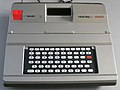 Philips Videopac+ G7400 video game console (1983)
 -
 Philips SE246 cordless phone
 -
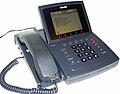 Philips screenphone (2009)
 -
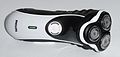 Philips electric razor, 2010


.jpg)


Inventions
[edit]Compact Cassette
[edit]In 1962 Philips invented the compact audio cassette medium for audio storage. Although there were other magnetic tape cartridge systems, the Compact Cassette became dominant as a result of Philips's decision to license the format free of charge.
Laserdisc
[edit]Laserdisc was a 30 cm disc designed with MCA meant to compete with VHS and even replace it. While not as generally popular as VHS, due to the initial investment costs of players, somewhat higher costs of movie titles, the initial read-only format and early manufacturing issues, it eventually enjoyed extensive success among serious video collectors, like its contemporaneous rival Betamax. The technologies created for Laserdisc would later be used again for the Compact Disc.
Compact Disc (CD)
[edit]Although Philips' and MCA's Laserdisc project never reached the VHS mass market level, Philips still thought the format should be able to succeed, and, in collaboration with Sony, launched the smaller CD in 1982.


DVD
[edit]The DVD (Digital Versatile Disc or Digital Video Disc), the eventual successor of the CD (Compact Disc), met a long road of setbacks. Philips wanted to continue with the CD in a new format called MultiMedia Compact Disc (MMCD), while another group (led by Toshiba) was developing a competing format, then named Super Density (SD) disc. Their representatives approached IBM for advice on the file system. IBM also learned of Philips' and Sony's initiative. IBM convinced a group of computer industry experts (among them Apple, Dell, etc.) to form a working group. The Technical Working Group (TWG) voted to boycott both formats unless they merged to prevent another format war (like the videotape format war). The result was the DVD specification, finalized in 1995. The DVD video format was first introduced in Japan in 1996, later in 1997 in the U.S. as limited test run, then across Europe and the other continents from late 1998 onwards.
Blu-ray Disc
[edit]Blu-ray Disc, yet again primarily developed by Philips and Sony, utilizes blue-violet coloured diodes to create an even shorter wavelength beam than CD or DVD. Because of this, the capacity is much more than that of CD or DVD, being 25 GB single-layered or 50 GB dual-layered.
References
[edit]- ^ a b Meijer, Bart H. (25 Mar 2021). "Philips sells appliances arm to China's Hillhouse for 3.7 bln euros". Reuters. Retrieved 14 Oct 2024.
- ^ a b Pooler, Michael (13 Sep 2020). "Transforming an electronics group". Financial Times. Retrieved 14 Oct 2024.
- ^ a b Mitra, Sounak (11 Dec 2014). "40 years ago...And now: Putting the lighting effects back on Philips". Business Standard.
- ^ Kaushik, Manu (30 Sep 2012). "Case study: Will Philips' attempt at repositioning its products work?". Business Today.
- ^ EETimes (2008-04-08). "Philips offloads US TV operation to Funai". EE Times. Retrieved 2024-10-14.
- ^ "Philips plans China TV license deal with TPV". Reuters. 19 Aug 2010.
- ^ "Philips spins off TV unit to HK's TPV Technology - Taipei Times". www.taipeitimes.com. 2012-04-03. Retrieved 2024-10-14.
- ^ Hayman, Pete (2014-01-21). "Philips to sell remaining stake in TV business to TP Vision". whathifi. Retrieved 2024-10-14.
- ^ "Philips to transfer its Audio, Video, Multimedia and Accessories business to Funai".
- ^ "Philips transfers lifestyle unit to Funai Electric for $202M".
- ^ "2014-5-20 | FY2014 | News Center | FUNAI ELECTRIC CO., Ltd".
- ^ "Philips Domestic Appliances becomes Versuni". BusinessWire.
- ^ "Versuni India, formerly Philips Domestic Appliances, opens manufacturing facility in Gujarat, to 1,000-plus jobs". The Times of India. 2024-01-03. ISSN 0971-8257. Retrieved 2024-10-14.
- ^ "Hillhouse said to consider India IPO for home appliance maker". MoneyControl. 3 May 2024.
- ^ "Our products | Versuni". www.versuni.com. Retrieved 2024-10-14.
- ^ "Waarom stopt Philips met zelf televisies maken?". de Volkskrant. 18 April 2011. Retrieved 18 April 2011.
- ^ Philipcscdi.com, History of Philips CD-i
- ^ "How can papers afford to give away DVDs?", news.bbc.co.uk, The BBC, 11 October 2005. Retrieved on 29 July 2007.
External links
[edit]| Divisions and subsidiaries |
| ||||
|---|---|---|---|---|---|
| Joint ventures and shareholdings |
| ||||
| Brands, products and standards |
| ||||
| People | |||||
| Places | |||||
| Related topics | |||||

