


Pingyao
Pingyao Ancient City
平遥古城 | |
|---|---|
 | |
  Pingyao Location in Shanxi | |
| Coordinates: 37°12′N 112°9′E / 37.200°N 112.150°E | |
| Country | China |
| Province | Shanxi |
| Prefecture | Jinzhong |
| County | Pingyao |
| Time zone | UTC+8 (China Standard) |
| Postal code | 031100 |
| Area code | 0354 |
| Website | www |
| Official name | Ancient City of Ping Yao |
| Type | Cultural |
| Criteria | ii, iii, iv |
| Designated | 1997 (21st session) |
| Reference no. | 812 |
| Region | Asia-Pacific |
| Extensions | 2000; 2001 |
| Pingyao | |||||||||||||||||||||
|---|---|---|---|---|---|---|---|---|---|---|---|---|---|---|---|---|---|---|---|---|---|
.svg) | |||||||||||||||||||||
| Traditional Chinese | 平遙 | ||||||||||||||||||||
| Simplified Chinese | 平遥 | ||||||||||||||||||||
| Literal meaning | remote plain | ||||||||||||||||||||
| |||||||||||||||||||||
| Alternative Chinese name | |||||||||||||||||||||
| Simplified Chinese | 平遥古城 | ||||||||||||||||||||
| Literal meaning | Pingyao Ancient City | ||||||||||||||||||||
| |||||||||||||||||||||
Pingyao, officially Pingyao Ancient City,[1] is a walled city in central Shanxi, China, famed for its importance in Chinese economic history and for its well-preserved Ming and Qing urban planning and architecture. Administratively, it comprises the town of Gutao in Pingyao County, Jinzhong. According to the seventh Chinese census data, the permanent resident population of the county is 450,697. Compared with the 502,712 people in the sixth national census in 2010, it has decreased by 52,015 people in ten years, a decrease of 10.35%, and the average annual growth rate is -1.09%.[2]
The town was founded in the 14th century C.E. and has been the seat of local government since at least the Qin. By the 16th century, it was a regional financial hub; some consider it to have been the financial centre of the Qing Empire in the late 19th century. It is a AAAAA-rated tourist attraction, and the settlement and the outlying Zhenguo Temple and Shuanglin Temple became a World Heritage Site in 1997.[3]
History[edit]
There was already a settlement in place at Pingyao by the reign of the Xuan King (r. c. 827 – c. 782 BC), when the Zhou raised earthen ramparts around the site.[4]
In the Spring and Autumn period, the county belonged to the kingdom of Jin. It was part of the kingdom of Zhao in the Warring States period. Under the Qin, it was known as Pingtao. During the Han Dynasty, it was known as the seat of Zhongdu County.
Pingyao served as the financial center of the region from the 16th century and of the entire Qing Empire during the late 19th century.[4] During those times, there were more than 20 financial institutions within the city,[5] comprising more than half of the total in the whole country. Rishengchang was the first and largest, controlling almost half of China's silver trade under the late Qing before going bankrupt in 1914 in the aftermath of the Xinhai Revolution.
Organized restorations have been undertaken periodically since the 15th century, the most recent phase beginning in 1979.[4] In 1986, China designated Pingyao as one of the Chinese Historical and Cultural Cities. In 2004, part of the southern walls collapsed; they have since been reconstructed.[citation needed] In 2015, Pingyao ancient city became a national 5A-class tourist attraction.
Geography[edit]
Pingyao is located on the east bank of the Fen River near the southwestern edge of the Taiyuan Basin. It is approximately 100 km (62 mi) south of central Taiyuan and 715 km (444 mi) southwest of Beijing, the national capital. Pingyao County is adjacent to Qi County, whose seat is also a protected historical and cultural city.
Climate[edit]
The climate of Pingyao is temperate. It is cold in winter, often having northwestern winds with little snow and severe fog. In the spring, the temperature varies greatly between day and night, with a little rain and some winds. Summertime is often hot, humid and rainy. Autumn days have falling temperatures with little rain and are cool and clear with abundant sunshine.
| Climate data for Pingyao, elevation 780 m (2,560 ft), (1991–2020 normals, extremes 1981–2010) | |||||||||||||
|---|---|---|---|---|---|---|---|---|---|---|---|---|---|
| Month | Jan | Feb | Mar | Apr | May | Jun | Jul | Aug | Sep | Oct | Nov | Dec | Year |
| Record high °C (°F) | 13.6 (56.5) |
22.2 (72.0) |
29.3 (84.7) |
37.3 (99.1) |
38.0 (100.4) |
41.1 (106.0) |
39.6 (103.3) |
37.7 (99.9) |
37.5 (99.5) |
30.3 (86.5) |
24.3 (75.7) |
17.5 (63.5) |
41.1 (106.0) |
| Mean daily maximum °C (°F) | 2.8 (37.0) |
7.3 (45.1) |
14.0 (57.2) |
21.4 (70.5) |
26.9 (80.4) |
30.4 (86.7) |
31.0 (87.8) |
29.1 (84.4) |
24.5 (76.1) |
18.5 (65.3) |
10.7 (51.3) |
3.9 (39.0) |
18.4 (65.1) |
| Daily mean °C (°F) | −4.4 (24.1) |
−0.5 (31.1) |
6.3 (43.3) |
13.5 (56.3) |
19.3 (66.7) |
23.2 (73.8) |
24.7 (76.5) |
22.8 (73.0) |
17.5 (63.5) |
11.0 (51.8) |
3.6 (38.5) |
−2.6 (27.3) |
11.2 (52.2) |
| Mean daily minimum °C (°F) | −9.9 (14.2) |
−6.4 (20.5) |
−0.3 (31.5) |
6.0 (42.8) |
11.5 (52.7) |
16.2 (61.2) |
19.2 (66.6) |
17.6 (63.7) |
12.0 (53.6) |
5.3 (41.5) |
−1.7 (28.9) |
−7.6 (18.3) |
5.2 (41.3) |
| Record low °C (°F) | −22.4 (−8.3) |
−24.1 (−11.4) |
−13.2 (8.2) |
−8.5 (16.7) |
−1.9 (28.6) |
5.3 (41.5) |
11.3 (52.3) |
8.3 (46.9) |
−0.7 (30.7) |
−8.0 (17.6) |
−21.9 (−7.4) |
−22.1 (−7.8) |
−24.1 (−11.4) |
| Average precipitation mm (inches) | 2.2 (0.09) |
4.3 (0.17) |
9.3 (0.37) |
26.1 (1.03) |
30.2 (1.19) |
42.4 (1.67) |
97.6 (3.84) |
90.9 (3.58) |
58.5 (2.30) |
32.4 (1.28) |
11.8 (0.46) |
2.4 (0.09) |
408.1 (16.07) |
| Average precipitation days (≥ 0.1 mm) | 2.3 | 2.6 | 3.6 | 5.3 | 6.2 | 9.1 | 11.3 | 10.2 | 8.1 | 6.2 | 3.7 | 1.6 | 70.2 |
| Average snowy days | 3.0 | 3.6 | 2.1 | 0.6 | 0 | 0 | 0 | 0 | 0 | 0.1 | 1.9 | 2.7 | 14 |
| Average relative humidity (%) | 52 | 49 | 46 | 47 | 47 | 55 | 68 | 73 | 72 | 67 | 60 | 53 | 57 |
| Mean monthly sunshine hours | 149.2 | 166.8 | 201.9 | 226.0 | 248.3 | 224.9 | 213.0 | 199.7 | 177.3 | 180.4 | 161.3 | 150.5 | 2,299.3 |
| Percent possible sunshine | 48 | 54 | 54 | 57 | 56 | 51 | 48 | 48 | 48 | 53 | 53 | 51 | 52 |
| Source: China Meteorological Administration[6][7] | |||||||||||||
Architecture[edit]
Pingyao still retains its urban layout from the Ming and Qing dynasties,[4] conforming to a typical ba gua pattern. More than 300 sites in or near the city have ancient ruins.[citation needed] The city has over a hundred streets and lanes, lined with close to 4,000 17th–19th century shops and residences.[3] The streets and storefronts still largely retain their historical appearance.
The city walls of Pingyao were constructed in 1370,[4] the 3rd year of the Hongwu Emperor of the Ming. They enclose an area of about 2.25 km2 (0.87 sq mi).[4] The town is accessed by six barbican gates, one each on the north and south walls and two each on the east and west walls. This pattern is similar to that of a turtle (the head, tail and four legs), earning Pingyao the moniker "Turtle City." The walls measure about 12 m (39 ft) high, with a perimeter of 6,163 m (20,220 ft). A 4 m wide and 4 m (13 ft) deep moat can be found just outside the walls. Aside from the four structured towers at the four corners, there are also 72 watchtowers and more than 3,000 battlements. The number of defensive works supposedly represents the number of Confucius's disciples and other students.[5] The walls are considered among the best-preserved ancient city walls on this scale.
Demographics[edit]
As of 2009, Pingyao had a population of 48,531 people living in 16,634 households. 12,132 residents held local hukous and 36,399 were from other parts of China.[8]
Governments[edit]
Pingyao Ancient City and its environs are organized as the town of "Gutao", the seat of Pingyao County. Gutao directly oversees 10 administrative villages:[9]
| Villages | ||||
|---|---|---|---|---|
| Name | Simp. | Trad. | Pinyin | Meaning |
| Dongcheng | 东城村 | 東城村 | Dōngchéngcūn | East City Village |
| Xicheng | 西城村 | 西城村 | Xīchéngcūn | West City Village |
| Nancheng | 南城村 | 南城村 | Nánchéngcūn | South City Village |
| Beicheng | 北城村 | 北城村 | Běichéngcūn | North City Village |
| Gankeng | 干坑村 | 干坑村 | Gānkēngcūn | |
| Shijiujie | 十九街村 | 十九街村 | Shíjiǔjiē Cūn | 19-Street Village |
| Chengnanbao | 城南堡村 | 城南堡村 | Chéngnánbǎo Cūn | Southern Rampart Village |
| Xinnanbao | 新南堡村 | 新南堡村 | Xīnnánbǎo Cūn | New Southern Rampart Village |
| Xinzhuang | 新庄村 | 新莊村 | Xīnzhuāngcūn | |
| Yanbi | 闫壁村 | 閆壁村 | Yánbìcūn | |
Economy[edit]
As of 2009, the town had a labour pool of 19,059 people. 3,811 farmers worked 9977 mu (613 ha or 1,510 acres) of arable land, producing 33.7m RMB of crops, livestock, and other goods. The local focus is on increased mechanization and working the available land intensively.[8] The area is well known for its beef[10] and also produces grain and cotton.[citation needed] The rest of the workforce is divided between industry and the service sector, particularly tourism. Industry produced 840m RMB and was focused on improving the energy efficiency of its practices.[8] A local specialty is lacquerware.[citation needed] The service sector, including tourism, produced less income than industry—790m RMB–but was growing rapidly and marked for special focus by local government.[8]
Tourism[edit]

Increases in tourism have put pressure on Pingyao. During China's Golden Weeks, the number of visitors to the city has sometimes been as high as 2½ times its planned maximum capacity. During the single week around May Day in 2007, the town made about 94.5m RMB from visiting tourists.[11]
Since that high point in 2007, the government has reduced the number and length of China's "golden weeks", spreading domestic tourism more equitably throughout the year. The Global Heritage Fund has also worked with the Pingyao County People's Government to protect the town against overdevelopment and damage from its high volume of visitors. The stated goal for their Pingyao Cultural Heritage Development Program is improved preservation of local vernacular architecture and traditional arts through improved planning and increased conservation efforts.[12]
Culture[edit]
Local specialties include Pingyao beef (平遥牛肉, Píngyáo niúròu) and wantuo (平遥碗托, Píngyáo wǎntuō), a favourite of the Empress Dowager Cixi.[10] Other local products are Changshengyuan rice wine (长升源黄酒), bean flour minjian (豆面抿尖),[citation needed] and Jiupian (揪片).
The silver merchants of Pingyao in the early 20th century were the subject of the 2009 film Empire of Silver.
Gallery[edit]
-
 Market Tower, constructed in 14th century
 -
 Pingyao's Confucius Temple
 -
 A statue inside the Shuanglin Temple in Pingyao
 -
 A street in Pingyao
 -
 City walls of Pingyao
 -
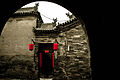 A door in a courtyard with red Chinese lanterns
 -
 Roof architecture


References[edit]
- ^ "Pingyao Ancient City", Scenic Spots, Taiyuan: Shanxi Provincial Tourism Bureau, 2012, archived from the original on 2017-07-18, retrieved 2017-11-20.
- ^ Pingyao County Bureau of Statistics (June 9, 2021). "平遥县第七次全国人口普查公报" [Bulletin of the Seventh National Population Census of Pingyao County]. Pingyao Government Network.
- ^ a b "Ancient City of Ping Yao", World Heritage Center, Paris: United Nations Educational, Scientific, and Cultural Organization, retrieved 19 Nov 2017.
- ^ a b c d e f "World Heritage List: Ping Yao (China), № 812", World Heritage Center, Paris: United Nations Educational, Scientific, and Cultural Organization, 26 July 1996, pp. 10–1.
- ^ a b "平遥古城", Scenic Spots, Taiyuan: Shanxi Provincial Tourism Bureau, 2012, archived from the original on 2017-07-18, retrieved 2017-11-20.
- ^ 中国气象数据网 – WeatherBk Data (in Simplified Chinese). China Meteorological Administration. Retrieved 26 August 2023.
- ^ 中国气象数据网 (in Simplified Chinese). China Meteorological Administration. Retrieved 26 August 2023.
- ^ a b c d "古陶镇基本情况", Official site, Pingyao: Pingyao County People's Government, 17 December 2009, archived from the original on 17 September 2009, retrieved 16 October 2009.
- ^ "走进平遥: Township Profile", Official site, Pingyao County People's Government, archived from the original on 17 September 2009, retrieved 20 Nov 2017. (in Chinese)
- ^ a b "A Bite of Shanxi", Scenic Spots, Taiyuan: Shanxi Provincial Tourism Bureau, archived from the original on 18 July 2017, retrieved 20 Nov 2017.
- ^ Zhuang Pinghui (9 May 2007), "Tourist Crowds Threaten Heritage", South China Morning Post, Hong Kong: SCMP Group.
- ^ "Pingyao Overview", Official site, Global Heritage Fund.
External links[edit]


- Official website of Pingyao County Government (in Chinese)
- Pingyao preservation project summary at Global Heritage Fund
- Explore Pingyao with Google Earth on Global Heritage Network
- UN World Heritage - Pingyao
- Well illustrated guide to Pingyao


| East |
|  |
|---|---|---|
| South Central |
| |
| Southwestern | ||
| North | ||
| Northeast | ||
| Northwestern | ||
| Multiple regions | ||
| International | |
|---|---|
| National | |
