


Saint Louis Zoo
| Saint Louis Zoo | |
|---|---|
 Saint Louis Zoo logo | |
 South entrance | |
 | |
| 38°38′06″N 90°17′24″W / 38.635°N 90.290°W | |
| Date opened | 1910 |
| Location | Forest Park St. Louis, Missouri |
| Land area | 90 acres (36 ha)[1] |
| No. of animals | 18,700[1] |
| No. of species | 603+[1] |
| Annual visitors | 3 million[2] |
| Memberships | AZA[3] |
| Public transit access |  MetroBus MetroBus |
| Website | www |
The Saint Louis Zoo, officially known as the Saint Louis Zoological Park, is a zoo in Forest Park, St. Louis, Missouri. It is recognized as a leading zoo in animal management, research, conservation, and education. The zoo is accredited by the Association of Zoos and Aquariums (AZA). Admission is free based on a public subsidy from a cultural tax district, the Metropolitan Zoological Park and Museum District (ZMD); fees are charged for some special attractions. A special feature is the 2 ft (610 mm) narrow-gauge Emerson Zooline Railroad with passenger trains pulled by Chance Rides C.P. Huntington locomotives that encircle the zoo, stopping at the more popular attractions.[4]
The city purchased its first exhibit, the Flight Cage, from the Smithsonian Institution following the 1904 St. Louis World's Fair. After the zoo was established in 1910, new exhibits, areas, and buildings were added through the decades to improve care of the animals, the range of animals and habitats shown, and education and interpretation. The head of the male lesser kudu, with his elegant spiraled horns, is the symbol of the Saint Louis Zoo.
In September 2017, the Saint Louis Zoo teamed up with the Missouri Botanical Garden and Washington University in St. Louis in a conservation effort known as the Living Earth Collaborative.[5] The collaborative, run by Washington University scientist Jonathan Losos, seeks to promote further understanding of the ways humans can help to preserve the varied natural environments that allow plants, animals, and microbes to survive and thrive.[6] Some of their other ongoing conservation efforts include the #byetobags movement, encouraging the use of reusable bags, and their turtle-tracking program, which tracks location, population, and health of the box turtle population of Forest Park.
In 2017 and 2018, the zoo was chosen by USA Today as the best in the United States.[7]
History[edit]
The early years[edit]

The 1904 St. Louis World's Fair is credited for the birth of the Saint Louis Zoo. The fair brought the world's attention to St. Louis and Forest Park. The Smithsonian Institution constructed a walk-through aviary for the World's Fair. Ten days after the World's Fair closed, the citizens of St. Louis chose to buy the 1904 World's Fair Flight Cage for $3,500, rather than have it dismantled and returned to Washington, DC. This was the first piece of what would become the Saint Louis Zoo.
By 1910, increased interest in a zoo brought together some concerned citizens, and they organized the Zoological Society of St. Louis. In 1914, it was incorporated as an independent civic organization of people interested in a zoo. Meanwhile, the citizens of St. Louis and surrounding municipalities expressed diverse opinions as to the appropriate location of a zoo if there should be one. Fairground Park, Carondolet Park, the Creve Coeur area, and Tower Grove Park were some of the places suggested in newspaper articles and letters to the editors and to civic groups. Some concerned citizens residing near Oakland Avenue, south of Forest Park, expressed their displeasure with a zoo in the park because of the smell of the animals.
The zoo initially held 51 deer and antelope, 11 buffaloes, a sacred cow, a sandhill crane, 20 prairie dogs, a dromedary camel, eagles, ducks, elk, foxes, geese, swans, rabbits, a raccoon, a China sheep, opossums, a buzzard, owls, and peafowl, among other animals.[8] The head of the Parks Department, Dwight Davis, voiced his opinion against Forest Park—that is, until the city set aside 77 acres (31 ha) in the park in which to establish a zoological park. A five-man board was appointed to act as the Zoological Board of Control.
The number of board members was increased to nine in 1916, the same year the citizens voted to create a tax for the construction of the Saint Louis Zoo, with a 1/5 mill tax. This was said to have been the first zoo in the world that the citizens of a community supported by passing a millage tax.
1920 through 1969[edit]

Expansion of the zoo started in 1921, when the Bear Pits were built. The zoo continued to expand with construction of the Primate House in 1923 and the Reptile House in 1927.[9]
The new Bird House was built in 1930.[9] With the coming of the Great Depression, revenues were down and construction of new exhibits slowed at the zoo.[9] In 1935, the Antelope House was built with the help of the Civil Works Administration, a program of President Franklin D. Roosevelt's New Deal.[9] This burst of construction ended in 1939 with the addition of the Ape House.[9] In 1939, the zoo acquired two giant pandas.[9] Their names were Happy and Pao Pei. Happy died in 1945 and Pao Pei in 1952.
The Stupp Memorial Pheasantry and the lion arena, now the Sea Lion Arena, were built in 1954.[9] Three years later, the Elephant House and its arena and moated yards were constructed.[9]
Major construction started on the zoo again in 1971 when the Aquatic House was built.[9] It continued with the opening of the Emerson Zooline Railroad in 1963, the Charles H. Yalem Children's Zoo, and the animal nursery in 1969.[9]
1971 through present[edit]

In 1972, the zoo joined the Metropolitan Zoological Park and Museum District and began to receive revenue from a public property tax of 8 cents for every $100 assessed. This enabled continued improvements and upgrades of exhibit areas. Two major areas of the zoo, Big Cat Country and Jungle of the Apes, were constructed in 1976 and 1986, respectively.[9]
In 1989, the Living World, a two-story building including classrooms, a reference library and teacher resource center, an auditorium, two exhibit halls emphasizing evolution and ecology, a large gift shop, a restaurant, and offices was built.[9] It was designed by Hellmuth, Obata and Kassabaum.[10]
In 1993, the zoo received a donation of the 355 acres (1.44 km2) Sears Lehmann farm, located west of St. Louis. It is to be used for the breeding of endangered species and educational purposes.[9]
In 1998, new areas were added with the Emerson Children's Zoo. Phase I of River's Edge, which opened in 1999, represented Asia: featuring Asian elephants, cheetahs, dwarf mongoose, and hyenas.[9]

In 2000, the Monsanto Insectarium, now called the Bayer Insectarium, including the Butterfly House, was built.[9] The North America (Missouri and Mississippi Rivers) portion of River's Edge opened in 2001. In 2002, the third phase, featuring habitats of South America and Africa, opened with hippos, rhinos, warthogs, carmine bee-eaters, capybaras, and giant anteaters.
In 2003, the Penguin and Puffin Coast opened with both outdoor and indoor exhibits. Also new that year was the Mary Ann Lee Conservation Carousel, featuring unique hand-carved wooden animals representing endangered species at the Saint Louis Zoo. The Donn and Marilyn Lipton Fragile Forest opened in 2005. Caribbean Cove, which features stingrays, opened in 2008.[9]

In 2010, the zoo started The Living Promise Campaign, a project that promised to raise $120 million to improve the zoo. In 2015, the zoo opened Polar Bear Point, a $16 million facility that includes different landscapes and exhibits about the polar bear's relationship with the Arctic ecosystem. Its first resident is named Kali, an orphaned polar bear donated to the zoo by the U.S. Fish and Wildlife Service. In 2017, the zoo added Centene Grizzly Ridge, an $11.1 million, 7,000 sq ft state-of-the-art habitat that replaced the bear grottoes built in 1921, which were used until 2015 when they were closed for the construction of Grizzly Ridge. Grizzly Ridge opened 15 September 2017 and is now home to two orphaned grizzlies from Montana. Huckleberry, or Huck, and his sister Finley were given to the zoo by the U.S. Fish and Wildlife Service. By the end of the project in 2014, the zoo had exceeded this goal by $14 million, which funded not only Grizzly Ridge or Polar Bear Point, but also Sea Lion Sound (a new and improved way of viewing the sea lions, including a walk-through tunnel), and improvements to other areas of the zoo such as Peabody Hall and River's Edge, among others.[11]
The most recent update to the zoo is the addition of the Michael and Quirsis Riney Primate Canopy Trails, a $13 million, 35,000 sq ft state-of-the-art outdoor exhibit for the zoo's primates. Primate Canopy Trails opened 12 July 2021 and is connected to the nearby Primate House built in 1925.[12] It replaced some of the outside primate habitats connected to the Primate House.
In 2013, the Saint Louis Zoo began a massive expansion of facilities and space for both visitors and staff. Most notable is a new development planned on 13.5 acres on the grounds of the former Forest Park Hospital, across Interstate 64 from the zoo campus. Once completed, the new facility would feature offices and classrooms, year-round exhibits, a mixed-use development that will link the complex with the adjacent Dogtown neighborhood, and an "iconic" connection of the two sites over Interstate 64. Most importantly, it was to shift all parking to the hospital site, freeing up roughly nine acres currently used as a surface lot for additional exhibits.[13] In June 2022, a five-year-old eastern black rhinoceros named Moyo was permanently transferred to Alabama's Birmingham Zoo to eventually develop his own family.[14] Unfortunately in late January 2024, Moyo suffered severe complications after a dental procedure. The zookeepers euthanized him afterwards.[15]
The St. Louis Zoo is currently developing a second campus in north St. Louis County, with a target opening date of 2027.[16] This $230 million, 425-acre campus will be called the St. Louis Zoo Wildcare Park and focus on endangered ungulate species and enormous habitats.[16] The proposed initial list of animals includes Giraffe, Grevy's zebra, Greater kudu, Addax, Bongo, Roan antelope, Somali wild ass, Przewalski's horse, Scimitar-horned oryx, Waterbuck, Nile lechwe, Banteng, various Gazelle species, Southern white rhinoceros, Eland, Sable antelope, Bactrian camel, and Ostrich. Proposed attractions include safari rides, an observation tower, glamping, and a museum.[16]
In March 2023, the St. Louis Zoo unveiled its first electric C.P. Huntington locomotive, named after Mary Meachum. The Emerson Zooline Railroad will eventually replace its remaining diesel-powered locomotives with the electric model.[17][18]
Zoo directors[edit]

The following people have served as directors of the zoo:[19]
- George P. Vierheller (1922–1962)
- R. Marlin Perkins (1962–1970), who gained fame for the zoo as host of Mutual of Omaha's Wild Kingdom
- William J. Hoff (1970–1973)
- Robert T. Briggs (1973–1975)
- Richard D. Schultz (1975–1982)
- Charles H. Hoessle (1982–2002)
- Dr. Jeffrey P. Bonner (2002–2022)
- Dwight Scott (2022 to present)
Park zones[edit]

The Saint Louis Zoo is divided into six zones: Lakeside Crossing, River's Edge, The Wild, Discovery Corner, Historic Hill, and Red Rocks.
Lakeside Crossing[edit]
Located in the center of the zoo, Lakeside Crossing has a variety of food services and shopping destinations, and a grassy plaza where visitors can sit and relax. Also featured here are Caribbean Cove and Sea Lion Sound. Caribbean Cove is a shallow touch-pool underneath a large pavilion that features cownose rays, southern stingrays, bonnethead sharks, and bamboo sharks. Open during the warmer months, it is one of the only parts of the zoo requiring an admission price.[20] Sea Lion Sound provides an underwater viewing tunnel of California sea lions and three harbor seals.
River's Edge[edit]

River's Edge is home to a variety of animals represented from four continents: North America, South America, Africa (Savannah and Nile), and Asia. The North America exhibit features fish and wildlife from the Missouri and Mississippi Rivers containing crayfish, American bullfrog, channel catfish, gar, and bluegill. The South America exhibit displays spectacled bears, bush dogs, capybaras, giant anteaters, and scarlet macaws.
The African Savanna exhibit displays eastern black rhinoceroses, African wild dogs, African sacred ibis, bat-eared foxes, red river hogs, and a colony of Southern carmine bee-eaters. The African Nile exhibit features hippopotamuses, tilapia, cheetahs, spotted hyenas, and a colony of dwarf mongoose. The Asia exhibit features adult Asian elephants and sun bears.
Discovery Corner[edit]
Discovery Corner is home to Emerson Dinoroarus and the Bayer Insectarium. Prior to its replacement with Dinoroarus in 2021, the Emerson Children's Zoo had many educational features, such as the see-through slide through the otter pool and many birds, snakes, frogs, and other animals that volunteers and staff bring out for the kids to see up close.[21] Dinoroarus is one of the only exhibits at the Zoo that requires an admittance fee. As of March 2016, the zoo has Tasmanian devils in this section.
Most of the zoo's invertebrates are found in the Bayer Insectarium. Represented species include leafcutter ant, flower mantis, Vietnamese walking stick, Atlas beetle, American burying beetle, sunburst diving beetle, water scorpion, brown widow spider, brown recluse spider, yellow garden spiders, Platymeris biguttatus, cobalt blue tarantula, Texas brown tarantula, and Egyptian fattail scorpion.
The Wild[edit]
The Wild is home to Grizzly Ridge, Polar Bear Point, Conservation Carousel, Fragile Forest, Jungle of the Apes, and Penguin and Puffin Coast. Polar Bear Point features a polar bear called Kali. Two grizzly bears named Huck and Finn arrived for the opening of Grizzly Ridge in 2017. The Fragile Forest and Jungle of the Apes features western lowland gorillas, chimpanzees and Sumatran orangutans in a naturalized outdoor setting. Penguin and Puffin Coast displays a variety of water birds including Magellanic penguins, king penguins, southern rockhopper penguins, gentoo penguins, horned puffins, tufted puffins, and king eiders. Individual habitats for red pandas and black-tailed prairie dogs are also in The Wild.
Historic Hill[edit]
.jpg)

Historic Hill contains Bird House, Bird Garden, Herpetarium, Chain of Lakes, Flight Cage and Cypress Swamp, Primate House, and Primate Canopy Trails. The Bird House features birds as varied as bald eagle, rhinoceros hornbill, hyacinth macaw, burrowing owl, toco toucan, Cape thick-knee, golden pheasant, kookaburra, Mariana fruit-dove, king vulture, horned guan, superb starling, tawny frogmouth, congo peafowl, and the Guam kingfisher, which is extinct in the wild. The Bird Garden contains outdoor bird enclosures.
The Herpetarium houses most of the zoo's reptiles and amphibians, including the critically endangered Jamaican iguana, Chinese alligator, McCord's box turtle, Panamanian golden frog, and Arakan forest turtle. Other species include the Komodo dragon, green anaconda, mountain chicken, spotted turtle, false gharial, king cobra, Gila monster, frill-necked lizard, Aldabra giant tortoise, tuatara, reticulated python, tiger salamander, three-toed amphiuma, pancake tortoise, and over two dozen species of pit vipers from around the world.
The Chain of Lakes is a series of small enclosures between the Bird House and the Herpetarium and Primate House, where the zoo's North American river otters and alligator snapping turtles reside. In 1904, the Flight Cage was the largest bird cage ever built, and is still one of the world's largest free-flight aviaries at 228 feet (69 m) long, 84 feet (26 m) wide, and 50 feet (15 m) high. The Cypress Swamp is dedicated to North American birds found it the cypress swamps of the southern Mississippi River. Among the birds in the aviary are black-crowned night heron, blue-winged teal, bufflehead duck, cattle egret, double-crested cormorant, great egret, wood duck, northern bobwhite, roseate spoonbill, snowy egret, and American white ibis. Primate House and Primate Canopy Trails is home to the zoo's monkeys and lemurs. Species included are Allen's swamp monkey, Coquerel's sifaka, cotton-top tamarin, black-and-white colobus monkey, mongoose lemur, ring-tailed lemur, spectacled langur, and white-faced saki.
Red Rocks[edit]
Red Rocks features Big Cat Country and Antelope House. Big Cat Country is home to several species of big cats. The represented species are the African lion, Amur leopard, Amur tiger, jaguar, puma, and snow leopard.
The species present at Antelope House are the addax, babirusa, Bactrian camel, Banteng, Central Chinese goral, gerenuk, Grevy's zebra, lesser kudu, Nile lechwe, okapi, reticulated giraffe, Sichuan takin, Soemmerring's gazelle, Somali wild ass, Speke's gazelle, and Transcapsian urial. Non-ungulates found in the Red Rocks include the marsupials red kangaroo and tammar wallaby, as well as several birds in mixed-exhibits with the ungulates, such as the East African crowned crane, ostrich, saddle-billed stork and Sarus Crane.
Gallery[edit]
-
 Northeast gate to the zoo
 -
 The original 1904 Flight Cage (Aviary)
 -

-
 An ostrich reacts to a lesser kudu in a shared enclosure in Red Rocks
 -

-
 Two penguins preening
 -
 Male rhinoceros
 -

-
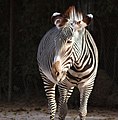 Zebra at Red Rocks
 -
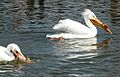 Pelicans in a pond
 -
 Sea lions at exhibit
 -
 Butterfly in Butterfly House


.jpg)


.jpg)

.jpg)

.jpg)
References[edit]
- ^ a b c "About the Saint Louis Zoo". stlzoo.org. St. Louis Zoo. Retrieved 27 January 2012.
- ^ "New Saint Louis Zoo study shows a visit to the zoo is good for your health". Association of Zoos and Aquariums.
- ^ "Currently Accredited Zoos and Aquariums". aza.org. AZA. Retrieved 27 January 2012.
- ^ St. Louis Zoo - Emerson Zooline Railroad
- ^ Jost, Ashley. "Washington U., St. Louis Zoo and Missouri Botanical Garden team up to tackle conservation". stltoday.com. Retrieved 2 August 2019.
- ^ "Our Mission". Living Earth Collaborative. 1 September 2017. Retrieved 2 August 2019.
- ^ "Best Zoo Winners: 2018 10Best Readers' Choice Travel Awards". 10Best. Retrieved 2 August 2019.
- ^ St. Louis Up To Date: The Great Industrial Hive of the Mississippi Valley. Richly Endowed by Nature as a Port of Entry, a Manufacturing Centre, and a Place of Residence. A Glance at Her History, a Review of Her Commerce, and a Description of Her Leading Business Enterprises; With Illustrations of Her Public and Commercial Buildings and Places of Interest. St. Louis, MO: Consolidated Illustrating Company. 1895.
- ^ a b c d e f g h i j k l m n o p "St. Louis Zoo". stlzoo.org. St. Louis Zoo. Retrieved 10 February 2010.
- ^ "George Hellmuth". city of St. Louis. Retrieved 15 January 2020.
- ^ "Centene Grizzly Ridge". Saint Louis Zoo. Saint Louis Zoo. Retrieved 22 May 2018.
- ^ "Michael and Quirsis Riney Primate Canopy Trails To Open July 12, 2021". Saint Louis Zoo. Saint Louis Zoo. Retrieved 25 August 2022.
- ^ "Framework Plan 2013" (PDF). Saint Louis Zoo. Archived from the original (PDF) on 6 September 2015. Retrieved 7 June 2017.
- ^ "Saint Louis Zoo hopes their black rhino creates a family in Alabama". 28 July 2022.
- ^ Beloved Birmingham Zoo Eastern Black Rhinoceros passes away
- ^ a b c "Saint Louis Zoo WildCare Park Updates". Saint Louis Zoo. Retrieved 24 January 2023.
- ^ Hahn, Valerie Schremp. "St. Louis Zoo unveils first electric train for its railroad". STLtoday.com. Retrieved 29 March 2023.
- ^ Skrivan, Laurie. "Photos: The St. Louis Zoo debut's first electric train, the Mary Meachum". STLtoday.com. Retrieved 29 March 2023.
- ^ "Dr. Jeffrey P. Bonner, Dana Brown President & CEO". St. Louis Zoo. Retrieved 16 November 2013.
- ^ St. Louis Zoo: Stingrays at Caribbean Cove
- ^ "Visiting the St. Louis Zoo". About.com. Archived from the original on 5 April 2017. Retrieved 16 November 2013.
External links[edit]

- Official website
- "Saint Louis Zoo photographs". University of Missouri–St. Louis. Historical Photos
- Saint Louis Zoo on Google Cultural Institute
| International | |
|---|---|
| National | |
