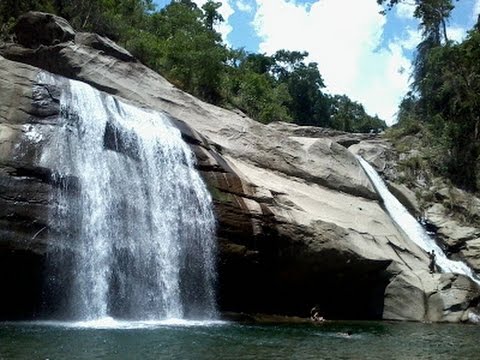
San Gabriel, La Union
 | This article needs additional citations for verification. (August 2013) |
San Gabriel
Baka-Burnotan | |
|---|---|
| Municipality of San Gabriel | |
 San Gabriel Municipal Hall | |
 Flag  Seal | |
| Nickname(s): The Softbroom Capital of the North; Highland Vegetable and Tourism Adventure Paradise of La Union | |
| Motto(s): San Gabriel, Mapangnamnamaan | |
| Anthem: San Gabriel Hymn | |
 Map of La Union with San Gabriel highlighted | |
OpenStreetMap  | |
.svg)  San Gabriel Location within the Philippines | |
| Coordinates: 16°40′N 120°24′E / 16.67°N 120.4°E | |
| Country | Philippines |
| Region | Ilocos Region |
| Province | La Union |
| District | 1st district |
| Founded | 1947 |
| Named for | Saint Gabriel |
| Barangays | 15 (see Barangays) |
| Government | |
| • Type | Sangguniang Bayan |
| • Mayor | Lany B. Carbonell |
| • Vice Mayor | Ramolito Guinomma |
| • Representative | Paolo Ortega |
| • Municipal Council | Members |
| • Electorate | 13,202 voters (2022) |
| Area | |
| • Total | 129.87 km2 (50.14 sq mi) |
| Elevation | 150 m (490 ft) |
| Highest elevation | 635 m (2,083 ft) |
| Lowest elevation | 5 m (16 ft) |
| Population (2020 census)[4] | |
| • Total | 18,943 |
| • Density | 150/km2 (380/sq mi) |
| • Households | 4,381 |
| Economy | |
| • Income class | 4th municipal income class |
| • Poverty incidence | 5.79 |
| • Revenue | ₱ 115.7 million (2020) |
| • Assets | ₱ 395.7 million (2020) |
| • Expenditure | ₱ 121.2 million (2020) |
| • Liabilities | ₱ 55.76 million (2020) |
| Service provider | |
| • Electricity | La Union Electric Cooperative (LUELCO) |
| Time zone | UTC+8 (PST) |
| ZIP code | 2513 |
| PSGC | |
| IDD : area code | +63 (0)72 |
| Native languages | Ilocano Tagalog |
| Website | https://www.sangabriellaunion.gov.ph/government |
San Gabriel , officially the Municipality of San Gabriel (Ilocano: Ili ti San Gabriel; Filipino: Bayan ng San Gabriel), is a 4th class municipality in the province of La Union, Philippines. According to the 2020 census, it has a population of 18,943 people.[4]
Etymology[edit]
The name of the town derived from the patron saint Gabriel.
History[edit]
San Gabriel was formerly known as sitio “Baka-Burnotan”, derived from “binnornutan” (English: "tug-of-war"). The sitio was the meeting place of both Christians and pagan Kankanaey settlers from nearby sitios to graze their cattle while playing the game. The name was later shortened to "burnotan". The wide plain and fertile soil attracted Christian and pagan settlers, who later intermarried which led to the increase in population.[6]
On April 19, 1897, a Roman Catholic priest Father Redondo established a church in the area and introduced the patron saint to be Saint Gabriel, from which the town was later named.[6]
In 1906, San Gabriel was made into a township under the sub-province of Amburayan in Mountain Province, with the first Presidente being Don Pablo Waggay. The township was converted into a municipal district of Amburayan in 1920, and into a municipality in 1922, following the settlement of a boundary dispute between La Union and Mountain Province.[6] The municipal district of San Gabriel, along with Sudipen and Pugo, was converted into a regular municipality by virtue of Executive Order No. 72 issued by President Manuel Roxas on July 30, 1947, through the sponsorship of then House Speaker Pro-Tempore Francisco Ortega.[6][7][8] As a result, the fourteen municipalities of La Union, all established under the Revised Administrative Code, were increased to seventeen.[7]
Geography[edit]
San Gabriel is the largest municipality by land area in the province of La Union. One of the landlocked towns of the province, San Gabriel is bounded on the north by Santol with an imaginary line from a point in Ticor following the Malanas River; on the east by the Province of Benguet with an imaginary line from the Bacawayan River Junction going south following a creek to Cabassitan River up to Barangay Duplas of San Juan, southwest by San Juan with an imaginary line from Duplas following the Cabassitan River westward to a point on a concrete monument near the place known as Alangigan and from this monument going north-west making an imaginary line to Sitio Bato crossing the Dayacos River, and on the west by Bacnotan from Sitio Bato to a point in Lacong, from this point going straight with an imaginary line to Ticor, North of Sitio Matagectec, Barangay Lacong.
The town is 17 kilometres (11 mi) from San Fernando and 286 kilometres (178 mi) from Manila.
Barangays[edit]
San Gabriel is politically subdivided into 15 barangays. [9] Each barangay consists of puroks and some have sitios.
- Amontoc
- Apayao
- Balbalayang
- Bayabas
- Bucao
- Bumbuneg
- Daking
- Lacong
- Lipay Este
- Lipay Norte
- Lipay Proper
- Lipay Sur
- Lon-oy
- Poblacion
- Polipol
Climate[edit]
| Climate data for San Gabriel, La Union | |||||||||||||
|---|---|---|---|---|---|---|---|---|---|---|---|---|---|
| Month | Jan | Feb | Mar | Apr | May | Jun | Jul | Aug | Sep | Oct | Nov | Dec | Year |
| Mean daily maximum °C (°F) | 30 (86) |
31 (88) |
32 (90) |
33 (91) |
32 (90) |
31 (88) |
30 (86) |
30 (86) |
30 (86) |
31 (88) |
31 (88) |
31 (88) |
31 (88) |
| Mean daily minimum °C (°F) | 21 (70) |
22 (72) |
23 (73) |
25 (77) |
26 (79) |
26 (79) |
25 (77) |
25 (77) |
25 (77) |
24 (75) |
23 (73) |
22 (72) |
24 (75) |
| Average precipitation mm (inches) | 42 (1.7) |
48 (1.9) |
74 (2.9) |
110 (4.3) |
269 (10.6) |
275 (10.8) |
362 (14.3) |
325 (12.8) |
330 (13.0) |
306 (12.0) |
126 (5.0) |
61 (2.4) |
2,328 (91.7) |
| Average rainy days | 11.2 | 12.0 | 17.1 | 21.2 | 27.1 | 26.8 | 28.1 | 27.0 | 26.0 | 24.5 | 17.7 | 12.4 | 251.1 |
| Source: Meteoblue[10] | |||||||||||||
Demographics[edit]
| Year | Pop. | ±% p.a. |
|---|---|---|
| 1918 | 3,485 | — |
| 1939 | 5,293 | +2.01% |
| 1948 | 5,805 | +1.03% |
| 1960 | 7,546 | +2.21% |
| 1970 | 8,527 | +1.23% |
| 1975 | 9,808 | +2.85% |
| 1980 | 10,248 | +0.88% |
| 1990 | 12,532 | +2.03% |
| 1995 | 13,489 | +1.39% |
| 2000 | 14,909 | +2.17% |
| 2007 | 15,803 | +0.81% |
| 2010 | 16,628 | +1.87% |
| 2015 | 18,172 | +1.71% |
| 2020 | 18,943 | +0.82% |
| Source: Philippine Statistics Authority[11][12][13][14] | ||
In the 2020 census, the population of San Gabriel, La Union, was 18,943 people,[4] with a density of 150 inhabitants per square kilometre or 390 inhabitants per square mile.
Economy[edit]
 | Graphs are unavailable due to technical issues. There is more info on Phabricator and on MediaWiki.org. |
San Gabriel is an agricultural town. In its early days, the people of San Gabriel were engaged mainly in highland farming as their means of livelihood. They produced rice, corn, sweet potatoes, and other root crops. As years passed, crop production decreased due to massive soil erosion in the uplands. Nevertheless, the inhabitants decided to improve their farming techniques and started making terraces. The perseverance of the people in constructing rice terraces and irrigation system along the hills and mountains of San Gabriel caused agricultural productivity to rebound.
Bananas and tiger grass ("Thysanolaena maxina") are also abundant in San Gabriel, which harvests materials for soft broom production on a weekly basis.
Government[edit]
Local government[edit]
San Gabriel, belonging to the first congressional district of the province of La Union, is governed by a mayor designated as its local chief executive and by a municipal council as its legislative body in accordance with the Local Government Code. The mayor, vice mayor, and the councilors are elected directly by the people through an election which is being held every three years.
Elected officials[edit]
| Position | Name |
|---|---|
| Congressman | Francisco Paolo Ortega |
| Mayor | Lany B. Carbonell |
| Vice-Mayor | Ramolito A. Guinomma |
| Councilors | Mario P. Aligo |
| Jerry T. Fernandez | |
| Geoffrey D. Awingan | |
| Mardo A. Bang-oa | |
| Isagani L. Dumaoang | |
| Mauricio P. Canutab | |
| Dominador P. Abuan | |
| Danilo A. Elias JR. |
Tourism[edit]
- Gumayenggeng Falls at Barangay Lipay
- Katebbegan Fall at Barangay Lipay Proper
- Bakes Falls and Lon-oy Spring at Barangay Lon-oy
- Lineng Pool at Poblacion
- Tinnag-Americano Falls at Barangay Polipol
- Tangadan Falls located at Barangay Amontoc[23]
Education[edit]
High schools[edit]
The town has 4 Public High Schools and 1 Private School.
- Saint Gabriel the Archangel High School, former (San Gabriel Academy) is the only private school secondary in the municipality, a Christian School that demands love and discipline from all who join the SGA High School Family.
- Balbalayang National High School
- Lipay Integrated School
- San Gabriel Senior High School
- San Gabriel Vocational High School
Gallery[edit]
-
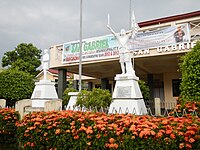 Municipal hall
 -
 Police station
 -
 Town center
 -
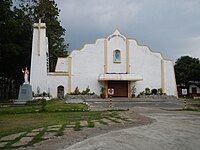
-
 Rural landscape


References[edit]
- ^ https://www.sangabriellaunion.gov.ph/government/elected-officials/
- ^ Municipality of San Gabriel | (DILG)
- ^ "2015 Census of Population, Report No. 3 – Population, Land Area, and Population Density" (PDF). Philippine Statistics Authority. Quezon City, Philippines. August 2016. ISSN 0117-1453. Archived (PDF) from the original on 25 May 2021. Retrieved 16 July 2021.
- ^ a b c Census of Population (2020). "Region I (Ilocos Region)". Total Population by Province, City, Municipality and Barangay. Philippine Statistics Authority. Retrieved 8 July 2021.
- ^ "PSA Releases the 2018 Municipal and City Level Poverty Estimates". Philippine Statistics Authority. 15 December 2021. Retrieved 22 January 2022.
- ^ a b c d "Municipality of San Gabriel". Provincial Government of La Union: Official Website. Retrieved 5 January 2015.
- ^ a b "Executive Order No. 72, s. 1947". Official Gazette (Philippines). Government of the Philippines. 30 July 1947. Retrieved 20 March 2023.
- ^ "Executive Summary (2013)" (PDF). Commission on Audit. Government of the Philippines. 2013. Retrieved 20 March 2023.
- ^ "Province: La Union". PSGC Interactive. Quezon City, Philippines: Philippine Statistics Authority. Retrieved 12 November 2016.
- ^ "San Gabriel: Average Temperatures and Rainfall". Meteoblue. Retrieved 26 April 2020.
- ^ Census of Population (2015). "Region I (Ilocos Region)". Total Population by Province, City, Municipality and Barangay. Philippine Statistics Authority. Retrieved 20 June 2016.
- ^ Census of Population and Housing (2010). "Region I (Ilocos Region)" (PDF). Total Population by Province, City, Municipality and Barangay. National Statistics Office. Retrieved 29 June 2016.
- ^ Censuses of Population (1903–2007). "Region I (Ilocos Region)". Table 1. Population Enumerated in Various Censuses by Province/Highly Urbanized City: 1903 to 2007. National Statistics Office.
{{cite encyclopedia}}: CS1 maint: numeric names: authors list (link) - ^ "Province of La Union". Municipality Population Data. Local Water Utilities Administration Research Division. Retrieved 17 December 2016.
- ^ "Poverty incidence (PI):". Philippine Statistics Authority. Retrieved 28 December 2020.
- ^ "Estimation of Local Poverty in the Philippines" (PDF). Philippine Statistics Authority. 29 November 2005.
- ^ "2003 City and Municipal Level Poverty Estimates" (PDF). Philippine Statistics Authority. 23 March 2009.
- ^ "City and Municipal Level Poverty Estimates; 2006 and 2009" (PDF). Philippine Statistics Authority. 3 August 2012.
- ^ "2012 Municipal and City Level Poverty Estimates" (PDF). Philippine Statistics Authority. 31 May 2016.
- ^ "Municipal and City Level Small Area Poverty Estimates; 2009, 2012 and 2015". Philippine Statistics Authority. 10 July 2019.
- ^ "PSA Releases the 2018 Municipal and City Level Poverty Estimates". Philippine Statistics Authority. 15 December 2021. Retrieved 22 January 2022.
- ^ "2019 National and Local Elections" (PDF). Commission on Elections. Retrieved 6 March 2022.
- ^ "Tangadan Falls" (JPG). i.ytimg.com. La Union. Archived from the original on 22 April 2023. Retrieved 10 June 2023.
External links[edit]

- Philippine Standard Geographic Code
- Philippine Census Information
- Local Governance Performance Management System
Places adjacent to San Gabriel, La Union | |
|---|---|