1893 Sea Islands hurricane
 Damaged houses in Beaufort, South Carolina | |
| Meteorological history | |
|---|---|
| Formed | August 15, 1893 |
| Dissipated | September 2, 1893 |
| Category 3 major hurricane | |
| 1-minute sustained (SSHWS/NWS) | |
| Highest winds | 120 mph (195 km/h) |
| Lowest pressure | 954 mbar (hPa); 28.17 inHg |
| Overall effects | |
| Fatalities | 1,000–2,000 |
| Damage | $1 million (1893 USD) |
| Areas affected | Georgia, South Carolina |
| IBTrACS | |
Part of the 1893 Atlantic hurricane season | |

The 1893 Sea Islands hurricane was a deadly major hurricane that struck the Sea Islands which was near Savannah, Georgia on August 27, 1893.[1] It was the 7th deadliest hurricane in the United States history, and was one of the three deadly hurricanes during the 1893 Atlantic hurricane season; the storm killed an estimated 1,000–2,000 people, mostly from storm surge. This is also the storm that made United States Life-Saving Service Keeper Dunbar Davis famous, by rescuing four ships. The long-term effects included strengthening Jim Crow at the expense of local Blacks.[2]
Meteorological history
[edit]
Tropical storm (39–73 mph, 63–118 km/h)
Category 1 (74–95 mph, 119–153 km/h)
Category 2 (96–110 mph, 154–177 km/h)
Category 3 (111–129 mph, 178–208 km/h)
Category 4 (130–156 mph, 209–251 km/h)
Category 5 (≥157 mph, ≥252 km/h)
Unknown


 Extratropical cyclone, remnant low, tropical disturbance, or monsoon depression
Modern analysis of historical records has allowed the history of this storm to be pieced together, although the analysis is only an estimate since few accurate meteorological records were taken.
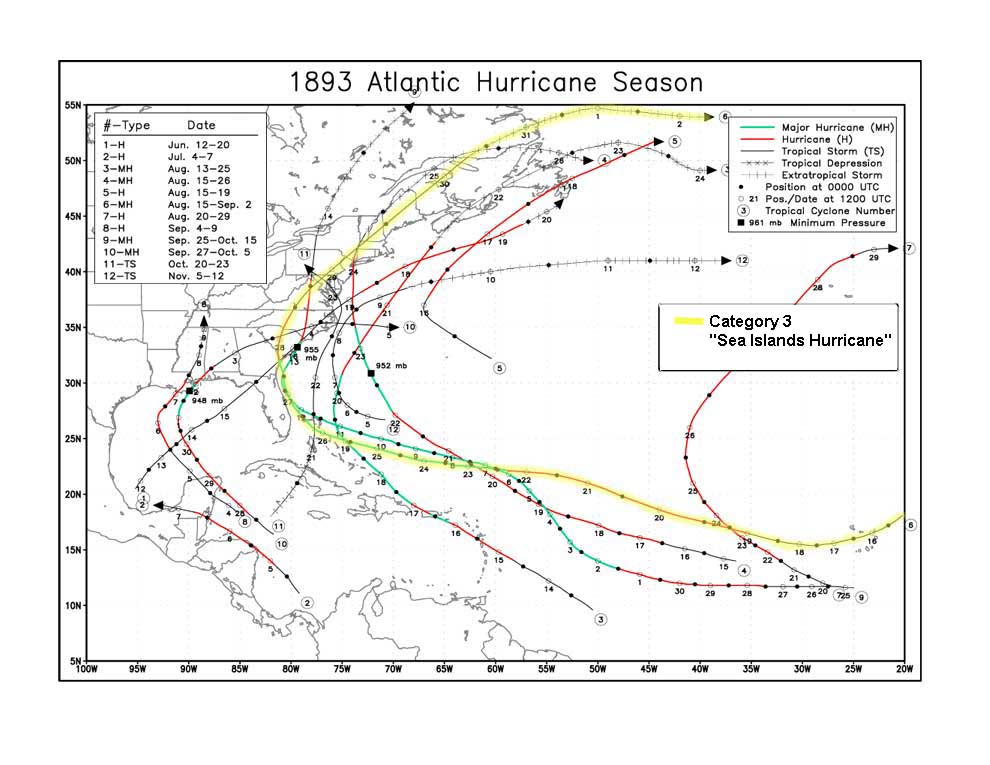
On August 15, 1893, a tropical storm formed east of Cape Verde. It likely passed directly through the islands on the 16th, leaving their vicinity during the evening of the 17th. It became a hurricane on the 19th, while crossing the Atlantic between the Cape Verde Islands and the Lesser Antilles. The hurricane continued to strengthen, attaining Category 3 status on August 22 while located northeast of the Lesser Antilles. By the evening of the 25th, the storm was approaching the Bahamas. During the approach it began to deviate from its westerly course and arc west-northwest. It is believed that the first effects of the storm were beginning to be felt in the Sea Islands area, with the winds steadily increasing during the night of the 25th.
Some of the inhabitants anticipated the storm and left the islands as quickly as possible. The conditions soon rapidly deteriorated on the island and the hurricane passed over sometime on the 26th. By now the hurricane was turning more and more towards the north. It moved parallel to the coast for about one hundred miles before making landfall.
Landfall occurred near Savannah, Georgia, on August 27. Reports from the time say that wind during landfall was around 120 mph (190 km/h), making it a category 3 storm. Pressure in Savannah was measured at 960 mbar (28 inHg); modern estimates put the pressure around 954 mbar (28.2 inHg) at landfall, and possibly as low as 931 mbar (27.5 inHg) out at sea. This would have made the hurricane most likely stronger than a Category 3 storm on the Saffir–Simpson Hurricane Scale. The hurricane passed north over South Carolina on August 28 and moved up the U.S. East Coast before becoming extratropical over Atlantic Canada. The storm likely intensified to a Category 4, or 5, but there are no reports of this occurring.
Impact
[edit]| Deadliest United States hurricanes | |||
|---|---|---|---|
| Rank | Hurricane | Season | Fatalities |
| 1 | 4 "Galveston" | 1900 | 8,000–12,000 |
| 2 | 4 "San Ciriaco" | 1899 | 3,400 |
| 3 | 4 Maria | 2017 | 2,982 |
| 4 | 5 "Okeechobee" | 1928 | 2,823 |
| 5 | 4 "Cheniere Caminada" | 1893 | 2,000 |
| 6 | 3 Katrina | 2005 | 1,392 |
| 7 | 3 "Sea Islands" | 1893 | 1,000–2,000 |
| 8 | 3 "Indianola" | 1875 | 771 |
| 9 | 4 "Florida Keys" | 1919 | 745 |
| 10 | 2 "Georgia" | 1881 | 700 |
| Reference: NOAA, GWU[3][4][nb 1] | |||

In the United States, coastal flooding was reported from St. Augustine, Florida, to Georgetown, South Carolina.[5]: 60 The storm downed hundreds of trees and partially or fully deroofed dozens of buildings in Florida, some as far as 50 mi (80 km) inland. Storm surge and abnormally high tides also caused damage, especially along the First Coast.[6] Winds deroofed structures as far south as St. Augustine and many buildings in Mayport suffered damage. Nearby, Jacksonville reported deroofed structures and downed trees and signs.[5]: 63 In Georgia, storm surge and tides inundated coastal areas with up to 7 ft (2.1 m) of water on Hutchinson Island and at least 6 ft (1.8 m) on Tybee Island and in parts of Savannah. Throughout the coast around Savannah and Tybee Island, tides washed away or destroyed homes, piers, and wharves, and beached ships, while winds destroyed many other buildings and downed numerous trees. Wind damage was reported as far inland as Augusta, Midville, and Waycross.[5]: 66
The hurricane carried with it a heavy storm surge, reaching 16 ft (4.9 m) above sea-level according to Clara Barton, although the modern NOAA SLOSH model calculates that some areas may have been inundated up to 30 ft (9.1 m),[7] which caused great destruction along the coastline and offshore Sea Islands in Georgia and South Carolina. Additionally, the News and Courier reported that storm surge reached 18 ft (5.5 m) at Wappoo Cut on Edisto Island and also noting the water "spread itself over the surrounding country like an endless inland lake. For two days communication between the island and the mainland was practically suspended".[5]: 68 Intense winds destroyed many homes, outbuildings, and trees on the island.[5]: 65 Waters from Port Royal Sound submerged Coosaw, Lady's, Parris, Warsaw, and Port Royal islands, including the city of Beaufort. There, coastal flooding significantly damaged or demolished waterfronts and wharves,[5]: 66 while few homes in Beaufort and Port Royal remained undamaged by the winds.[5]: 63
In Charleston, storm surge and tides flooded The Battery and some western parts of the city.[5]: 68 Winds downed trees and unroofed some homes.[5]: 65 An estimated 1,000 to 2,000 people were killed (mostly by drowning), putting it on-par with 2005's Hurricane Katrina as the sixth-deadliest hurricane in US history. St. Helena was estimated to have 6,000 African-Americans living there while 2,000 were women. The majority of the African-Americans owned land there and some rented. A lot of structures in that area were not elevated higher than 2 feet; therefore, they were covered by the first waves that went above the normal water mark.[8]
Although the hurricane was devastating, the American Red Cross did not arrive until October 1, possibly because of ongoing efforts following another hurricane that hit South Carolina in June. After the Red Cross arrived, a warehouse of clothing and food was started at Beaufort, South Carolina, to provide services to the affected. Relief efforts were impeded by a second Category 3 hurricane that struck just north of the area, near Charleston, South Carolina, on October 13. During a massive 10-month relief campaign, success was declared, with the Sea Islands population living in decent houses producing their own food again. Damages from the storm totaled to at least $1 million (1893 USD), equivalent to $34 million in 2023.[9]
Damage was reported as far north as Maine. Some areas, particularly New York City and Long Island, were already reeling from what later came to be known as the 1893 New York hurricane that had struck the region just days before, on August 24, and were damaged anew by this storm. "Immense" damage was reported to shade trees and telegraph and telephone wires in Washington. In Annapolis, Maryland "hardly a tree was left standing" and Baltimore reported the worst flooding since 1868. In New Jersey, damage was "heavy" in the New Brunswick area, and many trees were downed and roofs were blown off in Trenton. Damage was heavy all along the New Jersey coast and breakers were described as the biggest ever witnessed. Railroad tracks were under four feet of water between Bay Head and Berkley. In New York, several people died in The Rockaways, and a number of people were killed at points along the Hudson River when tow boats were destroyed. Crops were heavily damaged in Pennsylvania and upstate New York. Boats were wrecked and sunk in the Dunkirk area. In Brooklyn, where 13 houses under construction were destroyed, damage was "severe" and Gravesend Bay was "littered with the wrecks of small yachts and boats." In Coney Island, roofs were lifted off big buildings and carried for blocks. Waves topped the seawall by 15 feet at Battery Park. Damage was heavy at resorts on Long Island and it was the worst storm on the New England coast in 20 years.[10][11][12][13]
See also
[edit]
- 1893 Cheniere Caminada Hurricane
- 1893 Charleston Hurricane
- Hurricane Matthew
- Lists of Atlantic hurricanes
Notes
[edit]- ^ The storm category color indicates the intensity of the hurricane when landfalling in the U.S.
References
[edit]- ^ Gibson, Christine (September 2006). "Our 10 Greatest Natural Disasters". American Heritage Magazine. 57 (4). Archived from the original on October 15, 2006. Retrieved February 23, 2023.
- ^ Grego, (2022) .
- ^ Blake, Eric S; Landsea, Christopher W; Gibney, Ethan J (August 10, 2011). The deadliest, costliest and most intense United States tropical cyclones from 1851 to 2010 (and other frequently requested hurricane facts) (PDF) (NOAA Technical Memorandum NWS NHC-6). National Oceanic and Atmospheric Administration. p. 47. Archived (PDF) from the original on May 17, 2024. Retrieved August 10, 2011.
- ^ "Ascertainment of the Estimated Excess Mortality from Hurricane María in Puerto Rico" (PDF). Milken Institute of Public Health. August 27, 2018. Archived (PDF) from the original on August 29, 2018. Retrieved August 28, 2018.
- ^ a b c d e f g h i Mayes, Douglas Owens (2006). A Reanalysis of Five 19th Century South Carolina Major Hurricanes Using Local Data Sources (PDF) (Thesis). University of South Carolina. Retrieved November 11, 2024.
- ^ "Devastated by Storm". Idaho Daily Statesman. Boise, Idaho. August 29, 1893. p. 1. Retrieved June 4, 2024 – via Newspapers.com.

- ^ NOAA SLOSH model
- ^ "SEA ISLANDS OVERWHELMED: STEADILY THE LIST OF CYCLONE VICTIMS GROWS. CORONER'S ESTIMATE OVER 750 DEAD". New York Times Database. September 3, 1893. ProQuest 95079845.
- ^ David Longshore Encyclopedia of Hurricanes, Typhoons, and Cyclones pg. 286
- ^ Storm Swept Particulars of the Ruin brought by The Great Gale Many Points in New York, New Jersey and Pennsylvania SUFFER GREAT DAMAGE The Girard Guit September 1, 1893
- ^ Struck by a Cyclone Paterson Daily Press August 29, 1893
- ^ Huge Tidel Wave The Miamisburgh Bulletin September 1, 1893
- ^ New York's Storm It was a Veritable Tornado One of The Worst Ever Experienced The Lawrence Daily August 30, 1893

Further reading
[edit]- Grego, Caroline. (2022) Hurricane Jim Crow: How the Great Sea Island Storm of 1893 Shaped the Lowcountry South (u of North Carolina Press, 2022) online
- Grego, Caroline (2019). "Black Autonomy, Red Cross Recovery, and White Backlash after the Great Sea Island Storm of 1893". The Journal of Southern History. 85 (4): 803–840. doi:10.1353/soh.2019.0244. S2CID 208811556.
- Jones, Katharine M. (1960). "The Big Storm of 1893". Port Royal Under Six Flags, The Story of the Sea Islands. Indianapolis & New York: The Bobbs-Merrill Company.
- Marscher, William; Marscher, Fran (2004). The Great Sea Island Storm of 1893. Macon, GA: Mercer University Press. ISBN 0-86554-867-6.
- Rosenfeld, Jeff (1993). "The Forgotten Hurricane". Weatherwise. 46 (4): 13–18. doi:10.1080/00431672.1993.9930252.
- Satterthwait, Elisabeth Carpenter (1898). A Son of the Carolinas, A story of the Hurricane upon The Sea Islands. Philadelphia, Pa.: Henry Altemus. 273 pp. ISBN 0-8369-9062-5 (ISBN 0-8369-9062-5) – a historical-fiction account from the perspective of the people affected.
External links
[edit]- Cyclone of 1893 [1]
- NOAA Hurricane Track
- August 27 in Georgia history
- Beaufort County Public Library hurricane history
- North Florida & Coastal Georgia hurricanes, 1565–1899
- UNISYS 1893 hurricane tracks
- [2]
The Lowcountry of South Carolina | ||
|---|---|---|
| Counties |  | |
| Major communities | ||
| Sea islands | ||
| History & culture | ||
| Military installations | ||
| Natural areas | ||
| Other articles | ||