


Smoke Gets in Your Eyes
| "Smoke Gets in Your Eyes" | |
|---|---|
.jpg) | |
| Single by Gertrude Niesen with Ray Sinatra and his Orchestra | |
| B-side | "Jealousy" |
| Released | 1933 |
| Recorded | October 13, 1933 |
| Label | Victor |
| Composer(s) | Jerome Kern |
| Lyricist(s) | Otto Harbach |
| Producer(s) | Ray Sinatra |
"Smoke Gets in Your Eyes" is a show tune written by American composer Jerome Kern and lyricist Otto Harbach for the 1933 musical comedy Roberta. The song was sung in the Broadway show by Tamara Drasin. It was first recorded by Gertrude Niesen, with orchestral direction from Ray Sinatra, Frank Sinatra's second cousin,[1] on October 13, 1933. Niesen's recording of the song was released by Victor, with in the B-side "Jealousy", a song featuring Isham Jones and his Orchestra.[2] The line "When your heart's on fire, smoke gets in your eyes" apparently comes from a Russian proverb.[3]
By the time of Roberta in 1933, the tune had been composed for a tap dance in the 1927 musical Show Boat, but was not adopted; in 1932 it was retried as a march for a radio series theme tune.[3]
The song was also included in the 1952 remake of Roberta, Lovely to Look At, in which it was performed by Kathryn Grayson. It also was a no. 1 chart hit in 1959 for The Platters.
Recording history
[edit]1930s
[edit]Paul Whiteman had the first hit recording of the song on the record charts in 1934.[4] Whiteman and his Orchestra performed the song with vocals by Bob Lawrence, and this version topped the charts in the same year.[5] The song was reprised by Irene Dunne, who performed it in the 1935 film adaptation of the musical co-starring Fred Astaire, Ginger Rogers, and Randolph Scott. The Tommy Dorsey Orchestra released their version in 1938, with in the B-side the song "Night and Day".
During the mid-to-late 1930s, Larry Adler and Henry Hall recorded live radio performances of the song on BBC Radio: Adler's rendition was a syncopated, harmonica arrangement, while Hall's was with the BBC Orchestra with vocals by Dan Donovan; Hall's version was released as a 10" single.[6] Jazz pianist Art Tatum said in an introduction in 1955 that he also performed "Smoke Gets in Your Eyes" in the 1930s.
1940s
[edit]| Andre Kostelanets' "Smoke Gets In Your Eyes" | |
|---|---|
| 1941 cover version of the original 1933 song | |
 You may hear "Smoke Gets In Your Eyes" performed by Andre Kostelanetz in 1941 You may hear "Smoke Gets In Your Eyes" performed by Andre Kostelanetz in 1941Here on Archive.org |
Andre Kostelanetz recorded an easy listening arrangement of the song for Columbia Masterworks Records (4265-M) in 1941.[7]
In the same year, the Benny Goodman Orchestra played the song on the radio with Helen Forrest, but she left the ensemble during the early part of 1941,[8] so Goodman replaced her with Peggy Lee.[9] Lee's recording for a Mutual broadcast was released on the collaborative album Roll 'Em by Goodman and jazz drummer Sid Catlett.

Glenn Miller conducted his own rendition of the song at Abbey Road Studios in 1944, but due to his death later that year in the Second World War, his version was unreleased until 1995.[10] On October 30, 1946, Nat "King" Cole recorded the song with his trio, consisting in himself, Oscar Moore on guitar, and Johnny Miller on double bass, during a live broadcast from New York City.[11] Cole performed it on television in 1957 for The Nat King Cole Show.
Harry Belafonte covered the song in 1949 with jazz saxophonist Zoot Sims, and it was one of Belafonte's first recordings. Sims' performance was parodied on December 10, 1977, on The Muppet Show by Zoot from Dr. Teeth and the Electric Mayhem, the character he inspired.
1950s and later
[edit]
.jpg)

In 1950, both Charlie Parker and Jo Stafford released their versions of the song on their own respective albums, Bird at St. Nick's and Autumn in New York. Eartha Kitt recorded the song in 1952 with the Henri René Orchestra for her 1954 album That Bad Eartha, in the same sessions which yielded her 1953 hit single "Santa Baby".
Dinah Washington released the song in 1956 on her album Dinah!, and Jeri Southern named her 1957 album When Your Heart's on Fire after a lyric from the song; the album also features her version of the song. Polly Bergen performed the song during the series premiere of her variety show The Polly Bergen Show, originally airing September 21, 1957, in the same year of Nat King Cole's televised performance of the song, in The Nat King Cole Show.[12] In 1958, Sarah Vaughan released her rendition on her album, No Count Sarah.
JD Souther covered the song for the soundtrack to director Steven Spielberg's 1989 film Always, and has a cameo appearance performing it at a dance with the main characters, played by Richard Dreyfuss and Holly Hunter.
The Platters version
[edit]| "Smoke Gets in Your Eyes" | ||||
|---|---|---|---|---|
 | ||||
| Single by the Platters | ||||
| from the album Remember When? | ||||
| B-side | "No Matter What You Are" | |||
| Released | November 1958 | |||
| Genre | Doo-wop | |||
| Length | 2:40 | |||
| Label | Mercury | |||
| Composer(s) | Jerome Kern | |||
| Lyricist(s) | Otto Harbach | |||
| Producer(s) | Buck Ram[13] | |||
| The Platters singles chronology | ||||
| ||||
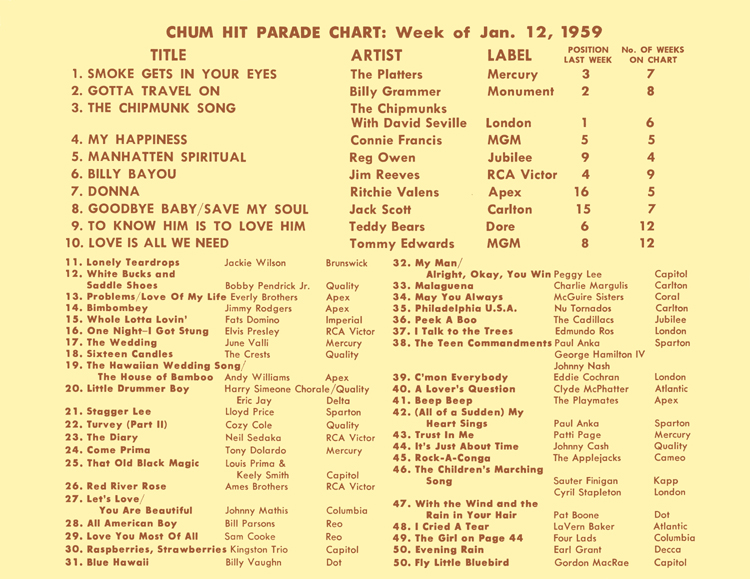
"Smoke Gets in Your Eyes" was recorded in 1958 by the Platters for their album Remember When? The group's version became a number one hit in the U.S. on the Billboard Hot 100 music chart. In 1959 it peaked at No. 3 on the Rhythm and Blues chart.[14] The song spent 20 weeks on the UK charts, peaking at Number 1 for one week on March 20 of that same year.[15] Buck Ram, the producer, said that Harbach praised them "for reviving his song with taste."[13] The widow of composer Jerome Kern disliked the recording so much she considered legal action to prevent its distribution.[16] However, she was informed that she was going to get huge royalties from the sales of the single.[3] It was expected to sell over a million copies, and she dropped her lawsuit.[17]
In 2019, the song by The Platters was inducted into the Grammy Hall of Fame.[18]
Chart history
[edit]
Weekly charts[edit]
|
Year-end charts[edit]
All-time charts[edit]
|
Blue Haze version
[edit]| "Smoke Gets in Your Eyes" | ||||
|---|---|---|---|---|
| Single by Blue Haze | ||||
| from the album Blue Haze | ||||
| B-side | "Anna Rosanna" | |||
| Released | 1972 | |||
| Genre | Doo-wop | |||
| Length | 3:15 | |||
| Label | A&M | |||
| Composer(s) | Jerome Kern | |||
| Lyricist(s) | Otto Harbach | |||
| Producer(s) | Johnny Arthey & Phil Swern | |||
| Blue Haze singles chronology | ||||
| ||||
Johnny Arthey's studio group Blue Haze released a version of "Smoke Gets in Your Eyes" as a single in 1972, and on the album Blue Haze the following year. Their version was an international hit, reaching the top 10 in Belgium, the Netherlands, and on Billboard's Easy Listening chart.
Chart performance
[edit]| Chart (1972) | Peak position |
|---|---|
| Australia (Go-Set)[30] | 30 |
| Canada (RPM 100)[31] | 13 |
| Flanders[32] | 2 |
| Netherlands (Hilversum 3 Top 30)[33] | 4 |
| Netherlands (Veronica Top 40)[34] | 4 |
| UK Singles Chart[35] | 32 |
| US Billboard Hot 100[35] | 27 |
| US Billboard Easy Listening[36] | 5 |
| US Cash Box Top 100[37] | 21 |
| US Record World The Singles Chart[38] | 14 |
| Wallonia[39] | 9 |
| West Germany[40] | 42 |
See also
[edit]
- List of 1930s jazz standards
- List of number-one singles in Australia during the 1950s
- List of number-one singles from the 1950s (UK)
- List of Billboard Hot 100 number ones of 1959
- List of number-one hits of 1959 (Italy)
References
[edit]- ^ Ray Sinatra: Frank's cousin, sinatrafamily.com, retrieved July 25, 2014
- ^ Victor 24454: Gertrude Niesen and Isham Jones – Smoke Gets In Your Eyes / Jealousy, popsike.com, retrieved July 24, 2014
- ^ a b c James Ferguson (May 17, 2021). "Smoke Gets in Your Eyes — as beautiful a tune as has ever been written". The Financial Times.
- ^ Gioia, Ted (2012). The Jazz Standards: A Guide to the Repertoire. New York City: Oxford University Press. pp. 371–373. ISBN 978-0-19-993739-4.
- ^ Tsort. "Song artist 12 - Paul Whiteman".
- ^ Henry Hall Orch - Smoke Gets in Your Eyes, Internet Archive, retrieved July 24, 2014
- ^ "Smoke gets In Your Eyes" performed by Andre Kostelanetz in 1941, Archive.org
- ^ Great Encounters #24: When Peggy Lee Joined Benny Goodmans Band, jerryjazzmusician.com, retrieved July 24, 2014
- ^ Peggy Lee official discography, peggylee.com, retrieved July 23, 2014
- ^ Missing Chapters, Vol. 5: The Complete Abbey Road Recordings, Allmusic, retrieved July 23, 2014
- ^ Nat King Cole: An Informal Discography (Sessions of 1946), alongthehall.com, retrieved July 24, 2014
- ^ "The Polly Bergen Show". Classic Television Archives. Retrieved January 9, 2011.
- ^ a b Buck Ram interviewed on the Pop Chronicles (1969)
- ^ Whitburn, Joel (2004). Top R&B/Hip-Hop Singles: 1942–2004. Record Research. p. 463.
- ^ Frith, Simon; Gillett, Charlie (1976). Rock File 4. Panther Books Ltd. p. 388.
- ^ Fred Bronson, The Billboard Book of Number One Hits, Billboard Publications, 1985, p. 48.
- ^ "Smoke Gets in Your Eyes Steyn's Song of the Week". The Mark Steyn Club. January 13, 2019.
- ^ "GRAMMY Hall Of Fame | Hall of Fame Artists". Grammy.com. Retrieved September 2, 2024.
- ^ "CHUM Chart Archives – January 12, 1959". CHUM. Retrieved July 5, 2022.
- ^ "The Platters – Smoke Gets in Your Eyes" (in Dutch). Ultratop 50. Retrieved June 14, 2018.
- ^ "The Platters – Smoke Gets in Your Eyes" (in French). Ultratop 50. Retrieved June 14, 2018.
- ^ "The Platters – Smoke Gets in Your Eyes" (in Dutch). Single Top 100. Retrieved June 14, 2018.
- ^ Platters - Full Official Chart History, Official Charts Company. Retrieved March 5, 2021.
- ^ "The Platters Chart History (Hot 100)". Billboard. Retrieved June 14, 2018.
- ^ Hot R&B/Hip-Hop Songs - Smoke Gets in Your Eyes The Platters Chart History, Billboard.com. Retrieved June 19, 2018.
- ^ "Top 20 Hit Singles of 1959". Rock.co.za. Retrieved March 26, 2020.
- ^ "Top 100 Songs of 1959 - the top-performing singles in the US in 1959". Musicoutfitters.com. Retrieved September 2, 2024.
- ^ "Cash Box YE Pop Singles - 1959". Tropicalglen.com. Retrieved September 2, 2024.
- ^ "Billboard Hot 100 60th Anniversary Interactive Chart". Billboard. Archived from the original on June 16, 2020. Retrieved December 10, 2018.
- ^ "GO-SET National Top 40", August 5, 1972. Retrieved March 4, 2021.
- ^ "RPM 100", RPM, Volume 18, No. 4, September 9, 1972. Retrieved March 5, 2021.
- ^ Blue Haze – Smoke Gets In Your Eyes, Ultratop. Retrieved March 5, 2021.
- ^ Blue Haze – Smoke Gets In Your Eyes, Dutchcharts.nl. Retrieved March 5, 2021.
- ^ Blue Haze – Smoke Gets In Your Eyes, Media Markt Top 40. Retrieved March 5, 2021.
- ^ a b Smoke Gets in Your Eyes By: Blue Haze, MusicVF.com. Retrieved March 5, 2021.
- ^ "Easy Listening", Billboard. January 13, 1973. p. 22. Retrieved March 5, 2021.
- ^ "Cash Box Top 100", Cash Box. December 26, 1970. Retrieved March 5, 2021.
- ^ "The Singles Chart", Record World. January 27, 1973. Retrieved March 5, 2021.
- ^ Blue Haze – Smoke Gets In Your Eyes, Ultratop. Retrieved February 15, 2018.
- ^ Blue Haze – Smoke Gets In Your Eyes, norwegiancharts.com. Retrieved March 5, 2021.
External links
[edit]
- 1933 songs
- 1930s jazz standards
- 1958 singles
- 1959 singles
- 1972 singles
- Barbra Streisand songs
- Benny Goodman songs
- The Platters songs
- Songs with music by Jerome Kern
- Songs with lyrics by Otto Harbach
- Billboard Hot 100 number-one singles
- Cashbox number-one singles
- Number-one singles in South Africa
- UK singles chart number-one singles
- Number-one singles in Australia
- Number-one singles in Canada
- Number-one singles in Italy
- Penny McLean songs
- Songs from musicals
- Torch songs
- Eartha Kitt songs
- Nana Mouskouri songs
- Mercury Records singles
- Victor Talking Machine Company singles
- A&M Records singles
- Carly Simon songs
- Irene Dunne songs