


Tensor density
In differential geometry, a tensor density or relative tensor is a generalization of the tensor field concept. A tensor density transforms as a tensor field when passing from one coordinate system to another (see tensor field), except that it is additionally multiplied or weighted by a power W of the Jacobian determinant of the coordinate transition function or its absolute value. A tensor density with a single index is called a vector density. A distinction is made among (authentic) tensor densities, pseudotensor densities, even tensor densities and odd tensor densities. Sometimes tensor densities with a negative weight W are called tensor capacity.[1][2][3] A tensor density can also be regarded as a section of the tensor product of a tensor bundle with a density bundle.
Motivation[edit]
In physics and related fields, it is often useful to work with the components of an algebraic object rather than the object itself. An example would be decomposing a vector into a sum of basis vectors weighted by some coefficients such as


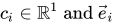


If we now try to express this same expression in a basis other than the standard basis, then the components of the vectors will change, say according to where is some 2 by 2 matrix of real numbers. Given that the area of the spanned parallelogram is a geometric invariant, it cannot have changed under the change of basis, and so the new representation of this matrix must be:



Definition[edit]
 | This article needs additional citations for verification. (September 2012) |
Some authors classify tensor densities into the two types called (authentic) tensor densities and pseudotensor densities in this article. Other authors classify them differently, into the types called even tensor densities and odd tensor densities. When a tensor density weight is an integer there is an equivalence between these approaches that depends upon whether the integer is even or odd.
Note that these classifications elucidate the different ways that tensor densities may transform somewhat pathologically under orientation-reversing coordinate transformations. Regardless of their classifications into these types, there is only one way that tensor densities transform under orientation-preserving coordinate transformations.
In this article we have chosen the convention that assigns a weight of +2 to , the determinant of the metric tensor expressed with covariant indices. With this choice, classical densities, like charge density, will be represented by tensor densities of weight +1. Some authors use a sign convention for weights that is the negation of that presented here.[4]
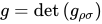
In contrast to the meaning used in this article, in general relativity "pseudotensor" sometimes means an object that does not transform like a tensor or relative tensor of any weight.
Tensor and pseudotensor densities[edit]
For example, a mixed rank-two (authentic) tensor density of weight transforms as:[5][6]

- ((authentic) tensor density of (integer) weight W)
![{\displaystyle {\mathfrak {T}}_{\beta }^{\alpha }=\left(\det {\left[{\frac {\partial {\bar {x}}^{\iota }}{\partial {x}^{\gamma }}}\right]}\right)^{W}\,{\frac {\partial {x}^{\alpha }}{\partial {\bar {x}}^{\delta }}}\,{\frac {\partial {\bar {x}}^{\epsilon }}{\partial {x}^{\beta }}}\,{\bar {\mathfrak {T}}}_{\epsilon }^{\delta }\,,}](https://wikimedia.org/api/rest_v1/media/math/render/svg/b95cb37968c46082f22ab0dd2a7f6c8aa605bb48)
where is the rank-two tensor density in the coordinate system, is the transformed tensor density in the coordinate system; and we use the Jacobian determinant. Because the determinant can be negative, which it is for an orientation-reversing coordinate transformation, this formula is applicable only when is an integer. (However, see even and odd tensor densities below.)


We say that a tensor density is a pseudotensor density when there is an additional sign flip under an orientation-reversing coordinate transformation. A mixed rank-two pseudotensor density of weight transforms as
- (pseudotensor density of (integer) weight W)
![{\displaystyle {\mathfrak {T}}_{\beta }^{\alpha }=\operatorname {sgn} \left(\det {\left[{\frac {\partial {\bar {x}}^{\iota }}{\partial {x}^{\gamma }}}\right]}\right)\left(\det {\left[{\frac {\partial {\bar {x}}^{\iota }}{\partial {x}^{\gamma }}}\right]}\right)^{W}\,{\frac {\partial {x}^{\alpha }}{\partial {\bar {x}}^{\delta }}}\,{\frac {\partial {\bar {x}}^{\epsilon }}{\partial {x}^{\beta }}}\,{\bar {\mathfrak {T}}}_{\epsilon }^{\delta }\,,}](https://wikimedia.org/api/rest_v1/media/math/render/svg/f6e13de04ac0e883a1432e057c1fd3ce3df05f6b)
where sgn( ) is a function that returns +1 when its argument is positive or −1 when its argument is negative.
Even and odd tensor densities[edit]
The transformations for even and odd tensor densities have the benefit of being well defined even when is not an integer. Thus one can speak of, say, an odd tensor density of weight +2 or an even tensor density of weight −1/2.
When is an even integer the above formula for an (authentic) tensor density can be rewritten as
- (even tensor density of weight W)
![{\displaystyle {\mathfrak {T}}_{\beta }^{\alpha }=\left\vert \det {\left[{\frac {\partial {\bar {x}}^{\iota }}{\partial {x}^{\gamma }}}\right]}\right\vert ^{W}\,{\frac {\partial {x}^{\alpha }}{\partial {\bar {x}}^{\delta }}}\,{\frac {\partial {\bar {x}}^{\epsilon }}{\partial {x}^{\beta }}}\,{\bar {\mathfrak {T}}}_{\epsilon }^{\delta }\,.}](https://wikimedia.org/api/rest_v1/media/math/render/svg/60a339c0d6b7f088479e216575bf39990552ddf8)
Similarly, when is an odd integer the formula for an (authentic) tensor density can be rewritten as
- (odd tensor density of weight W)
![{\displaystyle {\mathfrak {T}}_{\beta }^{\alpha }=\operatorname {sgn} \left(\det {\left[{\frac {\partial {\bar {x}}^{\iota }}{\partial {x}^{\gamma }}}\right]}\right)\left\vert \det {\left[{\frac {\partial {\bar {x}}^{\iota }}{\partial {x}^{\gamma }}}\right]}\right\vert ^{W}\,{\frac {\partial {x}^{\alpha }}{\partial {\bar {x}}^{\delta }}}\,{\frac {\partial {\bar {x}}^{\epsilon }}{\partial {x}^{\beta }}}\,{\bar {\mathfrak {T}}}_{\epsilon }^{\delta }\,.}](https://wikimedia.org/api/rest_v1/media/math/render/svg/ee47f5278c84205123eded6c3045125cb238866c)
Weights of zero and one[edit]
A tensor density of any type that has weight zero is also called an absolute tensor. An (even) authentic tensor density of weight zero is also called an ordinary tensor.
If a weight is not specified but the word "relative" or "density" is used in a context where a specific weight is needed, it is usually assumed that the weight is +1.
Algebraic properties[edit]
- A linear combination (also known as a weighted sum) of tensor densities of the same type and weight is again a tensor density of that type and weight.
- A product of two tensor densities of any types, and with weights and , is a tensor density of weight
- A product of authentic tensor densities and pseudotensor densities will be an authentic tensor density when an even number of the factors are pseudotensor densities; it will be a pseudotensor density when an odd number of the factors are pseudotensor densities. Similarly, a product of even tensor densities and odd tensor densities will be an even tensor density when an even number of the factors are odd tensor densities; it will be an odd tensor density when an odd number of the factors are odd tensor densities.
- The contraction of indices on a tensor density with weight again yields a tensor density of weight [7]
- Using (2) and (3) one sees that raising and lowering indices using the metric tensor (weight 0) leaves the weight unchanged.[8]


Matrix inversion and matrix determinant of tensor densities[edit]
If is a non-singular matrix and a rank-two tensor density of weight with covariant indices then its matrix inverse will be a rank-two tensor density of weight − with contravariant indices. Similar statements apply when the two indices are contravariant or are mixed covariant and contravariant.

If is a rank-two tensor density of weight with covariant indices then the matrix determinant will have weight where is the number of space-time dimensions. If is a rank-two tensor density of weight with contravariant indices then the matrix determinant will have weight The matrix determinant will have weight


General relativity[edit]
| General relativity |
|---|
 |



Relation of Jacobian determinant and metric tensor[edit]
Any non-singular ordinary tensor transforms as

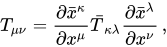
where the right-hand side can be viewed as the product of three matrices. Taking the determinant of both sides of the equation (using that the determinant of a matrix product is the product of the determinants), dividing both sides by and taking their square root gives

![{\displaystyle \left\vert \det {\left[{\frac {\partial {\bar {x}}^{\iota }}{\partial {x}^{\gamma }}}\right]}\right\vert ={\sqrt {\frac {\det({T}_{\mu \nu })}{\det \left({\bar {T}}_{\kappa \lambda }\right)}}}\,.}](https://wikimedia.org/api/rest_v1/media/math/render/svg/6db053d89bfa8305639f1853e8a0e5e0fa8d1d44)
When the tensor is the metric tensor, and is a locally inertial coordinate system where diag(−1,+1,+1,+1), the Minkowski metric, then −1 and so



![{\displaystyle \left\vert \det {\left[{\frac {\partial {\bar {x}}^{\iota }}{\partial {x}^{\gamma }}}\right]}\right\vert ={\sqrt {-{g}}}\,,}](https://wikimedia.org/api/rest_v1/media/math/render/svg/9e4dd7d11dec1530151b66622ef5a0d023ba626d)
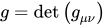
where is the determinant of the metric tensor

Use of metric tensor to manipulate tensor densities[edit]
Consequently, an even tensor density, of weight W, can be written in the form


where is an ordinary tensor. In a locally inertial coordinate system, where it will be the case that and will be represented with the same numbers.


When using the metric connection (Levi-Civita connection), the covariant derivative of an even tensor density is defined as

For an arbitrary connection, the covariant derivative is defined by adding an extra term, namely
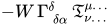
Equivalently, the product rule is obeyed

where, for the metric connection, the covariant derivative of any function of is always zero,


Examples[edit]
The expression is a scalar density. By the convention of this article it has a weight of +1.

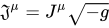
The density of electric current (for example, is the amount of electric charge crossing the 3-volume element divided by that element — do not use the metric in this calculation) is a contravariant vector density of weight +1. It is often written as or where and the differential form are absolute tensors, and where is the Levi-Civita symbol; see below.





The density of Lorentz force (that is, the linear momentum transferred from the electromagnetic field to matter within a 4-volume element divided by that element — do not use the metric in this calculation) is a covariant vector density of weight +1.


In N-dimensional space-time, the Levi-Civita symbol may be regarded as either a rank-N covariant (odd) authentic tensor density of weight −1 (εα1⋯αN) or a rank-N contravariant (odd) authentic tensor density of weight +1 (εα1⋯αN). Notice that the Levi-Civita symbol (so regarded) does not obey the usual convention for raising or lowering of indices with the metric tensor. That is, it is true that


The determinant of the metric tensor,

See also[edit]
- Action (physics) – Physical quantity of dimension energy × time
- Conservation law – Scientific law regarding conservation of a physical property
- Noether's theorem – Statement relating differentiable symmetries to conserved quantities
- Pseudotensor – Type of physical quantity
- Relative scalar
- Variational principle – Scientific principles enabling the use of the calculus of variations
Notes[edit]
- ^ Weinreich, Gabriel (July 6, 1998). Geometrical Vectors. University of Chicago Press. pp. 112, 115. ISBN 978-0226890487.
- ^ Papastavridis, John G. (Dec 18, 1998). Tensor Calculus and Analytical Dynamics. CRC Press. ISBN 978-0849385148.
- ^ Ruiz-Tolosa, Castillo, Juan R., Enrique (30 Mar 2006). From Vectors to Tensors. Springer Science & Business Media. ISBN 978-3540228875.
{{cite book}}: CS1 maint: multiple names: authors list (link) - ^ E.g. Weinberg 1972 pp 98. The chosen convention involves in the formulae below the Jacobian determinant of the inverse transition x → x, while the opposite convention considers the forward transition x → x resulting in a flip of sign of the weight.
- ^ M.R. Spiegel; S. Lipcshutz; D. Spellman (2009). Vector Analysis (2nd ed.). New York: Schaum's Outline Series. p. 198. ISBN 978-0-07-161545-7.
- ^ C.B. Parker (1994). McGraw Hill Encyclopaedia of Physics (2nd ed.). McGraw-Hill. p. 1417. ISBN 0-07-051400-3.
- ^ Weinberg 1972 p 100.
- ^ Weinberg 1972 p 100.
References[edit]
- Spivak, Michael (1999), A Comprehensive Introduction to Differential Geometry, Vol I (3rd ed.), p. 134.
- Kuptsov, L.P. (2001) [1994], "Tensor Density", Encyclopedia of Mathematics, EMS Press.
- Charles Misner; Kip S Thorne & John Archibald Wheeler (1973). Gravitation. W. H. Freeman. p. 501ff. ISBN 0-7167-0344-0.
{{cite book}}: CS1 maint: multiple names: authors list (link) - Weinberg, Steven (1972), Gravitation and Cosmology, John Wiley & sons, Inc, ISBN 0-471-92567-5