


The Big Parade
| The Big Parade | |
|---|---|
_poster.jpg) Theatrical release poster | |
| Directed by | King Vidor |
| Screenplay by | Story: Laurence Stallings Scenario: Harry Behn Titles: Joseph W. Farnham |
| Produced by | King Vidor (presented by) Irving Thalberg (uncredited) |
| Starring | |
| Cinematography | John Arnold |
| Edited by | Hugh Wynn |
| Music by | William Axt David Mendoza |
Production company | |
| Distributed by | Loew's Incorporated |
Release date |
|
Running time | 151 minutes |
| Country | United States |
| Languages | Silent film, English intertitles |
| Budget | $382,000[1] |
| Box office | $18–22 million (theatrical rental) |
The Big Parade is a 1925 American silent war drama film[2][3] directed by King Vidor, starring John Gilbert, Renée Adorée, Hobart Bosworth, Tom O'Brien, and Karl Dane.[4][5][6] Written by World War I veteran Laurence Stallings, the film is about an idle rich boy who joins the U.S. Army's Rainbow Division, is sent to France to fight in World War I, becomes a friend of two working-class men, experiences the horrors of trench warfare, and finds love with a French girl. A sound version of the film was released in 1930. While the sound version of the film has no audible dialog, it featured a synchronized musical score with sound effects using both the sound-on-disc and sound-on-film process.
The film has been praised for its realistic depiction of warfare,[7] and it heavily influenced a great many subsequent war films, especially All Quiet on the Western Front (1930).[8] The Big Parade is regarded as one of the greatest films made about World War I,[9] and, in 1992, was selected for preservation in the United States National Film Registry by the Library of Congress.[10][11]
Plot[edit]
In the United States in 1917, James "Jim" Apperson's idleness, in contrast to his hardworking brother, incurs the great displeasure of his wealthy businessman father. Then America enters World War I. Jim informs his worried mother that he has no intention of enlisting, and his father threatens to kick him out of the house if he does not join. However, when he runs into his patriotic friends at a send-off parade, he is persuaded to enlist, making his father very proud.
During training, Jim makes friendships with Southern construction worker Slim and Bronx bartender Bull. Their unit ships out to France, where they are billeted at a farm in the village of Champillon in the Marne.
All three men are attracted to Melisande, whose mother owns the farm. She repulses all their advances, but gradually warms to Jim, bonding at first over chewing gum. They eventually fall in love, despite not being able to speak each other's language. One day, however, Jim receives a letter and a photograph from Justyn, which reveals that they are engaged. When Melisande sees the picture, she realizes the situation and runs off in tears. Before Jim can decide what to do, his unit is ordered to the front. Melisande hears the commotion and races back, just in time for the lovers to embrace and kiss.
The Americans march towards the front and are strafed by an enemy fighter before it is shot down. The unit is sent to the attack immediately, advancing against snipers and machine guns in the woods, then more machine guns, artillery, and poison gas in the open. They settle down in a makeshift line. Jim shelters in a shellhole with Slim and Bull.
That night, orders come down for one man to go out and eliminate a troublesome mortar crew; Slim wins a spitting contest for the opportunity. He succeeds, but is spotted and wounded on the way back. After listening to Slim's pleas for help, Jim cannot stand it any longer and goes to his rescue against orders. Bull follows, but is shot and killed. By the time Jim reaches Slim, he is already dead. Jim is then shot in the leg. When a German comes to finish him off, Jim shoots and wounds him. The German starts crawling back to his line. Jim catches up to him in another shellhole, but, face to face, cannot bring himself to finish him off with his bayonet. Instead, he gives his erstwhile enemy a cigarette. Soon after, the German dies. However, Jim is not stuck in no man's land for long; the Americans attack, and he is taken away to a hospital.
From another patient, he learns that Champillon has changed hands four times. Worried about Melisande, Jim sneaks out of the hospital and hitches a ride. When he gets to the farmhouse, he finds it damaged and empty. Melisande and her mother have joined a stream of refugees. Jim collapses and is carried off in an ambulance by retreating soldiers.
After the war ends, Jim goes home to America. Before he arrives, his mother overhears Justyn and Jim's brother Harry discussing what to do; in Jim's absence, they have fallen in love. When Jim appears, it is revealed that he has had his leg amputated. Later, Jim tells his mother about Melisande; she tells him to go back and find her. When he returns to the farm, Melisande rushes into his arms.
Cast[edit]
- John Gilbert as James Apperson
- Renée Adorée as Melisande
- Hobart Bosworth as Mr. Apperson
- Claire McDowell as Mrs. Apperson
- Claire Adams as Justyn Reed
- Robert Ober as Harry Apperson
- Tom O'Brien as Bull
- Karl Dane as Slim
- Rosita Marstini as Melisande's mother
- Harry Crocker as Soldier (uncredited)
- Julanne Johnston as Justine Devereux
- Kathleen Key as Apperson sister
- Carl Voss as Officer (uncredited)
- George Beranger as German soldier
- Frank Currier
- Dan Mason
Music[edit]
The 1930 sound version featured a number of songs. The theme song was entitled “My Dream of the Big Parade” and was composed by Al Dubin (words) and Jimmy McHugh (music). Other songs featured on the soundtrack include “I’m Gonna Tramp Tramp Tramp” by B. G. DeSylva and Harry Woods, “Sweet Little Woman of Mine” by Frank Stanton (words) and Floyd Bartlett (music), “My Pal Jerry” by Fred Rose and “Douce Fievre (Whisper That You Love Me)” by Louis Weslyn (words) and Y. Ener (music).
Reception[edit]
The Big Parade was one of the great hits of the 1920s earning gross rentals of $4,990,000 in the United States and $1,141,000 overseas on a budget of $382,000 during its initial release, with MGM recording a profit of $3.4 million, its biggest of the silent era.[1][12] The domestic earnings were MGM's biggest until the release of Gone with the Wind (1939).[1] It played in some larger cities continually for a year or more, boosting Gilbert's career and made Renée Adorée a major star, although Adorée would soon be diagnosed with tuberculosis and die only a few years later. Its release in some nations of the British Empire was initially delayed to resolve claims that the film, in focusing only on America's part in the war, was propaganda.[13] The film ultimately grossed $18–$22 million in worldwide rentals and is sometimes proclaimed as the most successful film of the silent era,[14][15] although it is most likely this record falls to The Birth of a Nation (1915).[16] The film won the Photoplay Magazine Medal for best film of the year in 1925. The medal is considered the first significant annual movie award, prior to the establishment of the Oscars.[17]
After the film's producers found a clause in Vidor's contract that entitled the director to 20% of the net profits, studio lawyers called for a meeting with him. At the meeting, accountants upgraded the costs of the picture and downgraded their forecast of its potential success. Vidor was thus persuaded to sell his stake in the film before he could receive his percentage.[citation needed] However, the film's tremendous success established Vidor as one of MGM's top directors.[9]
Legacy[edit]
The Big Parade survives in a print of the 1930 sound version. The original silent version is now lost. In 1992, The Big Parade was selected for preservation in the United States National Film Registry by the Library of Congress as being "culturally, historically, or aesthetically significant".
Although the surviving print had the original 1930 soundtrack consisting of William Axt's musical score, the version released to the public had the score replaced with a modern one. Composer Carl Davis created a new orchestral score for the film in the 1980s (quoting the theme associated with Melisande in Axt's original setting), and it was added to the film and released on video in the late 1980s as part of the MGM and British television Thames Silents project. The original 1930 35mm negative was subsequently discovered intact, and has been the source for theatrical showings and the DVD and Blu-ray editions (Blu-ray was released October 1, 2013). In spite of the fact that William Axt's synchronzied score survives the film was again released with a modern score that bears no resemblance to the original score.
The 2013 DVD and Blu-ray Warner Home Video release of The Big Parade features the most complete TCM print of running time 151 minutes. It also contains an audio commentary track by film historian Jeffrey Vance (with excerpts from King Vidor's oral history with the Directors Guild of America). In February 2020, the film was shown at the 70th Berlin International Film Festival, as part of a retrospective dedicated to King Vidor's career.[18]
Gallery[edit]
-
 Renée Adorée and John Gilbert
 -
 The Big Parade, Lower right front (R to L): Renée Adorée, John Gilbert, Karl Dane, Tom O'Brien
 -
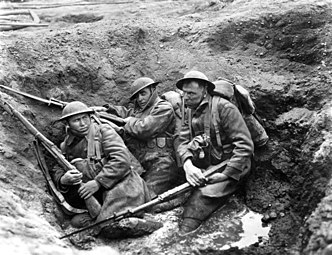 L to R Tom O'Brien, John Gilbert, Karl Dane

._Directed_by_King_Vidor,_M-G-M_studios.jpg)

See also[edit]
Footnotes[edit]
- ^ William Axt's 1930 score is still under copyright and is therefore not included in this version.
References[edit]
- ^ a b c H. Mark Glancy, 'MGM Film Grosses, 1924–28: The Eddie Mannix Ledger', Historical Journal of Film, Radio and Television, Vol 12 No. 2 1992 pp. 127–44
- ^ "The Big Parade (1925)". AFI Catalog. American Film Institute. Retrieved April 28, 2022.
Genre: Drama; Sub-genre:World War I
- ^ "The Big Parade (1925)". Allmovie. Retrieved April 28, 2022.
Genres: Drama, War
- ^ Variety film review; October 11, 1925, p. 36.
- ^ Variety film review; December 2, 1925, p. 40.
- ^ Harrison's Reports film review; December 5, 1925, p. 195.
- ^ Phillips, Richard (July 17, 2009). "Several movies well worth revisiting". World Socialist Web Site. Retrieved May 24, 2020.
The Big Parade's battle scenes are stunning and effectively recreate the horrors of the first imperialist slaughterhouse—the unrelenting machine-gun fire, heavy artillery, poisonous gas attacks and shell-shocked wounded soldiers.
- ^ Reinhardt, Bernd (April 7, 2020). "Rediscovering Hallelujah (1929), director King Vidor's sensitive film with all-black cast". World Socialist Web Site. Retrieved May 24, 2020.
His film The Big Parade (1925) influenced other anti-war classics such as Lewis Milestone's All Quiet on the Western Front (1930).
- ^ a b Silver, Charles. "King Vidor's The Big Parade". Museum of Modern Art. Retrieved May 24, 2020.
- ^ Wharton, Andy Marx, Dennis; Marx, Andy; Wharton, Dennis (December 4, 1992). "Diverse pix mix picked". Variety. Retrieved September 17, 2020.
{{cite web}}: CS1 maint: multiple names: authors list (link) - ^ "Complete National Film Registry Listing". Library of Congress. Retrieved September 17, 2020.
- ^ Scott Eyman, Lion of Hollywood: The Life and Legend of Louis B. Mayer, Robson, 2005 p 112
- ^ "Ban on Big Parade in Australia Not Settled; Parliament to Decide", Motion Picture News, 34 (01), New York City, New York: Motion Picture News, Inc.: 32, July 3, 1926, retrieved May 16, 2023
- ^ May, Richard P. (Fall 2005), "Restoring The Big Parade", The Moving Image, 5 (2): 140–146, doi:10.1353/mov.2005.0033, ISSN 1532-3978, S2CID 192076406,
...earning somewhere between $18 and $22 million, depending on the figures consulted
- ^ Robertson, Patrick (1991). Guinness Book of Movie Facts and Feats (4 ed.). Abbeville Publishing Group. p. 30. ISBN 9781558592360.
The top grossing silent film was King Vidor's The Big Parade (US 25), with worldwide rentals of $22 million.
- ^ Everson, William K. (1998) [First published 1978]. American Silent Film. Da Capo Press. p. 374. ISBN 978-0-306-80876-0.
Putting The Birth of a Nation in fifth place is open to question, since it is generally conceded to be the top-grossing film of all time. However, it has always been difficult to obtain reliable box-office figures for this film, and it may have been even more difficult in the mid-1930s. After listing it until the mid-1970s as the top-grosser, though finding it impossible to quote exact figures, Variety, the trade journal, suddenly repudiated the claim but without giving specific details or reasons. On the basis of the number of paid admissions, and continuous exhibition, its number one position seems justified.
- ^ "Honors for Arnold". American Cinematographer. December 1926. p. 5. Retrieved October 1, 2018.

- ^ "Berlinale 2020: Retrospective "King Vidor"". Berlinale. Retrieved February 28, 2020.

External links[edit]


- The Big Parade is available for free viewing and download at the Internet Archive
- The Big Parade at IMDb
- The Big Parade at AllMovie
- The Big Parade at the TCM Movie Database
- The Big Parade at the American Film Institute Catalog
- The Big Parade program booklet on archive.org
- The Big Parade at Virtual History
- The Big Parade essay by Daniel Eagan in America's Film Legacy: The Authoritative Guide to the Landmark Movies in the National Film Registry, A&C Black, 2010 ISBN 0826429777, pages 105–106 [1]

| International | |
|---|---|
| National | |
- 1925 films
- 1920s color films
- 1920s war drama films
- American black-and-white films
- American silent feature films
- American war drama films
- Films directed by King Vidor
- Films produced by Irving Thalberg
- Films set in 1917
- Films set in 1918
- Films shot in San Antonio
- Films with screenplays by Harry Behn
- Metro-Goldwyn-Mayer films
- Photoplay Awards film of the year winners
- United States National Film Registry films
- Western Front (World War I) films
- 1920s American films
- Silent American drama films
- Silent war drama films
- 1920s English-language films
- Films scored by William Axt