


United Nations Regional Groups
The United Nations Regional Groups are the geopolitical regional groups of member states of the United Nations. Originally, the UN member states were unofficially organized into five groups as an informal means of sharing the distribution of posts for General Assembly committees. Now this grouping has taken on a much more expansive and official role. Many UN bodies are allocated on the basis of geographical representation. Top leadership positions, including Secretary-General and President of the General Assembly, are rotated among the regional groups. The groups also coordinate substantive policy and form common fronts for negotiations and bloc voting.[1]

History[edit]
League of Nations[edit]
The precedent of the geographic distribution of seats was set by the United Nations' predecessor, the League of Nations. Under the League's system, a Nominations Committee was created in order to create election slates for distribution of seats in the Council of the League.[3]
This proved a difficult task as the number of seats on the Council was constantly changing. However, from 1926 to 1933 an unofficial pattern of distribution emerged where the non-permanent seats on the Council were distributed along the following lines:[3]
- 3 for Latin American states
- 1 for a Scandinavian state
- 1 for a Little Entente state (Czechoslovakia, Romania or Yugoslavia)
- 1 for a member of the British Commonwealth
- 1 for a Far Eastern state
- 1 seat each for Spain and Poland
United Nations[edit]
During the drafting of the United Nations Charter, the idea of geographic distribution of seats of the new organisation's bodies was one of the priorities of the drafters. On the United States' recommendation, the very first General Committee of the United Nations was composed of:[3]
- The five permanent members of the Security Council
- 3 Latin American states
- 2 British Commonwealth states
- 2 Eastern European states
- 1 Western European state
- 1 Middle Eastern state
This distribution began the precedent of using regional groups for the allocation of seats in United Nations bodies. For example, the first election to the Security Council used a similar scheme, allocating seats along the following lines:[4]
- The five permanent members of the Security Council
- 2 Latin American states
- 1 British Commonwealth state
- 1 Eastern European state
- 1 Western European states
- 1 Middle Eastern state
Elections to the Economic and Social Council also followed along similar lines, but instead allocated seats to "Near East states" and not "Middle Eastern states."
However, these arrangements were not formal and were based on "Gentlemen’s Agreements" agreed upon by the United States and the Soviet Union regarding the distribution of seats in United Nations bodies.
Reform[edit]
Following a wave of decolonization, there were multiple admissions into the United Nations from African, Asian and Pacific states. After the Bandung Conference in 1955, there was increasing solidarity among post-colonial states which led to pressure being put on the United Nations for increased representation of these states. This pressure led to the passage of Resolution 1192 (XII) of 12 December 1957, which established a formal pattern for distribution of seats on the General Committee.[5]
This was followed on 17 December 1963 by Resolutions 1990 (XVIII) and 1991 (XVIII). These resolutions further outlined the distribution of seats on the General Committee, but also outlined how seats would be geographically distributed on the Economic and Social and Security Councils. The resolutions outlined the regions as follow:[6]
- African and Asian states
- Latin American states
- Eastern European states
- Western Europe and Other states
On 20 December 1971 Resolution 2847 (XXVI) formally set up the present distribution system that is in place for the Economic and Social Council. It also split the African and Asian states region into two separate regions, one for Asia and one for Africa.[7]
Finally, on 19 December 1978 Resolution 33/138 was passed by the General Assembly. This resolution called for equitable geographic distribution of the presidency and vice-presidencies of the General Assembly, as well as of the chairmanship of the seven main committees.[8]
Present[edit]
The most recent change to the regional grouping system was in 2011, when the Asia Group was renamed the Group of Asia and the Pacific Small Island Developing States, also Asia and the Pacific Group or Asia-Pacific Group, in order to recognise the growing role Pacific island nations play in the United Nations System.[9][10]
Overview[edit]
Apart from allowing member states with related international interests to liaise, discuss and coordinate their voting and other activities at the United Nations, the main function of the regional groups is to distribute membership quotas in United Nations bodies and leadership positions. According to convention, the non-permanent membership seats of the United Nations Security Council is apportioned between regional groups according to a set formula. Other bodies, such as the United Nations Economic and Social Council and the United Nations Human Rights Council, also have set membership quotas for each regional group. The position of the President of the United Nations General Assembly rotates amongst the groups on a ten-year cycle (the current rule being that each regional group fills the position twice during the cycle, in effect it rotates on a five-year cycle).
| Regional Group | Number of members | Population (approx., rounded WP numbers) | UNSC permanent members | UNSC elected members | ECOSOC members | HRC members | UNGA President (unit digit of year) |
|---|---|---|---|---|---|---|---|
| Africa | 54 (28%) | 1140 million (16%) | 0 | 3 | 14 (26%) | 13 (28%) | 4 and 9 |
| Asia and the Pacific | 53 (28%) | 4240 million (59%) | 1 | 2 | 11 (20%) | 13 (28%) | 1 and 6 |
| EEG | 23 (12%) | 340 million (5%) | 1 | 1 | 6 (11%) | 6 (13%) | 2 and 7 |
| GRULAC | 33 (17%) | 621 million (9%) | 0 | 2 | 10 (19%) | 8 (17%) | 3 and 8 |
| WEOG | 28+1 (15%) | 904 million (12%) | 3 | 2 | 13 (24%) | 7 (15%) | 0 and 5 |
| None | 1 (1%) | 0.124 million (<1%) | – | – | – | – | – |
| Total of UN | 193 | 7240 million | 5 | 10 | 54 | 47 | All years |
Seating allocations[edit]
| Security Council | General Assembly | Economic and Social Council | Human Rights Council |
|---|---|---|---|

|

|

|

|
|
African Group
Asia and the Pacific Group
Eastern European Group
Latin American and Caribbean Group (GRULAC)
Western European and Others Group (WEOG)
UN member not in any voting group
| |||
The regional groups[edit]
African Group[edit]
The African Group consists of 54 member states (28% of all UN members), and is thus the largest regional group by number of member states. It is the only regional group that has a territory that coincides with the traditional continent of which its name originates. Its territory is composed entirely of land from Africa.
The African Group has three seats on the Security Council, all non-permanent. The group also has 14 seats on the Economic and Social Council and 13 seats on the Human Rights Council. In the rotation for the election of the President of the United Nations General Assembly, the group is responsible for electing nationals from its member states in years ending with 4 and 9; most recently, Tijjani Muhammad-Bande of Nigeria was elected to this position in 2019.
In 1964, South Africa was rejected by both the African Group and WEOG. South Africa joined the African Group after the end of apartheid.[3]
Member states of the African Group are as follows:[11]
 Algeria
 Angola
 Benin
Benin Botswana
 Burkina Faso
 Burundi
 Cape Verde
 Cameroon
 Central African Republic
 Chad
Chad Comoros
 Democratic Republic of the Congo
 Djibouti
 Egypt
Egypt Equatorial Guinea
 Eritrea
 Eswatini
 Ethiopia
 Gabon
Gabon The Gambia
 Ghana
Ghana Guinea
 Guinea-Bissau
 Ivory Coast
 Kenya
Kenya Lesotho
 Liberia
 Libya
Libya Madagascar
 Malawi
 Mali
Mali Mauritania
 Mauritius
 Morocco
 Mozambique
 Namibia
 Niger
Niger Nigeria
 Republic of the Congo
 Rwanda
 São Tomé and Príncipe
 Senegal
 Seychelles
 Sierra Leone
 Somalia
 South Africa
 South Sudan
 Sudan
Sudan Tanzania
 Togo
Togo Tunisia
 Uganda
 Zambia
 Zimbabwe


Asia and the Pacific Group[edit]
The Group of Asia and the Pacific Small Island Developing States (formerly the Asia Group), or Asia and the Pacific Group, consists of 53 member states (27% of all UN members) and is the second largest regional group by number of member states after the African Group. Its territory is composed of much of the continents of Asia and Oceania with the exception of a few countries.
Armenia, Azerbaijan, Georgia, and Russia are members of the Eastern European Group, while Australia, New Zealand, and Israel are members of the Western European and Others Group. Kiribati is the only UN member state that has never joined one of the regional groups[11] and Cyprus is the only European Union member state which is a member of the Asia and the Pacific Group. Additionally, Turkey participates in meetings of the Asia and the Pacific Group, but is for the purpose of elections considered part of the Western European and Others Group.
The Asia and the Pacific Group has three seats on the Security Council: China's permanent seat and two non-permanent seats. The group also has 11 seats on the Economic and Social Council and 13 seats on the Human Rights Council. In the rotation for the election of the President of the United Nations General Assembly, the group is responsible for electing nationals from its member states in years ending with 1 and 6; most recently, Abdulla Shahid of Maldives was elected to this position in 2021.
Member states of the Asia and the Pacific Group are as follows:[11]
 Islamic Republic of Afghanistan
 Bahrain
 Bangladesh
 Bhutan
 Brunei
 Cambodia
 China
China Cyprus
 East Timor
 Federated States of Micronesia
 Fiji
Fiji India
India Indonesia
 Iran
Iran Iraq
Iraq Japan
Japan Jordan
 Kazakhstan
 Kuwait
 Kyrgyzstan
 Laos
Laos Lebanon
 Malaysia
 Maldives
 Marshall Islands
 Mongolia
 Myanmar
 Nauru
Nauru Nepal
Nepal North Korea
 Oman
Oman Pakistan
 Palau
Palau Papua New Guinea
 Philippines
 Qatar
Qatar Samoa
Samoa Saudi Arabia
 Singapore
 Solomon Islands
 South Korea
 Sri Lanka
 Syria
Syria Tajikistan
 Thailand
 Tonga
Tonga Turkmenistan
 Tuvalu
 United Arab Emirates
 Uzbekistan
 Vanuatu
 Vietnam
 Yemen
Yemen


Eastern European Group[edit]
The Eastern European Group consists of 23 member states (12% of all UN members), and as such is the regional group with the fewest member states. Its territory is composed of land from Eastern Europe, as well as parts of Central Europe and Southeast Europe.
The Eastern European Group has two seats on the Security Council: Russia's permanent seat and one non-permanent seat. The group also has 6 seats on the Economic and Social Council and 6 seats on the Human Rights Council. In the rotation for the election of the President of the United Nations General Assembly, the group is responsible for electing nationals from its member states in years ending with 2 and 7; most recently, Csaba Kőrösi of Hungary was elected to this position in 2022.
Member states of the Eastern European Group are as follows:[11]


Latin American and Caribbean Group (GRULAC)[edit]
The Latin American and Caribbean Group, or GRULAC, consists of 33 member states (17% of all UN members). Its territory is composed of entirely of land from South and Central America, as well as some islands in the Caribbean and Mexico in North America. Any differences arise from the presence of dependent territories of European countries.[12]
The Latin American and Caribbean Group has two seats on the Security Council, both non-permanent. The group also has 10 seats on the Economic and Social Council and 8 seats on the Human Rights Council. In the rotation for the election of the President of the United Nations General Assembly, the group is responsible for electing nationals from its member states in years ending with 3 and 8; most recently, María Fernanda Espinosa of Ecuador was elected to this position in 2018.
Member states of the Latin American and Caribbean Group are as follows:[11]
 Antigua and Barbuda
 Argentina
 The Bahamas
 Barbados
 Belize
 Bolivia
 Brazil
 Chile
Chile Colombia
 Costa Rica
 Cuba
Cuba Dominica
 Dominican Republic
 Ecuador
 El Salvador
 Grenada
 Guatemala
 Guyana
 Haiti
Haiti Honduras
 Jamaica
 Mexico
 Nicaragua
 Panama
 Paraguay
 Peru
Peru Saint Kitts and Nevis
 Saint Lucia
 Saint Vincent and the Grenadines
 Suriname
 Trinidad and Tobago
 Uruguay
 Venezuela


Western European and Others Group (WEOG)[edit]
The Western European and Others Group, or WEOG, consists of 28 member states (15% of all UN members). Its territory is composed of land dispersed on all of the continents, but mostly centered in Western Europe and Northern America. Additionally, the United States acts as an observer, as it is not formally part of any regional group.
Including the United States, the Western European and Others Group has five seats on the Security Council: three permanent seats (France, the United Kingdom, and the United States) and two non-permanent seats. The group also has 13 seats on the Economic and Social Council and 7 seats on the Human Rights Council. In the rotation for the election of the President of the United Nations General Assembly, the group is responsible for electing nationals from its member states in years ending with 0 and 5; most recently, Volkan Bozkır of Turkey was elected to this position in 2020.
Member states of the Western European and Others Group are as follows:[11]


UN General Assembly observer states[edit]
Holy See[edit]
The Holy See participates in the Western European and Others Group as an observer only.[13]
State of Palestine[edit]
The Palestine Liberation Organization has participated in the Asia and the Pacific Group since 2 April 1986 as an observer.[14][15][16][17]
Calls for reform[edit]
The great variation in size (from 21 to 53) between the regional groups is problematic in that it may mean equal representation is more difficult to achieve.[4] Additionally, some of the groups might be in need of reform due to political changes within the group. Many members of the Eastern European Group have, in recent years, gradually aligned themselves with the Western European and Others Group due to their admission into the North Atlantic Treaty Organization and the European Union. Additionally, some members of the Western European and Others Group also feel disenfranchised due to increased coordination between European Union states that are in the group.[4]
In 1995, the Australian Government proposed that the regional groups be reorganised in seven groups as follows:
- Western Europe (24 members)
- Central and Eastern Europe (22 members)
- Middle East and the Maghreb (19 members)
- Africa (43 members)
- Central Asia and the Indian Ocean (17 members)
- East Asia and Oceania (25 members)
- America (35 members)
This proposal would create a homogenous Middle Eastern group, as well as meet the demands of South Pacific states who have called for their own region.[4]
In 1997, a Canadian study proposed that the regional groups be reorganised into nine groups as follows:
- Eurasia (21 members)
- Asia/Pacific (25 members)
- Mediterranean/Gulf (19 members)
- Northern Europe (20 members)
- Southern Europe (19 members)
- North Africa (23 members)
- Southern Africa (23 members)
- Americas (19 members)
- Caribbean (16 members)
This proposal would create groups of similar size, while also factoring in the local politics of the regions.[4][18]
In 2000, the government of Nauru, in its general debate address, called for a new regional group for Oceania. This new group would give more representation to Pacific island nations, who are at present grouped together with the Middle East, Central Asia and East Asia, limiting their opportunities. Aside from Nauru, this proposed bloc may also include Australia and New Zealand (both in the WEOG), Japan, South Korea, the ASEAN countries, and the rest of Oceania.[19]
Gallery[edit]
-
 Members of the African Group colour-coded for the number of years each spent on the Security Council as of 2010
 -
 Members of the Latin American and Caribbean Group colour-coded for the number of years each spent on the Security Council as of 2010
 -
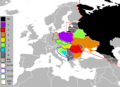 The Eastern European Group in 2010, with the years each member spent in the United Nations Security Council, including former members represented as outlines
 -
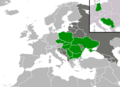 A map showing from which countries from the Eastern European Group has there been elected a President of the United Nations General Assembly as of September 2017
 -
 Members of the Western European and Others Group colour-coded for the number of years each spent on the Security Council as of 2010


See also[edit]
- IAEA Areas
- List of members of the United Nations Security Council
- List of members of the United Nations Economic and Social Council
- List of members of the United Nations Commission on Human Rights
- United Nations geoscheme
- Continental union
Notes[edit]
- ^ The sovereign entity with statehood over the territory of the Vatican City State.
- ^ Currently under Israeli occupation.
- ^ A disputed territory with undetermined political status.[2] Formerly Spanish Sahara up to 1976, administration is currently split between Morocco and the Sahrawi Arab Democratic Republic, both of which claim the entire territory. The Sahrawi Arab Democratic Republic's administrative control is limited to approximately 20% of the territory, with the remaining 80% of the territory occupied by Morocco. The United Nations Mission for the Referendum in Western Sahara is the United Nations peacekeeping mission to the territory (see Western Sahara conflict).
- ^ Assertion of territorial claims suspended under the Antarctic Treaty System.
- ^ In May 2000, Israel became a full member of the Group of Western European and other States on a temporary basis (subject to renewal), thereby enabling it to put forward candidates for election to various bodies of the General Assembly. In 2004, Israel obtained a permanent renewal to its membership.[11]
- ^ Turkey participates fully in both the Group of Western European and other States and the Group of Asia-Pacific States, but for electoral purposes is considered a member of the Group of Western European and other States only.[11]
- ^ The United States of America is not a member of any regional group, but attends meetings of the Group of Western European and other States as an observer and is considered to be a member of that group for electoral purposes.[11]
References[edit]
- ^ The GA Handbook: A practical guide to the United Nations General Assembly (PDF) (2 ed.). New York: Permanent Mission of Switzerland to the United Nations. 2017. p. 124. ISBN 978-0-615-49660-3.
- ^ BBC News: Western Sahara profile
- ^ a b c d Agam, Hasmy; Sam Daws; Terence O'Brien; Ramesh Takur (26 March 1999). What is Equitable Geographic Representation in the Twenty-First Century (PDF) (Report). United Nations University. Retrieved 5 March 2019.
- ^ a b c d e Winkelmann, Ingo (2010). "Regional Groups in the UN" (PDF). In Volger, Helmut (ed.). A Concise Encyclopedia of the United Nations (2nd ed.). Leiden: Martinus Nijhoff Publishers. pp. 592–96. ISBN 978-90-04-18004-8. S2CID 159105596. Archived from the original (PDF) on 13 January 2020. Retrieved 4 March 2019.
- ^ United Nations General Assembly Session 12 Resolution 1192 (XII). Composition of the General Committee of the General Assembly A/RES/1192(XII) 12 December 1957. Retrieved 5 March 2019.
- ^ United Nations General Assembly Session 18 Resolution 1991 (XVII). Question of Equitable Representation on the Security Council and the Economic and Social Council A/RES/1991(XVIII) 17 December 1963. Retrieved 5 March 2019.
- ^ United Nations General Assembly Session 26th Resolution 2847 (XXVI). Enlargement of the Economic and Social Council A/RES/2847(XXVI) 20 December 1971. Retrieved 5 March 2019.
- ^ United Nations General Assembly Session 33rd Resolution 33/138. Question of the Composition of the Relevant Organs of the United Nations : Amendments to Rules 31 and 38 of the Rules of Procedure of the General Assembly A/RES/33/138 19 December 1978. Retrieved 5 March 2019.
- ^ "UN Recognises The Pacific With Name Change". Secretariat of the Pacific Regional Environment Programme. 3 September 2011. Retrieved 26 February 2019.
- ^ "Asian group of nations at UN changes its name to Asia-Pacific group". Radio New Zealand. Wellington. 1 September 2011. Retrieved 26 February 2019.
- ^ a b c d e f g h i "United Nations Regional Groups of Member States". Department for General Assembly and Conference Management. United Nations. n.d. Retrieved 5 March 2019.
- ^ "Latin American and Caribbean Group (GRULAC)". Ministry of Foreign Affairs of the Republic of Colombia. Retrieved 2012-10-18.
- ^ "Groups of Member States | outreach.un.org.mun". outreach.un.org. Archived from the original on 2017-03-15. Retrieved 2017-08-10.
- ^ United Nations General Assembly (7 July 1998). "UNGA Resolution 52/250" (PDF). United Nations. Archived from the original (PDF) on May 22, 2011. Retrieved 2011-01-10.: "Palestine enjoys full membership in the Group of Asian States and the Economic and Social Commission for Western Asia."
- ^ Permanent Observer Mission of Palestine to the United Nations. "Status of Palestine at the United Nations". United Nations. Archived from the original on 2011-06-06. Retrieved 2011-01-10.: "On 2 April 1986, the Asian Group of the U.N. decided to accept the PLO as a full member."
- ^ United Nations Conference on Trade and Development. "Government structures". United Nations. Archived from the original on 2010-06-13. Retrieved 2011-01-10.: "At present, the PLO is a full member of the Asian Group of the United Nations, ..."
- ^ Doebbler, Curtis (27 November 2009). "International Law and Palestinian Independence: A View from Palestine". JURIST. University of Pittsburgh School of Law. Archived from the original on 2015-09-30. Retrieved 2011-01-10.: "Palestine is already recognised as a full member of the Asian Group of States in the UN, and often thereby submits and influences UN resolutions. Being a member state would also give the Palestinian representative to the UN the right to vote on General Assembly resolutions, among other UN decisions."
- ^ O'Brien, Terence (1997). "The United Nations: Legacy and Reform" (PDF). Retrieved 8 December 2020.
{{cite journal}}: Cite journal requires|journal=(help) - ^ United Nations General Assembly Session 55 Official Records 55/PV.25. 25th plenary meeting. General Debate A/55/PV.25 page 21. Vinci Niel Clodumar Nauru (in English). 20 September at 15:00.
External links[edit]
- UNAIDS, The Governance Handbook, January 2010 (pp. 28,29); PDF document at UN-AIDS website.