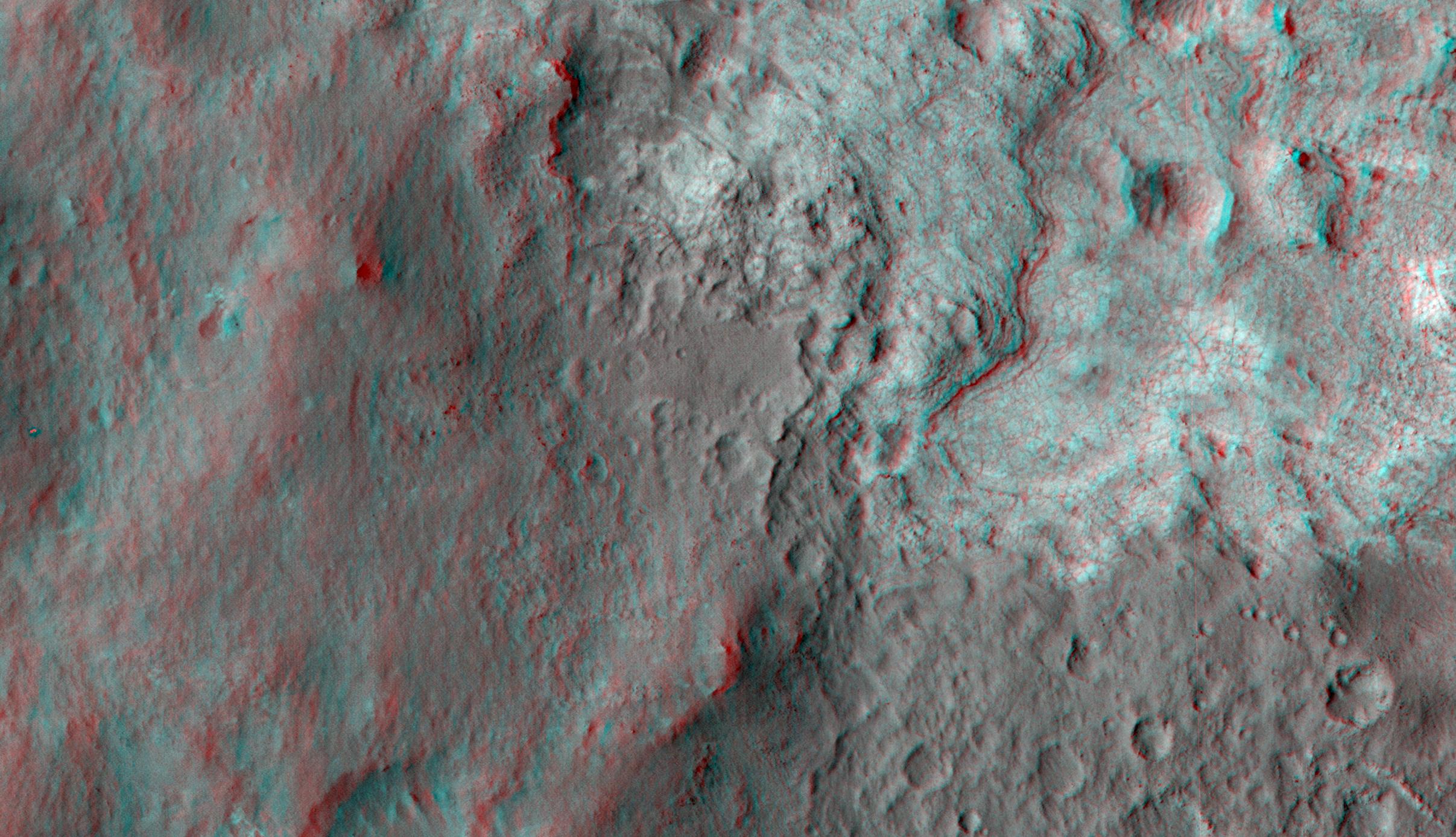
Aeolis quadrangle
 Map of Aeolis quadrangle from Mars Orbiter Laser Altimeter (MOLA) data. The highest elevations are red and the lowest are blue. The Spirit rover landed in Gusev crater. Aeolis Mons is in Gale Crater. | |
| Coordinates | 15°00′S 202°30′W / 15°S 202.5°W |
|---|---|

The Aeolis quadrangle is one of a series of 30 quadrangle maps of Mars used by the United States Geological Survey (USGS) Astrogeology Research Program. The Aeolis quadrangle is also referred to as MC-23 (Mars Chart-23).[1] The Aeolis quadrangle covers 180° to 225° W and 0° to 30° south on Mars, and contains parts of the regions Elysium Planitia and Terra Cimmeria. A small part of the Medusae Fossae Formation lies in this quadrangle.
The name refers to the name of a floating western island of Aeolus, the ruler of the winds. In Homer's account, Odysseus received the west wind Zephyr here and kept it in bags, but the wind got out.[2] [3]
It is famous as the site of two spacecraft landings: the Spirit rover landing site (14°34′18″S 175°28′43″E / 14.5718°S 175.4785°E) in Gusev crater (January 4, 2004), and the Curiosity rover in Gale Crater (4°35′31″S 137°26′25″E / 4.591817°S 137.440247°E) (August 6, 2012).[4]
A large, ancient river valley, called Ma'adim Vallis, enters at the south rim of Gusev Crater, so Gusev Crater was believed to be an ancient lake bed. However, it seems that a volcanic flow covered up the lakebed sediments.[5] Apollinaris Patera, a large volcano, lies directly north of Gusev Crater.[6]
Gale Crater, in the northwestern part of the Aeolis quadrangle, is of special interest to geologists because it contains a 2–4 km (1.2–2.5 mi) high mound of layered sedimentary rocks, named "Mount Sharp" by NASA in honor of Robert P. Sharp (1911–2004), a planetary scientist of early Mars missions.[7][8][9] More recently, on 16 May 2012, "Mount Sharp" was officially named Aeolis Mons by the USGS and IAU.[10]
Some regions in the Aeolis quadrangle show inverted relief.[11] In these locations, a stream bed may be a raised feature, instead of a valley. The inverted former stream channels may be caused by the deposition of large rocks or due to cementation. In either case erosion would erode the surrounding land but leave the old channel as a raised ridge because the ridge will be more resistant to erosion
Yardangs are another feature found in this quadrangle. They are generally visible as a series of parallel linear ridges, caused by the direction of the prevailing wind.
Spirit rover discoveries[edit]
The rocks on the plains of Gusev are a type of basalt. They contain the minerals olivine, pyroxene, plagioclase, and magnetite, and they look like volcanic basalt as they are fine-grained with irregular holes (geologists would say they have vesicles and vugs).[12][13] Much of the soil on the plains came from the breakdown of the local rocks. Fairly high levels of nickel were found in some soils; probably from meteorites.[14] Analysis shows that the rocks have been slightly altered by tiny amounts of water. Outside coatings and cracks inside the rocks suggest water deposited minerals, maybe bromine compounds. All the rocks contain a fine coating of dust and one or more harder kinds of material. One type can be brushed off, while another needed to be ground off by the Rock Abrasion Tool (RAT).[15]


There are a variety of rocks in the Columbia Hills, some of which have been altered by water, but not by very much water.
The dust in Gusev Crater is the same as dust all around the planet. All the dust was found to be magnetic. Moreover, Spirit found the magnetism was caused by the mineral magnetite, especially magnetite that contained the element titanium. One magnet was able to completely divert all dust hence all Martian dust is thought to be magnetic.[16] The spectra of the dust was similar to spectra of bright, low thermal inertia regions like Tharsis and Arabia that have been detected by orbiting satellites. A thin layer of dust, maybe less than one millimeter thick, covers all surfaces. Something in it contains a small amount of chemically bound water.[17][18]
Plains[edit]

 Above: An approximate true-color view of Adirondack, taken by Spirit's pancam. Right: Digital camera image (from Spirit's Pancam) of Adirondack after a RAT grind (Spirit's rock grinding tool) | |
| Feature type | Rock |
|---|---|
Observations of rocks on the plains show they contain the minerals pyroxene, olivine, plagioclase, and magnetite. These rocks can be classified in different ways. The amounts and types of minerals make the rocks primitive basalts—also called picritic basalts. The rocks are similar to ancient terrestrial rocks called basaltic komatiites. Rocks of the plains also resemble the basaltic shergottites, meteorites which came from Mars. One classification system compares the amount of alkali elements to the amount of silica on a graph; in this system, Gusev plains rocks lie near the junction of basalt, picrobasalt, and tephite. The Irvine-Barager classification calls them basalts.[12] Plain's rocks have been very slightly altered, probably by thin films of water because they are softer and contain veins of light colored material that may be bromine compounds, as well as coatings or rinds. It is thought that small amounts of water may have gotten into cracks inducing mineralization processes.[13][12] Coatings on the rocks may have occurred when rocks were buried and interacted with thin films of water and dust. One sign that they were altered was that it was easier to grind these rocks compared to the same types of rocks found on Earth.
The first rock that Spirit studied was Adirondack. It turned out to be typical of the other rocks on the plains.
-
 First color picture from Gusev crater. Rocks were found to be basalt. Everything was covered with a fine dust that Spirit determined was magnetic because of the mineral magnetite.
 -
 Cross-sectional drawing of a typical rock from the plains of Gusev crater. Most rocks contain a coating of dust and one or more harder coatings. Veins of water-deposited veins are visible, along with crystals of olivine. Veins may contain bromine salts.


Columbia Hills[edit]
Scientists found a variety of rock types in the Columbia Hills, and they placed them into six different categories. The six are: Clovis, Wishbone, Peace, Watchtower, Backstay, and Independence. They are named after a prominent rock in each group. Their chemical compositions, as measured by APXS, are significantly different from each other.[19] Most importantly, all of the rocks in Columbia Hills show various degrees of alteration due to aqueous fluids.[20] They are enriched in the elements phosphorus, sulfur, chlorine, and bromine—all of which can be carried around in water solutions. The Columbia Hills' rocks contain basaltic glass, along with varying amounts of olivine and sulfates.[21][22] The olivine abundance varies inversely with the amount of sulfates. This is exactly what is expected because water destroys olivine but helps to produce sulfates.
Acid fog is believed to have changed some of the Watchtower rocks. This was in a 200 meter long section of Cumberland Ridge and the Husband Hill summit. Certain places became less crystalline and more amorphous. Acidic water vapor from volcanoes dissolved some minerals forming a gel. When water evaporated, a cement formed and produced small bumps. This type of process has been observed in the lab when basalt rocks are exposed to sulfuric and hydrochloric acids.[23][24][25]
The Clovis group is especially interesting because the Mössbauer spectrometer (MB) detected goethite in it.[26] Goethite forms only in the presence of water, so its discovery is the first direct evidence of past water in the Columbia Hills's rocks. In addition, the MB spectra of rocks and outcrops displayed a strong decline in olivine presence,[21] although the rocks probably once contained much olivine.[27] Olivine is a marker for the lack of water because it easily decomposes in the presence of water. Sulfate was found, and it needs water to form. Wishstone contained a great deal of plagioclase, some olivine, and anhydrate (a sulfate). Peace rocks showed sulfur and strong evidence for bound water, so hydrated sulfates are suspected. Watchtower class rocks lack olivine consequently they may have been altered by water. The Independence class showed some signs of clay (perhaps montmorillonite a member of the smectite group). Clays require fairly long term exposure to water to form. One type of soil, called Paso Robles, from the Columbia Hills, may be an evaporate deposit because it contains large amounts of sulfur, phosphorus, calcium, and iron.[28] Also, MB found that much of the iron in Paso Robles soil was of the oxidized, Fe3+ form, which would happen if water had been present.[17]
Towards the middle of the six-year mission (a mission that was supposed to last only 90 days), large amounts of pure silica were found in the soil. The silica could have come from the interaction of soil with acid vapors produced by volcanic activity in the presence of water or from water in a hot spring environment.[29]
After Spirit stopped working scientists studied old data from the Miniature Thermal Emission Spectrometer, or Mini-TES and confirmed the presence of large amounts of carbonate-rich rocks, which means that regions of the planet may have once harbored water. The carbonates were discovered in an outcrop of rocks called "Comanche".[30][31]
In summary, Spirit found evidence of slight weathering on the plains of Gusev, but no evidence that a lake was there. However, in the Columbia Hills there was clear evidence for a moderate amount of aqueous weathering. The evidence included sulfates and the minerals goethite and carbonates which only form in the presence of water. It is believed that Gusev crater may have held a lake long ago, but it has since been covered by igneous materials. All the dust contains a magnetic component which was identified as magnetite with some titanium. Furthermore, the thin coating of dust that covers everything on Mars is the same in all parts of Mars.
Ma'adim Vallis[edit]
.jpg)

Recent studies lead scientists to believe that the water that formed Ma'adim Vallis originated in a complex of lakes.[32][33][34] The largest lake is located at the source of the Ma'adim Vallis outflow channel and extends into Eridania quadrangle and the Phaethontis quadrangle.[35] When the largest lake spilled over the low point in its boundary, a torrential flood would have moved north, carving the sinuous Ma'adim Vallis. At the north end of Ma'adim Vallis, the flood waters would have run into Gusev Crater.[36]
There is enormous evidence that water once flowed in river valleys on Mars. Images of curved channels have been seen in images from Mars spacecraft dating back to the early 1970s with the Mariner 9 orbiter.[37][38][39][40]
Vallis (plural valles) is the Latin word for "valley". It is used in planetary geology for the naming of landform features on other planets, including what could be old river valleys that were discovered on Mars, when probes were first sent to Mars. The Viking Orbiters caused a revolution in our ideas about water on Mars; huge river valleys were found in many areas. Space craft cameras showed that floods of water broke through dams, carved deep valleys, eroded grooves into bedrock, and traveled thousands of kilometers.[41][42][43] Some valles on Mars (Mangala Vallis, Athabasca Vallis, Granicus Vallis, and Tinjar Valles) clearly begin at graben. On the other hand, some of the large outflow channels begin in rubble-filled low areas called chaos or chaotic terrain. It has been suggested that massive amounts of water were trapped under pressure beneath a thick cryosphere (layer of frozen ground), then the water was suddenly released, perhaps when the cryosphere was broken by a fault.[44][45]
Gale Crater[edit]
Gale Crater, in the northwestern part of the Aeolis quadrangle, is of special interest to geologists because it contains a 2–4 km (1.2–2.5 mi) high mound of layered sedimentary rocks. On 28 March 2012 this mound was named "Mount Sharp" by NASA in honor of Robert P. Sharp (1911–2004), a planetary scientist of early Mars missions.[7][8][9] More recently, on 16 May 2012, Mount Sharp was officially named Aeolis Mons by the USGS and IAU.[10] The mound extends higher than the rim of the crater, so perhaps the layering covered an area much larger than the crater.[46] These layers are a complex record of the past. The rock layers probably took millions of years to be laid down within the crater, then more time to be eroded to make them visible.[47] The 5 km high mound is probably the thickest single succession of sedimentary rocks on Mars.[48] The lower formation may date from near the Noachian age, while the upper layer, separated by an erosional unconformity, may be as young as the Amazonian period.[49] The lower formation may have formed the same time as parts of Sinus Meridiani and Mawrth Vallis. The mound that lies in the center of Gale Crater was created by winds. Because the winds eroded the mound on one side more than another, the mound is skewed to one side, rather than being symmetrical.[50][51] The upper layer may be similar to layers in Arabia Terra. Sulfates and Iron oxides have been detected in the lower formation and anhydrous phases in the upper layer.[52] There is evidence that the first phase of erosion was followed by more cratering and more rock formation.[53] Also of interest in Gale Crater is Peace Vallis, officially named by the IAU on September 26, 2012,[54] which 'flows' down out of the Gale Crater hills to the Aeolis Palus below, and which seems to have been carved by flowing water.[55][56][57] On December 9, 2013, NASA reported that, based on evidence from Curiosity studying Aeolis Palus, Gale Crater contained an ancient freshwater lake which could have been a hospitable environment for microbial life.[58][59] Gale Crater contains a number of fans and deltas that provide information about lake levels in the past. These formations are: Pancake Delta, Western Delta, Farah Vallis delta and the Peace Vallis Fan.[60]
-
 Gale crater - surface materials (false colors; THEMIS; 2001 Mars Odyssey)
 -
 Gale Crater with Aeolis Mons rising from the center. The noted Curiosity rover landing area is near Peace Vallis in Aeolis Palus.
 -
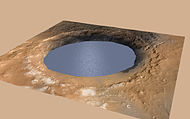 Ancient Lake fills Gale Crater on Mars (simulated view).
 -
-
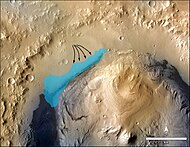
 Peace Vallis and alluvial fan near the Curiosity rover landing ellipse and site (noted by +)


-
 Curiosity rover landing site (green dot) - Blue dot marks Glenelg Intrigue - Blue spot marks the Base of Mount Sharp - a planned area of study.
 -
 Curiosity rover landing site - "Quad Map" includes "Yellowknife" Quad 51 of Aeolis Palus in Gale Crater.
 -
 Gale Crater Grand Canyon, as seen by HiRISE. Scale bar is 500 meters long.
 -
 Gale Crater sediment layers may have formed by lake or windblown particle deposition.
 -
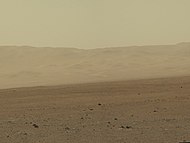 Gale Crater rim about 18 km (11 mi) North of the Curiosity rover on August 9, 2012
 -
 Aeolis Mons and Aeolis Palus in Gale Crater as viewed by the Curiosity rover on August 6, 2012
 -
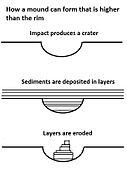 Aeolis Mons may have formed from the erosion of sediment layers that once filled Gale Crater.
 -
 Aeolis Mons as viewed from the Curiosity rover (August 9, 2012) (white balanced image)
 -
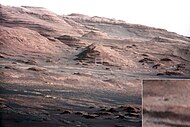 Layers at the base of Aeolis Mons - dark rock in inset is same size as the Curiosity rover (white balanced image).
 -

-
 First-Year and First-Mile Traverse Map of the Curiosity rover on Mars (August 1, 2013) (3-D)


-
 Slip Face on Downwind Side of 'Namib' Sand Dune on Mars, as seen by Curiosity. Dune stands about 13 feet (4.0 meters) high. Picture taken with Navcam.
 -
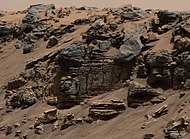 This evenly layered rock photographed by the Mast Camera (Mastcam) on NASA's Curiosity Mars rover shows a pattern typical of a lake-floor sedimentary deposit not far from where flowing water entered a lake.
 -
 View from the "Kimberley" formation on Mars taken by NASA's Curiosity rover
 -
 View from Mastcam on Curiosity showing sloping buttes and layered outcrops on lower Mount Sharp


Other craters[edit]
Impact craters generally have a rim with ejecta around them, in contrast volcanic craters usually do not have a rim or ejecta deposits. As craters get larger (greater than 10 km in diameter) they usually have a central peak.[61] The peak is caused by a rebound of the crater floor following the impact.[41] Sometimes craters will display layers. Since the collision that produces a crater is like a powerful explosion, rocks from deep underground are tossed onto the surface. Hence, craters can show us what lies deep under the surface.
-
 Boeddicker Crater Floor, as seen by HiRISE
 -
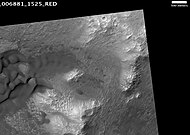 Central uplift of an Unnamed crater on the floor of Molesworth Crater, as seen by HiRISE. Dark sand dunes are on left side of image. The scale bar is 500 meters long.
 -
 Reuyl Crater Central Peak, as seen by HiRISE
 -
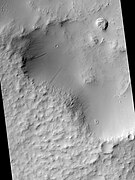 Galdakao Crater, as seen by HiRISE. Click on image to see dark slope streaks.
 -
 Layers in crater wall, as seen by HiRISE under HiWish program. Area in box is enlarged in the next image.
 -
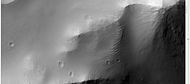 Enlargement from previous image, showing many thin layers. Note that the layers do not seem to be formed from rocks. They may be all that is left of a deposit that once filled the crater. Image was taken with HiRISE, under HiWish program.
 -
 Gullies on wall of impact crater, as seen by HiRISE under HiWish program. Curved ridges on the floor are remains of old glaciers.
 -
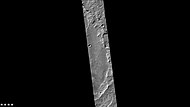 Graff Crater (Martian Crater), as seen by CTX camera (on Mars Reconnaissance Orbiter)


Mars Science Laboratory discoveries[edit]
The aim of the Mars Science Laboratory mission, and its surface robotic payload Curiosity rover, is to search for signs of ancient life. It is hoped that a later mission could then return samples that the laboratory identified as probably containing remains of life. To safely bring the craft down, a 12 mile wide, smooth, flat circle was needed. Geologists hoped to examine places where water once ponded[62] and to examine sedimentary layers.
On August 6, 2012, the Mars Science Laboratory landed on Aeolis Palus near Aeolis Mons in Gale Crater.[7][8][9][10][63][64] The landing was 2.279 km (1.416 mi) from the target (4°35′31″S 137°26′25″E / 4.591817°S 137.440247°E), closer than any previous rover landing and well within the target area.
On September 27, 2012, NASA scientists announced that Curiosity found evidence for an ancient streambed suggesting a "vigorous flow" of water on Mars.[55][56][57]

On October 17, 2012, at Rocknest, the first X-ray diffraction analysis of Martian soil was performed. The results revealed the presence of several minerals, including feldspar, pyroxenes and olivine, and suggested that the Martian soil in the sample was similar to the weathered basaltic soils of Hawaiian volcanoes. The sample used is composed of dust distributed from global dust storms and local fine sand. So far, the materials Curiosity has analyzed are consistent with the initial ideas of deposits in Gale Crater recording a transition through time from a wet to dry environment.[67]
On December 3, 2012, NASA reported that Curiosity performed its first extensive soil analysis, revealing the presence of water molecules, sulfur and chlorine in the Martian soil.[68][69] The presence of perchlorates in the sample seems highly likely. The presence of sulfate and sulfide is also likely because sulfur dioxide and hydrogen sulfide were detected. Small amounts of chloromethane, dichloromethane and trichloromethane were detected. The source of the carbon in these molecules is unclear. Possible sources include contamination of the instrument, organics in the sample and inorganic carbonates.[68][69]

On March 18, 2013, NASA reported evidence of mineral hydration, likely hydrated calcium sulfate, in several rock samples including the broken fragments of "Tintina" rock and "Sutton Inlier" rock as well as in veins and nodules in other rocks like "Knorr" rock and "Wernicke" rock.[70][71][72] Analysis using the rover's DAN instrument provided evidence of subsurface water, amounting to as much as 4% water content, down to a depth of 60 cm (2.0 ft), in the rover's traverse from the Bradbury Landing site to the Yellowknife Bay area in the Glenelg terrain.[70]
In March 2013, NASA reported Curiosity found evidence that geochemical conditions in Gale Crater were once suitable for microbial life after analyzing the first drilled sample of Martian rock, "John Klein" rock at Yellowknife Bay in Gale Crater. The rover detected water, carbon dioxide, oxygen, sulfur dioxide and hydrogen sulfide.[73][74][75] Chloromethane and dichloromethane were also detected. Related tests found results consistent with the presence of smectite clay minerals.[73][74][75][76][77]
In the journal Science from September 2013, researchers described a different type of rock called Jake M (or Jake Matijevic) It was the first rock analyzed by the Alpha Particle X-ray Spectrometer (APXS) instrument on the Curiosity rover, and it was different from other known martian igneous rocks as it is alkaline (>15% normative nepheline) and relatively fractionated. Jake M is similar to terrestrial mugearites, a rock type typically found at ocean islands and continental rifts. Jake M's discovery may mean that alkaline magmas may be more common on Mars than on Earth and that Curiosity could encounter even more fractionated alkaline rocks (for example, phonolites and trachytes).[78]


On December 9, 2013, NASA researchers described, in a series of six articles in the journal Science, many new discoveries from the Curiosity rover. Possible organics were found that could not be explained by contamination.[79][80] Although the organic carbon was probably from Mars, it can all be explained by dust and meteorites that have landed on the planet.[81][82][83] Because much of the carbon was released at a relatively low temperature in Curiosity's Sample Analysis at Mars (SAM) instrument package, it probably did not come from carbonates in the sample. The carbon could be from organisms, but this has not been proven. This organic-bearing material was obtained by drilling 5 centimeters deep in a site called Yellowknife Bay into a rock called “Sheepbed mudstone”. The samples were named John Klein and Cumberland. Microbes could be living on Mars by obtaining energy from chemical imbalances between minerals in a process called chemolithotrophy which means “eating rock.”[84] However, in this process only a very tiny amount of carbon is involved—much less than was found at Yellowknife Bay.[85][86]
Using SAM's mass spectrometer, scientists measured isotopes of helium, neon, and argon that cosmic rays produce as they go through rock. The fewer of these isotopes they find, the more recently the rock has been exposed near the surface. The four-billion-year-old lakebed rock drilled by Curiosity was uncovered between 30 million and 110 million years ago by winds which sandblasted away two meters of overlying rock. Next, they hope to find a site tens of millions of years younger by drilling close to an overhanging outcrop.[87]
The absorbed dose and dose equivalent from galactic cosmic rays and solar energetic particles on the Martian surface for ~300 days of observations during the current solar maximum was measured. These measurements are necessary for human missions to the surface of Mars, to provide microbial survival times of any possible extant or past life, and to determine how long potential organic biosignatures can be preserved. This study estimates that a one-meter depth drill is necessary to access possible viable radioresistant microbe cells. The actual absorbed dose measured by the Radiation Assessment Detector (RAD) is 76 mGy/yr at the surface. Based on these measurements, for a round trip Mars surface mission with 180 days (each way) cruise, and 500 days on the Martian surface for this current solar cycle, an astronaut would be exposed to a total mission dose equivalent of ~1.01 sievert. Exposure to one sievert is associated with a five percent increase in risk for developing fatal cancer. NASA's current lifetime limit for increased risk for its astronauts operating in low-Earth orbit is three percent.[88] Maximum shielding from galactic cosmic rays can be obtained with about 3 meters of Martian soil.[89]
The samples examined were probably once mud that for millions to tens of millions of years could have hosted living organisms. This wet environment had neutral pH, low salinity, and variable redox states of both iron and sulfur species.[81][90][91][92] These types of iron and sulfur could have been used by living organisms.[93] Carbon, hydrogen, oxygen, sulfur, nitrogen, and phosphorus were measured directly as key biogenic elements, and by inference, phosphorus is assumed to have been available.[84][86] The two samples, John Klein and Cumberland, contain basaltic minerals, Ca-sulfates, Fe oxide/hydroxides, Fe-sulfides, amorphous material, and trioctahedral smectites (a type of clay). Basaltic minerals in the mudstone are similar to those in nearby aeolian deposits. However, the mudstone has far less Fe-forsterite plus magnetite, so Fe-forsterite (type of olivine) was probably altered to form smectite (a type of clay) and magnetite.[94] A Late Noachian/Early Hesperian or younger age indicates that clay mineral formation on Mars extended beyond Noachian time; therefore, in this location neutral pH lasted longer than previously thought.[90]
In a press conference on December 8, 2014, Mars scientists discussed observations by Curiosity rover that show Mars' Mount Sharp was built by sediments deposited in a large lake bed over tens of millions of years. This finding suggests the climate of ancient Mars could have produced long-lasting lakes at many places on the Planet. Rock layers indicate that a huge lake was filled and evaporated many times. The evidence was many deltas that were stacked upon each other.[95][96][97][98][99]
Also in December 2014, it was announced that Curiosity had detected sharp increases in methane four times out of twelve during a 20-month period with the Tunable Laser Spectrometer (TLS) of the Sample Analysis at Mars instrument (SAM). Methane levels were ten times the usual amount. Due to the temporary nature of the methane spike, researchers believe the source is localized. The source may be biological or non-biological.[100][101][102]
On December 16, 2014, a team of researchers described how they have concluded that organic compounds have been found on Mars by Curiosity. The compounds were found in samples from drilling into Sheepbed mudstone. Chlorobenzene and several dichloroalkanes, such as dichloroethane, dichloropropane and dichlorobutane were discovered in the samples.[103][104]
On March 24, 2015, a paper was released describing the discovery of nitrates in three samples analyzed by Curiosity. The nitrates are believed to have been created from diatomic nitrogen in the atmosphere during meteorite impacts.[105][106] Nitrogen is needed for all forms of life because it is used in the building blocks of larger molecules like DNA and RNA. Nitrates contain nitrogen in a form that can be used by living organisms; nitrogen in the air can not be used by organisms. This discovery of nitrates adds to the evidence that Mars once had life.[107][108]
The Jet Propulsion Laboratory (JPL) announced in April 2015 the discovery of a network of two-tone mineral veins at an area called "Garden City" on lower Mount Sharp. The veins stand about 2.5 inches above the surface and are composed of two different minerals formed from at least two different fluid flows.[109] In Pahrump Hills, an area about 39 feet lower, the minerals clay, hematite, jarosite, quartz, and cristobalite were found.[110][111]
Measurements made by Curiosity allowed researchers to determine that Mars has liquid water at times. Because the humidity goes to 100% at night, salts, like calcium perchlorate, will absorb water from the air and form a brine in the soil. This process in which a salt absorbs water from the air is called deliquescence. Liquid water results even though the temperature is very low, as salts lower the freezing point of water. This principle is used when salt is spread on roads to melt snow/ice. The liquid brine produced in the night evaporates after sunrise. Much more liquid water is expected in higher latitudes where the colder temperature and more water vapor can result in higher levels of humidity more often.[112][113] The researchers cautioned that the amount of water was not enough to support life, but it could allow salts to move around in the soil.[114] The brines would occur mostly in the upper 5 cm of the surface; however, there is evidence that the effects of liquid water can be detected down to 15 cm. Chlorine-bearing brines are corrosive; therefore design changes may need to be made for future landers.[115]
French and U.S. scientists found a type of granite by studying images and chemical results of 22 rock fragments. The composition of the rocks was determined with the ChemCam instrument. These pale rocks are rich in feldspar and may contain some quartz. The rocks are similar to Earth's granitic continental crust. They are like rocks called TTG (Tonalite-Trondhjemite-Granodiorite). On the Earth, TTG was common in the terrestrial continental crust in the Archean era (more than 2.5 billion years ago). By landing in Gale crater, Curiosity was able to sample a variety of rocks because the crater dug deep into the crust, thus exposing old rocks, some of which may be about 3.6 billion years old. For many years, Mars was thought to be composed of the dark, igneous rock basalt, so this is a significant discovery.[116][117][118]
On October 8, 2015, a large team of scientists confirmed the existence of long-lasting lakes in Gale Crater. The conclusion of Gale having lakes was based on evidence of old streams with coarser gravel in addition to places where streams appear to have emptied out into bodies of standing water. If lakes were once present, Curiosity would start seeing water-deposited, fine-grained rocks closer to Mount Sharp. That is exactly what happened.
Finely laminated mudstones were discovered by Curiosity; this lamination represents the settling of plumes of fine sediment through a standing body of water. Sediment deposited in a lake formed the lower portion of Mount Sharp, the mountain in Gale crater.[119][120][121]
At a press conference in San Francisco at the American Geophysical Union meeting, a group of scientists told of a discovery of very high concentrations of silica at some sites, along with the first ever discovery of a silica mineral called tridymite. The scientific team believes that water was involved with putting the silica in place. Acidic water would tend transport other ingredients away and leave silica behind, whereas alkaline or neutral water could carry in dissolved silica that would be deposited. This finding used measurements from ChemCam, the Alpha Particle X-ray Spectrometer (APXS), and the Chemistry and Mineralogy (CheMin) instrument inside the rover. Tridymite was found in a rock named "Buckskin".[122] ChemCam and APXS measurements displayed high silica in pale zones along fractures in the bedrock beyond Marias Pass; hence silica may have been deposited by fluids that flowed through the fractures. CheMin found high silica levels in drilled material from a target called "Big Sky" and in another rock called "Greenhorn".[123]
As of the beginning of 2016, Curiosity had discovered seven hydrous minerals. The minerals are actinolite, montmorillonite, saponite, jarosite, halloysite, szomolnokite and magnesite. In some places the total concentration of all hydrous minerals was 40 vol%. Hydrous minerals help us understand the early water environment and possible biology on Mars.[124]
By using Curiosity's laser-firing device (ChemCam), scientists found manganese oxides in mineral veins in the "Kimberley" region of Gale Crater. These minerals need lots of water and oxidizing conditions to form; hence this discovery points to a water-rich, oxygen-rich past.[125][126][127]
A study of the kinds of minerals in veins examined with Curiosity found that evaporating lakes were present in the past in Gale crater. The Sheepbed Member mudstones of Yellowknife Bay (YKB) were examined in this research.[128][129]
Frost probably has formed in three locations in the first 1000 sols of the mission of the Curiosity exploration according to research published in Icarus in 2016.[130] This frost can cause weathering. Frost formation can explain the widespread detection of hydrated materials from orbit with the OMEGA instrument; it also can explain the hydrated component measured by Curiosity in Martian soil.[131][132][133]
Researchers in December 2016 announced the discovery of the element boron on Mars by Curiosity in mineral veins. For boron to be present there must have been a temperature between 0–60 degrees Celsius and a neutral-to-alkaline pH." The temperature, pH, and dissolved minerals of the groundwater support a habitable environment.[134] Moreover, boron has been suggested to be necessary for life to form. Its presence stabilizes the sugar ribose which is an ingredient in RNA.[135][136][137] Details of the discovery of Boron on Mars were given in a paper written by a large number of researchers and published in Geophysical Research Letters.[138][139][140]
Researchers have concluded that Gale Crater has experienced many episodes of groundwater with changes in the groundwater chemistry. These chemical changes would support life.[141][142][143][144][145][146]

In January 2017, JPL scientists announced the discovery of mud cracks on Mars. This find adds more evidence that Gale Crater was wet in the past.[147][148][149][150]
Studies of the wind around the Curiosity rover over a period of 3 billion years has shown that the Mount Sharp, the mound inside Gale Crater was created when winds removed material over billions of years and left material in the middle that is Mount Sharp. The researchers calculated that about 15,000 cubic miles (64,000 cubic kilometers) of material was removed from the crater. Curiosity has seen dust devils in action in the distance. Also, changes were visible as a dust devil passed close to the rover. Ripples in the sand below Curiosity were observed to move about one inch (2.5 cm) in just one day.[151][152]
CheMin found feldspar, mafic igneous minerals, iron oxides, crystalline silica, phyllosilicates, sulfate minerals in mudstone of Gale Crater. Some of the trends in these minerals at different levels suggested that at least part of the time the lake had near-neutral pH.[153][154]
An analysis of a large amount of data from ChemCam and APXS showed that most of the material encountered by Curiosity consists of just two major igneous rock types and traces of three others. One chief type is classified as a subalkaline, Mg-rich basalt (similar to MER Spirit basalt) and the other was a more evolved, higher Si, Al, lower Mg basalt.[155]

A large group of researchers discovered halos around fractures that they water existed in the ground long after water disappeared from Gale crater. Groundwater, carrying dissolved silica, moved in fractures and deposited silica there. This silica enrichment went across young and old rocks.[156][157]
Research of chemicals in layers in Gale Crater, published in 2017, suggest that the lake in Gale Crater had a neutral pH for much of the time. The mudstone in the Murray formation at the base of Mount Sharp indicated deposition in a lake environment. After the layers were deposited, an acid solution may have moved through the rock, which contained olivine and pyroxene, dissolving some minerals like magnetite and forming new ones like hematite and jarosite. The elements magnesium (Mg), iron (Fe), manganese (Mn), nickel (Ni), and zinc (Zn) were carried down. Eventually, Ni, Zn, and Mn coated (adsorbed onto) clay particles. Iron-oxides, Mg, and sulfur produced sulfates. The Murray formation was sampled at several locations for this research: Confidence Hills, Mojave 2, Telegraph peak, and Buckskin.[158][159]
Research presented in a June 2018 press conference described the detection of more organic molecules in a drill sample analyzed by Curiosity.[160][161] Some of the organic molecules found were thiophenes, benzene, toluene, and small carbon chains, such as propane or butane.[162] At least 50 nanomoles of organic carbon are still in the sample, but were not specifically determined. The remaining organic material probably exists as macromolecules organic sulfur molecules. Organic matter was from lacustrine mudstones at the base of the ~3.5-billion-year-old Murray formation at Pahrump Hills, by the Sample Analysis at Mars instrument suite.[163]
With two full Martian years (five Earth years) of measurements, scientists found that the annual average concentration of methane in Mars' atmosphere is 0.41 ppb. However, methane levels rise and fall with the seasons, going from 0.24 ppb in winter to 0.65 ppb in summer. The researchers also saw relatively large methane spikes, up to about 7 ppb, at random intervals.[160][164] The existence of methane in the Martian atmosphere is exciting because on Earth, most methane is produced by living organisms. Methane on Mars does not prove that life exists there, but it is consistent with life. Ultraviolet radiation from the sun destroys methane does not last long; consequently, something must have been creating or releasing it.[164]
Using date gathered with Mastcam, a team of researchers have found what they believe to be iron meteorites. These meteorites stand out in multispectral observations as not possessing the usual ferrous or ferric absorption features as the surrounding surface.[165]
Emily Lakdaealla wrote a detailed 2018 book about the Curiosity rover's instruments and history. She listed the minerals that Curiosity's CheMin has discovered. CheMin has discovered olivine, pyroxene, feldspar, quartz, magnetite, iron sulfides (pyrite and pyrrhotite), akaganeite, jarosite, and calcium sulfates (gypsum, anhydrite, basanite) [166]
Research presented in 2018 at the Geological Society of America Annual Meeting in Indianapolis, Indiana described evidence for huge floods in Gale Crater. One rock unit examined by Curiosity contains the rock conglomerate with particles up to 20 centimeters across. To create such a type of rock water must have been 10 to 20 meters in depth. Between two million years to 12,000 years ago, Earth experienced these type of floods.[167][168][169]
Using various gravity measurements, a team of scientists concluded that Mount Sharp may have formed right where it is, as it is. The authors stated, "Mount Sharp formed largely in its current form as a free-standing mound within Gale."[170] One idea was that it was part of material that covered a wide region and then eroded, leaving Mount Sharp. However, if that were the case, the layers on the bottom would be fairly dense. This gravity data show that the bottom layers are quite porous. Had they been under many layers of rock they would be compressed and be more dense. Intensity of the gravity was obtained by using data from Curiosity's accelerometers.[171][172][173]
Researched published in Nature Geoscience in October 2019 described how Gale crater underwent many wet and dry cycles as its lake waters disappeared.[174] Sulfate salts from evaporated water showed that pools of salty water once existed in Gale Crater. These ponds could have supported organisms. Basalts could have produced the calcium and magnesium sulfates that were found. Because of its low solubility, calcium sulfate is deposited early on as a lake dries up. However, the discovery of magnesium sulfate salts means that the lake must have almost totally evaporated. The remaining pools of water would have been very salty—such lakes on Earth contain organisms that are salt tolerant or "halotolerant". These minerals were found along the edges of what were lakes in the younger parts of Gale Crater.[175] When Curiosity was exploring deeper in the crater, clays found there showed that a lake existed for a long time, these new findings of sulfates the lake dried up and then get wetter over and over.
Sulfate salts have been detected in other places in Gale as white veins caused by groundwater moving through cracks in the rocks.[176]
Curiosity has found oxygen going into the air in Gale Crater. Measurements over three Martian years (almost six Earth years) by an instrument in the Sample Analysis at Mars (SAM) portable chemistry lab revealed that the level of oxygen went up throughout spring and summer by as much as 30%, and then dropped back to normal levels by fall. Each spring this occurred. These oxygen seasonal variations suggest some unknown process in the atmosphere or the surface is occurring.[177][178][179]

Evidence of life on Mars was published on January 19, 2022. Rover's Tunable Laser Spectrometer (TLS) determined the abundance of carbon isotopes in 24 samples. In many of the samples the relative amount of carbon-12 compared to carbon-13 suggested organisms altered the isotopes.[180]
Inverted relief[edit]
Some places on Mars show inverted relief. In these locations, a stream bed may be a raised feature, instead of a valley. The inverted former stream channels may be caused by the deposition of large rocks or due to cementation. In either case erosion would erode the surrounding land but leave the old channel as a raised ridge because the ridge will be more resistant to erosion.[181] An image below, taken with HiRISE shows sinuous ridges that may be old channels that have become inverted.[182]
-
 Meandering Ridges that are probably inverted stream channels. Image taken with HiRISE.
 -
 CTX image of craters with black box showing location of next image
 -
 Image from previous photo of a curved ridge that may be an old stream that has become inverted. Image taken with HiRISE under the HiWish program.
 -
 Sinuous Ridges within a branching fan in lower member of Medusae Fossae Formation, as seen by HiRISE
 -
 Inverted channels in Aleolis Planum NASA comments on these thusly: "These likely represent ancient, meandering river channels that flowed across the surface and buried themselves over time. The channels have subsequently been exposed to the surface by the wind, forming the cross-cutting ridges."
 -
 Close view of inverted channels. Note that some are flat on top.


Yardangs[edit]
Yardangs are common on Mars.[183] They are generally visible as a series of parallel linear ridges. Their parallel nature is thought to be caused by the direction of the prevailing wind. Two HiRISE images below show a good view of yardangs in the Aeolis quadrangle.[182] Yardangs are common in the Medusae Fossae Formation on Mars.
-
 Stream channels in inverted relief and yardangs, as seen by HiRISE
 -
 Aeolis Mensae Yardangs, as seen by HiRISE. Scale bar is 500 meters long. Click on image for better view of yardangs.
 -
 Medusae Fossae Formation southeast of Apollinaris Patera, as seen by HiRISE
 -
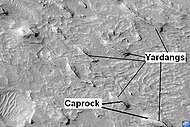 Yardangs in Medusae Fossae Formation with caprock labeled, as seen by HiRISE
 -
 Yardangs, as seen by HiRISE


Fretted terrain[edit]
Parts of the Aeolis quadrangle contain fretted terrain which is characterized by cliffs, mesas, buttes, and straight-walled canyons. It contains scarps or cliffs that are 1 to 2 km in height.[184][185]
Layered terrain[edit]
Researchers, writing in Icarus, have described layered units in the Aeolis quadrangle at Aeolis Dorsa. A deposit that contains yardang was formed after several other deposits. The yardangs contain a layered deposit called "rhythmite" which was thought to be formed with regular changes in the climate. Because the layers appear harden, a damp or wet environment probably existed at the time. The authors correlate these layered deposits to the upper layers of Gale crater's mound (Mt. Sharp).[186]
Many places on Mars show rocks arranged in layers. Sometimes the layers are of different colors. Light-toned rocks on Mars have been associated with hydrated minerals like sulfates. The Mars rover Opportunity examined such layers close-up with several instruments. Some layers are probably made up of fine particles because they seem to break up into find dust. Other layers break up into large boulders so they are probably much harder. Basalt, a volcanic rock, is thought to in the layers that form boulders. Basalt has been identified on Mars in many places. Instruments on orbiting spacecraft have detected clay (also called phyllosilicate) in some layers. Recent research with an orbiting near-infrared spectrometer, which reveals the types of minerals present based on the wavelengths of light they absorb, found evidence of layers of both clay and sulfates in Columbus crater.[187] This is exactly what would appear if a large lake had slowly evaporated.[188] Moreover, because some layers contained gypsum, a sulfate which forms in relatively fresh water, life could have formed in the crater.[189]
Scientists were excited about finding hydrated minerals such as sulfates and clays on Mars because they are usually formed in the presence of water.[190] Places that contain clays and/or other hydrated minerals would be good places to look for evidence of life.[191]
Rock can form layers in a variety of ways. Volcanoes, wind, or water can produce layers.[192] Layers can be hardened by the action of groundwater. Martian ground water probably moved hundreds of kilometers, and in the process it dissolved many minerals from the rock it passed through. When ground water surfaces in low areas containing sediments, water evaporates in the thin atmosphere and leaves behind minerals as deposits and/or cementing agents. Consequently, layers of dust could not later easily erode away since they were cemented together. On Earth, mineral-rich waters often evaporate forming large deposits of various types of salts and other minerals. Sometimes water flows through Earth's aquifers, and then evaporates at the surface just as is hypothesized for Mars. One location this occurs on Earth is the Great Artesian Basin of Australia.[193] On Earth the hardness of many sedimentary rocks, like sandstone, is largely due to the cement that was put in place as water passed through.
-
 Layers in lower member of Medusae Fossae Formation, as seen by HiRISE
 -
 Buttes and layers in Aeolis, as seen by Mars Global Surveyor
 -
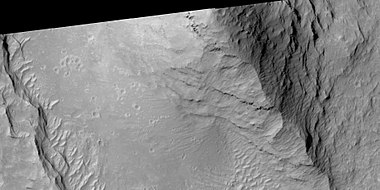 Layers, as seen by HiRISE
 -
 Layers along crater rim in Terra Sirenum, as seen by HiRIS under the HiWish program
 -
 Layered terrain, as seen by HiRISE under HiWish program. Location is East of Gale Crater in the Aeolis quadrangle.
 -
 Layers and mounds in Medusae Fossae Formation, as seen by HiRISE under HiWish program. Location is East of Gale Crater in the Aeolis quadrangle.
 -
 Layers and a field of small mounds Medusae Fossae Formation, as seen by HiRISE under HiWish program. Location is east of Gale Crater in the Aeolis quadrangle.
 -
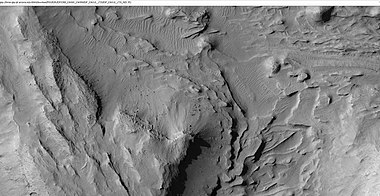 Mound showing layers at the base, as seen by HiRISE under HiWish program. Location is east of Gale Crater in the Aeolis quadrangle.
 -
 Layered structure, as seen by HiRISE under HiWish program
 -
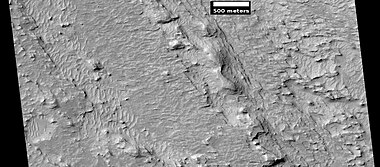 Layered features northeast of Gale Crater, as seen by HiRISE under HiWish program. Layers may be similar to the many layers that are being examined by the Curiosity rover.
 -
 Wide view of layered terrain, as seen by HiRISE under HiWish program. Location is northeast of Gale Crater.
 -
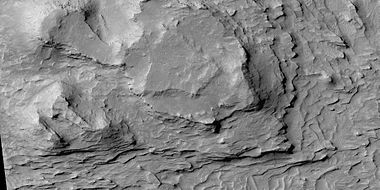 Close view of mound with layers, as seen by HiRISE under HiWish program. Note: this is an enlargement from the previous image.
 -
 Close view of mound with layers, as seen by HiRISE under HiWish program. Note: this is an enlargement from a previous image.
 -
 Wide view of layered terrain, as seen by HiRISE under HiWish program. Note: parts of this image are enlarged in the next three images.
 -
 Close view of layers in a mound, from previous image, as seen by HiRISE under HiWish program
 -
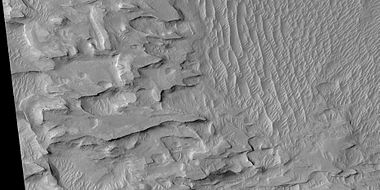 Close view of layers in a mound, from a previous image, as seen by HiRISE under HiWish program
 -
 Close view of layers in a mound, from a previous image, as seen by HiRISE under HiWish program


-
 Wide view of layered buttes and small mesas, as seen by HiRISE under HiWish program. Some dark slope streaks are visible.
 -
 Layered mesa and mounds with dark slope streaks, as seen by HiRISE under HiWish program
 -
 Close view of layered small mesa with dark slope streak, as seen by HiRISE under HiWish program. Box shows the size of a football field.
 -
 Close view of dark slope streak with strange breaks, as seen by HiRISE under HiWish program
 -
 Very close view of individual blocks breaking off layer in a butte, as seen by HiRISE under HiWish program. Blocks have angular shapes. Box shows size of football field.
 -
 Close view of blocks from a mesa, as seen by HiRISE under HiWish program. Arrow show a cube-shaped block.


-
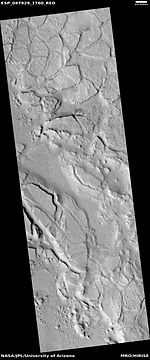 Layered mesas, as seen by HiRISE under HiWish program
 -
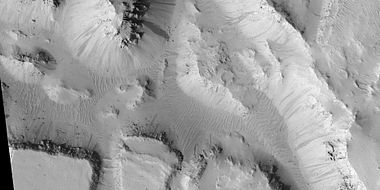 Layered mesas, as seen by HiRISE under HiWish program. Dark slope streaks are also visible.
 -
 Mesas, as seen by HiRISE under HiWish program. Top layer, the cap rock is breaking up into boulders.
 -
 Close view of cap rock breaking up into boulders, as seen by HiRISE under HiWish program


Linear ridge networks[edit]
Linear ridge networks are found in various places on Mars in and around craters.[194] Ridges often appear as mostly straight segments. They are hundreds of meters long, tens of meters high, and several meters wide. It is thought that impacts created fractures in the surface, these fractures later acted as channels for fluids. Fluids cemented the structures. With the passage of time, surrounding material was eroded away, thereby leaving hard ridges behind. Since the ridges occur in locations with clay, these formations could serve as a marker for clay which requires water for its formation.[195][196][197]
-
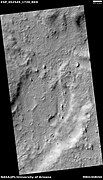 Wide view of ridges, as seen by HiRISE under HiWish program
 -
 Color view of ridges, as seen by HiRISE under HiWish program
 -
 Ridges, as seen by HiRISE under HiWish program
 -
 Ridges, as seen by HiRISE under HiWish program
 -
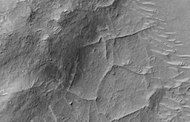 Ridges, as seen by HiRISE under HiWish program
 -
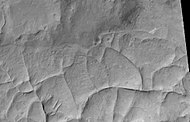 Ridges, as seen by HiRISE under HiWish program
 -
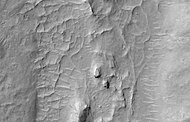 Ridges, as seen by HiRISE under HiWish program
 -
 Ridges, as seen by HiRISE under HiWish program
 -
 Ridges, as seen by HiRISE under HiWish program


Other features[edit]
-
 Landslide
 -
 Possible fan or delta, as seen by HiRISE under HiWish program
 -
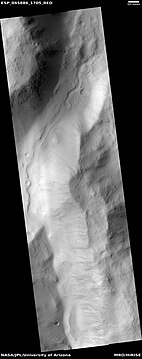 Channel, as seen by HiRISE under HiWish program
 -
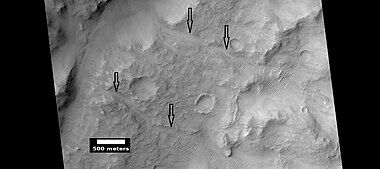 Channels (indicated with arrows), as seen by HiRISE under HiWish program
 -
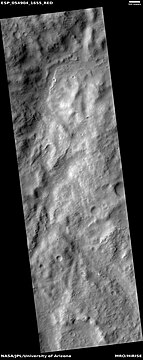 Channel, as seen by HiRISE under HiWish program
 -
 Tilted blocks as seen by HiRISE under HiWish program These blockls were formed horizonality, but have been tilted. Perhaps ice left the ground on one side.


Other Mars quadrangles[edit]


Interactive Mars map[edit]

 Interactive image map of the global topography of Mars. Hover your mouse over the image to see the names of over 60 prominent geographic features, and click to link to them. Coloring of the base map indicates relative elevations, based on data from the Mars Orbiter Laser Altimeter on NASA's Mars Global Surveyor. Whites and browns indicate the highest elevations (+12 to +8 km); followed by pinks and reds (+8 to +3 km); yellow is 0 km; greens and blues are lower elevations (down to −8 km). Axes are latitude and longitude; Polar regions are noted.
See also[edit]
- Adirondack – Boulder on Mars
- Carbonates on Mars – Overview of the presence of carbonates on Mars
- Climate of Mars – Climate patterns of the planet Mars
- Composition of Mars – Branch of the geology of Mars
- Equatorial layered deposits – Surface geological deposits on Mars
- Geology of Mars – Scientific study of the surface, crust, and interior of the planet Mars
- Groundwater on Mars – Water held in permeable ground
- Impact crater – Circular depression in a solid astronomical body formed by the impact of a smaller object
- Lakes on Mars – Overview of the presence of lakes on Mars
- Scientific information from the Mars Exploration Rover mission
- Timeline of Mars Science Laboratory – Event timeline of the NASA Mars Science Laboratory mission
- Yardangs on Mars – Aeolian formation
References[edit]
- ^ Davies, M.E.; Batson, R.M.; Wu, S.S.C. "Geodesy and Cartography" in Kieffer, H.H.; Jakosky, B.M.; Snyder, C.W.; Matthews, M.S., Eds. Mars. University of Arizona Press: Tucson, 1992.
- ^ "Planetary Names".
- ^ Blunck, J. 1982. Mars and its Satellites. Exposition Press. Smithtown, N.Y.
- ^ NASA Staff (6 August 2012). "NASA Lands Car-Size Rover Beside Martian Mountain". NASA/JPL. Archived from the original on 2012-08-14. Retrieved 2012-08-07.
- ^ a b "Spirit rover follows up on scientific surprises". NBC News. 4 January 2005. Retrieved 16 June 2017.
- ^ a b U.S. department of the Interior U.S. Geological Survey, Topographic Map of the Eastern Region of Mars M 15M 0/270 2AT, 1991
- ^ a b c NASA Staff (27 March 2012). "'Mount Sharp' on Mars Compared to Three Big Mountains on Earth". NASA. Retrieved 31 March 2012.
- ^ a b c Agle, D. C. (28 March 2012). "'Mount Sharp' On Mars Links Geology's Past and Future". NASA. Retrieved 31 March 2012.
- ^ a b c Staff (29 March 2012). "NASA's New Mars Rover Will Explore Towering 'Mount Sharp'". Space.com. Retrieved 30 March 2012.
- ^ a b c USGS (16 May 2012). "Three New Names Approved for Features on Mars". USGS. Retrieved 3 March 2021.
- ^ Ori, G., I. Di Pietro, F. Salese. 2015. A WATERLOGGED MARTIAN ENVIRONMENT: CHANNEL PATTERNS AND SEDIMENTARY ENVIRONMENTS OF THE ZEPHYRIA ALLUVIAL PLAIN. 46th Lunar and Planetary Science Conference (2015) 2527.pdf
- ^ a b c McSween, etal. 2004. "Basaltic Rocks Analyzed by the Spirit Rover in Gusev Crater". Science : 305. 842–845
- ^ a b Arvidson R. E.; et al. (2004). "Localization and Physical Properties Experiments Conducted by Spirit at Gusev Crater". Science. 305 (5685): 821–824. Bibcode:2004Sci...305..821A. doi:10.1126/science.1099922. PMID 15297662. S2CID 31102951.
- ^ Gelbert R.; et al. (2006). "The Alpha Particle X-ray Spectrometer (APXS): results from Gusev crater and calibration report". J. Geophys. Res. Planets. 111 (E2): n/a. Bibcode:2006JGRE..111.2S05G. doi:10.1029/2005JE002555. hdl:2060/20080026124. S2CID 129432577.
- ^ Christensen P (August 2004). "Initial Results from the Mini-TES Experiment in Gusev Crater from the Spirit Rover". Science. 305 (5685): 837–842. Bibcode:2004Sci...305..837C. doi:10.1126/science.1100564. PMID 15297667. S2CID 34983664.
- ^ Bertelsen, P., et al. 2004. "Magnetic Properties on the Mars Exploration Rover Spirit at Gusev Crater". Science: 305. 827–829
- ^ a b Bell, J (ed.) The Martian Surface. 2008. Cambridge University Press. ISBN 978-0-521-86698-9
- ^ Gelbert, R. et al. "Chemistry of Rocks and Soils in Gusev Crater from the Alpha Particle X-ray Spectrometer". Science: 305. 829-305
- ^ Squyres, S., et al. 2006 Rocks of the Columbia Hills. J. Geophys. Res. Planets. 111
- ^ Ming,D., et al. 2006 Geochemical and mineralogical indicators for aqueous processes in the Columbia Hills of Gusev crater, Mars. J. Geophys: Res.111
- ^ a b Schroder, C., et al. (2005) European Geosciences Union, General Assembly, Geophysical Research abstr., Vol. 7, 10254, 2005
- ^ Christensen, P. R. (2005-05-01). "Mineral Composition and Abundance of the Rocks and Soils at Gusev and Meridiani from the Mars Exploration Rover Mini-TES Instruments". AGU Spring Meeting Abstracts. 2005: P31A–04. Bibcode:2005AGUSM.P31A..04C.
- ^ "Signs of Acid Fog Found on Mars – SpaceRef". spaceref.com. 2 November 2015. Archived from the original on August 29, 2016. Retrieved 16 June 2017.
- ^ "Abstract: IN-SITU EVIDENCE FOR ALTERATION BY ACID FOG ON HUSBAND HILL, GUSEV CRATER, MARS (2015 GSA Annual Meeting in Baltimore, Maryland, USA (1–4 November 2015))". gsa.confex.com. Retrieved 16 June 2017.
- ^ COLE, Shoshanna B., et al. 2015. IN-SITU EVIDENCE FOR ALTERATION BY ACID FOG ON HUSBAND HILL, GUSEV CRATER, MARS. 2015 GSA Annual Meeting in Baltimore, Maryland, USA (1–4 November 2015) Paper No. 94-10
- ^ Klingelhofer, G., et al. (2005) Lunar Planet. Sci. XXXVI abstr. 2349
- ^ Morris,S., et al. Mossbauer mineralogy of rock, soil, and dust at Gusev crater, Mars: Spirit’s journal through weakly altered olivine basalt on the plains and pervasively altered basalt in the Columbia Hills. J. Geophys. Res.: 111
- ^ Ming,D., et al. 2006 Geochemical and mineralogical indicators for aqueous processes in the Columbia Hills of Gusev crater, Mars. J. Geophys. Res.111
- ^ "NASA - Mars Rover Spirit Unearths Surprise Evidence of Wetter Past". Nasa.gov. 2007-05-21. Retrieved 2017-06-16.
- ^ "Outcrop of long-sought rare rock on Mars found". Retrieved 16 June 2017.
- ^ Morris, Richard V.; Ruff, Steven W.; Gellert, Ralf; Ming, Douglas W.; Arvidson, Raymond E.; Clark, Benton C.; Golden, D. C.; Siebach, Kirsten; Klingelhöfer, Göstar; Schröder, Christian; Fleischer, Iris; Yen, Albert S.; Squyres, Steven W. (2010). "Identification of Carbonate-Rich Outcrops on Mars by the Spirit Rover". Science. 329 (5990): 421–4. Bibcode:2010Sci...329..421M. doi:10.1126/science.1189667. PMID 20522738. S2CID 7461676.
- ^ Cabrol, N. and E. Grin (eds.). 2010. Lakes on Mars. Elsevier. NY.
- ^ Rossman, R.; et al. (2002). "A large paleolake basin at the head of Ma'adim Vallis, Mars". Science. 296 (5576): 2209–2212. Bibcode:2002Sci...296.2209R. doi:10.1126/science.1071143. PMID 12077414. S2CID 23390665.
- ^ "HiRISE | Chaos in Eridania Basin (ESP_037142_1430)". Uahirise.org. 2014-09-10. Retrieved 2017-06-16.
- ^ Rossman, P. Irwin III; Ted A. Maxwell; Alan D. Howard; Robert A. Craddock; David W. Leverington (21 June 2002). "A Large Paleolake Basin at the Head of Ma'adim Vallis, Mars". Science. 296 (5576): 2209–2212. Bibcode:2002Sci...296.2209R. doi:10.1126/science.1071143. PMID 12077414. S2CID 23390665.
- ^ "APOD: 2002 June 27 – Carving Ma'adim Vallis". antwrp.gsfc.nasa.gov. Retrieved 16 June 2017.
- ^ Baker, V. 1982. The Channels of Mars. Univ. of Tex. Press, Austin, TX
- ^ Baker, V.; Strom, R.; Gulick, V.; Kargel, J.; Komatsu, G.; Kale, V. (1991). "Ancient oceans, ice sheets and the hydrological cycle on Mars". Nature. 352 (6336): 589–594. Bibcode:1991Natur.352..589B. doi:10.1038/352589a0. S2CID 4321529.
- ^ Carr, M (1979). "Formation of Martian flood features by release of water from confined aquifers". J. Geophys. Res. 84: 2995–300. Bibcode:1979JGR....84.2995C. doi:10.1029/jb084ib06p02995.
- ^ Komar, P (1979). "Comparisons of the hydraulics of water flows in Martian outflow channels with flows of similar scale on Earth". Icarus. 37 (1): 156–181. Bibcode:1979Icar...37..156K. doi:10.1016/0019-1035(79)90123-4.
- ^ a b Hugh H. Kieffer (1992). Mars. University of Arizona Press. ISBN 978-0-8165-1257-7. Retrieved 7 March 2011.
- ^ Raeburn, P. 1998. Uncovering the Secrets of the Red Planet Mars. National Geographic Society. Washington D.C.
- ^ Moore, P. et al. 1990. The Atlas of the Solar System. Mitchell Beazley Publishers NY, NY.
- ^ Carr, M (1979). "Formation of martian flood features by release of water from confined aquifers". J. Geophys. Res. 84: 2995–3007. Bibcode:1979JGR....84.2995C. doi:10.1029/jb084ib06p02995.
- ^ Hanna, J. and R. Phillips. 2005. Tectonic pressurization of aquifers in the formation of Mangala and Athabasca Valles on Mars. LPSC XXXVI. Abstract 2261.
- ^ "HiRISE | Layered Outcrop in Gale Crater (PSP_008437_1750)". Hirise.lpl.arizona.edu. 2008-08-06. Retrieved 2017-06-16.
- ^ "Mars Global Surveyor MOC2-265-L Release". mars.jpl.nasa.gov. Retrieved 16 June 2017.
- ^ Milliken R.; et al. (2010). "Paleoclimate of Mars as captured by the stratigraphic record in Gale Crater" (PDF). Geophysical Research Letters. 37 (4): L04201. Bibcode:2010GeoRL..37.4201M. doi:10.1029/2009gl041870. S2CID 3251143.
- ^ Thompson, B.; et al. (2011). "Constraints on the origin and evolution of the layered mound in Gale Crater, Mars using Mars Reconnaissance Orbiter data". Icarus. 214 (2): 413–432. Bibcode:2011Icar..214..413T. doi:10.1016/j.icarus.2011.05.002.
- ^ Anderson, William; Day, Mackenzie (2017). "Turbulent flow over craters on Mars: Vorticity dynamics reveal aeolian excavation mechanism". Physical Review E. 96 (4): 043110. Bibcode:2017PhRvE..96d3110A. doi:10.1103/PhysRevE.96.043110. PMID 29347578.
- ^ Anderson, W.; Day, M. (2017). "Turbulent flow over craters on Mars: Vorticity dynamics reveal aeolian excavation mechanism". Phys. Rev. E. 96 (4): 043110. Bibcode:2017PhRvE..96d3110A. doi:10.1103/physreve.96.043110. PMID 29347578.
- ^ Grotzinger, J. and R. Milliken. 2012. Sedimentary Geology of Mars. SEPM.
- ^ "Mars Global Surveyor MOC2-265-E Release". www.msss.com. Retrieved 3 March 2021.
- ^ IAU Staff (September 26, 2012). "Gazetteer of Planetary Nomenclature: Peace Vallis". IAU. Retrieved September 28, 2012.
- ^ a b Brown, Dwayne; Cole, Steve; Webster, Guy; Agle, D.C. (September 27, 2012). "NASA Rover Finds Old Streambed On Martian Surface". NASA. Retrieved September 28, 2012.
- ^ a b NASA (September 27, 2012). "NASA's Curiosity Rover Finds Old Streambed on Mars – video (51:40)". NASA Television. Archived from the original on 2021-12-15. Retrieved September 28, 2012.
- ^ a b Chang, Alicia (September 27, 2012). "Mars rover Curiosity finds signs of ancient stream". Associated Press. Retrieved March 3, 2021.
- ^ a b Chang, Kenneth (December 9, 2013). "On Mars, an Ancient Lake and Perhaps Life". The New York Times. Retrieved December 9, 2013.
- ^ a b Various (December 9, 2013). "Science – Special Collection – Curiosity Rover on Mars". Science. Retrieved December 9, 2013.
- ^ Dietrich, W., M. Palucis, T. Parker, D. Rubin, K.Lewis, D. Sumner, R. Williams. 2014. Clues to the relative timing of lakes in Gale Crater. Eighth International Conference on Mars (2014) 1178.pdf.
- ^ "Stones, Wind, and Ice: A Guide to Martian Impact Craters". www.lpi.usra.edu. Retrieved 16 June 2017.
- ^ "The Floods of Iani Chaos – Mars Odyssey Mission THEMIS". themis.asu.edu. Retrieved 16 June 2017.
- ^ "Mars Landing Sites 02". Archived from the original on 2009-02-25. Retrieved 2009-02-15.
- ^ [1][dead link]
- ^ Williams, R. M. E.; Grotzinger, J. P.; Dietrich, W. E.; Gupta, S.; Sumner, D. Y.; Wiens, R. C.; Mangold, N.; Malin, M. C.; Edgett, K. S.; Maurice, S.; Forni, O.; Gasnault, O.; Ollila, A.; Newsom, H. E.; Dromart, G.; Palucis, M. C.; Yingst, R. A.; Anderson, R. B.; Herkenhoff, K. E.; Le Mouelic, S.; Goetz, W.; Madsen, M. B.; Koefoed, A.; Jensen, J. K.; Bridges, J. C.; Schwenzer, S. P.; Lewis, K. W.; Stack, K. M.; Rubin, D.; et al. (2013-07-25). "Martian fluvial conglomerates at Gale Crater". Science. 340 (6136): 1068–1072. Bibcode:2013Sci...340.1068W. doi:10.1126/science.1237317. PMID 23723230. S2CID 206548731. Retrieved 2017-06-16.
- ^ Williams R.; et al. (2013). "Martian fluvial conglomerates at Gale Crater". Science. 340 (6136): 1068–1072. Bibcode:2013Sci...340.1068W. doi:10.1126/science.1237317. PMID 23723230. S2CID 206548731.
- ^ Brown, Dwayne (October 30, 2012). "NASA Rover's First Soil Studies Help Fingerprint Martian Minerals". NASA. Retrieved October 31, 2012.
- ^ a b Brown, Dwayne; Webster, Guy; Neal-Jones, Nancy (December 3, 2012). "NASA Mars Rover Fully Analyzes First Martian Soil Samples". NASA. Archived from the original on August 23, 2016. Retrieved December 3, 2012.
- ^ a b Chang, Ken (December 3, 2012). "Mars Rover Discovery Revealed". The New York Times. Retrieved December 3, 2012.
- ^ a b Webster, Guy; Brown, Dwayne (March 18, 2013). "Curiosity Mars Rover Sees Trend In Water Presence". NASA. Retrieved March 3, 2021.
- ^ Rincon, Paul (March 19, 2013). "Curiosity breaks rock to reveal dazzling white interior". BBC News. BBC. Retrieved March 19, 2013.
- ^ Paul Rincon (March 19, 2013). "Curiosity breaks rock to reveal dazzling white interior". BBC. Retrieved March 3, 2021.
- ^ a b Agle, DC; Brown, Dwayne (March 12, 2013). "NASA Rover Finds Conditions Once Suited for Ancient Life on Mars". NASA. Retrieved March 12, 2013.
- ^ a b Wall, Mike (March 12, 2013). "Mars Could Once Have Supported Life: What You Need to Know". Space.com. Retrieved March 12, 2013.
- ^ a b Chang, Kenneth (March 12, 2013). "Mars Could Once Have Supported Life, NASA Says". The New York Times. Retrieved March 12, 2013.
- ^ Harwood, William (March 12, 2013). "Mars rover finds habitable environment in distant past". Spaceflightnow. Retrieved March 12, 2013.
- ^ Grenoble, Ryan (March 12, 2013). "Life On Mars Evidence? NASA's Curiosity Rover Finds Essential Ingredients In Ancient Rock Sample". Huffington Post. Retrieved March 12, 2013.
- ^ Stolper, E.; et al. (2013). "The Petrochemistry of Jake M: A Martian Mugearite" (PDF). Science (Submitted manuscript). 341 (6153): 6153. Bibcode:2013Sci...341E...4S. doi:10.1126/science.1239463. PMID 24072927. S2CID 16515295.
- ^ Blake, D.; et al. (2013). "Curiosity at Gale crater, Mars: characterization and analysis of the Rocknest sand shadow – Medline" (PDF). Science (Submitted manuscript). 341 (6153): 1239505. Bibcode:2013Sci...341E...5B. doi:10.1126/science.1239505. PMID 24072928. S2CID 14060123.
- ^ Leshin, L.; et al. (2013). "Volatile, isotope, and organic analysis of martian fines with the Mars Curiosity rover - Medline". Science. 341 (6153): 1238937. Bibcode:2013Sci...341E...3L. CiteSeerX 10.1.1.397.4959. doi:10.1126/science.1238937. PMID 24072926. S2CID 206549244.
- ^ a b McLennan, M.; et al. (2013). "Elemental geochemistry of sedimentary rocks at Yellowknife Bay, Gale Crater, Mars" (PDF). Science (Submitted manuscript). 343 (6169): 1244734. Bibcode:2014Sci...343C.386M. doi:10.1126/science.1244734. hdl:2381/42019. PMID 24324274. S2CID 36866122.
- ^ Flynn, G. (1996). "The delivery of organic matter from asteroids and comets to the early surface of Mars". Earth Moon Planets. 72 (1–3): 469–474. Bibcode:1996EM&P...72..469F. doi:10.1007/BF00117551. PMID 11539472. S2CID 189901503.
- ^ Benner, S.; K.Devine; L. Matveeva; D. Powell. (2000). "The missing organic molecules on Mars". Proc. Natl. Acad. Sci. U.S.A. 97 (6): 2425–2430. Bibcode:2000PNAS...97.2425B. doi:10.1073/pnas.040539497. PMC 15945. PMID 10706606.
- ^ a b Grotzinger, J.; et al. (2013). "A Habitable Fluvio-Lacustrine Environment at Yellowknife Bay, Gale Crater, Mars". Science. 343 (6169): 1242777. Bibcode:2014Sci...343A.386G. CiteSeerX 10.1.1.455.3973. doi:10.1126/science.1242777. PMID 24324272. S2CID 52836398.
- ^ Kerr, R.; et al. (2013). "New Results Send Mars Rover on a Quest for Ancient Life". Science. 342 (6164): 1300–1301. Bibcode:2013Sci...342.1300K. doi:10.1126/science.342.6164.1300. PMID 24337267.
- ^ a b Ming, D.; et al. (2013). "Volatile and Organic Compositions of Sedimentary Rocks in Yellowknife Bay, Gale Crater, Mars" (PDF). Science (Submitted manuscript). 343 (6169): 1245267. Bibcode:2014Sci...343E.386M. doi:10.1126/science.1245267. PMID 24324276. S2CID 10753737.
- ^ Farley, K.; et al. (2013). "In Situ Radiometric and Exposure Age Dating of the Martian Surface" (PDF). Science. 343 (6169): 1247166. Bibcode:2014Sci...343F.386H. doi:10.1126/science.1247166. PMID 24324273. S2CID 3207080.
- ^ Staff (December 9, 2013). "Understanding Mars' Past and Current Environments". NASA. Archived from the original on December 20, 2013. Retrieved December 20, 2013.
- ^ Hassler, D.; et al. (2013). "Mars' Surface Radiation Environment Measured with the Mars Science Laboratory's Curiosity Rover" (PDF). Science (Submitted manuscript). 343 (6169): 1244797. Bibcode:2014Sci...343D.386H. doi:10.1126/science.1244797. hdl:1874/309142. PMID 24324275. S2CID 33661472.
- ^ a b Vaniman, D.; et al. (2013). "Mineralogy of a mudstone at Yellowknife Bay, Gale crater, Mars" (PDF). Science. 343 (6169): 1243480. Bibcode:2014Sci...343B.386V. doi:10.1126/science.1243480. PMID 24324271. S2CID 9699964.
- ^ Bibring, J.; et al. (2006). "Global mineralogical and aqueous mars history derived from OMEGA/Mars Express data". Science. 312 (5772): 400–404. Bibcode:2006Sci...312..400B. doi:10.1126/science.1122659. PMID 16627738. S2CID 13968348.
- ^ Squyres, S.; A. Knoll. (2005). "Sedimentary rocks and Meridiani Planum: Origin, diagenesis, and implications for life of Mars". Earth Planet. Sci. Lett. 240 (1): 1–10. Bibcode:2005E&PSL.240....1S. doi:10.1016/j.epsl.2005.09.038.
- ^ Nealson, K.; P. Conrad. (1999). "Life: past, present and future". Phil. Trans. R. Soc. Lond. B. 354 (1392): 1923–1939. doi:10.1098/rstb.1999.0532. PMC 1692713. PMID 10670014.
- ^ Keller, L.; et al. (1994). "Aqueous alteration of the Bali CV3 chondrite: Evidence from mineralogy, mineral chemistry, and oxygen isotopic compositions". Geochim. Cosmochim. Acta. 58 (24): 5589–5598. Bibcode:1994GeCoA..58.5589K. doi:10.1016/0016-7037(94)90252-6. PMID 11539152.
- ^ Brown, Dwayne; Webster, Guy (December 8, 2014). "Release 14-326 – NASA's Curiosity Rover Finds Clues to How Water Helped Shape Martian Landscape". NASA. Retrieved December 8, 2014.
- ^ Kaufmann, Marc (December 8, 2014). "(Stronger) Signs of Life on Mars". The New York Times. Retrieved December 8, 2014.
- ^ "NASA's Curiosity rover finds clues to how water helped shape Martian landscape". Retrieved 16 June 2017.
- ^ "The Making of Mount Sharp". www.jpl.nasa.gov. Retrieved 16 June 2017.
- ^ "NASA's Curiosity Rover Finds Clues to How Water Helped Shape Martian Landscape". NASA/JPL. Retrieved 16 June 2017.
- ^ Northon, Karen (19 November 2015). "NASA Rover Finds Active, Ancient Organic Chemistry on Mars". Retrieved 16 June 2017.
- ^ Webster1, C. et al. 2014. Mars methane detection and variability at Gale crate. Science. 1261713
- ^ "Mars Rover Finds "Active, Ancient Organic Chemistry"". 16 December 2014. Retrieved 16 June 2017.
- ^ "First detection of organic matter on Mars". Retrieved 16 June 2017.
- ^ Steigerwald, Bill (17 April 2015). "NASA Goddard Instrument's First Detection of Organic Matter on Mars". Retrieved 16 June 2017.
- ^ "Did Mars once have a nitrogen cycle? Scientists find fixed nitrogen in Martian sediments". Retrieved 16 June 2017.
- ^ Stern, J.; Sutter, B.; Freissinet, C.; Navarro-González, R.; McKay, C.; Archer, P.; Buch, A.; Brunner, A.; Coll, P.; Eigenbrode, J.; Fairen, A.; Franz, H.; Glavin, D.; Kashyap, S.; McAdam, A.; Ming, D.; Steele, A.; Szopa, C.; Wray, J.; Martín-Torres, F.; Zorzano, Maria-Paz; Conrad, P.; Mahaffy, P. (2015). "Evidence for indigenous nitrogen in sedimentary and aeolian deposits from the Curiosity rover investigations at Gale crater, Mars". Proceedings of the National Academy of Sciences. 112 (14): 4245–4250. Bibcode:2015PNAS..112.4245S. doi:10.1073/pnas.1420932112. PMC 4394254. PMID 25831544.
- ^ "Curiosity Rover Finds Biologically Useful Nitrogen on Mars – Astrobiology". astrobiology.com. 24 March 2015. Retrieved 16 June 2017.
- ^ "More Ingredients for Life Identified on Mars". Space.com. 23 March 2015. Retrieved 16 June 2017.
- ^ "Mars Rover Curiosity Spots 'Ice Cream Sandwich' Rocks (Photos)". Space.com. 2 April 2015. Retrieved 16 June 2017.
- ^ "NASA's Curiosity Eyes Prominent Mineral Veins on Mars". NASA/JPL. Retrieved 16 June 2017.
- ^ Greicius, Tony (20 January 2015). "Mars Science Laboratory – Curiosity". Retrieved 16 June 2017.
- ^ "NASA Mars Rover's Weather Data Bolster Case for Brine". NASA/JPL. Retrieved 16 June 2017.
- ^ University of Copenhagen – Niels Bohr Institute. "Mars might have salty liquid water." ScienceDaily. ScienceDaily, 13 April 2015. <www.sciencedaily.com/releases/2015/04/150413130611.htm>.
- ^ "On Mars, Liquid Water Appears at Night, Study Suggests". Space.com. 13 April 2015. Retrieved 16 June 2017.
- ^ Martin-Torre, F. et al. 2015. Transient liquid water and water activity at Gale crater on Mars. Nature geoscienceDOI:10.1038/NGEO2412
- ^ "Evidence of Mars' Primitive Continental Crust – SpaceRef". spaceref.com. 13 July 2015. Retrieved 16 June 2017.
- ^ "Curiosity rover finds evidence of Mars' primitive continental crust: ChemCam instrument shows ancient rock much like Earth's". Retrieved 16 June 2017.
- ^ Sautter, V.; Toplis, M.; Wiens, R.; Cousin, A.; Fabre, C.; Gasnault, O.; Maurice, S.; Forni, O.; Lasue, J.; Ollila, A.; Bridges, J.; Mangold, N.; Le Mouélic, S.; Fisk, M.; Meslin, P.-Y.; Beck, P.; Pinet, P.; Le Deit, L.; Rapin, W.; Stolper, E.; Newsom, H.; Dyar, D.; Lanza, N.; Vaniman, D.; Clegg, S.; Wray, J. (2015). "In situ evidence for continental crust on early Mars" (PDF). Nature Geoscience. 8 (8): 605–609. Bibcode:2015NatGe...8..605S. doi:10.1038/ngeo2474. hdl:2381/42016.
- ^ "Wet Paleoclimate of Mars Revealed by Ancient Lakes at Gale Crater - Astrobiology". astrobiology.com. 8 October 2015. Retrieved 2021-12-11.
- ^ Clavin, Whitney (October 8, 2015). "NASA's Curiosity Rover Team Confirms Ancient Lakes on Mars". NASA. Retrieved October 9, 2015.
- ^ Grotzinger, J.P.; et al. (October 9, 2015). "Deposition, exhumation, and paleoclimate of an ancient lake deposit, Gale crater, Mars". Science. 350 (6257): aac7575. Bibcode:2015Sci...350.7575G. doi:10.1126/science.aac7575. PMID 26450214. S2CID 586848.
- ^ "New Mars rover findings revealed: Much higher concentrations of silica indicate 'considerable water activity'". ScienceDaily. Retrieved 2021-12-11.
- ^ "High Concentrations of Silica Indicate Considerable Water Activity on Mars – SpaceRef". spaceref.com. 21 December 2015. Retrieved 16 June 2017.
- ^ Lin H.; et al. (2016). "Abundance retrieval of hydrous minerals around the Mars Science Laboratory landing site in Gale crater, Mars". Planetary and Space Science. 121: 76–82. Bibcode:2016P&SS..121...76L. doi:10.1016/j.pss.2015.12.007.
- ^ NASA/Jet Propulsion Laboratory. "NASA rover findings point to a more Earth-like Martian past." ScienceDaily. ScienceDaily, 27 June 2016. <www.sciencedaily.com/releases/2016/06/160627125731.htm>.
- ^ Lanza, Nina L.; Wiens, Roger C.; Arvidson, Raymond E.; Clark, Benton C.; Fischer, Woodward W.; Gellert, Ralf; Grotzinger, John P.; Hurowitz, Joel A.; McLennan, Scott M.; Morris, Richard V.; Rice, Melissa S.; Bell, James F.; Berger, Jeffrey A.; Blaney, Diana L.; Bridges, Nathan T.; Calef, Fred; Campbell, John L.; Clegg, Samuel M.; Cousin, Agnes; Edgett, Kenneth S.; Fabre, Cécile; Fisk, Martin R.; Forni, Olivier; Frydenvang, Jens; Hardy, Keian R.; Hardgrove, Craig; Johnson, Jeffrey R.; Lasue, Jeremie; Le Mouélic, Stéphane; Malin, Michael C.; Mangold, Nicolas; Martìn-Torres, Javier; Maurice, Sylvestre; McBride, Marie J.; Ming, Douglas W.; Newsom, Horton E.; Ollila, Ann M.; Sautter, Violaine; Schröder, Susanne; Thompson, Lucy M.; Treiman, Allan H.; VanBommel, Scott; Vaniman, David T.; Zorzano, Marìa-Paz (2016). "Oxidation of manganese in an ancient aquifer, Kimberley formation, Gale crater, Mars". Geophysical Research Letters. 43 (14): 7398–7407. Bibcode:2016GeoRL..43.7398L. doi:10.1002/2016GL069109. S2CID 6768479.
- ^ "NASA Rover Findings Point to a More Earth-like Martian Past". NASA/JPL. Retrieved 16 June 2017.
- ^ Schwenzer, S. P.; Bridges, J. C.; Wiens, R. C.; Conrad, P. G.; Kelley, S. P.; Leveille, R.; Mangold, N.; Martín-Torres, J.; McAdam, A.; Newsom, H.; Zorzano, M. P.; Rapin, W.; Spray, J.; Treiman, A. H.; Westall, F.; Fairén, A. G.; Meslin, P.-Y. (2016). "Fluids during diagenesis and sulfate vein formation in sediments at Gale crater, Mars". Meteoritics & Planetary Science. 51 (11): 2175–202. Bibcode:2016M&PS...51.2175S. doi:10.1111/maps.12668. hdl:2164/14057.
- ^ "Veins on Mars were formed by evaporating ancient lakes". Retrieved 16 June 2017.
- ^ Martinex, G.; et al. (2016). "Likely frost events at Gale crater: Analysis from MSL/REMS measurements". Icarus. 280: 93–102. Bibcode:2016Icar..280...93M. doi:10.1016/j.icarus.2015.12.004.
- ^ Audouard J.; et al. (2014). "Water in the martian regolith from OMEGA/Mars Express". J. Geophys. Res. Planets. 119 (8): 1969–1989. arXiv:1407.2550. Bibcode:2014JGRE..119.1969A. doi:10.1002/2014JE004649. S2CID 13900560.
- ^ Leshin, L (2013). "Volatile, isotope, and organic analysis of martian fines with the Mars Curiosity rover". Science. 341 (6153): 1238937. Bibcode:2013Sci...341E...3L. doi:10.1126/science.1238937. PMID 24072926. S2CID 206549244.
- ^ Meslin P.; et al. (2013). "Soil diversity and hydration as observed by ChemCam at Gale crater, Mars". Science. 341 (6153): 1238670. Bibcode:2013Sci...341E...1M. doi:10.1126/science.1238670. PMID 24072924. S2CID 7418294.
- ^ "First Detection of Boron on the Surface of Mars – SpaceRef". spaceref.com. 13 December 2016. Retrieved 16 June 2017.
- ^ Stephenson J.; et al. (2013). "Boron Enrichment in Martian Clay". PLOS ONE. 8 (6): e64624. Bibcode:2013PLoSO...864624S. doi:10.1371/journal.pone.0064624. PMC 3675118. PMID 23762242.
- ^ Ricardo, A.; Carrigan, M.A.; Olcott, A.N.; Benner, S.A. (2004). "Borate minerals stabilize ribose". Science. 303 (5655): 196. CiteSeerX 10.1.1.688.7103. doi:10.1126/science.1092464. PMID 14716004. S2CID 5499115.
- ^ Kim HJ, Benner SA (2010). ""Comment on "The silicate-mediated formose reaction: bottom-up synthesis of sugar silicates". Science. 20 (329): 5994. Bibcode:2010Sci...329..902K. doi:10.1126/science.1188697. PMID 20724620.
- ^ Gasda, P.; et al. (2017). "In situ detection of boron by ChemCam on Mars". Geophysical Research Letters. 44 (17): 8739–8748. Bibcode:2017GeoRL..44.8739G. doi:10.1002/2017GL074480. hdl:2381/41995.
- ^ "Discovery of boron on Mars adds to evidence for habitability: Boron compounds play role in stabilizing sugars needed to make RNA, a key to life".
- ^ Gasda, Patrick J.; Haldeman, Ethan B.; Wiens, Roger C.; Rapin, William; Bristow, Thomas F.; Bridges, John C.; Schwenzer, Susanne P.; Clark, Benton; Herkenhoff, Kenneth; Frydenvang, Jens; Lanza, Nina L.; Maurice, Sylvestre; Clegg, Samuel; Delapp, Dorothea M.; Sanford, Veronica L.; Bodine, Madeleine R.; McInroy, Rhonda (2017). "In situ detection of boron by ChemCam on Mars". Geophysical Research Letters. 44 (17): 8739–8748. Bibcode:2017GeoRL..44.8739G. doi:10.1002/2017GL074480. hdl:2381/41995.
- ^ Schwenzer, S. P.; et al. (2016). "Fluids during diagenesis and sulfate vein formation in sediments at Gale Crater, Mars". Meteorit. Planet. Sci. 51 (11): 2175–2202. Bibcode:2016M&PS...51.2175S. doi:10.1111/maps.12668. hdl:2164/14057.
- ^ L'Haridon, J., N. Mangold, W. Rapin, O. Forni, P.-Y. Meslin, E. Dehouck, M. Nachon, L. Le Deit, O. Gasnault, S. Maurice, R. Wiens. 2017. Identification and implications of iron detection within calcium sulfate mineralized veins by ChemCam at Gale crater, Mars, paper presented at 48th Lunar and Planetary Science Conference, The Woodlands, Tex., Abstract 1328.
- ^ Lanza, N. L.; et al. (2016). "Oxidation of manganese in an ancient aquifer, Kimberley formation, Gale crater". Geophys. Res. Lett. 43 (14): 7398–7407. Bibcode:2016GeoRL..43.7398L. doi:10.1002/2016GL069109. S2CID 6768479.
- ^ Frydenvang, J.; et al. (2017). "Diagenetic silica enrichment and late-stage groundwater activity in Gale crater, Mars". Geophysical Research Letters. 44 (10): 4716–4724. Bibcode:2017GeoRL..44.4716F. doi:10.1002/2017GL073323. hdl:2381/40220. S2CID 215820551. Retrieved March 3, 2021.
- ^ Yen, A. S.; et al. (2017). "Multiple stages of aqueous alteration along fractures in mudstone and sandstone strata in Gale Crater, Mars". Earth Planet. Sci. Lett. 471: 186–198. Bibcode:2017E&PSL.471..186Y. doi:10.1016/j.epsl.2017.04.033.
- ^ Nachon, M.; et al. (2014). "Calcium sulfate veins characterized by ChemCam/Curiosity at Gale crater, Mars" (PDF). J. Geophys. Res. Planets. 119 (9): 1991–2016. Bibcode:2014JGRE..119.1991N. doi:10.1002/2013JE004588. S2CID 32976900.
- ^ "Possible Signs of Ancient Drying in Martian Rock". www.jpl.nasa.gov. Retrieved 16 June 2017.
- ^ "Desiccation Cracks Reveal the Shape of Water on Mars - SpaceRef". 20 April 2018.
- ^ Stein, N.; Grotzinger, J.P.; Schieber, J.; Mangold, N.; Hallet, B.; Newsom, H.; Stack, K.M.; Berger, J.A.; Thompson, L.; Siebach, K.L.; Cousin, A.; Le Mouélic, S.; Minitti, M.; Sumner, D.Y.; Fedo, C.; House, C.H.; Gupta, S.; Vasavada, A.R.; Gellert, R.; Wiens, R. C.; Frydenvang, J.; Forni, O.; Meslin, P. Y.; Payré, V.; Dehouck, E. (2018). "Desiccation cracks provide evidence of lake drying on Mars, Sutton Island member, Murray formation, Gale Crater". Geology. 46 (6): 515–518. Bibcode:2018Geo....46..515S. doi:10.1130/G40005.1. hdl:10044/1/59804.
- ^ Stein, N.; Grotzinger, J.P.; Schieber, J.; Mangold, N.; Hallet, B.; Newsom, H.; Stack, K.M.; Berger, J.A.; Thompson, L.; Siebach, K.L.; Cousin, A. (2018-04-16). "Desiccation cracks provide evidence of lake drying on Mars, Sutton Island member, Murray formation, Gale Crater". Geology. 46 (6): 515–518. Bibcode:2018Geo....46..515S. doi:10.1130/G40005.1. hdl:10044/1/59804. ISSN 0091-7613. S2CID 135039801.
- ^ Day, M., G. Kocurek. 2017. Observations of an aeolian landscape: From surface to orbit in Gale Crater. Icarus. 10.1016/j.icarus.2015.09.042
- ^ "Martian Winds Carve Mountains, Move Dust, Raise Dust". NASA/JPL. Retrieved 16 June 2017.
- ^ Bristow T. F. et al. 2015 Am. Min., 100.
- ^ Rampe, E., et al. 2017. MINERAL TRENDS IN EARLY HESPERIAN LACUSTRINE MUDSTONE AT GALE CRATER, MARS. Lunar and Planetary Science XLVIII (2017). 2821pdf
- ^ Bridges, C., et al. 2017. THE IGNEOUS END MEMBER COMPOSITIONS PRESERVED IN GALE CRATER SEDIMENTS. Lunar and Planetary Science XLVIII (2017). 2504.pdf
- ^ Frydenvang, J.; Gasda, P. J.; Hurowitz, J. A.; Grotzinger, J. P.; Wiens, R. C.; Newsom, H. E.; Edgett, K. S.; Watkins, J.; Bridges, J. C.; Maurice, S.; Fisk, M. R.; Johnson, J. R.; Rapin, W.; Stein, N. T.; Clegg, S. M.; Schwenzer, S. P.; Bedford, C. C.; Edwards, P.; Mangold, N.; Cousin, A.; Anderson, R. B.; Payré, V.; Vaniman, D.; Blake, D. F.; Lanza, N. L.; Gupta, S.; Van Beek, J.; Sautter, V.; Meslin, P.-Y.; et al. (2017). "Diagenetic silica enrichment and late-stage groundwater activity in Gale crater, Mars". Geophysical Research Letters. 44 (10): 4716–4724. Bibcode:2017GeoRL..44.4716F. doi:10.1002/2017GL073323. hdl:2381/40220. S2CID 215820551.
- ^ "'Halos' Discovered on Mars Widen Time Frame for Potential Life – Astrobiology". astrobiology.com. 30 May 2017. Retrieved 16 June 2017.
- ^ Rampe, E.B.; Ming, D.W.; Blake, D.F.; Bristow, T.F.; Chipera, S.J.; Grotzinger, J.P.; Morris, R.V.; Morrison, S.M.; Vaniman, D.T.; Yen, A.S.; Achilles, C.N.; Craig, P.I.; Des Marais, D.J.; Downs, R.T.; Farmer, J.D.; Fendrich, K.V.; Gellert, R.; Hazen, R.M.; Kah, L.C.; Morookian, J.M.; Peretyazhko, T.S.; Sarrazin, P.; Treiman, A.H.; Berger, J.A.; Eigenbrode, J.; Fairén, A.G.; Forni, O.; Gupta, S.; Hurowitz, J.A.; et al. (2017). "Mineralogy of an ancient lacustrine mudstone succession from the Murray formation, Gale crater, Mars". Earth and Planetary Science Letters. 471: 172–85. Bibcode:2017E&PSL.471..172R. doi:10.1016/j.epsl.2017.04.021. hdl:10044/1/51997.
- ^ "Evidence of Diverse Environments in Mars Curiosity Rover Samples – Astrobiology". astrobiology.com. 9 June 2017. Retrieved 16 June 2017.
- ^ a b "Curiosity finds that Mars' methane changes with the seasons". 2018-06-29.
- ^ Eigenbrode, J.; et al. (2018). "Organic matter preserved in 3-billion-year-old mudstones at Gale crater, Mars". Science. 360 (6393): 1096–1101. Bibcode:2018Sci...360.1096E. doi:10.1126/science.aas9185. hdl:10044/1/60810. PMID 29880683.
- ^ "Curiosity Finds Ancient Organic Compounds That Match Meteoritic Samples - Astrobiology". 8 June 2018.
- ^ Eigenbrode, Jennifer L.; Summons, Roger E.; Steele, Andrew; Freissinet, Caroline; Millan, Maëva; Navarro-González, Rafael; Sutter, Brad; McAdam, Amy C.; Franz, Heather B.; Glavin, Daniel P.; Archer, Paul D.; Mahaffy, Paul R.; Conrad, Pamela G.; Hurowitz, Joel A.; Grotzinger, John P.; Gupta, Sanjeev; Ming, Doug W.; Sumner, Dawn Y.; Szopa, Cyril; Malespin, Charles; Buch, Arnaud; Coll, Patrice (2018). "Organic matter preserved in 3-billion-year-old mudstones at Gale crater, Mars". Science. 360 (6393): 1096–1101. Bibcode:2018Sci...360.1096E. doi:10.1126/science.aas9185. hdl:10044/1/60810. PMID 29880683.
- ^ a b Webster, C.; et al. (2018). "Background levels of methane in Mars' atmosphere show strong seasonal variations". Science. 360 (6393): 1093–1096. Bibcode:2018Sci...360.1093W. doi:10.1126/science.aaq0131. PMID 29880682.
- ^ Wellington, D., et al. 2018. IRON METEORITE CANDIDATES WITHIN GALE CRATER, MARS, FROM MSL/MASTCAM MULTISPECTRAL OBSERVATIONS. 49th Lunar and Planetary Science Conference 2018 (LPI Contrib. No. 2083). 1832.pdf
- ^ Lakdawalla, E. 2018. The Design and Engineering of Curiosity: How the Mars Rover Performs its job. Springer Praxis Publishing. Chichester, UK
- ^ "Evidence of outburst flooding indicates plentiful water on early Mars".
- ^ Heydari, Ezat (2018-11-04). "Significance of Flood Deposits in Gale Crater, Mars". Geological Society of America.
- ^ "Evidence of outburst flooding indicates plentiful water on early Mars".
- ^ Lewis, Kevin W.; Peters, Stephen; Gonter, Kurt; Morrison, Shaunna; Schmerr, Nicholas; Vasavada, Ashwin R.; Gabriel, Travis (2019). "A surface gravity traverse on Mars indicates low bedrock density at Gale crater". Science. 363 (6426): 535–537. Bibcode:2019Sci...363..535L. doi:10.1126/science.aat0738. PMID 30705193. S2CID 59567599.
- ^ "'Mars Buggy' Curiosity Measures a Mountain's Gravity". NASA Jet Propulsion Laboratory (JPL).
- ^ Lewis, Kevin W.; Peters, Stephen; Gonter, Kurt; Morrison, Shaunna; Schmerr, Nicholas; Vasavada, Ashwin R.; Gabriel, Travis (2019). "A surface gravity traverse on Mars indicates low bedrock density at Gale crater". Science. 363 (6426): 535–537. Bibcode:2019Sci...363..535L. doi:10.1126/science.aat0738. PMID 30705193. S2CID 59567599.
- ^ Lewis, K., et al. 2019. A surface gravity traverse on Mars indicates low bedrock density at Gale crater. Science: 363, 535-537.
- ^ "NASA's Curiosity Rover Finds an Ancient Oasis on Mars". NASA Jet Propulsion Laboratory (JPL).
- ^ "We Just Got More Solid Evidence Mars' Gale Crater Once Held a Vast Salty Lake". 4 October 2019.
- ^ "Salts in Gale Crater suggest Mars lost its water through drastic climate fluctuations". PBS. 7 October 2019.
- ^ Shekhtman, Svetlana (Nov 8, 2019). "Curiosity Rover Serves Scientists a New Mystery: Oxygen". NASA.
- ^ Trainer, M., et al. . 2019. Seasonal variations in atmospheric composition as measured in Gale Crater, Mars. Journal of Geophysical Research: Planets
- ^ "1st Methane, Now Oxygen: Another Possible 'Biosignature' Gas is Acting Weird on Mars". Space.com. 13 November 2019.
- ^ "Newly discovered carbon may yield clues to ancient Mars".
- ^ "HiRISE | HiPOD: 29 Jul 2023".
- ^ a b "HiRISE | Sinuous Ridges Near Aeolis Mensae". Hiroc.lpl.arizona.edu. 2007-01-31. Archived from the original on 2016-03-05. Retrieved 2017-06-16.
- ^ Grotzinger, J. and R. Milliken (eds.) 2012. Sedimentary Geology of Mars. SEPM
- ^ Sharp, R. 1973. Mars Fretted and chaotic terrains. J. Geophys. Res.: 78. 4073–4083
- ^ Kieffer, Hugh H.; et al., eds. (1992). Mars. Tucson: University of Arizona Press. ISBN 0-8165-1257-4.
- ^ Kite, Edwin S.; Howard, Alan D.; Lucas, Antoine S.; Armstrong, John C.; Aharonson, Oded; Lamb, Michael P. (2015). "Stratigraphy of Aeolis Dorsa, Mars: Stratigraphic context of the great river deposits". Icarus. 253: 223–42. arXiv:1712.03951. Bibcode:2015Icar..253..223K. doi:10.1016/j.icarus.2015.03.007. S2CID 15459739.
- ^ Cabrol, N. and E. Grin (eds.). 2010. Lakes on Mars. Elsevier.NY.
- ^ Wray, J. et al. 2009. Columbus Crater and other possible paleolakes in Terra Sirenum, Mars. Lunar and Planetary Science Conference. 40: 1896.
- ^ "Martian "Lake Michigan" Filled Crater, Minerals Hint". News.nationalgeographic.com. 2010-10-28. Archived from the original on December 5, 2009. Retrieved 2012-08-04.
- ^ "Target Zone: Nilosyrtis? | Mars Odyssey Mission THEMIS". Themis.asu.edu. Retrieved 2012-08-04.
- ^ "HiRISE | Craters and Valleys in the Elysium Fossae (PSP_004046_2080)". Hirise.lpl.arizona.edu. Retrieved 2012-08-04.
- ^ "HiRISE | High Resolution Imaging Science Experiment". Hirise.lpl.arizona.edu?psp_008437_1750. Retrieved 2012-08-04.
- ^ Habermehl, M. A. (1980) The Great Artesian Basin, Australia. J. Austr. Geol. Geophys. 5, 9–38.
- ^ Head, J., J. Mustard. 2006. Breccia dikes and crater-related faults in impact craters on Mars: Erosion and exposure on the floor of a crater 75 km in diameter at the dichotomy boundary, Meteorit. Planet Science: 41, 1675-1690.
- ^ Mangold; et al. (2007). "Mineralogy of the Nili Fossae region with OMEGA/Mars Express data: 2. Aqueous alteration of the crust". J. Geophys. Res. 112 (E8): E08S04. Bibcode:2007JGRE..112.8S04M. doi:10.1029/2006JE002835. S2CID 15188454.
- ^ Mustard et al., 2007. Mineralogy of the Nili Fossae region with OMEGA/Mars Express data: 1. Ancient impact melt in the Isidis Basin and implications for the transition from the Noachian to Hesperian, J. Geophys. Res., 112.
- ^ Mustard; et al. (2009). "Composition, Morphology, and Stratigraphy of Noachian Crust around the Isidis Basin" (PDF). J. Geophys. Res. 114 (7): E00D12. Bibcode:2009JGRE..114.0D12M. doi:10.1029/2009JE003349.
- ^ Morton, Oliver (2002). Mapping Mars: Science, Imagination, and the Birth of a World. New York: Picador USA. p. 98. ISBN 0-312-24551-3.
- ^ "Online Atlas of Mars". Ralphaeschliman.com. Retrieved December 16, 2012.
- ^ "PIA03467: The MGS MOC Wide Angle Map of Mars". Photojournal. NASA / Jet Propulsion Laboratory. February 16, 2002. Retrieved December 16, 2012.
Further reading[edit]
- Grotzinger, J. and R. Milliken (eds.). 2012. Sedimentary Geology of Mars. SEPM.
- Lakdawalla E (2011). "Target: Gale Curiosity Will Soon Have a New Home". The Planetary Report. 31 (4): 15–21.
- Lakdawalla, E. 2018. The Design and Engineering of Curiosity: How the Mars Rover Performs its job. Springer Praxis Publishing. Chichester, UK
External links[edit]

- Video (04:32) – Evidence: Water "Vigorously" Flowed On Mars – September, 2012
- Lakes, Fans, Deltas and Streams: Geomorphic Constraints ...
- Lakes on Mars – Nathalie Cabrol (SETI Talks)
- Boron Discovered in Ancient Habitable Mars Groundwater
- Steven Benner – Life originated on Mars? – 19th Annual International Mars Society Convention
- John Grotzinger - Project Scientist, Curiosity - 20th Annual International Mars Society Convention
- Gazetteer of Planetary Nomenclature International Astronomical Union (IAU) Working Group for Planetary System Nomenclature (WGPSN)
| Geography | |||||||||||
|---|---|---|---|---|---|---|---|---|---|---|---|
| Astronomy |
| ||||||||||
| Exploration |
| ||||||||||
| Related | |||||||||||