Bicycle boulevard
 | This article needs additional citations for verification. (March 2010) |

A bicycle boulevard, sometimes referred to as a neighborhood greenway,[1] neighborway,[2] neighborhood bikeway[3] or neighborhood byway[4] is a type of bikeway composed of a low-speed street which has been "optimized" for bicycle traffic.[5] Bicycle boulevards discourage cut-through motor-vehicle traffic but may allow local motor-vehicle traffic at low speeds. They are designed to give priority to bicyclists as through-going traffic. They are intended as a low-cost, politically popular way to create a connected network of streets with good bicyclist comfort and/or safety.
Bicycle boulevards attempt to achieve several goals:
- discouragement of non-local motor vehicle traffic;
- low speed limits;
- low motor-vehicle traffic volumes;
- free-flow travel for bikes by assigning the right-of-way to the bicycle boulevard at intersections wherever possible;
- traffic control to help bicycles cross major arterial roads;
- a distinctive look and/or ambiance such that cyclists become aware of the existence of the bike boulevard and motorists are alerted that the street is a priority route for bicyclists; and,
- enhanced environment due to the promotion of bicycle usage.
These bikeway design elements are intended to appeal to casual, risk-averse, inexperienced and younger bicyclists who would not otherwise be willing to cycle with motor vehicle traffic. Compared to a bike path or rail trail, a bicycle boulevard is also a relatively low-cost approach to appealing to a broader cycling demographic.
Features[edit]
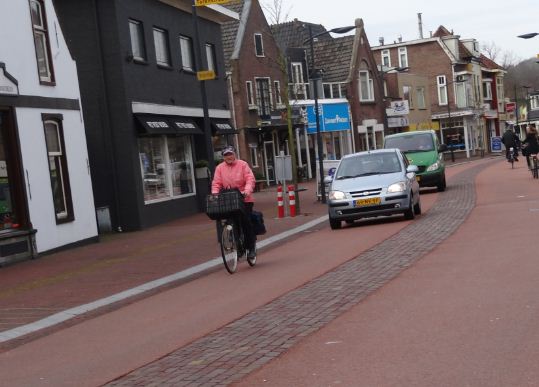
A bicycle boulevard is generally marked with a sign at the beginning and the end of the bicycle boulevard.[6] Also necessary for the road to be called a bicycle boulevard is coloring; in the Netherlands, the parts of the road where the cyclists ride on is marked in red (same color as used for segregated cycle facilities in the Netherlands). These sections of the road are called rabatstroken.[7] Motorists also ride on this section, yet also have a non-colored part of the road which they can drive on with one half (two wheels) of the car when they wish to pass a cyclist.[8]
Bicycle boulevards may use a variety of traffic calming elements to achieve a safe environment. This makes it difficult for motorists to use the street at a high speed. However, they do not block access to motor vehicles completely (i.e. using bollards) which would designate the route as segregated cycle facilities rather than a bicycle boulevard.[citation needed]
Some bicycle boulevards have higher road surface standards than other residential streets, and encourage riders to use the full lane, encouraging parity between bicycles and motor vehicles.[citation needed]
Discouraging non-local motor vehicle traffic[edit]

Permeable barriers such as bollards are sometimes used to allow cycling traffic to continue through while diverting motorized traffic from using the street as a through street.[citation needed]
Locations[edit]
Road designs of bicycle boulevards can be found in the United States, Canada (Vancouver, Saskatoon,[9] Winnipeg[10][11]), the Netherlands, Germany, Belgium, Denmark, France, Spain and New Zealand
United States[edit]
Bicycle boulevards can be found in a growing number of United States cities, including:[12]
- Arizona: Tucson
- California: Palo Alto, Berkeley, Emeryville, San Jose, San Luis Obispo, Long Beach
- Florida: Gainesville
- Kansas: Manhattan
- Michigan: Kalamazoo
- Minnesota: Minneapolis,[13] Saint Paul
- Missouri: Columbia
- New Mexico: Albuquerque
- North Carolina: Wilmington
- Oregon: Portland, Eugene, and Bend
- Oklahoma: Tulsa
- Washington: Seattle[14]
- Wisconsin: Madison
Palo Alto established the first bicycle boulevard[15] in the United States. It was named for Ellen Fletcher, a Holocaust survivor and one of America's first bike activists.[16]
In Berkeley, boulevards are mostly residential streets, but some sections pass through commercial areas. Generally, there are few cars on these streets, in large part because of the pre-existing traffic calming devices that slow and/or divert traffic. Bicycle boulevards may or may not have bicycle lanes.[citation needed]
In Minneapolis, a grant from the federal government within the Non-Motorized Pilot Program helped to build a bike boulevard on Bryant Avenue and the planning of others.[17][18]
Similarly in Columbia, the Non-Motorized Pilot Program project helped fund the first bike boulevard in Missouri along Ash and Windsor Streets. At least one other was planned.[citation needed]
In Wilmington, help from a Fit Community 2009 grant through the North Carolina Health and Wellness Trust Fund enabled the City of Wilmington to construct North Carolina's first bicycle boulevard. The Ann Street Bicycle Boulevard runs from South Water Street to South 15th Street[19] and serves as part of the much longer River to the Sea Bikeway,[20] which connects downtown Wilmington to Wrightsville Beach.[citation needed]
In Portland, a $600 million 20-year plan (2010–2030) has the goal of making 25 percent of trips in the city be by bicycle through the establishment of 700 miles (1,100 km) of new bikeways; one of the projects within the plan is to combine the work on street features that reduce stormwater runoff with the construction of curb extensions and other components of bicycle boulevards.[21]
In Albuquerque, a city with more than 400 miles (640 km) of on-street bicycle facilities and multi-use trails,[22] the grand opening of the first bicycle boulevard in New Mexico was held on April 14, 2009. The bicycle boulevard runs from San Mateo Blvd SE, west along Silver Ave SE/SW to 14th St SW. It then continues north on 14th St to Mountain Rd NW. The last leg continues west on Mountain Rd NW to the Paseo del Bosque Recreation Trail which parallels the Rio Grande.[citation needed]
In Madison, the first full bicycle boulevard spans East Mifflin Street in Madisons Tenney-Lapham Neighborhood, a second spans the entire length of Kendall Avenue in University Heights and the Regent Neighborhood.[citation needed]
In Seattle, the city is implementing a city-wide network of "Neighborhood Greenways".[14] The work is being carried out with the aid and cooperation of the non-profit "Seattle Neighborhood Greenways".[23]
US naming conventions[edit]
The City of Berkeley, California, is credited with coining the phrase bicycle boulevard in the late 1980s,[by whom?] but not every jurisdiction has adopted this term. In November 2011, the City of Boston began to use the term neighborways instead of bicycle boulevards. This added to a growing list of terms for bicycle boulevards since Portland has been calling them neighborhood greenways; Seattle has followed the same convention.[14]
Other terms for bicycle boulevards in the US include:[original research?]
- Cyclestreets
- Bike boulevards
- Quiet streets
- Neighborhood byways
- Bicycle-friendly streets
- Bicycle-friendly corridors
- Bicycle parkways
- Neighborhood parkways
- Bicycle greenways
Netherlands[edit]
In the Netherlands, fietsstraten [nl] ('cycle streets') have a similar road design — although most residential streets in the Netherlands which do not have on-road bike lanes or segregated bike lanes would fit the American definition of bicycle boulevards. A fietsstraat can link dedicated bike-only paths, service roads, and other types of bike-friendly street configurations to complete a route. (Extensive information has been compiled about these facilities at the Pedal Portland blog[24] and the Northeastern University webpage.)[25]
In Amsterdam for example, by 2005 about 40% of journeys were by bicycle and transport planners at the Dienst Infrastructuur Verkeer en Vervoer (Infrastructure Traffic and Transport Directorate) have adopted a bicycle policy that blends many different bike-friendly street designs such as segregated bicycle lanes, on-road bicycle lanes and fietsstraten.[26] The general concept is that cyclists can integrate relatively safely with vehicular traffic that is travelling at, or below, 30 km/h (19 mph) but that segregated bike lanes should be installed along roads with a higher speed limit. With these, and many other, bike-friendly policies in place, Amsterdam has the highest rate of cycling of any capital city in the world. Cycle streets are also on the rise in other cities within the country, including Utrecht.[27][28]

Germany[edit]
In Germany a comparable road design is called Fahrradstraße [de] ('bicycle road'), introduced into the Highway Code in 1997.[29] Any other vehicles are prohibited unless marked with an additional sign.[30]
Belgium[edit]
In Belgium, the Fietsstraat [nl] (in Dutch/Flemish) or rue cyclable (in French), was introduced into the Highway Code with effect from 13 February 2012.[31] One had earlier been introduced in the Visserij in Ghent (Gent) in the summer of 2011. The first one in Brussels appeared in 2013 on a service road alongside Avenue Louise.[citation needed]
The OpenStreetMap wiki and also the several locations on this subject may be of interest to reader.
Denmark[edit]
In Denmark, the first cykelgade [da] ('cycle street') was opened in 2011 in Aarhus.[32] Since then cycle streets have been implemented in several cities across the country.
Almost all Danish cycle streets allow motorized vehicles to drive on them, although some might be one way only. The speed limit is 50km/h although the law states that drivers should limit their speed to that of cyclists, normally under 30km/h[33]
France[edit]
In France, the equivalent road design is called vélorue ('bike street') or rue cyclable ('cycle street'). The cities of Strasbourg (2017), Bordeaux (2018) and Dijon (2019) are among the first to test it out.
Spain[edit]
In Spain, cycle streets are known as ciclocalles.[citation needed]
New Zealand[edit]
In New Zealand, bicycle boulevards are generally designated as 'neighbourhood greenways',[34] although Auckland refers to them as local paths[35] to avoid confusion with its off-road greenways network. Christchurch was the first city to implement a number of neighbourhood greenway sections as part of its Major Cycle Routes programme, including the Rapanui–Shag Rock Stage 1 through Linwood.[36]
See also[edit]
References[edit]
- ^ "Neighborhood Greenways | The City of Portland, Oregon". Portlandoregon.gov. Retrieved 17 August 2016.
- ^ "Louisville Neighborways". LouisvilleKy.gov. 25 September 2014. Retrieved 17 August 2016.
- ^ "Neighborhood Bikeway Plan". Co.washington.or.us. 13 May 2015. Archived from the original on 28 September 2021. Retrieved 17 August 2016.
- ^ "Transportation - What is a Neighborhood Byway? | Salt Lake City - The Official City Government Website". Slcgov.com. Retrieved 17 August 2016.
- ^ "Bicycle Boulevards - National Association of City Transportation Officials". Nacto.org. 20 June 2014. Retrieved 17 August 2016.
- ^ "Nieuws | Fietsersbond". Archived from the original on 16 April 2014. Retrieved 15 April 2014.
- ^ "Fietsstraat" [Street bike] (in Dutch). Gemeentehuis Oss. 14 April 2011. Archived from the original on 13 August 2016. Retrieved 12 August 2016.
- ^ "Image of colored parts of the road and non-colored section" (JPG). Verkeerskunde.nl. Retrieved 17 August 2016.[non-primary source needed]
- ^ "Bike Boulevard". saskatoon.ca. Archived from the original on 13 June 2013. Retrieved 20 August 2013.
- ^ "Powers Bike Boulevard". City of Winnipeg. Archived from the original on 26 August 2013. Retrieved 20 August 2013.
- ^ "Eugenie Bike Boulevard" (PDF). City of Winnipeg. Archived from the original (PDF) on 11 December 2013. Retrieved 20 August 2013.
- ^ "States are Losing Millions in Biking and Walking Funds". Streets Blog USA. Angie Schmitt. 5 September 2018. Retrieved 17 November 2018.
- ^ "Bicycle Boulevards". City of Minneapolis. Archived from the original on 10 August 2011. Retrieved 8 November 2011.
- ^ a b c "Neighborhood Greenways". Seattle Department of Transportation. February 2018. p. 1.
- ^ Krieg, Martin. "Founder". National Bicycle Greenway (NBG). Archived from the original on 31 May 2012. Retrieved 25 July 2012.
- ^ Szczepanski, Carolyn (18 March 2013). "Women's (Bike) History: Ellen Fletcher". News from the League, March 18, 2013. League of american bicyclists. Retrieved 24 August 2018.
- ^ "Minneapolis Sets Out to Build 30 Miles of Protected Bike Lanes By 2020". Streets Blog USA. Angie Schmitt. 21 April 2015. Retrieved 17 November 2018.
- ^ "From Minneapolis: Ten Street Design Solutions to Transform Your City". Streets Blog USA. Carolyn Szczepanski. 22 August 2011. Retrieved 17 November 2018.
- ^ "River to the Sea Bikeway in Wilmington, NC". Rivertoseabikeway.com. Retrieved 17 August 2016.
- ^ "River to the Sea Bikeway in Wilmington, NC". Rivertoseabikeway.com. 7 May 2016. Retrieved 17 August 2016.
- ^ James Mayer (6 March 2010). "Mayor Adams finds $20 million for bike boulevards". The Oregonian. Archived from the original on 9 March 2010. Retrieved 8 March 2010.
- ^ "Bicycling — City of Albuquerque". Cabq.gov. Archived from the original on 12 October 2012. Retrieved 17 August 2016.
- ^ "Seattle Neighborhood Greenways :: Safe Streets for All". Seattle Neighborhood Greenways. Retrieved 3 March 2018.
- ^ "The Netherlands' Neighborhood Greenways – Can We Make Portland's Greenways More Like Theirs?". pedalportland.org. Archived from the original on 23 August 2011. Retrieved 27 November 2011.
- ^ "Bicycling Facilities in Holland". coe.neu.edu. Archived from the original on 23 September 2011. Retrieved 27 November 2011.
- ^ (in Dutch) Dienst Infrastructuur Verkeer en Vervoer Archived 2005-01-27 at the Wayback Machine, official website of the Dutch Traffic and Transport Infrastructure Service
- ^ "Dnu". Archived from the original on 16 April 2014. Retrieved 15 April 2014.
- ^ "Pagina niet gevonden 404 | Gemeente Utrecht". Archived from the original on 16 April 2014. Retrieved 15 April 2014.
- ^ Alrutz, D./ Stellmacher-Hein, J.: Sicherheit des Radverkehrs auf Erschließungsstrassen, Berichte der Bundesanstalt für Straßenwesen, Heft V 37; Bergisch Gladbach 1997, German
- ^ OpenStreetMap description of bicycle road
- ^ "Fietsstraat krijgt officieel verkeersbord".
- ^ Jesper Bech Pedersen (22 June 2011). "Mejlgade bliver Danmarks første cykelgade" [Mejlgade will be Denmark's first bicycle street]. stiften.dk (in Danish).
- ^ https://www.retsinformation.dk/eli/lta/2023/425
- ^ "Neighbourhood greenways". Waka Kotahi NZ Transport Agency.
- ^ "Greenways, Bike Boulevards and Local Paths - Auckland's new Cycleway Guidelines". Bike Auckland. 9 October 2016.
- ^ "First Look: Rapanui Cycleway Stage 1 – Cycling in Christchurch". cyclingchristchurch.co.nz. 17 December 2017. Retrieved 24 August 2018.
Further reading[edit]
- Transportation Research Board (2017). Neighborhood Greenways; Applications, Research & Effectiveness.
- Walker, Lindsay; Tresidder, Mike; Birk, Mia (July 2009). Fundamentals of Bicycle Boulevard Planning & Design (PDF). Archived from the original (PDF) on 18 August 2016. Retrieved 12 August 2016.
- Minikel, Eric (2012). "Cyclist safety on bicycle boulevards and parallel arterial routes in Berkeley, California". Accident Analysis & Prevention. 45: 241–7. doi:10.1016/j.aap.2011.07.009. PMID 22269506.
- Dill, Jennifer; McNeil, Nathan; Broach, Joseph; Ma, Liang (2014). "Bicycle boulevards and changes in physical activity and active transportation: Findings from a natural experiment". Preventive Medicine. 69 (Suppl 1): S74–8. doi:10.1016/j.ypmed.2014.10.006. PMID 25456802.
- Broach, Joseph; Dill, Jennifer; Gliebe, John (2012). "Where do cyclists ride? A route choice model developed with revealed preference GPS data". Transportation Research Part A: Policy and Practice. 46 (10): 1730–40. doi:10.1016/j.tra.2012.07.005.
- Griswold, Julia; Medury, Aditya; Schneider, Robert (2011). "Pilot Models for Estimating Bicycle Intersection Volumes". Transportation Research Record. 2247: 1–7. doi:10.3141/2247-01. S2CID 109916042.
- McNeil, Nathan (4 June 2010). Bikeability and the Twenty-Minute Neighborhood (PDF). Archived from the original (PDF) on 20 December 2016. Retrieved 12 August 2016.
- Shields, Margaret M. (2015). Investigating the campus cycling environment of a large southeastern university from an ecological perspective (PhD Thesis). University of Alabama. OCLC 915139278.
- Lindsey, Greg; Wilson, Jeff; Anne Yang, Jihui; Alexa, Christopher (2008). "Urban Greenways, Trail Characteristics and Trail Use: Implications for Design". Journal of Urban Design. 13 (1): 53–79. doi:10.1080/13574800701804033. S2CID 110810237.
- Koorey, Glen (2012). Neighbourhood Greenways: Invisible Infrastructure for Walking and Cycling. 2 Walk & Cycle Conference. Hastings, New Zealand. hdl:10092/6832. OCLC 805587963.
External links[edit]

- Portland’s Bike Boulevards Become Neighborhood Greenways by Streetfilms
- Berkeley’s Bike Boulevards by Streetfilms
| In-roadway bikeways |
| ||||||
|---|---|---|---|---|---|---|---|
| Right-of-way paths |
| ||||||
| Health, safety and infrastructure |
| ||||||
| Design Guidelines |
| ||||||