


Bush dog
| Bush dog[1] | |
|---|---|
.jpg)
| |
| Bush dog at Prague Zoo | |
Scientific classification 
| |
| Domain: | Eukaryota |
| Kingdom: | Animalia |
| Phylum: | Chordata |
| Class: | Mammalia |
| Order: | Carnivora |
| Infraorder: | Cynoidea |
| Family: | Canidae |
| Subfamily: | Caninae |
| Tribe: | Canini |
| Genus: | Speothos |
| Species: | S. venaticus
|
| Binomial name | |
| Speothos venaticus (Lund, 1842)
| |
| Subspecies | |
| |

| |
| Bush dog range | |
The bush dog (Speothos venaticus) is a canine found in Central and South America.[1][2] In spite of its extensive range, it is very rare in most areas except in Suriname, Guyana and Peru;[2][4] it was first described by Peter Wilhelm Lund from fossils in Brazilian caves and was believed to be extinct.[4]
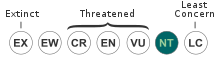
The bush dog is the only living species in the genus Speothos,[1] and genetic evidence suggests that its closest living relative is the maned wolf of central South America[5] or the African wild dog.[6] The species is listed as Near Threatened by the IUCN.[7][8][9]
In Brazil, it is called cachorro-vinagre ('vinegar dog') and cachorro-do-mato ('bush dog'). In Spanish-speaking countries, it is called perro vinagre ('vinegar dog'), zorro vinagre ('vinegar fox'), perro de agua ('water dog'), and perro de monte ('shrub or woodland dog').
Description
[edit]Adult bush dogs have soft long brownish-tan fur, with a lighter reddish tinge on the head, neck and back and a bushy tail, while the underside is dark, sometimes with a lighter throat patch. Younger individuals, however, have black fur over their entire bodies.[4] Adults typically have a head-body length of 57–75 cm (22–30 in), with a 12.5–15 cm (5–6 in) tail. They have a shoulder height of 20–30 cm (8–12 in) and weigh 5–8 kg (11–18 lb).[10][better source needed] They have short legs relative to their body, as well as a short snout and relatively small ears.[4]
The teeth are adapted for its carnivorous habits. Uniquely for an American canid, the dental formula is 3.1.4.13.1.4.2 for a total of 38 teeth.[4] The bush dog is one of three canid species (the other two being the dhole and the African wild dog) with trenchant heel dentition, having a single cusp on the talonid of the lower carnassial tooth that increases the cutting blade length.[4] Females have four pairs of teats and both sexes have large scent glands on either side of the anus.[4] Bush dogs have partially webbed toes, which allow them to swim more efficiently.[11]
Genetics
[edit]Speothos has a diploid chromosome number of 74,[12] and so it is unable to produce fertile hybrids with other canids.[citation needed]
Distribution and habitat
[edit]
Bush dogs are found from Costa Rica[13] in Central America and through much of South America east of the Andes, as far south as central Bolivia, Paraguay, and southern Brazil. They primarily inhabit lowland forests up to 1,900 metres (6,200 ft) elevation,[4] wet savannas and other habitats near rivers, but may also be found in drier cerrado and open pasture.[2] The historic range of this species may have extended as far north as Costa Rica where the species may still be found in suitable habitat.[2][14][15] New, repeated observations of bush dog groups have been recorded in east-central (Barbilla National Park) and south-eastern (La Amistad International Park) Costa Rica, and a substantial portion of the Talamanca Mountains up to 120 km (75 mi) to the north-northwest and at elevations up to 2,119 m (6,952 ft).[16] Very recent fossils dating from 300 AD to 900 AD (the Late Ceramic Age) have been found in the Manzanilla site on the eastern coast of Trinidad.[17]
There are three recognised subspecies:[1][4]
- The South American bush dog (Speothos venaticus venaticus), with a range including southern Colombia and Venezuela, the Guyanas, most of Brazil, eastern Ecuador and Peru, Bolivia, and northern Paraguay.
- The Panamanian bush dog (Speothos venaticus panamensis), with a range including Panama, northern Colombia and Venezuela, western Ecuador.
- The southern bush dog (Speothos venaticus wingei), with a range including southern Brazil and Paraguay, as well as extreme northeastern Argentina. The first camera trap photos of this species in Argentina were obtained in April 2016 from the Selva Paranaense Don Otto Ecological Private Reserve, located in Eldorado Department of the Misiones province of Argentina.[18][19]
Behavior
[edit]Bush dogs are carnivores and hunt during the day. Their typical prey are pacas, agoutis, acouchis and capybaras, all large rodents.[12] Although they can hunt alone, bush dogs are usually found in small packs. The dogs can bring down much larger prey, including peccaries and rheas, and a pack of six dogs has even been reported hunting a 250 kg (550 lb) tapir, where they trailed the animal and nipped at its legs until it was felled. When hunting paca, part of the pack chases it on land and part wait for it in the water, where it often retreats.[4]
Bush dogs appear to be the most gregarious South American canid species. They use hollow logs and cavities such as armadillo burrows for shelter. Packs consist of a single mated pair and their immediate relations, and have a home range of 3.8 to 10 square kilometres (1.5 to 3.9 sq mi).[4] Only the adult pair breed, while the other members of the pack are subordinate, and help with rearing and guarding any pups.[20] Packmates keep in contact with frequent whines, perhaps because visibility is poor in the undergrowth where they typically hunt.[21] While eating large prey, parents position themselves at either ends of the animal, making it easier for the pups to disembowel it.[4]
Reproduction
[edit]

Bush dogs mate throughout the year; oestrus lasts up to twelve days and occurs every 15 to 44 days.[22] Like many other canids, bush dog mating includes a copulatory tie, during which the animals are locked together.[22] Urine-marking plays a significant role in their pre-copulatory behavior.[23][24]
Gestation lasts from 65 to 83 days and normally results in the birth of a litter of three to six pups, although larger litters of up to 10 have been reported.[4] The young are born blind and helpless and initially weigh 125 to 190 grams (4.4 to 6.7 oz). The eyes open after 14 to 19 days and the pups first emerge from the nativity den shortly thereafter.[4] The young are weaned at around four weeks and reach sexual maturity at one year.[25] They can live for up to 10 years in captivity.[4]
Conservation
[edit]Very little is known about bush dogs compared to other canines of the World and their conservation is still in the beginning stages. The species is so uncommon that when bush dog bones were discovered in a cave in 1839, paleontologist Peter Wilhelm Lund thought that they were already extinct.[7] However, bush dogs are not extinct and studies suggest that bush dogs are able to live in a wide variety of habitats and are a generalist species.
Some barriers to bush dog conservation include their dense habitat and very scattered population making them difficult to locate, the need for very large areas not disturbed by humans for the bush dogs to live in because they live and hunt in packs, and their very shy nature. The species is currently listed as Near Threatened by the IUCN because of an estimated 20–25 percent loss in numbers over the latest 12-year period.[9] The main threats to bush dogs in the wild are in order of most important: habitat loss, including fragmentation, the loss of prey species because of human poaching, and diseases that they can get from the domestic dog populations that they come across. The type of habitat loss that is affecting bush dogs the most is clear cutting of trees in the Amazon and other good habitats for wood, cattle farming and palm oil. Disease from domestic dogs is slowly becoming a bigger and bigger problem for bush dogs, because of human encroachment they now share more of their habitat than ever with potentially unvaccinated domestic dogs. Hunting of bush dogs is prohibited in most of their range, countries banning the hunting of the species include Colombia, Ecuador, Brazil, French Guiana, Paraguay, Peru, Bolivia, Panama and Argentina. There is nothing that explicitly bans bush dog hunting in the laws of Guyana and Suriname. Another issue is that many of the countries that the bush dog lives in have limited resources in place to enforce the wildlife laws that are made.
Currently[when?], scientists are using a number of different methods to try to create a management plan for bush dogs. Traditional camera traps have not worked well in evaluating the species because of how shy they are; as a result, scientists have deployed scent-detecting dogs to try to find the bush dogs’ burrows where they rest at night.[8] The hope is to collect better data about habitat use of the species, what kind of prey they hunt, and how and when the cubs branch off from the pack. There are protected areas that exist throughout the bush dogs’ range, such as the Yasuni Biosphere Reserve; this will theoretically be able to support feeder populations. In good news for the species, as recently as 2020, bush dogs were caught on camera traps in the Talamanca Mountains of Costa Rica, suggesting that they may be expanding their range northward and even higher in elevation than previously thought possible. This could mean that if humans put in a concerted effort to try to save bush dogs, the species will be able to respond well and keep a steady population or maybe even gain in numbers.
References
[edit]- ^ a b c d Wozencraft, W. C. (2005). "Order Carnivora". In Wilson, D. E.; Reeder, D. M. (eds.). Mammal Species of the World: A Taxonomic and Geographic Reference (3rd ed.). Johns Hopkins University Press. ISBN 978-0-8018-8221-0. OCLC 62265494.
- ^ a b c d e DeMatteo, K.; Michalski, F.; Leite-Pitman, M. R. P. (2011). "Speothos venaticus". IUCN Red List of Threatened Species. 2011: e.T20468A9203243. doi:10.2305/IUCN.UK.2011-2.RLTS.T20468A9203243.en. Retrieved November 19, 2021.
- ^ "Appendices". CITES. Retrieved January 14, 2022.
- ^ a b c d e f g h i j k l m n o de Mello Beiseigel, B.; Zuercher, G. L. (2005). "Speotheos venaticus". Mammalian Species (783): 1–6. doi:10.1644/783.1. S2CID 198129207.
- ^ Wayne, R. K.; et al. (1997). "Molecular systematics of the Canidae". Systematic Biology. 46 (4): 622–653. doi:10.1093/sysbio/46.4.622. PMID 11975336.
- ^ Nyakatura, K.; et al. (2012). "Updating the evolutionary history of Carnivora (Mammalia): a new species-level supertree complete with divergence time estimates". BMC Biology. 10 (12): 12. doi:10.1186/1741-7007-10-12. PMC 3307490. PMID 22369503.
- ^ a b Beisiegel, B.M. (2009), "First camera trap record of bush dogs in the state of Sao Paulo, Brazil" (PDF), Canid News, vol. 12, no. 5, S2CID 41021664, retrieved March 12, 2024
- ^ a b Heft, Jeremy (June 12, 2021). "How Do Dogs Help With Bush Dog Conservation". WolfCenter.org. Wolf Education and Research Center. Retrieved April 2, 2023.
- ^ a b DeMatteo, Karen. "Using a survey of carnivore conservationists to gain new insight into the ecology and conservation status of the bush dog" (PDF). Canids.org. SSC Canid Specialist Group. Retrieved April 2, 2023.
- ^ "Speothos venaticus". ARKive. Archived from the original on December 5, 2008. Retrieved December 15, 2016.
- ^ Attenbourough, David (November 20, 2002). "5: Meat Eaters". The Life of Mammals (TV documentary). BBC / Discovery Channel. Event occurs at 17:10 min.
- ^ a b Paschka, Nick (2000). "Speothos venaticus (bush dog)". Animal Diversity Web. University of Michigan. Retrieved December 17, 2023.
- ^ Alvarado, Laura (November 23, 2017). "New Mammal Species Found in Costa Rica". The Costa Rica Star. Archived from the original on April 10, 2023. Retrieved March 12, 2024.
- ^ de la Rosa, C. L.; Nocke, C. C. (2000). A Guide to the Carnivores of Central America: Natural History, Ecology, and Conservation. Austin: University of Texas Press. pp. 206–211. ISBN 9780292716056.
- ^ Sillero-Zubiri, Claudio; Hoffman, Michael; MacDonald, David W. (2004). Canids: Foxes, Wolves, Jackals, and Dogs: Status Survey and Conservation Action Plan. Gland, Switzerland / Cambridge, England: IUCN. p. 77. ISBN 978-2-8317-0786-0.
- ^ Sáenz-Bolaños, Carolina; Fuller, Todd K.; Mooring, Michael S.; Porras, Junior; Sievert, Paul R.; Montalvo, Victor H.; Carrillo, Eduardo J. (2019). "Bush Dogs in Central America: Recent Range Expansion, Cryptic Distribution, or Both?". Tropical Conservation Science. 12 (1–5): 194008291984975. doi:10.1177/1940082919849758. ISSN 1940-0829.
- ^ Delsol, Nicolas; Grouard, Sandrine (November 2015). "Comments on Amerindian Hunting Practices in Trinidad (West Indies): Tetrapods From the Manzanilla Site (Late Ceramic Age 300–900 AD)". The Journal of Island and Coastal Archaeology. 11 (3): 14–15. doi:10.1080/15564894.2015.1102781 – via ResearchGate.
- ^ "First photos of the Bush Dog (Speothos venaticus) with camera trap in Argentina". Red Yaguareté. 2017.
- ^ Ocampo, Nicolás Lodeiro; Nigro, Norberto Ángel; Gnatiuk, Daniel Gonzalo; Gasparri, Bárbara (July 2017). "Primeras fotos de zorro pitoco (Speothos venaticus) obtenidas con cámaras trampa en Argentina". Nótulas Faunísticas. 2nd Series (219): 1–5. ISSN 1853-9564 – via Reg Yaguareté. Bilingual, English/Spanish.
- ^ Macdonald, D. W. (1996). "Social behaviour of captive bush dogs (Speothos venaticus)". Journal of Zoology. 239 (4): 525–543. doi:10.1111/j.1469-7998.1996.tb05941.x.
- ^ Macdonald, D. (1984). The Encyclopedia of Mammals. New York: Facts on File. pp. 31. ISBN 0-87196-871-1 – via Internet Archive.
- ^ a b Porton, Ingrid J.; et al. (1987). "Aseasonality of bush dog reproduction and the influence of social factors on the estrous cycle" (PDF). Journal of Mammalogy. 68 (4): 867–871. doi:10.2307/1381569. JSTOR 1381569.
- ^ Porton, Ingrid J. (1983). "Bush dog urine-marking: Its role in pair formation and maintenance" (PDF). Animal Behaviour. 31 (4): 1061–1069. doi:10.1016/S0003-3472(83)80013-X. Archived from the original (PDF) on December 18, 2023.
- ^ Kleiman, Devra G. (1972). "Social behavior of the maned wolf (Chrysocyon brachyurus) and bush dog (Speothos venaticus): A study in contrast". Journal of Mammalogy. 53 (4): 791–806. doi:10.2307/1379214. JSTOR 1379214.
- ^ Bekoff, M.; et al. (1981). "Life-history patterns and sociality in canids: Body size, reproduction, and behavior". Oecologia. 50 (3): 386–390. Bibcode:1981Oecol..50..386B. doi:10.1007/BF00344981. PMID 28309059. S2CID 7564251.
Bibliography
[edit]- Duplaix, Nicole; Simon, Noel (1976). World Guide to Mammals. Crown Publishers / Mandarin Publishers. ISBN 9780517529201.
- Flower, William Henry (February 17, 1880). "On the bush-dog (Icticyon venaticus Lund)". Proceedings of the Zoological Society of London. 1880: 70–76 – via Internet Archive.
External links
[edit]

- IUCN Red List near threatened species
- Speothos
- Fauna of the Amazon
- Fauna of the Guianas
- Mammals of Bolivia
- Carnivorans of Brazil
- Mammals of Colombia
- Mammals of Ecuador
- Mammals of Guyana
- Carnivorans of Central America
- Mammals of Peru
- Near threatened animals
- Mammals of Venezuela
- Near threatened biota of South America
- Mammals described in 1842