


California Highway Patrol
| California Highway Patrol | |
|---|---|
 Patch | |
 Door shield | |
 Badge | |
 Flag | |
| Abbreviation | CHP |
| Motto | Safety, Service, and Security |
| Agency overview | |
| Formed | August 14, 1929 |
| Employees | 11,000 (as of 2023)[1] |
| Annual budget | $3.2 billion (as of 2023)[2] |
| Jurisdictional structure | |
| Operations jurisdiction | California, U.S. |
 | |
| Map of California Highway Patrol's jurisdiction | |
| Size | 163,696 square miles (423,970 km2) |
| Population | 39,613,500 (2019 est.)[3] |
| Legal jurisdiction |  Statewide Statewide |
| Governing body | California State Legislature |
| Constituting instrument |
|
| General nature | |
| Specialist jurisdiction |
|
| Operational structure | |
| Headquarters | Sacramento, California, United States |
| Officers | 7,000 (authorised, as of 2023)[4] |
| Civilian members | 3,384 (as of 2019)[1] |
| Commissioner responsible |
|
| Parent agency | California State Transportation Agency (CalSTA) |
| Divisions | 8 |
| Facilities | |
| Stations | 16 Commercial Enforcement Facilities 103 Area Offices |
| Actual patrol cars |
|
| Motorcycles | Harley Davidson Electra Glide |
| Planes | |
| Helicopters | Eurocopter AS350 Écureuil |
| Website | |
| www | |
The California Highway Patrol (CHP) is a state patrol of the U.S. state of California. The CHP has primary patrol jurisdiction over all California highways and roads and streets outside city limits, and can exercise law enforcement powers anywhere within the state. The California Highway Patrol can assist local and county agencies and can patrol major city streets along with local and county law enforcement, state and interstate highways, and is the primary law enforcement agency in rural parts of the state.
The California State Legislature originally established the California Highway Patrol as a branch of the Division of Motor Vehicles in the Department of Public Works, with legislation signed by Governor C. C. Young on August 14, 1929. It was subsequently established as a separate department with legislation signed by Governor Earl Warren in 1947. The CHP gradually assumed increased responsibility beyond the enforcement of the State Vehicle Act and eventually merged with the smaller California State Police in 1995.[5] It is currently organized as part of the California State Transportation Agency (CalSTA).
In addition to its highway patrol duties, the CHP also provides other services including protecting state buildings and facilities (most notably the California State Capitol) and guarding state officials. The CHP also works with municipal and federal law enforcement agencies, providing assistance in investigations, patrol and other aspects of law enforcement.
The California Highway Patrol is the largest state police agency in the United States, with 11,000 employees, over 7,600 of whom are sworn officers, according to a study in December 2019.
The CHP gained international recognition in the late 1970s to the early 1980s through the broadcast of the TV series CHiPs, which chronicled the adventures of two fictional CHP motorcycle officers and served as technical advisors to the 1950s TV show Highway Patrol.[clarification needed]
Duties[edit]
The agency is responsible for law enforcement on all California state routes (including all freeways and expressways), U.S. Highways, Interstate Highways and all public roads in unincorporated and incorporated portions of any specific county.[6] Local police or the local sheriff's department having a contract with an incorporated city are primarily responsible for investigating and enforcing traffic laws in incorporated cities, but any peace officer of the CHP can still enforce any state law anywhere within the state, even though the agency's primary mission is related to transportation.[7] Furthermore, CHP officers act as bailiffs for the California Supreme Court and California Court of Appeal, as well as providing security at buildings occupied by the State of California.

CHP officers enforce the California Vehicle Code, pursue fugitives spotted on the highways, and attend to all significant obstructions and accidents within their jurisdiction. They patrol in various vehicles including the 2014 & 2016 Ford Police Interceptor Utility, 2015 Dodge Charger and in 2015 Chevrolet Tahoes. The main vehicle that the CHP uses to patrol is the Dodge Charger Pursuit in the RWD V6 Police Package. The only Hemi V8 Chargers CHP have are in the EVOC unit used for training purposes. CHP Officers have been using some police cars from the early 2000s such as Ford Expeditions.
CHP officers are responsible for investigating and disposing of car accidents, disabled vehicles, debris, and other impediments to the free flow of traffic. They are often the first responders at the scene of an accident (or obstruction), and in turn summon paramedics, firefighters, tow truck drivers or Caltrans personnel. The CHP files traffic collision reports for state highways and within unincorporated areas. The CHP responds to and investigates all accidents involving school buses throughout the state including incorporated cities.
CHP also has Multidisciplinary Accident Investigation Teams (MAIT) for the investigation of traffic collisions.[8]
Special responsibilities[edit]
The CHP also publishes data on traffic accidents in California from a database called SWITRS (Statewide Integrated Traffic Records System).

After the September 11, 2001 attacks the CHP became responsible for securing and patrolling a number of potential terrorist targets in California. These sites include nuclear power plants, government buildings, and key infrastructure sites. The CHP also maintains a SWAT team on 24‑hour stand‑by to respond to any terrorist activity.
In September 2005, the CHP sent its two Mobile Field Forces (highly trained and equipped quick reaction/deployment teams for civil disturbances and/or disasters) to the Gulf Coast to assist in the aftermath of Hurricane Katrina. Before the National Guard arrived, the CHP had four patrol helicopters over Marianna, Florida, more than eighty vehicles on the ground, and more than 200 officers and other staff, including a SWAT team, deployed in New Orleans.[9]
The CHP also has officers assigned to drug task forces and other criminal investigative task forces throughout the state, and maintains highly trained Warrant Service Teams (WST) throughout each of its Divisions. These teams serve high-risk felony arrest and search warrants generated as a result of CHP investigations, and the WST assists local, state, and federal law enforcement agencies to serve the same type of high-risk warrants. CHP investigators also work closely with agents of the State Bureau of Investigation, Office of the Attorney General.
The CHP also has a Special Response Team(SRT) for rapidly responding to natural disasters or civil disturbances throughout the state. Specialized training and equipment help to quickly quell unrest, preserve life, prevent property damage, and ensure the safety of the public.
Additionally, the CHP has dozens of narcotic patrol and explosive detection K-9 teams stationed throughout the state.
The California Highway Patrol's additional responsibilities includes a governor protection detail.
Somewhat controversially, the cities of Oakland and Stockton have contracted with the California Highway Patrol to assist their police departments with local patrol duties, including traffic stops and responding to 911 calls.[10][11][12]
Pay and pensions[edit]
Average officer pay was $118,000 in 2014.[13] By law, salaries are set by an average of the five largest police departments in the state.[14] In 2012, the top paid CHP officer received $483,581, 44 other officers earning over $200,000, and over 5,000 officers receiving over $100,000.[14] In 2011, CHP officers earned $82.4 million in overtime, triple the amount in the second largest state, and with one officer earning over $93,000 in overtime alone.[14] Officers are strictly prohibited from working more than 16.5 hours at a time before having to take a minimum 8-hour break.[14]
In 1999, Governor Gray Davis signed SB 400, which allowed CHP officers to retire at age 50 and continue receiving as much as 90% of their peak pay as a pension.[15] This raised the pension earned for 30 years of service from an average of $62,218 to $96,270.[15] Officers' average retirement age is 54.[15] New officers have a retirement age of 57 in accordance with CalPers 2.7% at 57 formula.[16] As of 2019, a new contract was negotiated with the state, causing officers to increase their contribution to the retirement plan by deferring any percentage over 3% of their annual raise towards their pension. This brings their contribution closer to a 50–50 split with the state, while boosting state contributions toward the officers' retirements from other sources.[17][18]
Organization and accreditation[edit]

The CHP is led by the Commissioner, who is appointed by the Governor of California. The Deputy Commissioner is also appointed by the Governor and the Assistant Commissioners are appointed by the Commissioner.
On February 3, 2023, Acting Commissioner Duryee was appointed to Commissioner by Governor Gavin Newsom.
Hierarchy[edit]
- Commissioner of the Highway Patrol — Sean A. Duryee[19][20]
- Office of Employee Relations
- Deputy Commissioner of the Highway Patrol — Troy D. Lukkes[21]
- Office of Inspector General
- Office of Community Outreach & Media Relations
- Office of Legal Affairs
- Office of Internal Affairs
- Office of Risk Management
- Office of Equal Employment Opportunity
- Assistant Commissioner, Field Operations — Aniceto Ortiz[21]
- Northern Division
- Valley Division
- Golden Gate Division
- Central Division
- Southern Division
- Border Division
- Coastal Division
- Inland Division
- Office of Air Operations
- Protective Services Division
- Capitol Protection Section
- Dignitary Protection Section
- Judicial Protection Section
- Assistant Commissioner, Staff Operations — Brandon S. Johnson[21]
- Administrative Services Division
- Enforcement and Planning Division
- Information Management Division
- Office of Employee Safety and Assistance
- Personnel and Training Division
On November 20, 2010, the CHP received its initial accreditation under the CALEA Advanced Law Enforcement Accreditation Program. Upon receiving this honor, the CHP became the largest CALEA-accredited law enforcement agency in the nation.[22]
On November 16, 2013, the CHP Academy was formally recognized as an accredited Public Safety Training Academy by CALEA, becoming the first accredited state police training academy in the nation. Additionally, the department succeeded in its bid for Advanced Law Enforcement reaccreditation, and remains the largest accredited law enforcement agency in the nation.[22]
On November 22, 2014, the CHP communications centers were formally accredited by CALEA under the Public Safety Communications Agencies Accreditation Program. Having received this honor, the CHP became the first accredited state highway patrol in the nation to receive communications accreditation.[22]
Having received accreditation status for its communications centers, the CHP became one of only two agencies in California to receive the CALEA TRI-ARC award, which is given to agencies having concurrent CALEA accreditation for their law enforcement, public safety communications and public safety training Academy. The CHP is one of nearly 20 agencies to have received this award.[22]
Rank structure[edit]
| Title | Insignia |
|---|---|
| Commissioner | 
|
| Deputy Commissioner | 
|
| Assistant Commissioner | 
|
| Chief | 
|
| Assistant Chief | 
|
| Captain | 
|
| Lieutenant | 
|
| Sergeant |  |
| Officer | No Insignia |
| Cadet | No Insignia |

Traditions[edit]
CHP uniforms are traditionally khaki-colored with campaign hat and blue-and-gold trouser stripe. Command officers wear a tan combination cap. The dress uniform includes a forest green jacket and royal blue tie (bow tie for motor officers). Cold weather and utility uniforms are dark blue.

Leather gear is black basketweave leather with brass snaps and buckles.
Standard traffic enforcement patrol vehicles are required by state law to have a white door with, in the case of the CHP, a star. The CHP operates traditional black and white as well as all-white patrol vehicles.
The California Highway Patrol is one of the few organizations to continue to use the older toll-free "Zenith 1-2000" number. With the falling cost of telephone area code 800 and 888 numbers, most organizations have chosen to switch to one of the newer numbers and discontinue use of the Zenith service, which requires operator assistance. The CHP's traditions include its own radio codes, widely adopted by local agencies. The most important is 11‑99, which signifies that an officer needs emergency assistance or that an officer is down.
In 1981, a charitable foundation called the 11‑99 Foundation was founded to provide benefits and scholarships to officers and their families. The members of the foundation's board of directors have provided over $16 million in assistance to current, retired, and those fallen in the line of duty CHP employees and their families. The organization's name is taken from the radio code.[23]


Fallen officers[edit]
Since its inception in 1929, 227 officers have died in the line of duty. The top three frequent causes of line of duty deaths to date are (in order of cause): Automobile/Motorcycle Accidents, Gunfire, and Vehicular Assault (i.e., struck by drunk driver, reckless driving, or hearing and/or visually impaired drivers).[24] 1964 was the deadliest year, in which eight officers died in the line of duty; 1970 and 1978 were the second deadliest years, in which seven officers died in the line of duty.


Mexico Liaison Unit[edit]
The "Mexico Liaison Unit" is a Border Division Unit based in San Diego. Since the CHP has no jurisdiction directly in Mexico, officers from the Unit work closely with Mexican authorities to recover stolen vehicles and assist with other law enforcement issues. The purpose of the "Mexico Liaison Unit" is to develop and maintain positive working relations with Mexican authorities in order to:
- Locate and identify stolen U.S. vehicles taken to Mexico
- Identify vehicle thieves and ensure their prosecution, either in Mexico or California
- Provide assistance to Mexican and U.S. authorities
The unit was originally established in 1958 and only consisted of one officer. It was discontinued in the 1970s, and reestablished in 1980. The unit now consists of one sergeant and six officers, all of whom are fluent in Spanish.[25]
Newhall Incident[edit]
On April 6, 1970, four California Highway Patrol officers were killed in a 41⁄2‑minute shootout in the Newhall region of Southern California. The incident is a landmark in CHP history because of both its emotional impact and the procedural and doctrinal reforms implemented by the CHP in the incident's aftermath.
The shootout occurred in a restaurant parking lot just before midnight. Officers Walt Frago and Roger Gore were alerted by radio of a vehicle carrying someone who brandished a weapon. They spotted the car, fell in behind, called for backup, and began the stop procedure. When the suspects' vehicle came to a halt in the parking lot, the driver was instructed to step out of the vehicle and spread his hands on the hood. Gore approached him and Frago moved to the passenger side. The passenger side door suddenly swung open and the passenger sprung out, firing at Frago, who fell with two shots in his chest. The gunman, later identified as Jack Twinning, then turned and fired once at Gore, who returned fire. In that moment the driver, Bobby Davis, turned and shot Gore twice at close range. Both officers died instantly.
When Officers James Pence and George Alleyn drove in moments later, they could not see suspects or other officers, but both immediately came under fire. Officer Pence put out an 11‑99 call ("officer in distress") then took cover behind the passenger door. Alleyn grabbed his shotgun, and positioned himself behind the driver-side door. Both officers were mortally wounded in the ensuing exchange, and one suspect was hit.
Suspects Jack Twinning and Bobby Davis escaped, later abandoned their vehicle and then split up. For nine hours, officers blanketed the area searching for the killers. Twinning broke into a house and briefly held a man hostage. Officers used tear gas before storming the house, but Twinning committed suicide with the shotgun he stole from Frago. Davis was captured, stood trial and convicted on four counts of murder. He was sentenced to death, but in 1972, the California Supreme Court declared the death penalty to be cruel and unusual punishment and in 1973, the court commuted his sentence to life in prison.
Of the incident, Ronald Reagan, who was governor of California at the time, said the following: "If anything worthwhile comes of this tragedy, it should be the realization by every citizen that often the only thing that stands between them and losing everything they hold dear ... is the man wearing a badge."[26]
A follow-up investigation eventually led to a complete revision of procedures during high-risk and felony stops. Firearms procedures have also changed fundamentally due to this incident, and physical methods of arrest have been improved. The police baton and pepper spray have been added to the officer's arsenal, with more in‑depth training in their use.[27]
The 25th anniversary of the Newhall Incident was observed on April 6, 1995, at the present Newhall Area office, where a brick memorial pays tribute to Officers George Alleyn (6290), Walt Frago (6520), Roger Gore (6547) and James Pence (6885). The memorial once stood at the former Newhall office, but was rebuilt at the new site, about one mile (1.6 km) from the scene of the slayings.[28]
History of the former California State Police and its Merger with the California Highway Patrol[edit]
On July 12, 1995, the California State Police, which was a separate agency, was merged into the CHP, thus greatly expanding the agency's mandate.[5] In addition to safety on the state highway system, it is now responsible for the safety of all elected state officials and all people who work in or are utilizing a state building in California, such as the State Capitol Building in Sacramento.
It has also been discussed to merge the Law Enforcement Division of the California Department of Fish and Wildlife into the California Highway Patrol.[29][30] By doing so, this may allow for better protection of California's environment and natural resources. The underfunded CDFW Law Enforcement Division[31][32][33] has faced low numbers of Game Wardens also known as Wildlife Officers for the last ten years; a similar idea is already in place in Oregon and Alaska, where the Oregon State Police[34] and Alaska State Troopers[35] serve as game wardens under a separate fish and wildlife division within the two departments.
Firearms[edit]
The California Highway Patrol currently issues the Smith & Wesson M&P pistol, replacing the Smith & Wesson 4006 TSW.
Vehicles[edit]
![[icon]](/wiki/File:Wiki_letter_w_cropped.svg) | This section needs expansion. You can help by adding to it. (September 2013) |
Origins[edit]
When motor vehicles in California were first seen as needing legislation, law enforcement agencies began to patrol using motorcycles, cars and trucks.[36]: 9 Motorcycle officers in 1920 Fresno, started a group to assist each other and promote road safety – the Joaquin Valley Traffic Officer's Association – led by Harry Wilson who they elected as president. They renamed themselves the California Association of Highway Patrolmen in 1921, and became the California Highway Patrol in 1927 under the auspices of the Department of Motor Vehicles.[36]: 10
Motorcycles[edit]

Through the public competitive bidding process, the Harley-Davidson Electraglide motorcycle was selected as the primary enforcement motorcycle for the California Highway Patrol in 2013.[citation needed]
These replacement enforcement motorcycles will replenish the department's aging motorcycle fleet. In a cost-saving move, the CHP previously deferred the purchase of replacement motorcycles and has not purchased enforcement motorcycles since January 14, 2011. As a result, approximately 20 percent of the current fleet has logged 100,000 plus miles – well exceeding the manufacturer's warranty.[citation needed]
CHP's motorcycle program enhances public safety. Motorcycle officers are able to effectively enforce traffic laws in areas in which enforcement by four-wheel vehicles is impractical. Motorcycles can access scenes of accidents and natural disasters more quickly and work commute traffic in way that is unique to the motorcycle. Additionally, motorcycles play a special role in dignitary protection.[citation needed]
The CHP has approximately 415 enforcement motorcycles working the roads throughout California. The CHP purchased 121 of the Harley-Davidson enforcement motorcycles to replace motorcycles that have high mileage or have been damaged in traffic collisions. As of June 2013, approximately 22 percent of the CHP's motorcycle fleet is over 100,000 miles with more than half of those over 125,000 miles. On average, a CHP enforcement motorcycle is driven 14,000 miles per year.[citation needed]
Early motorcycles used included Indian, Harley-Davidson and Henderson manufactured bikes during the 1920s and 30s;[36]: 18, 20, 23 though by 1941, the main manufacturers used at the training academy were Harley-Davidson and Indian.[36]: 30
In 1998, CHP began using the BMW R1100RT-P, with features including a helmet interface for communications, two batteries, and a top speed of 130 miles per hour (210 km/h).[37][38]
Patrol cars[edit]
 | This section needs additional citations for verification. (January 2019) |


The Department of General Services is responsible for selecting a vehicle based on price, performance and payload capacity for the CHP. The bid specifications require a pursuit-rated, rear-wheel drive or all-wheel drive that can carry at least 1,500 pounds, the approximate weight of four officers, their equipment, and the police vehicle equipment.
As of July 2013, CHP had not purchased patrol vehicles since January 2011, and their fleet was rapidly aging. On average, CHP patrol vehicles are driven 33,000 miles per year. Half of their 2,153-vehicle fleet had over 100,000 miles as of June 2013. After 100,000 miles, the warranty on CHP vehicles expires, forcing CHP to pay for maintenance costs. In July 2013, the CHP was authorized to purchase up to 751 new vehicles to begin replacing its aging fleet, starting with cars that have the highest mileage.
Through a public, competitive bidding process, the Ford Police Interceptor Utility was selected as the new enforcement vehicle for the CHP in 2013. The 1st generation of Ford Police Interceptor Utility, from 2013 to 2019, is all wheel drive and powered by a naturally aspirated 3.7 liter V6 engine. It is a Flex Fuel vehicle that can use gasoline or E85, and gets 16 mpg city and 21 mpg highway.
Around this time several Dodge Charger Pursuits were also purchased for testing.
The Ford Crown Victoria Police Interceptor averaged 14 mpg city and 21 mpg highway. The new Ford Police Interceptor Utility Vehicle costs $26,578, which includes a 5-year, 100,000-mile warranty. The department was paying $24,043 for the Ford Crown Victoria Police Interceptors and recently spent hundreds of thousands of dollars per month to maintain all vehicles no longer covered by warranty. Several vehicles were allocated to public affairs officers and are used for recruiting purposes. An example of these vehicles can be seen at the California State Fair and other venues. The last Crown Victoria's were retired in September 2020.[39]
CHP also uses the Ford F-250, RAM 2500, and Chevrolet Silverado 1500 (still in testing) for commercial vehicle enforcement.
In July 2016, it was announced that the CHP would be taking delivery of 516 2016 Dodge Charger Pursuits.[40] These cars were hoped to be more reliable than the Ford Police Interceptor Utility, which have been plagued with various recalls and breakdowns, the most notable breakdowns being transmission and PTU (transfer case) failures.
In 2017, it was announced that the CHP were going to start using Chevrolet Tahoe Police Pursuit Vehicles (PPV) for rural and resident posts, along with areas that see snowfall in the winter months. This is because of their ability to carry a larger "basic load" of normal issue equipment, equipment that may be only in a few cars, and/or not carried in patrol cars at all, in a more urban setting, along with the selectable 4 wheel drive system to allow better performance in the snow.
In 2022, CHP began rolling out the all wheel drive version of the 2020 Charger Pursuit. These, like their predecessor, are powered by the naturally aspirated 3.6 liter V6 Pentastar engine, making 292bhp and 260lb/ft of torque.
As of 2023 the California Highway Patrol has officially rolled out its 299 2020 Ford Police Interceptor Utility after a 3-year hold due to an issue involving the low-band frequency of the headlights which caused issues with the radios. These vehicles are powered by the naturally aspirated flex fuel 3.3 liter V6, making 285bhp and 260lb/ft of torque. During 2023, the average mileage of its in-service primary patrol vehicles ranged anywhere from 150,000 miles to nearly 400,000 miles, proving the 2013-2019 Year Interceptor Utilities nearly or just as capable as the previous Ford Crown Victoria Police Interceptors.
It was also reported in 2023 that the CHP is testing the latest generation Dodge Durango special service package, and has selected the 2020 Chevrolet Tahoe PPV to be upfitted and utilized after completing the latest batch of Dodge Chargers.
As it stands, the highest mileage vehicle that was used by the California Highway Patrol was a 2013 Ford PIU, with an odometer at 384,857 miles upon retirement, which had patrolled the California/Nevada Border in Needles.[41]
Aircraft[edit]

The CHP utilizes both helicopters and fixed-wing aircraft. As of October 2020, the fleet consisted of:[42]
- 15 Airbus Helicopters (Eurocopter) AS350B3 Squirrels
- 8 Cessna T206H Turbo Stationairs
- 7 Gippsaero GA8 TC-320 Airvans
- 1 Raytheon (Beechcraft) B300 Super King Air
- 1 Cessna 208B Grand Caraven EX
Notable incidents[edit]
George Gwaltney[edit]
George Gwaltney, a former officer from Barstow, was convicted on May 10, 1984, in federal court for the on‑duty rape and murder of 23-year-old Robin Bishop on January 11, 1982. He had reported finding a dead body off a deserted stretch of interstate 15 the same day he murdered her with his service weapon. Gwaltney was tried twice for this murder at the San Bernardino County Court House. The first trial ended with the jury deadlocked 8–4 and the second 7–5. The district attorney attempted to try Gwaltney a third time, but a Superior court judge dismissed the murder charge. Since Gwaltney was allowed to go free for the first two state trials, the FBI took over the case. The FBI was able to piece together the events leading up to the murder and the on-duty rape of Robin Bishop and interrogating Gwaltney's alibi, Preston Olson and his mother. There was more forensic evidence that the FBI succeeded in getting to build their case against Gwaltney; soon his story started to fall apart. After the six-month investigation by the FBI, George Michael Gwaltney was arrested in Barstow and tried at the US District Court in Los Angeles. He was represented by a public defender who chose not to have Gwaltney testify as he had done in the previous two state trials. He was found guilty of the murder, rape and the deprivation of Robin Bishop's civil rights while on duty. He was the first California Highway Patrol officer to be charged with the indictment of violating the civil rights of Robin Bishop as well as being the first CHP officer known to commit a murder while on duty. Following the conviction, Gwaltney was subsequently sentenced to 90 years in prison, being eligible for parole after serving at least 30 years. Gwaltney died in federal custody from a heart attack in 1997.[43][44]
Craig Peyer[edit]
Craig Peyer, a former officer from Poway, is serving a forty-year prison sentence for the on-duty strangulation and murder of 20-year-old Cara Knott on December 27, 1986. After she was killed, Knott's body was discarded over an abandoned highway bridge. Peyer was convicted of first-degree murder in 1988. Though he has maintained innocence ever since, Peyer has been denied parole consistently.[45] In 2004, the parole board offered Peyer the chance to prove his alleged innocence by providing a DNA sample to compare against a drop of blood found on Cara's shoe, using modern DNA profiling. Peyer declined to provide a sample, nor explain why he declined to do so.
Pictures[edit]
In 2006, two officers forwarded photos taken of Nikki Catsouras, a teenager who died in a motor vehicle accident, to colleagues without authorization. These photos quickly spread on the internet. The family sued and reached a settlement in the case with CHP for $2.37 million in 2012.[46][47]
Programs[edit]
The CHP hosts or partners with numerous programs for public safety education and community involvement.
Youth programs[edit]
- Start Smart – a class for prospective and new teen drivers
- Every 15 Minutes – a two-day anti-drunk driving presentation for high school students
- Impact Teen Drivers – a nonprofit against teen distracted driving that is partnered with the CHP
- Make the Right Turn – aimed at educating 11- to 14-year-olds about drugs and peer pressure
- California Highway Patrol Explorer Program – A law enforcement career exploration program for teenagers ages 15–21 years old who are interested in becoming a CHP Officer.
- Sober Graduation – promoting sober driving and the use of a designated driver for teens
- Red Ribbon Week – a week in October dedicated to education about the dangers of illicit drugs for students of all ages
Vehicle Theft Recognition and Awards Program[edit]
- 10851 Award for Superior Efforts in Vehicle Theft Arrests and Recovery. The CHP developed the 10851 Awards Program to recognize the superior efforts made by CHP and allied law enforcement personnel who have met specified criteria toward the reduction of stolen vehicle crimes. This includes actual arrests made of suspects charged with California Vehicle Code Section 10851 – Vehicle Theft. The CHP, in conjunction with the California State Automobile Association, presented an estimated 2,009 awards in 1995 to the more than 170 allied agencies participating in the 10851 Awards Program.[48]
-
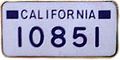 California Highway Patrol 10851 Award Pin

Other programs[edit]
- Highway Safety Corridor Program – promoting caution on roads with high accident rates
- Senior Volunteer Program – Citizens ages 55 and older can volunteer their time to help the CHP out in their community.
- Designated Driver Program – program to reduce drunk driving incidents through using a designated driver
Origins of the name[edit]
When the CHP was formed, there were discussions as to what to call this new agency. The consensus was for the name "California Highway Patrol". The American Automobile Association (AAA) is a private organization which provided, among other things, roadside assistance to their members. At that time, the AAA had a fleet of trucks which patrolled the roads so they could assist their members. These trucks carried a sign which said "Highway Patrol". The CHP organizers decided it would be best to contact the AAA to see if they would object to the state using this name. The AAA considered the idea, and gave their consent.[49]
See also[edit]
References[edit]
- ^ a b "Table 76". FBI. September 19, 2015. Retrieved October 6, 2020.
- ^ "Proposed Fund Shift for CHP and DMV Capital Projects". Legislative Analyst's Office. Retrieved January 16, 2024.
- ^ "California: Population estimates". U.S. Census Bureau. July 1, 2019. Retrieved April 24, 2021.
- ^ [1]
- ^ a b "History of CHP; the CHP-CSP Merger". Archived from the original on May 28, 2010.
- ^ "Cal. Sts. & High. Code §§ 2400, 2401".
- ^ "California Penal Code § 830.2(a)". California Office of Legislative Counsel. Retrieved December 24, 2018.
- ^ "Multidisciplinary Accident Investigation Teams (MAIT)". www.chp.ca.gov.
- ^ News Release 05-42, Media Relations Office, California Highway Patrol, September 29, 2005
- ^ Richards, Kathleen. "Are CHP Patrols in Oakland Worth It?". East Bay Express. Retrieved August 19, 2014.
- ^ "Oakland Approves Extra Patrols From CHP". KPIX-TV. May 8, 2013. Retrieved August 19, 2014.
- ^ Berton, Justin (March 11, 2013). "Oakland's use of CHP help draws critics". San Francisco Chronicle.
- ^ Ortiz, Jon (February 9, 2015). "CHP officers' pay up 11 percent; number of officers declines". The Sacramento Bee. Retrieved September 19, 2016.
- ^ a b c d Vekshin, Alison; Young, Elise; Yap, Rodney (December 16, 2012). "Highest-Paid California Trooper is Chief Banking $484,000". Bloomberg News. Retrieved September 19, 2016.
- ^ a b c Dolan, Jack (September 18, 2016). "The Pension Gap". Los Angeles Times. Retrieved September 19, 2016.
- ^ "Salary and Benefits - Officer". Home. October 6, 2020. Retrieved October 6, 2020.
- ^ Joffe, Marc (September 26, 2019). "California Highway Patrol Officers Temporarily Forgo Pay Hikes to Help Fund Pension Liabilities". Reason Foundation. Retrieved October 6, 2020.
- ^ Ventecher, Wes (August 26, 2019). "California state workers are giving up a raise. New contract reflects pension debt concerns". www.sacbee.com. Retrieved October 6, 2020.
- ^ "Archived copy" (PDF). Archived from the original (PDF) on September 27, 2011. Retrieved August 19, 2011.
{{cite web}}: CS1 maint: archived copy as title (link) - ^ "CHP Organization". www.chp.ca.gov. Archived from the original on April 29, 2009.
- ^ a b c "Find an Office".
- ^ a b c d "CALEA Accreditation". www.chp.ca.gov. Retrieved October 6, 2020.
 This article incorporates text from this source, which is in the public domain.
- ^ "Chapter 2 – Chaplaincy Responses". Archived from the original on September 12, 2009. Retrieved August 19, 2014.
- ^ "California Highway Patrol, CA". The Officer Down Memorial Page (ODMP).
- ^ "CHP-Mexico Liaison". Archived from the original on July 18, 2009. This article incorporates text from this source, which is in the public domain.
- ^ Anderson, John; Marsh Cassady (1998). The Newhall Incident: America's Worst Uniformed Cop Massacre. Quill Driver Books. ISBN 978-1-884956-01-0.
- ^ "CHP: The Newhall Incident". Archived from the original on October 26, 2008. Retrieved January 25, 2009.
- ^ "CHP: The Newhall Incident". Archived from the original on October 26, 2008. Retrieved January 25, 2009.
- ^ "California Fish and Game Commission Meeting March 6, 2008".
- ^ Tom Stienstra (December 8, 2002), "A how-to guide in revamping woeful CDFW", San Francisco Chronicle
- ^ ""A world without game wardens?" ESPN March 6, 2008". ESPN.
- ^ Tom Stienstra (September 23, 2007). "Game-warden shortage is about to get worse". San Francisco Chronicle.
- ^ ""Lots of ocean, but few game wardens!", The Sacramento Bee, August 23, 2007". sacbee.com. Archived from the original on August 21, 2007.
- ^ "Oregon State Police Fish and Wildlife Division". Archived from the original on July 31, 2012.
- ^ "Home - AWT - Alaska Department of Public Safety". dps.alaska.gov.
- ^ a b c d Mattos, Rick (2008). California Highway Patrol. Charleston, SC: Arcadia Pub. ISBN 9780738556208. Retrieved September 1, 2013.
- ^ Carpenter, Susan (June 25, 2013). "BMW's R1200RT-P: Big, bad and packing heat". Los Angeles Times. Retrieved September 1, 2013.
- ^ Satrom, Scott (April 5, 2016). "chips-tv.com". chips-tv.com.
- ^ Huffman, John Pearley (September 6, 2020). "Here Are the CHP's Last 2 Ford Crown Victoria Police Cars Ever". Car and Driver. Retrieved June 16, 2022.
- ^ "CHP Adds Dodge Chargers for Highway Enforcement". May 6, 2016. Retrieved July 30, 2016.
- ^ Finley, Kristen (September 27, 2023). "World's Highest Mileage Police Interceptor Retires with almost 385K Miles!". Ford Trucks. Retrieved October 6, 2023.
- ^ "FAA Registry". Archived from the original on October 27, 2012. Retrieved January 24, 2020.
- ^ "Bad Cop: George Gwaltney and the Problem of Police Accountability".
- ^ "790 F.2d 1378: United States of America, Plaintiff-appellee, v. George Michael Gwaltney, Defendant-appellant :: US Court of Appeals Cases :: Justia". Cases.justia.com. Retrieved August 19, 2014.
- ^ "Killer CHP Officer Denied Parole". nbcsandiego.com. September 21, 2008. Archived from the original on October 4, 2008.[dead link]
- ^ "Catsouras family wins right to sue over death photos". February 2010.
- ^ "CHP settles over leaked photos of woman killed in crash". Los Angeles Times. January 31, 2012. Retrieved June 16, 2022.
- ^ "Auto Theft". www.chp.ca.gov.
- ^ "California Highway Patrol (CHP) terminology". www.americanindian.net.

Further reading[edit]
- Crane, Bob, California Association of Highway Patrolmen Golden Chronicle 1920–1970, (Sacramento, California: California Association of Highway Patrolmen, 1970).
External links[edit]

- Official website
- CHP Traffic Incident Information Page
- CHP recruitment website
- California Association of Highway Patrolmen (CAHP) website
Executive state agencies, departments and other entities of the State of California | ||
|---|---|---|
| Cabinet-level superagencies |  | |
| Cabinet-level departments | ||
| Cabinet-level offices |
| |
| BCSH departments | ||
| GOA departments | ||
| CalEPA departments | ||
| HHS departments |
| |
| LWDA departments | ||
| CNRA departments | ||
| CalSTA departments | ||
| Independent entities | ||


- ^ "Page 5, Rank Structure" (PDF). chp.cav.gov.