


Bell tower
.JPG)
A bell tower is a tower that contains one or more bells, or that is designed to hold bells even if it has none. Such a tower commonly serves as part of a Christian church, and will contain church bells, but there are also many secular bell towers, often part of a municipal building, an educational establishment, or a tower built specifically to house a carillon. Church bell towers often incorporate clocks, and secular towers usually do, as a public service.
The term campanile (/ˌkæmpəˈniːli, -leɪ/, also US: /ˌkɑːm-/, Italian: [kampaˈniːle]), from the Italian campanile, which in turn derives from campana, meaning "bell", is synonymous with bell tower; though in English usage campanile tends to be used to refer to a free standing bell tower. A bell tower may also in some traditions be called a belfry, though this term may also refer specifically to the substructure that houses the bells and the ringers rather than the complete tower.
The tallest free-standing bell tower in the world, 113.2 metres (371 ft) high, is the Mortegliano Bell Tower, in the Friuli-Venezia Giulia region, Italy.[1][2]
Purpose[edit]
-

-
 The Leaning Tower of Pisa, campanile of the Duomo di Pisa, Italy
 -


Bells are rung from a tower to enable them to be heard at a distance. Church bells can signify the time for worshippers to go to church for a communal service, and can be an indication of the fixed times of daily Christian prayer, called the canonical hours, which number seven and are contained in breviaries. They are also rung on special occasions such as a wedding, or a funeral service. In some religious traditions they are used within the liturgy of the church service to signify to people that a particular part of the service has been reached.[3]

A bell tower may have a single bell, or a collection of bells which are tuned to a common scale. They may be stationary and chimed, rung randomly by swinging through a small arc, or swung through a full circle to enable the high degree of control of English change ringing. They may house a carillon or chimes, in which the bells are sounded by hammers connected via cables to a keyboard. These can be found in many churches and secular buildings in Europe and America including college and university campuses.[4]
A variety of electronic devices exist to simulate the sound of bells, but any substantial tower in which a considerable sum of money has been invested will generally have a real set of bells.


Some churches have an exconjuratory in the bell tower, a space where ceremonies were conducted to ward off weather-related calamities, like storms and excessive rain. The main bell tower of the Cathedral of Murcia has four.
In Christianity, many churches ring their church bells from belltowers three times a day, at 9 am, 12 pm and 3 pm to summon the Christian faithful to recite the Lord's Prayer;[5][6][7] the injunction to pray the Lord's prayer thrice daily was given in Didache 8, 2 f.,[8][9][10] which, in turn, was influenced by the Jewish practice of praying thrice daily found in the Old Testament, specifically in Psalm 55:17, which suggests "evening and morning and at noon", and Daniel 6:10, in which the prophet Daniel prays thrice a day.[8][9][11][12] The early Christians thus came to pray the Lord's Prayer at 9 am, 12 pm and 3 pm;[13] as such, in Christianity, many Lutheran and Anglican churches ring their church bells from belltowers three times a day: in the morning, at noon and in the evening calling Christians to recite the Lord's Prayer.[5][6][14] Many Catholic Christian churches ring their bells thrice a day, at 6 a.m., noon, and 6 p.m., to call the faithful to recite the Angelus, a prayer recited in honour of the Incarnation of God.[15][16] Oriental Orthodox Christians, such as Copts and Indians, use a breviary such as the Agpeya and Shehimo to pray the canonical hours seven times a day while facing in the eastward direction; church bells are tolled, especially in monasteries, to mark these seven fixed prayer times (cf. Psalm 119:164).[17][18]
The Christian tradition of the ringing of church bells from a belltower is analogous to Islamic tradition of the adhan (call to prayer) from a minaret.[19][20]
Old bell towers which are no longer used for their original purpose may be kept for their historic or architectural value, though in countries with a strong campanological tradition they often continue to have the bells rung.
History[edit]
Europe[edit]
In 400 AD, Paulinus of Nola introduced church bells into the Christian Church.[21][22] By the 11th century, bells housed in belltowers became commonplace.[22]
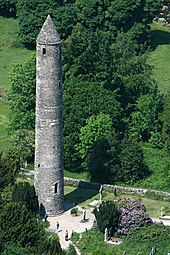
Historic bell towers exist throughout Europe. The Irish round towers are thought to have functioned in part as bell towers. Famous medieval European examples include Bruges (Belfry of Bruges), Ypres (Cloth Hall, Ypres), Ghent (Belfry of Ghent). Perhaps the most famous European free-standing bell tower, however, is the so-called "Leaning Tower of Pisa", which is the campanile of the Duomo di Pisa in Pisa, Italy. In 1999 thirty-two Belgian belfries were added to the UNESCO's list of World Heritage Sites. In 2005 this list was extended with one Belgian and twenty-three Northern French belfries and is since known as Belfries of Belgium and France. Most of these were attached to civil buildings, mainly city halls, as symbols of the greater power the cities in the region got in the Middle Ages; a small number of buildings not connected with a belfry, such as bell towers of—or with their—churches, also occur on this same list (details). In the Middle Ages, cities sometimes kept their important documents in belfries. Not all are on a large scale; the "bell" tower of Katúň, in Slovakia, is typical of the many more modest structures that were once common in country areas. Archaic wooden bell towers survive adjoining churches in Lithuania and as well as in some parts of Poland.
In Orthodox Eastern Europe bell ringing also have a strong cultural significance (Russian Orthodox bell ringing), and churches were constructed with bell towers (see also List of tall Orthodox Bell towers).
China[edit]
Bell towers (Chinese: Zhonglou, Japanese: Shōrō) are common in China and the countries of related cultures. They may appear both as part of a temple complex and as an independent civic building, often paired with a drum tower, as well as in local church buildings. Among the best known examples are the Bell Tower (Zhonglou) of Beijing and the Bell Tower of Xi'an.
Gallery[edit]
- Bell towers, belfries and campaniles by date
-
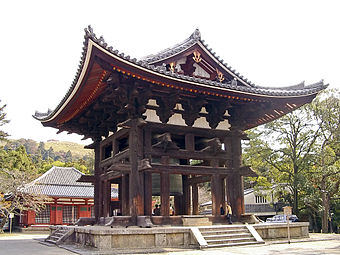 Old Belfry of Tōdai-ji, Japan (752, rebuilt 1200)
 -
-

-
 The Domtoren, bell tower of the St. Martin's Cathedral, Utrecht, Netherlands (13th century)
 -
 Separate bell tower at Feock Church, Cornwall (13th century)
 -
 Inside the belfry of St Medard & St Gildard's, in Little Bytham in Lincolnshire, England (13th century)
 -
 Beijing Bell Tower (1272, reconstructed 1420, 1800)
 -
 Bell Tower of Xi'an (1384)
 -
 Belfry of Aalst, Belgium (1460)
 -
-
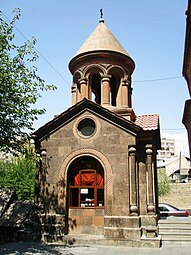
 Great Lavra Bell Tower of Kyiv Pechersk Lavra, Ukraine (1745)
 -
 Bell tower at Mission San Carlos Borromeo de Carmelo (1797)
 -
 Belfry of Bruges, Belgium (1240) (modified 1480s, 1820)
 -
 Belfry of Tampere Old Church, Finland (1828)
 -
 Bell Tower, Church of the Good Shepherd (Rosemont, Pennsylvania) (1894)
 -
 Sather Tower (more commonly known as "The Campanile"), Berkeley, CA (1914)
 -
 Belfry of Lille, France (1921)
 -
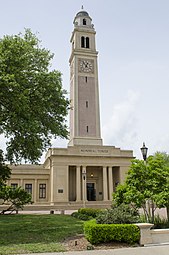 Memorial Tower at Louisiana State University, Baton Rouge, Louisiana (1923)
 -
 Campanile at the University of Northern Iowa (1927)
 -
 The Singing Tower at Bok Tower Gardens, Lake Wales, FL (1929)
 -
 Main Building (University of Texas at Austin), Austin, TX (1937)
 -
 Rainbow Tower, Niagara Falls, Canada (1947)
 -
 Campanile at the Basilica of the National Shrine of the Immaculate Conception, Washington, D.C., paid for by the Knights of Columbus; known as "The Knight's Tower". (1959)
 -
 The bell tower of the Cathedral of Petrópolis, Brazil (1960s)
 -
 The Addleshaw Tower of Chester Cathedral, England (1973–74)
 -

-
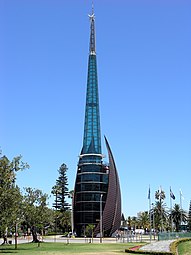 'Swan Bells', Perth, Western Australia (2000)


.jpg)


.jpg)


See also[edit]
References and notes[edit]
- ^ "25 tallest clock towers/government structures/palaces" (PDF). Council on Tall Buildings and Urban Habitat. January 2008. Archived from the original (PDF) on 2008-10-30. Retrieved 2008-08-09.
- ^ "Campus tour booklet" (PDF). University of Birmingham. Retrieved 2008-08-09.
- ^ Church Words: Origins and Meanings. Forward Movement. 1996. ISBN 978-0880281720. Retrieved 16 August 2012.
There are two sorts of liturgical bells in the history of the Christian Church-church bells in spires or towers used to call the faithful to worship, and sanctuary bells used to call attention to the coming of Christ in the Holy Eucharist.
- ^ "The World Carillon Federation (WCF)". Carillon.org. Retrieved 2012-02-19.
- ^ a b George Herbert Dryer (1897). History of the Christian Church. Curts & Jennings.
…every church-bell in Christendom to be tolled three times a day, and all Christians to repeat Pater Nosters (The Lord's Prayer)
- ^ a b Joan Huyser-Honig (2006), Uncovering the Blessing of Fixed-Hour Prayer, Calvin Institute of Christian Worship,
Early Christians prayed the Lord's Prayer three times a day. Medieval church bells called people to common prayer.
- ^ "Church bells". Wisconsin Evangelical Lutheran Synod. 25 July 2017. Retrieved 8 August 2020.
- ^ a b Gerhard Kittel; Gerhard Friedrich (1972). Theological Dictionary of the New Testament, Volume 8. William B. Eerdmans Publishing Company. p. 224. ISBN 978-0802822505. Retrieved 26 October 2012.
The praying of the Lord's Prayer three times a day in Did., 8, 2 f. is connected with the Jewish practice --> 218, 3 ff.; II, 801, 16 ff.; the altering of other Jewish customs is demanded in the context.
- ^ a b Roger T. Beckwith (2005). Calendar, Chronology, and Worship: Studies in Ancient Judaism and Early Christianity. Brill Publishers. p. 193. ISBN 9004146032. Retrieved 26 October 2012.
The Church had now two hours of prayer, observed individually on weekdays and corporately on Sundays – yet the Old Testament spoke of three daily hours of prayer, and the Church itself had been saying the Lord's Prayer three times a day.
- ^ Matthew: A Shorter Commentary. Continuum International Publishing Group. 2005. ISBN 978-0567082497. Retrieved 16 August 2012.
Moreover, the central portion of the Eighteen Benedictions, just like the Lord's Prayer, falls into two distinct parts (in the first half the petitions are for the individuals, in the second half for the nation); and early Christian tradition instructs believers to say the Lord's Prayer three times a day (Did. 8.3) while standing (Apost. const. 7.24), which precisely parallels what the rabbis demanded for the Eighteen Benedictions.
- ^ James F White (2010). Introduction to Christian Worship, 3rd ed.: Revised and Enlarged. Abingdon Press. ISBN 978-1426722851. Retrieved 12 October 2012.
Late in the first century or early in the second, the Didache advised Christians to pray the Lord's prayer three times a day. Others sought disciplines in the Bible itself as ways to make the scriptural injunction to "pray without ceasing" (1 Thess. 5:17) practical. Psalm 55:17 suggested "evening and morning and at noon," and Daniel prayed three times a day (Dan. 6:10).
- ^ Catechism Of The Catholic Church. Continuum International Publishing Group. 1999. ISBN 0-860-12324-3. Retrieved 2 September 2014.
Late in the first century or early in the second, the Didache advised Christians to pray the Lord's prayer three times a day. Others sought disciplines in the Bible itself as ways to make the scriptural injunction to "pray without ceasing" (1 Thess. 5:17) practical. Psalm 55:17 suggested "evening and morning and at noon," and Daniel prayed three times a day (Dan. 6:10).
- ^ Beckwith, Roger T. (2005). Calendar, Chronology And Worship: Studies in Ancient Judaism And Early Christianity. Brill. ISBN 978-90-04-14603-7.
So three minor hours of prayer were developed, at the third, sixth and ninth hours, which, as Dugmore points out, were ordinary divisions of the day for worldly affairs, and the Lord's Prayer was transferred to those hours.
- ^ "Church bells". Wisconsin Evangelical Lutheran Synod. 25 July 2017. Retrieved 8 August 2020.
- ^ John P. Anderson (2009). Joyce's Finnegans Wake: The Curse of Kabbalah, Volume 2. Universal Publishers. ISBN 978-1599429014. Retrieved 16 August 2012.
The Angelus is a Christian devotion in memory of the Incarnation. Its name is derived from the opening words, Angelus Domini nuntiavit Mariæ. It consists of three Biblical verses describing the mystery, recited as versicle and response, alternating with the salutation "Hail Mary!" and traditionally is recited in Catholic churches, convents and monasteries three times daily, 6:00 am, 12:00 noon and 6:00 pm, accompanied by the ringing of the Angelus bell. Some High Church Anglican and Lutheran churches also use the devotion.
- ^ The Anglican Service Book: A Traditional Language Adaptation of the 1979 Book of Common Prayer, Together with the Psalter Or Psalms of David and Additional Devotions. Good Shepherd Press. 1991. ISBN 978-0962995507. Retrieved 16 August 2012.
The Angelus: In many churches the bell is run morning, noon, and evening in memory of the Incarnation of God, and the faithful say the following prayers, except during Eastertide, when the Regina coeli is said.
- ^ "What is the relationship between bells and the church? When and where did the tradition begin? Should bells ring in every church?". Coptic Orthodox Diocese of the Southern United States. 2020. Retrieved 8 August 2020.
- ^ Mary Cecil, 2nd Baroness Amherst of Hackney (1906). A Sketch of Egyptian History from the Earliest Times to the Present Day. Methuen. p. 399.
Prayers 7 times a day are enjoined, and the most strict among the Copts recite one of more of the Psalms of David each time they pray. They always wash their hands and faces before devotions, and turn to the East.
{{cite book}}: CS1 maint: numeric names: authors list (link) - ^ Church Words: Origins and Meanings. Psychology Press. 1996. ISBN 978-0880281720. Retrieved 2012-08-16.
But even for Muslims who pray infrequently, the adhan marks the passage of time through the day (in much the same way as church bells do in many Christian communities) and serves as a constant reminder that they are living in a Muslim community.
- ^ Islamic Beliefs, Practices, and Cultures. Marshal Cavendish. 2009. p. 77. ISBN 978-0761479260. Retrieved 16 August 2012.
Muslims living in predominantly Islamic lands, however, have the benefit of the call to prayer (adhan). In the same way that much of the Christian world traditionally used bells to summon the faithful to church services, so the early Muslim community developed its own method of informing the entire community that the time for prayer had arrived.
- ^ Kathy Luty, David Philippart (1997). Clip Notes for Church Bulletins – Volume 1. ISBN 978-1568541693.
The first known use of bells in churches was by a bishop named Paulinus in the year 400.
- ^ a b Roger J. Smith (1997). "Church Bells". Sacred Heart Catholic Church and St. Yves Mission. Archived from the original on 2021-12-07. Retrieved 2012-10-26.
Bells came into use in our churches as early as the year 400, and their introduction is ascribed to Paulinus, bishop of Nola, a town of Campania, in Italy. Their use spread rapidly, as in those unsettled times the church-bell was useful not only for summoning the faithful to religious services, but also for giving an alarm when danger threatened. Their use was sanctioned in 604 by Pope Sabinian, and a ceremony for blessing them was established a little later. Very large bells, for church towers, were probably not in common use until the eleventh century.
External links[edit]

- Belfries of Belgium and France, UNESCO World Heritage Centre entry
- Les Beffrois – France, Belgique, Pays-Bas, blog describing several bell towers (in French)
- All Saints Bell Tower
