


Malankara Orthodox Syrian Church
 | This article needs additional citations for verification. (June 2019) |
| Malankara Orthodox
Syrian Church (Indian Orthodox Church) | |
|---|---|
 MOSC Catholicate Palace | |
| Classification | Oriental Orthodox |
| Orientation | Eastern Christianity |
| Scripture | Peshitta |
| Theology | Miaphysitism |
| Polity | Episcopal |
| Governance | Episcopal Synod |
| Primate | Malankara Metropolitan & Catholicos of East Baselios Marthoma Mathews III |
| Region | India and the Nasrani Malayali diaspora |
| Language | Syriac, Konkani, Malayalam, English |
| Liturgy | West Syriac Rite (Malankara Rite) |
| Headquarters | Catholicate Palace, Kottayam, Kerala, India |
| Founder | Thomas the Apostle Dionysius VI[1][2]: 285 [3] |
| Origin | 1st century by tradition,[4] 1912 |
| Independence | 1912 (Establishment of Catholicate)[5] |
| Separated from | Syriac Orthodox Church[6]: 197 |
| Branched from | Saint Thomas Christians, Malankara Church |
| Separations | Syro-Malankara Catholic Church (1930)[6]: 197 |
| Members | 0.5 million in Kerala[7] |
| Other name(s) | മലങ്കര സഭ (Malankara Church) Indian Orthodox Church |
| Official website | mosc.in |
| Part of a series on |
| Oriental Orthodoxy |
|---|
 |
| Oriental Orthodox churches |
 Christianity portal Christianity portal |


| Part of a series on |
| Christianity in India |
|---|
 |
The Malankara Orthodox Syrian Church (MOSC)[8] also known as the Indian Orthodox Church (IOC)[9] or simply as the Malankara Church,[10] is an autocephalous[11][12][5] Oriental Orthodox church headquartered in Devalokam, near Kottayam, India. It serves India's Saint Thomas Christian (also known as Nasrani) population. According to tradition, these communities originated in the missions of Thomas the Apostle in the 1st century (circa 52 AD).[13] It employs the Malankara Rite, an Indian form of the West Syriac liturgical rite.
The MOSC descends from the Malankara Church and its affiliation with the Syriac Orthodox Church. However, between 1909 and 1912, a schism over the authority of the Syriac Orthodox Patriarch of Antioch resulted in the dissolution of the unified Malankara Church and establishment of the overlapping and conflicting MOSC and Jacobite Syrian Christian Church (JSCC).[3] Since 1912, the MOSC has maintained a catholicate, the Catholicos of the East and Malankara Metropolitan–presently Baselios Marthoma Mathews III–who is the primate of the church.
The MOSC drafted and formally adopted a constitution in 1934, in order to define the relationship it has with the Syriac Orthodox Church and the patriarch, wherein it defined itself a division of the Syriac Orthodox Church with its supreme spiritual leader being the Patriarch of Antioch. However the constitution stipulated that all the spiritual duties of the patriarch in the Malankara Church was entrusted to the Catholicos of the East and reiterated that its administration was the prerogative of the Malankara Metropolitan. The constitution further declared that the positions of the Catholicos of the East and Malankara Metropolitan are to be held by the same person from then on, who shall henceforth act as the spiritual and administrative head of the church.[14] The Malankara Orthodox Syrian Church asserts communion with the other Oriental Orthodox churches. However, regular legal and occasional physical confrontations between the MOSC and the Syriac Orthodox JSCC have continued despite multiple efforts to reconcile the churches.[3][15][2]: 272
The Malankara Orthodox Syrian Church accepts miaphysitism,[16][17] which holds that in the one person of Jesus Christ, divinity and humanity are united in one (μία, mia) nature (φύσις – "physis") without separation, without confusion, without alteration and without mixing[18] where Christ is consubstantial with God the Father. Around 500 bishops within the Patriarchates of Alexandria, Antioch and Jerusalem refused to accept the dyophysitism (two natures) doctrine decreed by the 4th ecumenical council, the Council of Chalcedon in 451,[dubious – discuss] an incident that resulted in the second major split in the main body of the Christian Church (after the Nestorian schism). While the Oriental Orthodox churches rejected the Chalcedonian definition, the sees that would later become the Catholic Church and the Eastern Orthodox Church accepted this council.[19]
Self-reporting roughly 2.5 million members (with external estimates of roughly 1 million)[20] across 30 dioceses worldwide, a significant proportion of the Malankara Orthodox Syrian Church's adherents reside in the southern India state of Kerala with the diaspora communities in North America, Europe, the Middle East, Malaysia, Singapore, Australia and New Zealand.[21]
History
[edit]Early history
[edit]
According to tradition, Christianity first arrived in India with Thomas the Apostle during the 1st century AD, evolving into Saint Thomas Christianity over several centuries.[22] While isolated and generally independent in administration, Indian Christians maintained contact with the Christian hierarchies of Antioch, Persia, and potentially Alexandria.[23][24] The Saint Thomas Christians had relationships with the Persian Church of the East from at least the 6th century onward. The Indians inherited its East Syriac dialect for liturgical use and gradually became Syriac Christians in ritual and doctrine. They received clerical support from Persian bishops, who traveled to Kerala in merchant ships on the spice route.[25] For much of this period, Saint Thomas Christians were under the leadership of an archdeacon (a native ecclesiastical head with temporal powers, deriving from the Greek arkhidiākonos).
During the 16th century, efforts by the Portuguese Padroado–an arm of the Catholic Church–to bring the Saint Thomas Christians under the administration of the Latin Church and attempts to Latinize the Malankara Rite led to the first of several rifts in the community. These divisions intensified following the 1599 Synod of Diamper. Saint Thomas Christians who were opposed to the Portuguese Padroado missionaries took the Coonan Cross Oath on 3 January 1653.[26][27][28] The Dutch East India Company expulsion of the Portuguese from much of Malabar enabled the reconciliation of some Saint Thomas Christians and the Catholic Church, with this group eventually evolving into the Syro-Malabar Catholic Church, an Eastern Catholic church that adopted the Chaldean Catholic Church's East Syriac Rite and Diophysite christology.
Malankara Church
[edit]Many Saint Thomas Christian chose to remain independent from the Catholic Church. Patriarch Gregorios Abdal Jaleel, the Syriac Orthodox Archbishop of Jerusalem, witnessed the 1665 ordination of Thomas as Bishop Thoma I, who forged a renewed relationship with the Syriac Orthodox Church of Antioch and Saint Thomas Christians, which laid the foundation for adopting West Syrian liturgy and practices over the next two centuries. Those who supported the indigenous church leader of Malankara, Thoma I, and adopted West Syrian liturgies and practices and Miaphysite faith evolved into the Malankara Church.[29][30][31][32][33]
19th century
[edit]The Arthat Padiyola declared that the administration of Malankara Church was independent and the bishops from Rome, Antioch, and Babylon had no role in the Malankara Church hierarchy, despite continued efforts to integrate the remaining independent Saint Thomas Christians into these patriarchates. In 1807, four gospels of Holy Bible in Syriac were translated to Malayalam by Kayamkulam Philipose Ramban. The Malankara Orthodox Theological Seminary in Kottayam was established in 1815 under the leadership of Pulikottil Ittup Ramban (Mar Dionysius II). The Mavelikara Synod (Padiyola) led by Cheppad Mar Dionysius rejected the suggestions put forward by Anglican missioneries and Reformation group and declared the beliefs and theology of Malankara Church were same as the Syriac Orthodox Church of Antioch.[citation needed]
20th century
[edit]Geevarghese Dionysius of Vattasseril, who became the Malankara metropolitan bishop in 1908, played a significant role with the other clerical and lay leaders of Malankara in re-establishing the Catholicos of the East in India in 1912. In 1909 the relations with the Syrian Orthodox Church soured, when Patriarch Ignatius Abded Aloho II who arrived in India, began demanding registered deeds granting the patriarch temporal authority over the church. Dionysius rejected the request and thus emerged two factions in the church. The faction that supported the Patriarch came to be called as "Bava Kakshi" (Patriarch Faction) and the faction that supported the Malankara Metropolitan came to be known as "Methran Kakshi" (Metropolitan Faction).[34][35] The Malankara Orthodox Syrian Church wanted to retain its autocephaly, and appealed to Syriac Orthodox Patriarch of Antioch Ignatius Abdul Masih II. He enthroned Murimattathil Paulose Ivanios as Baselios Paulose I, Catholicos of the East, on the apostolic throne of St. Thomas at St. Mary's Church in Niranam on 15 September 1912.[36]
In 1934, The Malankara Church adopted a constitution for smooth functioning of the church, parishes and institution. In 1947, Saint Gregorios of Parumala was declared as a saint by the Church. In 1952 the Official Residence of the Malankara Metropolitan and the Headquarters of Malankara Church was shifted to Devalokam from Pazhaya Seminary. In 1958, The Supreme Court declared Catholicos Baselios Geevarghese II as the legitimate Malankara Metropolitan. The two factions of the Malankara Orthodox Church rejoined. In 1964, Syriac Orthodox Patriarch of Antioch participated in the enthronement ceremony of the Catholicos and Malankara Metropolitan, Baselios Augen I. In 1995, the Supreme Court of India declared the MOSC constitution adopted in 1934 was valid.[citation needed]
21st century
[edit]In 2002, fresh elections were conducted in Malankara Association under the observation of Supreme Court of India. The Supreme Court declared Catholicos Baselios Marthoma Mathews II is the official and legitimate Malankara Metropolitan and also declared that this decision cannot be disputed in any platform. In 2003, Vattasheril Dionysius VI was declared as a saint. In 2012, the centennial of the establishment of the church and Catholicate were celebrated with history classes and church publications.[37] On 3 July 2017, a major verdict by the Supreme Court of India declared the MOSC legally applicable to all parishes in disputed possession between the MOSC and Jacobite Syrian Christian Church.[38]
Hierarchy and doctrine
[edit]
The spiritual head of the church is the Catholicos of the East, and its temporal head is the Malankara Metropolitan. Since 1934, both titles have been vested in one person; the official title of the head of the church is "The Catholicos of the Apostolic Throne of Saint Thomas and The Malankara Metropolitan". Baselios Marthoma Mathews III was enthroned as the Malankara Metropolitan and the Catholicos of the East. He is the eighth Catholicose of the East in Malankara and the 21st Malankara Metropolitan.
Oriental Orthodox Churches, including the Malankara Orthodox Syrian Church, accept only the first three ecumenical councils: the First Council of Nicaea, the First Council of Constantinople, and the Council of Ephesus. The church, like all other Oriental Orthodox Churches, uses the original Nicene Creed[39] without the filioque clause.[40] Like the Syriac Orthodox Church, it primarily uses the liturgy of Saint James in Malayalam, Konkani, Kannada, Hindi, English and other Indian languages.
Liturgy and canonical hours
[edit]
The church has used the Malankara Rite, part of the Antiochene Rite, since the 17th century.[41] The Jacobite Church and the Maronite Church also belong to the same liturgical family. In the first half of the fifth century, the Antiochene church adopted the Liturgy of Saint James. In the 4th and 5th centuries, The liturgical language of fourth- and fifth-century Jerusalem and Antioch was Greek, and the original liturgy was composed in Greek.
After the Council of Chalcedon in 451, the Eastern Church was divided in two; one group accepted the council, and the other opposed it. Both groups continued to use the Greek version of the Saint James liturgy. The Byzantine emperor Justin (518–527) expelled the opponents from Antioch, and they took refuge in the Syriac-speaking Mesopotamia on the Roman–Persian border (modern eastern Syria, Iraq, and southeastern Turkey). The Antiochene liturgical rites were gradually translated into Syriac, and Syriac hymns were introduced.
Gregorios Abdal Jaleel came to Malankara from Jerusalem in 1665 and introduced Syriac Orthodox liturgical rites. The most striking characteristic of the Antiochene liturgy is its large number of anaphoras (celebrations of the Eucharist). About eighty are known, and about a dozen are used in India. All have been composed following the Liturgy of Saint James.[42]
Christians of the Malankara Orthodox Syrian Church pray the canonical hours of the Shehimo at fixed prayer times seven times a day.[43]
The liturgy of Mor Addai is still in use, in anaphora form, similar to the Maronite Sharar. The anaphora of St. John Chrysostom is sometimes used.
Saints
[edit]
In conformity with other Eastern and Oriental Orthodox churches, and also with the Roman Catholic Church, the Malankara Orthodox Syrian Church adheres to the tradition of seeking the intercession of saints. Several have been canonized:
- Geevarghese Gregorios of Parumala: Entombed in St. Peter and St. Paul's Church, Parumala, and canonized by Geevarghese II in 1947
- Baselios Yeldo: Entombed in St. Thomas Church, Kothamangalam, and canonised by Geevarghese II in 1947
- Geevarghese Dionysius of Vattasseril: Entombed in the Orthodox Theological Seminary, Kottayam, and canonized by Mathews II in 2003
- Antonio Francisco Xavier Alvares: Entombed in St. Mary's Orthodox Church, Ribandar, and declared a regional saint by Paulose II in 2015. (Not officially canonized a saint)[44]
- Fr. Roque Zephrin Noronah: Entombed in St. Mary's Orthodox Cathedral, Brahmavar, and declared a regional saint by Paulose II in 2015 (Not officially canonized a saint)[45]
-
 Geevarghese Gregorios of Parumala
 -
 Geevarghese Dionysius of Vattasseril
 -
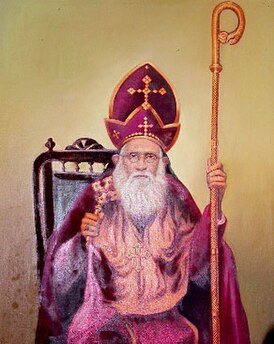 Antonio Francisco Xavier Alvares
.jpg)


Metropolitan
[edit]The temporal, ecclesiastical and spiritual administration of the church is vested in the Malankara Metropolitan, subject to the church constitution which was adopted in 1934.[46] The Malankara Metropolitan is president of the Malankara Syrian Christian Association (Malankara Association) and its managing committee, and trustee of community properties. He is the custodian of the Pazhaya Seminary and other common properties of Malankara Syrian Community. He is also the custodian of vattipanam interest which was deposited in Travancore Government by Marthoma VII. He is elected by the Malankara association.
List of Malankara metropolitans
[edit]- Thoma I (1653–1670)[47]
- Thoma II (1670–1686)
- Thoma III (1686–1688)
- Thoma IV (1688–1728)
- Thoma V (1728–1765)
- Thoma VI (1765–1808)
- Thoma VII (1808–1809)
- Thoma VIII (1809–1816)
- Thoma IX (1816)
- Dionysius II (1816)
- Dionysius III (1817–1825)
- Dionysius IV (1825–1852)
- Mathews Athanasius (1852–1877)
- Dionysius V (1865–1909)[48]
- Dionysius VI (1909–1934)[49]
- Geevarghese II (1934–1964)[50] From 1934 Malankara Metropolitan also holds the office of Catholicos of the East of the Malankara Orthodox Syrian Church.
- Augen I (1964–1975), also Catholicos of the East
- Mathews I (1975–1991), also Catholicos of the East
- Mathews II (1991–2005),[51] also Catholicos of the East
- Didymos I (2005–2010), also Catholicos of the East
- Paulose II (2010–2021), also Catholicos of the East
- Mathews III (15 October 2021 – present), also Catholicos of the East[52][53]
Catholicate
[edit]"Catholicos" means "the general head", and can be considered equivalent to "universal bishop."[54] The early church had three priestly ranks: episcopos (bishop), priest and deacon. By the end of the third century, bishops of important cities in the Roman Empire became known as metropolitans. The fourth-century ecumenical councils recognized the authority of the metropolitan. By the fifth century, the bishops of Rome, Constantinople, Alexandria and Antioch gained control of the churches in surrounding cities.[55] They gradually became the heads of the regional churches, and were known as patriarchs (common father).
Outside the Roman Empire, patriarchs were known as catholicos. There were four catholicates before the fifth century: the Catholicate of the East, the Catholicate of Armenia, the Catholicate of Georgia and the Catholicate of Albania. The archdeacons reigned from the fourth to the 16th centuries; in 1653, the archdeacon was elevated to bishop by the community as Mar Thoma I.
The Catholicate of the East was relocated to India in 1912, and Baselios Paulose I was seated on the apostolic throne of St. Thomas as the Catholicos of the East by the disposed Patriarch of Antioch Abdul Masih. The headquarters of the Malankara Orthodox Syrian Church and the Catholicos of the East is the Catholicate Palace at Devalokam, Kottayam, Kerala, which was consecrated on 31 December 1951. The new palace, built in 1961, was dedicated by visiting Armenian Catholicos Vazgen I.
The Holy Synod and Managing committee designated H.G.Dr. Mathews Mor Severios to the new Malankara Metropolitan and Catholicos of Malankara Church succeeding Baselios Marthoma Paulose II. He was consecrated as the 22nd Malankara Metropolitan during the Malankara Association that took place on 14 October 2021 at St. Peter and St. Paul's Church, Parumala and enthroned as the 9th Catholicos of Malankara Church on 15 October 2021.[56] Relics of St. Thomas are kept in the catholicate chapel, and Geevarghese II, Augen I, Mathews I and Paulose II are interred there.
List of Catholicos of the East of the Malankara Orthodox Syrian Church
[edit]The list of Catholicos of the East of Malankara Church:
- Baselios Paulose I (1912–1914)
- Vacant (1914–1925)
- Baselios Geevarghese I (1925–1928)
- Baselios Geevarghese II (1929–1964)
- From 1934 Catholicos is also holding the office of Malankara Metropolitan.
- Baselios Augen I (1964–1975)
- Baselios Mar Thoma Mathews I (1975–1991)
- Baselios Mar Thoma Mathews II (1991–2005)
- Baselios Mar Thoma Didymos I (2005–2010)
- Baselios Mar Thoma Paulose II (2010–2021)
- Baselios Mar Thoma Mathews III (2021–present)
Administration
[edit]Until the 17th century, the church was administered by the archdeacon (Malankara Moopan).[57] The elected archdeacon was in charge of day-to-day affairs, including the ordination of deacons to the priesthood. Ordinations were performed by Persian bishops visiting India. The Malankara Palliyogam (a forerunner of the Malankara Association) consisted of elected representatives from individual parishes. The isolation of the Malankara church from the rest of Christendom preserved the apostolic age's democratic nature through interactions with Portuguese (Roman Catholic) and British (Anglican) colonialists. From the 17th to the 20th centuries, the church had five pillars of administration:
- The Episcopal Synod, presided over by the Catholicos of the East
- The Malankara Association, presided by Malankara Metropolitan
- Three trustees: the Malankara metropolitan and priest and lay trustees
- The Malankara Association's managing and working committees[58][59]
1934 church constitution
[edit]Envisioned by Dionysius VI, the church's general and day-to-day administration was codified in its 1934 constitution. The constitution[60] was presented at the 26 December 1934 Malankara Christian Association meeting at M. D. Seminary,[61] adopted and enacted. It has been amended three times. Although the constitution was challenged in court by dissident supporters of the Patriarch of Antioch, Supreme Court rulings in 1958, 1995, 2017 and 2018 upheld its validity.[62]
The constitution's first article asserts the relationship between the Syriac Orthodox Church and the Malankara Church. The second article addresses the establishment of the Malankara Church by St. Thomas and ascribes primacy to the Catholicos. The third article regards the church's name. The fourth article describes the faith and its traditions. The fifth article examines church governance canon law.[63]
Malankara Association
[edit]The elected Malankara Association, consisting of parish members, manages the church's religious and social concerns. Formerly the Malankara Palli-yogam (മലങ്കര പള്ളി യോഗം; Malankara Parish Assembly, its modern form is believed to have been founded in 1873 as the Mulanthuruthy Synod, a gathering of parish representatives in Parumala. In 1876, the Malankara Association began.[64]
The church constitution outlines the association's powers and responsibilities. The Catholicos of the East and Malankara Metropolitan is the president, and the diocesan metropolitan bishops are vice-presidents. All positions are elected. Each parish is represented in the association by an elected priest and laypeople, proportional to parish-membership size.
Co-trustees
[edit]This is a list of co-trustees (priest trustee & lay trustee) elected by the Malankara Association of the Malankara Orthodox Syrian Church:[65][66]
| Year of Election | Clergy Trustee | Duration | Lay Trustee | Duration |
|---|---|---|---|---|
| 1869 | Punnathra Chacko Chandapilla Kathanar | 21 Oct 1869 – 13 Sep 1886 | Kulangara Ittychan Pailey | 12 Oct 1869 – ? |
| 1886 | Konat Kora Yohannan Kathanar | 13 Sep 1886 – 9 Mar 1890 | Kunnumpurath Kora Ulahannan, Kottayam | 13 Sep 1886 & 31 Mar 1892 – 24 Feb 1901 |
| 1892 | Konat Kora Mathan Malpan | 31 Mar 1892 & 23 Nov 1895 – 7 Sep 1911 |
- | |
| 1901 | - | C. J. Kurien (Kunnumpurath Ulahannan Kora), Kottayam | 25 Apr 1901 – 7 Sep 1911 | |
| 1911 | Palappalil Mani Paulose Kathanar Pampakuda | 7 Sep 1911 – 21 Dec 1955 | Chirakadavil Kora Kochu Korula, Kottayam (d. 1931) | 07 Sep 1911 – 31 May 1931 |
| 1931 | - | E. I Joseph, Kottayam | 10 Jul 1931 – 15 Jul 1946 | |
| 1958 | Manalil Jacob Kathanar | 26 Dec 1958 – 28 Dec 1965 | Ooppoottil Kurien Abraham, Kottayam | 26 Dec 1958 – 12 Dec 1978 |
| 1965 | Thengumthottathil T. S. Abraham Cor Episcopa | 28 Dec 1965 – 28 Dec 1982 | - | |
| 1980 | - | Padinjarekkara P. C. Abraham, Kottayam | 1 May 1980 – 21 Mar 2007 | |
| 1982 | Konat Abraham Malpan | 28 Dec 1982 – 3 Mar 1987 | - | |
| 1987 | Fr. Mathai Nooranal | 29 Dec 1987 – 29 Nov 2002 | - | |
| 2004 | Fr. Dr. O. Thomas | 10 Jun 2004 – 21 Mar 2007 | - | |
| 2007 | Fr. Johns Abraham Konat | 21 Mar 2007 – 7 Mar 2012 | M.G. George Muthoot | 21 Mar 2007 – 7 Mar 2012 |
| 2012 | Fr. Johns Abraham Konat | 7 Mar 2012 – 1 Mar 2017 | M.G. George Muthoot | 7 Mar 2012 – 1 Mar 2017 |
| 2017 | Fr. Dr. M.O. John | 1 Mar 2017 – 4 Aug 2022 | George Paul (d. 2019) | 1 Mar 2017 – 26 Nov 2019 |
| 2022 | Fr. Dr. Thomas Varghese Amayil | 4 Aug 2022 – present | Ronny Varghese Abraham | 4 Aug 2022 – present |
Dioceses
[edit]Malankara Orthodox Syrian Church Dioceses[67]
- Thiruvananthapuram Diocese
- Kollam Diocese
- Kottarakkara Punaloor Diocese
- Adoor Kadampanad Diocese
- Thumpamon Diocese
- Nilakal Diocese
- Mavelikara Diocese
- Chengannur Diocese
- Niranam Diocese
- Kottayam Diocese
- Kottayam Central Diocese
- Idukki Diocese
- Kandanad West Diocese
- Kandanad East Diocese
- Kochi Diocese
- Angamaly Diocese
- Thrissur Diocese
- Kunnamkulam Diocese
- Malabar Diocese
- Sulthan Bathery Diocese
- Brahmavar Diocese
- Bangalore Diocese
- Madras Diocese
- Bombay Diocese
- Ahmedabad Diocese
- Delhi Diocese
- Calcutta Diocese
- UK, Europe and Africa Diocese
- Northeast America Diocese
- Southwest America Diocese
- Canada Diocese[68]
- Asia Pacific Diocese[69]
Metropolitan bishops
[edit]The church's episcopal synod has the following diocesan bishops:[70][71]
- Baselios Marthoma Mathews III Catholicos of the East and Malankara Metropolitan.Kandanad West, Bangalore Diocese and Kottayam Central
- Thomas Athanasius – Metropolitan of Kandanad East Diocese
- Yuhanon Meletius – Metropolitan of Thrissur Diocese
- Kuriakose Clemis Valiya Metropolita[72] – Retired
- Geevarghese Coorilose – Metropolitan of Bombay Diocese
- Zachariah Nicholovos – Metropolitan of Northeast America Diocese
- Yakob Irenios – Metropolitan of Kochi Diocese
- Gabriel Gregorios -Metropolitan of Trivandrum Diocese
- Yuhanon Chrysostamos – Metropolitan of Niranam Diocese
- Yuhanon Policarpos – Metropolitan of Ankamali Diocese
- Mathews Theodosius - On Leave
- Joseph Dionysius – Metropolitan of Kollam Diocese
- Abraham Ephiphanios – Metropolitan of Mavelikara Diocese
- Mathews Thimothios – Metropolitan of Chengannur Diocese
- Alexios Eusebios - Metropolitan of Calcutta Diocese
- Yuhanon Dioscoros – Metropolitan of Kottayam Diocese
- Youhanon Demetrios – Metropolitan of Delhi Diocese
- Yuhanon Thevodoros – Metropolitan of Kottarakara–Punalur Diocese
- Yakob Elias – Metropolitan of Brahmavar Diocese
- Joshua Nicodemos – Metropolitan of Nilackal Diocese
- Zacharias Aprem – Metropolitan of Adoor–Kadampanadu Diocese
- Geevarghese Yulios – Metropolitan of Kunnamkulam Diocese
- Abraham Seraphim – Metropolitan of Thumbamon Diocese[73]
- Abraham Stephanos-Metropolitan of UK, Europe, Africa Diocese
- Thomas Ivanios- Metropolitan of Southwest America Diocese
- Geevarghese Theophilos- Metropolitan of Ahmedabad Diocese & Asst. Metropolitan of Bombay Diocese
- Geevarghese Philexinos- Metropolitan of Madras Diocese & Asst. Metropolitan of Bangalore Diocese[74]
- Geevarghese Pachomios- Metropolitan of Malabar Diocese
- Geevarghese Barnabas- Metropolitan of Sulthan Bathery Diocese
- Zachariah Severios- Metropolitan of Idukki Diocese
Churches with historical importance
[edit]


- St. Peter and St. Paul's Church, Parumala
- St. George's Church, Chandanapally
- St. Mary's Orthodox Cathedral, Arthat
- St. Mary's Church, Thiruvithamcode, established by Apostle Saint Thomas
- St. Mary's Church, Niranam, established by Apostle Saint Thomas
- St. Mary’s Orthodox Cathedral, Puthencavu
- Mar Beshanania Orthodox Church, Vanchithra, Kozhencherry
- St. Mary's Orthodox Cathedral, Pazhanji
- St. Mary's Church, Kottayam
- KalladaValiyapally
- KundaraValiyapally
- St. Thomas Orthodox Syrian Cathedral, Mulanthuruthy
- Thumpamon Valiya Pally
- Ambalam Pally, Kunnamkulam
- Thevalakkara Church
- Kottakkakathu Old Syrian Church, Karthikappally
- Puthuppally Pally
- St. Mary's Orthodox Cathedral, Kandanad
- St. George Orthodox Valiyapally, Mylapra
- St. Thomas Orthodox Cathedral, Kadampanad
- St. Peter and St. Paul's Church, Kolenchery
- St. George Orthodox Church, Cheppad
- St. Mary's Orthodox Syrian Cathedral, Piravom
- St. George's Church, Kadamattom
- St Mary's Orthodox Church, Kallooppara
- St. George's Church, Chandanapally
- St. Mary’s Orthodox Cathedral, Puthiyacavu Mavelikara
- Old Syrian Church, Chengannur
- St. Stephen's Orthodox Cathedral, Kudassanad
- Kadeesa Orthodox Cathedral, Kayamkulam
Monasteries and convents
[edit]Spiritual organizations
[edit]The church has a number of spiritual organizations:
- Orthodox Syrian Sunday School Association of the East (OSSAE)[75]
- Orthodox Christian Youth Movement (OCYM)
- Mar Gregorios Orthodox Christian Student Movement (MGOCSM)[76]
- Divyabodhanam (Theological Education Programme for the Laity)
- St. Paul's & St.Thomas Suvishesha Sangam (National Association for Mission Studies)
- Orthodox Sabha Gayaka Sangham
- Malankara Orthodox Baskiyoma Association
- Servants of the Cross
- Akhila Malankara Prayer Group Association
- Akhila Malankara Orthodox Shusrushaka Sangham (AMOSS)
- Mission Board and Mission Society
- Ministry of Human Empowerment
- Akhila Malankara Balasamajam
- St. Thomas Orthodox Vaidika Sanghom
- Marth Mariam Vanitha Samajam (women's wing)
- Sruti School of Liturgical Music
- Ecological Commission
- Ardra Charitable Trust[77]
Seminaries
[edit]The two seminaries which offers bachelor's and master's degrees in theology are Orthodox Theological Seminary, Kottayam[78] and St. Thomas Orthodox Theological Seminary, Nagpur.[79] The Malankara Orthodox Seminary at Kottayam is the first Orthodox Seminary in Asia established in year 1815.
Ecumenical relations
[edit]The church was a founding member of the World Council of Churches.[80] Catholicos Geevarghese II and other metropolitan participated in the 1937 Conference on Faith and Order in Edinburgh; a church delegation participated in the 1948 WCC meeting in Amsterdam in 1948, and the church played a role in the 1961 WCC conference in New Delhi. Metropolitan Paulos Gregorios was president of the WCC from 1983 to 1991.
The church participated in the 1965 Conference of Oriental Orthodox Churches in Addis Ababa.[81] It is a member of the Faith and Order Commission, the Christian Conference of Asia and the Global Christian Forum. A number of primates of sister churches have visited, including Patriarch Justinian of Romania in February 1957 and in January 1969; Catholicos of All Armenians Vazgen I in December 1963; Armenian Patriarch Derderian of Jerusalem in December 1972; Patriarch Pimen I of Moscow in January 1977; Catholicos-Patriarch of All Georgia Ilia II in September 1982; Archbishop of Canterbury Robert Runcie in 1986, Patriarch Teoctist Arăpașu of Romania in 1989; Ecumenical Patriarch of Constantinople Bartholomew I in November 2000; Metropolitan (later Patriarch) Kirill of the Russian Orthodox Church in December 2006; Catholicos of All Armenians Karekin II in November 2008, Patriarch of Ethiopia Abune Paulos in December 2008; the Armenian Catholicos of Cilicia Aram I Keshishian in February 2010, and Patriarch of Ethiopia Abune Mathias in November 2016.
Order of St. Thomas
[edit]The Order of St. Thomas, the church's highest award is presented to heads of state and churches by the Catholicos of the East and Malankara Metropolitan. Recipients include Bartholomew I of Constantinople, Patriarch and Catholicos of All Armenians Karekin II, Patriarch of Ethiopia Abune Paulos, Armenian Catholicos of Cilicia Aram I, and Patriarch of Ethiopia Abune Mathias.[82]
See also
[edit]
References
[edit]- ^ "St. Vattasseril Geevarghese Mar Dionysios". Pilning, Bristol: St. Mary's Indian Orthodox. Retrieved 5 May 2022.
- ^ a b Attwater, Donald (1937). The Dissident Eastern Churches. Milwaukee: Bruce Publishing Company.
- ^ a b c Brock, Sebastian P. (2018). "Thomas Christians". In Mardutho, Beth (ed.). Gorgias Encyclopedic Dictionary of the Syriac Heritage: Electronic Edition. Gorgias Press. Retrieved 9 July 2022.
- ^ Lossky, Nicholas; Bonino, José Miguez; Pobee, John, eds. (1991). "Oriental Orthodox Churches". Dictionary of the Ecumenical Movement. Geneva: World Council of Churches. p. 756-757.
- ^ a b "The Malankara Orthodox Syrian Church". Catholic Near East Welfare Association. Retrieved 9 July 2022.
- ^ a b Attwater, Donald (1935). "The Malankarese". The Catholic Eastern Churches (1937 revised ed.). Milwaukee: Bruce Publishing Company.
- ^ Zachariah, K.C. (April 2016). "Religious denominations of Kerala" (PDF). Kerala: Centre for Development Studies (CDS). Working paper 468. Archived from the original (PDF) on 11 June 2022.
- ^ Thomas Arthur Russell (2010). Comparative Christianity: A Student's Guide to a Religion and Its Diverse Traditions. Universal-Publishers. p. 40. ISBN 978-1-59942-877-2.
The Malankara Orthodox Church of India(also called by a variety of names, such as the Malankara Church). It is located in Kerala, India.
- ^ "Home". Northeast American Diocese of the Malankara Orthodox Syrian Church. Retrieved 20 June 2022.
- ^ John; Anthony McGuckin (November 2010). The Encyclopedia Of Eastern Orthodox Christianity, 2 Volume Set. West Sussex: Wiley-Blackwells. p. 878. ISBN 978-1-4443-9254-8.
The Malankara Orthodox Syrian Church, also known as Indian Orthodox Church also Malankara Church, is one of the major and oldest churches in the world.
- ^ Lucian N. Leustean (2010). Eastern Christianity and the Cold War, 1945–91. New York: Routeledge Taylor & Francis Group. p. 317. ISBN 978-0-203-86594-1.
- ^ Fahlbusch; Lochman; Mbiti; Pelikan (November 2010). The Encyclopedia Of Christianity, Volume 5 S-Z. Gittingen, Germany: Vandenhoeck&Rupercht. p. 285. ISBN 978-0-8028-2417-2.
The autocephalous Malankara Orthodox Church is governed by Holy Episcopal Synod of 24 Bishops presided over by His Holiness Moran Mar Baselios Mar Thoma Didimos Catholicos of the East and Malankara Metropolitan.
- ^ The Encyclopedia of Christianity, Volume 5 by Erwin Fahlbusch. Wm. B. Eerdmans Publishing – 2008. p. 285. ISBN 978-0-8028-2417-2.
- ^ Malankara Orthodox Syrian Church. The Constitution of the Malankara Orthodox Syrian Church in English.
- ^ FP Staff (27 September 2019). "Malankara church row: All you need to know about century-old dispute between Jacobite, Orthodox factions in Kerala". FirstPost. Retrieved 27 April 2020.
- ^ Winkler 1997, p. 33-40.
- ^ Brock 2016, p. 45–52.
- ^ The Blackwell Companion to Eastern Christianity by Ken Parry 2009 ISBN 1-4443-3361-5 page 88 [1]
- ^ "Catholic Encyclopedia: Henoticon". Newadvent.org. 1 June 1910. Retrieved 30 June 2013.
- ^ Varghese, Baby (2011). "Malankara Orthodox Syrian Church". In Sebastian P. Brock; Aaron M. Butts; George A. Kiraz; Lucas Van Rompay (eds.). Gorgias Encyclopedic Dictionary of the Syriac Heritage: Electronic Edition. Gorgias Press. Retrieved 22 September 2016.
- ^ "The Malankara Orthodox Syrian Church". Malankara Orthodox Syrian Church. Retrieved 31 May 2022.
- ^ Baby Varghese (2010). "Renewal in the Malankara Orthodox Church, India". Studies in World Christianity. 16 (3). Edinburgh University Press: 226–244. doi:10.3366/swc.2010.0102. ISSN 1354-9901.
- ^ "St. Thomas Christians". Catholic Encyclopedia. Archived from the original on 25 January 2020. Retrieved 11 March 2020 – via New Advent.
- ^ Brock, Sebastian P. "Thomas Christians". eGEDSH.
- ^ Frykenberg 2008, p. 93; Wilmshurst 2000, p. 343.
- ^ Brown 1956, p. 100.
- ^ Baum & Winkler 2003, p. 115-116.
- ^ Neill 2004, p. 316.
- ^ Vadakkekara 2007, pp. 84, 86; Frykenberg 2008, p. 361.
- ^ "Synod of Diamper." Encyclopedia Britannica. Encyclopedia Britannica Online. Encyclopedia Britannica Inc., 2011. Web. 23 December 2011.
- ^ For the Acts and Decrees of the Synod cf. Michael Geddes, "A Short History of the Church of Malabar Together with the Synod of Diamper &c." London, 1694;Repr. in George Menachery, Ed., Indian Church History Classics, Vol.1, Ollur 1998, pp.33-112
- ^ Thekkedath, History of Christianity in India"
- ^ Eugene Cardinal Tisserant, "Eastern Christianity in India"
- ^ "A feud that began in 19th century: What happened before Jacobite-Orthodox locked horns". 6 February 2019.
- ^ "From 1599 to today: Tracing Kerala's Jacobite vs Orthodox church battle". 8 August 2017.
- ^ "About the church". Niranam St. Mary's Orthodox Syrian Church. 2009. Archived from the original on 27 January 2010. Retrieved 25 April 2010.
- ^ "Centenary celebrations of Malankara Orthodox Syrian Church begin | Kochi News - Times of India". The Times of India. 3 November 2011.
- ^ "Kerala church split". scroll.in.
- ^ Geevarghese Mar Yulios : Ecumenical Council of Nicea and Nicene Creed
- ^ Paulos Mar Gregorios: Oriental and Eastern Orthodox churches
- ^ "Liturgy Holy Qurbana St. Thomas Indian Orthodox Church". indianorthodoxireland.ie. 13 May 2016. Retrieved 6 November 2019.
- ^ "Malankara Orthodox Church – Holy Qurbana". Malankaraorthodoxchurch.in. Archived from the original on 30 April 2013. Retrieved 23 October 2012.
- ^ Kurian, Jake. ""Seven Times a Day I Praise You" – The Shehimo Prayers". Diocese of South-West America of the Malankara Orthodox Syrian Church. Retrieved 2 August 2020.
- ^ Philip, Dr. Ajesh T.; Alexander, George (May 2018). The Mission Untold. Western Rites of Syriac-Malankara Orthodox Churches. Vol. I. India: OCP Publications, Alappuzha. p. 17. ISBN 978-1-387-80316-3.
- ^ Philip, Dr. Ajesh T.; Alexander, George (May 2018). The Mission Untold. Western Rites of Syriac-Malankara Orthodox Churches. Vol. I. India: OCP Publications, Alappuzha. p. 83. ISBN 978-1-387-80316-3.
- ^ "1934 constitution of The Malankara Church (മലങ്കരസഭ ഭരണഘടന)". Archived from the original on 2 May 2018. Retrieved 29 February 2020.
- ^ "Coonan Cross Oath History". Archived from the original on 24 February 2021. Retrieved 29 February 2020.
- ^ "Royal Court Verdict declared Pulikottil Joseph Dionysius as the rightful Malankara Metropolitan".
- ^ "In 1929, Travancore High Court declared Dionysius of Vattasseril will remain as the Malankara Metropolitan (Vattipanam Suit)".
- ^ "In 1958, Supreme Court of India declared Baselios Geevarghese II is the rightful Malankara Metropolitan (Samudayam Suit)".
- ^ "Supreme Court Order July 12, 2002 declared Baselios Mar Thoma Mathews II is the unquestionable Malankara Metropolitan of the Malankara Church".
- ^ "Supreme head of the Malankara Orthodox Syrian Church passes away". The Hindu. 12 July 2021.
- ^ "Ordination of the new Malankara Metropolitan & Catholicos. H.H Moran Baselios Marthoma Paulose 2 is the present Malankara Metropolitan.Baselios Marthoma Paulose 2 is the 21st Malankara Metropolitan". November 2010.
- ^ "The Catholicate of the Malankara Orthodox Syrian Church". Malankara Syrian Orthodox Church. Retrieved 12 March 2020.
- ^ "The Catholicate of the Malankara orthodox Syrian Church |". mosc.in. Retrieved 14 January 2024.
- ^ "Catholicos of the East | our-church". stthomasorthodoxcathedral.com. Archived from the original on 4 August 2020. Retrieved 6 November 2019.
- ^ Niranam Granthavari (Record of History written during 1770–1830). Editor Paul Manalil, M.O.C.Publications, Catholicate Aramana, Kottayam. 2002.
- ^ "The Managing Committee". mosc.in.
- ^ "The Working Committee". mosc.in.
- ^ "Malankara Orthodox Syrian Church Constitution" (PDF). 1934.
The Malankara Church is a division of the Orthodox Syrian Church. The Primate of the Orthodox Syrian Church is the Patriarch of Antioch.
- ^ "The Constitution of the Malankara Orthodox Church". mosc.in.
- ^ Rajagopal, Krishnadas (16 November 2017). "SC says no review of Malankara Church verdict: Upholds 1934 constitution of Church". The Hindu.
- ^ "The Constitution of the Malankara Orthodox Church". Malankara Orthodox Syrian Church. Retrieved 14 September 2023.
- ^ "Malankara Association". malankaraorthodoxchurch.in. Archived from the original on 25 April 2013. Retrieved 22 October 2012.
- ^ "Malankara Association". mosc.in. Retrieved 15 April 2023.
- ^ "Malankara Association". www.ovsonline.in. Retrieved 15 April 2023.
- ^ "Malankara Orthodox Syrian Church Dioceses". mosc.in. 1 November 2024. Retrieved 10 April 2018.
- ^ "Kalpana No.267/2024 – New Diocese" (PDF). mosc.in. 1 November 2024. Retrieved 2 November 2024.
- ^ "Kalpana No.267/2024 – New Diocese" (PDF). mosc.in. 1 November 2024. Retrieved 2 November 2024.
- ^ "Holy Synod". mosc.in. 2019.
- ^ "Kalpana No. 344/2022 Appointments of Bishops" (PDF). mosc.in. Retrieved 27 September 2023.
- ^ "Kalpana No. 248 – H G Mar Cleemis Valiya Metropolita" (PDF). mosc.in. Retrieved 26 September 2023.
- ^ "Kalpana No. 240 – Thumpamon Diocese Mar Seraphim Metropolitan" (PDF). mosc.in. Retrieved 27 September 2023.
- ^ "Kalpana No. 242 – Bangalore Diocese Mar Philaxenos Metropolitan" (PDF). mosc.in. Retrieved 27 September 2023.
- ^ "OSSAE website". ossae.org.
- ^ "MGOCSMwebsite". mgocsm.in/index.php.
- ^ "Spiritual Organisation". mosc.in. Malankara Orthodox Syrian Church.
- ^ "Orthodox Theological Seminary Kottayam". Retrieved 13 March 2020.
- ^ "St. Thomas Orthodox Theological Seminary {STOTS), Nagpur". Retrieved 13 March 2020.
- ^ "World council of churches, Amsterdam 1948". archive.org. 1948. p. 230.
- ^ "Addis Ababa Conference". theorthodoxchurch.info.
- ^ "Recipients of the order of St. Thomas". Malankaraorthodox.tv. Retrieved 1 August 2018.
Bibliography
[edit]- Baum, Wilhelm; Winkler, Dietmar W. (2003). The Church of the East: A Concise History. London-New York: Routledge-Curzon. ISBN 9781134430192.
- Brock, Sebastian P. (2016). "Miaphysite, not Monophysite!". Cristianesimo Nella Storia. 37 (1): 45–52. ISBN 9788815261687.
- Brown, Leslie W. (1956). The Indian Christians of St Thomas: An Account of the Ancient Syrian Church of Malabar. Cambridge: Cambridge University Press.
- Fahlbusch, Erwin Fahlbusch, Geoffrey William Bromiley (198), The Encyclopedia of Christianity, Wm. B. Eerdmans Publishing, 2008, ISBN 978-0-8028-2417-2
{{citation}}: CS1 maint: multiple names: authors list (link) - Frykenberg, Robert E. (2008). Christianity in India: From Beginnings to the Present. Oxford: Oxford University Press. ISBN 978-0-19-826377-7.
- Joseph Cheeran, et al.(2002) Tradition and History of Indian Orthodox Church, p. 300–423
- Menachery, George (1973). The St. Thomas Christian Encyclopaedia of India Vol. II.
- Menachery, George (1998). The Indian Church History Classics: The Nazranies.
- Neill, Stephen (1966). Colonialism and Christian Missions. New York: McGraw-Hill.
- Neill, Stephen (2004) [1984]. A History of Christianity in India: The Beginnings to AD 1707. Cambridge: Cambridge University Press. ISBN 9780521548854.
- Neill, Stephen (2002) [1985]. A History of Christianity in India: 1707-1858. Cambridge: Cambridge University Press. ISBN 9780521893329.
- Tamcke, Martin (2009). Die Christen vom tur Abdin: Hinführung zur Syrisch-orthodoxen Kirche. Verlag Otto Lembeck. 3874765806.
- Vadakkekara, Benedict (2007). Origin of Christianity in India: A Historiographical Critique. Delhi: Media House. ISBN 9788174952585.
- Van der Ploeg, J. P. M. (1983). The Christians of St. Thomas in South India and their Syriac Manuscripts. Dharmaram Publications.
- Wilmshurst, David (2000). The Ecclesiastical Organisation of the Church of the East, 1318–1913. Louvain: Peeters Publishers. ISBN 9789042908765.
- Wilmshurst, David (2011). The Martyred Church: A History of the Church of the East. London: East & West Publishing Limited. ISBN 9781907318047.
- Winkler, Dietmar W. (1997). "Miaphysitism: A New Term for Use in the History of Dogma and in Ecumenical Theology". The Harp. 10 (3): 33–40.
External links
[edit]
- Official website of the Indian (Malankara) Orthodox Syrian Church
- Complete website of Catholicos of The East and Malankara Metropolitan
- Malankara Orthodox Syrian Church Constitution of 1934
- Indian Orthodox Radio | E – Radio from the Shores of Malankara to the World
- Indian Orthodox Herald: News about the Catholicate of the East
- Matha Mariam Media: A Complete Orthodox Web Portal maintained by Trivandrum Diocese
- ICON Indian Christian Orthodox Network – Catholicos of the East
- Malankara Orthodox TV

Eastern Christian communion of autocephalous churches from Armenia, Egypt, Eritrea, Ethiopia, Sudan and parts of the Middle East, and India | ||
| Autocephalous churches | | |
| Autonomous churches |
| |
| Independent churches |
| |
| Liturgy | ||
Traditional ecclesiastical jurisdictions of primates in Christianity, sorted according to earliest apostolic legacy and branched where multiple denominational claimants: bold blue = Catholic Church, light blue = Eastern Orthodox Church, bold/light green = Oriental Orthodoxy, italic blue = Nestorianism | |||||||||||||||||||||
| Early Christianity (Antiquity) (30–325/476) |
| ||||||||||||||||||||
| Middle Ages (476–1517) |
| ||||||||||||||||||||
| Early Modern era (1517–1789) |
| ||||||||||||||||||||
| Late Modern era (since 1789) |
| ||||||||||||||||||||
| Related | |||||||||||||||||||||
| International | |
|---|---|
| National | |

- Malankara Orthodox Syrian Church
- 1912 establishments in British India
- Oriental Orthodoxy in India
- Saint Thomas Christians
- Members of the National Council of Churches
- Members of the World Council of Churches
- Oriental Orthodox organizations established in the 20th century
- Affiliated institutions of the National Council of Churches in India