Free and open-source software

 | It has been suggested that Free software be merged into this article. (Discuss) Proposed since May 2024. |
| It has been suggested that Open-source software be merged into this article. (Discuss) Proposed since May 2024. |

Free and open-source software (FOSS) is software that is available under a license that grants the right to use, modify, and distribute the software, modified or not, to everyone free of charge. The public availability of the source code is, therefore, a necessary but not sufficient condition. FOSS is an inclusive umbrella term for free software and open-source software.[a][1] FOSS is in contrast to proprietary software, which consists of software under restrictive copyright or licensing as well as software with undisclosed source code.
The rights granted to users of FOSS originate from the "Four Essential Freedoms" of the Free Software Definition and the criteria of The Open Source Definition.[4][6] Other benefits of using FOSS include decreased software costs, increased security against malware, stability, privacy, opportunities for educational usage, and giving users more control over their own hardware. Free and open-source operating systems such as Linux distributions and descendants of BSD are widely used today, powering millions of servers, desktops, smartphones, and other devices.[9][10] Free-software licenses and open-source licenses are used by many software packages today. The free software movement and the open-source software movement are online social movements behind widespread production, adoption and promotion of FOSS, with the former preferring to use the term free/libre and open-source software (FLOSS).
Overview
[edit]"Free and open-source software" (FOSS) is an umbrella term for software that is considered free software and/or open-source software.[1] The precise definition of the terms "free software" and "open-source software" applies them to any software distributed under terms that allow users to use, modify, and redistribute said software in any manner they see fit, without requiring that they pay the author(s) of the software a royalty or fee for engaging in the listed activities.[11]
Although there is an almost complete overlap between free-software licenses and open-source-software licenses, there is a strong philosophical disagreement between the advocates of these two positions. The terminology of FOSS was created to be a neutral on these philosophical disagreements between the Free Software Foundation (FSF) and Open Source Initiative (OSI) and have a single unified term that could refer to both concepts, although Richard Stallman argues that it fails to be neutral unlike the similar term; "Free/Libre and Open Source Software" (FLOSS).[12]
Free software
[edit]Richard Stallman's Free Software Definition, adopted by the FSF, defines free software as a matter of liberty, not price,[13][14] and that which upholds the Four Essential Freedoms. The earliest known publication of this definition of his free software definition was in the February 1986 edition[15] of the FSF's now-discontinued GNU's Bulletin publication. The canonical source for the document is in the philosophy section of the GNU Project website. As of August 2017[update], it is published in 40 languages.[16]
Four essential freedoms of free software
[edit]To meet the definition of "free software", the FSF requires the software's licensing respect the civil liberties / human rights of what the FSF calls the software user's "Four Essential Freedoms".[17]
- The freedom to run the program as you wish, for any purpose (freedom 0).
- The freedom to study how the program works, and change it so it does your computing as you wish (freedom 1). Access to the source code is a precondition for this.
- The freedom to redistribute copies so you can help others (freedom 2).
- The freedom to distribute copies of your modified versions to others (freedom 3). By doing this, you can give the whole community a chance to benefit from your changes. Access to the source code is a precondition for this.[17]
Open-source software
[edit]The Open Source Definition is used by the Open Source Initiative (OSI) to determine whether a software license qualifies for the organization's insignia for open-source software. The definition was based on the Debian Free Software Guidelines, written and adapted primarily by Bruce Perens.[18][19] Perens did not base his writing on the Four Essential Freedoms of free software from the Free Software Foundation, which were only later available on the web.[20] Perens subsequently stated that he felt Eric Raymond's promotion of open-source unfairly overshadowed the Free Software Foundation's efforts and reaffirmed his support for free software.[21] In the following 2000s, he spoke about open source again.[22][23]
History
[edit] | This section appears to contradict the article History of free and open-source software. (June 2015) |
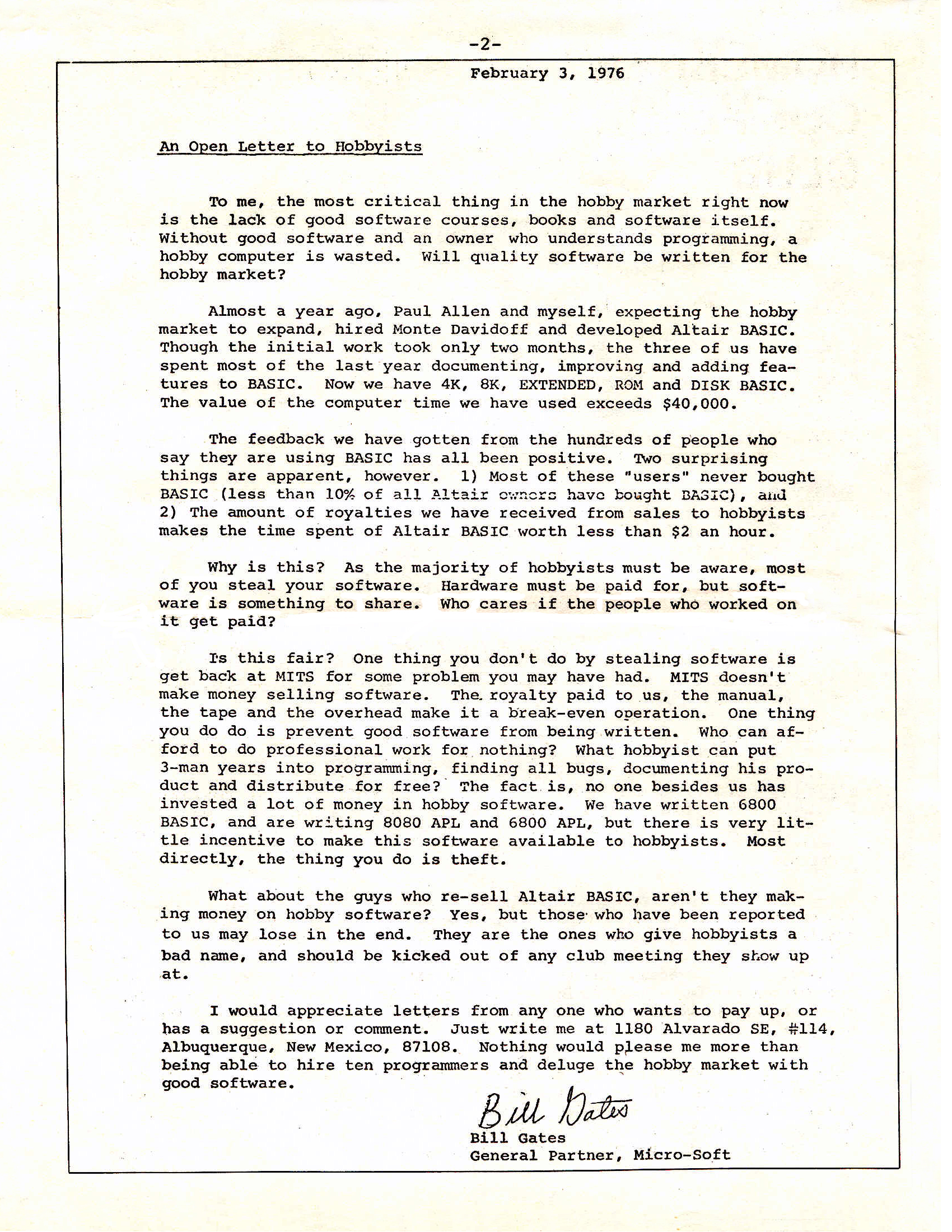
From the 1950s and on through the 1980s, it was common for computer users to have the source code for all programs they used, and the permission and ability to modify it for their own use. Software, including source code, was commonly shared by individuals who used computers, often as public-domain software[24] (FOSS is not the same as public domain software, as public domain software does not contain copyrights[25]). Most companies had a business model based on hardware sales, and provided or bundled software with hardware, free of charge.[26]
By the late 1960s, the prevailing business model around software was changing. A growing and evolving software industry was competing with the hardware manufacturer's bundled software products; rather than funding software development from hardware revenue, these new companies were selling software directly. Leased machines required software support while providing no revenue for software, and some customers who were able to better meet their own needs did not want the costs of software bundled with hardware product costs. In United States vs. IBM, filed January 17, 1969, the government charged that bundled software was anticompetitive.[27] While some software was still being provided without monetary cost and license restriction, there was a growing amount of software that was only at a monetary cost with restricted licensing. In the 1970s and early 1980s, some parts of the software industry began using technical measures (such as distributing only binary copies of computer programs) to prevent computer users from being able to use reverse engineering techniques to study and customize software they had paid for. In 1980, the copyright law was extended to computer programs in the United States[28]—previously, computer programs could be considered ideas, procedures, methods, systems, and processes, which are not copyrightable.[29][30]
Early on, closed-source software was uncommon until the mid-1970s to the 1980s, when IBM implemented in 1983 an "object code only" policy, no longer distributing source code.[31][32][33]
In 1983, Richard Stallman, longtime member of the hacker community at the MIT Artificial Intelligence Laboratory, announced the GNU project, saying that he had become frustrated with the effects of the change in culture of the computer industry and its users.[34] Software development for the GNU operating system began in January 1984, and the Free Software Foundation (FSF) was founded in October 1985. An article outlining the project and its goals was published in March 1985 titled the GNU Manifesto. The manifesto included significant explanation of the GNU philosophy, Free Software Definition and "copyleft" ideas. The FSF takes the position that the fundamental issue Free software addresses is an ethical one—to ensure software users can exercise what it calls "The Four Essential Freedoms".[17]
The Linux kernel, created by Linus Torvalds, was released as freely modifiable source code in 1991. Initially, Linux was not released under either a Free software or an Open-source software license. However, with version 0.12 in February 1992, he relicensed the project under the GNU General Public License.[35]
FreeBSD and NetBSD (both derived from 386BSD) were released as Free software when the USL v. BSDi lawsuit was settled out of court in 1993. OpenBSD forked from NetBSD in 1995. Also in 1995, The Apache HTTP Server, commonly referred to as Apache, was released under the Apache License 1.0.
In 1997, Eric Raymond published The Cathedral and the Bazaar, a reflective analysis of the hacker community and Free software principles. The paper received significant attention in early 1998, and was one factor in motivating Netscape Communications Corporation to release their popular Netscape Communicator Internet suite as Free software. This code is today better known as Mozilla Firefox and Thunderbird.
Netscape's act prompted Raymond and others to look into how to bring the FSF's Free software ideas and perceived benefits to the commercial software industry. They concluded that FSF's social activism was not appealing to companies like Netscape, and looked for a way to rebrand the Free software movement to emphasize the business potential of sharing and collaborating on software source code. The new name they chose was "Open-source", and quickly Bruce Perens, publisher Tim O'Reilly, Linus Torvalds, and others signed on to the rebranding. The Open Source Initiative was founded in February 1998 to encourage the use of the new term and evangelize open-source principles.[36]
While the Open Source Initiative sought to encourage the use of the new term and evangelize the principles it adhered to, commercial software vendors found themselves increasingly threatened by the concept of freely distributed software and universal access to an application's source code. A Microsoft executive publicly stated in 2001 that "Open-source is an intellectual property destroyer. I can't imagine something that could be worse than this for the software business and the intellectual-property business."[37] Companies have indeed faced copyright infringement issues when embracing FOSS.[38] For many years FOSS played a niche role outside of the mainstream of private software development. However the success of FOSS Operating Systems such as Linux, BSD and the companies based on FOSS such as Red Hat, has changed the software industry's attitude and there has been a dramatic shift in the corporate philosophy concerning its development.[39]
Usage
[edit]Benefits over proprietary software
[edit]Personal control, customizability and freedom
[edit]Users of FOSS benefit from the Four Essential Freedoms to make unrestricted use of, and to study, copy, modify, and redistribute such software with or without modification. If they would like to change the functionality of software they can bring about changes to the code and, if they wish, distribute such modified versions of the software or often − depending on the software's decision making model and its other users − even push or request such changes to be made via updates to the original software.[40][41][42][43][44]
Privacy and security
[edit]Manufacturers of proprietary, closed-source software are sometimes pressured to building in backdoors or other covert, undesired features into their software.[45][46][47][48] Instead of having to trust software vendors, users of FOSS can inspect and verify the source code themselves and can put trust on a community of volunteers and users.[44] As proprietary code is typically hidden from public view, only the vendors themselves and hackers may be aware of any vulnerabilities in them[44] while FOSS involves as many people as possible for exposing bugs quickly.[49][50]
Low costs or no costs
[edit]FOSS is often free of charge although donations are often encouraged. This also allows users to better test and compare software.[44]
Quality, collaboration and efficiency
[edit]FOSS allows for better collaboration among various parties and individuals with the goal of developing the most efficient software for its users or use-cases while proprietary software is typically meant to generate profits. Furthermore, in many cases more organizations and individuals contribute to such projects than to proprietary software.[44] It has been shown that technical superiority is typically the primary reason why companies choose open source software.[44]
Drawbacks compared to proprietary software
[edit]Security and user-support
[edit]According to Linus's law the more people who can see and test a set of code, the more likely any flaws will be caught and fixed quickly. However, this does not guarantee a high level of participation. Having a grouping of full-time professionals behind a commercial product can in some cases be superior to FOSS.[44][49][51]
Furthermore, publicized source code might make it easier for hackers to find vulnerabilities in it and write exploits. This however assumes that such malicious hackers are more effective than white hat hackers which responsibly disclose or help fix the vulnerabilities, that no code leaks or exfiltrations occur and that reverse engineering of proprietary code is a hindrance of significance for malicious hackers.[49]
Hardware and software compatibility
[edit]Sometimes, FOSS is not compatible with proprietary hardware or specific software. This is often due to manufacturers obstructing FOSS such as by not disclosing the interfaces or other specifications needed for members of the FOSS movement to write drivers for their hardware - for instance as they wish customers to run only their own proprietary software or as they might benefit from partnerships.[52][53][54][55][56][57][58]
Bugs and missing features
[edit]While FOSS can be superior to proprietary equivalents in terms of software features and stability, in many cases it has more unfixed bugs and missing features when compared to similar commercial software.[59][additional citation(s) needed] This varies per case, and usually depends on the level of interest in a particular project. However, unlike close-sourced software, improvements can be made by anyone who has the motivation, time and skill to do so.[51][additional citation(s) needed]
A common obstacle in FOSS development is the lack of access to some common official standards, due to costly royalties or required non-disclosure agreements (e.g., for the DVD-Video format).[60]
Less guarantee of development
[edit]There is often less certainty of FOSS projects gaining the required resources and participation for continued development than commercial software backed by companies.[61][additional citation(s) needed] However, companies also often abolish projects for being unprofitable, yet large companies may rely on, and hence co-develop, open source software.[50] On the other hand, if the vendor of proprietary software ceases development, there are no alternatives; whereas with FOSS, any user who needs it still has the right, and the source-code, to continue to develop it themself, or pay a 3rd party to do so.
Missing applications
[edit]As the FOSS operating system distributions of Linux has a lower market share of end users there are also fewer applications available.[62][63]
Adoption by governments
[edit] |
| Country | Description |
|---|---|
| Brazil | In 2006, the Brazilian government has simultaneously encouraged the distribution of cheap computers running Linux throughout its poorer communities by subsidizing their purchase with tax breaks.[64] |
| Ecuador | In April 2008,[65] Ecuador passed a similar law, Decree 1014, designed to migrate the public sector to Libre Software.[66] |
| France | In March 2009, the French Gendarmerie Nationale announced it will totally switch to Ubuntu by 2015. The Gendarmerie began its transition to open source software in 2005 when it replaced Microsoft Office with OpenOffice.org across the entire organization.[67] In September 2012, the French Prime Minister laid down a set of action-oriented recommendations about using open-source in the French public administration.[68] These recommendations are published in a document based on the works of an inter-ministerial group of experts.[69] This document promotes some orientations like establishing an actual convergence on open-source stubs, activating a network of expertise about converging stubs, improving the support of open-source software, contributing to selected stubs, following the big communities, spreading alternatives to the main commercial solutions, tracing the use of open-source and its effects, developing the culture of use of the open-source licenses in the developments of public information systems. One of the aim of this experts groups is also to establish lists of recommended open-source software to use in the French public administration.[70] |
| Germany | In the German City of Munich, conversion of 15,000 PCs and laptops from Microsoft Windows-based operating systems to a Debian-based Linux environment called LiMux spanned the ten years of 2003 to 2013. After successful completion of the project, more than 80% of all computers were running Linux.[71] On November 13, 2017, The Register reported that Munich was planning to revert to Windows 10 by 2020.[72] But in 2020, Munich decided to shift back from Microsoft to Linux again.[73] In 2022 Germany launched[74] Open CoDE, its own FOSS repository and forum. |
| India | The Government of Kerala, India, announced its official support for free and open-source software in its State IT Policy of 2001,[75][discuss] which was formulated after the first-ever Free software conference in India, Freedom First!, held in July 2001 in Trivandrum, the capital of Kerala. In 2009, Government of Kerala started the International Centre for Free and Open Source Software (ICFOSS).[76] In March 2015 the Indian government announced a policy on adoption of FOSS.[77][78] |
| Italy | The Italian military is transitioning to LibreOffice and the OpenDocument Format (ODF). LibreItalia Association announced on September 15, 2015, that the Ministry of Defence would over the next year-and-a-half install this suite of office productivity tools on some 150,000 PC workstations, making it Europe's second-largest LibreOffice implementation.[79] By June 23, 2016, 6,000 stations have been migrated.[80] E-learning military platform.[81][needs update] |
| Jordan | In January 2010, the Government of Jordan announced a partnership with Ingres Corporation (now named Actian), an open-source database-management company based in the United States, to promote open-source software use, starting with university systems in Jordan.[82] |
| Malaysia | Malaysia launched the "Malaysian Public Sector Open Source Software Program", saving millions on proprietary software licenses until 2008.[83][84] |
| Peru | In 2005, the Government of Peru voted to adopt open source across all its bodies.[85] The 2002 response to Microsoft's critique is available online. In the preamble to the bill, the Peruvian government stressed that the choice was made to ensure that key pillars of democracy were safeguarded: "The basic principles which inspire the Bill are linked to the basic guarantees of a state of law."[86] |
| Uganda | In September 2014, the Uganda National Information Technology Authority (NITA-U) announced a call for feedback on an Open Source Strategy & Policy[87] at a workshop in conjunction with the ICT Association of Uganda (ICTAU). |
| United States | In February 2009, the White House moved its website to Linux servers using Drupal for content management.[88] In August 2016, the United States government announced a new federal source code policy which mandates that at least 20% of custom source code developed by or for any agency of the federal government be released as open-source software (OSS).[89] In addition, the policy requires that all source code be shared between agencies. The public release is under a three-year pilot program and agencies are obliged to collect data on this pilot to gauge its performance. The overall policy aims to reduce duplication, avoid vendor 'lock-in', and stimulate collaborative development. A new website code |
| Venezuela | In 2004, a law in Venezuela (Decree 3390) went into effect, mandating a two-year transition to open source in all public agencies. As of June 2009[update], the transition was still under way.[91][92][needs update] |
Adoption by supranational unions and international organizations
[edit]European Union
[edit]"We migrated key functions from Windows to Linux because we needed an operating system that was stable and reliable -- one that would give us in-house control. So if we needed to patch, adjust, or adapt, we could."
In 2017, the European Commission stated that "EU institutions should become open source software users themselves, even more than they already are" and listed open source software as one of the nine key drivers of innovation, together with big data, mobility, cloud computing and the internet of things.[95]
In 2020, the European Commission adopted its Open Source Strategy 2020-2023,[96] including encouraging sharing and reuse of software and publishing Commission's source code as key objectives. Among concrete actions there is also to set up an Open Source Programme Office in 2020[97] and in 2022 it launched its own FOSS repository https://code.europa.eu/.[98]
In 2021, the Commission Decision on the open source licensing and reuse of Commission software (2021/C 495 I/01)[99] was adopted, under which, as a general principle, the European Commission may release software under EUPL or another FOSS license, if more appropriate. There are exceptions though.
In May 2022,[100] the Expert group on the Interoperability of European Public Services came published 27 recommendations to strengthen the interoperability of public administrations across the EU. These recommendations are to be taken into account later in the same year in Commission's proposal of the "Interoperable Europe Act".
Production
[edit] | This section should include a summary of, or be summarized in, another article. (July 2017) |
Issues and incidents
[edit]GPLv3 controversy
[edit] | This section provides insufficient context for those unfamiliar with the subject. (February 2017) |
While copyright is the primary legal mechanism that FOSS authors use to ensure license compliance for their software, other mechanisms such as legislation, patents, and trademarks have implications as well. In response to legal issues with patents and the Digital Millennium Copyright Act (DMCA), the Free Software Foundation released version 3 of its GNU General Public License (GNU GPLv3) in 2007 that explicitly addressed the DMCA and patent rights.
After the development of the GNU GPLv3 in 2007, the FSF (as the copyright holder of many pieces of the GNU system) updated many[citation needed] of the GNU programs' licenses from GPLv2 to GPLv3. On the other hand, the adoption of the new GPL version was heavily discussed in the FOSS ecosystem,[101] several projects decided against upgrading to GPLv3. For instance the Linux kernel,[102][103] the BusyBox[104][105] project, AdvFS,[106] Blender,[107] and the VLC media player decided against adopting the GPLv3.[108]
Apple, a user of GCC and a heavy user of both DRM and patents, switched the compiler in its Xcode IDE from GCC to Clang, which is another FOSS compiler[109] but is under a permissive license.[110] LWN speculated that Apple was motivated partly by a desire to avoid GPLv3.[109] The Samba project also switched to GPLv3, so Apple replaced Samba in their software suite by a closed-source, proprietary software alternative.[111]
Skewed prioritization, ineffectiveness and egoism of developers
[edit]Leemhuis criticizes the prioritization of skilled developers who − instead of fixing issues in already popular open-source applications and desktop environments − create new, mostly redundant software to gain fame and fortune.[112]
He also criticizes notebook manufacturers for optimizing their own products only privately or creating workarounds instead of helping fix the actual causes of the many issues with Linux on notebooks such as the unnecessary power consumption.[112]
Commercial ownership of open-source software
[edit]Mergers have affected major open-source software. Sun Microsystems (Sun) acquired MySQL AB, owner of the popular open-source MySQL database, in 2008.[113]
Oracle in turn purchased Sun in January 2010, acquiring their copyrights, patents, and trademarks. Thus, Oracle became the owner of both the most popular proprietary database and the most popular open-source database. Oracle's attempts to commercialize the open-source MySQL database have raised concerns in the FOSS community.[114] Partly in response to uncertainty about the future of MySQL, the FOSS community forked the project into new database systems outside of Oracle's control. These include MariaDB, Percona, and Drizzle.[115] All of these have distinct names; they are distinct projects and cannot use the trademarked name MySQL.[116]
Legal cases
[edit]Oracle v. Google
[edit]In August 2010, Oracle sued Google, claiming that its use of Java in Android infringed on Oracle's copyrights and patents. In May 2012, the trial judge determined that Google did not infringe on Oracle's patents and ruled that the structure of the Java APIs used by Google was not copyrightable. The jury found that Google infringed a small number of copied files, but the parties stipulated that Google would pay no damages.[117] Oracle appealed to the Federal Circuit, and Google filed a cross-appeal on the literal copying claim.[118]
Economics
[edit]By defying ownership regulations in the construction and use of information—a key area of contemporary growth—the Free/Open Source Software (FOSS) movement counters neoliberalism and privatization in general.[119][120]
By realizing the historical potential of an "economy of abundance" for the new digital world, FOSS may lay down a plan for political resistance or show the way towards a potential transformation of capitalism.[120]
According to Yochai Benkler, Jack N. and Lillian R. Berkman Professor for Entrepreneurial Legal Studies at Harvard Law School, free software is the most visible part of a new economy of commons-based peer production of information, knowledge, and culture. As examples, he cites a variety of FOSS projects, including both free software and open-source.[121]
See also
[edit]
Notes
[edit]- ^ FOSS is an inclusive term that covers both free software and open-source software,[1] which despite describing similar development models, have differing cultures and philosophical backgrounds.[2] Free refers to the users' freedom to copy and re-use the software. The Free Software Foundation, an organization that advocates the free software model, suggests that to understand the concept, one should "think of free as in free speech, not as in free beer". (See "The Free Software Definition". GNU. Retrieved 4 February 2010.) Free software focuses on the fundamental freedoms it gives to users, whereas open source software focuses on the perceived strengths of its peer-to-peer development model.[3]
References
[edit]- ^ a b c Sources describing free and open-source software as an umbrella term encompassing both free software and open source software: [4][5][6][7][8]
- ^ Feller 2005, pp. 89, 362.
- ^ Feller 2005, pp. 101–106, 110–111.
- ^ a b Fortunato, Laura; Galassi, Mark (17 May 2021). "The case for free and open source software in research and scholarship". Philosophical Transactions of the Royal Society A. 379 (2197). Royal Society: 7. doi:10.1098/rsta.2020.0079. PMID 33775148.
- ^ Crowston, Kevin; Wei, Kangning; Howison, James; Wiggins, Andrea (5 March 2008). "Free/Libre open-source software development: What we know and what we do not know". ACM Computing Surveys. 44 (2). Association for Computing Machinery: 7:1–7:35. doi:10.1145/2089125.2089127. ISSN 0360-0300. Retrieved 15 December 2024.
FLOSS is an umbrella term covering a diversity of kinds of software and approaches to development [...] The distinction between free software and open-source software is sometimes controversial, and there are important differences between these two development communities [Kelty 2008]. However, our focus in this article is research on their development processes, which are acknowledged by participants to be largely similar [...], hence our use of this umbrella term.
- ^ a b Greenleaf, Graham; Lindsay, David (7 June 2018). "Voluntary Licensing Creating Public Rights". Public Rights: Copyright's Public Domains. Cambridge University Press. pp. 483, 485. doi:10.1017/9781316460214.017. ISBN 978-1-107-13406-5. Retrieved 15 December 2024.
The two predominant strains of FOSS licences are those that comply with the Open Source Initiative's 'Open Source Definition', and those that comply with the Free Software Foundation's 'Free Software Definition' [...] The list of 'open source' licences kept by the OSI, and of 'free' software licences kept by the FSF, are together called FOSS (free and open-source software) licences. All FOSS licences, because they meet the requirements of either OSI or FSF, should also meet our criteria for neutral voluntary licences and thus software licensed under them is part of the public domain.
- ^ Mitchell, Iain G. (2009). "Foreword and statement of purpose: an introduction to IFOSS L. Rev". International Free and Open Source Software Law Review. 1 (1): 5. ISSN 2666-8106. Retrieved 15 December 2024.
The Review does not endorse any one licensing model, focus or emphasis, but rather seeks, in an academically rigorous and objective manner, to increase the knowledge and understanding about the legal mechanisms used by all forms of Free and Open Source Software licences. It uses the term Free and Open Source Software to cover both Free Software and Open Source Software. FOSS is a term that can be used without particular bias towards either political approach.
- ^ Maracke, Catharina (2019). "Free and Open Source Software and FRAND-based patent licenses". Journal of World Intellectual Property. 22 (3–4). Wiley: 78–102. doi:10.1111/jwip.12114. ISSN 1747-1796. Retrieved 15 December 2024.
The term "Free and Open Source Software" includes both, Free Software as defined by the Free Software Foundation and Open Source Software as defined by the Open Source Initiative. In the following article, the term Free and Open Source Software (FOSS) will be used.
- ^ Hatlestad 2005.
- ^ Claburn 2007.
- ^ Feller 2005, p. xvii.
- ^ Stallman, Richard. "FLOSS and FOSS". www.gnu.org. Archived from the original on 2018-09-16. Retrieved 2018-09-15.
- ^ "GNU". 20 September 2011. Archived from the original on 14 October 2013. Retrieved 23 October 2011.
- ^ Maracke, Catharina (2019-02-25). "Free and Open Source Software and FRAND-based patent licenses: How to mediate between Standard Essential Patent and Free and Open Source Software". The Journal of World Intellectual Property. 22 (3–4): 78–102. doi:10.1111/jwip.12114. ISSN 1422-2213. S2CID 159111696.
- ^ "GNU's Bulletin, Volume 1 Number 1, page 8". GNU. Archived from the original on 2015-06-23. Retrieved 2015-06-20.
- ^ "The Free Software Definition – Translations of this page". GNU. Archived from the original on 2013-10-14. Retrieved 2014-04-18.
- ^ a b c Free Software Foundation (27 December 2016). "What is free software? The Free Software Definition". The GNU Project -- GNU. Archived from the original on 14 October 2013. Retrieved 15 September 2018.
- ^ "The Open Source Definition by Bruce Perens". 1999-03-29. Archived from the original on 2014-09-15. Retrieved 2016-01-20., Open Sources: Voices from the Open Source Revolution, January 1999, ISBN 1-56592-582-3
- ^ "The Open Source Definition". 7 July 2006. Archived from the original on 2013-10-15. Retrieved 2015-06-20., The Open Source Definition according to the Open Source Initiative
- ^ "Slashdot.org". News.slashdot.org. 16 February 2009. Archived from the original on 17 July 2013. Retrieved 23 October 2011.
- ^ "It's Time to Talk About Free Software Again". Archived from the original on 2014-07-16. Retrieved 2015-02-18.
- ^ "Bruce Perens - State of Open Source Message: A New Decade For Open Source". Perens.com. 1998-02-09. Archived from the original on 2013-11-04. Retrieved 2009-07-15.
- ^ Barr, Joe (January 13, 2003). "Meet the Perens". LinuxWorld Magazine. Archived from the original on November 6, 2013. Retrieved February 18, 2017.
- ^ Shea, Tom (1983-06-23). "Free software - Free software is a junkyard of software spare parts". InfoWorld. Archived from the original on 2024-05-15. Retrieved 2016-02-10.
- ^ Corbly, James Edward (2014-09-25). "The Free Software Alternative: Freeware, Open Source Software, and Libraries". Information Technology and Libraries. 33 (3): 65. doi:10.6017/ital.v33i3.5105. ISSN 2163-5226. Archived from the original on 2021-05-01. Retrieved 2021-04-28.
- ^ Gates, Bill (February 3, 1976), An Open Letter to Hobbyists, archived from the original on April 16, 2018, retrieved September 17, 2017
- ^ Fisher, McKie & Mancke 1983.
- ^ Computer Software 1980 Copyright Act, Pub. L. No. 96-517, 94 Stat. 3015, 3028 Archived 2013-03-30 at the Wayback Machine.
- ^ "Copyright Basics". www.lib.purdue.edu. Archived from the original on 2015-06-30. Retrieved 2015-04-01.
- ^ Weber 2009.
- ^ Object code only: is IBM playing fair? Archived 2021-04-29 at the Wayback Machine IBM's OCO policy protects its own assets but may threaten customers investment on Computerworld - 8 Febr. 1988
- ^ Firm sidestep IBM policy by banning software changes Archived 2021-08-18 at the Wayback Machine on Computerworld (18 March 1985)
- ^ Gallant, John (1985-03-18). "IBM policy draws fire – Users say source code rules hamper change". Computerworld. Archived from the original on 2021-08-18. Retrieved 2015-12-27.
While IBM's policy of withholding source code for selected software products has already marked its second anniversary, users are only now beginning to cope with the impact of that decision. But whether or not the advent of object-code-only products has affected their day-to-day DP operations, some users remain angry about IBM's decision. Announced in February 1983, IBM's object-code-only policy has been applied to a growing list of Big Blue system software products
- ^ William 2002.
- ^ "Release notes for Linux kernel 0.12". Kernel.org. Archived from the original on 2007-08-19. Retrieved 2016-07-25.
- ^ "History of the OSI". Opensource.org. 19 September 2006. Archived from the original on 2012-07-26. Retrieved 2014-02-02.
- ^ Charny 2001.
- ^ "Issues when embracing FOSS". sourcecodecontrol.co. 31 December 2016. Archived from the original on 17 December 2019. Retrieved 14 September 2023.
- ^ Miller, Voas & Costello 2010, pp. 14–16.
- ^ Kirk, St Amant (2007). Handbook of Research on Open Source Software: Technological, Economic, and Social Perspectives: Technological, Economic, and Social Perspectives. Idea Group Inc (IGI). ISBN 9781591408925. Retrieved 4 July 2017.
- ^ Jacquart, Rene (2008). Building the Information Society: IFIP 18th World Computer Congress Topical Sessions 22–27 August 2004 Toulouse, France. Springer. ISBN 9781402081576. Retrieved 4 July 2017.
- ^ Lopez-Tarruella, Aurelio (2012). Google and the Law: Empirical Approaches to Legal Aspects of Knowledge-Economy Business Models. Springer Science & Business Media. ISBN 9789067048453. Archived from the original on 30 December 2019. Retrieved 4 July 2017.
- ^ "What is free software?". www.gnu.org. Archived from the original on 15 November 2023. Retrieved 4 July 2017.
- ^ a b c d e f g "10 Reasons Open Source Is Good for Business". PCWorld. 2010-11-05. Archived from the original on 22 June 2017. Retrieved 4 July 2017.
- ^ "Microsoft Back Doors". www.gnu.org. Archived from the original on 5 December 2019. Retrieved 4 July 2017.
- ^ "Microsoft Accidentally Leaks Key to Windows Backdoor - Schneier on Security". www.schneier.com. 15 August 2016. Archived from the original on 25 August 2017. Retrieved 4 July 2017.
- ^ Thomson, Iain. "Snowden leak: Microsoft added Outlook.com backdoor for Feds". The Register. Archived from the original on 25 August 2017. Retrieved 4 July 2017.
- ^ Strandburg, Katherine J.; Raicu, Daniela Stan (2005). Privacy and Technologies of Identity: A Cross-Disciplinary Conversation. Springer Science & Business Media. ISBN 9780387260501. Retrieved 4 July 2017.
- ^ a b c "Is Open Source Software More Secure?" (PDF). Archived (PDF) from the original on 24 July 2017. Retrieved 4 July 2017.
- ^ a b "Open source software is more secure than you think". SC Media US. 8 October 2013. Archived from the original on 25 August 2017. Retrieved 12 July 2017.
- ^ a b "Too Big to Fail Open-Source Software Needs Hacker Help". Observer. 4 November 2016. Archived from the original on 22 July 2017. Retrieved 12 July 2017.
- ^ Fogel, Karl (2005). Producing Open Source Software: How to Run a Successful Free Software Project. O'Reilly Media, Inc. ISBN 9780596552992. Retrieved 4 July 2017.
- ^ Sery, Paul G. (2007). Ubuntu Linux For Dummies. John Wiley & Sons. ISBN 9780470125052. Retrieved 4 July 2017.
- ^ "Linux Today - KERNEL-DEV: UDI and Free Software by Richard Stallman". www.linuxtoday.com. Archived from the original on 25 August 2017. Retrieved 4 July 2017.
- ^ Vaughan-Nichols, Steven J. "Microsoft tries to block Linux off Windows 8 PCs". ZDNet. Archived from the original on 14 July 2017. Retrieved 12 July 2017.
- ^ Kingsley-Hughes, Adrian. "Lenovo reportedly blocking Linux on Windows 10 Signature Edition PCs (updated)". ZDNet. Archived from the original on 14 July 2017. Retrieved 12 July 2017.
- ^ "Linux Today - How Microsoft Changes the Prices at OEMs to Block GNU/Linux Sales". www.linuxtoday.com. Archived from the original on 25 August 2017. Retrieved 12 July 2017.
- ^ "Microsoft 'killed Dell Linux' – States". The Register. Archived from the original on 17 July 2017. Retrieved 12 July 2017.
- ^ Hill, Benjamin Mako. "When Free Software Isn't (Practically) Superior". Archived from the original on 13 July 2017. Retrieved 11 July 2017.
- ^ DVD FLLC (2009) How To Obtain DVD Format/Logo License (2005–2009) Archived 2010-03-18 at the Wayback Machine
- ^ Arthur, Tatnall (2007). Encyclopedia of Portal Technologies and Applications. Idea Group Inc (IGI). ISBN 9781591409908. Retrieved 11 July 2017.
- ^ Baldauf, Kenneth; Stair, Ralph (2008). Succeeding with Technology. Cengage Learning. ISBN 978-1423925293. Retrieved 12 July 2017.
- ^ Mastering Information Technology for CXC CSEC CAPE. Dennis Adonis. Retrieved 12 July 2017.
- ^ Casson & Ryan 2006.
- ^ "[News] Ecuador Ahead of the World with Democracy of Knowledge". Archived from the original on 2014-12-18. Retrieved 2022-02-15.
- ^ (in Spanish) Estebanmendieta.com Archived 2014-06-28 at the Wayback Machine, Decree 1014
- ^ Paul 2009.
- ^ [1] Archived 2017-08-27 at the Wayback Machine PM Bulletin (Circular letter) #5608-SG of September 19th, 2012
- ^ [2] Archived 2018-09-10 at the Wayback Machine Use of the open-source software in the administration
- ^ [3] Archived 2017-08-27 at the Wayback Machine Interministerial base of open-source applications
- ^ "Landeshauptstadt München - Aktuelle Zahlen" (in German). Muenchen.de. Archived from the original on 2014-08-27. Retrieved 2014-07-28.
- ^ "Munich council: To hell with Linux, we're going full Windows in 2020". Archived from the original on 2017-12-01. Retrieved 2017-12-04.
- ^ "Linux not Windows: Why Munich is shifting back from Microsoft to open source – again". Archived from the original on 2021-04-09. Retrieved 2021-04-17.
- ^ Riordan, Ciarán O. (2022-09-20). "Germany launches opencode.de | Joinup". joinup.ec.europa.eu. Archived from the original on 2022-10-24. Retrieved 2022-10-24.
- ^ ""Role of Open or Free Software", Section 15, page 20, of the State IT Policy (2001) of the Government of Kerala, copy available at the UN Public Administration Network (UNPAN) site" (PDF). Archived from the original (PDF) on 2013-11-03. Retrieved 2014-02-02.
- ^ "Kerala IT | Welcome". www.keralait.org. Archived from the original on 2019-10-26. Retrieved 2019-09-18.
- ^ Alawadhi 2015.
- ^ "Policy on Adoption of Open Source Software for Government of India" (PDF). Archived (PDF) from the original on 2015-08-15. Retrieved 2022-09-14.
- ^ "Italian military to switch to... | Joinup". joinup.ec.europa.eu. 15 September 2015. Archived from the original on 2019-09-21. Retrieved 2019-09-18.
- ^ "Un anno di LibreDifesa". LibreItalia (in Italian). 23 June 2016. Archived from the original on 9 October 2017. Retrieved 10 May 2018.
- ^ "Difel: LibreDifesa". el-stelmilit.difesa.it. Archived from the original on 2017-10-09. Retrieved 2017-10-09.
- ^ "Jordan Information Ministry signs deal on open source - Government - News & Features". Edge Middle East. 16 January 2010. Archived from the original on 2012-08-04. Retrieved 2012-04-23.
- ^ "OSCC.org". Archived from the original on 2011-10-27. Retrieved 23 October 2011.
- ^ "OSCC.org". Archived from the original on 2011-10-05. Retrieved 23 October 2011.
- ^ Clarke 2005.
- ^ National Advisory Council on Innovation Open Software Working Group (July 2004). "Free/Libre & Open Source Software and Open Standards in South Africa" (PDF). Archived (PDF) from the original on 22 December 2014. Retrieved 31 May 2008.
- ^ "Open Source Strategy & Policy". Archived from the original on September 27, 2014. Retrieved February 15, 2022.
- ^ Vaughan-Nichols 2009.
- ^ a b Scott, Tony; Rung, Anne E (8 August 2016). Federal Source Code Policy: Achieving Efficiency, Transparency, and Innovation through Reusable and Open Source Software — Memorandum for the Heads of Departments and Agencies — M-16-21 (PDF). Washington DC, US: Office of Budget and Management, Executive Office of the President. Archived (PDF) from the original on 21 January 2017. Retrieved 2016-09-14. Also available as HTML at: sourcecode
.cio .gov - ^ New, William (22 August 2016). "New US Government Source Code Policy Could Provide Model For Europe". Intellectual Property Watch. Geneva, Switzerland. Archived from the original on 28 August 2016. Retrieved 2016-09-14.
- ^ "Venezuela Open Source". Archived from the original on February 16, 2008. Retrieved February 15, 2022.
- ^ Chavez, Hugo F. (December 2004). "Publicado en la Gaceta oficial No 38.095 de fecha 28/ 12/ 2004". Archived from the original on 9 August 2011. Retrieved 23 October 2011.
- ^ Gunter 2013.
- ^ Bridgewater 2013.
- ^ Directorate General for Communications Networks, Content and Technology (2017). The economic and social impact of software & services on competitiveness and innovation. ISBN 978-92-79-66177-8. Archived from the original on 2017-05-06. Retrieved 2017-03-27.
- ^ "Open source software strategy". European Commission - European Commission. Archived from the original on 2022-10-24. Retrieved 2022-10-24.
- ^ "EC Open Source Programme Office | Joinup". joinup.ec.europa.eu. Archived from the original on 2022-10-24. Retrieved 2022-10-24.
- ^ Riordan, Ciarán O. (2022-09-19). "EC's code.europa.eu launches | Joinup". joinup.ec.europa.eu. Archived from the original on 2022-10-24. Retrieved 2022-10-24.
- ^ "COMMISSION DECISION of 8 December 2021 on the open source licensing and reuse of Commission software (2021/C 495 I/01)". Official Journal of the European Union. 2021-12-08. Archived from the original on 2022-10-24. Retrieved 2022-10-24.
- ^ GAUKEMA, Laurens (2022-05-13). "Official expert recommendations for a new Interoperability Policy | Joinup". joinup.ec.europa.eu. Archived from the original on 2022-10-24. Retrieved 2022-10-24.
- ^ Mark (2008-05-08). "The Curse of Open Source License Proliferation". socializedsoftware.com. Archived from the original on 2015-12-08. Retrieved 2015-11-30.
Currently the decision to move from GPL v2 to GPL v3 is being hotly debated by many open source projects. According to Palamida, a provider of IP compliance software, there have been roughly 2489 open source projects that have moved from GPL v2 to later versions.
- ^ Torvalds, Linus. "COPYING". kernel.org. Archived from the original on 17 December 2015. Retrieved 13 August 2013.
Also note that the only valid version of the GPL as far as the kernel is concerned is _this_ particular version of the license (ie v2, not v2.2 or v3.x or whatever), unless explicitly otherwise stated.
- ^ Kerner, Sean Michael (2008-01-08). "Torvalds Still Keen On GPLv2". internetnews.com. Archived from the original on 2015-02-12. Retrieved 2015-02-12.
"In some ways, Linux was the project that really made the split clear between what the FSF is pushing which is very different from what open source and Linux has always been about, which is more of a technical superiority instead of a -- this religious belief in freedom," Torvalds told Zemlin. "So, the GPL Version 3 reflects the FSF's goals and the GPL Version 2 pretty closely matches what I think a license should do and so right now, Version 2 is where the kernel is."
- ^ corbet (2006-10-01). "Busy busy busybox". lwn.net. Archived from the original on 2016-01-07. Retrieved 2015-11-21.
Since BusyBox can be found in so many embedded systems, it finds itself at the core of the GPLv3 anti-DRM debate. [...]The real outcomes, however, are this: BusyBox will be GPLv2 only starting with the next release. It is generally accepted that stripping out the "or any later version" is legally defensible, and that the merging of other GPLv2-only code will force that issue in any case
- ^ Landley, Rob (2006-09-09). "Re: Move GPLv2 vs v3 fun..." lwn.net. Archived from the original on 2016-01-07. Retrieved 2015-11-21.
Don't invent a straw man argument please. I consider licensing BusyBox under GPLv3 to be useless, unnecessary, overcomplicated, and confusing, and in addition to that it has actual downsides. 1) Useless: We're never dropping GPLv2.
- ^ "HP Press Release: HP Contributes Source Code to Open Source Community to Advance Adoption of Linux". www.hp.com. Archived from the original on 2011-12-27. Retrieved 2016-01-14.
- ^ Prokoudine, Alexandre (26 January 2012). "What's up with DWG adoption in free software?". libregraphicsworld.org. Archived from the original on 2016-11-09. Retrieved 2015-12-05.
[Blender's Toni Roosendaal:] "Blender is also still 'GPLv2 or later'. For the time being we stick to that, moving to GPL 3 has no evident benefits I know of."
- ^ Denis-Courmont, Rémi. "VLC media player to remain under GNU GPL version 2". videolan.org. Archived from the original on 2015-11-22. Retrieved 2015-11-21.
In 2001, VLC was released under the OSI-approved GNU General Public version 2, with the commonly-offered option to use "any later version" thereof (though there was not any such later version at the time). Following the release by the Free Software Foundation (FSF) of the new version 3 of its GNU General Public License (GPL) on the 29th of June 2007, contributors to the VLC media player, and other software projects hosted at videolan.org, debated the possibility of updating the licensing terms for future version of the VLC media player and other hosted projects, to version 3 of the GPL. [...] There is strong concern that these new additional requirements might not match the industrial and economic reality of our time, especially in the market of consumer electronics. It is our belief that changing our licensing terms to GPL version 3 would currently not be in the best interest of our community as a whole. Consequently, we plan to keep distributing future versions of VLC media player under the terms of the GPL version 2.
- ^ a b Brockmeier 2010.
- ^ "LLVM Developer Policy". LLVM. Archived from the original on November 13, 2012. Retrieved November 19, 2012.
- ^ Holwerda 2011.
- ^ a b Leemhuis, Thorsten (7 July 2017). "Kommentar: Linux scheitert an Egozentrik" (in German). heise online. Archived from the original on 7 July 2017. Retrieved 12 July 2017.
- ^ "Sun to Acquire MySQL". MySQL AB. Archived from the original on 2011-07-18. Retrieved 2008-01-16.
- ^ Thomson 2011.
- ^ Samson 2011.
- ^ Nelson 2009.
- ^ Niccolai 2012.
- ^ Jones 2012.
- ^ Berry, David M. (2008). Copy, Rip Burn: The Politics of Copyleft and Open Source (1 ed.). London: Pluto Press. p. 272. ISBN 978-0745324142. Archived from the original on 2021-07-09. Retrieved 2021-03-25.
- ^ a b Georgopoulou, Panayiota (2009). "The free/open source software movement Resistance or change?". Civitas - Revista de Ciências Sociais. 9 (1). doi:10.15448/1984-7289.2009.1.5569. ISSN 1519-6089. Archived from the original on 13 July 2017. Retrieved 11 July 2017.
- ^ Benkler 2003.
Sources
[edit]- Alawadhi, Neha (March 30, 2015). "Government announces policy on open source software". The Times of India. Archived from the original on 2016-01-10. Retrieved 2015-06-27.
- Benkler, Yochai (April 2003). "Freedom in the Commons: Towards a Political Economy of Information". Duke Law Journal. 52 (6). Archived from the original on 2011-03-06. Retrieved 2014-01-08.
- Bridgewater, Adrian (May 13, 2013). "International Space Station adopts Debian Linux, drops Windows & Red Hat into airlock". Computer Weekly. Archived from the original on 2015-06-24. Retrieved 2015-06-27.
- Brockmeier, Joe (September 15, 2010). "Apple's Selective Contributions to GCC". LWN.net. Archived from the original on 2020-01-01. Retrieved 2015-06-22.
- Casson, Tony; Ryan, Patrick S. (May 1, 2006). "Open Standards, Open Source Adoption in the Public Sector, and Their Relationship to Microsoft's Market Dominance". In Bolin, Sherrie (ed.). Standards Edge: Unifier or Divider?. Sheridan Books. p. 87. ISBN 978-0974864853. SSRN 1656616.
- Charny, B. (May 3, 2001). "Microsoft Raps Open-Source Approach". CNET News. Archived from the original on July 29, 2012. Retrieved February 15, 2022.
- Claburn, Thomas (January 17, 2007). "Study Finds Open Source Benefits Business". InformationWeek. CMP Media, LLC. Archived from the original on 2007-12-02. Retrieved 2007-11-25.
- Clarke, Gavin (September 29, 2005). "Peru's parliament approves pro-open source bill". The Register. Archived from the original on 2011-11-09. Retrieved 2015-06-27.
- ElBoghdady, Dina; Tsukayama, Hayley (September 29, 2011). "Facebook tracking prompts calls for FTC investigation". The Washington Post. Archived from the original on 2015-06-30. Retrieved 2015-06-27.
- Feller, Joseph, ed. (2005). Perspectives on Free and Open Source Software. MIT Press. ISBN 978-0262062466.
- Fisher, Franklin M.; McKie, James W.; Mancke, Richard B. (1983). IBM and the U.S. Data Processing Industry: An Economic History. Praeger. ISBN 978-0-03-063059-0.
- Gunter, Joel (May 10, 2013). "International Space Station to boldly go with Linux over Windows". The Telegraph. Archived from the original on 2022-01-11. Retrieved 2015-06-27.
- Hatlestad, Luc (August 9, 2005). "LinuxWorld Showcases Open-Source Growth, Expansion". InformationWeek. CMP Media, LLC. Archived from the original on 2007-12-02. Retrieved 2007-11-25.
- Holwerda, Thom (March 26, 2011). "Apple Ditches SAMBA in Favour of Homegrown Replacement". OS News. Archived from the original on 2012-01-14. Retrieved 2015-06-22.
- Jones, Pamela (October 5, 2012). "Oracle and Google File Appeals". Groklaw. Archived from the original on 2012-12-01. Retrieved 2015-06-22.
- Miller, K. W.; Voas, J.; Costello, T. (2010). "Free and open source software". IT Professional. 12 (6): 14–16. doi:10.1109/MITP.2010.147. S2CID 24463978.
- Nelson, Russell (December 13, 2009). "Open Source, MySQL, and trademarks". Opensource.org. Open Source Initiative. Archived from the original on 2011-10-21. Retrieved 2015-06-22.
- Niccolai, James (June 20, 2012). "Oracle agrees to 'zero' damages in Google lawsuit, eyes appeal". Computerworld. Archived from the original on 2012-11-17. Retrieved 2015-06-22.
- Paul, Ryan (March 11, 2009). "French police: we saved millions of euros by adopting Ubuntu". Ars Technica. Archived from the original on 2009-03-13. Retrieved 2015-06-27.
- Perens, Bruce (1999). "The Open Source Definition". Open Sources: Voices from the Open Source Revolution. O'Reilly Media. ISBN 978-1-56592-582-3.
- Samson, Ted (March 17, 2011). "Non-Oracle MySQL fork deemed ready for prime time". InfoWorld. Archived from the original on 2015-06-23. Retrieved 2015-06-22.
- Stallman, Richard (n.d.). "Why Open Source misses the point of Free Software". GNU. Free Software Foundation. Archived from the original on 2011-08-04. Retrieved 2015-06-27.
- Thomson, Iain (September 16, 2011). "Oracle offers commercial extensions to MySQL". The Register. Archived from the original on 2019-10-26. Retrieved 2015-06-22.
- Vaughan-Nichols, Steven J. (October 29, 2009). "Obama Invites Open Source into the White House". PCWorld. Archived from the original on 2009-10-31. Retrieved 2015-06-27.
- Vaughan-Nichols, Steven (January 8, 2011). "No GPL Apps for Apple's App Store". ZDNet. Archived from the original on 2014-11-15. Retrieved 2015-06-27.
- Weber, Steve (2009). The Success of Open Source. Harvard University Press. p. 4. ISBN 9780674044999.
- William, Sam (2002). Free as in Freedom: Richard Stallman's Crusade for Free Software. O'Reilly Media. ISBN 978-0596002879.
Further reading
[edit]- Barr, Joe (1998). "Why "Free Software" is better than "Open Source"". Free Software Foundation. Archived from the original on 2007-07-03. Retrieved 2007-11-25.
- Berry, David (2008). Copy, Rip, Burn: The Politics of Copyleft and Open Source (1 ed.). London: Pluto Press. p. 272. ISBN 978-0745324142. Archived from the original on 2021-07-09. Retrieved 2021-03-25.
- Salus, Peter H. (March 28, 2005). "A History of Free and Open Source". Groklaw. Archived from the original on 2015-09-24. Retrieved 2015-06-22.
- Vetter, G. (2009). "Commercial Free and Open Source Software: Knowledge Production, Hybrid Appropriability, and Patents". Fordham Law Review. 77 (5): 2087–2141. Archived from the original on 2012-04-24. Retrieved 2011-10-23.
- Wheeler, David A. (May 8, 2014). "Why Open Source Software / Free Software (OSS/FS, FLOSS, or FOSS)? Look at the Numbers!". DWheeler.com. Archived from the original on 2015-06-21. Retrieved 2015-06-22.

| General | |||
|---|---|---|---|
| Software packages | |||
| Community | |||
| Organisations | |||
| Licenses |
| ||
| Challenges | |||
| Related topics | |||