Jinnah Antarctic Station
 | This article needs additional citations for verification. (August 2015) |
Jinnah Antarctic Station
جناح جنوبی قطب اسٹیشن | |
|---|---|
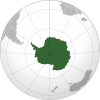
  Jinnah Antarctic Station Location within Antarctica | |
| Coordinates: 70°24′S 25°45′E / 70.4°S 25.75°E | |
| Country |  Pakistan Pakistan |
| Location in Antarctica | Sør Rondane Mountains, Queen Maud Land (claimed by Norway) |
| Administration | Pakistan Antarctic Programme (via National Institute of Oceanography) |
| Established | 25 January 1991[1] (33 years, 3 months ago) |
| Named for | Muhammad Ali Jinnah |
| Time zone | UTC+3:00 (SYOT) |
| Type | Seasonal |
| Period | Summer |
| Status | No Data |
| Activities | Oceanography |
| Website | National Institute of Oceanography |
The Jinnah Antarctic Station is an Antarctic research station operated by the Pakistan Antarctic Programme.[2][3] Located in East Antarctica, it lies in the vicinity of the Sør Rondane Mountains in Queen Maud Land, and is named after Muhammad Ali Jinnah.
History[edit]
In 1991, shortly after Pakistan became a member of the Scientific Committee on Antarctic Research,[4] the Pakistan Antarctic Programme was launched by the National Institute of Oceanography under the Ministry of Science and Technology; it was led by the Pakistan Navy, which provided logistical support for the research effort as well as for the establishment of the Jinnah Antarctic Station. The first expedition landed on 15 January,[5] before they formally established the summer research station (Jinnah I) on 25 January 1991.[1]
The station was used by the second Pakistani Antarctic expedition in 1992-1993, when they established a new field station, Jinnah II, at 70°50′S 25°10′E / 70.833°S 25.167°E. During this expedition they also established a new automatic weather station, the Iqbal Observatory, 125 kilometres south of the station at 71°27′36″S 25°17′24″E / 71.46000°S 25.29000°E.[6][7]
Pakistan currently maintains one summertime research station and the Iqbal weather observatory in Queen Maud Land, a Norwegian-claimed Antarctic territory.[8]
Facilities[edit]
 | This section may require cleanup to meet Wikipedia's quality standards. The specific problem is: excess weight. (July 2022) |
The facilities were quickly expanded by the National Institute of Oceanography. Government advisors belonging to the Ministry of Science and Technology frequently visited the area. Pakistani naval engineers and scientists oversaw the development of the base. In 2001, the data operational system was linked to the Badr-B satellite, beginning regular transmission of digital imagery of the region to NIO headquarters in Karachi. In 2002, SUPARCO scientists visited the base, where they set up and installed an advanced, supercomputer-equipped facility, run by the NIO and SUPARCO's scientists. In 2005, Pakistan Air Force engineers and scientists built a small airstrip, and a control room to monitor flights to and from Pakistan. In 2010, Pakistan's government approved a plan to expand the JAS facility into a permanent operational base.[9][failed verification][7][10]
Foreign cooperation[edit]
United States[edit]
Communication gears were set up with the United States Antarctic Program.[when?]
As part of a joint effort with the United States, the Jinnah Antarctic Station is frequently visited by American scientists who conduct research with their Pakistani counterparts.[citation needed]
See also[edit]
References[edit]
- ^ a b Headland, Robert K. (2009). A Chronology of Antarctic exploration. London: Quaritch. p. 539. ISBN 978-0-9550852-8-4.
- ^ Mills, J.M. (2003). Exploring polar frontiers: a historical encyclopedia. Vol. 1 (A–M). Santa Barbara: ABC-CLIO.
- ^ "Antarctic Research". Pakistan: National Institute of Oceanography. Archived from the original on 15 August 2010.
- ^ Curator. "SCAR Member Countries and Unions". Scientific Committee on Antarctic Research. Retrieved 29 July 2022.
- ^ "Pakistan Scientific Expedition to Antarctica 1991". www.istampgallery.com. 5 January 2017. Archived from the original on 11 January 2020. Retrieved 7 October 2020.
- ^ Headland, Robert K. (2009). A Chronology of Antarctic exploration. London: Quaritch. p. 552. ISBN 978-0-9550852-8-4.
- ^ a b "Jinnah Antarctic Station (JAS): Antarctic Scientific Research Station". 18 November 2020.
- ^ Sana Jamal (25 October 2020). "Pakistan eager to revive Antarctic expedition". GulfNews. Event occurs at 18:01.
- ^ Molle, Kris (29 October 2010). "Pakistan and Antarctica". Polar Conservation Organisation. Archived from the original on 28 January 2012.
- ^ "Pakistan wishes to relaunch its Antarctic programme". 24 October 2020.