


Kia Rio
| Kia Rio | |
|---|---|
 Fourth generation Kia Rio | |
| Overview | |
| Manufacturer | Kia |
| Also called | Kia Pride (2005–2017) Kia K2 (China; 2011–2020) |
| Production | 1999–2023 |
| Model years | 2001–2023 (North America) |
| Body and chassis | |
| Class | Subcompact car (B) |
| Body style | 3-door hatchback (2011–2017) 5-door hatchback 4-door sedan/saloon 5-door station wagon (1999–2005) |
| Layout | Front-engine, front-wheel-drive |
| Chronology | |
| Predecessor | Kia Pride Kia Avella |
| Successor |
|
The Kia Rio (Korean: 기아 리오) is a subcompact car manufactured by Kia from 1999 to 2023. Body styles have included a three and five-door hatchback and four-door sedan, equipped with inline-four gasoline and diesel engines, and front-wheel drive.
The Rio replaced the first generation Pride—a rebadged version of the Ford Festiva—and the Avella, a subcompact sold as a Ford in some markets. A second generation was introduced in 2005 in Europe and in 2006 in North America, sharing its platform with the Hyundai Accent, a subcompact manufactured by its sister Hyundai Motor Company in South Korea.
In August 2023, the K3 was introduced as its successor in several markets such as Mexico and the GCC countries.
First generation (DC; 1999)[edit]
| First generation (DC) | |
|---|---|
_LS_hatchback_(2015-11-13)_01_(cropped).jpg) Wagon (pre-facelift) | |
| Overview | |
| Production | November 1999 – 2005 (South Korea) 2001–2013 (Ecuador)[1][2] 2005–2012 (Iran) |
| Model years | 2001–2005 (North America) |
| Assembly | South Korea: Gwangmyeong (Sohari Plant) Ecuador: Quito (AYMESA) Iran: Tehran (SAIPA) Russia: Kaliningrad (Avtotor) |
| Designer | I.DE.A Institute[3] |
| Body and chassis | |
| Body style | 4-door sedan 5-door station wagon |
| Powertrain | |
| Engine | 1.3 L B3 I4 (petrol) 1.5 L B5-DE I4 (petrol) 1.6 L B6 I4 (petrol) |
| Transmission | 5-speed manual 4-speed F4A-EL automatic |
| Dimensions | |
| Wheelbase | 2,410 mm (94.9 in) |
| Length | 4,215 mm (165.9 in) (2000–02) 4,240 mm (166.9 in) (2002–05) |
| Width | 1,675 mm (65.9 in) (2000–02) 1,680 mm (66.1 in) (2002–05) |
| Height | 1,440 mm (56.7 in) |
.jpg)
_LS_hatchback_(2015-11-13)_02.jpg)
The first generation Kia Rio (referred internally as the "DC") was offered in both four-door sedan and five-door station wagon body styles. When released, it was the least-expensive mass-produced car to be sold in the United States.[4] While the Rio's styling and affordability were well-received, it was derided for its poor build quality and driving experience.[5]
The station wagon was marketed as the "Rio Cinco" in the United States, "Rio RX-V" in Canada, and "Rio Look" in Chile. The sedan/saloon version was not sold in the United Kingdom, and the station wagon/hatchback was known as the "Rio" there. In Greece, both versions were sold as the "Rio". In South Korea, this was the only generation to use the "Rio" name, as the "Pride" name was used from the second generation onwards.
The first generation Rio offered only one engine for each model year in the United States: a 96 hp (72 kW) 1.5-litre DOHC I4 gasoline engine from 2001 through 2002. Then a larger version appeared, a 1.6-litre DOHC four-cylinder rated at 104 hp (78 kW) used for model years 2003 through 2005. All years offered a choice of a five-speed manual transmission or a four-speed F4A-EL automatic. An alternative of a 1.3-litre (1,343 cc) SOHC four-cylinder/eight-valve petrol, producing 75 hp (56 kW) was offered in some other countries, including the United Kingdom and most of continental Europe. The USA-version five-door featured power steering and a tachometer, optional on the sedan. The European version was marketed under several trim levels; standard equipment for all trims included a driver airbag. Additional features were available for promotion in Greece, including leather seats and car alarm. In Europe, the various national markets received different selections of the three engines.
The domestic Korean market versions did not include the 1.6-liter version, as the South Korean taxation system heavily penalizes cars of more than 1,500 cc. Claimed outputs for the domestic versions (JIS) were higher, at 84 PS (62 kW) for the little 1.3 and 108 PS (79 kW) for the DOHC 1.5.[6] For the SOHC 1.5 95 PS (70 kW) was claimed. The first generation hatchback was marketed as the Rio RX-V in South Korea.
Safety features included seat belts and an airbag for the driver. ABS was available as an option for entry-line cars but fitted by default for top of the range models (i.e., Rio LX, in the UK, and Rio LS, in Greece).
There was a version called the Sports-Pac, which featured a bonnet scoop, a rear wing, golden wheels, and blue paint, all inspired by the Subaru Impreza WRX STi. Mechanically the Sports-Pac was identical to regular models, with the exception of lowered suspension.[7]
Facelift[edit]
In 2002, the Rio received a mild redesign (for the 2003 model year in the US) including upgrades in engine, suspension, brakes, and new exterior and interior styling. After this 2002 facelift, the entire range received the "Rio SF" moniker in the domestic South Korean market, with "SF" standing for both "Science Fiction" and "Safety First".
In Europe, the facelifted Rio received minor changes in external look and engine improvement of the 1.3 from 75 hp (56 kW) to 80 hp (60 kW) at 5,500 rpm, and 86 lb⋅ft (117 N⋅m) at 3,000 rpm.
Iranian production of the facelifted Rio by SAIPA began in 2005. The cars were not equipped with ABS or airbags until 2012, powered by a version of the 1.5 litre engine which produces 96 hp (72 kW) at 5,500 rpm and 135 N⋅m (100 ft⋅lbf) torque at 4,500 rpm. In early 2012, the production ended.
-
 Sedan (facelift)
 -
 Sedan (facelift)
 -
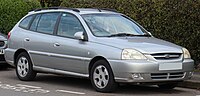 Wagon (facelift)
 -
 Wagon (facelift)

_-_rear_(cropped).jpg)


Second generation (JB; 2005)[edit]
| Second generation (JB) | |
|---|---|
_hatchback_02.jpg) Hatchback (pre-facelift) | |
| Overview | |
| Also called | Kia Pride Kia Sephia Sport (Colombia, taxi version) |
| Production | 2005–2011 |
| Model years | 2006–2011 (North America) |
| Assembly | South Korea: Gwangmyeong (Sohari Plant) China: Yancheng (Yancheng Plant) Russia: Izhevsk (IzhAvto) |
| Body and chassis | |
| Body style | 5-door hatchback 4-door sedan |
| Related | Hyundai Accent (MC) |
| Powertrain | |
| Engine | 1.4 L G4EE Alpha II I4 (petrol) 1.6 L G4ED Alpha II I4 (petrol) 1.5 L U-Line I4 (diesel)[8] |
| Transmission | 5-speed manual 4-speed automatic |
| Dimensions | |
| Wheelbase | 2,500 mm (98.4 in) |
| Length | 3,990 mm (157.1 in) (hatchback) 4,240 mm (166.9 in) (2005–09 sedan) 4,250 mm (167.3 in) (2009–11 sedan) |
| Width | 1,695 mm (66.7 in) |
| Height | 1,470 mm (57.9 in) |
Kia introduced the second generation (JB) in early 2005 model year in Europe and for model year 2006 in North America, based on a redesigned platform shared with the Hyundai Accent. The engine was upgraded to a 110 hp 1.6-litre DOHC four-cylinder "Alpha II" engine now also shared with the Hyundai Accent. Other changes include a new exterior design, an increase in exterior size and interior volume, increased safety features and fuel economy. The station wagon was dropped with this generation in favor of a new 5-door hatchback.
-
 Hatchback (pre-facelift)
 -
 Sedan (pre-facelift)
_LX_hatchback_(2015-05-29)_02_(cropped).jpg)
.jpg)
Kia offered the 2006 sedan as the Rio and Rio LX, the LX trim included power steering, air conditioning, and CD player. The Rio5 (USA) is offered simply in SX trim level with leather-covered steering wheel. As in the first generation, only the five-door hatchback version was offered in some European markets (including the UK). Three engines are available; a 1.6-litre DOHC engine with 110 hp (82 kW), a lesser 1.4-litre version with 96 hp (72 kW) and a 1.5-litre turbo-diesel engine with 109 hp. However, in the US market only the 1.6-litre gasoline engine is offered, in two body styles: a four-door-sedan and a five-door hatch. The European version's common rail diesel engine produces 110 PS (81 kW).
In 2007, an SX trim level was added to the Rio sedan with the same features supplied with the Rio5 SX.
In 2007, the South Korean government began testing approximately 4,000 pre-production Rio hybrid-electric models, with parent company Hyundai Kia Automotive Group later announcing and subsequently withdrawing anticipated release dates for the hybrid model.[9][10]
For 2008, Kia offered the LX trim level for the Rio5 (similar to the Rio LX sedan) and a limited production of Rio5 SX Tuner models, featuring Falken FK452 tires, Tanabe strut tower brace and Eibach Federn lowering springs.[11]
For the 2009 model year, all Rio and Rio5 trims received standard Sirius Satellite Radio (complimentary for three months) and radios with USB port & auxiliary jack, the auxiliary jack substituting for a Bluetooth mobile phone connection for devices with an earphone jack. The Kia Rio ranked 5th in the "20 least expensive 2009 vehicles to insure" list by Insure.com. According to research, the Rio is one of the least expensive vehicles to insure.[12]
For the Malaysian market, the second generation Rio was launched on the 7 September 2005 available with only one trim level with only the hatchback body style and powered by a 1.4-litre 16 valve DOHC engine with a 4-speed automatic gearbox and was fully imported from South Korea.[13][14][15]
Facelift[edit]
_%E2%80%93_Frontansicht,_3._Juli_2011,_Essen.jpg)
_%E2%80%93_Heckansicht,_3._Juli_2011,_Essen.jpg)

For the 2010 model year, the models received a facelift in late 2009, adopting Kia's new Tiger nose grille. In addition, the steering wheel receives the same design as the Kia Soul and Kia Forte, featuring optional Bluetooth hands-free phone operation, and the gauges cluster receives a new red backlit design. The headlights were modified slightly, with a darker appearance and parking lights and side-marker lights sharing the turn-signal housing. Side moldings on the car became narrower and body-colored. For the UK version, the Rio looks exactly the same as the US version, except that only the hatchback variant is sold there. It has Kia's new 'Tiger Nose' grille (for the 2010 model) and is powered by a 1.4-litre DOHC four-cylinder 16-valve petrol engine, or a 1.5-liter DOHC four-cylinder 16-valve diesel. They both have a five speed manual gearbox.
This facelifted Kia Rio was never being sold in the markets of Central and Southeastern Europe,[16][17] apparently due to dismal sales, as well as due to the insufficient production capacities.
_Sports_SE_hatchback_(2010-10-16)_01.jpg)
Safety[edit]
- IIHS
The 2006 Rio received Poor to Average ratings from the Insurance Institute for Highway Safety (IIHS).[18]
| Test | Rating |
| Overall: |  
|
| Moderate overlap front: | Average |
| Side: | Poor |
| Roof strength: | Average |
| Head restraints & seats: | Poor |
- Euro NCAP
Euro NCAP test results for a LHD, 5-door hatchback variant on a 2005 registration:
| Test | Score | Rating |
|---|---|---|
| Adult occupant: |
| |
| Child occupant: |
| |
| Pedestrian: |
|
Third generation (UB/QB; 2011)[edit]
Starting from the third generation, the Rio was split into two different models, one being the global model (codename: UB), and the other is a specific model for Russia and China (codename: QB).
Global version (UB)[edit]
| Third generation (UB) | |
|---|---|
_%E2%80%93_Frontansicht_(2),_25._Oktober_2011,_D%C3%BCsseldorf.jpg) 5-door hatchback (pre-facelift) | |
| Overview | |
| Also called | Kia Pride |
| Production | 2011–2017 |
| Model years | 2012–2017 (North America) |
| Assembly | South Korea: Gwangmyeong (Sohari Plant) Malaysia: Gurun (NAM) |
| Designer | |
| Body and chassis | |
| Body style | 3-door hatchback 5-door hatchback 4-door sedan |
| Platform | Hyundai-Kia PB |
| Related | Kia Pegas/Soluto Hyundai Accent (RB) Hyundai Veloster Hyundai HB20 Hyundai Reina |
| Powertrain | |
| Engine | |
| Transmission | 5-speed manual 6-speed M6CF1 manual 4-speed automatic 6-speed A6GF1 automatic |
| Dimensions | |
| Wheelbase | 2,570 mm (101.2 in) |
| Length | 4,046 mm (159.3 in) (hatchback) 4,366 mm (171.9 in) (sedan) |
| Width | 1,720 mm (67.7 in) |
| Height | 1,455 mm (57.3 in) |
| Curb weight | 1,093–1,141 kg (2,410–2,515 lb) |
The global third-generation Rio debuted on March 1, 2011, at the Geneva Motor Show, again based on the Hyundai Accent. It was designed at Kia's design studios in Irvine, California. The vehicle feature sloping shoulder lines and wedge-shaped exteriors, which is inline with other Kia models at the time such as the 2011 Optima and Sportage. The Rio also feature its own interpretation of Kia's signature grille known as the "Tiger Nose", which is slimmed down to connect to the headlamp design. The new design includes a larger air intake. Its extended wheelbase of 2,570 mm (101.2 in) improves passenger and cargo space.[23][24]
The Rio in Europe also receives a 3-door model. It is mechanically identical to the 5-door, though its longer doors give it a more sporting appearance that appeals to younger audiences. The 3-door is also noticeably cheaper than the 5-door.
In November 2011, the third-generation Rio was awarded Semperit Irish Car of the Year and in December was awarded Australian Carsguide's 2011 Car of the Year award as well, triumphing over many other vehicles including the likes of the Range Rover Evoque and the recently facelifted Ford Territory.
-
 Rear view (3-door hatchback)
 -
 Rear view (5-door hatchback)
 -
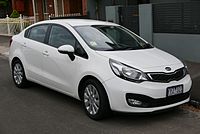 Sedan
Sedan -
 Rear view
 -
 Interior
_SLS_3-door_hatchback_(23816069452)_(cropped).jpg)
_%E2%80%93_Heckansicht_(1),_25._Oktober_2011,_D%C3%BCsseldorf.jpg)
_Si_sedan_(2016-01-04)_01.jpg)
_Si_sedan_(2016-01-04)_02.jpg)

Powertrain[edit]
The UB Rio featured 1.4-litre or 1.6-litre Hyundai GDI Gamma engines. The European market also received the option of a 1.25-litre petrol engine, as well as a 1.4-litre or 1.1-litre CRDi turbo-diesel engine - the 1.1-litre engine having the lowest CO2 emissions and highest MPG of any non-electric or hybrid car currently on sale at time of writing; up to 88 mpg on the EU combined cycle (73 mpg in US gallons) and emitting only 85 grams of CO2 per kilometer. This market, however, lacked the 1.6-litre engine, with the 1.4-litre being the most powerful on offer.
Transmission options included a 6-speed manual and 6-speed automatic for the American market, with the European market receiving a 5-speed manual for the 1.25-litre Petrol engine, a 6-speed manual for the 1.4-litre petrol, 1.1-litre and 1.4-litre diesels and a 4-speed automatic for the 1.4-litre petrol "2" spec model in 5-door configuration. Intelligent stop & go was an option on almost all available trim and engine levels.
Facelift (2015)[edit]
-
 Facelift Kia Rio 5-door hatchback (front)
 -
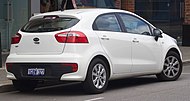 Facelift Kia Rio 5-door hatchback (rear)
 -
 Facelift Kia Rio 3-door hatchback
 -
 Facelift Kia Rio 4-door sedan
_S_5-door_hatchback_(2018-08-27)_01.jpg)
_S_5-door_hatchback_(2018-08-27)_02.jpg)
_S_3-door_hatchback_(2018-11-26).jpg)

Safety[edit]
Latin NCAP[edit]
The Korean-made Rio Sedan in its most basic Latin American market configuration with no airbags, no ABS and no ESC received 0 stars for adult occupants and 1 star for toddlers from Latin NCAP in May 2017.[25]
IIHS[edit]
The 2012 Rio received Marginal to Good ratings from the Insurance Institute for Highway Safety (IIHS).[26]
| Test | Rating |
| Overall: |
|
| Small overlap front: | Marginal |
| Moderate overlap front: | Good |
| Side: | Average |
| Roof strength: | Good |
| Head restraints & seats: | Good |
Euro NCAP[edit]
Euro NCAP test results for a LHD, 5-door hatchback standard European market variant on a 2011 registration:
| Test | Points | % |
|---|---|---|
| Overall: |
| |
| Adult occupant: | 33 | 92% |
| Child occupant: | 41.1 | 84% |
| Pedestrian: | 16.7 | 46% |
| Safety assist: | 6 | 86% |
Russian/Chinese version (QB)[edit]
| Third generation (QB) | |
|---|---|
 Kia K2 sedan (China; pre-facelift) | |
| Overview | |
| Also called | Kia K2 (China)[28] |
| Production | 2011–2017 |
| Assembly | China: Yancheng (DYK) Russia: St. Petersburg (HMMR) |
| Body and chassis | |
| Body style | 5-door hatchback 4-door sedan |
| Platform | Hyundai-Kia PB |
| Related | Hyundai Accent/Solaris (RB) Hyundai Reina |
| Powertrain | |
| Engine | Petrol: 1.4 L Gamma MPi I4 1.6 L Gamma MPi I4 |
| Transmission | 5/6-speed manual 4/6-speed automatic |
| Dimensions | |
| Wheelbase | 2,570 mm (101.2 in) |
| Length | 4,120–4,125 mm (162.2–162.4 in) (hatchback) 4,370–4,377 mm (172.0–172.3 in) (sedan) |
| Width | 1,700 mm (66.9 in) |
| Height | 1,470 mm (57.9 in) |
| Curb weight | 1,115–1,151 kg (2,458–2,538 lb) |
Kia developed a separate Rio model for the Russian market. Production began on 15 August 2011 at the Hyundai plant in Saint Petersburg, and the QB Kia Rio was officially released in Russia on 17 August 2011.[29][30] Hatchback production in Russia started in January 2012.[31] The QB Rio features a more conservative design than the UB Rio. This version was also released to Chinese market, badged as the Kia K2.
-
 Kia K2 sedan (China; pre-facelift)
 -
 Kia K2 hatchback (China; pre-facelift)
 -
 Kia K2 hatchback (China; facelift)
 -
 Kia K2 hatchback (China; facelift)

.jpg)

,_rear_8.3.18.jpg)
Fourth generation (YB/SC/FB/UC; 2016)[edit]
 | This section needs to be updated. (October 2020) |
The fourth-generation Rio also consists of two different models, one being the global model produced in South Korea, Mexico and Algeria known with the model code YB or SC, and the other is a specific model for Russia and China known with the model code FB or UC and produced in the aforementioned countries and in Ukraine.[32]
Global version (YB/SC)[edit]
| Fourth generation (YB/SC) | |
|---|---|
_S_5-door_hatchback_(2018-08-06)_01.jpg) Hatchback (pre-facelift) | |
| Overview | |
| Also called | Kia Tonic (crossover version, Colombia)[33] |
| Production | December 2016 – December 2023 |
| Model years | 2018–2023 (North America, Europe, Australia) |
| Assembly | South Korea: Gwangmyeong (Sohari Plant) Mexico: Monterrey, Nuevo Leon (KMMX)[34] Algeria: Batna (GLOVIZ)[35] |
| Designer | Peter Schreyer |
| Body and chassis | |
| Body style | 5-door hatchback 4-door sedan[36] |
| Platform | Hyundai-Kia GB |
| Related | Kia Stonic Hyundai Accent (HC) Hyundai i20 (GB) |
| Powertrain | |
| Engine | |
| Transmission | 5/6-speed manual 4/6-speed automatic 7-speed dual-clutch CVT |
| Dimensions | |
| Wheelbase | 2,580 mm (101.6 in) |
| Length | 4,065 mm (160.0 in) (hatchback) 4,385 mm (172.6 in) (sedan) |
| Width | 1,725 mm (67.9 in) |
| Height | 1,450–1,460 mm (57.1–57.5 in) |
Kia presented the global fourth-generation Rio at the 2016 Paris Motor Show. The new car was designed in Kia's California and Germany design centers and features longer front overhangs, larger hood and a more upright C-pillars for the hatchback model.[37] The hatchback model is 15 mm longer, 5 mm wider and 5 mm shorter in height than its predecessor.
Unlike the previous generations, the fourth-generation Rio is an export-only model since it is not offered in the South Korean domestic market due to decreasing sales of its predecessor.[38] In the country, the Rio-based Stonic crossover was offered instead.
In European markets, the car is only offered in a 5-door hatchback form, while the 3-door hatchback option was discontinued.[39] In other markets such as the Americas, both the 5-door hatchback and sedan body styles are offered.[40][41] For the North American market, the Rio is manufactured alongside the Forte at the newly built Pesquería plant in Mexico.[34]
For the North American market, the 1.6-liter Gamma GDi engine was replaced by the 1.6-litre Gamma II MPi starting from the 2020 model year. The EPA fuel economy rating was significantly improved as a result, while rated maximum horsepower reduced from 130 hp (132 PS; 97 kW) to a peak 120 hp (122 PS; 89 kW).
-
 Rear view (hatchback)
 -
 Rio GT-Line
 -
 Rear view (GT-Line)
_S_5-door_hatchback_(2018-08-06)_02.jpg)


Facelift[edit]
The facelifted Rio featured changes in the front fascia with a revised bumper design. It was first introduced in Europe in May 2020, along with the inclusion of a 1.0-litre mild hybrid engine to replace the previous 1.0-litre T-GDi engine.[42]
The facelifted model went on sale in Mexico in October 2020.[43] In the US and Canada, the facelifted model was introduced in December 2020 for the 2021 model year for both hatchback and sedan models, with upgrades in standard equipment.[44]
-
 Facelift (hatchback)
 -
 Facelift (sedan)
 -
 Facelift (sedan)
_FL_IMG_5315.jpg)
,_front_3.12.23.jpg)
,_rear_3.12.23.jpg)
Rio Cross/Tonic[edit]
A rugged crossover-styled variant of the Rio was released in Colombia as the Kia Tonic.[45][46] It is also offered in selected Latin America countries such as Panama and Peru as the Rio Cross.[47]
-
 2019 Kia Tonic (Colombia)
 -
 Rear view
.png)
.png)
Awards[edit]
The YB Rio won the 2017 Red Dot Award for Passenger Car Design[48] and the 2017 iF Design Award for Discipline Product.[49]
Safety[edit]

The Rio has optional rear disc brakes.[50][51]
Latin NCAP[edit]
The New Rio Sedan with 1 airbag, no ABS and no ESC received 2 stars for adult occupants and 2 stars for toddlers from Latin NCAP in August 2017.[52]
Euro NCAP[edit]
Euro NCAP test results for a LHD, 5-door hatchback variant with standard equipment on a 2017 registration:
| Test | Points | % |
|---|---|---|
| Overall: |
| |
| Adult occupant: | 32.5 | 85% |
| Child occupant: | 41.2 | 84% |
| Pedestrian: | 26 | 62% |
| Safety assist: | 3 | 25% |
Euro NCAP test results for a LHD, 5-door hatchback variant with optional safety pack on a 2017 registration:
| Test | Points | % |
|---|---|---|
| Overall: |
| |
| Adult occupant: | 35.5 | 93% |
| Child occupant: | 41.2 | 84% |
| Pedestrian: | 29.8 | 71% |
| Safety assist: | 7.1 | 59% |
IIHS[edit]
2018[edit]
IIHS crash test results for an LHD, 4-door sedan variant with standard equipment, 2018 model year, and its top trim won the Top Safety Pick+ award:
| Test | Rating | |||
| Small overlap front: | Good | |||
| Moderate overlap front (driver side): | Good | |||
| Moderate overlap front (passenger side): | Acceptable | |||
| Side: | Good | |||
| Roof strength: | Good | |||
| Head restraints & seats: | Good | |||
| Headlights |
|
varies by trim/option | ||
| Front crash prevention: | Superior | optional | ||
| Child seat anchors (Latch) ease of use: | Acceptable |
2022[edit]
IIHS crash test results, 2022 model year:[55]
| Test | Rating | |||
| Small overlap front: | Good | |||
| Moderate overlap front (driver side): | Good | |||
| Moderate overlap front (passenger side): | Acceptable | |||
| Side: | Good | |||
| Roof strength: | Good | |||
| Head restraints & seats: | Good | |||
| Headlights |
|
varies by trim/option | ||
| Child seat anchors (Latch) ease of use: | Acceptable |
Russian/Chinese version (FB/UC)[edit]
| Fourth generation (FB/UC) | |
|---|---|
_(cropped).jpg) 2017 Kia Rio (Russia; pre-facelift) | |
| Overview | |
| Also called | Kia K2 (China) Kia KX Cross (crossover version, China) |
| Production | 2017–2022 (Russia) 2017–2020 (China) |
| Assembly | China: Yancheng (DYK) Russia: St. Petersburg (HMMR) Ukraine: Zaporizhia (ZAZ)[56] |
| Body and chassis | |
| Body style | 5-door hatchback 4-door sedan |
| Platform | Hyundai-Kia K2 |
| Related | Hyundai Accent/Verna/Solaris (HCi/HCr/YC) |
| Powertrain | |
| Engine | |
| Transmission | 6-speed manual 6-speed automatic |
| Dimensions | |
| Wheelbase | 2,600 mm (102.4 in) |
| Length | 4,240–4,275 mm (166.9–168.3 in) (hatchback) 4,400–4,420 mm (173.2–174.0 in) (sedan) |
| Width | 1,740–1,750 mm (68.5–68.9 in) |
| Height | 1,510 mm (59.4 in) (hatchback) 1,470 mm (57.9 in) (sedan) |
| Curb weight | 1,115–1,151 kg (2,458–2,538 lb) |
The Rio produced and marketed in Russia and China (as the K2 and KX Cross) is internally referred to by the FB or UC model codes.[57] The version for Russia differs with the YB Rio with a different design, longer wheelbase, a different line of engines and suspension settings.
The model was unveiled in Russia in June 2017. Compared to its predecessor, the QB Rio, the FB Rio received improved suspension tuning and an electric power steering. In terms of dimensions, the sedan model is 23 mm (0.9 in) longer in length, 40 mm (1.6 in) wider and 30 mm (1.2 in) longer in wheelbase. Due to the revised rear suspension configuration, trunk space of the sedan model was reduced from 500 L to 480 L. The 1.4-litre Gamma engine was replaced by the Kappa engine of the similar displacement, while the 1.6-litre Gamma engine option was retained from the previous generation.[58]
Production of the FB Rio sedan began on 4 July 2017 at the Hyundai plant in Saint Petersburg alongside the related Hyundai Solaris, and sales began on 1 August 2017. It was also offered in Ukraine and in various CIS countries, such as Belarus, Armenia, Azerbaijan and Kazakhstan.
The facelifted Kia Rio was launched to the Russian market in 2020. The updated model features a reshaped headlights and front bumper, with LED headlights in offer for higher grade levels.[59]
-
 Kia K2 sedan (China)
 -
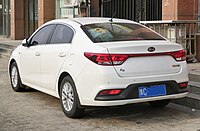 Kia K2 sedan (China)
 -
 2020 Kia Rio (Russia; facelift)


.jpg)
Crossover versions[edit]
In October 2017, Kia Russia introduced the Rio X-Line as a crossover-styled hatchback version of the FB Rio. The Rio X-Line has an increased ground clearance of 10 mm, modified suspension settings, and unpainted plastic body claddings to mimic crossover styling. Sales began in Russia on 14 November 2017. The Rio X-Line was also introduced in China at the 2017 Auto Shanghai as the Kia KX Cross. The KX Cross is 30 mm (1.2 in) wider and 40 mm (1.6 in) longer than the standard Rio hatchback.[60][61]
-
 Kia KX Cross (China)
 -
 Kia KX Cross (China)
 -
 2018 Kia Rio X-Line 1.6 (Netherlands)
 -
 2018 Kia Rio X-Line 1.6 (Netherlands)


.jpg)
.jpg)
Successor[edit]
_front_view.jpg)
The fourth-generation Rio was succeeded by the K3, which was introduced in August 2023. The K3 nameplate was previously used by the Chinese and South Korean market Forte/Cerato which is a segment above the Rio. The Forte/Cerato, which was succeeded by K4 in 2024.[62][63]
Sales[edit]
The Rio/K2 was Kia's best selling model worldwide in 2012 and 2015.
| Year | Europe[64] | U.S.[65] | Mexico[66] | South Korea[67] | Global |
|---|---|---|---|---|---|
| 2000 | 2,904 | 16,624 | 24,216 | ||
| 2001 | 17,570 | 51,541 | 18,651 | ||
| 2002 | 25,138 | 51,195 | 19,837 | ||
| 2003 | 34,436 | 41,285 | 7,844 | ||
| 2004 | 32,629 | 38,518 | 2,273 | ||
| 2005 | 27,859 | 30,290 | 15,663 | ||
| 2006 | 30,759 | 28,388 | 23,045 | ||
| 2007 | 22,288 | 33,370 | 25,919 | ||
| 2008 | 20,268 | 36,532 | 22,197 | ||
| 2009 | 25,020 | 34,666 | 18,532 | ||
| 2010 | 19,335 | 24,619 | 14,339 | ||
| 2011 | 30,730 | 20,111 | 15,537 | ||
| 2012 | 69,752 | 40,275 | 16,380 | 466,826[68] | |
| 2013 | 58,041 | 40,742 | 11,037 | ||
| 2014 | 58,425 | 35,933 | 8,893 | ||
| 2015 | 63,930 | 23,742 | 6,987 | 466,573[69] | |
| 2016 | 67,622 | 28,700 | 12,138 | 4,158 | 445,404[70] |
| 2017 | 70,309 | 16,760 | 29,096 | 2,028 | 252,327 |
| 2018 | 45,654 | 22,975 | 32,904 | 167,422 | |
| 2019 | 39,721 | 24,961 | 36,730 | 264,535 | |
| 2020 | 33,052 | 23,927 | 29,014 | ||
| 2021 | 34,265 | 31,362 | 35,249 | ||
| 2022 | 33,613 | 26,996 | 50,958 | ||
| 2023 | 25,959 | 26,804 | 40,490 |
References[edit]
- ^ "Vehicles". Aymesa - La primera ensambladora de vehículos del Ecuador. Archived from the original on 29 November 2014. Retrieved 26 December 2013.
- ^ "Kia Rio Stylus". Kia Motors Ecuador. Archived from the original on 26 December 2013. Retrieved 26 December 2013.
- ^ "Kia Rio Sedan". carrozzieri-italiani.com. Retrieved 29 January 2024.
- ^ "Kia Rio - Road Test - Auto Reviews". Car and Driver. Retrieved 2010-07-03.
- ^ "Kia Rio Overview". Edmunds.com. Retrieved 2010-07-03.
- ^ Nötzli, Max, ed. (7 March 2002). Automobil Revue 2002 (in German and French). Vol. 97. Berne, Switzerland: Büchler Grafino AG. p. 337. ISBN 3-905386-02-X.
- ^ "2005 Subaru Impreza WRX STi vs Kia Rio Sports-Pac comparison review: classic MOTOR". WhichCar. Retrieved 2018-10-26.
- ^ "Kia Rio Technical Specification". 2007. Retrieved 2007-11-04.
- ^ "Hyundai Delays Hybrid Program". 2007. Archived from the original on 2007-10-11. Retrieved 2007-11-04.
- ^ "Hyundai signs final deal on Czech plant". Daily Times of Pakistan. 2006-05-19. Archived from the original on 2015-04-02. Retrieved 2007-11-04.
- ^ Luc Gagné, Luc Gagné (2008-09-05). "2008 Kia Rio5 SX Tuner Review". auto123.com. Retrieved 2009-03-02.
- ^ The Most Expensive Cars to Insure Archived 2016-01-10 at the Wayback Machine Jun. 03, 2009, U.S. News Rankings & Reviews
- ^ khong, ys (2005-09-08). "ALL-NEW RIO EXPECTED TO BOOST NAZA KIA SALES - Autoworld.com.my". Autoworld.com.my. Retrieved 2018-05-05.
- ^ "2006 Kia Rio". Paul Tan's Automotive News. 2005-09-09. Retrieved 2018-05-05.
- ^ "Kia Rio 1.4 Test Drive Report". Paul Tan's Automotive News. 2007-04-06. Retrieved 2018-05-05.
- ^ "Kia Motors Polska" (in Polish). Archived from the original on 2010-10-17. Retrieved 2023-01-20.
- ^ "Kia Motors Croatia - Model Range" (in Croatian). Archived from the original on 2010-07-02. Retrieved 2023-01-20.
- ^ "2006 Kia Rio". Insurance Institute for Highway Safety. Retrieved 2017-05-29.
- ^ "Kia Rio (2005)". Euro NCAP. Retrieved 2017-10-05.
- ^ US D647005, Kim, Sung Wook, "Passenger car", published 2011-10-18, assigned to Kia Motors Corp.
- ^ US D741225, Baik, Seung-Hwan, "Passenger car", published 2015-10-20, assigned to Kia Motors Corp.
- ^ "All-new Kia Rio shows its face". Auto Express. Retrieved 2011-09-24.
- ^ Serban, Tudor. "KIA Rio 5 doors Specs & Photos - 2011, 2012, 2013, 2014, 2015, 2016". autoevolution. Retrieved 2023-03-17.
- ^ "KIA Rio Sedan Specs & Photos - 2011, 2012, 2013, 2014, 2015, 2016, 2017, 2018, 2019, 2020, 2021, 2022, 2023". autoevolution. Retrieved 2023-03-17.
- ^ "Official results of the Kia Rio Sedan - NO Airbags 2017". LATIN NCAP - PARA AUTOS MAS SEGUROS.
- ^ "2012 Kia Rio". Insurance Institute for Highway Safety. Retrieved 2017-05-29.
- ^ "Kia Rio (2011)". Euro NCAP. Retrieved 2017-10-05.
- ^ "Kia K2 for China". Livelifedrive.com. 2011-04-19.
- ^ "Российский седан Kia Rio официально представлен". Drom.ru (in Russian). Retrieved 2020-06-14.
- ^ "Новый KIA Rio представлен публике!". kia-bnmotors.ru (in Russian). Retrieved 2020-06-14.
- ^ "History of the KIA brand. Assembling a Kia Rio car: production in Russia and abroad Which Korea produces Kia cars". nashipoezda.ru. Retrieved 2021-12-18.
- ^ "Kia Rio (FB) характеристики, двигатели, рестайлинг и комплектации" [Kia Rio (FB) characteristics, engines, restyling and equipment]. kiazone.ru. Retrieved 2022-06-10.
- ^ Mantilla, Óscar Julián Restrepo (2018-09-26). "Kia Tonic: Características, versiones y precios en Colombia". El Carro Colombiano (in Spanish). Retrieved 2020-08-23.
- ^ a b "Kia producirá en la planta de Pesquería un modelo de Hyundai". Expansión. 2016-01-25. Retrieved 2017-04-23.
- ^ "Four models of the Kia brand in the Batna plant". Eco-Algeria. 2017-03-19. Retrieved 2017-04-13.
- ^ "2018 Kia Rio Sedan". Autoblog. 2017-04-13. Retrieved 2017-04-14.
- ^ "All New Kia Rio Will Debut Next Month". Top Gear Philippines. 2016-08-24. Retrieved 2016-09-01.
- ^ "소형차 엑센트·프라이드 단종..경차에 치이고 소형 SUV에 밀려" [Small car Accent Pride discontinued... Hit by a compact car and pushed by a small SUV]. 카가이 (in Korean). 2017-12-27. Retrieved 2021-06-21.
- ^ "New 2017 Kia Rio: full prices and specs revealed". Auto Express. Retrieved 2022-06-10.
- ^ Laurel, Drei (2016-09-02). "Kia Has Unveiled the All-New Rio Subcompact Hatch". Top Gear Philippines. Retrieved 2016-09-04.
- ^ Meiners, Jens (2017-02-13). "2018 Kia Rio Hatchback Euro-Spec". Car & Driver. Retrieved 2017-04-14.
- ^ "Kia Rio Facelift Debuts With Smart Face, Mild Hybrid Engine". Motor1.com. Retrieved 2022-06-10.
- ^ "KIA Rio 2021 llega a México, ligera actualización para seguir siendo de los consentidos". 22 October 2020.
- ^ Capparella, Joey (2020-12-28). "2021 Kia Rio U.S. Specs and Pricing Detailed". Car and Driver. Retrieved 2022-06-10.
- ^ Mantilla, Óscar Julián Restrepo (2018-09-26). "Kia Tonic: Características, versiones y precios en Colombia". El Carro Colombiano (in Spanish). Retrieved 2020-10-13.
- ^ Tiempo, Casa Editorial El. "Kia tonic: el rio se pasa a crossover". Revista Motor (in Spanish). Retrieved 2020-10-13.
- ^ García, Gerardo (2018-09-27). "El KIA Tonic es un Rio campero para cubrir el hueco de Stonic en Latinoamérica". Motorpasión México (in Spanish). Retrieved 2021-11-10.
- ^ "Kia Rio - Red Dot Award: Product Design". Red Dot. Retrieved 2017-07-30.
- ^ "Kia Rio". International Forum Design. Retrieved 2017-07-30.
- ^ Romero, Jonathan (May 31, 2021). "Kia Rio MY2021: lanzamiento en Argentina, desde U$S 25.500". 16 Valvulas.
- ^ Castañeda, Fabián Rojas (April 23, 2021). "Kia Rio 2022 en Colombia: Precios, características y versiones".
- ^ "Official results of the Kia New Rio Sedan + 1 Airbag 2017". LATIN NCAP - PARA AUTOS MAS SEGUROS.
- ^ "Kia Rio (with Standard Equipment)". Euro NCAP. Retrieved 2017-09-06.
- ^ "Kia Rio (with Safety Pack)". Euro NCAP. Retrieved 2017-09-06.
- ^ "2022 Kia Rio 4-door sedan". IIHS-HLDI crash testing and highway safety.
- ^ "Assembly of Kia Rios started at the Zaporozhye plant - Auto-Motor". Tek Deeps. 2021-02-03. Retrieved 2021-12-18.
- ^ "Новый Kia Rio - первый российский тест" [New Kia Rio - the first Russian test]. www.zr.ru. Retrieved 2022-06-10.
- ^ "Кожа, подогревы, светодиоды: все о новом Kia Rio" [Leather, heating, LEDs: all about the new Kia Rio]. Autonews (in Russian). Retrieved 2022-06-10.
- ^ "Обновлённый Kia Rio начали продавать в России" [Updated Kia Rio started selling in Russia]. Wroom.ru (in Russian). 2020-10-01. Retrieved 2020-10-09.
- ^ "New Kia Pegas and K2 Cross Debut at Auto Shanghai". allcarschannel.com. 2017-04-19. Archived from the original on 2020-08-03. Retrieved 2017-04-20.
- ^ Gnaticov, Christian (2017-04-19). "Kia Pegas Compact Sedan And K2 Cross Are Tailored For Chinese Customers". Carscoops. Retrieved 2017-04-20.
- ^ Padeanu, Adrian. "2024 Kia K3 Sedan Teased Ahead Of August 8 Debut, Is It A Rio Or Forte?". Motor1.com. Retrieved 2023-08-06.
- ^ Lye, Gerard (August 9, 2023). "2024 Kia K3 sedan debuts in Mexico – Rio successor with 1.6L, 2.0L engines; 6MT, 6AT; available as GT-Line". Paul Tan's Automotive News. Retrieved August 9, 2023.
- ^ Demandt, Bart (2014-01-29). "Kia Rio European sales figures". carsalesbase.com. Retrieved 2023-03-17.
- ^ "News - Sales Data - Sales Data - Kia Motors America Newsroom". www.kiamedia.com. Retrieved 25 October 2018.
- ^ "Venta al público y producción de vehículos ligeros por marca, modelo, segmento y país origen". PX-Web (in Spanish). Retrieved 2024-02-24.
- ^ "Sales Results - Investor Relations; Kia Global Brand Site".
- ^ "Kia Motors Global Media Center : Kia Motors Ends 2012 with 9.3% Increase in Global Sales". Archived from the original on 2017-09-08. Retrieved 2017-09-08.
- ^ "Kia Motors posts 0.3% rise in 2015 global sales". 7 January 2016. Retrieved 25 October 2018.
- ^ "Kia Motors posts 3.2% rise in 2016 Global Sales". 6 January 2017. Retrieved 25 October 2018.
External links[edit]

- Official website (U.S., sedan)