


Lillebonne
Lillebonne | |
|---|---|
     From left to right, top to bottom: Juliobona museum as seen from the theatre with the city-centre in the background; Gallo-Roman theatre; the Notre-Dame church; a Gallo-Roman Apollo statue found at Lillebonne; the Medieval castle. | |
 Coat of arms | |
Location of Lillebonne  | |
  Lillebonne  Lillebonne | |
| Coordinates: 49°31′08″N 0°32′03″E / 49.5189°N 0.5343°E | |
| Country | France |
| Region | Normandy |
| Department | Seine-Maritime |
| Arrondissement | Le Havre |
| Canton | Bolbec |
| Intercommunality | Caux Seine Agglo |
| Government | |
| • Mayor (2020–2026) | Christine Déchamps[1] |
| Area 1 | 14.66 km2 (5.66 sq mi) |
| Population (2021)[2] | 8,729 |
| • Density | 600/km2 (1,500/sq mi) |
| Time zone | UTC+01:00 (CET) |
| • Summer (DST) | UTC+02:00 (CEST) |
| INSEE/Postal code | 76384 /76170 |
| Elevation | 0–1,338 m (0–4,390 ft) (avg. 6 m or 20 ft) |
| 1 French Land Register data, which excludes lakes, ponds, glaciers > 1 km2 (0.386 sq mi or 247 acres) and river estuaries. | |
Lillebonne (French pronunciation: [lilbɔn]) is a commune in the Seine-Maritime department in the Normandy region in Northern France. It lies 3.5 miles (5.6 km) north of the Seine and 24 miles (39 km) east of Le Havre.
History[edit]
Before the Roman conquest of Gaul, Iuliobona was the capital of the Caletes, or inhabitants of the Pays de Caux. It was destroyed by Julius Caesar and afterwards rebuilt by Augustus. Before it was again ruined by the barbarian invasions, it had become an important centre whence Roman roads branched out in all directions. It was an administrative, military and commercial city located close to the Seine. This made it a great transportation route between Britannia (modern-day Britain) and the remainder of the Roman Empire. It was also a crossroads of communication in order to bring Roman ways to Harfleur, Étretat, Dieppe, Évreux and Rouen.
The remains of Roman baths and of a theatre capable of holding 3,000 persons have been brought to light. Many Roman and Gallic relics, notably a bronze statue of Apollo (displayed in the Louvre), and two fine mosaics on show in the museum at Rouen, have been found. In the Middle Ages the fortifications of the town were constructed out of materials supplied by the Roman theatre. The town recovered some of its old importance under William the Conqueror.
Lillebonne is the birthplace of the writer Annie Ernaux.
-
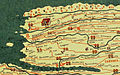 Detail of the Tabula Peutingeriana from 1st-4th century, (Juliobona is at the center)
 -
 Roman theatre of Lillebonne
 -
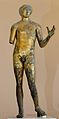 Apollo found at Lillebonne, bronze statue from 2nd century, museum of the Louvre (Paris)
 -
 Bronze head of a Roman god, found at Lillebonne, Musée des antiquités of the Seine-Maritime (Rouen)
 -
 Orpheus mosaic found at Lillebonne, Musée des antiquités of the Seine-Maritime (Rouen)


Geography[edit]
Lillebonne lies in the valley of the river Bolbec at the foot of wooded hills at the junction of the D982, D29 and the D81 roads.
Demographics[edit]
| Year | Pop. | ±% p.a. |
|---|---|---|
| 1968 | 9,615 | — |
| 1975 | 10,241 | +0.91% |
| 1982 | 9,622 | −0.89% |
| 1990 | 9,310 | −0.41% |
| 1999 | 9,738 | +0.50% |
| 2009 | 9,190 | −0.58% |
| 2014 | 9,018 | −0.38% |
| 2020 | 8,761 | −0.48% |
| Source: INSEE[3] | ||
Sights[edit]

The church of Notre Dame, partly modern, preserves a Gothic portal of the 16th century, and a graceful tower of the same period. The park contains a fine cylindrical keep and other remains of a castle founded by William the Conqueror and rebuilt in the 13th century.
The Gallo-Roman amphitheatre of Lillebonne was built in the first century, and was altered in the second century so that it could be used as both an amphitheatre and a theatre. Part of its remains are still visible today from Félix Faur Square, and the foundations of some of its remnants (the wings and backdrop) remain under the square.
Economy[edit]
The principal industries were cotton-spinning and the manufacture of calico and candles. There was also a prosperous manufacture of starch belonging to the Legrain family. Petrochemistry is now the main industry in the area, with a part of the nearby Notre-Dame-de-Gravenchon refining and petrochemical complex extending over the Lillebonne commune.
Twin towns[edit]


See also[edit]
References[edit]
- This article incorporates text from a publication now in the public domain: Chisholm, Hugh, ed. (1911). "Lillebonne". Encyclopædia Britannica. Vol. 16 (11th ed.). Cambridge University Press. p. 686.

- ^ "Répertoire national des élus: les maires" (in French). data.gouv.fr, Plateforme ouverte des données publiques françaises. 13 September 2022.
- ^ "Populations légales 2021". The National Institute of Statistics and Economic Studies. 28 December 2023.
- ^ Population en historique depuis 1968, INSEE
External links[edit]

- Tourism office of Lillebonne (in French)

| International | |
|---|---|
| National | |
| Geographic | |
