Nuclear propulsion
Nuclear propulsion includes a wide variety of propulsion methods that use some form of nuclear reaction as their primary power source.[1] The idea of using nuclear material for propulsion dates back to the beginning of the 20th century. In 1903 it was hypothesized that radioactive material, radium, might be a suitable fuel for engines to propel cars, planes, and boats.[2] H. G. Wells picked up this idea in his 1914 fiction work The World Set Free.[3] Many aircraft carriers and submarines currently use uranium fueled nuclear reactors that can provide propulsion for long periods without refueling. There are also applications in the space sector with nuclear thermal and nuclear electric engines which could be more efficient than conventional rocket engines.

Surface ships, submarines, and torpedoes[edit]


Nuclear-powered vessels are mainly military submarines, and aircraft carriers.[1] Russia is the only country that currently has nuclear-powered civilian surface ships, mainly icebreakers. The US Navy currently (as of 2022) has 11 aircraft carriers and 70 submarines in service, that are all powered by nuclear reactors. For more detailed articles see:
Civilian maritime use[edit]
Military maritime use[edit]
Torpedo[edit]
Russia's Channel One Television news broadcast a picture and details of a nuclear-powered torpedo called Status-6 on about 12 November 2015. The torpedo was stated as having a range of up to 10,000 km, a cruising speed of 100 knots, and an operational depth of up to 1000 metres below the surface. The torpedo carried a 100-megaton nuclear warhead.[4]
One of the suggestions emerging in the summer of 1958 from the first meeting of the scientific advisory group that became JASON was for "a nuclear-powered torpedo that could roam the seas almost indefinitely".[5]
Aircraft and missiles[edit]

Research into nuclear-powered aircraft was pursued during the Cold War by the United States and the Soviet Union as they would presumably allow a country to keep nuclear bombers in the air for extremely long periods of time, a useful tactic for nuclear deterrence. Neither country created any operational nuclear aircraft.[1] One design problem, never adequately solved, was the need for heavy shielding to protect the crew from radiation sickness. Since the advent of ICBMs in the 1960s the tactical advantage of such aircraft was greatly diminished and respective projects were cancelled.[1] Because the technology was inherently dangerous it was not considered in non-military contexts. Nuclear-powered missiles were also researched and discounted during the same period.[1]
Aircraft[edit]
- Convair X-6
- Myasishchev M-50 - Aviation Week hoax[7]
- Aircraft Nuclear Propulsion - General Electric's project to build a nuclear-powered bomber
- Tupolev Tu-95LAL
Missiles[edit]
- Project Pluto - which developed the SLAM missile, that used a nuclear-powered air ramjet for propulsion[1]
- Burevestnik nuclear-powered cruise missile announced by Vladimir Putin in 2018.[8]
Spacecraft[edit]
Many types of nuclear propulsion have been proposed, and some of them (e.g., NERVA) tested for spacecraft applications.[9]
Nuclear pulse propulsion[edit]
- Project Orion, first engineering design study of nuclear pulse (i.e., atomic explosion) propulsion[10]
- Project Daedalus, 1970s British Interplanetary Society study of a fusion rocket
- Project Longshot, US Naval Academy-NASA nuclear pulse propulsion design
- AIMStar, a proposed Antimatter-catalyzed nuclear pulse propulsion craft that uses clouds of antiprotons to initiate fission and fusion within fuel pellets
- ICAN-II, a proposed crewed interplanetary spacecraft that used the antimatter-catalyzed nuclear pulse propulsion engine as its main form of propulsion
- External Pulsed Plasma Propulsion (EPPP), a propulsion concept by NASA that derives its thrust from plasma waves generated from a series of small, supercritical fission/fusion pulses behind an object in space.[11]
Nuclear thermal rocket[edit]

Bimodal nuclear thermal rockets conduct nuclear fission reactions similar to those employed at nuclear power plants including submarines. The energy is used to heat the liquid hydrogen propellant. Advocates of nuclear-powered spacecraft point out that at the time of launch, there is almost no radiation released from the nuclear reactors. Nuclear-powered rockets are not used to lift off the Earth. Nuclear thermal rockets can provide great performance advantages compared to chemical propulsion systems. Nuclear power sources could also be used to provide the spacecraft with electrical power for operations and scientific instrumentation.[12] Examples:
- NERVA (Nuclear Energy for Rocket Vehicle Applications), a US nuclear thermal rocket program
- Project Rover, an American project to develop a nuclear thermal rocket. The program ran at the Los Alamos Scientific Laboratory from 1955 through 1972.
- Project Timberwind (1987–1991), part of the Strategic Defense Initiative
- RD-0410, a Soviet nuclear thermal rocket engine developed from 1965 through the 1980s
- Demonstration Rocket for Agile Cislunar Operations (DRACO), under development in the 2020s
Ramjet[edit]
- Bussard ramjet, a conceptual interstellar fusion ramjet named after Robert W. Bussard.
Direct nuclear[edit]
- Fission fragment rocket
- Fission sail
- Fusion rocket
- Gas core reactor rocket
- Nuclear salt-water rocket
- Radioisotope rocket
- Nuclear photonic rocket
Nuclear electric[edit]
- Nuclear electric rocket
- Project Prometheus, NASA development of nuclear propulsion for long-duration spaceflight, begun in 2003
Russian Federal Space Agency development[edit]
Anatolij Perminov, head of the Russian Federal Space Agency, announced[when?] that it is going to develop a nuclear-powered spacecraft for deep space travel.[13][14] Preliminary design was done by 2013, and 9 more years are planned for development (in space assembly). The price is set at 17 billion rubles (600 million dollars).[15] The nuclear propulsion would have mega-watt class,[16][17] provided necessary funding, Roscosmos Head stated.
This system would consist of a space nuclear power and a matrix of ion engines. "...Hot inert gas temperature of 1500 °C from the reactor turns turbines. The turbine turns the generator and compressor, which circulates the working fluid in a closed circuit. The working fluid is cooled in the radiator. The generator produces electricity for the same ion (plasma) engine..."[18][failed verification]
According to him, the propulsion will be able to support human mission to Mars, with cosmonauts staying on the Red planet for 30 days. This journey to Mars with nuclear propulsion and a steady acceleration would take six weeks, instead of eight months by using chemical propulsion – assuming thrust of 300 times higher than that of chemical propulsion.[19][20]
Terrestrial vehicles[edit]
Cars[edit]
The idea of making cars that used radioactive material, radium, for fuel dates back to at least 1903. Analysis of the concept in 1937 indicated that the driver of such a vehicle might need a 50-ton lead barrier to shield them from radiation.[21]
In 1941, a Caltech physicist named R. M. Langer espoused the idea of a car powered by uranium-235 in the January edition of Popular Mechanics. He was followed by William Bushnell Stout, designer of the Stout Scarab and former Society of Engineers president, on 7 August 1945 in The New York Times. The problem of shielding the reactor continued to render the idea impractical.[22] In December 1945, a John Wilson of London, announced he had created an atomic car. This created considerable interest. The Minister of Fuel and Power along with a large press contingent turned out to view it. The car did not show and Wilson claimed that it had been sabotaged. A later court case found that he was a fraud and there was no nuclear-powered car.[23][24]
Despite the shielding problem, through the late 1940s and early 1950s debate continued around the possibility of nuclear-powered cars. The development of nuclear-powered submarines and ships, and experiments to develop a nuclear-powered aircraft at that time kept the idea alive.[25] Russian papers in the mid-1950s reported the development of a nuclear-powered car by Professor V P Romadin, but again shielding proved to be a problem.[26] It was claimed that its laboratories had overcome the shielding problem with a new alloy that absorbed the rays.[27]
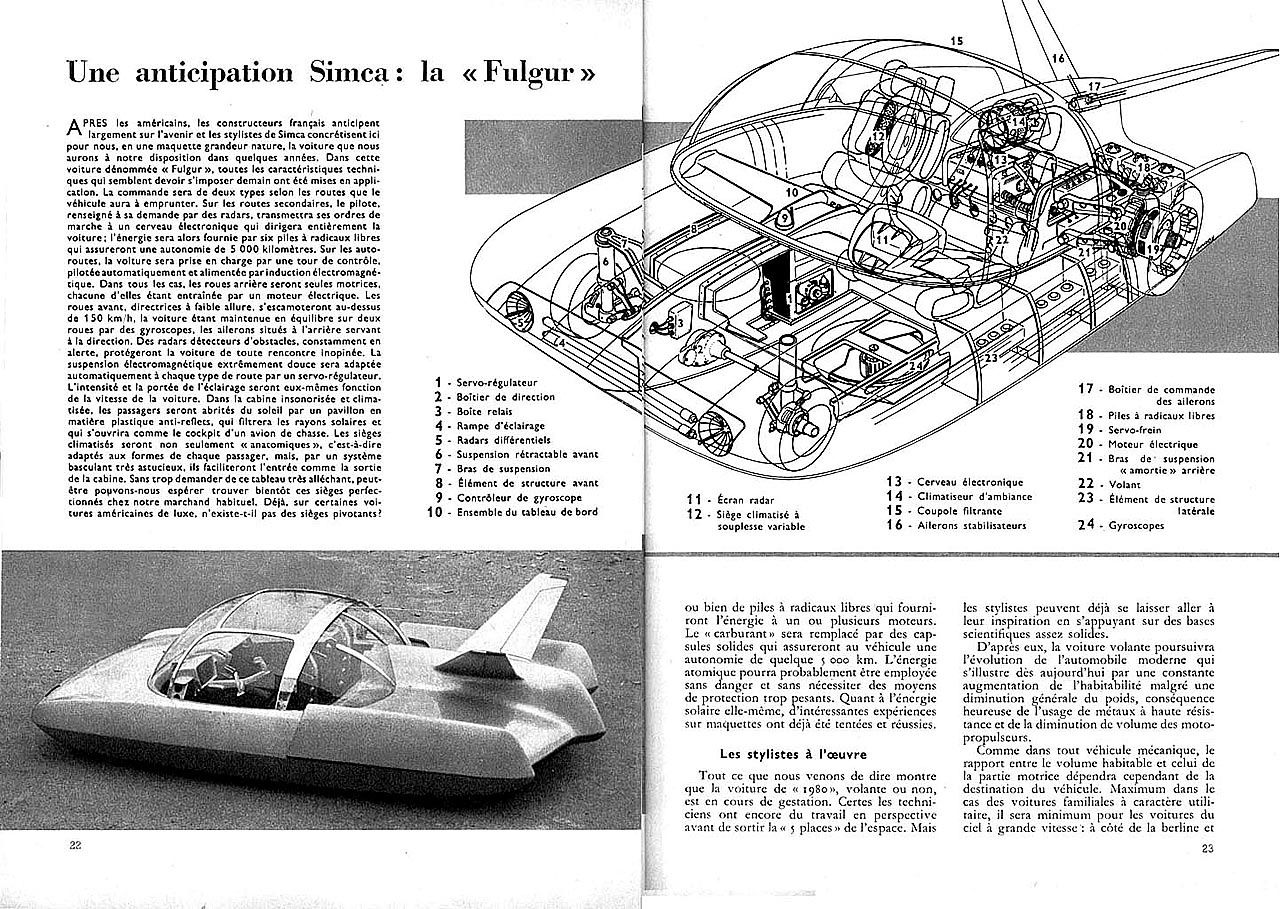
In 1958, at the height of the 1950s American automobile culture there were at least four theoretical nuclear-powered concept cars proposed, the American Ford Nucleon and Studebaker Packard Astral, as well as the French Simca Fulgur designed by Robert Opron[28][29] and the Arbel Symétric. Apart from these concept models, none were built and no automotive nuclear power plants ever made. Chrysler engineer C R Lewis had discounted the idea in 1957 because of estimates that an 80,000 lb (36,000 kg) engine would be required by a 3,000 lb (1,400 kg) car. His view was that an efficient means of storing energy was required for nuclear power to be practical.[30] Despite this, Chrysler's stylists in 1958 drew up some possible designs.
In 1959 it was reported that Goodyear Tire and Rubber Company had developed a new rubber compound that was light and absorbed radiation, obviating the need for heavy shielding. A reporter at the time considered it might make nuclear-powered cars and aircraft a possibility.[31]
Ford made another potentially nuclear-powered model in 1962 for the Seattle World's Fair, the Ford Seattle-ite XXI.[32][33] This also never went beyond the initial concept.
In 2009, for the hundredth anniversary of General Motors' acquisition of Cadillac, Loren Kulesus created concept art depicting a car powered by thorium.[34]
Other[edit]
The Chrysler TV-8 was an experimental concept tank designed by Chrysler in the 1950s.[1] The tank was intended to be a nuclear-powered medium tank capable of land and amphibious warfare. The design was never mass-produced.[35]
The X-12 was a nuclear powered locomotive, proposed in a feasibility study done in 1954 at the University of Utah.[36]
The Mars rover Curiosity is powered by a radioisotope thermoelectric generator (RTG), like the successful Viking 1 and Viking 2 Mars landers in 1976.[37][38]
See also[edit]

References[edit]
- ^ a b c d e f g Trakimavičius, Lukas. "The Future Role of Nuclear Propulsion in the Military" (PDF). NATO Energy Security Centre of Excellence. Archived from the original (PDF) on 2021-10-18. Retrieved 2021-10-15.
- ^ Some practical uses of radium rays, The Republic, Sunday, September 13, 1903
- ^ The new source of energy, The World Set Free, H G Wells, Collins, London and Glasgow, 1956 edition, page 55
- ^ Russia reveals giant nuclear torpedo in state TV 'leak', BBC news, 12 November 2015 - retrieved 27 November 2015
- ^ Science Magazine, 29 November 1991, p.1284
- ^ Thornton, G; Blumbeg, B. (January 1961). "Aircraft Nuclear Propulsion Heat Transfer Reactor Experiments Fulfill Test Goals". Nucleonics. 19 (1). McGraw-Hill. ISSN 0096-6207.
- ^ Norris, Guy (14 October 2014). "False Starts For Aviation's Atomic Age". Aviation Week. Retrieved 17 October 2014.
- ^ Gady, Franz-Stefan (2 March 2018). "Russia Reveals 'Unstoppable' Nuclear-Powered Cruise Missile". The Diplomat. Retrieved 26 March 2018.
- ^ Moeckel, W. E. (August 1969). Propulsion Systems for Manned Exploration of the Solar System (NASA TM X-1864) (PDF) (Report). U. S. National Aeronautics and Space Administration. Retrieved January 15, 2023.
- ^ Schmidt, G. R.; Bonometti, J. A.; Morton, P. J. (July 2000). Nuclear Pulse Propulsion: Orion and Beyond (AIAA 2000-3856) (PDF) (Report). Am. Inst. Aero. Astro. Retrieved January 15, 2023.
- ^ External Pulsed Plasma Propulsion (EPPP) (PDF) (Report). NASA. January 1, 1999. Retrieved January 15, 2023.
- ^ Contact: Gynelle C. Steele (July 15, 2005). "F-22 Raptor Stealth". NASA Glenn's Research & Technology. Archived from the original on February 19, 2006. Retrieved 2009-07-08.
- ^ "Russian Space Agency Announces Plans to Build Nuclear-Powered Deep Space Rocket". Archived from the original on 2017-04-20. Retrieved 2017-04-20.
- ^ Russia And US To Discuss Nuke-Powered Spaceship Project
- ^ Russians to ride a nuclear-powered spacecraft to Mars // 2009
- ^ Page, Lewis (5 April 2011). "Russia, NASA to hold talks on nuclear-powered spacecraft. Muscovites have the balls but not the money". The Register. Retrieved 26 December 2013.
- ^ "Interview: Academician Anatoly Koroteyev An Inside Look at Russia's Nuclear Power Propulsion System" (PDF). 21st Century Science and Technology. No. Fall/Winter 2012-2013. 21st Century. 3 December 2012. Retrieved 26 December 2013.
- ^ (in Russian) Academician Anatoly Koroteev: "Nuclear power can provide a qualitative leap in the development of space" Archived 2014-07-14 at the Wayback Machine
- ^ "Space Propulsion for Martian Mission may be Developed in 6-9 Years". Archived from the original on 2011-04-05. Retrieved 2011-07-11.
- ^ Russia Leads Nuclear Space Race After U.S. Drops Out
- ^ The Science Review, Issues 1-12, University of Melbourne Science Club, Melbourne University, 1937, page 22
- ^ Automobile Quarterly, Volume 31 Number 1, 1992, pages 14-29
- ^ First Atomic Car "sabotaged", Townsville Daily Bulletin, Queensland, Australia, Monday 3 December 1945 page 2
- ^ "Atomic Car" hoax - Elderly inventor gets goal sentence, Cairns Post, Queensland Australia, Monday 22 July 1946, page 3
- ^ "Benson Ford poses challenge on atomic powered automobiles". The Brooklyn Daily Eagle. October 2, 1951. p. 3. Retrieved June 4, 2015 – via Newspapers.com.

- ^ Reading Eagle, Sunday, February 20, 1955, page 8
- ^ Atom-powered Automobile Claimed Russian, The victoria Advocate, Victoria, Texas, Sunday, January 30, 1955, page 7
- ^ "Radioactive cars of the twentieth century". Archived from the original on 26 October 2018. Retrieved 26 April 2012.
- ^ "Une anticipation Simca : la "fulgur"" (in French). Retrieved 26 April 2012.
- ^ Hearst Magazines (April 1957). "The Atom powered carPopular Mechanics". Popular Mechanics. Hearst Magazines. p. 141.
- ^ Advent of Atom Powered Plane Speeded, Ray Cromley, The Victoria Advocate, Victoria, Texas, Wednesday, June 24, 1959, page 4
- ^ Hanlon, Mike (4 June 2004). "Ford Seattle-ite: one of history's most significant concept cars". Gizmag.com. Retrieved 26 April 2012.
- ^ "1962 Ford Seattle-ite XXI". Archived from the original on 12 May 2013. Retrieved 26 April 2012.
- ^ WTF? Cadillac World Thorium Fuel Concept?
- ^ Hunnicutt, RP (1990). A History of the American Main Battle Tank, Volume 2: Abrams. United States: Presidio. p. 36. ISBN 9780891413882.
- ^ Abel, G.K.; Borst, L.B.; Bowie, D.M.; Petty, K.W.; Stover, B.J.; Van Dilla, M.A. (1954), An Atomic Locomotive, retrieved 2023-12-14
- ^ "Multi-Mission Radioisotope Thermoelectric Generator" (PDF). NASA/JPL. January 1, 2008. Archived from the original (PDF) on August 13, 2012. Retrieved August 6, 2012.
- ^ "Mars Exploration: Radioisotope Power and Heating for Mars Surface Exploration" (PDF). NASA/JPL. April 18, 2006. Archived from the original (PDF) on October 12, 2012. Retrieved September 7, 2009.

Further reading[edit]
- Bussard, R.; DeLauer, R. (1958). Nuclear Rocket Propulsion (Report). McGraw-Hill.
- Bussard, R. (1965). Fundamentals of Nuclear Flight (Report). McGraw-Hill.
- Cushin, Harry (April 1951). "Atomic Power — In your car". Motor Trend. Archived from the original on 2015-05-13. Retrieved 2012-04-23.
External links[edit]

 | This article's use of external links may not follow Wikipedia's policies or guidelines. (January 2015) |
- Nuclear Space Propulsion: NASA 1968 on YouTube
- S. K. Borowski et al., "Nuclear Thermal Rocket/Vehicle Design Options for Future NASA Missions to the Moon and Mars", U. S. National Aeronautics and Space Administration, NASA-TM-0107071, September 1993.
- RKA home page in English
- (in Japanese) ソヴィエト連邦における宇宙用原子炉の開発とその実用
- (in Russian) RKA home page in Russian
- Atomic Rockets -- Realistic Designs Archived 2010-01-06 at the Wayback Machine ten speculative concepts from NASA
- RW Bussard, An advanced fusion energy system for outer-planet space propulsion, 2003
- A Survey of Nuclear Propulsion Technologies for Space Applications, A. Micks, March 15, 2013
| Spacecraft |
| ||||||||
|---|---|---|---|---|---|---|---|---|---|
| Sea vessels | |||||||||
| Aircraft |
| ||||||||
| Ground | |||||||||

| |||||||||||||||||||||||||||||||||||||||||||||||||||||||
| |||||||||||||||||||||||||||||||||||||||||||||||||||||||

| International | |
|---|---|
| National | |
| Other | |