Nuclear decommissioning
Nuclear decommissioning is the process leading to the irreversible complete or partial closure of a nuclear facility, usually a nuclear reactor, with the ultimate aim at termination of the operating licence. The process usually runs according to a decommissioning plan, including the whole or partial dismantling and decontamination of the facility, ideally resulting in restoration of the environment up to greenfield status. The decommissioning plan is fulfilled when the approved end state of the facility has been reached.
The process typically takes about 15 to 30 years, or many decades more when an interim safe storage period is applied for radioactive decay. Radioactive waste that remains after the decommissioning is either moved to an on-site storage facility where it is still under control of the owner, or moved to a dry cask storage or disposal facility at another location. The final disposal of nuclear waste from past and future decommissioning is a growing still unsolved problem.
Decommissioning is an administrative and technical process. The facility is dismantled to the point that it no longer requires measures for radiation protection. It includes clean-up of radioactive materials. Once a facility is fully decommissioned, no radiological danger should persist. The license will be terminated and the site released from regulatory control. The plant licensee is then no longer responsible for the nuclear safety.
The costs of decommissioning are to be covered by funds that are provided for in a decommissioning plan, which is part of the facility's initial authorization. They may be saved in a decommissioning fund, such as a trust fund.
There are worldwide also hundreds of thousands small nuclear devices and facilities, for medical, industrial and research purposes, that will have to be decommissioned at some point.[1]
Definition
[edit]Nuclear decommissioning is the administrative and technical process leading to the irreversible closure of a nuclear facility such as a nuclear power plant (NPP), a research reactor, an isotope production plant, a particle accelerator, or uranium mine. It refers to the administrative and technical actions taken to remove all or some of the regulatory controls from the facility to bring about that its site can be reused. Decommissioning includes planning, decontamination, dismantling and materials management.[2]
Decommissioning is the final step in the lifecycle of a nuclear installation. It involves activities from shutdown and removal of nuclear material to the environmental restoration of the site.[3] The term decommissioning covers all measures carried out after a nuclear installation has been granted a decommissioning licence until nuclear regulatory supervision is no longer necessary. The aim is ideally to restore the natural initial state that existed before the construction of the nuclear power plant, the so-called greenfield status.[4]
Decommissioning includes all steps as described in the decommissioning plan, leading to the release of a nuclear facility from regulatory control. The decommissioning plan is fulfilled when the approved end state of the facility has been reached. Disposal facilities for radioactive waste are closed rather than decommissioned. The use of the term decommissioning implies that no further use of the facility (or part thereof) for its existing purpose is foreseen. Though decommissioning typically includes dismantling of the facility, it is not necessarily part of it as far as existing structures are reused after decommissioning and decontamination.[5],p. 49-50
From the owner's perspective, the ultimate aim of decommissioning is termination of the operating license, once he has given certainty that the radiation at the site is below the legal limits, which in the US is an annual exposure of 25 millirem in case of releasing of the site to the public for unrestricted use.[6] The site will be dismantled to the point that it no longer requires measures for radiation protection. Once a facility is decommissioned no radioactive danger persists and it can be released from regulatory control.
The complete process usually takes about 20 to 30 years.[3] In the US, the decommissioning must be completed within 60 years of the plant ceasing operations, unless a longer time is necessary to protect public health and safety;[6] up to 50 years are for radioactive decay and 10 years to dismantle the facility.[7]
Steps in the decommissioning process
[edit]The decommissioning process encompasses:
- pre-decommissioning
- development of a decommissioning plan
- involvement of the public (in democracies)
- application for a decommissioning license
- permanent shutdown
- removal and disposal of nuclear fuel, coolant(s) and/or moderator
- decommissioning
- dismantling and decontamination
- in the US, a License Termination Plan (LTP) has to be submitted two years prior to (the expected) termination of the plant license.[8]
- restoration of the environment
- termination of the operating license; turn over responsibilities
- monitoring of the site (in case of deferred dismantling/Safstor)
- monitoring and maintenance of the interim storage of spent fuel
- final disposal of radioactive waste
Decommissioning plan
[edit]Under supervision of the IAEA, a member state first developes a decommissioning plan to demonstrate the feasibility of decommissioning and assure that the associated costs are covered. At the final shutdown, a final decommissioning plan describes in detail how the decommissioning will take place, how the facility will be safely dismantled, ensuring radiation protection of the workers and the public, addressing environmental impacts, managing radioactive and non-radioactive materials, and termination of the regulatory authorization.[2] In the EU, decommissioning operations are overseen by Euratom. Member states are assisted by the European Commission.[3]
The progressive demolition of buildings and removal of radioactive material is potentially occupationally hazardous, expensive, time-intensive, and presents environmental risks that must be addressed to ensure radioactive materials are either transported elsewhere for storage or stored on-site in a safe manner.
Disposal of nuclear waste
[edit].jpg)
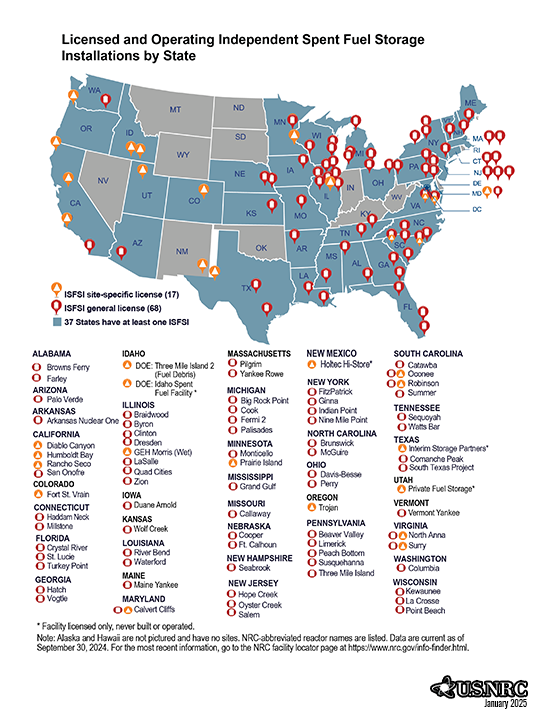
Radioactive waste that remains after the decommissioning is either moved to an on-site storage facility where it still is under control of the plant owner, or moved to a dry cask storage or disposal facility at another location.[9] The problem of long-term disposal of nuclear waste is still unsolved. Pending the availability of geologic repository sites for long-term disposal, interim storage is necessary. As the planned Yucca Mountain nuclear waste repository – like elsewhere in the world – is controversial, on- or off-site storage in the US usually takes place in Independent Spent Fuel Storage Facilities (ISFSI's).[10]
In the UK, all eleven Magnox reactors are in decommissioning under responsibility of the NDA. The spent fuel was removed and transferred to the Sellafield site in Cumbria for reprocessing.[11] Facilities for "temporary" storage of nuclear waste – mainly 'Intermediate Level Waste' (ILW) – are in the UK called Interim Storage Facilities (ISF's).[12]
Environmental impact assessment
[edit]The decommission of a nuclear reactor can only take place after the appropriate licence has been granted pursuant to the relevant legislation. As part of the licensing procedure, various documents, reports and expert opinions have to be written and delivered to the competent authority, e.g. safety report, technical documents and an environmental impact assessment (EIA). In the European Union these documents are a precondition for granting such a licence is an opinion by the European Commission according to Article 37 of the Euratom Treaty.[13] On the basis of these general data, the Commission must be in a position to assess the exposure of reference groups of the population in the nearest neighbouring states.
Options
[edit]There are several options for decommissioning:
Immediate dismantling (DECON in the United States; )
Shortly after the permanent shutdown, the dismantling and/or decontamination of the facility begins. Equipment, structures, systems and components that contain radioactive material are removed and/or decontaminated to a level that permits the ending of regulatory control of the facility and its release, either for unrestricted use or with restrictions on its future use.[5],p. 50 The operating license is terminated.[6]
Deferred dismantling (SAFSTOR in the United States; "care and maintenance" (C&M) in the UK)
The final decommissioning is postponed for a longer period, usually 30 to 50 years. Often the non-nuclear part of the facility is dismantled and the fuel removed immediately. The radioactive part is maintained and monitored in a condition that allows the radioactivity to decay. Afterwards, the plant is dismantled and the property decontaminated to levels that permit release for unrestricted or restrict use.[5] In the US, the decommissioning must be completed within 60 years.[6] With deferred dismantling, costs are shifted to the future, but this entails the risk of rising expenditures for decades to come and changing rules.[14] Moreover, the site cannot be re-used until the decommissioning is finished, while there are no longer revenues from production.
Partial entombment
The US has introduced the so-called In Situ Decommissioning (ISD) closures. All aboveground structures are dismantled; all remaining belowground structures are entombed by grouting all spaces. Advantages are lower decommissioning costs and safer execution. Disadvantages are main components remaining undismantled and definitively inaccessible. The site has to be monitored indefinitely.
This method was implemented at the Savannah River Site in South Carolina for the closure of the P and R Reactors. With this method, the cost of decommissioning for each reactor was about $73 million. In comparison, the decommissioning of each reactor using traditional methods would have been an estimated $250 million. This resulted in a 71% decrease in cost.[15] Other examples are the Hallam nuclear reactor and the Experimental Breeder Reactor II.
Complete entombment
The facility will not be dismantled. Instead it is entombed and maintained indefinitely, and surveillance is continued until the entombed radioactive waste is decayed to a level permitting termination of the license and unrestricted release of the property. The licensee maintains the license previously issued.[16] This option is likely the only possible one in case of a nuclear disaster where the reactor is destroyed and dismantling is impossible or too dangerous. An example of full entombment is the Chernobyl reactor.
In IAEA terms, entombment is not considered an acceptable strategy for decommissioning a facility following a planned permanent shutdown, except under exceptional circumstances, such as a nuclear disaster. In that case, the structure has to be maintained and surveillance continued until the radioactive material is decayed to a level permitting termination of the licence and unrestricted release of the structure.[5],p. 50
Costs
[edit]The calculation of the total cost of decommissioning is challenging, as there are large differences between countries regarding inclusion of certain costs, such as on-site storage of fuel and radioactive waste from decommissioning, dismanting of non-radioactive buildings and structures, and transport and (final) disposal of radioactive waste.[17],p. 61
Moreover, estimates of future costs of deferred decommissioning are virtually impossible, due to the long periode, where inflation and rising costs are unpredictable. Nuclear decommissioning projects are characterized by high and highly variable costs, long schedule and a range of risks. Compared with non-nuclear decommissioning, additional costs are usually related with radiological hazards and safety & security requirements, but also with higher wages for required higher qualified personnel. Benchmarking, comparing projects in different countries, may be useful in estimating the cost of decommissioning. While, for instance, costs for spent fuel and high-level-waste management significantly impacts the budget and schedule of decommissioning projects, it is necessary to clarify which is the starting and the ending point of the decommissioning process.[18]
The effective decommissioning activities begin after all nuclear fuel has been removed from the plant areas that will be decommissioned and these activities form a critical component of pre-decommissioning operations, thus should be factored into the decommissioning plan. The chosen option – immediate or deferred decommissioning – impacts the overall costs. Many other factors also influence the cost. A 2018 KPMG article about decommissioning costs observes that many entities do not include the cost of managing spent nuclear fuel, removed from the plant areas that will be decommissioned (in the US routinely stored in ISFSIs).[19]
In 2004, in a meeting in Vienna, the International Atomic Energy Agency estimated the total cost for the decommissioning of all nuclear facilities. Decommissioning of all nuclear power reactors in the world would require US$187 billion; US$71 billion for fuel cycle facilities; less than US$7 billion for all research reactors; and US$640 billion for dismantling all military reactors for the production of weapons-grade plutonium, research fuel facilities, nuclear reprocessing chemical separation facilities, etc. The total cost to decommission the nuclear fission industry in the World (from 2001 to 2050) was estimated at US$1 trillion.[20] Market Watch estimated (2019) the global decommissioning costs in the nuclear sector in the range of US$1 billion to US$1.5 billion per 1,000-megawatt plant.[21]
The huge costs of research and development for (geological) longterm disposal of nuclear waste are collectively defrayed by the taxpayers in different countries, not by the companies.
Decommissioning funds
[edit]The costs of decommissioning are to be covered by funds that are provided for in a decommissioning plan, which is part of the facility's initial authorization, before the start of the operations. In this way, it is ensured that there will be sufficient money to pay for the eventual decommissioning of the facility. This may for example be through saving in a trust fund or a guarantee from the parent company[22]
Switzerland has a central fund for decommissioning its five nuclear power reactors, and another one for disposal the nuclear waste.[23] Germany has also a state-owned fund for decommissioning of the plants and managing radioactive waste, for which the reactor owners have to pay. The UK Government (the taxpayers) will pay most of the costs for both nuclear decommissioning and existing waste. [24] The decommissioning of all Magnox reactors is entirely funded by the state.[25]
Since 2010, owners of new nuclear plants in the Netherlands are obliged to set up a decommissioning fund before construction is started.[26]
Underfunding
[edit]The economic costs of decommissioning will increase as more assets reach the end of their life, but few operators have put aside sufficient funds.[21]
In 2016 the European Commission assessed that European Union's nuclear decommissioning liabilities were seriously underfunded by about 118 billion euros, with only 150 billion euros of earmarked assets to cover 268 billion euros of expected decommissioning costs covering both dismantling of nuclear plants and storage of radioactive parts and waste.[27]
In Feb 2017, a committee of the French parliament warned that the state-controlled EDF has underestimated the costs for decommissioning. France had set aside only €23 billion for decommissioning and waste storage of its 58 reactors, which was less than a third of 74 billion in expected costs,[27] while the UK's NDA estimated that clean-up of UK's 17 nuclear sites will cost between €109-€250 billion. EDF estimated the total cost at €54 billion. According to the parliamentary commission, the clean-up of French reactors will take longer, be more challenging and cost much more than EDF anticipates. It said that EDF showed "excessive optimism" concerning the decommissioning.[24] EDF values some €350 million per reactor, whereas European operators count with between 900 million and 1.3 billion euros per reactor. The EDF's estimate was primarily based on the single historic example of the already dismantled Chooz A reactor. The committee argued that costs like restoration of the site, removal of spent fuel, taxes and insurance and social costs should be included.[28]
Similar concerns about underfunding exist in the United States, where the U.S. Nuclear Regulatory Commission has located apparent decommissioning funding assurance shortfalls and requested 18 power plants to address that issue.[29] The decommissioning cost of Small modular reactors is expected to be twice as much respect to Large Reactors.[30]
Examples by country
[edit]
In France, decommissioning of Brennilis Nuclear Power Plant, a fairly small 70 MW power plant, already cost €480 million (20x the estimate costs) and is still pending after 20 years. Despite the huge investments in securing the dismantlement, radioactive elements such as plutonium, caesium-137 and cobalt-60 leaked out into the surrounding lake.[32][33]
In the UK, the decommissioning of civil nuclear assets were estimated to be £99 to £232 billion (2020), earlier in 2005 under-estimated to be £20-40 billion. The Sellafield site (Calder Hall, Windscale and the reprocessing facility) alone accounts for most of the decommissioning cost and increase in cost;[21] as of 2015, the costs were estimated £53.2 billion.[25] In 2019, the estimate was even much higher: £97 billion.[34] A 2013 estimate by the United Kingdom's Nuclear Decommissioning Authority predicted costs of at least £100 billion to decommission the 19 existing United Kingdom nuclear sites.[35]
In Germany, decommissioning of Niederaichbach nuclear power plant, a 100 MW power plant, amounted to more than €143 million.[citation needed]
Lithuania has increased the prognosis of decommissioning costs from €2019 million in 2010 to €3376 million in 2015.[21]
United States
[edit]The decommissioning can only be completed after the on-site storage of nuclear waste has been ended. Under the 1982 Nuclear Waste Policy Act, a "Nuclear Waste Fund", funded by tax on electricity was established to build a geologic repository. On May 16, 2014, collection of the fee was suspended[36] after a complaint by owners and operators of nuclear power plants. By 2021, the Fund had a balance of more than $44 billion, including interest. Later, the Fund has been put back into the general fund and is being used for other purposes. As the plan for the Yucca Mountain nuclear waste repository has been canceled, DOE announced in 2021 the establishing of an interim repository for nuclear waste.[37]
Because the government has failed to establish a central repository, the federal government pays about half-a-billion dollars a year to the utilities as penalty, to compensate the cost of storage at more than 80 ISFSI sites in 35 states as of 2021.[38] As of 2021, the government had paid $9 billion to utility companies for their interim storage costs, which may grow to $31 billion or more.[37]
Nuclear waste costed the American taxpayers through the Department of Energy (DOE) budget as of 2018 about $30 billion per year, $18 billion for nuclear power and $12 billion for waste from nuclear weapons programs.[38]
KPMG estimated the total cost of decommissioning the US nuclear fleet as of 2018 to be greater than US$150 billion. About two-thirds can be attributed to costs for termination of the NRC operating licence; 25% to management of spent fuel; and 10% to site restoration.[19] The decommissioning of only the three uranium enrichment facilities would have an estimated cost (2004) of US$18.7 to 62 billion, with an additional US$2 to 6 billion for the dismantling of a large inventory of depleted uranium hexafluoride. A 2004 GAO report indicated the "costs will have exceeded revenues by $3.5 billion to $5.7 billion (in 2004 dollars)" for the 3 enrichment facilities slated for decommissioning.[39]
International collaboration
[edit]Organizations that promote the international sharing of information, knowledge, and experiences related to nuclear decommissioning include the International Atomic Energy Agency, the Organization for Economic Co-operation and Development's Nuclear Energy Agency and the European Atomic Energy Community.[40] In addition, an online system called the Deactivation and Decommissioning Knowledge Management Information Tool was developed under the United States Department of Energy and made available to the international community to support the exchange of ideas and information. The goals of international collaboration in nuclear decommissioning are to reduce decommissioning costs and improve worker safety.[40]
Decommissioning of ships, mobile reactors, and military reactors
[edit]
Many warships and a few civil ships have used nuclear reactors for propulsion. Former Soviet and American warships have been taken out of service and their power plants removed or scuttled. Dismantling of Russian submarines and ships and American submarines and ships is ongoing. Russia has a fleet of nuclear-powered vessels in decommissioning, dumped in the Barents Sea. Estimated cost for the decommissioning of the two K-27 and K-159 submarines alone was €300 million (2019),[41] or $330 million.[42] Marine power plants are generally smaller than land-based electrical generating stations.
The biggest American military nuclear facility for the production of weapons-grade plutonium was Hanford site (in the State of Washington), now defueled, but in a slow and problematic process of decontamination, decommissioning, and demolition. There is "the canyon", a large structure for the chemical extraction of plutonium with the PUREX process. There are also many big containers and underground tanks with a solution of water, hydrocarbons and uranium-plutonium-neptunium-cesium-strontium (all highly radioactive). With all reactors now defueled, some were put in SAFSTOR (with their cooling towers demolished). Several reactors have been declared National Historic Landmarks.
List of inactive or decommissioned civil nuclear reactors
[edit]A wide range of nuclear facilities have been decommissioned so far. The number of decommissioned nuclear reactors out of the List of nuclear reactors is small. As May 2022, about 700 nuclear reactors have been retired from operation in several early and intermediate stages (cold shut-down, defueling, SAFSTOR, internal demolition), but only about 25 have been taken to fully "greenfield status".[43] Many of these sites still host spent nuclear fuel in the form of dry casks embedded in concrete filled steel drums.[44]
As of 2017, most nuclear plants operating in the United States were designed for a life of about 30–40 years[45] and are licensed to operate for 40 years by the US Nuclear Regulatory Commission.[46][47] As of 2020, the average age of these reactors was about 39 years.[47] Many plants are coming to the end of their licensing period and if their licenses are not renewed, they must go through a decontamination and decommissioning process.[45][48][43]
Generally are not included the costs of storage of nuclear waste, including spent fuel, and maintenance of the storage facility, pending the realization of repository sites for long-term disposal[17],p. 246 (in the US Independent Spent Fuel Storage Installations (ISFSI's).[9] Thus many entities do not include the cost of managing spent nuclear fuel, removed from the plant areas that will be decommissioned.[19] There are, however, large differences between countries regarding inclusion of certain costs, such as on-site storage of fuel and radioactive waste from decommissioning, dismanting of non-radioactive buildings and structures, and transport and (final) disposal of radioactive waste.[17],p. 61
The year of costs may refer to the value corrected for exchange rates and inflation until that year (e.g. 2020-dollars).
The stated power in the list is preferably given in design net capacity (reference unit power) in MWe, similar to the List of commercial nuclear reactors.
| Country | Location | Reactor type | Operative life | Decommissioning | Decommissioning costs |
|---|---|---|---|---|---|
| Austria | Zwentendorf | BWR 723 MWe | Never activated due to referendum in 1978[51] | Now a technics museum | |
| Belgium | SCK•CEN – BR3, located at Mol, Belgium |
PWR (BR-3) | 1962–1987 (25 years) |
2002- [52] | Still unknown |
| Bulgaria | Kozloduy Units 1, 2, 3, 4[53] |
PWR VVER-440 (4 x 408 MWe) |
Reactors 1,2 closed in 2003, reactors 3,4 closed in 2006 |
Ongoing | Still unknown |
| Canada | Gentilly Unit 1 (Québec) |
CANDU-BWR 250 MWe |
180 days (between 1966 and 1973) |
Ongoing | Still unknown
stage two:[clarification needed] |
| Canada | Gentilly-2(Québec) | CANDU-BWR 675 MWe |
October 1, 1983 to December 28, 2012 | Ongoing | $1.8 billion (estimated) [57] |
| Canada | Pickering NGS Units A2, A3 (Ontario) |
CANDU-PWR 8 x 542 MWe |
30 years (from 1974 to 2004) |
Ongoing
Two units currently in "cold standby" |
Still unknown
calculated:[clarification needed] $270–430/kWe[citation needed] |
| China[60] | Beijing (CIAE) | HWWR 10 MWe (multipurpose Heavy Water Experimental Reactor for the production of plutonium and tritium) | 49 years (1958–2007) |
SAFSTOR until 2027 | Still unknown
proposed: $6 million for dismantling |
| France[61] | Brennilis | HWGCR 70 MWe | 12 years (1967–1979) |
Ongoing
Phase 3 |
Still unknown
already spent €480 million |
| France | Bugey Unit 1 |
UNGG Gas cooled, graphite moderator |
1972–1994 | Ongoing
postponed |
Still unknown |
| France | Chinon Units 1, 2, 3 |
Gas-graphite | (1973–1990) |
Ongoing
postponed |
Still unknown |
| France | Chooz-A | PWR 300 MW | 24 years (1967–1991) |
2007-
Ongoing
Deferred dismantling;[65] |
Still unknown |
| France | Saint-Laurent | Gas-graphite | 1969–1992 | Ongoing
Postponed |
Still unknown |
| France | Rapsodie at Cadarache |
Experimental Fast breeder nuclear reactor (sodium-cooled) 40 MWe |
15 years (1967–1983) |
1983- Ongoing dismantling planned by 2005; general decontamination planned by 2020[66] |
Still unknown |
| France | Phénix at Marcoule |
Experimental Fast breeder nuclear reactor (sodium-cooled) 233 MWe |
36 years (1973–2009)[67] |
2005-
Ongoing |
Still unknown |
| France | Superphénix at Creys-Malville |
Fast breeder nuclear reactor (sodium-cooled) |
11 years (1985–1996)[69] |
Ongoing
1) Defuelled |
Still unknown |
| East Germany | Greifswald Units 1, 2, 3, 4, 5, 6 |
VVER-440 5 x 408 MWe |
Reactors 1–5 closed in 1989/1990, reactor 6: finished but never operated |
Ongoing
Immediate |
Still unknown |
| East Germany | Rheinsberg Unit 1 |
VVER-210 70–80 MWe |
24 years (1966–1990) |
Ongoing
In dismantling |
Still unknown |
| East Germany | Stendal Units 1, 2, 3, 4 |
VVER-1000 (4 x 1000 MWe) |
Never activated (1st reactor 85% completed) |
Not radioactive (Cooling towers demolished; Structure in exhibition inside an industrial park) |
Still unknown |
| West Germany | Gundremmingen-A | BWR 250 MWe |
11 years |
Ongoing
Immediate |
Still unknown |
| India[73] | Rajasthan Atomic Power Station Unit 1 (Rajasthan) |
PHWR 100 MWe (similar to CANDU) | 44 years (1970–2014) |
Ongoing | Still unknown |
| Italy[74] | Caorso | BWR 840 MWe[75][76] |
3 years[citation needed] (1978 – Closed in 1987 after referendum in 1986) |
SAFSTOR: 30 years (internal demolition) |
€450 million (dismantling) + €300 million (fuel reprocessing)[77][78][79][80] |
| Italy | Garigliano (Caserta) | BWR 150 MWe[81] |
Closed on March 1, 1982 | Ongoing | Still unknown |
| Italy | Latina (Foce Verde) | Magnox 210 MWe Gas-graphite[82] |
24 years (1962 – Closed in 1986 after referendum) |
SAFSTOR: 30 years (internal demolition) |
Still unknown |
| Italy | Trino Vercellese | PWR Westinghouse, 270 MWe[83] |
(Closed in 1986 after referendum) |
SAFSTOR: 30 years (internal demolition) |
Still unknown |
| Japan | Fukushima Dai-ichi Unit 1 |
BWR 439 MWe | November 17, 1970 – March 11, 2011 | Ongoing
Since 2011 Tōhoku earthquake and tsunami of March 11 |
Estimated at ¥10 trillion (US$100 billion) for decontaminating Fukushima and dismantling all reactors in Japan and considering long time damage to environment and economy, including agriculture, cattle breeding, fishery, water potabilization, tourism, loss of reputation in the world (without considering further health care spending and reduction of life expectancy).[89] |
| Japan | Fukushima Dai-ichi Unit 2 |
BWR 760 MWe | December 24, 1973 – March 11, 2011 | Ongoing | Still unknown |
| Japan | Fukushima Dai-ichi Unit 3 |
BWR 760 MWe | October 26, 1974 – March 11, 2011 | Ongoing | Still unknown |
| Japan | Fukushima Dai-ichi Unit 4 |
BWR 760 MWe | February 24, 1978 – March 11, 2011 | Ongoing
Since March 11, 2011 Reactor defueled when tsunami hit |
Still unknown |
| Japan | Fukushima Dai-ichi Unit 5 |
BWR 760 MWe | September 22, 1977 – March 11, 2011 | Planned decommissioning Cold shutdown since March 11, 2011 |
Still unknown |
| Japan | Fukushima Dai-ichi Unit 6 |
BWR 1067 MWe | May 4, 1979 – March 11, 2011 | Planned decommissioning Cold shutdown since March 11, 2011 |
Still unknown |
| Japan | Fukushima Daini Unit 1[90] |
BWR 1067 MWe | July 31, 1981 – 11 March 2011 | Planned decommissioning Cold shutdown since March 11, 2011 [91] |
Still unknown |
| Japan | Fugen[92] | Advanced thermal reactor (MOX fuel core, heavy water-BWR) 165 MWe |
1979–2003 | Ongoing | Still unknown |
| Japan | Tokai Unit 1 |
Magnox (GCR) 160 MWe | 1966–1998 | deferred dismantling: 10 years[96][97] then decon until 2018 |
¥93 billion[98] (€660 million of 2003) |
| North Korea | Yongbyon | Magnox-type (reactor for the production of nuclear weapons through PUREX treatment) |
1985–2005 (20 years) Deactivated after a treaty[99] |
deferred dismantling; cooling tower dismantled | Still unknown |
| Netherlands | Dodewaard | BWR Westinghouse 55 MWe |
1968–1997 (28 years) |
2002-2100+ safe-storage; start dismantling in 2045; separate interim storage of high-level waste at COVRA for 100 years or longer[100][17],p. 171 |
estimated cost €134 million (1999);[26] €180 million (2016)[17],p. 174 |
| Russia | Mayak[101] (Chelyabinsk-65) |
PUREX plant for uranium enrichment |
1946–1956 (10 years) |
Ongoing | Still unknown |
| Russia | Seversk[102] (Tomsk-7) |
Three plutonium reactors Plant for uranium enrichment |
Two fast-breeder reactors closed (of three), after disarmaments agreements with USA in 2003.[103] |
Ongoing | Still unknown |
| Slovakia | Jaslovské Bohunice Units 1, 2[104][105] |
VVER 440/230 2 X 440 MWe |
(1978–2006) (1980–2008) |
Ongoing | Still unknown |
| Spain[106] | José Cabrera | PWR 1 x 160 MWe (Westinghouse) |
38 years (1968–2006) |
2010-2023[107][108][109] | Still unknown Estimation increased from €135 mln in 2003 to €217.8 mln in 2014[110] |
| Spain | Santa María de Garoña (Burgos) |
BWR/3 1 x 466 MWe (by Dutch RDM) |
1966–2013 | Ongoing
Defueled |
Still unknown |
| Spain | Vandellós Unit 1 |
UNGG 480 MWe (gas-graphite) |
18 years Incident: fire in a turbogenerator (1989) |
SAFSTOR: 30 years (internal demolition) |
Still unknown
Phases 1 and 2: €93 million |
| Sweden | Barsebäck Units 1, 2 |
BWR 2 x 615 MW | Reactor 1: 24 years 1975–1999 Reactor 2: 28 years 1977 – 2005 |
SAFSTOR: demolition will begin in 2020 | The Swedish Radiation Safety Authority has assessed that the costs for decommissioning and final disposal for the Swedish nuclear power industry may be underestimated by SKB by at least 11 billion Swedish kronor ($1.63 billion)[111] |
| Sweden | Oskarshamn
Units 1, 2 |
BWR 1 x 473 MW
BWR 1 x 638 MW |
Reactor 1: 45 years 1972–2017 Reactor 2: 41 years 1975 – 2016 |
Ongoing | Still unknown |
| Sweden | Ringhals
Units 1, 2 |
BWR 1 x 881 MW
PWR 1 x 904 MW |
Reactor 1: 44 years 1976–2020 Reactor 2: 44 years 1975 – 2019 |
Ongoing | Still unknown |
| Switzerland[112] | DIORIT | MWe CO2-Gas-heavy water (experimental) |
Decommissioned[113] | Still unknown | |
| Switzerland | LUCENS | 8,3 MWe CO22-Gas-heavy water (experimental) |
(1962–1969) Incident: fire in 1969 |
Decommissioned[114] | Still unknown |
| Switzerland | SAPHIR | 0,01–0,1 MWe (Light water pool) |
39 years (1955–1994) (Experimental demonstrator) |
Decommissioned[114] | Still unknown |
| Ukraine | Chernobyl-4 (110 km from Kyiv) |
RBMK-1000 1000 MWe |
hydrogen explosion, then graphite fire (1986) (INES 7) |
Ongoing
ENTOMBMENT |
Still unknown Future: riding sarcophagus in steel[115] |
| Location | Reactor type | Operative life | Decommissioning | Decommissioning costs |
|---|---|---|---|---|
| Berkeley | Magnox (2 x 138 MWe) |
1962–1989 (27 years) |
save storage | Still unknown |
| Bradwell | Magnox 2 x 121 MWe |
1962–2002 (40 years) |
2002-2083 or later save storage[116] |
Still unknown |
| Calderhall Sellafield |
Magnox 4 x 60 MWe |
1956-2003 (44–46 years)[117][118] |
save storage[119] | Still unknown |
| Chapelcross | Magnox 4 x 60 MWe ("sister reactor" to Calderhall) |
1959–2004 (45 years) |
save storage | Still unknown |
| Dounreay: DMTR (Research facility of UKAEA) |
Fast-neutron reactor | 1958–1969 | Ongoing
Demolition contract awarded December 2018[120] |
Still unknown |
| Dounreay: DFR (Research facility of UKAEA) |
Loop-type fast breeder.
14 MWe.[121] |
1959–1977 | Ongoing[122] | Still unknown |
| Dounreay: PFR (Research facility of UKAEA) |
Pool-type fast breeder cooled by liquid sodium, fueled with MOX.250 MWe.[123] | 1974–1994 (with average 26.9% load)[124] Delays and reliability problems before reaching full power.[125] |
Remotely operated robot 'Reactorsaurus' will be sent in to decontaminate equipment as too dangerous a task for a human.[126] Control panel has been earmarked for an exhibition at London Science Museum (2016). [127] | Still unknown |
| Winfrith Dorset |
SGHWR 92 MWe |
1968 to 1990 (22 years) |
1995- dismantled; off-site storage of waste[128] |
Still unknown |
| Location | Reactor type | Operative life | Decommissioning | Decommissioning costs |
|---|---|---|---|---|
| Connecticut Yankee Connecticut |
PWR 619 MWe |
1968–1996 (28 years) |
1998-2007 DECON; on-site ISFSI waste storage[131] |
931 mln;[132] additional $575.5 mln in court awarded from DOE for waste storage at 3 plants[133] |
| Crystal River 3 Florida |
PWR 825 MWe |
1977–2009 (32 years) |
2013-2037 (estimated) DECON; on-site ISFSI waste storage[134] |
In 2013 estimated ~$1,2 bln[135] |
| Dresden Unit 1 (Illinois) |
BWR 207 MWe |
1960–1978 (18 years) |
Defueled in safety in 1998 now in SAFSTOR[136] Fuel in on-site dry-casks.[137] |
Still unknown |
| Fort St. Vrain (Colorado) |
HTGR (helium-graphite) 330 MWe |
1979–1989 (10 years)[138] |
1989-1992 (3 years) dismantled; off-site ISFSI waste storage; replaced by conventional station[139] |
$283 million[132] |
| Pacific Gas & Electric – Humboldt Bay Unit 3 |
BWR 63 MWe | 1963–1976 (13 years)[140] |
1988-2021 (33 years) License terminated in Oct 2021; site released for unrestricted use; New license for on-site storage facility for the spent fuel.[141] |
Unknown Fund for $53.3 million required for decommissioning of storage alone.[141] |
| Maine Yankee | PWR 860 MWe |
24 years (closed in 1996) |
DECON; on-site ISFSI waste storage[142][143] | $635 million[144] |
| Piqua NGS (Ohio) |
OCM (Organically Cooled/Moderated) reactor 46 MWe[145] | 2 years (closed in 1966) |
ENTOMB (coolant design inadequate for neutron flux) |
Still unknown |
| Rancho Seco NGS[146] (California) |
PWR 913 MWe | 12 years (Closed after a referendum in 1989) |
SAFSTOR: 5–10 years completed in 2009 [147] Fuel in insite long-term dry-cask storage |
$538.1 million [148] |
| San Onofre NGS Unit 1 (California) |
PWR 436 MWe Westinghouse Electric Corporation | 1967–1992 (25 years)[149] |
1993-2032 (estimated) dismantled; on-site ISFSI waste storage for whole plant[150] |
Still unknown |
| San Onofre NGS Units 2, 3 (California)[151] |
PWR 1070 MWe 1080 MWe |
Unit 2: 1983–2013 Unit 3: 1984–2013 In 2011, Edison finished replacing the steam generators in both reactors with improved Mitsubishi ones, but the new design had several problems, cracked, causing leaks and vibrations.[152] |
in defueling.Permanent shutdown – DECON soon defueling[153] |
Still unknown
2014 cost forecast: |
| Shippingport (Pennsylvania) |
BWR 60 MWe | 25 years (closed in 1989) |
Decon completed dismantled in 5 years (first small experimental reactor) |
$98.4 million[156] |
| Three Mile Island Nuclear Generating Station Unit 2 (Pennsylvania) |
PWR 913 MWe | 1978–1979 Core meltdown incident |
Post-Defuelling Phase 2 (1979) |
$805 million (estimated)[157] |
| Trojan (Oregon) |
PWR 1,180 MWe | 16 years (Closed in 1993 because of proximity to seismic fault) |
SAFSTOR (cooling tower demolished in 2006) |
[158] |
| Vermont Yankee | BWR 620 MWe (General Electric) |
1972–2014 (42 years) |
Ongoing 2015– |
~$1.24 billion |
| Yankee Rowe (Massachusetts) |
PWR 180 MWe | 1961–1991 (30 years) Construction cost was $45 million |
completed in 2007[159] on-site ISFSI waste storage |
$608 million (See main article) |
| Zion Units 1, 2 (Illinois) |
2 x PWR 1040 MWe (Westinghouse) |
1973/1974–1998 (25 years) |
1998-2020 [160] after SAFSTOR full dismantling; New on-site for spent fuel storage |
Costs for SAFSTOR unknown; for dismantling & decontamination estimated in 2010 $1 billion + demolition city fees millions;[161] for remaining waste unknown |
See also
[edit]- Lists of nuclear disasters and radioactive incidents
- Marcoule Nuclear Site in France
- Nuclear Decommissioning Authority
- Nuclear entombment
- Ship-Submarine Recycling Program
References
[edit]- ^ Decommissioning of nuclear facilities, p. 52. IAEA, 9 Sep 2002
- ^ a b Decommissioning of nuclear installations. IAEA (accessed Feb 2023)
- ^ a b c Decommissioning of nuclear facilities. European Commission (accessed Feb 2023)
- ^ Decommissioning & dismantling. Gesellschaft für Anlagen- und Reaktorsicherheit (GRS) (accessed Feb 2023)
- ^ a b c d IAEA Nuclear Safety and Security Glossary, 2022 (p. 137). 3.7 MB. Via
- ^ a b c d Backgrounder on Decommissioning Nuclear Power Plants. U.S.NRC, update 17 Oct 2022
- ^ Overview of Reactor Decommissioning. NRC, 18 Oct 2017 (2.4 MB)
- ^ Summary of License Termination Plan Submittals by Three Nuclear Power Plants. EPRI, 28 Oct 2002
- ^ a b Storage of Spent Nuclear Fuel. U.S.NRC, update 9 Jan 2023.
"Decommissioned Reactor Sites – After terminating reactor operations and removing structures used in reactor operations, the licensee stores spent fuel on-site pending off-site transport to either a site-specific ISFSI that is authorized to receive the spent fuel, or a permanent geologic repository licensed for disposal." - ^ Independent spent fuel storage installation (ISFSI). U.S.NRC, update 9 March 2021
- ^ Radiological hazard on all Magnox nuclear sites across UK set to reduce by 99%. Nuclear Decommissioning Authority, 13 Jan 2017 (archived)
- ^ Nuclear Decommissioning: Chapelcross a timeline. Newsnet.scot, 10 Jan 2022
- ^ "Heuel-Fabianek, B., Kümmerle, E., Möllmann-Coers, M., Lennartz, R. (2008): The relevance of Article 37 of the Euratom Treaty for the dismantling of nuclear reactors. atw – International Journal for Nuclear Power 6/2008" (PDF). Archived from the original (PDF) on 11 September 2008.
- ^ US utility’s deferred reactor clean-up shows cost pressure on early closures. Reuters Events, 21 Sep 2016
- ^ SRS P and R Reactor Disassembly Basin In Situ Decommissioning. ARC-EFCOG Collaboration, 2012
- ^ ENTOMB U.S.NRC (update 9 March 2021)
"ENTOMB — a method of decommissioning, in which radioactive contaminants are encased in a structurally long-lived material, such as concrete. The entombed structure is maintained and surveillance is continued until the entombed radioactive waste decays to a level permitting termination of the license and unrestricted release of the property. During the entombment period, the licensee maintains the license previously issued by the NRC." - ^ a b c d e Costs of decommissioning nuclear power plants, NEA No. 7201, OECD, 2016 (viewer). PDF (4 MB)
- ^ How benchmarking can support the selection, planning and delivery of nuclear decommissioning projects. Diletta Colette Invernizzi, Giorgio Locatelli and Naomi J. Brookes, Progress in Nuclear Energy no. 99: 155–164, 1 Aug 2017. doi:10.1016/j.pnucene.2017.05.002.
- ^ a b c Decommissioning nuclear – Understanding the reporting obligations. KPMG Canada, 2018 (3.1 MB)
- ^ "Status of Decommissioning of Nuclear Facilities around the World" (PDF).
- ^ a b c d Invernizzi, Diletta Colette; Locatelli, Giorgio; Velenturf, Anne; Love, Peter ED.; Purnell, Phil; Brookes, Naomi J. (1 September 2020). "Developing policies for the end-of-life of energy infrastructure: Coming to terms with the challenges of decommissioning". Energy Policy. 144: 111677. doi:10.1016/j.enpol.2020.111677. hdl:11311/1204791. ISSN 0301-4215. Free access.
- ^ – Backgrounder on Decommissioning Nuclear Power Plants. U.S.NRC:
"Before a nuclear power plant begins operations, the licensee must establish or obtain a financial mechanism – such as a trust fund or a guarantee from its parent company – to ensure there will be sufficient money to pay for the ultimate decommissioning of the facility."
– Decommissioning of nuclear installations. IAEA:
"As part of a facility’s initial authorization, a decommissioning plan is developed that demonstrates the feasibility of decommissioning and provides assurance that provisions are in place to cover the associated costs." - ^ Repository delay reduces Swiss NPPs' decommissioning costs. Nuclear Engineering International, 22 Dec 2016
- ^ a b EDF facing bankruptcy as decommissioning time for France's ageing nuclear fleet nears. Paul Dorfman, The Ecologist, 16 March 2017
- ^ a b Table of the cost of decommissioning of the UK Magnox reactors, entirely funded by the state (in 2015-pounds): Nuclear Decommissioning Authority: Strategy, Appendix B, p. 129. March 2016. Via
- ^ a b Geld tekort voor sloop Dodewaard . Volkskrant, 19 Oct 2010 (in Dutch)
- ^ a b EU short of 118 billion euros in nuclear decommissioning funds. Reuters, 16 Feb 2016
- ^ France's lower-cost decommissioning plan rests on Chooz A reactor learnings. Reuters, 22 Feb 2017
- ^ "NRC Requests Plans from 18 Nuclear Power Plants to Address Apparent Decommissioning Funding Assurance Shortfalls" (PDF). Nuclear Regulatory Commission. 19 June 2009. Retrieved 30 December 2014.
- ^ Locatelli, Giorgio; Mancini, Mauro (2 July 2010). "Competitiveness of Small-Medium, New Generation Reactors: A Comparative Study on Decommissioning" (PDF). Journal of Engineering for Gas Turbines and Power. 132 (10): 102906. doi:10.1115/1.4000613. hdl:11311/565407. ISSN 0742-4795.
- ^ "Permit issued for dismantling of Isar 2". World Nuclear News. 25 March 2024.
- ^ "Brennilis". Le Telegramme. 29 November 2007. Archived from the original on 18 May 2022. Retrieved 26 October 2021.
- ^ "Ouest-France: "Brennilis : EDF se fait taper sur les doigts"". Archived from the original on 1 May 2011.
- ^ Nuclear Provision: the cost of cleaning up Britain’s historic nuclear sites. NDA, Update 4 July 2019
- ^ House of Commons Committee of Public Accounts (4 February 2013). "Nuclear Decommissioning Authority: Managing risk at Sellafield" (PDF). London: The Stationery Office Limited.
{{cite journal}}: Cite journal requires|journal=(help) - ^ United States Senate Congressional Record Vol. 163, No. 90 (Senate - May 24, 2017), United States Reports (Government).
- ^ a b The feds have collected more than $44 billion for a permanent nuclear waste dump — here’s why we still don’t have one. CNBC, 19 Dec 2021
- ^ a b The steep costs of nuclear waste in the U.S. Stanford Earth Matters magazine, 3 July 2018
- ^ United States General Accounting Office.URANIUM ENRICHMENT: Decontamination and Decommissioning Fund Is Insufficient to Cover Cleanup Costs., United States Reports (Government).
- ^ a b c World Nuclear Association Decommissioning Nuclear Facilities Archived 16 October 2008 at the Wayback Machine published by www.world-nuclear.org (Association of nuclear reactors builders), March 2017
- ^ Major European bank could help Russia lift its sunken nuclear submarines. Bellona, 18 March 2020
- ^ Russia’s ‘slow-motion Chernobyl’ at sea. BBC, 2 Sep 2020
- ^ a b "Nuclear Decommissioning: Decommission nuclear facilities - World Nuclear Association". www.world-nuclear.org.
- ^ List of Nuclear Fuel Cycle Facilities (NFCIS)
- ^ a b "Nuclear Decommissioning: Decommission nuclear facilities". World-nuclear.org. Archived from the original on 19 October 2015. Retrieved 6 September 2013.
- ^ U.S. Nuclear Regulatory Commission:Sites Undergoing Decommissioning (by Location or Name)
- ^ a b "How old are U.S. nuclear power plants and when was the last one built? – FAQ –". U.S. Energy Information Administration (EIA). Retrieved 17 May 2021.
- ^ "NRC: Decommissioning of Nuclear Facilities". NRC. 28 June 2013. Retrieved 6 September 2013.
- ^ NRC Locations of Power Reactor Sites Undergoing Decommissioning
- ^ Office of Scientific and Technical Information (OSTI)Appendix A – A Summary of the Shutdown and Decommissioning Experience for Nuclear Power Plants in the United States and the Russian Federation. Appendix B – A Summary of the Regulatory Environment for the Shutdown and Decommissioning of Nuclear Power Plants in the United States and the Russian Federation. Appendix C – Recommended Outlines for Decommissioning Documentation
- ^ "sustainabilityinstitute.org is registered with Pair Domains". Sustainability Institute. Archived from the original on 11 May 2011.
- ^ Belgian Reactor 3 - BR3. SCK•CEN (archived Apr 2019, no update)
- ^ "Nuclear Power in Bulgaria | Bulgarian nuclear energy - World Nuclear Association". www.world-nuclear.org.
- ^ "Taking Canada's Gentilly-1 to a "static state (by Balarko Gupta)" (PDF). IAEA. Archived from the original (PDF) on 29 April 2011.
- ^ "ASCE: Gentilly-1 a study in nuclear decommission". Archived from the original on 27 April 2011.
- ^ A Chernobyl in Québec? (correspondence on the dangers of Québec's only nuclear plant)
- ^ Quebec nuclear reactor shutdown will cost $1.8 billion CBC news. October 03, 2012
- ^ Ontario Power Generation: Pickering Nuclear Power
- ^ "Relicensing Pickering Nuclear Generating Station". FAIREWINDS. Archived from the original on 13 February 2014. Retrieved 21 January 2014.
- ^ "IAEA: Decommissioning in China" (PDF).
- ^ "Nuclear Power in France | French Nuclear Energy - World Nuclear Association". www.world-nuclear.org.
- ^ Brennilis: Incendie À La Centrale Nucléaire, Le Plan D’urgence Déclenché
- ^ "The global state of nuclear decommissioning: costs rising, funds shrinking, and industry looks to escape liability by decades of delay".
- ^ "BRENNILIS, LABORATOIRE DU DÉMANTÈLEMENT". 1 September 2011 – via www.usinenouvelle.com.
{{cite journal}}: Cite journal requires|journal=(help) - ^ "WM2009 Conference, March 1–5, 2009 Phoenix, AZ – International Cooperation for the Dismantling of Chooz A Reactor Pressure Vessel – 9087" (PDF).
- ^ Decommissioning of LMRs in France. ECA, 2003
- ^ Soldaini, Michel (15 January 2008). "Phenix Decommissioning Project - Overview". OSTI 21144200 – via www.osti.gov.
- ^ Demantelement de la centrale Phenix. CEA, 14 March 2013 (French)
- ^ "Superphénix; still more problems ahead | Wise International". www.wiseinternational.org.
- ^ "ANS / Store / Journals / Electronic Articles / Nuclear Technology / Volume 150 / Number 1 / Recent Sodium Technology Development for the Decommissioning of the Rapsodie and Superphénix Reactors and the Management of Sodium Wastes". Archived from the original on 2 July 2015. Retrieved 1 July 2015.
- ^ Decommissioning of Fast Reactors after Sodium Draining
- ^ "Decommissioning of nuclear installations: World first for the robot CHARLI - 2013 - News". Archived from the original on 26 September 2015. Retrieved 1 July 2015.
- ^ "INDIA – CISED: Economics of Nuclear Power Heavy Water Reactors" (PDF). Archived from the original (PDF) on 25 February 2009. Retrieved 12 January 2009.
- ^ "Country Nuclear Waste Profile - NEWMDB - IAEA". newmdb.iaea.org.
- ^ Zona Nucleare – La centrale nucleare in fase di smantellamento ex-ENEL di Caorso (Piacenza)
- ^ "Il Fiume Po: La Centrale Nucleare di Caorso". Archived from the original on 1 May 2011.
- ^ Renzo Guerzoni. "Il decommissioning della centrale nucleare di Caorso" (PDF). Sogin. p. 6. Archived from the original (PDF) on 3 May 2015.
- ^ "Via libera allo smantellamento della centrale di Caorso". Archived from the original on 28 March 2012. Retrieved 26 July 2011.
- ^ "Accordo tra la SOGIN e la Sudsvik svedese". Archived from the original on 28 March 2012.
- ^ "PER CAORSO UN ADDIO LUNGO MEZZO SECOLO PIANO ENEL PER SMANTELLARE LA C - la Repubblica.it". Archivio - la Repubblica.it.
- ^ Zona Nucleare – La centrale nucleare in fase di smantellamento ex-ENEL di Garigliano (Caserta)
- ^ Zona Nucleare – La centrale nucleare in fase di smantellamento ex-ENEL di Foce Verde (Latina)
- ^ Zona Nucleare – La centrale nucleare in fase di smantellamento ex-ENEL di Trino Vercellese (Vercelli)
- ^ "Fukushima Nuclear Accident Update Log". www.iaea.org. 2 June 2011.
- ^ "3 nuclear reactors melted down after quake, Japan confirms". CNN. 7 June 2011. Retrieved 13 July 2011.
- ^ "'Melt-through' at Fukushima? / Govt report to IAEA suggests situation worse than meltdown". Yomiuri. 8 June 2011. Archived from the original on 7 June 2011. Retrieved 8 June 2011.
- ^ "Japan to raise Fukushima crisis level to worst". Archived from the original on April 12, 2011. Retrieved April 12, 2011.
- ^ "Japan raises nuclear crisis to same level as Chernobyl". Reuters. 12 April 2011.
- ^ The Japan Times: Whether Tepco fails or not, it’s taxpayers’ tab
- ^ "The Other Fukushima Nuclear Power Plant".
- ^ "Fukushima Daini Nuclear Power Station all shutdown | NextBigFuture.com". 12 March 2011.
- ^ "Fugen NPP official website". Archived from the original on 1 November 2005. Retrieved 10 March 2017.
- ^ "Fugen Decommissioning Engineering Center". Archived from the original on 23 May 2011.
- ^ "原発解体~世界の現場は警告する~|NHKスペシャル(文字おこし)(1) : 座間宮ガレイの世界". blog.livedoor.jp.
- ^ "Deconstruction of Nuclear power plant" – via vimeo.com.
- ^ Article in IAEA-TECDOC—1043: Permanent cessation of Tokai power plant's operation.
- ^ Science Links Japan: Progression of decommissioning of Tokai power plant. First case of power reactor in Japan Archived May 13, 2011, at the Wayback Machine.
- ^ Organisation for Economic Co-operation and Development/Nuclear Energy Agency, report 2003: Strategy Selection for the Decommissioning of Nuclear Facilities (page 118).
- ^ "Nuclear agreement: N Korea halts decommissioning". the Guardian. 26 August 2008.
- ^ Radioactive waste management and decommissioning in the Netherlands. OECD-NEA, Oct 2008
- ^ "Inquinamento - Greenpeace Italia". www.greenpeace.org.
- ^ "UK-Russia Closed Nuclear Cities Partnership". Archived from the original on 14 August 2009.
- ^ "World Nuclear Association - World Nuclear News". www.world-nuclear-news.org.
- ^ "BBC News | Europe | Full ahead for Slovak nuclear reactor". news.bbc.co.uk.
- ^ "YAHOO NEWS: Slovakia forced to restart nuclear reactors after Ukrainian gas crisis".
- ^ Nuclear Power in Spain - February 2017
- ^ Dismantling of the Jose Cabrera Nuclear Power Plant.
- ^ Dismantling of Spain’s José Cabrera NPP almost complete. NEI, 30 June 2022
- ^ Decommissioning milestone at Spain's Zorita plant. WNN, 27 June 2022
- ^ Comparison of estimated and actual decommissioning cost of José Cabrera NPP. ENRESA, Sep 2016
- ^ "Business News Today: Read Latest Business news, India Business News Live, Share Market & Economy News". The Economic Times.
- ^ "Nuclear Energy Agency: Decommissioning in Switzerland" (PDF).
- ^ ENSI: Aufsichtsberichte, since around the year 2000
- ^ a b the same source
- ^ European Bank for Reconstruction and Development: Breakthrough for Chernobyl nuclear decommissioning efforts (Consortium Novarka to build New Safe Confinement Holtec International to complete Spent Fuel Storage) Archived August 21, 2008, at the Wayback Machine
- ^ First of the UK’s earliest nuclear sites to be sealed for a period of “care and maintenance”. Nuclear Decommissioning Authority, 16 Jan 2017. archived
- ^ Calder Hall Celebrates 40 Years of Operation – Press Release. BNFL, 22 Feb 2004
- ^ Brown, Paul (21 March 2003). "First nuclear power plant to close". The Guardian. London.
- ^ NDA Calder Hall Nuclear Power Station Feasibility Study 2007.
- ^ "Scotland's oldest nuclear reactor to go as demolition contract awarded". GOV.UK. Retrieved 5 March 2019.
- ^ "Dounreay completes first phase of breeder shipments - World Nuclear News". www.world-nuclear-news.org. Retrieved 5 March 2019.
- ^ "Free at last as jammed fuel is lifted out". GOV.UK. 4 December 2017. Retrieved 5 March 2019.
- ^ "New nuclear reactor for Dounreay". BBC. 9 February 1966. Retrieved 10 April 2016.
- ^ "PRIS: Dounreay PFR". IAEA. Retrieved 28 April 2014.
- ^ Frank von Hippel; et al. (February 2010). Fast Breeder Reactor Programs: History and Status (PDF). International Panel on Fissile Materials. pp. 73–88. ISBN 978-0-9819275-6-5. Retrieved 28 April 2014.
- ^ "'Reactorsaurus' to rip up station". BBC. 5 May 2009. Retrieved 5 May 2009.
- ^ "BBC News – Plan to display parts of Dounreay at London museum". BBC Online. Retrieved 24 April 2014.
- ^ Winfrith. Office for Nuclear Regulation (update 10 Dec 2021)
- ^ Sites Undergoing Decommissioning U.S. Nuclear Regulatory Commission (NRC)
- ^ Map of ISFSI Locations. U.S.NRC, update Oct 2021
- ^ Decommissioning. Connecticut Yankee (accessed Feb 2023)
- ^ a b No 4428 - Rapport d'information, p. 69, 71. Assemblée nationale, 1 Feb 2017 (in French); Web text
- ^ Fuel Storage. Connecticut Yankee (accessed Feb 2023)
- ^ Crystal River Unit 3 Nuclear Generating Plant. NRC, update 13 Apr 2022
- ^ Shutting down Crystal River nuclear plant will cost $1.2 billion, take 60 years. Tampa Bay Times, 11 Dec 2013
- ^ "Dresden - Unit 1". NRC Web.
- ^ "UCSUSA: Dresden Nuclear Generating Station".
- ^ FORT ST. VRAIN. PRIS-IAEA
- ^ Fort St. Vrain Station. Xcel Energy (Dec 2010 archived)
- ^ Humboldt Bay Permanent Shutdown. IAEA PRIS
- ^ a b NRC Terminates Humboldt Bay Nuclear Power Plant License. NRC, 18 Nov 2021
- ^ "Maine Yankee USA Nuclear Power Station Project - Power Technology | Energy News and Market Analysis". www.power-technology.com.
- ^ "Maine Yankee Decommissioning 80% Complete" (PDF). Archived from the original (PDF) on 1 May 2011.
- ^ "Maine Yankee Decommissioning Experience Report" (PDF). Archived from the original (PDF) on 10 December 2014. Retrieved 7 January 2009.
- ^ US NRC Information Digest 2008–2009
- ^ "OSTI.GOV". www.osti.gov.
- ^ Rancho Seco nuclear power plant ends decommissioning Archived September 2, 2012, at the Wayback Machine 10-2009
- ^ "SACRAMENTO MUNICIPAL AUTHORITY DISTRICT: RANCHO SECO REPORT ON DECOMMISSIONING FUNDING STATUS" (PDF).
- ^ SAN ONOFRE-1 PRIS-IAEA
- ^ San Onofre – Unit 1. NRC (update 14 July 2021)
- ^ "Fission Stories #92: San Onofre's Allegators". All Things Nuclear. 15 May 2012.
- ^ "Cracked Steam Generator Tubes at San Onofre". All Things Nuclear. 27 March 2012.
- ^ NRC Plans for Decommissioning of San Onofre Nuclear Generating Station Units 2 and 3 July 8, 2016
- ^ Southern California Edison (23 September 2014). "San Onofre Nuclear Generating Station Units 2 and 3 Irradiated Fuel Management Plan" (PDF). NRC. p. 14.
- ^ "Calif. nuclear plant to cost $4.4 billion to dismantle". CBS News. AP. 2 August 2014. Retrieved 3 August 2014.
- ^ Crimi, F. P. (1 January 1986). "Shippingport station decommissioning project start of physical decommissioning". OSTI 5660448 – via www.osti.gov.
- ^ "Three Mile Island - Unit 2". NRC Web.
- ^ Koberstein, Paul (March 9, 2005). "Trojan: PGE's Nuclear Gamble". Willamette Week. p. A1. Archived from the original on September 29, 2007. Retrieved June 15, 2007.
- ^ Yankee Rowe decommissioning complete. Bob Audette, Bennington Banner, 18 Aug 2007
- ^ Zion Units 1 & 2. U.S. NRC, update June 2022
- ^ Exelon sets stage for dismantling Zion reactor. Chicago Tribune, 23 Aug 2010. Archived.
"When work is complete, Exelon will resume responsibility for the 200-acre site, where spent fuel will be stored in large concrete casks,".
External links
[edit] Media related to Nuclear decommissioning at Wikimedia Commons
- NUCLEAR ENERGY AGENCY of the Organisation for Economic Co-operation & Development: Cost of Decommissioning Nuclear Energy Plants (2016)
- UNITED STATES NUCLEAR REGULATORY COMMISSION: Backgrounder on Decommissioning Nuclear Power Plants
- Business Insider – UK: Getting Rid Of Old Nuclear Reactors Worldwide Is Going To Cost Way More Than People Think
- Germany's economy minister Sigmar Gabriel says state won't pay for nuclear decommissioning (May 18, 2014)
- Nuclear Decommissioning Report (www.ndreport.com) is the multi-media platform for the nuclear decommissioning industry.
- decommissioning.info is a portal with information on nuclear decommissioning
- US Sites Undergoing Decommissioning
- European website on decommissioning of nuclear installations
- Decommissioning Fund Methodologies for Nuclear Installations in the EU, rapport by the German Wuppertal Institute, commissioned by the European Commission. May 2007.
- Master 'Nuclear Energy' – Decommissioning and Waste management Archived April 12, 2019, at the Wayback Machine