


Phoenix Raceway
 | |
.png) Phoenix Raceway as of 2019 | |
| Location | 7602 S Avondale Boulevard Avondale, Arizona 85323 United States |
|---|---|
| Time zone | UTC-07:00 (UTC-06:00 DST) |
| Coordinates | 33°22′29.1″N 112°18′40.14″W / 33.374750°N 112.3111500°W |
| Capacity | 42,000[1] |
| Owner | NASCAR (2019–present) International Speedway Corporation (1997–2019) |
| Operator | NASCAR (1997–present) |
| Opened | 1964 |
| Former names | Phoenix International Raceway (1964–1973, 1976–2017) FasTrack International Speedway (January 1973–August 1976) Jeff Gordon Raceway (November 15, 2015) ISM Raceway (2018–January 2020) |
| Major events | Current: NASCAR Cup Series NASCAR Cup Series Championship Race (1988–present) United Rentals Work United 500 (2005–present) NASCAR Xfinity Series NASCAR Xfinity Series Championship Race (1999–present) United Rentals 200 (2005–present) NASCAR Craftsman Truck Series Craftsman 150 (1995–present) ARCA Menards Series General Tire 150 (2020–present) Former: IndyCar Series Desert Diamond West Valley Phoenix Grand Prix (1964–2005, 2016–2018) NASCAR Mexico Series Toyota 120 (2013–2015) CART Circle K/Fiesta Bowl 200 (1964–1986) |
| Website | https://www.phoenixraceway.com/ |
| Dogleg Oval (1964–present) | |
| Surface | Asphalt |
| Length | 1.000[2] miles (1.609[2] km) |
| Turns | 4 |
| Banking | Start / Finish Straightaway: 3° Dogleg: 10–11° Straightaway from Dogleg to Turn 1: 10° Turn 1: 8° Turn 2: 8–9° (Progressive) Backstretch: 3° Turns 3 & 4: 10–11° (Progressive) |
| Race lap record | 0:19.7379 [182.392 mph (293.531 km/h) ( Tony Kanaan, Dallara DW12, 2016, IndyCar Series) Tony Kanaan, Dallara DW12, 2016, IndyCar Series) |
| Road Course (1991–2011) | |
| Surface | Asphalt |
| Length | 1.510 miles (2.430 km) |
| Turns | 12 |
| Race lap record | 0:50.695 ( Juan Manuel Fangio II, Eagle MkIII, 1992, IMSA GTP) Juan Manuel Fangio II, Eagle MkIII, 1992, IMSA GTP) |
| Exterior Road course (1964–1990) | |
| Surface | Asphalt |
| Length | 2.000 miles (3.219 km) |
| Turns | 7 |
| Long Road course (1964–1990) | |
| Surface | Asphalt |
| Length | 2.700 miles (4.345 km) |
| Turns | 14 |
| Race lap record | 1:44.400 ( Dave MacDonald, Cooper Monaco King Cobra, 1964, Group 4) Dave MacDonald, Cooper Monaco King Cobra, 1964, Group 4) |
| Short Road course (1964–1990) | |
| Surface | Asphalt |
| Length | 1.400 miles (2.253 km) |
| Turns | 7 |
Phoenix Raceway is a 1-mile, low-banked tri-oval race track located in Avondale, Arizona, near Phoenix. The motorsport track opened in 1964 and currently hosts two NASCAR race weekends annually including the final championship race since 2020. Phoenix Raceway has also hosted the CART, IndyCar Series, USAC and the WeatherTech SportsCar Championship. The raceway is currently owned and operated by NASCAR.
Phoenix Raceway is home to two annual NASCAR race weekends, one of 13 facilities on the NASCAR schedule to host more than one race weekend a year. It first joined the NASCAR Cup Series schedule in 1988 as a late season event and was given a spring date in 2005. The track has hosted races for the NASCAR Craftsman Truck Series since its inaugural 1995 season and the NASCAR Xfinity Series since 1999.[3]
NASCAR Championship Weekend for the top three series has been held at Phoenix since 2020, the first year since NASCAR inaugurated the weekend that Homestead-Miami Speedway did not host. The track will hold the championship races through at least the 2024 season.[4]
History[edit]
Phoenix International Raceway was built in 1964 around the Estrella Mountains on the outskirts of Avondale. Because of the terrain and the incorporation of a road course and drag strip, designers had to build a "dogleg" into the backstretch. The original road course was 2.700 mi (4.345 km) in length and ran both inside and outside of the main oval track.[5] The hillsides adjacent to the track also offer a unique vantage point to watch races from. "Monument Hill", located alongside turns 3 and 4 (now turns 1 and 2 due to the track's 2018 reconfiguration), is a favorite among race fans because of the unique view and lower ticket prices. At the top of this hill lies a USGS bench marker known as Gila and Salt River Meridian, now listed on the National Register of Historic Places. Long before Phoenix Raceway existed, this spot was the original land survey point for all of what later became the state of Arizona.[6]

Phoenix International Raceway was built with the goal of being the western home of open wheel racing. Sports cars and USAC began racing at the track in 1964, and the track quickly became a favorite of drivers and soon replaced the old track at the Arizona State Fairgrounds.[5]
In 1973, the track was purchased by FasTrack International, Inc. and renamed FasTrack International Speedway.[7] The name was reverted to Phoenix International Raceway in August 1976 when USAC team owner Bob Fletcher bought the speedway.[8]
In 1977, the first Copper World Classic was held, a marque event for USAC midget and Silver Crown cars.[9]
NASCAR began racing at Phoenix International Raceway in 1978.
Then 1979 saw the inaugural CART race, the Arizona 150, which was won by Gordon Johncock driving a Penske PC6/78.
However, it was not until 1988 when NASCAR's premier series, now the NASCAR Cup Series, began racing at the track. Following the announcement of NASCAR being added to the track schedule, Phoenix International Raceway built a 3-story suite building outside of turn 1 and increased grandstand capacity to 30,000. A year prior, the track's main grandstand was struck by lightning and burned to the ground, reconstruction was finished in time for the first NASCAR cup race. That first race was won by Alan Kulwicki where in his celebration he performed the first "Polish Victory Lap".[9]

In 1991, the old 2.700 mi (4.345 km) road course was removed and replaced by a 1.510 mi (2.430 km) infield road course. In 1996 the grandstand capacity was increased to 65,000. International Speedway Corporation (ISC) officially took ownership of Phoenix Raceway from Emmett "Buddy" Jobe in April 1997. Racing at Phoenix International Raceway began to dramatically change in 2003. Turn 2 was reconstructed by pushing back the outside wall to make racing safer. The wall originally came to an end where the old road course crossed the oval track. At the same time, an access tunnel was built under turn 4. Previously, vehicles had to use crossover gates and pedestrians used a crossover bridge. In 2004, NASCAR announced it would give a second annual race weekend to Phoenix International Raceway starting with the 2005 season. Following the announcement, the track installed lights to allow the newly scheduled NASCAR race to be run in the evening. The addition of a second NASCAR racing weekend had dramatic effects on the economy of the state of Arizona. A study at Arizona State University estimated that Phoenix International Raceway brings in nearly $473 million annually to the state. 2005 would also become the last year that a major open-wheel racing series would race at PIR, until it was recently announced that the track will return to the schedule for the 2016 IndyCar season. Despite the 2006 departure from the schedule, the track was still used by IndyCar for testing purposes.[9]
In 2006, the Allison Grandstand was expanded from turn 1 to turn 2, increasing the reserved seating to 76,800. Included with the expansion is "Octane", an exclusive lounge on top of the grandstands overlooking turn 1. In 2008 Phoenix International Raceway added the SPEED Cantina, a one-of-a-kind at-track sports bar and grill, outside turn 2. In early 2010, some of the grandstands along the backstretch were removed to allow additional room for recreational vehicles, thus the seating capacity dropped to around 67,000.[9]
On June 11, 2015, Phoenix International Raceway announced the track would be renamed to Jeff Gordon Raceway for the Quicken Loans Race for Heroes 500 in tribute to Gordon, who was contesting his last NASCAR season as a full-time driver in 2015.[10]
On January 30, 2017, Phoenix International Raceway and ISC announced a $178 million renovation called the Phoenix Raceway Project Powered by DC Solar. The project was completed in October 2018, just in time for their November race weekend.[11] It was also noted that the facility would be referred to as Phoenix Raceway moving forward, signaling the removal of International from the track's name.[12]
New amenities after it was completed:[13]
- Grandstand seating capacity will be 45,000.
- upgraded Club, 32 renovated suites and 19 new suites.
- New escalators and elevators, in addition to the existing elevators that will be upgraded.
- New souvenir areas, a new First Aid and EMS location, a new Guest Services area, as well as multiple new restrooms, including ADA restrooms.
- New Fanzone located in the infield.
- New DC solar fan midway.
- New Busch Garage, new Corporate Hospitality, and new Guest Services and Ticketing buildings.
- Technology upgrades planned for the Phoenix Raceway Project Powered by DC Solar include flat screen TVs throughout common areas, a new PA system and free Wi-Fi available throughout all common areas including the DC Solar Fan Midway, Infield and in-seat Wi-Fi.
Additional changes to the track after the project was completed:
- Removal of the former front stretch grandstands.
- Moving of the start / finish line to the area between the old turns 1/2 and the dogleg, thus flipping the turn numbering.
- Reconfiguration of pit road to include:
- Moving the pit entrance down the new backstretch (former front straightaway) and the exit to just past the new start / finish line.
- Extending pit road stalls around the new turn 4 (former turn 1) and to just past the new start / finish line. The majority of the pit stalls will be on a curve and prior to the start / finish line.
- Tightening of the radius of pit road through the new turn 4 (former turn 1)
In September 2017, PIR formed a partnership with Ingenuity Sun Media (ISM Connect) to rename the track to ISM Raceway starting in 2018.[14] On June 22, 2018 IndyCar announced it will not return to ISM in 2019 due to mediocre races and poor attendance.[15]
On January 28, 2019, it was revealed on ISC's 2018 annual report that the raceway's track seating was reduced from 51,000 to 42,000.[1]
On March 26, 2019 it was announced that starting in 2020, the track will become the host of the NASCAR championship weekend.[16]
On January 3, 2020, the track mutually agreed to terminate the naming rights agreement with ISM Connect and its name reverted to Phoenix Raceway.[17]
Movies and television[edit]
Phoenix was only mentioned in the episode Drive, Lady, Drive on the TV show CHiPs even though they used Riverside International Raceway as the stand in and racing footage from Ontario, Daytona and Atlanta were used. Phoenix was also in the movie Days of Thunder starring Tom Cruise and Nicole Kidman.
Track renovation and length[edit]
-
 Road course before renovation in 2011
 -
 Oval track before renovation in 2011
 -
 Track after renovation in 2011
 -
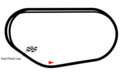 Track after renovation in 2019


The raceway was originally constructed with a 2.700 mi (4.345 km) road course that ran on both the inside and the outside of the main tri-oval. In 1991 the track was reconfigured with the 1.510 mi (2.430 km) interior layout. Phoenix Raceway currently has an estimated grandstand seating capacity of around 51,000. Lights were installed around the track in 2004 following the addition of a second annual NASCAR race weekend.
In November 2010, ISC and the Avondale City Council announced plans for a $100 million long-term development for Phoenix International Raceway. $15 million would go towards repaving the track for the first time since 1990 and building a new media center. The plans also include a reconfiguration of the track.[18] The front stretch was widened from 52 to 62 ft (16 to 19 m), the pit stalls were changed from asphalt to concrete, the dogleg (between Turn 2 and Turn 3) was moved outward by 95 ft (29 m), tightening the turn radius of the dogleg from 800 to 500 ft (240 to 150 m). Along with the other changes, progressive banking was added to the turns: Turns 1 and 2, which had 11 degrees of banking, changed to 10 degrees on the bottom and 11 degrees on the top. Turns 3 and 4, which had 9 degrees of banking, changed to 8 degrees on the bottom and 9 on the top. Project leader Bill Braniff, Senior Director of Construction for North American Testing Corporation (NATC), a subsidiary of Phoenix International Raceway's parent company International Speedway Corporation, said "All of the changes – including the adjustment of the dog-leg – will be put in place in order to present additional opportunities for drivers to race side-by-side. We’re very confident that we’ll have multi-groove racing at Phoenix from Day 1 because of the variable banking that will be implemented.”[19][20] The infield road course was also sealed off and removed from use, making Phoenix International Raceway an oval-only facility.[19] The reconfiguration project was completed by mid-August 2011, and on August 29–30, five drivers tested the new track, describing the new dogleg and backstretch as a "rollercoaster" as now when they enter it dips, then rises on exit and dips down going into turn 3, due to the elevation changes. On October 4–5, several NASCAR Cup Series teams tested the oval which was open to the public. Over $7 million went towards connecting the track property to the Avondale water and sewer systems. Work began following the 2011 Subway Fresh Fit 500.[18] The reconfiguration in 2011 increased the banking slightly, removed the road course entirely and removed the grass and curbing inside of the dogleg, giving sanctioning bodies the option of whether or not to allow drivers to shortcut the dogleg and run on the now-paved apron that replaced the grass.
Renovations in 2018 reconfigured the pit road and infield areas, and moved the start/finish line to just coming out of what was turn 2 (now turn 4), before the dogleg.
The owner of the track and NASCAR specified the oval length as exactly one mile. However, after a 2016 INDYCAR Test in the West, INDYCAR measured the track as 1.022 mi (1.645 km).[21] That was the first IndyCar race after the renovation in 2011, in which the dogleg was extended outwards. In 2019 the oval track was rebuilt again and the start / finish line was relocated. The length of the oval was not changed. Before the renovation in 2011, the racetrack was also accepted by USAC, CART and IndyCar with a length of exactly one mile.
Lap records[edit]
As of November 2020, the fastest official race lap records at Phoenix Raceway are listed as:
Racing events[edit]
Current events[edit]
- NASCAR Cup Series
- United Rentals Work United 500 (Spring, 2005–present)
- NASCAR Cup Series Championship Race (Fall, 1988–present)
- NASCAR Xfinity Series
- United Rentals 200 (Spring, 2005–present)
- NASCAR Xfinity Series Championship Race (Fall, 1999–present)
- NASCAR Camping World Truck Series
- Lucas Oil 150 (1995–present)
- ARCA Menards Series
- General Tire 150 (2020–present)
Previous events[edit]
- AMA Superbike Championship (1992–1993, 1997–1999)
- Atlantic Championship (1991–1995)
- Barber Pro Series (1992–1996, 2001)
- Can-Am (1987)
- CART
- Slick-50 200 (1979, 1981–1982, 1984, 1986–1995)
- Circle K/Fiesta Bowl 200 (1979–1986)
- Grand-Am Rolex Sports Car Series
- The GAINSCO Grand Prix (2000–2006)
- IMSA GT Championship
- Exxon World Sports Car Championships (1992–1995)
- IndyCar Series
- Desert Diamond West Valley Phoenix Grand Prix (1996–2005, 2016–2018)
- Indy Lights
- Phoenix Grand Prix (1986–1995, 2003–2005, 2016)
- NASCAR Craftsman Truck Series
- GM Goodwrench / AC Delco 300 (1995–1998)
- ARCA Menards Series West
- Casino Arizona 50 (1978–1984, 1988–1996, 2003–2004, 2010–2014)
- Talking Stick Resort 75 (1998–2014)
- NASCAR Mexico Series
- Toyota 120 (2013–2015)
- NASCAR Autozone Elite Division | Southwest (1988–2006)
- SCCA Formula Super Vee (1980–1990)
- Trans-Am Series (1995–1997)
- USAC IndyCar
- Jimmy Bryan 150 (1964–1972, 1974–1978)
- Bobby Ball 150 (1964–1978)
- USAC Honda National Midget Championship
- Copper World Classic (1980–2009)
- USAC Stock Car (1968, 1970)
- USAC Mini-Indy Series (1977–1978)
- U.S. F2000 National Championship (1990, 1992, 1997–1999, 2003)
NASCAR Cup Series stats[edit]
Records[edit]
(As of 11/6/22)
| Most Wins | 9 | Kevin Harvick |
| Most Top 5s | 19 | Kevin Harvick |
| Most Top 10s | 29 | Kevin Harvick |
| Starts | 40 | Kevin Harvick |
| Poles | 4 | Ryan Newman |
| Most Laps Completed | 9530 | Mark Martin |
| Most Laps Led | 1596 | Kevin Harvick |
| Avg. Start* | 8.1 | Rusty Wallace |
| Avg. Finish* | 5.2 | Alan Kulwicki |
| Closest Finish | 0.01 | Kevin Harvick |
* from minimum 5 starts.
Race winners[edit]
- (*) Rain-shortened event
- (**) Race extended due to green-white-checker finish
- a April race extended to 375 laps (600 km)
- b November 2011 races when track reconfigured to 1.022 miles
| Season | Date | Winning Driver | Make | Distance | Avg Speed | Margin of Victory |
|---|---|---|---|---|---|---|
| 1988 | November 6 | Alan Kulwicki | Ford Thunderbird | 312 mi | 90.457 mph (145.576 km/h) | 18.500 sec |
| 1989 | November 5 | Bill Elliott | Ford Thunderbird | 312 mi | 105.683 mph (170.080 km/h) | 0.470 sec |
| 1990 | November 4 | Dale Earnhardt | Chevrolet Lumina | 312 mi | 96.786 mph (155.762 km/h) | 0.670 sec |
| 1991 | November 3 | Davey Allison | Ford Thunderbird | 312 mi | 95.746 mph (154.088 km/h) | 11.440 sec |
| 1992 | November 1 | Davey Allison | Ford Thunderbird | 312 mi | 103.885 mph (167.187 km/h) | 3.220 sec |
| 1993 | October 31 | Mark Martin | Ford Thunderbird | 312 mi | 100.375 mph (161.538 km/h) | 0.170 sec |
| 1994 | October 30 | Terry Labonte | Chevrolet Lumina | 312 mi | 107.463 mph (172.945 km/h) | 3.090 sec |
| 1995 | October 29 | Ricky Rudd | Ford Thunderbird | 312 mi | 102.128 mph (164.359 km/h) | 0.530 sec |
| 1996 | October 27 | Bobby Hamilton | Pontiac Grand Prix | 312 mi | 109.709 mph (176.560 km/h) | 1.230 sec |
| 1997 | November 2 | Dale Jarrett | Ford Thunderbird | 312 mi | 110.824 mph (178.354 km/h) | 2.105 sec |
| 1998 | October 25 | Rusty Wallace | Ford Taurus | 257 mi* | 100.375 mph (161.538 km/h) | 0.170 sec |
| 1999 | November 7 | Tony Stewart | Pontiac Grand Prix | 312 mi | 118.132 mph (190.115 km/h) | 2.081 sec |
| 2000 | November 5 | Jeff Burton | Ford Taurus | 312 mi | 105.041 mph (169.047 km/h) | 0.854 sec |
| 2001 | October 28 | Jeff Burton | Ford Taurus | 312 mi | 102.613 mph (165.140 km/h) | 2.645 sec |
| 2002 | November 10 | Matt Kenseth | Ford Taurus | 312 mi | 113.857 mph (183.235 km/h) | 1.344 sec |
| 2003 | November 2 | Dale Earnhardt Jr. | Chevrolet Monte Carlo SS | 312 mi | 93.984 mph (151.253 km/h) | 0.735 sec |
| 2004 | November 7 | Dale Earnhardt Jr. | Chevrolet Monte Carlo SS | 315 mi** | 94.848 mph (152.643 km/h) | 1.431 sec |
| 2005 | April 23 | Kurt Busch | Ford Taurus | 312 mi | 102.707 mph (165.291 km/h) | 2.315 sec |
| November 13 | Kyle Busch | Chevrolet Monte Carlo SS | 312 mi | 102.641 mph (165.185 km/h) | 0.609 sec | |
| 2006 | April 22 | Kevin Harvick | Chevrolet Monte Carlo SS | 312 mi | 107.063 mph (172.301 km/h) | 2.774 sec |
| November 13 | 96.131 mph (154.708 km/h) | 0.250 sec | ||||
| 2007 | April 21 | Jeff Gordon | Chevrolet Impala SS | 312 mi | 107.71 mph (173.342 km/h) | 0.697 sec |
| November 11 | Jimmie Johnson | Chevrolet Impala SS | 312 mi | 102.989 mph (165.745 km/h) | 0.870 sec | |
| 2008 | April 12 | Jimmie Johnson | Chevrolet Impala SS | 312 mi | 103.292 mph (166.232 km/h) | 7.002 sec |
| November 9 | 313 mi** | 104.725 mph (168.539 km/h) | 0.295 sec | |||
| 2009 | April 18 | Mark Martin | Chevrolet Impala SS | 312 mi | 108.042 mph (173.877 km/h) | 0.734 sec |
| November 15 | Jimmie Johnson | Chevrolet Impala SS | 312 mi | 110.486 mph (177.810 km/h) | 1.033 sec | |
| 2010 | April 10 | Ryan Newman | Chevrolet Impala SS | 378 mi**a | 99.732 mph (160.503 km/h) | 0.130 sec |
| November 14 | Carl Edwards | Ford Fusion | 312 mi | 110.758 mph (178.248 km/h) | 4.770 sec | |
| 2011 | February 27 | Jeff Gordon | Chevrolet Impala SS | 312 mi | 102.961 mph (165.700 km/h) | 1.137 sec |
| November 13 | Kasey Kahne | Toyota Camry | 318.844 mi | 112.909 mph (181.709 km/h) | 0.802 sec | |
| 2012 | March 4 | Denny Hamlin | Toyota Camry | 318.844 mi | 110.085 mph (177.165 km/h) | 7.315 sec |
| November 11 | Kevin Harvick | Chevrolet Impala SS | 326.018 mi** | 111.182 mph (178.930 km/h) | 0.580 sec | |
| 2013 | March 3 | Carl Edwards | Ford Fusion | 322.952 mi** | 105.187 mph (169.282 km/h) | 1.024 sec |
| November 10 | Kevin Harvick | Chevrolet SS | 318.844 mi | 105.733 mph (170.161 km/h) | 1.796 sec | |
| 2014 | March 2 | Kevin Harvick | Chevrolet SS | 318.844 mi | 109.229 mph (175.787 km/h) | 0.489 sec |
| November 9 | 318.844 mi | 99.991 mph (160.920 km/h) | 1.636 sec | |||
| 2015 | March 15 | Kevin Harvick | Chevrolet SS | 318.844 mi | 105.753 mph (170.193 km/h) | 1.153 sec |
| November 15 | Dale Earnhardt Jr. | Chevrolet SS | 223.818 mi* | 106.512 mph (171.414 km/h) | Under caution | |
| 2016 | March 13 | Kevin Harvick | Chevrolet SS | 313 mi** | 113.212 mph (182.197 km/h) | 0.010 sec |
| November 13 | Joey Logano | Ford Fusion | 331.128 mi | 102.866 mph (165.547 km/h) | 0.802 sec | |
| 2017 | March 19 | Ryan Newman | Chevrolet SS | 320.908** mi | 104.271 mph (167.808 km/h) | 0.312 sec |
| November 12 | Matt Kenseth | Toyota Camry | 318.844 mi | 105.534 mph (169.841 km/h) | 1.207 sec | |
| 2018 | March 11 | Kevin Harvick | Ford Fusion | 318.844 mi | 108.073 mph (173.927 km/h) | 0.774 sec |
| November 11 | Kyle Busch | Toyota Camry | 318.844 mi | 98.354 mph (158.285 km/h) | 0.501 sec | |
| 2019 | March 10 | Kyle Busch | Toyota Camry | 318.844 mi | 101.693 mph (163.659 km/h) | 1.259 sec |
| November 10 | Denny Hamlin | Toyota Camry | 318.884 mi | 111.429 mph (179.328 km/h) | 0.377 sec | |
| 2020 | March 8 | Joey Logano | Ford Mustang | 318.884 mi | 94.407 mph (151.933 km/h) | 0.276 sec |
| November 8 | Chase Elliott | Chevrolet Camaro ZL1 | 318.884 mi | 112.096 mph (180.401 km/h) | 2.740 sec | |
| 2021 | March 14 | Martin Truex Jr. | Toyota Camry | 318.884 mi | 103.808 mph (167.063 km/h) | 1.680 sec |
| November 7 | Kyle Larson | Chevrolet Camaro ZL1 | 318.884 mi | 100.348 mph (161.494 km/h) | 0.472 sec | |
| 2022 | March 13 | Chase Briscoe | Ford Mustang | 318.884 mi | 100.339 mph (161.479 km/h) | 0.771 sec |
Track records[edit]
| Record | Date | Driver | Time | Speed/Avg. Speed | |
|---|---|---|---|---|---|
| IndyCar Series | |||||
| Qualifying- 2 laps | April 28, 2017 | Hélio Castroneves | 37.7538 | 194.905 mph (313.669 km/h) | |
| Race | March 19, 2005 | Sam Hornish Jr. | 1:30:24 | 137.753 mph (221.692 km/h) (before reconfiguration) | |
| Indy Lights | |||||
| Qualifying- 2 laps | April 1, 2016 | Kyle Kaiser | 43.8334 | 167.872 mph (270.164 km/h) | |
| Race | April 2, 2016 | Kyle Kaiser | 36:57.9123 | 149.297 mph (240.270 km/h) | |
| NASCAR Cup Series | |||||
| Qualifying | November 13, 2015 | Jimmie Johnson | 25.147 | 146.308 mph (235.460 km/h) | |
| Race | November 7, 1999 | Tony Stewart | 2:38:28 | 118.132 mph (190.115 km/h) (before reconfiguration) | |
| NASCAR Xfinity Series | |||||
| Qualifying | November 14, 2015 | Kyle Busch | 25.992 | 141.933 mph (228.419 km/h) | |
| Race | November 4, 2000 | Jeff Burton | 1:44:13 | 115.145 mph (185.308 km/h) | |
| NASCAR Truck Series | |||||
| Qualifying | November 13, 2015 | Erik Jones | 26.179 | 137.515 mph (221.309 km/h) | |
| Race | November 7, 2002 | Kevin Harvick | 1:24:26 | 108.104 mph (173.977 km/h) (before reconfiguration) | |
| ARCA Menards Series West | |||||
| Qualifying | November 12, 2011 | Greg Pursley | 26.894 | 136.804 mph (220.165 km/h)[42] | |
| Race | October 5, 2003 | Scott Lynch | 1:18:46 | 114.262 mph (183.887 km/h) (before reconfiguration) | |
| CART | |||||
| Qualifying | April 1, 1995 | Bryan Herta | 19.019 | 181.952 mph (292.823 km/h) (before reconfiguration) | |
| Race | April 12, 1987 | Roberto Guerrero | 1:26:56 | 138.020 mph (222.122 km/h) (before reconfiguration) | |
| USAC | |||||
| Qualifying | October 27, 1978 | Danny Ongais | 36.285 | 145.513 mph (234.180 km/h) | |
| Race | November 4, 1972 | Bobby Unser | 1:27:32 | 127.618 mph (205.381 km/h) | |
Source:[43]
| |||||
NOTE: Calculations based on the 1.022 mile standard established in 2016 by INDYCAR.
Other events[edit]
Phoenix Raceway hosts Arizona’s Goldeush, Decadence, and PHXLIGHTS festivals each year. In addition, the track hosts frequent headlining shows. Certain events have been held in the Raceway infield and pit lane; most are held in the area just behind the main grandstand, using the structure itself as a backdrop. American DJ Subtronics holds the record for the largest headlining EDM show at the venue (and in Arizona’s history), with an attendance figure of over 15,000 in April 2023.
See also[edit]
References[edit]
- ^ a b Page, Scott (January 27, 2019). "International Speedway Corporation continues to reduce tack seating". Jayski's Silly Season Site. ESPN. Retrieved January 29, 2019.
- ^ a b "Home". Archived from the original on October 31, 2020. Retrieved August 2, 2020.
- ^ "The best seat in NASCAR isn't really a seat at all". Nascar.com. August 12, 2010. Retrieved November 16, 2010.
- ^ Long, Dustin (May 31, 2023). "NASCAR Championship Weekend returns to Phoenix in 2024". Nascar.com. Retrieved June 15, 2023.
- ^ a b "Phoenix Raceway". Autoracing.com. Retrieved November 16, 2010.
- ^ Caraviello, David (April 12, 2008). "The best seat in NASCAR isn't really a seat at all". Nascar.com. Retrieved November 16, 2010.
- ^ Radosta, John S. (February 25, 1973). "Three Auto Race Tracks Are Back in the Running". The New York Times. Retrieved November 2, 2020.
- ^ Reynard, Calvin (August 29, 1976). "FasTrack Dead, Long Live PIR". Arizona Daily Star. Retrieved November 2, 2020 – via Newspapers.com.
- ^ a b c d "Timeline". Phoenixraceway.com. Archived from the original on January 16, 2014. Retrieved November 16, 2010.
- ^ Knight, Michael (June 11, 2015). "PIR to be renamed in honor of Jeff Gordon for fall race". The Arizona Republic. Retrieved June 11, 2015.
- ^ "NASCAR Official Home | Race results, schedule, standings, news, drivers".
- ^ Jeff Gluck [@jeff_gluck] (January 30, 2017). "More Phoenix tidbits: — Track using "Phoenix Raceway" in marketing now. — No more infield camping" (Tweet) – via Twitter.
- ^ "New Amenities - Phoenix International Raceway". Archived from the original on August 11, 2017. Retrieved February 2, 2017.
- ^ Knight, Michael (September 25, 2017). "Phoenix International Raceway to become ISM Raceway starting in 2018". The Arizona Republic. Retrieved October 5, 2017.
- ^ "Phoenix removed from IndyCar schedule for 2019".
- ^ Norman, Brad (March 26, 2019). "2020 NASCAR schedule unveiled, with plenty of changes | NASCAR.com". NASCAR.com. Retrieved March 31, 2019.
- ^ Knight, Michael (January 3, 2020). "Call it Phoenix Raceway again -- ISM naming rights discontinued at Avondale track | AZCentral.com". AZCentral.com. Retrieved January 3, 2020.
- ^ a b Madrid, David. "PIR starts its engine on $100M expansion". azcentral.com. Retrieved November 21, 2010.
- ^ a b "PIR TO BE REPAVED AFTER FEBRUARY RACE - Phoenix International Raceway". Archived from the original on September 27, 2017. Retrieved February 24, 2011.
- ^ Montedonico, Ben (February 26, 2011). "A Layout Of The Phoenix International Raceway Reconfiguration". StockCar Spin. Retrieved March 23, 2016.
- ^ http://www.imscdn.com/INDYCAR/Documents/3413/2016-04-02/indycar-eventsummary.pdf [bare URL PDF]
- ^ a b c d "Phoenix Raceway - Racing Circuits". Retrieved June 9, 2022.
- ^ a b c "Phoenix - Motorsport Magazine". Retrieved May 27, 2022.
- ^ "2016 Phoenix Indy Lights". Retrieved June 9, 2022.
- ^ "2019 Bluegreen Vacations 500". Retrieved June 9, 2022.
- ^ "NASCAR Truck 2020 Phoenix". Retrieved June 9, 2022.
- ^ "NASCAR XFINITY 2018 Phoenix Results | NASCAR XFINITY Race Results". Retrieved June 9, 2022.
- ^ "1996 Phoenix Indycars". Retrieved July 16, 2022.
- ^ "1995 Phoenix Champ Cars". Retrieved July 16, 2022.
- ^ "1995 Phoenix Indy Lights". Retrieved March 19, 2023.
- ^ "Auto Racing". The Sunday Oregonian. April 10, 1988.
Mark earned his first Super Vee pole position with a fast lap of 26.274, 137.017 mph on the one mile Phoenix oval.
- ^ a b "2 h Phoenix 1992". Retrieved July 3, 2022.
- ^ a b c d "200 mile Phoenix 2002". Retrieved July 3, 2022.
- ^ a b "2 h Phoenix 1995". Retrieved July 3, 2022.
- ^ a b c "250 mile Phoenix 2004". Retrieved July 3, 2022.
- ^ a b "Phoenix 1 Hour IMSA GTS 1993". Retrieved July 3, 2022.
- ^ "250 mile Phoenix 2003". Retrieved July 3, 2022.
- ^ a b "200 mile Phoenix 2000". Retrieved July 3, 2022.
- ^ "IMSA Supercar Phoenix 1993". Retrieved July 3, 2022.
- ^ "National Open Phoenix 1964". Retrieved July 3, 2022.
- ^ "SCCA National Phoenix [AP+BP] 1965". Retrieved July 3, 2022.
- ^ Green, Kevin (November 12, 2011). "Qualifying: Pursley Tops The Field". NASCAR Home Tracks. Archived from the original on April 2, 2012. Retrieved November 12, 2011.
- ^ "Race Results at Phoenix International Raceway". racing-reference.info. Retrieved November 15, 2010.
External links[edit]

- Official Site
- Phoenix Raceway race results at Racing-Reference
- PIR Page on NASCAR.com
- RacewayReport.com: Phoenix International Raceway Page – Local area information, track specs, mapping, news and more.
- Trackpedia guide to driving this track
- High Resolution image from Google Maps
| International | |
|---|---|
| Geographic | |

- Avondale, Arizona
- Champ Car circuits
- IMSA GT Championship circuits
- IndyCar Series tracks
- Motorsport venues in Arizona
- NASCAR races at Phoenix Raceway
- NASCAR tracks
- ARCA Menards Series tracks
- Sports in Maricopa County, Arizona
- Sports venues in Maricopa County, Arizona
- 1964 establishments in Arizona
- Sports venues completed in 1964