


European pine marten
| European pine marten | |
|---|---|
.jpg)
| |
Scientific classification 
| |
| Domain: | Eukaryota |
| Kingdom: | Animalia |
| Phylum: | Chordata |
| Class: | Mammalia |
| Order: | Carnivora |
| Family: | Mustelidae |
| Genus: | Martes |
| Species: | M. martes
|
| Binomial name | |
| Martes martes | |

| |
| European pine marten range (green – native, red – introduced) | |
| Synonyms | |
|
Mustela martes Linnaeus, 1758 | |
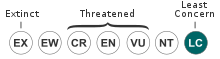
The European pine marten (Martes martes), also known as the pine marten, is a mustelid native to and widespread in most of Europe, Asia Minor, the Caucasus and parts of Iran, Iraq and Syria. It is listed as Least Concern on the IUCN Red List.[1] It is less commonly also known as baum marten[2] or sweet marten.[3]
Description
[edit]
The European pine marten's fur is usually light to dark brown. It is short and coarse in the summer, growing longer and silkier during the winter. It has a cream- to yellow-coloured "bib" marking on its throat. Its body is up to 53 cm (21 in) long, with a bushy tail of about 25 cm (9.8 in). It weighs around 1.5–1.7 kg (3.3–3.7 lb); males are slightly larger than females. It has excellent senses of sight, smell, and hearing.[4]
Distribution and habitat
[edit]Scotland, Ireland, England and Wales
[edit]
The European pine marten was for many years common only in northwestern Scotland.[5] A study in 2012 found that it has spread from the Scottish Highlands north into Sutherland and Caithness and southeastwards from the Great Glen into Moray, Aberdeenshire, Perthshire, Tayside, and Stirlingshire, with some in the Central Belt, on the Kintyre and Cowal peninsulas and on Skye and Mull. The expansion in the Galloway Forest has been limited compared with that in the core marten range. Martens were reintroduced to the Glen Trool Forest in the early 1980s and only restricted spread has occurred from there.[6]
In England, the European pine marten was considered to be extinct. Analysis of a scat found at Kidland Forest in Northumberland in June 2010 may represent either a recolonisation from Scotland, or a relict population that has escaped notice previously.[7] There have been numerous reported sightings of European pine martens in Cumbria; however, only in 2011, scat was found and DNA-tested,[8] followed in October 2022 by images of a European pine marten in Grizedale Forest.[9]
In July 2015, the first confirmed sighting of a European pine marten in England for over a century was recorded by an amateur photographer in the woodlands of Shropshire.[10] Sightings have continued in the area and juveniles were recorded in 2019, indicating a breeding population.[11] In July 2017, footage of a live European pine marten was captured by a camera trap in the North York Moors in Yorkshire;[12][13] in March 2018, the first ever footage of a European pine marten in Northumberland was captured by the Back from the Brink pine marten project.[14]
The European pine marten's presence in Southern England's New Forest was confirmed in 2021.[15][16] In September 2022, the first European pine marten to be seen in London in a century was spotted by the Zoological Society of London's wildlife cameras as part of a hedgehog monitoring program.[17] The Kent Wildlife Trust in collaboration with the Sussex Wildlife Trust announced a project in February 2024 to assess the feasibility of reintroducing European pine martens to South East England.[18][19]
There is a small population of the European pine marten in Wales. Scat found in Cwm Rheidol forest in 2007 was confirmed by DNA testing to be from a European pine marten. A male was found in 2012 as road kill near Newtown, Powys. This was the first confirmation in Wales of the species, living or dead, since 1971.[20] The Vincent Wildlife Trust (VWT) has begun a reinforcement of these mammals in the mid-Wales area. During autumn 2015, 20 European pine martens were captured in Scotland, in areas where a healthy European pine marten population occurs, under licence from Scottish Natural Heritage. These individuals were translocated and released in an area of mid-Wales. All of the martens were fitted with radio collars and are being tracked daily to monitor their movements and find out where they have set up territories. During autumn 2016, the VWT planned to capture and release another 20 European pine martens in the hope of creating a self-sustaining population.[21] Following the success of these projects, 35 European pine martens were reintroduced between 2019 and 2021 to the Forest of Dean in South West England where they were last seen in 1860,[22][23] with the hope that in time they will merge with the growing population in Wales to form a contiguous presence.[24] After successful breeding every year, by 2023 their numbers were estimated to be approaching 60.[25]
The European pine marten is still quite rare in Ireland, but the population is recovering and spreading; its traditional strongholds are in the west and south, especially the Burren and Killarney National Park, but the population in the Midlands has significantly increased in recent years.[26] A study managed by academics at Queen's University Belfast, using cameras and citizen scientists, published in 2015, showed that European pine martens were distributed across all counties of Northern Ireland.[27]
Behaviour and ecology
[edit]

The European pine marten is the only mustelid with semiretractable claws. This enables them to lead more arboreal lifestyles, such as climbing or running on tree branches, although they are also relatively quick runners on the ground. They are mainly active at night and dusk. They have small, rounded, highly sensitive ears and sharp teeth adapted for eating small mammals, birds, insects, frogs, and carrion. They have also been known to eat berries, fruits, birds' eggs, nuts, and honey. The European pine marten is territorial and marks its home range by depositing feces. Its scat is black and twisted.[5]
The recovery of the European pine marten in Ireland has been credited with reducing the population of invasive grey squirrels.[28] Where the range of the expanding European pine marten population meets that of the grey squirrel, the population of the grey squirrels quickly retreats and the red squirrel population recovers. Because the grey squirrel spends more time on the ground than the red squirrel, which co-evolved with the pine marten, they are thought to be far more likely to come in contact with this predator.[29]
Lifespan
[edit]The European pine marten has lived to 18 years in captivity, but the maximum age recorded in the wild is only 11 years, with 3–4 years being more typical. They reach sexual maturity at 2–3 years of age. Copulation usually occurs on the ground and can last more than 1 hour.[30] Mating occurs in July and August but the fertilized egg does not enter the uterus for about 7 months. The young are usually born in late March or early April after a month-long gestation period that happens after the implantation of the fertilized egg, in litters of one to five.[4] Young European pine martens weigh around 30 g (1.1 oz) at birth. The young begin to emerge from their dens around 7–8 weeks after birth and are able to disperse from the den around 12–16 weeks after their birth.[citation needed]
Predators
[edit]Larger mammalian predators and birds of prey such as Eurasian lynx, wolverine, red fox, golden eagle, white-tailed eagle, northern goshawk and Eurasian eagle owl prey on European pine martens, especially young individuals.[31]
Threats
[edit]Humans are the greatest threat to the European pine marten. They are vulnerable to conflict with humans, arising from predator control for other species, or following predation of livestock and the use of inhabited buildings for denning. Martens may also be affected by woodland loss, which results in habitat loss for the animal.[6] Persecution (illegal poisoning and shooting), loss of habitat leading to fragmentation, and other human disturbances have caused a considerable decline in the European pine marten population. In some areas, they are also prized for their very fine fur. In the UK, European pine martens and their dens are offered full protection under the Wildlife and Countryside Act 1981 and the Environmental Protection Act 1990.[32]
In culture
[edit]The European pine marten is one of the national symbols of Croatia[33] and appears on the Croatian euro coins. Previously, the European pine marten appeared on the obverse side of the 1-, 2-, 5-, and 25-Croatian kuna,[34] the word "kuna" meaning "marten" in Croatian.[35]
See also
[edit]References
[edit]- ^ a b Herrero, J.; Kranz, A.; Skumatov, D.; Abramov, A.V.; Maran, T.; Monakhov, V.G. (2016). "Martes martes". IUCN Red List of Threatened Species. 2016: e.T12848A45199169. doi:10.2305/IUCN.UK.2016-1.RLTS.T12848A45199169.en. Retrieved 19 November 2021.
- ^ "Definition of 'baum marten'". Collins Dictionary. Retrieved 2 February 2019.
- ^ "Definition of 'sweet marten'". Collins Dictionary. Retrieved 2 February 2019.
- ^ a b "Pine marten". Trees for Life (Scotland). Retrieved 4 June 2022.
- ^ a b "Pine marten". Vincent Wildlife Trust. 12 March 2015. Retrieved 10 March 2018.
- ^ a b Croose, E.; Birks, J.D.S.; Schofield, H.W. (2013). Expansion zone survey of pine marten (Martes martes) distribution in Scotland (Project no: 13645) (PDF) (Commissioned Report). Vol. 520. Vincent Wildlife Trust; Scottish Natural Heritage. Archived from the original (PDF) on 3 May 2015. Retrieved 18 August 2013.
- ^ "Found at last! pine marten rediscovered in Northumberland". Northumberland Wildlife Trust. 2010. Archived from the original on 10 March 2018. Retrieved 10 March 2018.
{{cite web}}: CS1 maint: unfit URL (link) - ^ "Pine Marten rediscovered in Cumbria after 10 years!". Wild Travel Magazine. 2011. Archived from the original on 18 October 2014. Retrieved 14 October 2014.
- ^ "First Grizedale Forest pine marten in 10 years caught on camera". BBC News. 2022.
- ^ "Shropshire pine marten sighting is the first in a century". BBC News. 2015. Retrieved 4 June 2022.
- ^ "Shropshire Pine Marten Project". Shropshire Wildlife Trust. Retrieved 4 June 2022.
- ^ "Rare pine marten captured on camera in Yorkshire". BBC News. 2017. Retrieved 4 June 2022.
- ^ "First ever images of pine marten in Yorkshire". NatureSpy. 2017. Retrieved 8 March 2018.
- ^ "Rare pine marten captured on camera in Northumberland". Northumberland Gazette. 2018. Retrieved 31 July 2018.
- ^ "Hidden cameras spot New Forest pine marten". BBC News. 2021. Retrieved 2023-10-30.
- ^ "Rare animal returns to the New Forest after an absence of decades". Daily Echo. 2024. Retrieved 2024-01-07.
- ^ "Endangered pine marten spotted in London for the first time in 100 years". BBC Science Focus Magazine. Retrieved 2022-09-13.
- ^ "South East Pine Marten Restoration Project | Kent Wildlife Trust". www.kentwildlifetrust.org.uk. Retrieved 2024-03-06.
- ^ "Kent and Sussex could see pine marten populations reintroduced". BBC News. 2024. Retrieved 2024-03-06.
- ^ McCarthy, Michael (2012). "'Extinct' animal turns up in Wales as roadside carcass proves elusive pine martens still exist". The Independent. Retrieved 4 June 2022.
- ^ "Pine Marten Recovery Projects". Vincent Wildlife Trust. 2015. Retrieved 10 March 2018.
- ^ "Pine martens reintroduced to England | The Wildlife Trusts". www.wildlifetrusts.org. 2019-10-01. Retrieved 2023-11-17.
- ^ "Forest's pine martens are crossing the Wye". The Forester. 2021. Retrieved 2023-10-31.
- ^ "Project Pine Marten | Gloucestershire Wildlife Trust". www.gloucestershirewildlifetrust.co.uk. Retrieved 2023-10-31.
- ^ "Forest of Dean: Another successful breeding year for pine martens". BBC News. 2023. Retrieved 2023-10-31.
- ^ Kelleher, Lynn (4 March 2013). "Red squirrels make comeback as pine martens prey on greys". Irish Independent. Retrieved 4 June 2022.
- ^ Macauley, Connor (6 July 2015). "QUB study shows pine martens are more common in NI than thought". BBC News. Retrieved 4 June 2022.
- ^ Sheehy, E.; Lawton, C. (2014). "Population crash in an invasive species following the recovery of a native predator: the case of the American grey squirrel and the European pine marten in Ireland". Biodiversity and Conservation. 23 (3): 753–774. Bibcode:2014BiCon..23..753S. doi:10.1007/s10531-014-0632-7. S2CID 10449048.
- ^ "The Pine Marten: FAQs". Pine Marten Recovery Project. Retrieved 31 March 2018.
- ^ Forder, V. (2006). "Mating behaviour in captive pine martens Martes martes" (PDF). Wildwood Trust. Archived from the original (PDF) on 10 March 2018. Retrieved 10 March 2018.
- ^ Heptner, V. G. "Mammals of Soviet Union. Sea cows and carnivora." Vysshaya shkola 2 (1967): 1-1004.
- ^ "Pine marten (Martes martes)". ARKive. Archived from the original on 24 March 2010. Retrieved 18 August 2013.
- ^ Olivia, L. (2023). "What is the National Animal of Croatia?". Inspired by Croatia. Retrieved 2 February 2024.
- ^ "1 Kuna (Latin text) - Croatia". Numista. 2024. Retrieved 2 February 2024.
- ^ "Money in Croatia". Visit Croatia. 3 April 2013. Retrieved 18 February 2020.
Further reading
[edit]- Macdonald, David W. (2001). Mammals of Europe. Princeton University Press. ISBN 978-06910-9-160-0.

