


Regular prime

In number theory, a regular prime is a special kind of prime number, defined by Ernst Kummer in 1850 to prove certain cases of Fermat's Last Theorem. Regular primes may be defined via the divisibility of either class numbers or of Bernoulli numbers.
The first few regular odd primes are:
- 3, 5, 7, 11, 13, 17, 19, 23, 29, 31, 41, 43, 47, 53, 61, 71, 73, 79, 83, 89, 97, 107, 109, 113, 127, 137, 139, 151, 163, 167, 173, 179, 181, 191, 193, 197, 199, ... (sequence A007703 in the OEIS).
History and motivation
[edit]In 1850, Kummer proved that Fermat's Last Theorem is true for a prime exponent p if p is regular. This focused attention on the irregular primes.[1] In 1852, Genocchi was able to prove that the first case of Fermat's Last Theorem is true for an exponent p, if (p, p − 3) is not an irregular pair. Kummer improved this further in 1857 by showing that for the "first case" of Fermat's Last Theorem (see Sophie Germain's theorem) it is sufficient to establish that either (p, p − 3) or (p, p − 5) fails to be an irregular pair.
((p, 2k) is an irregular pair when p is irregular due to a certain condition described below being realized at 2k.)
Kummer found the irregular primes less than 165. In 1963, Lehmer reported results up to 10000 and Selfridge and Pollack announced in 1964 to have completed the table of irregular primes up to 25000. Although the two latter tables did not appear in print, Johnson found that (p, p − 3) is in fact an irregular pair for p = 16843 and that this is the first and only time this occurs for p < 30000.[2] It was found in 1993 that the next time this happens is for p = 2124679; see Wolstenholme prime.[3]
Definition
[edit]Class number criterion
[edit]An odd prime number p is defined to be regular if it does not divide the class number of the pth cyclotomic field Q(ζp), where ζp is a primitive pth root of unity.
The prime number 2 is often considered regular as well.
The class number of the cyclotomic field is the number of ideals of the ring of integers Z(ζp) up to equivalence. Two ideals I, J are considered equivalent if there is a nonzero u in Q(ζp) so that I = uJ. The first few of these class numbers are listed in OEIS: A000927.
Kummer's criterion
[edit]Ernst Kummer (Kummer 1850) showed that an equivalent criterion for regularity is that p does not divide the numerator of any of the Bernoulli numbers Bk for k = 2, 4, 6, ..., p − 3.
Kummer's proof that this is equivalent to the class number definition is strengthened by the Herbrand–Ribet theorem, which states certain consequences of p dividing the numerator of one of these Bernoulli numbers.
Siegel's conjecture
[edit]It has been conjectured that there are infinitely many regular primes. More precisely Carl Ludwig Siegel (1964) conjectured that e−1/2, or about 60.65%, of all prime numbers are regular, in the asymptotic sense of natural density.
Taking Kummer's criterion, the chance that one numerator of the Bernoulli numbers , , is not divisible by the prime is




so that the chance that none of the numerators of these Bernoulli numbers are divisible by the prime is
- .

By E_(mathematical_constant), we have
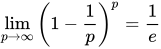
so that we obtain the probability
- .

It follows that about of the primes are regular by chance. Hart et al.[4] indicate that of the primes less than are regular.



Irregular primes
[edit]An odd prime that is not regular is an irregular prime (or Bernoulli irregular or B-irregular to distinguish from other types of irregularity discussed below). The first few irregular primes are:
- 37, 59, 67, 101, 103, 131, 149, 157, 233, 257, 263, 271, 283, 293, 307, 311, 347, 353, 379, 389, 401, 409, 421, 433, 461, 463, 467, 491, 523, 541, 547, 557, 577, 587, 593, ... (sequence A000928 in the OEIS)
Infinitude
[edit]K. L. Jensen (a student of Nielsen[5]) proved in 1915 that there are infinitely many irregular primes of the form 4n + 3.[6] In 1954 Carlitz gave a simple proof of the weaker result that there are in general infinitely many irregular primes.[7]
Metsänkylä proved in 1971 that for any integer T > 6, there are infinitely many irregular primes not of the form mT + 1 or mT − 1,[8] and later generalized this.[9]
Irregular pairs
[edit]If p is an irregular prime and p divides the numerator of the Bernoulli number B2k for 0 < 2k < p − 1, then (p, 2k) is called an irregular pair. In other words, an irregular pair is a bookkeeping device to record, for an irregular prime p, the particular indices of the Bernoulli numbers at which regularity fails. The first few irregular pairs (when ordered by k) are:
- (691, 12), (3617, 16), (43867, 18), (283, 20), (617, 20), (131, 22), (593, 22), (103, 24), (2294797, 24), (657931, 26), (9349, 28), (362903, 28), ... (sequence A189683 in the OEIS).
The smallest even k such that nth irregular prime divides Bk are
- 32, 44, 58, 68, 24, 22, 130, 62, 84, 164, 100, 84, 20, 156, 88, 292, 280, 186, 100, 200, 382, 126, 240, 366, 196, 130, 94, 292, 400, 86, 270, 222, 52, 90, 22, ... (sequence A035112 in the OEIS)
For a given prime p, the number of such pairs is called the index of irregularity of p.[10] Hence, a prime is regular if and only if its index of irregularity is zero. Similarly, a prime is irregular if and only if its index of irregularity is positive.
It was discovered that (p, p − 3) is in fact an irregular pair for p = 16843, as well as for p = 2124679. There are no more occurrences for p < 109.
Irregular index
[edit]An odd prime p has irregular index n if and only if there are n values of k for which p divides B2k and these ks are less than (p − 1)/2. The first irregular prime with irregular index greater than 1 is 157, which divides B62 and B110, so it has an irregular index 2. Clearly, the irregular index of a regular prime is 0.
The irregular index of the nth prime is
- 0, 0, 0, 0, 0, 0, 0, 0, 0, 0, 1, 0, 0, 0, 0, 1, 0, 1, 0, 0, 0, 0, 0, 0, 1, 1, 0, 0, 0, 0, 1, 0, 0, 1, 0, 2, 0, 0, 0, 0, 0, 0, 0, 0, 0, 0, 0, 0, 0, 1, 0, 0, 0, 1, 1, 0, 1, 0, 0, 1, 1, 1, 1, 0, 0, 0, 0, 1, 0, 2, 0, ... (Start with n = 2, or the prime = 3) (sequence A091888 in the OEIS)
The irregular index of the nth irregular prime is
- 1, 1, 1, 1, 1, 1, 1, 2, 1, 1, 1, 1, 1, 1, 1, 1, 1, 2, 2, 1, 1, 1, 1, 1, 1, 1, 2, 3, 1, 1, 2, 1, 1, 2, 1, 1, 1, 3, 1, 2, 3, 1, 1, 2, 1, 1, 2, 1, 1, 1, 1, 1, 1, 2, 1, 1, 1, 1, 1, 1, 1, 2, 1, 1, 1, 1, 1, 1, 3, 1, 1, 1, ... (sequence A091887 in the OEIS)
The primes having irregular index 1 are
- 37, 59, 67, 101, 103, 131, 149, 233, 257, 263, 271, 283, 293, 307, 311, 347, 389, 401, 409, 421, 433, 461, 463, 523, 541, 557, 577, 593, 607, 613, 619, 653, 659, 677, 683, 727, 751, 757, 761, 773, 797, 811, 821, 827, 839, 877, 881, 887, 953, 971, ... (sequence A073276 in the OEIS)
The primes having irregular index 2 are
- 157, 353, 379, 467, 547, 587, 631, 673, 691, 809, 929, 1291, 1297, 1307, 1663, 1669, 1733, 1789, 1933, 1997, 2003, 2087, 2273, 2309, 2371, 2383, 2423, 2441, 2591, 2671, 2789, 2909, 2957, ... (sequence A073277 in the OEIS)
The primes having irregular index 3 are
- 491, 617, 647, 1151, 1217, 1811, 1847, 2939, 3833, 4003, 4657, 4951, 6763, 7687, 8831, 9011, 10463, 10589, 12073, 13217, 14533, 14737, 14957, 15287, 15787, 15823, 16007, 17681, 17863, 18713, 18869, ... (sequence A060975 in the OEIS)
The least primes having irregular index n are
- 2, 3, 37, 157, 491, 12613, 78233, 527377, 3238481, ... (sequence A061576 in the OEIS) (This sequence defines "the irregular index of 2" as −1, and also starts at n = −1.)
Generalizations
[edit]Euler irregular primes
[edit]Similarly, we can define an Euler irregular prime (or E-irregular) as a prime p that divides at least one Euler number E2n with 0 < 2n ≤ p − 3. The first few Euler irregular primes are
- 19, 31, 43, 47, 61, 67, 71, 79, 101, 137, 139, 149, 193, 223, 241, 251, 263, 277, 307, 311, 349, 353, 359, 373, 379, 419, 433, 461, 463, 491, 509, 541, 563, 571, 577, 587, ... (sequence A120337 in the OEIS)
The Euler irregular pairs are
- (61, 6), (277, 8), (19, 10), (2659, 10), (43, 12), (967, 12), (47, 14), (4241723, 14), (228135437, 16), (79, 18), (349, 18), (84224971, 18), (41737, 20), (354957173, 20), (31, 22), (1567103, 22), (1427513357, 22), (2137, 24), (111691689741601, 24), (67, 26), (61001082228255580483, 26), (71, 28), (30211, 28), (2717447, 28), (77980901, 28), ...
Vandiver proved in 1940 that Fermat's Last Theorem (xp + yp = zp) has no solution for integers x, y, z with gcd(xyz, p) = 1 if p is Euler-regular. Gut proved that x2p + y2p = z2p has no solution if p has an E-irregularity index less than 5.[11]
It was proven that there is an infinity of E-irregular primes. A stronger result was obtained: there is an infinity of E-irregular primes congruent to 1 modulo 8. As in the case of Kummer's B-regular primes, there is as yet no proof that there are infinitely many E-regular primes, though this seems likely to be true.
Strong irregular primes
[edit]A prime p is called strong irregular if it is both B-irregular and E-irregular (the indexes of Bernoulli and Euler numbers that are divisible by p can be either the same or different). The first few strong irregular primes are
- 67, 101, 149, 263, 307, 311, 353, 379, 433, 461, 463, 491, 541, 577, 587, 619, 677, 691, 751, 761, 773, 811, 821, 877, 887, 929, 971, 1151, 1229, 1279, 1283, 1291, 1307, 1319, 1381, 1409, 1429, 1439, ... (sequence A128197 in the OEIS)
To prove the Fermat's Last Theorem for a strong irregular prime p is more difficult (since Kummer proved the first case of Fermat's Last Theorem for B-regular primes, Vandiver proved the first case of Fermat's Last Theorem for E-regular primes), the most difficult is that p is not only a strong irregular prime, but 2p + 1, 4p + 1, 8p + 1, 10p + 1, 14p + 1, and 16p + 1 are also all composite (Legendre proved the first case of Fermat's Last Theorem for primes p such that at least one of 2p + 1, 4p + 1, 8p + 1, 10p + 1, 14p + 1, and 16p + 1 is prime), the first few such p are
- 263, 311, 379, 461, 463, 541, 751, 773, 887, 971, 1283, ...
Weak irregular primes
[edit]A prime p is weak irregular if it is either B-irregular or E-irregular (or both). The first few weak irregular primes are
- 19, 31, 37, 43, 47, 59, 61, 67, 71, 79, 101, 103, 131, 137, 139, 149, 157, 193, 223, 233, 241, 251, 257, 263, 271, 277, 283, 293, 307, 311, 347, 349, 353, 373, 379, 389, 401, 409, 419, 421, 433, 461, 463, 491, 509, 523, 541, 547, 557, 563, 571, 577, 587, 593, ... (sequence A250216 in the OEIS)
Like the Bernoulli irregularity, the weak regularity relates to the divisibility of class numbers of cyclotomic fields. In fact, a prime p is weak irregular if and only if p divides the class number of the 4pth cyclotomic field Q(ζ4p).
Weak irregular pairs
[edit]In this section, "an" means the numerator of the nth Bernoulli number if n is even, "an" means the (n − 1)th Euler number if n is odd (sequence A246006 in the OEIS).
Since for every odd prime p, p divides ap if and only if p is congruent to 1 mod 4, and since p divides the denominator of (p − 1)th Bernoulli number for every odd prime p, so for any odd prime p, p cannot divide ap−1. Besides, if and only if an odd prime p divides an (and 2p does not divide n), then p also divides an+k(p−1) (if 2p divides n, then the sentence should be changed to "p also divides an+2kp". In fact, if 2p divides n and p(p − 1) does not divide n, then p divides an.) for every integer k (a condition is n + k(p − 1) must be > 1). For example, since 19 divides a11 and 2 × 19 = 38 does not divide 11, so 19 divides a18k+11 for all k. Thus, the definition of irregular pair (p, n), n should be at most p − 2.
The following table shows all irregular pairs with odd prime p ≤ 661:
| p | integers 0 ≤ n ≤ p − 2 such that p divides an |
p | integers 0 ≤ n ≤ p − 2 such that p divides an |
p | integers 0 ≤ n ≤ p − 2 such that p divides an |
p | integers 0 ≤ n ≤ p − 2 such that p divides an |
p | integers 0 ≤ n ≤ p − 2 such that p divides an |
p | integers 0 ≤ n ≤ p − 2 such that p divides an |
| 3 | 79 | 19 | 181 | 293 | 156 | 421 | 240 | 557 | 222 | ||
| 5 | 83 | 191 | 307 | 88, 91, 137 | 431 | 563 | 175, 261 | ||||
| 7 | 89 | 193 | 75 | 311 | 87, 193, 292 | 433 | 215, 366 | 569 | |||
| 11 | 97 | 197 | 313 | 439 | 571 | 389 | |||||
| 13 | 101 | 63, 68 | 199 | 317 | 443 | 577 | 52, 209, 427 | ||||
| 17 | 103 | 24 | 211 | 331 | 449 | 587 | 45, 90, 92 | ||||
| 19 | 11 | 107 | 223 | 133 | 337 | 457 | 593 | 22 | |||
| 23 | 109 | 227 | 347 | 280 | 461 | 196, 427 | 599 | ||||
| 29 | 113 | 229 | 349 | 19, 257 | 463 | 130, 229 | 601 | ||||
| 31 | 23 | 127 | 233 | 84 | 353 | 71, 186, 300 | 467 | 94, 194 | 607 | 592 | |
| 37 | 32 | 131 | 22 | 239 | 359 | 125 | 479 | 613 | 522 | ||
| 41 | 137 | 43 | 241 | 211, 239 | 367 | 487 | 617 | 20, 174, 338 | |||
| 43 | 13 | 139 | 129 | 251 | 127 | 373 | 163 | 491 | 292, 336, 338, 429 | 619 | 371, 428, 543 |
| 47 | 15 | 149 | 130, 147 | 257 | 164 | 379 | 100, 174, 317 | 499 | 631 | 80, 226 | |
| 53 | 151 | 263 | 100, 213 | 383 | 503 | 641 | |||||
| 59 | 44 | 157 | 62, 110 | 269 | 389 | 200 | 509 | 141 | 643 | ||
| 61 | 7 | 163 | 271 | 84 | 397 | 521 | 647 | 236, 242, 554 | |||
| 67 | 27, 58 | 167 | 277 | 9 | 401 | 382 | 523 | 400 | 653 | 48 | |
| 71 | 29 | 173 | 281 | 409 | 126 | 541 | 86, 465 | 659 | 224 | ||
| 73 | 179 | 283 | 20 | 419 | 159 | 547 | 270, 486 | 661 |
The only primes below 1000 with weak irregular index 3 are 307, 311, 353, 379, 577, 587, 617, 619, 647, 691, 751, and 929. Besides, 491 is the only prime below 1000 with weak irregular index 4, and all other odd primes below 1000 with weak irregular index 0, 1, or 2. (Weak irregular index is defined as "number of integers 0 ≤ n ≤ p − 2 such that p divides an.)
The following table shows all irregular pairs with n ≤ 63. (To get these irregular pairs, we only need to factorize an. For example, a34 = 17 × 151628697551, but 17 < 34 + 2, so the only irregular pair with n = 34 is (151628697551, 34)) (for more information (even ns up to 300 and odd ns up to 201), see [12]).
| n | primes p ≥ n + 2 such that p divides an | n | primes p ≥ n + 2 such that p divides an |
| 0 | 32 | 37, 683, 305065927 | |
| 1 | 33 | 930157, 42737921, 52536026741617 | |
| 2 | 34 | 151628697551 | |
| 3 | 35 | 4153, 8429689, 2305820097576334676593 | |
| 4 | 36 | 26315271553053477373 | |
| 5 | 37 | 9257, 73026287, 25355088490684770871 | |
| 6 | 38 | 154210205991661 | |
| 7 | 61 | 39 | 23489580527043108252017828576198947741 |
| 8 | 40 | 137616929, 1897170067619 | |
| 9 | 277 | 41 | 763601, 52778129, 359513962188687126618793 |
| 10 | 42 | 1520097643918070802691 | |
| 11 | 19, 2659 | 43 | 137, 5563, 13599529127564174819549339030619651971 |
| 12 | 691 | 44 | 59, 8089, 2947939, 1798482437 |
| 13 | 43, 967 | 45 | 587, 32027, 9728167327, 36408069989737, 238716161191111 |
| 14 | 46 | 383799511, 67568238839737 | |
| 15 | 47, 4241723 | 47 | 285528427091, 1229030085617829967076190070873124909 |
| 16 | 3617 | 48 | 653, 56039, 153289748932447906241 |
| 17 | 228135437 | 49 | 5516994249383296071214195242422482492286460673697 |
| 18 | 43867 | 50 | 417202699, 47464429777438199 |
| 19 | 79, 349, 87224971 | 51 | 5639, 1508047, 10546435076057211497, 67494515552598479622918721 |
| 20 | 283, 617 | 52 | 577, 58741, 401029177, 4534045619429 |
| 21 | 41737, 354957173 | 53 | 1601, 2144617, 537569557577904730817, 429083282746263743638619 |
| 22 | 131, 593 | 54 | 39409, 660183281, 1120412849144121779 |
| 23 | 31, 1567103, 1427513357 | 55 | 2749, 3886651, 78383747632327, 209560784826737564385795230911608079 |
| 24 | 103, 2294797 | 56 | 113161, 163979, 19088082706840550550313 |
| 25 | 2137, 111691689741601 | 57 | 5303, 7256152441, 52327916441, 2551319957161, 12646529075062293075738167 |
| 26 | 657931 | 58 | 67, 186707, 6235242049, 37349583369104129 |
| 27 | 67, 61001082228255580483 | 59 | 1459879476771247347961031445001033, 8645932388694028255845384768828577 |
| 28 | 9349, 362903 | 60 | 2003, 5549927, 109317926249509865753025015237911 |
| 29 | 71, 30211, 2717447, 77980901 | 61 | 6821509, 14922423647156041, 190924415797997235233811858285255904935247 |
| 30 | 1721, 1001259881 | 62 | 157, 266689, 329447317, 28765594733083851481 |
| 31 | 15669721, 28178159218598921101 | 63 | 101, 6863, 418739, 1042901, 91696392173931715546458327937225591842756597414460291393 |
The following table shows irregular pairs (p, p − n) (n ≥ 2), it is a conjecture that there are infinitely many irregular pairs (p, p − n) for every natural number n ≥ 2, but only few were found for fixed n. For some values of n, even there is no known such prime p.
| n | primes p such that p divides ap−n (these p are checked up to 20000) | OEIS sequence |
| 2 | 149, 241, 2946901, 16467631, 17613227, 327784727, 426369739, 1062232319, ... | A198245 |
| 3 | 16843, 2124679, ... | A088164 |
| 4 | ... | |
| 5 | 37, ... | |
| 6 | ... | |
| 7 | ... | |
| 8 | 19, 31, 3701, ... | |
| 9 | 67, 877, ... | A212557 |
| 10 | 139, ... | |
| 11 | 9311, ... | |
| 12 | ... | |
| 13 | ... | |
| 14 | ... | |
| 15 | 59, 607, ... | |
| 16 | 1427, 6473, ... | |
| 17 | 2591, ... | |
| 18 | ... | |
| 19 | 149, 311, 401, 10133, ... | |
| 20 | 9643, ... | |
| 21 | 8369, ... | |
| 22 | ... | |
| 23 | ... | |
| 24 | 17011, ... | |
| 25 | ... | |
| 26 | ... | |
| 27 | ... | |
| 28 | ... | |
| 29 | 4219, 9133, ... | |
| 30 | 43, 241, ... | |
| 31 | 3323, ... | |
| 32 | 47, ... | |
| 33 | 101, 2267, ... | |
| 34 | 461, ... | |
| 35 | ... | |
| 36 | 1663, ... | |
| 37 | ... | |
| 38 | 101, 5147, ... | |
| 39 | 3181, 3529, ... | |
| 40 | 67, 751, 16007, ... | |
| 41 | 773, ... |
See also
[edit]References
[edit]- ^ Gardiner, A. (1988), "Four Problems on Prime Power Divisibility", American Mathematical Monthly, 95 (10): 926–931, doi:10.2307/2322386, JSTOR 2322386
- ^ Johnson, W. (1975), "Irregular Primes and Cyclotomic Invariants", Mathematics of Computation, 29 (129): 113–120, doi:10.2307/2005468, JSTOR 2005468
- ^ Buhler, J.; Crandall, R.; Ernvall, R.; Metsänkylä, T. (1993). "Irregular primes and cyclotomic invariants to four million". Math. Comp. 61 (203): 151–153. Bibcode:1993MaCom..61..151B. doi:10.1090/s0025-5718-1993-1197511-5.
- ^ Irregular primes to two billion, William Hart, David Harvey and Wilson Ong,9 May 2016, arXiv:1605.02398v1
- ^ Leo Corry: Number Crunching vs. Number Theory: Computers and FLT, from Kummer to SWAC (1850–1960), and beyond
- ^ Jensen, K. L. (1915). "Om talteoretiske Egenskaber ved de Bernoulliske Tal". NYT Tidsskr. Mat. B 26: 73–83. JSTOR 24532219.
- ^ Carlitz, L. (1954). "Note on irregular primes" (PDF). Proceedings of the American Mathematical Society. 5 (2). AMS: 329–331. doi:10.1090/S0002-9939-1954-0061124-6. ISSN 1088-6826. MR 0061124.
- ^ Tauno Metsänkylä (1971). "Note on the distribution of irregular primes". Ann. Acad. Sci. Fenn. Ser. A I. 492. MR 0274403.
- ^ Tauno Metsänkylä (1976). "Distribution of irregular prime numbers". Journal für die reine und angewandte Mathematik. 1976 (282): 126–130. doi:10.1515/crll.1976.282.126. S2CID 201061944.
- ^ Narkiewicz, Władysław (1990), Elementary and analytic theory of algebraic numbers (2nd, substantially revised and extended ed.), Springer-Verlag; PWN-Polish Scientific Publishers, p. 475, ISBN 3-540-51250-0, Zbl 0717.11045
- ^ "The Top Twenty: Euler Irregular primes". primes.utm.edu. Retrieved 2021-07-21.
- ^ "Bernoulli and Euler numbers". homes.cerias.purdue.edu. Retrieved 2021-07-21.
Further reading
[edit]- Kummer, E. E. (1850), "Allgemeiner Beweis des Fermat'schen Satzes, dass die Gleichung xλ + yλ = zλ durch ganze Zahlen unlösbar ist, für alle diejenigen Potenz-Exponenten λ, welche ungerade Primzahlen sind und in den Zählern der ersten (λ−3)/2 Bernoulli'schen Zahlen als Factoren nicht vorkommen", J. Reine Angew. Math., 40: 131–138
- Siegel, Carl Ludwig (1964), "Zu zwei Bemerkungen Kummers", Nachrichten der Akademie der Wissenschaften in Göttingen, 1964: 51–57, MR 0163899
- Iwasawa, K.; Sims, C. C. (1966), "Computation of invariants in the theory of cyclotomic fields", Journal of the Mathematical Society of Japan, 18 (1): 86–96, doi:10.2969/jmsj/01810086
- Wagstaff, Jr., S. S. (1978), "The Irregular Primes to 125000", Mathematics of Computation, 32 (142): 583–591, doi:10.2307/2006167, JSTOR 2006167
- Granville, A.; Monagan, M. B. (1988), "The First Case of Fermat's Last Theorem is True for All Prime Exponents up to 714,591,416,091,389", Transactions of the American Mathematical Society, 306 (1): 329–359, doi:10.1090/S0002-9947-1988-0927694-5, MR 0927694
- Gardiner, A. (1988), "Four Problems on Prime Power Divisibility", American Mathematical Monthly, 95 (10): 926–931, doi:10.2307/2322386, JSTOR 2322386
- Ernvall, R.; Metsänkylä, T. (1991), "Cyclotomic Invariants for Primes Between 125000 and 150000", Mathematics of Computation, 56 (194): 851–858, doi:10.2307/2008413, JSTOR 2008413
- Ernvall, R.; Metsänkylä, T. (1992), "Cyclotomic Invariants for Primes to One Million" (PDF), Mathematics of Computation, 59 (199): 249–250, doi:10.2307/2152994, JSTOR 2152994
- Buhler, J. P.; Crandall, R. E.; Sompolski, R. W. (1992), "Irregular Primes to One Million", Mathematics of Computation, 59 (200): 717–722, doi:10.2307/2153086, JSTOR 2153086
- Boyd, D. W. (1994), "A p-adic Study of the Partial Sums of the Harmonic Series", Experimental Mathematics, 3 (4): 287–302, doi:10.1080/10586458.1994.10504298, Zbl 0838.11015
- Shokrollahi, M. A. (1996), Computation of Irregular Primes up to Eight Million (Preliminary Report), ICSI Technical Report, vol. TR-96-002
- Buhler, J.; Crandall, R.; Ernvall, R.; Metsänkylä, T.; Shokrollahi, M.A. (2001), "Irregular Primes and Cyclotomic Invariants to 12 Million", Journal of Symbolic Computation, 31 (1–2): 89–96, doi:10.1006/jsco.1999.1011
- Richard K. Guy (2004), "Section D2. The Fermat Problem", Unsolved Problems in Number Theory (3rd ed.), Springer Verlag, ISBN 0-387-20860-7
- Villegas, F. R. (2007), Experimental Number Theory, New York: Oxford University Press, pp. 166–167, ISBN 978-0-19-852822-7
External links
[edit]- Weisstein, Eric W. "Irregular prime". MathWorld.
- Chris Caldwell, The Prime Glossary: regular prime at The Prime Pages.
- Keith Conrad, Fermat's last theorem for regular primes.
- Bernoulli irregular prime
- Euler irregular prime
- Bernoulli and Euler irregular primes.
- Factorization of Bernoulli and Euler numbers
- Factorization of Bernoulli and Euler numbers