


Wieferich prime


| Named after | Arthur Wieferich |
|---|---|
| Publication year | 1909 |
| Author of publication | Wieferich, A. |
| No. of known terms | 2 |
| Conjectured no. of terms | Infinite |
| Subsequence of |
|
| First terms | 1093, 3511 |
| Largest known term | 3511 |
| OEIS index | A001220 |
In number theory, a Wieferich prime is a prime number p such that p2 divides 2p − 1 − 1,[4] therefore connecting these primes with Fermat's little theorem, which states that every odd prime p divides 2p − 1 − 1. Wieferich primes were first described by Arthur Wieferich in 1909 in works pertaining to Fermat's Last Theorem, at which time both of Fermat's theorems were already well known to mathematicians.[5][6]
Since then, connections between Wieferich primes and various other topics in mathematics have been discovered, including other types of numbers and primes, such as Mersenne and Fermat numbers, specific types of pseudoprimes and some types of numbers generalized from the original definition of a Wieferich prime. Over time, those connections discovered have extended to cover more properties of certain prime numbers as well as more general subjects such as number fields and the abc conjecture.
As of April 2023[update], the only known Wieferich primes are 1093 and 3511 (sequence A001220 in the OEIS).
Equivalent definitions
The stronger version of Fermat's little theorem, which a Wieferich prime satisfies, is usually expressed as a congruence relation 2p -1 ≡ 1 (mod p2). From the definition of the congruence relation on integers, it follows that this property is equivalent to the definition given at the beginning. Thus if a prime p satisfies this congruence, this prime divides the Fermat quotient . The following are two illustrative examples using the primes 11 and 1093:

- For p = 11, we get which is 93 and leaves a remainder of 5 after division by 11, hence 11 is not a Wieferich prime. For p = 1093, we get or 485439490310...852893958515 (302 intermediate digits omitted for clarity), which leaves a remainder of 0 after division by 1093 and thus 1093 is a Wieferich prime.


Wieferich primes can be defined by other equivalent congruences. If p is a Wieferich prime, one can multiply both sides of the congruence 2p−1 ≡ 1 (mod p2) by 2 to get 2p ≡ 2 (mod p2). Raising both sides of the congruence to the power p shows that a Wieferich prime also satisfies 2p2 ≡2p ≡ 2 (mod p2), and hence 2pk ≡ 2 (mod p2) for all k ≥ 1. The converse is also true: 2pk ≡ 2 (mod p2) for some k ≥ 1 implies that the multiplicative order of 2 modulo p2 divides gcd(pk − 1, φ(p2)) = p − 1, that is, 2p−1 ≡ 1 (mod p2) and thus p is a Wieferich prime. This also implies that Wieferich primes can be defined as primes p such that the multiplicative orders of 2 modulo p and modulo p2 coincide: ordp2 2 = ordp 2, (By the way, ord10932 = 364, and ord35112 = 1755).
H. S. Vandiver proved that 2p−1 ≡ 1 (mod p3) if and only if .[7]: 187

History and search status
Are there infinitely many Wieferich primes?
In 1902, Meyer proved a theorem about solutions of the congruence ap − 1 ≡ 1 (mod pr).[8]: 930 [9] Later in that decade Arthur Wieferich showed specifically that if the first case of Fermat's last theorem has solutions for an odd prime exponent, then that prime must satisfy that congruence for a = 2 and r = 2.[10] In other words, if there exist solutions to xp + yp + zp = 0 in integers x, y, z and p an odd prime with p ∤ xyz, then p satisfies 2p − 1 ≡ 1 (mod p2). In 1913, Bachmann examined the residues of . He asked the question when this residue vanishes and tried to find expressions for answering this question.[11]
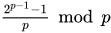
The prime 1093 was found to be a Wieferich prime by W. Meissner in 1913 and confirmed to be the only such prime below 2000. He calculated the smallest residue of for all primes p < 2000 and found this residue to be zero for t = 364 and p = 1093, thereby providing a counterexample to a conjecture by Grave about the impossibility of the Wieferich congruence.[12] E. Haentzschel later ordered verification of the correctness of Meissner's congruence via only elementary calculations.[13]: 664 Inspired by an earlier work of Euler, he simplified Meissner's proof by showing that 10932 | (2182 + 1) and remarked that (2182 + 1) is a factor of (2364 − 1).[14] It was also shown that it is possible to prove that 1093 is a Wieferich prime without using complex numbers contrary to the method used by Meissner,[15] although Meissner himself hinted at that he was aware of a proof without complex values.[12]: 665

The prime 3511 was first found to be a Wieferich prime by N. G. W. H. Beeger in 1922[16] and another proof of it being a Wieferich prime was published in 1965 by Guy.[17] In 1960, Kravitz[18] doubled a previous record set by Fröberg[19] and in 1961 Riesel extended the search to 500000 with the aid of BESK.[20] Around 1980, Lehmer was able to reach the search limit of 6×10⁹.[21] This limit was extended to over 2.5×10¹⁵ in 2006,[22] finally reaching 3×10¹⁵. It is now known that if any other Wieferich primes exist, they must be greater than 6.7×10¹⁵.[23]
In 2007–2016, a search for Wieferich primes was performed by the distributed computing project Wieferich@Home.[24] In 2011–2017, another search was performed by the PrimeGrid project, although later the work done in this project was claimed wasted.[25] While these projects reached search bounds above 1×10¹⁷, neither of them reported any sustainable results.
In 2020, PrimeGrid started another project that searches for Wieferich and Wall–Sun–Sun primes simultaneously. The new project uses checksums to enable independent double-checking of each subinterval, thus minimizing the risk of missing an instance because of faulty hardware.[26] The project ended in December 2022, definitely proving that a third Wieferich prime must exceed 264 (about 18×1018).[27]
It has been conjectured (as for Wilson primes) that infinitely many Wieferich primes exist, and that the number of Wieferich primes below x is approximately log(log(x)), which is a heuristic result that follows from the plausible assumption that for a prime p, the (p − 1)-th degree roots of unity modulo p2 are uniformly distributed in the multiplicative group of integers modulo p2.[28]
Properties
Connection with Fermat's Last Theorem
The following theorem connecting Wieferich primes and Fermat's Last Theorem was proven by Wieferich in 1909:[10]
- Let p be prime, and let x, y, z be integers such that xp + yp + zp = 0. Furthermore, assume that p does not divide the product xyz. Then p is a Wieferich prime.
The above case (where p does not divide any of x, y or z) is commonly known as the first case of Fermat's Last Theorem (FLTI)[29][30] and FLTI is said to fail for a prime p, if solutions to the Fermat equation exist for that p, otherwise FLTI holds for p.[31] In 1910, Mirimanoff expanded[32] the theorem by showing that, if the preconditions of the theorem hold true for some prime p, then p2 must also divide 3p − 1 − 1. Granville and Monagan further proved that p2 must actually divide mp − 1 − 1 for every prime m ≤ 89.[33] Suzuki extended the proof to all primes m ≤ 113.[34]
Let Hp be a set of pairs of integers with 1 as their greatest common divisor, p being prime to x, y and x + y, (x + y)p−1 ≡ 1 (mod p2), (x + ξy) being the pth power of an ideal of K with ξ defined as cos 2π/p + i sin 2π/p. K = Q(ξ) is the field extension obtained by adjoining all polynomials in the algebraic number ξ to the field of rational numbers (such an extension is known as a number field or in this particular case, where ξ is a root of unity, a cyclotomic number field).[33]: 332 From uniqueness of factorization of ideals in Q(ξ) it follows that if the first case of Fermat's last theorem has solutions x, y, z then p divides x+y+z and (x, y), (y, z) and (z, x) are elements of Hp.[33]: 333 Granville and Monagan showed that (1, 1) ∈ Hp if and only if p is a Wieferich prime.[33]: 333
Connection with the abc conjecture and non-Wieferich primes
A non-Wieferich prime is a prime p satisfying 2p − 1 ≢ 1 (mod p2). J. H. Silverman showed in 1988 that if the abc conjecture holds, then there exist infinitely many non-Wieferich primes.[35] More precisely he showed that the abc conjecture implies the existence of a constant only depending on α such that the number of non-Wieferich primes to base α with p less than or equal to a variable X is greater than log(X) as X goes to infinity.[36]: 227 Numerical evidence suggests that very few of the prime numbers in a given interval are Wieferich primes. The set of Wieferich primes and the set of non-Wieferich primes, sometimes denoted by W2 and W2c respectively,[37] are complementary sets, so if one of them is shown to be finite, the other one would necessarily have to be infinite. It was later shown that the existence of infinitely many non-Wieferich primes already follows from a weaker version of the abc conjecture, called the ABC-(k, ε) conjecture.[38] Additionally, the existence of infinitely many non-Wieferich primes would also follow if there exist infinitely many square-free Mersenne numbers[39] as well as if there exists a real number ξ such that the set {n ∈ N : λ(2n − 1) < 2 − ξ} is of density one, where the index of composition λ(n) of an integer n is defined as and , meaning gives the product of all prime factors of n.[37]: 4


Connection with Mersenne and Fermat primes
It is known that the nth Mersenne number Mn = 2n − 1 is prime only if n is prime. Fermat's little theorem implies that if p > 2 is prime, then Mp−1 (= 2p − 1 − 1) is always divisible by p. Since Mersenne numbers of prime indices Mp and Mq are co-prime,
- A prime divisor p of Mq, where q is prime, is a Wieferich prime if and only if p2 divides Mq.[40]
Thus, a Mersenne prime cannot also be a Wieferich prime. A notable open problem is to determine whether or not all Mersenne numbers of prime index are square-free. If q is prime and the Mersenne number Mq is not square-free, that is, there exists a prime p for which p2 divides Mq, then p is a Wieferich prime. Therefore, if there are only finitely many Wieferich primes, then there will be at most finitely many Mersenne numbers with prime index that are not square-free. Rotkiewicz showed a related result: if there are infinitely many square-free Mersenne numbers, then there are infinitely many non-Wieferich primes.[41]
Similarly, if p is prime and p2 divides some Fermat number Fn = 22n + 1, then p must be a Wieferich prime.[42]
In fact, there exists a natural number n and a prime p that p2 divides (where is the n-th cyclotomic polynomial) if and only if p is a Wieferich prime. For example, 10932 divides , 35112 divides . Mersenne and Fermat numbers are just special situations of . Thus, if 1093 and 3511 are only two Wieferich primes, then all are square-free except and (In fact, when there exists a prime p which p2 divides some , then it is a Wieferich prime); and clearly, if is a prime, then it cannot be Wieferich prime. (Any odd prime p divides only one and n divides p − 1, and if and only if the period length of 1/p in binary is n, then p divides . Besides, if and only if p is a Wieferich prime, then the period length of 1/p and 1/p2 are the same (in binary). Otherwise, this is p times than that.)


For the primes 1093 and 3511, it was shown that neither of them is a divisor of any Mersenne number with prime index nor a divisor of any Fermat number, because 364 and 1755 are neither prime nor powers of 2.[43]
Connection with other equations
Scott and Styer showed that the equation px – 2y = d has at most one solution in positive integers (x, y), unless when p4 | 2ordp 2 – 1 if p ≢ 65 (mod 192) or unconditionally when p2 | 2ordp 2 – 1, where ordp 2 denotes the multiplicative order of 2 modulo p.[44]: 215, 217–218 They also showed that a solution to the equation ±ax1 ± 2y1 = ±ax2 ± 2y2 = c must be from a specific set of equations but that this does not hold, if a is a Wieferich prime greater than 1.25 x 10¹⁵.[45]: 258
Binary periodicity of p − 1
Johnson observed[46] that the two known Wieferich primes are one greater than numbers with periodic binary expansions (1092 = 0100010001002=44416; 3510 = 1101101101102=66668). The Wieferich@Home project searched for Wieferich primes by testing numbers that are one greater than a number with a periodic binary expansion, but up to a "bit pseudo-length" of 3500 of the tested binary numbers generated by combination of bit strings with a bit length of up to 24 it has not found a new Wieferich prime.[47]
Abundancy of p − 1
It has been noted (sequence A239875 in the OEIS) that the known Wieferich primes are one greater than mutually friendly numbers (the shared abundancy index being 112/39).
Connection with pseudoprimes
It was observed that the two known Wieferich primes are the square factors of all non-square free base-2 Fermat pseudoprimes up to 25×109.[48] Later computations showed that the only repeated factors of the pseudoprimes up to 1012 are 1093 and 3511.[49] In addition, the following connection exists:
- Let n be a base 2 pseudoprime and p be a prime divisor of n. If , then also .[31]: 378 Furthermore, if p is a Wieferich prime, then p2 is a Catalan pseudoprime.


Connection with directed graphs
For all primes p up to 100000, L(pn+1) = L(pn) only in two cases: L(10932) = L(1093) = 364 and L(35112) = L(3511) = 1755, where L(m) is the number of vertices in the cycle of 1 in the doubling diagram modulo m. Here the doubling diagram represents the directed graph with the non-negative integers less than m as vertices and with directed edges going from each vertex x to vertex 2x reduced modulo m.[50]: 74 It was shown, that for all odd prime numbers either L(pn+1) = p · L(pn) or L(pn+1) = L(pn).[50]: 75
It was shown that and if and only if 2p − 1 ≢ 1 (mod p2) where p is an odd prime and is the fundamental discriminant of the imaginary quadratic field . Furthermore, the following was shown: Let p be a Wieferich prime. If p ≡ 3 (mod 4), let be the fundamental discriminant of the imaginary quadratic field and if p ≡ 1 (mod 4), let be the fundamental discriminant of the imaginary quadratic field . Then and (χ and λ in this context denote Iwasawa invariants).[51]: 27



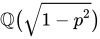


Furthermore, the following result was obtained: Let q be an odd prime number, k and p are primes such that p = 2k + 1, k ≡ 3 (mod 4), p ≡ −1 (mod q), p ≢ −1 (mod q3) and the order of q modulo k is . Assume that q divides h+, the class number of the real cyclotomic field , the cyclotomic field obtained by adjoining the sum of a p-th root of unity and its reciprocal to the field of rational numbers. Then q is a Wieferich prime.[52]: 55 This also holds if the conditions p ≡ −1 (mod q) and p ≢ −1 (mod q3) are replaced by p ≡ −3 (mod q) and p ≢ −3 (mod q3) as well as when the condition p ≡ −1 (mod q) is replaced by p ≡ −5 (mod q) (in which case q is a Wall–Sun–Sun prime) and the incongruence condition replaced by p ≢ −5 (mod q3).[53]: 376


Generalizations
Near-Wieferich primes
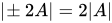
A prime p satisfying the congruence 2(p−1)/2 ≡ ±1 + Ap (mod p2) with small |A| is commonly called a near-Wieferich prime (sequence A195988 in the OEIS).[28][54] Near-Wieferich primes with A = 0 represent Wieferich primes. Recent searches, in addition to their primary search for Wieferich primes, also tried to find near-Wieferich primes.[23][55] The following table lists all near-Wieferich primes with |A| ≤ 10 in the interval [1×10⁹, 3×10¹⁵].[56] This search bound was reached in 2006 in a search effort by P. Carlisle, R. Crandall and M. Rodenkirch.[22][57] Bigger entries are by PrimeGrid.
| p | 1 or −1 | A |
|---|---|---|
| 3520624567 | +1 | −6 |
| 46262476201 | +1 | +5 |
| 47004625957 | −1 | +1 |
| 58481216789 | −1 | +5 |
| 76843523891 | −1 | +1 |
| 1180032105761 | +1 | −6 |
| 12456646902457 | +1 | +2 |
| 134257821895921 | +1 | +10 |
| 339258218134349 | −1 | +2 |
| 2276306935816523 | −1 | −3 |
| 82687771042557349 | -1 | -10 |
| 3156824277937156367 | +1 | +7 |
The sign +1 or -1 above can be easily predicted by Euler's criterion (and the second supplement to the law of quadratic reciprocity).
Dorais and Klyve[23] used a different definition of a near-Wieferich prime, defining it as a prime p with small value of where is the Fermat quotient of 2 with respect to p modulo p (the modulo operation here gives the residue with the smallest absolute value). The following table lists all primes p ≤ 6.7 × 10¹⁵ with .


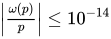
| p | ||
|---|---|---|
| 1093 | 0 | 0 |
| 3511 | 0 | 0 |
| 2276306935816523 | +6 | 0.264 |
| 3167939147662997 | −17 | 0.537 |
| 3723113065138349 | −36 | 0.967 |
| 5131427559624857 | −36 | 0.702 |
| 5294488110626977 | −31 | 0.586 |
| 6517506365514181 | +58 | 0.890 |


The two notions of nearness are related as follows. If , then by squaring, clearly . So if A had been chosen with small, then clearly is also (quite) small, and an even number. However, when is odd above, the related A from before the last squaring was not "small". For example, with , we have which reads extremely non-near, but after squaring this is which is a near-Wieferich by the second definition.






Base-a Wieferich primes
A Wieferich prime base a is a prime p that satisfies
- ap − 1 ≡ 1 (mod p2),[8] with a less than p but greater than 1.
Such a prime cannot divide a, since then it would also divide 1.
It's a conjecture that for every natural number a, there are infinitely many Wieferich primes in base a.
Bolyai showed that if p and q are primes, a is a positive integer not divisible by p and q such that ap−1 ≡ 1 (mod q), aq−1 ≡ 1 (mod p), then apq−1 ≡ 1 (mod pq). Setting p = q leads to ap2−1 ≡ 1 (mod p2).[58]: 284 It was shown that ap2−1 ≡ 1 (mod p2) if and only if ap−1 ≡ 1 (mod p2).[58]: 285–286
Known solutions of ap−1 ≡ 1 (mod p2) for small values of a are:[59] (checked up to 5 × 10¹³)
a primes p such that ap − 1 = 1 (mod p2) OEIS sequence 1 2, 3, 5, 7, 11, 13, 17, 19, 23, 29, ... (All primes) A000040 2 1093, 3511, ... A001220 3 11, 1006003, ... A014127 4 1093, 3511, ... 5 2, 20771, 40487, 53471161, 1645333507, 6692367337, 188748146801, ... A123692 6 66161, 534851, 3152573, ... A212583 7 5, 491531, ... A123693 8 3, 1093, 3511, ... 9 2, 11, 1006003, ... 10 3, 487, 56598313, ... A045616 11 71, ... 12 2693, 123653, ... A111027 13 2, 863, 1747591, ... A128667 14 29, 353, 7596952219, ... A234810 15 29131, 119327070011, ... A242741 16 1093, 3511, ... 17 2, 3, 46021, 48947, 478225523351, ... A128668 18 5, 7, 37, 331, 33923, 1284043, ... A244260 19 3, 7, 13, 43, 137, 63061489, ... A090968 20 281, 46457, 9377747, 122959073, ... A242982 21 2, ... 22 13, 673, 1595813, 492366587, 9809862296159, ... A298951 23 13, 2481757, 13703077, 15546404183, 2549536629329, ... A128669 24 5, 25633, ... 25 2, 20771, 40487, 53471161, 1645333507, 6692367337, 188748146801, ... 26 3, 5, 71, 486999673, 6695256707, ... A306255 27 11, 1006003, ... 28 3, 19, 23, ... 29 2, ... 30 7, 160541, 94727075783, ... A306256 31 7, 79, 6451, 2806861, ... A331424 32 5, 1093, 3511, ... 33 2, 233, 47441, 9639595369, ... 34 46145917691, ... 35 3, 1613, 3571, ... 36 66161, 534851, 3152573, ... 37 2, 3, 77867, 76407520781, ... A331426 38 17, 127, ... 39 8039, ... 40 11, 17, 307, 66431, 7036306088681, ... 41 2, 29, 1025273, 138200401, ... A331427 42 23, 719867822369, ... 43 5, 103, 13368932516573, ... 44 3, 229, 5851, ... 45 2, 1283, 131759, 157635607, ... 46 3, 829, ... 47 ... 48 7, 257, ... 49 2, 5, 491531, ... 50 7, ...
For more information, see[60][61][62] and.[63] (Note that the solutions to a = bk is the union of the prime divisors of k which does not divide b and the solutions to a = b)
The smallest solutions of np−1 ≡ 1 (mod p2) are
- 2, 1093, 11, 1093, 2, 66161, 5, 3, 2, 3, 71, 2693, 2, 29, 29131, 1093, 2, 5, 3, 281, 2, 13, 13, 5, 2, 3, 11, 3, 2, 7, 7, 5, 2, 46145917691, 3, 66161, 2, 17, 8039, 11, 2, 23, 5, 3, 2, 3, ... (The next term > 4.9×10¹³) (sequence A039951 in the OEIS)
There are no known solutions of np−1 ≡ 1 (mod p2) for n = 47, 72, 186, 187, 200, 203, 222, 231, 304, 311, 335, 355, 435, 454, 546, 554, 610, 639, 662, 760, 772, 798, 808, 812, 858, 860, 871, 983, 986, 1002, 1023, 1130, 1136, 1138, ....
It is a conjecture that there are infinitely many solutions of ap−1 ≡ 1 (mod p2) for every natural number a.
The bases b < p2 which p is a Wieferich prime are (for b > p2, the solutions are just shifted by k·p2 for k > 0), and there are p − 1 solutions < p2 of p and the set of the solutions congruent to p are {1, 2, 3, ..., p − 1}) (sequence A143548 in the OEIS)
p values of b < p2 2 1 3 1, 8 5 1, 7, 18, 24 7 1, 18, 19, 30, 31, 48 11 1, 3, 9, 27, 40, 81, 94, 112, 118, 120 13 1, 19, 22, 23, 70, 80, 89, 99, 146, 147, 150, 168 17 1, 38, 40, 65, 75, 110, 131, 134, 155, 158, 179, 214, 224, 249, 251, 288 19 1, 28, 54, 62, 68, 69, 99, 116, 127, 234, 245, 262, 292, 293, 299, 307, 333, 360 23 1, 28, 42, 63, 118, 130, 170, 177, 195, 255, 263, 266, 274, 334, 352, 359, 399, 411, 466, 487, 501, 528 29 1, 14, 41, 60, 63, 137, 190, 196, 221, 236, 267, 270, 374, 416, 425, 467, 571, 574, 605, 620, 645, 651, 704, 778, 781, 800, 827, 840
The least base b > 1 which prime(n) is a Wieferich prime are
- 5, 8, 7, 18, 3, 19, 38, 28, 28, 14, 115, 18, 51, 19, 53, 338, 53, 264, 143, 11, 306, 31, 99, 184, 53, 181, 43, 164, 96, 68, 38, 58, 19, 328, 313, 78, 226, 65, 253, 259, 532, 78, 176, 276, 143, 174, 165, 69, 330, 44, 33, 332, 94, 263, 48, 79, 171, 747, 731, 20, ... (sequence A039678 in the OEIS)
We can also consider the formula , (because of the generalized Fermat little theorem, is true for all prime p and all natural number a such that both a and a + 1 are not divisible by p). It's a conjecture that for every natural number a, there are infinitely many primes such that .

Known solutions for small a are: (checked up to 4 × 10¹¹) [64]
primes such that 1 1093, 3511, ... 2 23, 3842760169, 41975417117, ... 3 5, 250829, ... 4 3, 67, ... 5 3457, 893122907, ... 6 72673, 1108905403, 2375385997, ... 7 13, 819381943, ... 8 67, 139, 499, 26325777341, ... 9 67, 887, 9257, 83449, 111539, 31832131, ... 10 ... 11 107, 4637, 239357, ... 12 5, 11, 51563, 363901, 224189011, ... 13 3, ... 14 11, 5749, 17733170113, 140328785783, ... 15 292381, ... 16 4157, ... 17 751, 46070159, ... 18 7, 142671309349, ... 19 17, 269, ... 20 29, 162703, ... 21 5, 2711, 104651, 112922981, 331325567, 13315963127, ... 22 3, 7, 13, 94447, 1198427, 23536243, ... 23 43, 179, 1637, 69073, ... 24 7, 353, 402153391, ... 25 43, 5399, 21107, 35879, ... 26 7, 131, 653, 5237, 97003, ... 27 2437, 1704732131, ... 28 5, 617, 677, 2273, 16243697, ... 29 73, 101, 6217, ... 30 7, 11, 23, 3301, 48589, 549667, ... 31 3, 41, 416797, ... 32 95989, 2276682269, ... 33 139, 1341678275933, ... 34 83, 139, ... 35 ... 36 107, 137, 613, 2423, 74304856177, ... 37 5, ... 38 167, 2039, ... 39 659, 9413, ... 40 3, 23, 21029249, ... 41 31, 71, 1934399021, 474528373843, ... 42 4639, 1672609, ... 43 31, 4962186419, ... 44 36677, 17786501, ... 45 241, 26120375473, ... 46 5, 13877, ... 47 13, 311, 797, 906165497, ... 48 ... 49 3, 13, 2141, 281833, 1703287, 4805298913, ... 50 2953, 22409, 99241, 5427425917, ...


Wieferich pairs
A Wieferich pair is a pair of primes p and q that satisfy
- pq − 1 ≡ 1 (mod q2) and qp − 1 ≡ 1 (mod p2)
so that a Wieferich prime p ≡ 1 (mod 4) will form such a pair (p, 2): the only known instance in this case is p = 1093. There are only 7 known Wieferich pairs.[65]
- (2, 1093), (3, 1006003), (5, 1645333507), (5, 188748146801), (83, 4871), (911, 318917), and (2903, 18787) (sequence OEIS: A282293 in OEIS)
Wieferich sequence
Start with a(1) any natural number (>1), a(n) = the smallest prime p such that (a(n − 1))p − 1 = 1 (mod p2) but p2 does not divide a(n − 1) − 1 or a(n − 1) + 1. (If p2 divides a(n − 1) − 1 or a(n − 1) + 1, then the solution is a trivial solution) It is a conjecture that every natural number k = a(1) > 1 makes this sequence become periodic, for example, let a(1) = 2:
- 2, 1093, 5, 20771, 18043, 5, 20771, 18043, 5, ..., it gets a cycle: {5, 20771, 18043}.
- (sequence A359952 in the OEIS)
Let a(1) = 83:
- 83, 4871, 83, 4871, 83, 4871, 83, ..., it gets a cycle: {83, 4871}.
Let a(1) = 59 (a longer sequence):
- 59, 2777, 133287067, 13, 863, 7, 5, 20771, 18043, 5, ..., it also gets 5.
However, there are many values of a(1) with unknown status, for example, let a(1) = 3:
- 3, 11, 71, 47, ? (There are no known Wieferich primes in base 47).
Let a(1) = 14:
- 14, 29, ? (There are no known Wieferich prime in base 29 except 2, but 22 = 4 divides 29 − 1 = 28)
Let a(1) = 39 (a longer sequence):
- 39, 8039, 617, 101, 1050139, 29, ? (It also gets 29)
It is unknown that values for a(1) > 1 exist such that the resulting sequence does not eventually become periodic.
When a(n − 1)=k, a(n) will be (start with k = 2): 1093, 11, 1093, 20771, 66161, 5, 1093, 11, 487, 71, 2693, 863, 29, 29131, 1093, 46021, 5, 7, 281, ?, 13, 13, 25633, 20771, 71, 11, 19, ?, 7, 7, 5, 233, 46145917691, 1613, 66161, 77867, 17, 8039, 11, 29, 23, 5, 229, 1283, 829, ?, 257, 491531, ?, ... (For k = 21, 29, 47, 50, even the next value is unknown)
Wieferich numbers
A Wieferich number is an odd natural number n satisfying the congruence 2φ(n) ≡ 1 (mod n2), where φ denotes the Euler's totient function (according to Euler's theorem, 2φ(n) ≡ 1 (mod n) for every odd natural number n). If Wieferich number n is prime, then it is a Wieferich prime. The first few Wieferich numbers are:
- 1, 1093, 3279, 3511, 7651, 10533, 14209, 17555, 22953, 31599, 42627, 45643, 52665, 68859, 94797, 99463, ... (sequence A077816 in the OEIS)
It can be shown that if there are only finitely many Wieferich primes, then there are only finitely many Wieferich numbers. In particular, if the only Wieferich primes are 1093 and 3511, then there exist exactly 104 Wieferich numbers, which matches the number of Wieferich numbers currently known.[2]
More generally, a natural number n is a Wieferich number to base a, if aφ(n) ≡ 1 (mod n2).[66]: 31
Another definition specifies a Wieferich number as odd natural number n such that n and are not coprime, where m is the multiplicative order of 2 modulo n. The first of these numbers are:[67]

- 21, 39, 55, 57, 105, 111, 147, 155, 165, 171, 183, 195, 201, 203, 205, 219, 231, 237, 253, 273, 285, 291, 301, 305, 309, 327, 333, 355, 357, 385, 399, ... (sequence A182297 in the OEIS)
As above, if Wieferich number q is prime, then it is a Wieferich prime.
Weak Wieferich prime
A weak Wieferich prime to base a is a prime p satisfies the condition
- ap ≡ a (mod p2)
Every Wieferich prime to base a is also a weak Wieferich prime to base a. If the base a is squarefree, then a prime p is a weak Wieferich prime to base a if and only if p is a Wieferich prime to base a.
Smallest weak Wieferich prime to base n are (start with n = 0)
- 2, 2, 1093, 11, 2, 2, 66161, 5, 2, 2, 3, 71, 2, 2, 29, 29131, 2, 2, 3, 3, 2, 2, 13, 13, 2, 2, 3, 3, 2, 2, 7, 7, 2, 2, 46145917691, 3, 2, 2, 17, 8039, 2, 2, 23, 5, 2, 2, 3, ...
Wieferich prime with order n
For integer n ≥2, a Wieferich prime to base a with order n is a prime p satisfies the condition
- ap−1 ≡ 1 (mod pn)
Clearly, a Wieferich prime to base a with order n is also a Wieferich prime to base a with order m for all 2 ≤ m ≤ n, and Wieferich prime to base a with order 2 is equivalent to Wieferich prime to base a, so we can only consider the n ≥ 3 case. However, there are no known Wieferich prime to base 2 with order 3. The first base with known Wieferich prime with order 3 is 9, where 2 is a Wieferich prime to base 9 with order 3. Besides, both 5 and 113 are Wieferich prime to base 68 with order 3.
Lucas–Wieferich primes
Let P and Q be integers. The Lucas sequence of the first kind associated with the pair (P, Q) is defined by
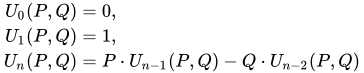
for all . A Lucas–Wieferich prime associated with (P, Q) is a prime p such that Up−ε(P, Q) ≡ 0 (mod p2), where ε equals the Legendre symbol . All Wieferich primes are Lucas–Wieferich primes associated with the pair (3, 2).[3]: 2088


Wieferich places
Let K be a global field, i.e. a number field or a function field in one variable over a finite field and let E be an elliptic curve. If v is a non-archimedean place of norm qv of K and a ∈ K, with v(a) = 0 then v(aqv − 1 − 1) ≥ 1. v is called a Wieferich place for base a, if v(aqv − 1 − 1) > 1, an elliptic Wieferich place for base P ∈ E, if NvP ∈ E2 and a strong elliptic Wieferich place for base P ∈ E if nvP ∈ E2, where nv is the order of P modulo v and Nv gives the number of rational points (over the residue field of v) of the reduction of E at v.[68]: 206
See also
- Wall–Sun–Sun prime – another type of prime number which in the broadest sense also resulted from the study of FLT
- Wolstenholme prime – another type of prime number which in the broadest sense also resulted from the study of FLT
- Wilson prime
- Table of congruences – lists other congruences satisfied by prime numbers
- PrimeGrid – primes search project
- BOINC
- Distributed computing
References
- ^ Franco, Z.; Pomerance, C. (1995), "On a conjecture of Crandall concerning the qx + 1 problem" (PDF), Mathematics of Computation, 64 (211): 1333–36, Bibcode:1995MaCom..64.1333F, doi:10.2307/2153499, JSTOR 2153499.
- ^ a b Banks, W.D.; Luca, F.; Shparlinski, I.E. (2007), "Estimates for Wieferich numbers" (PDF), The Ramanujan Journal, 14 (3): 361–378, doi:10.1007/s11139-007-9030-z, S2CID 39279379, archived from the original (PDF) on 2013-05-03, retrieved 2011-03-12.
- ^ a b McIntosh, R.J.; Roettger, E.L. (2007), "A search for Fibonacci–Wieferich and Wolstenholme primes" (PDF), Mathematics of Computation, 76 (260): 2087–2094, Bibcode:2007MaCom..76.2087M, CiteSeerX 10.1.1.105.9393, doi:10.1090/S0025-5718-07-01955-2
- ^ The Prime Glossary: Wieferich prime
- ^ Israel Kleiner (2000), "From Fermat to Wiles: Fermat's Last Theorem Becomes a Theorem", Elemente der Mathematik, 55: 21, doi:10.1007/PL00000079, S2CID 53319514.
- ^ Leonhard Euler (1736), "Theorematum quorundam ad numeros primos spectantium demonstratio" (PDF), Novi Comm. Acad. Sci. Petropol. (in Latin), 8: 33–37.
- ^ Dickson, L. E. (1917), "Fermat's Last Theorem and the Origin and Nature of the Theory of Algebraic Numbers", Annals of Mathematics, 18 (4): 161–187, doi:10.2307/2007234, JSTOR 2007234
- ^ a b Wilfrid Keller; Jörg Richstein (2005), "Solutions of the congruence ap−1 ≡ 1 (mod pr)" (PDF), Mathematics of Computation, 74 (250): 927–936, doi:10.1090/S0025-5718-04-01666-7.
- ^ Meyer, W. Fr. (1902). "Ergänzungen zum Fermatschen und Wilsonschen Satze". Arch. Math. Physik. 3. 2: 141–146. Retrieved 2020-09-02.
- ^ a b Wieferich, A. (1909), "Zum letzten Fermat'schen Theorem", Journal für die reine und angewandte Mathematik (in German), 1909 (136): 293–302, doi:10.1515/crll.1909.136.293, S2CID 118715277.
- ^ Bachmann, P. (1913). "Über den Rest von ". Journal für Mathematik (in German). 142 (1): 41–50.
- ^ a b Meissner, W. (1913), "Über die Teilbarkeit von 2p − 2 durch das Quadrat der Primzahl p=1093" (PDF), Sitzungsber. D. Königl. Preuss. Akad. D. Wiss. (in German), Zweiter Halbband. Juli bis Dezember, Berlin: 663–667, JFM 44.0218.02
- ^ Haentzschel, E. (1916), "Über die Kongruenz 21092 ≡ 1 (mod 10932)", Jahresbericht der Deutschen Mathematiker-Vereinigung (in German), 25: 284
- ^ Haentzschel, E. (1925), "Über die Kongruenz 21092 ≡ 1 (mod 10932)", Jahresbericht der Deutschen Mathematiker-Vereinigung (in German), 34: 184
- ^ Ribenboim, P. (1983), "1093", The Mathematical Intelligencer, 5 (2): 28–34, doi:10.1007/BF03023623
- ^ Beeger, N. G. W. H. (1922), "On a new case of the congruence 2p − 1 ≡ 1 (mod p2)", Messenger of Mathematics, 51: 149–150
- ^ Guy, R. K. (1965), "A property of the prime 3511", The Mathematical Gazette, 49 (367): 78–79, doi:10.2307/3614249, JSTOR 3614249
- ^ Kravitz, S. (1960). "The Congruence 2p-1 ≡ 1 (mod p2) for p < 100,000" (PDF). Mathematics of Computation. 14 (72): 378. doi:10.1090/S0025-5718-1960-0121334-7.
- ^ Fröberg C. E. (1958). "Some Computations of Wilson and Fermat Remainders" (PDF). Mathematics of Computation. 12 (64): 281. doi:10.1090/S0025-5718-58-99270-6.
- ^ Riesel, H. (1964). "Note on the Congruence ap−1 ≡ 1 (mod p2)" (PDF). Mathematics of Computation. 18 (85): 149–150. doi:10.1090/S0025-5718-1964-0157928-6.
- ^ Lehmer, D. H. (1981). "On Fermat's quotient, base two" (PDF). Mathematics of Computation. 36 (153): 289–290. doi:10.1090/S0025-5718-1981-0595064-5.
- ^ a b Ribenboim, Paulo (2004), Die Welt der Primzahlen: Geheimnisse und Rekorde (in German), New York: Springer, p. 237, ISBN 978-3-540-34283-0
- ^ a b c Dorais, F. G.; Klyve, D. (2011). "A Wieferich Prime Search Up to 6.7×1015" (PDF). Journal of Integer Sequences. 14 (9). Zbl 1278.11003. Retrieved 2011-10-23.
- ^ "statistics". elMath.org. 2016-09-02. Archived from the original on 2016-09-02. Retrieved 2019-09-18.
- ^ "WSS and WFS are suspended". PrimeGrid Message Board. May 11, 2017.
- ^ "Message boards : Wieferich and Wall-Sun-Sun Prime Search". PrimeGrid.
- ^ "WW Statistics". PrimeGrid.
- ^ a b Crandall, Richard E.; Dilcher, Karl; Pomerance, Carl (1997), "A search for Wieferich and Wilson primes" (PDF), Mathematics of Computation, 66 (217): 433–449, Bibcode:1997MaCom..66..433C, doi:10.1090/S0025-5718-97-00791-6.
- ^ Coppersmith, D. (1990), "Fermat's Last Theorem (Case I) and the Wieferich Criterion" (PDF), Mathematics of Computation, 54 (190): 895–902, Bibcode:1990MaCom..54..895C, doi:10.1090/s0025-5718-1990-1010598-2, JSTOR 2008518.
- ^ Cikánek, P. (1994), "A Special Extension of Wieferich's Criterion" (PDF), Mathematics of Computation, 62 (206): 923–930, Bibcode:1994MaCom..62..923C, doi:10.2307/2153550, JSTOR 3562296.
- ^ a b Dilcher, K.; Skula, L. (1995), "A new criterion for the first case of Fermat's last theorem" (PDF), Mathematics of Computation, 64 (209): 363–392, Bibcode:1995MaCom..64..363D, doi:10.1090/s0025-5718-1995-1248969-6, JSTOR 2153341
- ^ Mirimanoff, D. (1910), "Sur le dernier théorème de Fermat", Comptes Rendus Hebdomadaires des Séances de l'Académie des Sciences (in French), 150: 204–206.
- ^ a b c d Granville, A.; Monagan, M. B. (1988), "The First Case of Fermat's Last Theorem is true for all prime exponents up to 714,591,416,091,389", Transactions of the American Mathematical Society, 306 (1): 329–359, doi:10.1090/S0002-9947-1988-0927694-5.
- ^ Suzuki, Jiro (1994), "On the generalized Wieferich criteria", Proceedings of the Japan Academy, Series A, 70 (7): 230–234, doi:10.3792/pjaa.70.230
- ^ Charles, D. X. "On Wieferich primes" (PDF). wisc.edu.
- ^ Silverman, J. H. (1988), "Wieferich's criterion and the abc-conjecture", Journal of Number Theory, 30 (2): 226–237, doi:10.1016/0022-314X(88)90019-4
- ^ a b DeKoninck, J.-M.; Doyon, N. (2007), "On the set of Wieferich primes and of its complement" (PDF), Annales Univ. Sci. Budapest., Sect. Comp., 27: 3–13
- ^ Broughan, K. (2006), "Relaxations of the ABC Conjecture using integer k'th roots" (PDF), New Zealand J. Math., 35 (2): 121–136
- ^ Ribenboim, P. (1979). 13 Lectures on Fermat's Last Theorem. New York: Springer. p. 154. ISBN 978-0-387-90432-0.
- ^ Mersenne Primes: Conjectures and Unsolved Problems
- ^ Rotkiewicz, A. (1965). "Sur les nombres de Mersenne dépourvus de diviseurs carrés et sur les nombres naturels n, tels que n2|2n − 2". Mat. Vesnik (in French). 2 (17): 78–80.
- ^ Ribenboim, Paulo (1991), The little book of big primes, New York: Springer, p. 64, ISBN 978-0-387-97508-5
- ^ Bray, H. G.; Warren, L. J. (1967), "On the square-freeness of Fermat and Mersenne numbers", Pacific J. Math., 22 (3): 563–564, doi:10.2140/pjm.1967.22.563, MR 0220666, Zbl 0149.28204
- ^ Scott, R.; Styer, R. (April 2004). "On px − qy = c and related three term exponential Diophantine equations with prime bases". Journal of Number Theory. 105 (2): 212–234. doi:10.1016/j.jnt.2003.11.008.
- ^ Scott, R.; Styer, R. (2006). "On the generalized Pillai equation ±ax±by = c". Journal of Number Theory. 118 (2): 236–265. doi:10.1016/j.jnt.2005.09.001.
- ^ Wells Johnson (1977), "On the nonvanishing of Fermat quotients (mod p)", J. Reine Angew. Math., 292: 196–200
- ^ Dobeš, Jan; Kureš, Miroslav (2010). "Search for Wieferich primes through the use of periodic binary strings". Serdica Journal of Computing. 4: 293–300. Zbl 1246.11019.
- ^ Ribenboim, P. (2004). "Chapter 2. How to Recognize Whether a Natural Number is a Prime" (PDF). The Little Book of Bigger Primes. New York: Springer-Verlag. p. 99. ISBN 978-0-387-20169-6.
- ^ Pinch, R. G. E. (2000). The Pseudoprimes up to 1013. Lecture Notes in Computer Science. Vol. 1838. pp. 459–473. doi:10.1007/10722028_30. ISBN 978-3-540-67695-9.
- ^ a b Ehrlich, A. (1994), "Cycles in Doubling Diagrams mod m" (PDF), The Fibonacci Quarterly, 32 (1): 74–78.
- ^ Byeon, D. (2006), "Class numbers, Iwasawa invariants and modular forms" (PDF), Trends in Mathematics, 9 (1): 25–29, archived from the original (PDF) on 2012-04-26, retrieved 2012-09-05
- ^ Jakubec, S. (1995), "Connection between the Wieferich congruence and divisibility of h+" (PDF), Acta Arithmetica, 71 (1): 55–64, doi:10.4064/aa-71-1-55-64
- ^ Jakubec, S. (1998), "On divisibility of the class number h+ of the real cyclotomic fields of prime degree l" (PDF), Mathematics of Computation, 67 (221): 369–398, doi:10.1090/s0025-5718-98-00916-8
- ^ Joshua Knauer; Jörg Richstein (2005), "The continuing search for Wieferich primes" (PDF), Mathematics of Computation, 74 (251): 1559–1563, Bibcode:2005MaCom..74.1559K, doi:10.1090/S0025-5718-05-01723-0.
- ^ About project Wieferich@Home
- ^ PrimeGrid, Wieferich & near Wieferich primes p < 11e15 Archived 2012-10-18 at the Wayback Machine
- ^ Ribenboim, Paulo (2000), My numbers, my friends: popular lectures on number theory, New York: Springer, pp. 213–229, ISBN 978-0-387-98911-2
- ^ a b Kiss, E.; Sándor, J. (2004). "On a congruence by János Bolyai, connected with pseudoprimes" (PDF). Mathematica Pannonica. 15 (2): 283–288.
- ^ Fermat Quotient at The Prime Glossary
- ^ "Wieferich primes to base 1052".
- ^ "Wieferich primes to base 10125".
- ^ "Fermat quotients qp(a) that are divisible by p". www1.uni-hamburg.de. 2014-08-09. Archived from the original on 2014-08-09. Retrieved 2019-09-18.
- ^ "Wieferich primes with level ≥ 3".
- ^ "Solution of (a + 1)p−1 − ap−1 ≡ 0 (mod p2)".
- ^ Weisstein, Eric W. "Double Wieferich Prime Pair". MathWorld.
- ^ Agoh, T.; Dilcher, K.; Skula, L. (1997), "Fermat Quotients for Composite Moduli", Journal of Number Theory, 66 (1): 29–50, doi:10.1006/jnth.1997.2162
- ^ Müller, H. (2009). "Über Periodenlängen und die Vermutungen von Collatz und Crandall". Mitteilungen der Mathematischen Gesellschaft in Hamburg (in German). 28: 121–130.
- ^ Voloch, J. F. (2000), "Elliptic Wieferich Primes", Journal of Number Theory, 81 (2): 205–209, doi:10.1006/jnth.1999.2471
Further reading
- Haussner, R. (1926), "Über die Kongruenzen 2p−1 − 1 ≡ 0 (mod p2) für die Primzahlen p=1093 und 3511", Archiv for Mathematik og Naturvidenskab (in German), 39 (5): 7, JFM 52.0141.06, DNB 363953469
- Haussner, R. (1927), "Über numerische Lösungen der Kongruenz up−1 − 1 ≡ 0 (mod p2)", Journal für die Reine und Angewandte Mathematik (in German), 1927 (156): 223–226, doi:10.1515/crll.1927.156.223, S2CID 117969297
- Ribenboim, P. (1979), Thirteen lectures on Fermat's Last Theorem, Springer-Verlag, pp. 139, 151, ISBN 978-0-387-90432-0
- Guy, Richard K. (2004), Unsolved Problems in Number Theory (3rd ed.), Springer Verlag, p. 14, ISBN 978-0-387-20860-2
- Crandall, R. E.; Pomerance, C. (2005), Prime numbers: a computational perspective (PDF), Springer Science+Business Media, pp. 31–32, ISBN 978-0-387-25282-7
- Ribenboim, P. (1996), The new book of prime number records, New York: Springer-Verlag, pp. 333–346, ISBN 978-0-387-94457-9