Integers occurring in the coefficients of the Taylor series of 1/cosh t
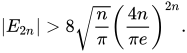
In mathematics , the Euler numbers are a sequence En of integers (sequence A122045 OEIS ) defined by the Taylor series expansion
1
cosh
t
=
2
e
t
+
e
−
t
=
∑
n
=
0
∞
E
n
n
!
⋅
t
n
{\displaystyle {\frac {1}{\cosh t}}={\frac {2}{e^{t}+e^{-t}}}=\sum _{n=0}^{\infty }{\frac {E_{n}}{n!}}\cdot t^{n}}
where
cosh
(
t
)
{\displaystyle \cosh(t)}
hyperbolic cosine function . The Euler numbers are related to a special value of the Euler polynomials , namely:
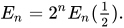
E
n
=
2
n
E
n
(
1
2
)
.
{\displaystyle E_{n}=2^{n}E_{n}({\tfrac {1}{2}}).}
The Euler numbers appear in the Taylor series expansions of the secant and hyperbolic secant functions. The latter is the function in the definition. They also occur in combinatorics , specifically when counting the number of alternating permutations of a set with an even number of elements.
Examples [ edit ] The odd-indexed Euler numbers are all zero . The even-indexed ones (sequence A028296 OEIS ) have alternating signs. Some values are:
E 0 =
1
E 2 =
−1
E 4 =
5
E 6 =
−61
E 8 =
385
E 10 =
521
E 12 =
702 765
E 14 =
360 981
E 16 =
391 512 145
E 18 =
404 879 675 441
Some authors re-index the sequence in order to omit the odd-numbered Euler numbers with value zero, or change all signs to positive (sequence A000364 OEIS ). This article adheres to the convention adopted above.
Explicit formulas [ edit ] In terms of Stirling numbers of the second kind [ edit ] Following two formulas express the Euler numbers in terms of Stirling numbers of the second kind [1] [2]
E
n
=
2
2
n
−
1
∑
ℓ
=
1
n
(
−
1
)
ℓ
S
(
n
,
ℓ
)
ℓ
+
1
(
3
(
1
4
)
(
ℓ
)
−
(
3
4
)
(
ℓ
)
)
,
{\displaystyle E_{n}=2^{2n-1}\sum _{\ell =1}^{n}{\frac {(-1)^{\ell }S(n,\ell )}{\ell +1}}\left(3\left({\frac {1}{4}}\right)^{(\ell )}-\left({\frac {3}{4}}\right)^{(\ell )}\right),}
E
2
n
=
−
4
2
n
∑
ℓ
=
1
2
n
(
−
1
)
ℓ
⋅
S
(
2
n
,
ℓ
)
ℓ
+
1
⋅
(
3
4
)
(
ℓ
)
,
{\displaystyle E_{2n}=-4^{2n}\sum _{\ell =1}^{2n}(-1)^{\ell }\cdot {\frac {S(2n,\ell )}{\ell +1}}\cdot \left({\frac {3}{4}}\right)^{(\ell )},}
where
S
(
n
,
ℓ
)
{\displaystyle S(n,\ell )}
Stirling numbers of the second kind , and
x
(
ℓ
)
=
(
x
)
(
x
+
1
)
⋯
(
x
+
ℓ
−
1
)
{\displaystyle x^{(\ell )}=(x)(x+1)\cdots (x+\ell -1)}
rising factorial .
As a double sum [ edit ] Following two formulas express the Euler numbers as double sums[3]
E
2
n
=
(
2
n
+
1
)
∑
ℓ
=
1
2
n
(
−
1
)
ℓ
1
2
ℓ
(
ℓ
+
1
)
(
2
n
ℓ
)
∑
q
=
0
ℓ
(
ℓ
q
)
(
2
q
−
ℓ
)
2
n
,
{\displaystyle E_{2n}=(2n+1)\sum _{\ell =1}^{2n}(-1)^{\ell }{\frac {1}{2^{\ell }(\ell +1)}}{\binom {2n}{\ell }}\sum _{q=0}^{\ell }{\binom {\ell }{q}}(2q-\ell )^{2n},}
E
2
n
=
∑
k
=
1
2
n
(
−
1
)
k
1
2
k
∑
ℓ
=
0
2
k
(
−
1
)
ℓ
(
2
k
ℓ
)
(
k
−
ℓ
)
2
n
.
{\displaystyle E_{2n}=\sum _{k=1}^{2n}(-1)^{k}{\frac {1}{2^{k}}}\sum _{\ell =0}^{2k}(-1)^{\ell }{\binom {2k}{\ell }}(k-\ell )^{2n}.}
As an iterated sum [ edit ] An explicit formula for Euler numbers is:[4]
E
2
n
=
i
∑
k
=
1
2
n
+
1
∑
ℓ
=
0
k
(
k
ℓ
)
(
−
1
)
ℓ
(
k
−
2
ℓ
)
2
n
+
1
2
k
i
k
k
,
{\displaystyle E_{2n}=i\sum _{k=1}^{2n+1}\sum _{\ell =0}^{k}{\binom {k}{\ell }}{\frac {(-1)^{\ell }(k-2\ell )^{2n+1}}{2^{k}i^{k}k}},}
where i denotes the imaginary unit with i 2 = −1
As a sum over partitions [ edit ] The Euler number E 2n partitions of 2n ,[5]
E
2
n
=
(
2
n
)
!
∑
0
≤
k
1
,
…
,
k
n
≤
n
(
K
k
1
,
…
,
k
n
)
δ
n
,
∑
m
k
m
(
−
1
2
!
)
k
1
(
−
1
4
!
)
k
2
⋯
(
−
1
(
2
n
)
!
)
k
n
,
{\displaystyle E_{2n}=(2n)!\sum _{0\leq k_{1},\ldots ,k_{n}\leq n}{\binom {K}{k_{1},\ldots ,k_{n}}}\delta _{n,\sum mk_{m}}\left(-{\frac {1}{2!}}\right)^{k_{1}}\left(-{\frac {1}{4!}}\right)^{k_{2}}\cdots \left(-{\frac {1}{(2n)!}}\right)^{k_{n}},}
as well as a sum over the odd partitions of 2n − 1 ,[6]
E
2
n
=
(
−
1
)
n
−
1
(
2
n
−
1
)
!
∑
0
≤
k
1
,
…
,
k
n
≤
2
n
−
1
(
K
k
1
,
…
,
k
n
)
δ
2
n
−
1
,
∑
(
2
m
−
1
)
k
m
(
−
1
1
!
)
k
1
(
1
3
!
)
k
2
⋯
(
(
−
1
)
n
(
2
n
−
1
)
!
)
k
n
,
{\displaystyle E_{2n}=(-1)^{n-1}(2n-1)!\sum _{0\leq k_{1},\ldots ,k_{n}\leq 2n-1}{\binom {K}{k_{1},\ldots ,k_{n}}}\delta _{2n-1,\sum (2m-1)k_{m}}\left(-{\frac {1}{1!}}\right)^{k_{1}}\left({\frac {1}{3!}}\right)^{k_{2}}\cdots \left({\frac {(-1)^{n}}{(2n-1)!}}\right)^{k_{n}},}
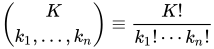
where in both cases K = k 1 + ··· + kn
(
K
k
1
,
…
,
k
n
)
≡
K
!
k
1
!
⋯
k
n
!
{\displaystyle {\binom {K}{k_{1},\ldots ,k_{n}}}\equiv {\frac {K!}{k_{1}!\cdots k_{n}!}}}
is a multinomial coefficient . The Kronecker deltas in the above formulas restrict the sums over the k s to 2k 1 + 4k 2 + ··· + 2nkn = 2n and to k 1 + 3k 2 + ··· + (2n − 1)kn = 2n − 1
As an example,
E
10
=
10
!
(
−
1
10
!
+
2
2
!
8
!
+
2
4
!
6
!
−
3
2
!
2
6
!
−
3
2
!
4
!
2
+
4
2
!
3
4
!
−
1
2
!
5
)
=
9
!
(
−
1
9
!
+
3
1
!
2
7
!
+
6
1
!
3
!
5
!
+
1
3
!
3
−
5
1
!
4
5
!
−
10
1
!
3
3
!
2
+
7
1
!
6
3
!
−
1
1
!
9
)
=
−
50
521.
{\displaystyle {\begin{aligned}E_{10}&=10!\left(-{\frac {1}{10!}}+{\frac {2}{2!\,8!}}+{\frac {2}{4!\,6!}}-{\frac {3}{2!^{2}\,6!}}-{\frac {3}{2!\,4!^{2}}}+{\frac {4}{2!^{3}\,4!}}-{\frac {1}{2!^{5}}}\right)\\[6pt]&=9!\left(-{\frac {1}{9!}}+{\frac {3}{1!^{2}\,7!}}+{\frac {6}{1!\,3!\,5!}}+{\frac {1}{3!^{3}}}-{\frac {5}{1!^{4}\,5!}}-{\frac {10}{1!^{3}\,3!^{2}}}+{\frac {7}{1!^{6}\,3!}}-{\frac {1}{1!^{9}}}\right)\\[6pt]&=-50\,521.\end{aligned}}}
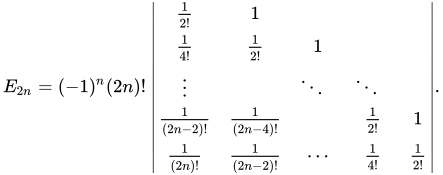
As a determinant [ edit ] E 2n determinant
E
2
n
=
(
−
1
)
n
(
2
n
)
!
|
1
2
!
1
1
4
!
1
2
!
1
⋮
⋱
⋱
1
(
2
n
−
2
)
!
1
(
2
n
−
4
)
!
1
2
!
1
1
(
2
n
)
!
1
(
2
n
−
2
)
!
⋯
1
4
!
1
2
!
|
.
{\displaystyle {\begin{aligned}E_{2n}&=(-1)^{n}(2n)!~{\begin{vmatrix}{\frac {1}{2!}}&1&~&~&~\\{\frac {1}{4!}}&{\frac {1}{2!}}&1&~&~\\\vdots &~&\ddots ~~&\ddots ~~&~\\{\frac {1}{(2n-2)!}}&{\frac {1}{(2n-4)!}}&~&{\frac {1}{2!}}&1\\{\frac {1}{(2n)!}}&{\frac {1}{(2n-2)!}}&\cdots &{\frac {1}{4!}}&{\frac {1}{2!}}\end{vmatrix}}.\end{aligned}}}
As an integral [ edit ] E 2n
(
−
1
)
n
E
2
n
=
∫
0
∞
t
2
n
cosh
π
t
2
d
t
=
(
2
π
)
2
n
+
1
∫
0
∞
x
2
n
cosh
x
d
x
=
(
2
π
)
2
n
∫
0
1
log
2
n
(
tan
π
t
4
)
d
t
=
(
2
π
)
2
n
+
1
∫
0
π
/
2
log
2
n
(
tan
x
2
)
d
x
=
2
2
n
+
3
π
2
n
+
2
∫
0
π
/
2
x
log
2
n
(
tan
x
)
d
x
=
(
2
π
)
2
n
+
2
∫
0
π
x
2
log
2
n
(
tan
x
2
)
d
x
.
{\displaystyle {\begin{aligned}(-1)^{n}E_{2n}&=\int _{0}^{\infty }{\frac {t^{2n}}{\cosh {\frac {\pi t}{2}}}}\;dt=\left({\frac {2}{\pi }}\right)^{2n+1}\int _{0}^{\infty }{\frac {x^{2n}}{\cosh x}}\;dx\\[8pt]&=\left({\frac {2}{\pi }}\right)^{2n}\int _{0}^{1}\log ^{2n}\left(\tan {\frac {\pi t}{4}}\right)\,dt=\left({\frac {2}{\pi }}\right)^{2n+1}\int _{0}^{\pi /2}\log ^{2n}\left(\tan {\frac {x}{2}}\right)\,dx\\[8pt]&={\frac {2^{2n+3}}{\pi ^{2n+2}}}\int _{0}^{\pi /2}x\log ^{2n}(\tan x)\,dx=\left({\frac {2}{\pi }}\right)^{2n+2}\int _{0}^{\pi }{\frac {x}{2}}\log ^{2n}\left(\tan {\frac {x}{2}}\right)\,dx.\end{aligned}}}
Congruences [ edit ] W. Zhang[7]
p
{\displaystyle p}
(
−
1
)
p
−
1
2
E
p
−
1
≡
{
0
mod
p
if
p
≡
1
mod
4
;
−
2
mod
p
if
p
≡
3
mod
4
.
{\displaystyle (-1)^{\frac {p-1}{2}}E_{p-1}\equiv \textstyle {\begin{cases}0\mod p&{\text{if }}p\equiv 1{\bmod {4}};\\-2\mod p&{\text{if }}p\equiv 3{\bmod {4}}.\end{cases}}}
W. Zhang and Z. Xu[8]
p
≡
1
(
mod
4
)
{\displaystyle p\equiv 1{\pmod {4}}}
α
≥
1
{\displaystyle \alpha \geq 1}
E
ϕ
(
p
α
)
/
2
≢
0
(
mod
p
α
)
{\displaystyle E_{\phi (p^{\alpha })/2}\not \equiv 0{\pmod {p^{\alpha }}}}
where
ϕ
(
n
)
{\displaystyle \phi (n)}
Euler's totient function .
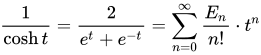
Asymptotic approximation [ edit ] The Euler numbers grow quite rapidly for large indices as
they have the following lower bound
|
E
2
n
|
>
8
n
π
(
4
n
π
e
)
2
n
.
{\displaystyle |E_{2n}|>8{\sqrt {\frac {n}{\pi }}}\left({\frac {4n}{\pi e}}\right)^{2n}.}
Euler zigzag numbers [ edit ] The Taylor series of
sec
x
+
tan
x
=
tan
(
π
4
+
x
2
)
{\displaystyle \sec x+\tan x=\tan \left({\frac {\pi }{4}}+{\frac {x}{2}}\right)}
∑
n
=
0
∞
A
n
n
!
x
n
,
{\displaystyle \sum _{n=0}^{\infty }{\frac {A_{n}}{n!}}x^{n},}
where An is the Euler zigzag numbers , beginning with
1, 1, 1, 2, 5, 16, 61, 272, 1385, 7936, 50521, 353792, 2702765, 22368256, 199360981, 1903757312, 19391512145, 209865342976, 2404879675441, 29088885112832, ... (sequence A000111 OEIS ) For all even n ,
A
n
=
(
−
1
)
n
2
E
n
,
{\displaystyle A_{n}=(-1)^{\frac {n}{2}}E_{n},}
where En n ,
A
n
=
(
−
1
)
n
−
1
2
2
n
+
1
(
2
n
+
1
−
1
)
B
n
+
1
n
+
1
,
{\displaystyle A_{n}=(-1)^{\frac {n-1}{2}}{\frac {2^{n+1}\left(2^{n+1}-1\right)B_{n+1}}{n+1}},}
where Bn Bernoulli number .
For every n ,
A
n
−
1
(
n
−
1
)
!
sin
(
n
π
2
)
+
∑
m
=
0
n
−
1
A
m
m
!
(
n
−
m
−
1
)
!
sin
(
m
π
2
)
=
1
(
n
−
1
)
!
.
{\displaystyle {\frac {A_{n-1}}{(n-1)!}}\sin {\left({\frac {n\pi }{2}}\right)}+\sum _{m=0}^{n-1}{\frac {A_{m}}{m!(n-m-1)!}}\sin {\left({\frac {m\pi }{2}}\right)}={\frac {1}{(n-1)!}}.}
[citation needed See also [ edit ] References [ edit ]
^ Jha, Sumit Kumar (2019). "A new explicit formula for Bernoulli numbers involving the Euler number" . Moscow Journal of Combinatorics and Number Theory . 8 (4): 385–387. doi :10.2140/moscow.2019.8.389 . S2CID 209973489 . ^ Jha, Sumit Kumar (15 November 2019). "A new explicit formula for the Euler numbers in terms of the Stirling numbers of the second kind" . ^ Wei, Chun-Fu; Qi, Feng (2015). "Several closed expressions for the Euler numbers" . Journal of Inequalities and Applications . 219 (2015). doi :10.1186/s13660-015-0738-9 ^ Tang, Ross (2012-05-11). "An Explicit Formula for the Euler zigzag numbers (Up/down numbers) from power series" (PDF) . Archived (PDF) from the original on 2014-04-09. ^ Vella, David C. (2008). "Explicit Formulas for Bernoulli and Euler Numbers" . Integers . 8 (1): A1. ^ Malenfant, J. (2011). "Finite, Closed-form Expressions for the Partition Function and for Euler, Bernoulli, and Stirling Numbers". arXiv :1103.1585 math.NT ]. ^ Zhang, W.P. (1998). "Some identities involving the Euler and the central factorial numbers" (PDF) . Fibonacci Quarterly . 36 (4): 154–157. Archived (PDF) from the original on 2019-11-23. ^ Zhang, W.P.; Xu, Z.F. (2007). "On a conjecture of the Euler numbers" . Journal of Number Theory . 127 (2): 283–291. doi :10.1016/j.jnt.2007.04.004
External links [ edit ]
Possessing a specific set of other numbers
Expressible via specific sums













![{\displaystyle {\begin{aligned}E_{10}&=10!\left(-{\frac {1}{10!}}+{\frac {2}{2!\,8!}}+{\frac {2}{4!\,6!}}-{\frac {3}{2!^{2}\,6!}}-{\frac {3}{2!\,4!^{2}}}+{\frac {4}{2!^{3}\,4!}}-{\frac {1}{2!^{5}}}\right)\\[6pt]&=9!\left(-{\frac {1}{9!}}+{\frac {3}{1!^{2}\,7!}}+{\frac {6}{1!\,3!\,5!}}+{\frac {1}{3!^{3}}}-{\frac {5}{1!^{4}\,5!}}-{\frac {10}{1!^{3}\,3!^{2}}}+{\frac {7}{1!^{6}\,3!}}-{\frac {1}{1!^{9}}}\right)\\[6pt]&=-50\,521.\end{aligned}}}](https://wikimedia.org/api/rest_v1/media/math/render/svg/7eebe65e17bf7a388a247283db84ec59f60ed065)
![{\displaystyle {\begin{aligned}(-1)^{n}E_{2n}&=\int _{0}^{\infty }{\frac {t^{2n}}{\cosh {\frac {\pi t}{2}}}}\;dt=\left({\frac {2}{\pi }}\right)^{2n+1}\int _{0}^{\infty }{\frac {x^{2n}}{\cosh x}}\;dx\\[8pt]&=\left({\frac {2}{\pi }}\right)^{2n}\int _{0}^{1}\log ^{2n}\left(\tan {\frac {\pi t}{4}}\right)\,dt=\left({\frac {2}{\pi }}\right)^{2n+1}\int _{0}^{\pi /2}\log ^{2n}\left(\tan {\frac {x}{2}}\right)\,dx\\[8pt]&={\frac {2^{2n+3}}{\pi ^{2n+2}}}\int _{0}^{\pi /2}x\log ^{2n}(\tan x)\,dx=\left({\frac {2}{\pi }}\right)^{2n+2}\int _{0}^{\pi }{\frac {x}{2}}\log ^{2n}\left(\tan {\frac {x}{2}}\right)\,dx.\end{aligned}}}](https://wikimedia.org/api/rest_v1/media/math/render/svg/1628941c1d84b5ab1f5475623da7fc2d24469b03)