


Allium fistulosum
| Welsh onion | |
|---|---|

| |
| Allium fistulosum at a farm | |
Scientific classification 
| |
| Kingdom: | Plantae |
| Clade: | Tracheophytes |
| Clade: | Angiosperms |
| Clade: | Monocots |
| Order: | Asparagales |
| Family: | Amaryllidaceae |
| Subfamily: | Allioideae |
| Genus: | Allium |
| Subgenus: | A. subg. Cepa |
| Species: | A. fistulosum
|
| Binomial name | |
| Allium fistulosum | |
| Synonyms[1] | |
| |
| Nutritional value per 100 g (3.5 oz) | |
|---|---|
| Energy | 142 kJ (34 kcal) |
6.5 g | |
| Sugars | 2.18 g |
| Dietary fiber | 2.4 g |
0.4 g | |
1.9 g | |
| Vitamins | Quantity %DV† |
| Thiamine (B1) | 4% 0.05 mg |
| Riboflavin (B2) | 7% 0.09 mg |
| Niacin (B3) | 3% 0.4 mg |
| Pantothenic acid (B5) | 3% 0.169 mg |
| Vitamin B6 | 4% 0.072 mg |
| Folate (B9) | 4% 16 μg |
| Vitamin C | 30% 27 mg |
| Vitamin E | 3% 0.51 mg |
| Vitamin K | 161% 193.4 μg |
| Minerals | Quantity %DV† |
| Calcium | 4% 52 mg |
| Iron | 7% 1.22 mg |
| Magnesium | 5% 23 mg |
| Manganese | 6% 0.137 mg |
| Phosphorus | 4% 49 mg |
| Potassium | 7% 212 mg |
| Sodium | 1% 17 mg |
| Zinc | 5% 0.52 mg |
| †Percentages estimated using US recommendations for adults,[2] except for potassium, which is estimated based on expert recommendation from the National Academies.[3] | |
Allium fistulosum, the Welsh onion, also commonly called bunching onion, long green onion, Japanese bunching onion, and spring onion, is a species of perennial plant, often considered to be a kind of scallion.
The species is very similar in taste and odor to the related common onion, Allium cepa, and hybrids between the two (tree onions) exist. A. fistulosum, however, does not develop bulbs, and possesses hollow leaves (fistulosum means "hollow") and scapes. Larger varieties of A. fistulosum, such as the Japanese negi, resemble the leek, whilst smaller varieties resemble chives. A. fistulosum can multiply by forming perennial evergreen clumps.[4][5] It is also grown in a bunch as an ornamental plant.
Names[edit]
The common name "Welsh onion" does not refer to Wales; indeed, the plant is neither indigenous to Wales nor particularly common in Welsh cuisine (the green Allium common to Wales is the leek, A. ampeloprasum, the national vegetable of Wales[6][7]). Instead, it derives from a near-obsolete botanical use of "Welsh" in the sense "foreign, non-native", as the species is native to China, though cultivated in many places and naturalized in scattered locations throughout Eurasia and North America.[1][8]
Historically, A. fistulosum was known as the cibol.[9] In Cornwall, they are known as chibols, and in the west of Scotland as sybows.[10][11]
Other names that may be applied to this plant include green onion, salad onion, and spring onion. These names are ambiguous, as they may also be used to refer to any young green onion stalk, whether grown from Welsh onions, common onions, or other similar members of the genus Allium (also see scallion).[12]
Culinary use[edit]
A. fistulosum is an ingredient in Asian cuisine, especially in East Asia and Southeast Asia. It is particularly important in China, Japan, and Korea, hence one of the English names for this plant, Japanese bunching onion.[citation needed]
In the West, A. fistulosum is primarily used as a scallion or salad onion, but is more widely used in other parts of the world, particularly East Asia.[13]
Jamaica[edit]
Known as escallion,[14] A. fistulosum is an ingredient in Jamaican cuisine, in combination with thyme, Scotch bonnet pepper, garlic, and allspice (called pimento). Recipes with escallion sometimes suggest leek as a substitute in salads. Jamaican dried spice mixtures using escallion are available commercially.[citation needed]
The Jamaican name is probably a variant of scallion, the term used loosely for the spring onion and various other plants in the genus Allium.[citation needed]
Japan[edit]
The Japanese name is negi (葱), which can also refer to other plants of the genus Allium, or more specifically naganegi (長葱), meaning "long onion". Common onions were introduced to East Asia in the 19th century, but A. fistulosum remains more popular and widespread.[13] It is used in miso soup, negimaki (beef and scallion rolls),[15] among other dishes, and it is widely sliced up and used as a garnish, such as on teriyaki or takoyaki.[citation needed]
-
 Duck soba with negi

Korea[edit]
In Korea, A. fistulosum along with A. × proliferum is called pa (파, "scallion"), while common onions are called yangpa (양파, "Western scallion"). Larger varieties, looking similar to leek and sometimes referred to as "Asian leek", are called daepa (대파, "big scallion"), while the thinner early variety is called silpa (실파, "thread scallion"). A similar scallion plant, A. × wakegi (now considered a synonym of A. × proliferum), is called jjokpa (쪽파). Both daepa and silpa are usually used as a spice, herb, or garnish in Korean cuisine. The white part of daepa is often used as the flavour base for various broths and infused oil, while the green part of silpa is preferred as garnish. Dishes using daepa include pa-jangajji (pickled scallions), pa-mandu (scallion dumplings), pa-sanjeok (skewered beef and scallions), and padak (scallion chicken), which is a variety of Korean fried chicken topped with shredded raw daepa. Dishes using silpa include pa-namul (seasoned scallions), pa-jangguk (scallion beef-broth soup), and pa-ganghoe (parboiled scallion rolls) where silpa is used as a ribbon that bundles other ingredients.[citation needed]
-
 Thick daepa type
 -
 Thin silpa type
 -
 Pa-namul (seasoned blanched scallions)
 -
 Pa-muchim (seasoned shredded scallions) eaten with samgyeopsal (grilled pork belly)
 -
 Pa-sanjeok (skewered beef and scallions)
 -

.jpg)
.jpg)


Russia[edit]
A. fistulosum is used in Russia in the spring for adding green leaves to salads.[citation needed]
Image gallery[edit]
-
 A. fistulosum
 -
 Grown in Guizhou, China
 -
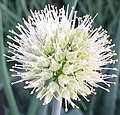 Flower
 -
 A. fistulosum – MHNT


See also[edit]
References[edit]
- ^ a b "Allium fistulosum". World Checklist of Selected Plant Families. Kew Royal Botanical Gardens. Archived from the original on 1 October 2013.
- ^ United States Food and Drug Administration (2024). "Daily Value on the Nutrition and Supplement Facts Labels". Retrieved 28 March 2024.
- ^ National Academies of Sciences, Engineering, and Medicine; Health and Medicine Division; Food and Nutrition Board; Committee to Review the Dietary Reference Intakes for Sodium and Potassium (2019). Oria, Maria; Harrison, Meghan; Stallings, Virginia A. (eds.). Dietary Reference Intakes for Sodium and Potassium. The National Academies Collection: Reports funded by National Institutes of Health. Washington (DC): National Academies Press (US). ISBN 978-0-309-48834-1. PMID 30844154.
{{cite book}}: CS1 maint: multiple names: authors list (link) - ^ "Floridata Profile". floridata.com. Archived from the original on 17 April 2023. Retrieved 7 March 2009.
- ^ Thompson, Sylvia (1995). The Kitchen Garden. Bantam Books. ISBN 9780553081381.
- ^ "The leek, national emblem of Wales". BBC Wales. 28 February 2013. Archived from the original on 17 February 2023. Retrieved 30 December 2021.
- ^ "Welsh Leeks secures protection". wales.gov. 29 November 2022. Archived from the original on 24 March 2023. Retrieved 16 March 2023.
- ^ "Welsh, adj. and n.". OED Online. Oxford University Press. March 2023. Def. 3. Archived from the original on 5 April 2024. Retrieved 12 May 2023.
- ^ Ward, A: The Encyclopedia of Food and Beverage Archived 12 February 2010 at Archive-It, New York, 1911. Retrieved 5 January 2007.
- ^ "sybow, n.". OED Online. Oxford University Press. March 2023. Archived from the original on 5 April 2024. Retrieved 12 May 2023.
- ^ "chibol, n.". OED Online. Oxford University Press. March 2023. Def. 1. Archived from the original on 5 April 2024. Retrieved 12 May 2023.
- ^ "chibol, n.". OED Online. Oxford University Press. March 2023. Def. 2. Archived from the original on 5 April 2024. Retrieved 12 May 2023.
- ^ a b Fritsch, R.M.; N. Friesen (2002). "Chapter 1: Evolution, Domestication, and Taxonomy". In H.D. Rabinowitch and L. Currah (ed.). Allium Crop Science: Recent Advances. Wallingford, UK: CABI Publishing. p. 18. ISBN 0-85199-510-1.
- ^ "Major Pests of Escallion (Allium fistulosum) in Jamaica" (PDF). Ministry of Agriculture and Lands, Jamaica. November 2006. Archived from the original (PDF) on 5 May 2016. Retrieved 15 March 2015.
- ^ "Recipe – Chicken Negimaki – NYTimes.com". The New York Times. 13 August 2010. Archived from the original on 27 October 2022. Retrieved 15 September 2012.
External links[edit]
 Media related to Allium fistulosum at Wikimedia Commons
- PROTAbase on Allium fistulosum
- World's Largest Allium fistulosum

| Onion cultivars | |||
|---|---|---|---|
| Onion species | |||
| Onion food | |||
| Garlic cultivars | |||
| Garlic species |
| ||
| Garlic food | |||
| Garlic and onion constituents | |||
| Related |
| ||

| Authority control databases: National |
|---|
