


The Lion Sleeps Tonight
 | This article needs additional citations for verification. (May 2019) |
| "The Lion Sleeps Tonight" | |
|---|---|
 | |
| Single by the Tokens | |
| from the album The Lion Sleeps Tonight | |
| A-side | "Tina" |
| Released | 1961 |
| Recorded | 1961 |
| Genre | |
| Length | 2:41 |
| Label | RCA Victor |
| Songwriter(s) |
|
| Audio | |
| The Lion Sleeps Tonight (Wimoweh) (Audio) on YouTube | |
"The Lion Sleeps Tonight" is a song originally written and first recorded in 1939 by Solomon Linda[2] under the title "Mbube",[3] through South African Gallo Record Company. Lyrics of Linda's original version were written in Zulu, while those of the English one were later written by George David Weiss.
The song has been adapted and covered internationally by many pop and folk artists. It was recorded as "Wimoweh" by The Weavers in November 1951, and published by "Folkways Music Publishers", a branch of the then-Folkways Records, in December of the same year.[4] Artists who have recorded various versions of the song include also R.E.M., NSYNC, Henri Salvador, Karl Denver, Jimmy Dorsey, Yma Sumac, Noro Morales, Miriam Makeba, and The Kingston Trio.[5]
In 1961, a version adapted into English with the title "The Lion Sleeps Tonight" by the doo-wop group The Tokens became a number-one hit in the United States. It went on to earn millions in royalties from cover versions and film licensing. The pop group Tight Fit made a cover of the song in 1982, reaching number one hit in the UK. This song is written and composed in the key of F major.
History[edit]

The original song title was "Mbube" (the Zulu word for "lion") and was written and first recorded in 1939 by Solomon Linda,[6] a South African Zulu singer, who worked for the Gallo Record Company in Johannesburg as a cleaner and record packer. He spent his weekends performing with his musical ensemble, "The Evening Birds", and it was at this record label, under the direction of producer "Griffiths Motsieloa", that Linda and his fellow musicians recorded several songs, including "Mbube", which incorporated a call and response pattern common among many Sub-Saharan African ethnic groups, including the Zulu.
According to journalist Rian Malan:
"Mbube" wasn't the most remarkable tune, but there was something compelling about the underlying chant, a dense meshing of low male voices above which Solomon yodelled and howled for two exhilarating minutes, improvising occasionally. The third take was the best, achieving immortality when Solly took a deep breath, opened his mouth, and improvised the melody that the world now associates with these words:
In the jungle, the mighty jungle, the lion sleeps tonight.[2]
Issued as a 78-rpm phonograph record[7] and marketed to black audiences, "Mbube" became a hit and Linda a star throughout South Africa. By 1948, the song had sold over 100,000 copies in Africa and among black South African immigrants in Great Britain. Linda's song also gave the name to a style of African A cappella music that evolved into Isicathamiya (also called Mbube music), popularized by the group Ladysmith Black Mambazo.[8]
In 1949 Alan Lomax, then working as folk music director for Decca Records, brought Solomon Linda's 78-rpm recording to the attention of his friend Pete Seeger, leader of the folk group The Weavers. In November 1951, after having performed the song for at least a year in their concerts, The Weavers recorded an adapted version with brass, string orchestra and chorus and released it as a 78-rpm single titled "Wimoweh", a mishearing of the original song's chorus of "Uyimbube" ("You are a lion" in Zulu). Their version contained the chanting chorus "Wimoweh" and Linda's improvised line. The Weavers credited the song as "Oral tradition", with arrangement by "Paul Campbell", later found to be a pseudonym used by The Weavers in order to claim royalties.[9] It reached Billboard's top ten and became a staple of The Weavers' live repertoire, achieving further exposure on their best-selling The Weavers at Carnegie Hall LP album, recorded in 1955 and released in 1957.
Exotica singer Yma Sumac covered the song, for which Juilliard School-trained songwriter George David Weiss brought in soprano Anita Darian to let her perform before, during and after the soprano saxophone solo in such version, issued in 1952 on Capitol Records.[10] The song was recorded extensively by other folk revival groups such as The Kingston Trio, who released it in 1958.
Miriam Makeba also covered the song in 1960, with the original title "Mbube" and giving writing credits to "J. Linda".[9] In 1961, two RCA Records producers, Hugo Peretti and Luigi Creatore, hired Weiss to arrange a Doo-wop and Rhythm and blues cover of "Wimoweh" for the B-side of a 45-rpm single called "Tina", sung by group The Tokens. Weiss wrote the English lines "In the jungle, the mighty jungle, The lion sleeps tonight..." and "Hush, my darling, don't fear, my darling...".[citation needed] "The Lion Sleeps Tonight" was issued by RCA in that year, and it rocketed to number one on the Billboard Hot 100. Weiss' "Abilene Music, Inc." was the publisher of this arrangement, and listed "Albert Stanton" (a pseudonym for "Al Brackman", the business partner of Pete Seeger's music publisher, Howie Richmond) as one of the song's writers or arrangers.[citation needed]
Copyright issues[edit]
Social historian Ronald D. Cohen writes: "Howie Richmond copyrighted many songs originally in the public domain but now slightly revised to satisfy Decca and also to reap profits".[11] Howie Richmond's claim of author's copyright could secure both the songwriter's royalties and his company's publishing share of the song earnings.[2]
Although Solomon Linda was listed as a performer on the record itself, the Weavers thought they had recorded a traditional Zulu song. Their managers, the publisher, and their attorneys knew otherwise because they had been contacted by — and had reached an agreement with — Eric Gallo of Gallo Record Company in South Africa. The Americans maintained, however, that South African copyrights were not valid because South Africa was not a signatory to U.S. copyright law.[2] In the 1950s, after Linda's authorship was made clear, Pete Seeger sent $1000 to the South African artist. The folk singer also said he instructed TRO/Folkways to henceforth pay his share of authors' earnings to Linda. Seeger apparently trusted his publisher's word of honor and either saw no need, or was unable, to make sure these instructions to be carried out.[2]
In 2000, South African journalist Rian Malan wrote a feature article for Rolling Stone magazine in which he recounted Linda's story and estimated that the song had earned $15 million for its use in the Disney 1994 movie The Lion King alone. The piece prompted filmmaker François Verster to create the Emmy-winning documentary A Lion's Trail, released in 2002, which tells Linda's story while incidentally exposing the workings of the multi-million dollar corporate music publishing industry.[12] In 2003 a CGI animation French TV series, Pat & Stan, features protagonists, a brown hippopotamus and a yellow dog, singing "The Lion Sleeps Tonight". It marked the two's debut appearance and was the pilot episode to ITV's shorts and the sketch of the same name.
In July 2004, as a result of the publicity generated by Malan's article and the subsequent documentary, the song became the subject of a lawsuit between Linda's estate and Disney, claiming that the latter owed $1.6 million in royalties for the use of "The Lion Sleeps Tonight" in the film and musical stage productions of The Lion King.[13] At the same time, the Richmond Organization began to pay $3,000 annually to the Linda's estate. In February 2006, the South African singer's descendants reached a legal settlement with Abilene Music Publishers, who held the worldwide rights and had licensed the song to Disney, to place the earnings of the song in a trust.[14][15]
In 2012, "Mbube" fell into the public domain, owing to the copyright law of South Africa, while "The Lion Sleeps Tonight" is still in copyright. The copyright issues were also treated in the 2019 movie ReMastered: The Lion's Share.[16]
Selected list of recorded versions[edit]
 | This section has multiple issues. Please help improve it or discuss these issues on the talk page. (Learn how and when to remove these template messages)
|
| "Mbube" | |
|---|---|
.jpg) | |
| Single by Solomon Linda's Original Evening Birds | |
| B-side | "Ngi Hambiki" |
| Released | 1939 |
| Recorded | c. 1939 |
| Studio | Gallo Recording Studios |
| Genre | |
| Length | 2:44 |
| Label | Gallo Record Company |
| Songwriter(s) | |
| Audio | |
| Mbube (Audio) on YouTube | |
The song has been recorded by numerous artists, and is a standard that has become a part of popular culture.
"Mbube"[edit]
- 1939 Solomon Linda and the Evening Birds
- 1939 Solomon Linda and the Evening Birds (take 2) featured in the first film adaptation of Cry, the Beloved Country[17][18]
- 1960 Miriam Makeba, on the Miriam Makeba album
- 1988 Ladysmith Black Mambazo, during opening sequence of movie Coming to America, but not on the soundtrack album
- 1991 Dolly Rathebe & the Elite Swingsters, on the Woza! album
- 1994 Ladysmith Black Mambazo, as "Mbube (The Lion Sleeps Tonight)", on the Gift of the Tortoise album
- 1996 Soweto String Quartet, as "Imbube", on the Renaissance album
- 2005 Soweto Gospel Choir, as "Imbube", on the Blessed album
- 2006 Ladysmith Black Mambazo, on the Long Walk to Freedom album
- 2007 CH2 and Soweto String Quartet, as "Imbube", on the Pap & Paella album
- 2010 Angélique Kidjo, on the Õÿö album
- 2019 Lebo M, on the soundtrack album of the computer-animated remake of The Lion King film
- 2020 Mahotella Queens featuring "Bokkie ULT" & "Cuebur", as "Mbube 2020"[19]
"Wimoweh"[edit]
- 1952: The Weavers, US No. 6
- 1952: Jimmy Dorsey
- 1952: Yma Sumac
- 1957: The Weavers, live version
- 1957: The Georgetown Chimes, on the Under the Tree with the Georgetown Chimes album
- 1959: Bill Hayes (on Kapp Records)
- 1959: The Kingston Trio
- 1961: Karl Denver, UK No. 4[20]
- 1962: Bert Kaempfert, on the A Swingin' Safari album, (on Polydor Records); made mostly as an instrumental save for the "Wimoweh" chorus.
- 1962: Hugh Masekela, on the Trumpet Africaine album
- 1964: Glen Campbell, on The Astounding 12-String Guitar of Glen Campbell album
- 1964: Chet Atkins
- 1971: Rumplestiltskin, on the Black Magician album
- 1975: Bamses Venner
- 1993: Nanci Griffith featuring Odetta, on the Other Voices, Other Rooms album
- 1994: Roger Whittaker, on the Roger Whittaker Live! album
- 1994: Manu Dibango featuring Ladysmith Black Mambazo, on the Waka Afrika album
- 1998: Pete Seeger, on the For Kids And Just Plain Folks album
- 1999: Desmond Dekker, on the Halfway To Paradise album
"The Lion Sleeps Tonight"[edit]
| "The Lion Sleeps Tonight" | ||||
|---|---|---|---|---|
 | ||||
| Single by Robert John | ||||
| from the album Robert John | ||||
| B-side | "Janet" | |||
| Released | December 1971 | |||
| Genre | ||||
| Label | Atlantic | |||
| Songwriter(s) |
| |||
| Producer(s) | Hank Medress and Dave Appell | |||
| Robert John singles chronology | ||||
| ||||
| "The Lion Sleeps Tonight" | ||||
|---|---|---|---|---|
 | ||||
| Single by Tight Fit | ||||
| from the album Tight Fit | ||||
| B-side | "Rhythm, Movement And Throbbing" | |||
| Released | January 1982 | |||
| Recorded | 1981 | |||
| Genre | Pop | |||
| Length | 3:18 | |||
| Label | Jive | |||
| Songwriter(s) |
| |||
| Producer(s) | Tim Friese-Greene[22] | |||
| Tight Fit singles chronology | ||||
| ||||
- 1961: The Tokens, US No. 1, UK No. 11, Canada No. 1[23]
- 1962: Henri Salvador, FR No. 1, as "Le lion est mort ce soir", a French version whose title means "The Lion Died Tonight"
- 1965: The New Christy Minstrels
- 1965: The Shangaans, on the Jungle Drums album
- 1966: The Townsmen, Canada No. 70[24]
- 1967: The Hounds
- 1968: The Tremeloes, on the Silence Is Golden album
- 1971: Eric Donaldson
- 1972: Robert John, US No. 3, gold record / Canada No. 15[25]
- 1972: Dave Newman, UK No. 34
- 1974: Ras Michael and the Sons of Negus, as "Rise Jah Jah Children (The Lion Sleeps)"
- 1975: Brian Eno, on the Working Backwards: 1983-1973 and Eno Box II: Vocal albums
- 1976: Dove[26]
- 1979: The Stylistics
- 1980: Passengers
- 1982: Tight Fit, UK No. 1, on the Tight Fit album:[27] the record sold over a million copies in the UK[28]
- 1982: The Nylons, Canada No. 91[29]
- 1982: Maria Conchita Alonso
- 1990: Ladysmith Black Mambazo featuring The Mint Juleps, on the Spike Lee & Company: Do It a Cappella PBS documentary and album
- 1991: P.J. Powers featuring Hotline, on The Best Of compilation album
- 1991: Big Daddy, mashed up with "Welcome to the Jungle"
- 1992: Talisman, on the A Capella album
- 1992: They Might Be Giants featuring Laura Cantrell, interpolated into "The Guitar (The Lion Sleeps Tonight)"
- 1993: Pow woW, FR No. 1, cover of Salvador's version
- 1993: R.E.M., B-side of "The Sidewinder Sleeps Tonite" and on The Automatic Box (Disc 3) album
- 1993: The Nylons, re-issue on The Best Of compilation album
- 1993: Streetnix, on the Listen album
- 1994: Dennis Marcellino
- 1994: Tonic Sol-Fa
- 1995: Lebo M, in the Rhythm of the Pride Lands album, an LP with songs inspired by the music of The Lion King film
- 1997: Barbados
- 1997: 'N Sync, B-side of "For the Girl Who Has Everything"
- 1998: The Undertones, on the 8 Degrees and Rising album
- 2001: Baha Men featuring Imani Coppola, sampled the chorus in the song "You All Dat" on the Who Let the Dogs Out album
- 2001: Rockapella
- 2002: Mango Groove, on the Eat a Mango album
- 2004: Daniel Küblböck
- 2005: The Mavericks
- 2006: VeggieTales characters, on the Bob and Larry Sing the 70s album
- 2009: Melo-M, on the Around the World album
- 2010: Gerard Joling featuring Cool Down Café, on the Goud album
- 2014: Billy Joel and Jimmy Fallon, on The Tonight Show Starring Jimmy Fallon album[30]
- 2015: Justin Fletcher, as Gail Force character on Gigglebiz children tv show
- 2016: Tight Fit, "Rainforest Radio Edit" re-issue on the Together album (on Almighty Records)[31]
- 2019: Billy Eichner and Seth Rogen, on The Lion King remake film and soundtrack album
- 2019: Wiese
- 2024: Voiceplay featuring J. None, A cappella version[32] with a very creative setting and animal digital representation
Charted singles[edit]
The Tokens[edit]
Weekly charts[edit]
|
Year-end charts[edit]
|
Robert John[edit]
Weekly charts[edit]
|
Year-end charts[edit]
|
Tight Fit[edit]
Weekly charts[edit]
|
Year-end charts[edit]
|
R.E.M.[edit]
Weekly charts[edit]
|
Year-end charts[edit]
|
See also[edit]
References[edit]
- ^ Stanley, Bob (2022). "Revival: Trad Jazz and Folk". Let's Do It - The Birth of Pop Music: A History. New York: Pegasus Books. p. 477.
- ^ a b c d e Malan, Rian (2000). "In the Jungle". Longform.org. Rolling Stone. Archived from the original on 14 February 2020. Retrieved 5 March 2022.
- ^ "Seeking justice for Lion Sleeps Tonight composer". BBC News. 29 December 2020. Retrieved 4 January 2021.
- ^ Library of Congress. Copyright Office. (1952). Catalog of Copyright Entries 1952 Published Music Jan-Dec 3D Ser Vol 6 Pt 5A. United States Copyright Office. U.S. Govt. Print. Off.
- ^ William and Mary Libraries Special Collections Research Center (17 May 1952). Cash Box. Cash Box Pub. Co.
- ^ Frith, Simon, Popular Music: critical concepts in media and cultural studies, Volume 4, London: Routledge, 2004. ISBN 978-0-415-33270-5. p. 271
- ^ Cad, Saint (31 July 2012). "Top 10 Famous Songs With Unknown Originals". listverse.com. Retrieved 21 June 2013.
- ^ Frith, Simon (2004). Popular music: critical concepts in media and cultural studies, Volume 4. London: Routledge. ISBN 978-0-415-33270-5.
- ^ a b David Hutcheon, "The Story Behind the Song: The Lion Sleeps Tonight", Mojo '60s, #9, 2017, pp. 18-19
- ^ "Show 18 — Blowin' in the Wind: Pop discovers folk music. [Part 1]". Pop Chronicles. UNT Digital Library. 18 May 1969. Retrieved 24 September 2010.
- ^ Cohen, Ronald D. (2002). Rainbow Quest: the Folk Music Revival and American Society. Amherst: University of Massachusetts Press. p. 71.
- ^ "National Television Academy Presents 27th Annual News & Documentary Emmy Awards" (press release), 25 September 2006.
- ^ "3rd Ear Music Forum - Mbube - Mickey Mouse Under House Arrest in SAfrica?". 3rdearmusic.com. Retrieved 29 March 2014.
- ^ Blair, David (30 October 2004). "Penniless singer's family sue Disney for Lion King royalties". The Daily Telegraph. Retrieved 1 July 2017.
- ^ "It's a Lawsuit, a Mighty Lawsuit". Time.com. 25 October 2004. Archived from the original on 15 May 2007. Retrieved 14 February 2007.
- ^ https://www.imdb.com/title/tt9046576/ [user-generated source]
- ^ Solomon Linda, Evening Birds - Mbube (take 2, rare), archived from the original on 12 December 2021, retrieved 1 September 2021
- ^ Earliest Wimoweh Mbube Lion Sleeps Tonight ? '51, archived from the original on 12 December 2021, retrieved 1 September 2021
- ^ "Seeking justice for Lion Sleeps Tonight composer". BBC News. 29 December 2020.
- ^ "Karl Denver". The Official Charts Company.
- ^ Breihan, Tom (19 February 2020). "The Number Ones: Robert John's "Sad Eyes"". Stereogum. Retrieved 12 July 2023.
In 1972, John recorded an adult-contempo cover of the Tokens' "The Lion Sleeps Tonight"...
- ^ Rice, Jo (1982). The Guinness Book of 500 Number One Hits (1st ed.). Enfield, Middlesex: Guinness Superlatives Ltd. p. 222. ISBN 0-85112-250-7.
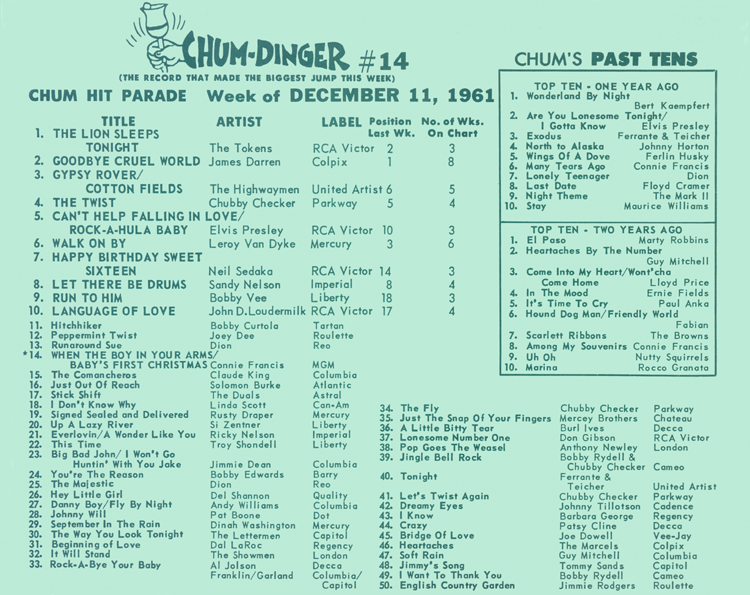
- ^ "CHUM Hit Parade - December 11, 1961".
- ^ "RPM Top 100 Singles - October 10, 1966" (PDF).
- ^ "RPM Top 100 Singles - March 11, 1972" (PDF).
- ^ McFarlane, Ian (1999). "Encyclopedia entry for 'Dove'". Encyclopedia of Australian Rock and Pop. St Leonards, NSW: Allen & Unwin. ISBN 1-86508-072-1. Archived from the original on 3 August 2004.
- ^ Roberts, David (2006). British Hit Singles & Albums (19th ed.). London: Guinness World Records Limited. p. 406. ISBN 1-904994-10-5.
- ^ Sedghi, Ami (4 November 2012). "UK's million-selling singles: the full list". The Guardian. Retrieved 4 November 2012.
- ^ "RPM Top 100 Singles - April 5, 1986" (PDF).
- ^ "Jimmy Fallon and Billy Joel Sing "The Lion Sleeps Tonight"". Time Magazine. 21 March 2014. Retrieved 15 May 2021.
- ^ "Tight Fit — Together — Almighty Records". Almightyrecords.com. Retrieved 21 March 2018.
- ^ "Voiceplay ft. J. None sing "The Lion Sleeps Tonight"". Youtube. Retrieved 25 January 2024.
- ^ "The Tokens – The Lion Sleeps Tonight" (in Dutch). Ultratop 50. Retrieved 15 June 2018.
- ^ "The Tokens – The Lion Sleeps Tonight" (in French). Ultratop 50. Retrieved 15 June 2018.
- ^ "flavour of new zealand - Lever hit parades". Flavourofnz.co.nz. Archived from the original on 6 April 2023. Retrieved 1 May 2019.
- ^ "Tokens: Artist Chart History". Official Charts Company. Retrieved 15 June 2018.
- ^ "The Tokens Chart History (Hot 100)". Billboard. Retrieved 15 June 2018.
- ^ "The Tokens Chart History (Hot R&B/Hip-Hop Songs)". Billboard. Retrieved 15 June 2018.
- ^ "Offiziellecharts.de – The Tokens – The Lion Sleeps Tonight" (in German). GfK Entertainment charts. Retrieved 15 June 2018. To see peak chart position, click "TITEL VON The Tokens"
- ^ [1] [dead link]
- ^ Kent, David (1993). Australian Chart Book 1970-1992. St Ives, N.S.W.: Australian Chart Book. ISBN 0-646-11917-6.
- ^ "Top RPM Singles: Issue 7602." RPM. Library and Archives Canada. Retrieved 25 November 2020.
- ^ "Top RPM Adult Contemporary: Issue 5318." RPM. Library and Archives Canada. Retrieved 25 November 2020.
- ^ "SA Charts 1965–March 1989". Retrieved 5 September 2018.
- ^ "Robert John Chart History (Hot 100)". Billboard. Retrieved 25 November 2020.
- ^ "Robert John Chart History (Adult Contemporary)". Billboard. Retrieved 25 November 2020.
- ^ "Cash Box Top 100 3/18/72". Tropicalglen.com. Archived from the original on 23 October 2016. Retrieved 21 March 2018.
- ^ "Offiziellecharts.de – Robert John – The Lion Sleeps Tonight" (in German). GfK Entertainment charts. Retrieved 25 November 2020. To see peak chart position, click "TITEL VON Robert John"
- ^ "Top 100 Hits of 1972/Top 100 Songs of 1972". Musicoutfitters.com. Archived from the original on 27 April 2017. Retrieved 1 December 2017.
- ^ "Cash Box YE Pop Singles - 1972". Tropicalglen.com. Archived from the original on 28 September 2018. Retrieved 1 May 2019.
- ^ Kent, David (1993). Australian Chart Book 1970–1992 (illustrated ed.). St Ives, N.S.W.: Australian Chart Book. p. 310. ISBN 0-646-11917-6.
- ^ "Tight Fit – The Lion Sleeps Tonight" (in German). Ö3 Austria Top 40. Retrieved 25 November 2020.
- ^ "Tight Fit – The Lion Sleeps Tonight" (in Dutch). Ultratop 50. Retrieved 25 November 2020.
- ^ "Tight Fit – The Lion Sleeps Tonight". Tracklisten. Retrieved 25 November 2020.
- ^ "The Irish Charts – Search Results – Lion Sleeps Tonight". Irish Singles Chart. Retrieved 25 November 2020.
- ^ "Nederlandse Top 40 – week 17, 1982" (in Dutch). Dutch Top 40. Retrieved 9 November 2021.
- ^ "Tight Fit – The Lion Sleeps Tonight" (in Dutch). Single Top 100. Retrieved 25 November 2020.
- ^ "Tight Fit – The Lion Sleeps Tonight". Top 40 Singles. Retrieved 25 November 2020.
- ^ "Tight Fit – The Lion Sleeps Tonight". Singles Top 100. Retrieved 25 November 2020.
- ^ "Tight Fit – The Lion Sleeps Tonight". Swiss Singles Chart. Retrieved 25 November 2020.
- ^ "Official Singles Chart Top 100". Official Charts Company. Retrieved 25 November 2020.
- ^ "Offiziellecharts.de – Tight Fit – The Lion Sleeps Tonight" (in German). GfK Entertainment charts. Retrieved 25 November 2020.
- ^ "Archívum – Slágerlisták – MAHASZ" (in Hungarian). Single (track) Top 40 lista. Magyar Hanglemezkiadók Szövetsége. Retrieved 30 March 2023.
- ^ "National Top 100 Singles for 1982". Kent Music Report. 3 January 1983. Retrieved 22 January 2023 – via Imgur.
- ^ "Jaaroverzichten 1982". Ultratop. Retrieved 9 November 2021.
- ^ "Top 100-Jaaroverzicht van 1982". Dutch Top 40. Retrieved 9 November 2021.
- ^ "Jaaroverzichten – Single 1982". dutchcharts.nl. Retrieved 9 November 2021.
- ^ "Top 100 Single-Jahrescharts". GfK Entertainment (in German). offiziellecharts.de. Retrieved 9 November 2021.
- ^ "Íslenski Listinn Topp 40 (2.–8. apríl)". Dagblaðið Vísir (in Icelandic). 1 April 1993. p. 29. Retrieved 24 January 2021.
- ^ "Árslistinn 1993". Dagblaðið Vísir (in Icelandic). 4 January 1994. p. 17. Retrieved 24 January 2021.
External links[edit]
- "Solomon Linda, Songwriter Who Penned 'The Lion,' Finally Gets His Just Desserts"
- Sample of "Mbube" performed by Solomon Linda's Original Evening Birds (WMA Stream).
- "Family of 'Lion Sleeps Tonight' Writer to Get Millions": All Things Considered, NPR
- "Penniless singer's family sue Disney for Lion King royalties": Daily Telegraph
- The Lion Sleeps Tonight. BBC World Service documentary by Paul Gambaccini first broadcast 16 July 2010, archived
- 200+ recordings of Mbube/Wimoweh/The Lion Sleeps Tonight on FLORENCOM's YouTube tribute channel
- "The Money Show" 6 May 2021 episode of Afropop Worldwide, which includes a history of "Mbube"/"The Lion Sleeps Tonight"
- Video comparing "Mbube" and "The Lion Sleeps Tonight" on VYIMBVBE's YouTube tribute channel
| International | |
|---|---|
| National | |
| Other | |



- Songs about cats
- Songs about sleep
- 1961 singles
- 1972 singles
- 1982 singles
- Billboard Hot 100 number-one singles
- Cashbox number-one singles
- Doo-wop songs
- Miriam Makeba songs
- Nanci Griffith songs
- Glen Campbell songs
- Henri Salvador songs
- European Hot 100 Singles number-one singles
- Dutch Top 40 number-one singles
- UK Singles Chart number-one singles
- Robert John songs
- Song recordings produced by Hugo & Luigi
- Song recordings produced by Tim Friese-Greene
- Songs written by Hugo Peretti
- Songs written by Luigi Creatore
- Songs written by George David Weiss
- South African songs
- 1939 songs
- RCA Victor singles
- Atlantic Records singles
- Jive Records singles
- The Tokens songs
- Internet memes introduced in 2019
- Lions in popular culture