1890s in film
From Wikipedia, the free encyclopedia
| List of years in film (table) |
|---|
| ... 1880 . 1881 . 1882 . 1883 . 1884 . 1885 . 1886 ... 1887 1888 1889 -1890- 1891 1892 1893 ... 1894 . 1895 . 1896 . 1897 . 1898 . 1899 . 1900 ... In television: 1887 1888 1889 -1890- 1891 1892 1893 |
| Art . Archaeology . Architecture . Literature . Music . Philosophy . Science +... |
| List of years in film |
|---|
| Years in film |
|---|
| 1870s |
The decade of the 1890s in film involved some significant events.
Contents |
Events [edit]
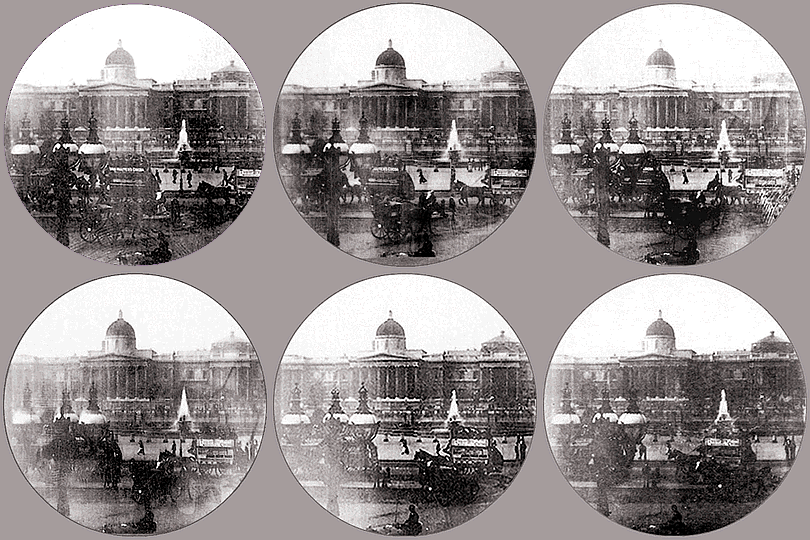
- 1890 - Wordsworth Donisthorpe and W. C. Crofts, filmed London's Trafalgar Square[1] using a camera patented in 1889.[2]
- 1891 - Designed around the work of Muybridge, Marey, and Eastman, Thomas Edison's employee, William K. L. Dickson finishes work on a motion-picture camera, and a viewing machine, called the Kinetoscope.
- May 20, 1891 - Thomas Edison holds the first public presentation of his Kinetoscope for the National Federation of Women's Clubs.
- August 24, 1891 - Thomas Edison files for a patent of the Kinetoscope.
- 1892 In France, Charles-Émile Reynaud began to have public screenings in Paris at the Théâtre Optique, with hundreds of drawings on a reel that he wound through his Zoetrope projector to construct moving images that continued for 15 minutes.
- 1892 - The Eastman Company becomes the Eastman Kodak Company.
- March 14, 1893 - Thomas Edison is granted Patent #493,426 for "An Apparatus for Exhibiting Photographs of Moving Objects" (The Kinetoscope).
- 1893 Thomas Edison builds a motion-picture studio near his laboratory, dubbed the "Black Maria" by his staff.
- May 9, 1893 - In America, Thomas Edison holds the first public exhibition of films shot using his Kinetograph at the Brooklyn Institute. Unfortunately, only one person at a time could use his viewing machine, the Kinetoscope.
- January 7, 1894 - Thomas Edison films his assistant, Fred Ott sneezing with the Kinetoscope at the "Black Maria."
- April 14, 1894 - The first commercial presentation of the Kinetoscope took place in the Holland Brothers' Kinetoscope Parlor at 1155 Broadway, New York City.
- 1894 - Kinetoscope viewing parlors begin to open in major cities. Each parlor contains several machines.
- 1895 - In France, brothers named Auguste and Louis Lumière, designed and built a lightweight, hand-held motion picture camera called the Cinématographe. The Lumière brothers discovered that their machine could also be used to project images onto a large screen. The Lumière brothers created several short films at this time that are considered to be pivotal in the history of motion pictures.
- November 1895 - In Germany, Emil and Max Skladanowsky develop their own film projector.
- December 1895 - In France, Auguste and Louis Lumière hold their first public screening of films shot with their Cinématographe.
- January 1896 - In Britain, Birt Acres and Robert W. Paul developed their own film projector, the Theatrograph (later known as the Animatograph).
- January 1896 - In the United States, a projector called the Vitascope was designed by Charles Francis Jenkins and Thomas Armat. Armat began working with Thomas Edison to manufacture the Vitascope, which projected motion pictures.
- April 1896 - Thomas Edison and Thomas Armat's Vitascope is used to project motion pictures in public screenings in New York City
- 1896 - French magician and filmmaker Georges Méliès begins experimenting with the new motion picture technology, developing a lot of early special effects techniques, including stop-motion photography.
- 1897 - A total of 125 people die during a film screening at the Charity Bazaar in Paris after a curtain catches on fire from the ether used to fuel the projector lamp.

- 1899 - Pathé-Frères is founded.
Films [edit]
This is an incomplete list of films made in the 1890s:
- London's Trafalgar Square (Wordsworth Donisthorpe and W. C. Crofts 1890)
- Monkeyshines (William Dickson and William Heise 1890)
- Dickson Greeting (William Dickson 1891)
- Blacksmith Scene (William Dickson 1893)
- Fred Ott's Sneeze (William Dickson 1894)
- Fred Ott Holding a Bird (William Dickson 1894)
- Buffalo Dance (William Dickson 1894)
- Dickson Experimental Sound Film (William Dickson 1895)
- L'Arrivée d'un train en gare de La Ciotat (Auguste and Louis Lumière 1895)
- Workers Leaving the Lumière Factory (Louis Lumière 1895)
- L'Arroseur Arrosé (Louis Lumière 1895)
- Baignade en mer (Georges Méliès 1896)
- Le Manoir du diable (Georges Méliès 1896)
- The Kiss (William Heise 1896)
- La Fée aux Choux (Alice Guy Blaché 1896)
- Rip van Winkle (William Dickson 1896)
- Admiral Cigarette (William Heise 1897)
- The Milker's Mishap (James H. White 1897)
- New Pillow Fight (director unknown 1897)
- The Nearsighted School Teacher (director unknown 1898)
- Jeanne d'Arc (1899 film) (Georges Méliès 1899)
Births [edit]
- January 22, 1893 - Conrad Veidt
- October 4, 1895 - Buster Keaton
- January 3, 1897 - Marion Davies
- September 30, 1898 - Renée Adorée
See also [edit]
- Film, History of film, List of lists of films
- Decades in film:
Notes [edit]
- ^ Burns, Paul T, The History of The Discovery of Cinematography - 1885–1889, retrieved 2009-05-10 and Ten Remaining Frames Of Donisthorpe's 1890 'Trafalgar Square' Footage Come To Life (GIF), retrieved 2009-05-10
- ^ Herbert, S. (1998), Industry, Liberty, and a Vision: Wordsworth Donisthorpe's Kinesigraph, London: The Projection Box, ISBN 0-9523941-3-8