


1990 Japanese Grand Prix
| 1990 Japanese Grand Prix | |||
|---|---|---|---|
| Race 15 of 16 in the 1990 Formula One World Championship | |||
.svg) | |||
| Race details | |||
| Date | 21 October 1990 | ||
| Official name | XVI Fuji Television Japanese Grand Prix | ||
| Location | Suzuka Circuit, Suzuka, Mie, Japan | ||
| Course | Permanent racing facility | ||
| Course length | 5.860 km (3.641[1] miles) | ||
| Distance | 53 laps, 310.580 km (192.985 miles) | ||
| Weather | Sunny | ||
| Attendance | 316,000[2] | ||
| Pole position | |||
| Driver | McLaren-Honda | ||
| Time | 1:36.996 | ||
| Fastest lap | |||
| Driver |
 Riccardo Patrese Riccardo Patrese | Williams-Renault | |
| Time | 1:44.233 on lap 40 | ||
| Podium | |||
| First | Benetton-Ford | ||
| Second | Benetton-Ford | ||
| Third | Lola-Lamborghini | ||
|
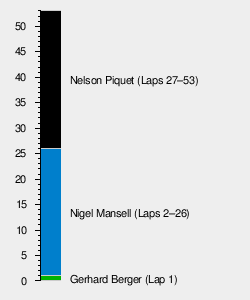
Lap leaders | |||
The 1990 Japanese Grand Prix was a Formula One motor race held on 21 October 1990 at Suzuka. It was the fifteenth and penultimate race of the 1990 Formula One season. It was the 16th Japanese Grand Prix and the 6th held at Suzuka. The race saw a first-corner collision between World Championship rivals Brazilian driver Ayrton Senna and French driver Alain Prost, the second consecutive year that the World Championship had been decided by a collision between the two at the same track. The collision immediately put both cars out of the race and secured Senna his second World Championship, a reversal of fortunes from the 1989 Japanese Grand Prix, where the collision had secured the championship for Prost.
The race saw a best result to that point for the Benetton Formula team, with their drivers Brazilian veteran Nelson Piquet and his protégé Roberto Moreno finishing first and second in their Benetton B190s. It was back to back wins for Benetton in Japan after the team's win the previous year. Japanese driver Aguri Suzuki scored a career-best result for himself, the Larrousse team and the Lamborghini engine, finishing third in his Lola LC90. With Ferrari scoring no points after Nigel Mansell's retirement, the McLaren team secured their sixth and third consecutive Constructors' Championship.
As of September 2024[update], this was the last race where no European driver finished the race on the podium, and two South American drivers and an Asian driver filled the top three positions. It was also the only race where the Larrousse team scored a podium finish during their eight seasons of competing in Formula One, and the first and only podium finish for the Lamborghini V12 engine in Formula One. Suzuki's podium finish was the first for a Japanese driver (later matched by Takuma Sato and Kamui Kobayashi) and the last for a Japanese driver at his home race until Kamui Kobayashi did so at the 2012 Japanese Grand Prix. Moreover, it was the last of Brazil's eleven one-twos in Formula One, the only one featuring Piquet and Moreno; of the other ten, eight featured Piquet and Senna and the other two had Emerson Fittipaldi and José Carlos Pace.
Pre-race
[edit]Before the race, Brabham announced that they would use Yamaha engines for 1991, while Footwork announced a Porsche engine deal for 1991 and retained both their 1990 drivers, Alex Caffi and Michele Alboreto. Prior to the race, the Life Racing Engines and EuroBrun teams withdrew from the sport. EuroBrun's Roberto Moreno joined the Benetton team replacing the previous year's race winner Alessandro Nannini, who was unable to attend the race following a helicopter crash that also ended his Formula One career, one week after the Spanish Grand Prix. Jean Alesi did not start after suffering a neck injury during Friday's practice. As his grid position was left empty, this was the third consecutive race to have only 25 starters instead of the usual 26. Nigel Mansell also announced a U-turn on his decision to retire by making public his agreement to join Williams-Renault for two years from 1991 after being given assurances from Frank Williams, Patrick Head, and Renault that they could deliver him a car in which he could win a World Championship and that he would be the team's undisputed No. 1 driver. On Saturday, Soichiro Honda, the founder of Honda, met Ayrton Senna in the McLaren pit.[3]
Qualifying
[edit]Qualifying report
[edit]After the withdrawal of the EuroBrun and Life teams, there was no need for a pre-qualifying session as only 30 cars remained in the event. The four drivers relieved of the necessity to pre-qualify, Yannick Dalmas, Gabriele Tarquini (both AGS), Olivier Grouillard (Osella) and Bertrand Gachot (Coloni) were ultimately the four drivers that failed to qualify for the race. Gachot crashed heavily in the Friday session. Roberto Moreno, who had left EuroBrun and joined Benetton, qualified easily in ninth position.[4]
Qualifying classification
[edit]| Pos | No | Driver | Constructor | Q1 | Q2 | Gap |
|---|---|---|---|---|---|---|
| 1 | 27 |  Ayrton Senna Ayrton Senna
|
McLaren-Honda | 1:38.828 | 1:36.996 | — |
| 2 | 1 |  Alain Prost Alain Prost
|
Ferrari | 1:38.684 | 1:37.228 | +0.232 |
| 3 | 2 |  Nigel Mansell Nigel Mansell
|
Ferrari | 1:38.969 | 1:37.719 | +0.723 |
| 4 | 28 |  Gerhard Berger Gerhard Berger
|
McLaren-Honda | 1:38.374 | 1:38.118 | +1.122 |
| 5 | 5 |  Thierry Boutsen Thierry Boutsen
|
Williams-Renault | 1:39.577 | 1:39.324 | +2.328 |
| 6 | 20 | Nelson Piquet
|
Benetton-Ford | 1:41.041 | 1:40.049 | +3.053 |
| 7 | 4 | Jean Alesi
|
Tyrrell-Ford | 1:40.052 | no time | +3.056 |
| 8 | 6 | Riccardo Patrese
|
Williams-Renault | 1:40.355 | 1:40.664 | +3.359 |
| 9 | 19 | Roberto Moreno
|
Benetton-Ford | 1:41.719 | 1:40.579 | +3.583 |
| 10 | 30 |  Aguri Suzuki Aguri Suzuki
|
Lola-Lamborghini | 1:41.442 | 1:40.888 | +3.892 |
| 11 | 23 | Pierluigi Martini
|
Minardi-Ford | 1:40.899 | 1:41.964 | +3.903 |
| 12 | 11 | Derek Warwick
|
Lotus-Lamborghini | 1:41.482 | 1:41.024 | +4.028 |
| 13 | 16 | Ivan Capelli
|
Leyton House-Judd | 1:41.657 | 1:41.033 | +4.037 |
| 14 | 3 | Satoru Nakajima
|
Tyrrell-Ford | 1:41.208 | 1:41.078 | +4.082 |
| 15 | 12 | Johnny Herbert
|
Lotus-Lamborghini | 1:43.111 | 1:41.558 | +4.562 |
| 16 | 15 | Maurício Gugelmin
|
Leyton House-Judd | 1:42.049 | 1:41.698 | +4.702 |
| 17 | 29 | Éric Bernard
|
Lola-Lamborghini | 1:42.141 | 1:41.709 | +4.713 |
| 18 | 25 | Nicola Larini
|
Ligier-Ford | 1:43.396 | 1:42.339 | +5.343 |
| 19 | 21 | Emanuele Pirro
|
Dallara-Ford | 1:40.230 | 1:42.361 | +5.365 |
| 20 | 24 | Gianni Morbidelli
|
Minardi-Ford | 1:42.858 | 1:42.364 | +5.368 |
| 21 | 26 | Philippe Alliot
|
Ligier-Ford | 1:44.106 | 1:42.593 | +5.597 |
| 22 | 8 | Stefano Modena
|
Brabham-Judd | 1:42.617 | no time | +5.621 |
| 23 | 7 |  David Brabham David Brabham
|
Brabham-Judd | 1:43.156 | no time | +6.160 |
| 24 | 10 | Alex Caffi
|
Arrows-Ford | 1:43.270 | 1:43.887 | +6.274 |
| 25 | 9 | Michele Alboreto
|
Arrows-Ford | 1:43.304 | 1:43.610 | +6.308 |
| 26 | 22 | Andrea de Cesaris
|
Dallara-Ford | 1:43.601 | 1:43.647 | +6.605 |
| 27 | 14 | Olivier Grouillard
|
Osella-Ford | 1:43.993 | 1:43.782 | +6.786 |
| 28 | 17 | Gabriele Tarquini
|
AGS-Ford | 1:44.281 | 29:56.038 | +7.285 |
| 29 | 18 | Yannick Dalmas
|
AGS-Ford | 1:44.410 | 1:46.326 | +7.414 |
| 30 | 31 | Bertrand Gachot
|
Coloni-Ford | 20:22.535 | 1:45.393 | +8.397 |
Race
[edit]Race report
[edit]Ayrton Senna qualified on pole but was unhappy with the dirty side of the track it was situated on, arguing that pole should always be on the racing line. He and Gerhard Berger then went to the Japanese stewards to request a change of position of pole to the cleaner left side of the track. The stewards initially agreed but an injunction by FISA president Jean Marie Balestre later that night rejected the decision and the original pole position remained on the dirtier right side of the track. In addition, the FIA had warned that crossing the yellow line of the pit exit on the right to better position oneself at the first corner would not be permitted, further infuriating Senna.[5] At the start, Prost took the lead but Senna attempted to take the inside line into the first corner. The two drivers made contact, sending both off the track and into instant retirement. The crash meant that Senna had clinched the Drivers' Championship for a second time, as with one race left in the season, Prost could not overtake his points tally. Benetton-Ford's dominance of the podium prevented Ferrari from scoring enough points to stop McLaren clinching its sixth constructors' title. After the collision, the race proceeded with Gerhard Berger's McLaren MP4/5B leading and Nigel Mansell's Ferrari 641 second. On lap 2, Berger spun off at the first corner on sand thrown onto the track by the Senna/Prost collision, leaving Mansell to lead the race from the two Benettons of Nelson Piquet and Roberto Moreno. Anticipating that Benetton would follow their usual strategy of not making a pit stop, Mansell built up a gap until he pitted for tyres at the end of lap 26. After a quick stop, he left his box with heavy wheelspin, and a driveshaft failed. The Ferrari pulled over at the end of the pit lane and retired. Piquet inherited the lead and retained it until the chequered flag, with his teammate Moreno following closely, achieving Benetton's first one-two finish. Aguri Suzuki also drove a non-stop race, finishing third, the first Japanese driver to do so. The two Williams FW13B-Renaults of Riccardo Patrese and Thierry Boutsen finished fourth and fifth, while Satoru Nakajima finished sixth in a Tyrrell 019, the second Japanese driver in the points.[6] Both Suzuki and Moreno achieved their only career podiums in Formula One.
Reaction
[edit]Prost and Senna discussed the event afterwards,[7] with Senna claiming it was not how he wanted it but how it had to be. Prost was infuriated by this, and described the move as "disgusting" and Senna as "a man without value".[8] He later said that he almost retired from the sport instantly after the incident.[6]
After winning his third and final World Championship in 1991, Senna admitted that his move was deliberate,[9] and that it was a payback for 1989.[10][11][12] The pair went on to win one more championship each (Senna in 1991 and Prost in 1993) and eventually reconciled their differences on the podium in their final race together at the 1993 Australian Grand Prix.[13]
In a discussion with his fellow Grand Prix commentator Murray Walker at the BBC in 1991, 1976 World Champion James Hunt said "Oh no, I think he Senna took an awful lot of vilification from Balestre over a period of a couple of years. He feels with great justification in my opinion that Balestre single handedly robbed him of the world championship which Senna is the be all and end or and when he finally won this year with Balestre out of the way, he snapped at a moment of adrenaline and I think to my opinion that humanised him. No he didn't, he did not. He neither said that he pushed Prost off, nor did he push him off and that is what a lot of the idiot press picked up, they all said that. He said that he had decided before the race that he would not gonna give way right, in fact he never stuck to that if you look at the replay, he did give way on the kerb on the inside trying to avoid Prost who was driving into him right and once more the year before Prost drove into him without any doubt at all at the hairpin in Japan. Absolute if you look at the replays of both Prost turned into the corner on both occasions way before the turning in point right and the other thing is in the second incident at the first corner right, it was a testimony that Prost previously excellent brain had collapsed totally right because the only person that did not need to be pushed off without a doubt that race was Prost and he pushed himself off. The evidence is there to see, this one is not a question of views, this one is a question of looking at the evidence."[14]
Race classification
[edit]Championship standings after the race
[edit]- Bold Text indicates World Champions.
|
| ||||||||||||||||||||||||||||||||||||||||||||
- Note: Only the top five positions are included for both sets of standings.
References
[edit]- ^ "1990 Japanese Grand Prix". Motorsport Database. 21 October 1990. Archived from the original on 29 September 2023. Retrieved 8 February 2024.
- ^ "Formula 1 Honda Japanese Grand Prix 2022 – Media Kit" (PDF). Fédération Internationale de l'Automobile. 5 October 2022. Archived (PDF) from the original on 9 October 2023. Retrieved 8 February 2024.
- ^ starrgarage (2 May 2009). Sankyūberimatchi nanbā 1! Nanbā 1! サンキューベリマッチ ナンバー1! ナンバー1! [Thank you very much number 1! Number 1!]. Archived from the original on 9 October 2023. Retrieved 8 February 2024 – via YouTube. Video: Soichiro Honda meet Ayrton Senna
{{cite AV media}}: CS1 maint: postscript (link) - ^ Walker, Murray (1990). Murray Walker's Grand Prix Year. Hazleton Publishing. pp. 127–134. ISBN 0-905138-82-1.
- ^ Galloway, James (1 May 2014). "'The world saw him as a McLaren man' – Maurice Hamilton on his new Senna book". Sky Sports. Archived from the original on 15 August 2023. Retrieved 8 February 2024.
- ^ a b Collantine, Keith (21 October 2010). "Senna clinches second world championship by taking Prost out – RaceFans". RaceFans. Archived from the original on 25 September 2023. Retrieved 8 February 2024.
- ^ Oskar, Oskar (September 2004). "Alain Prost Grand Prix Homepage – Suzuka Special Part 3". Prostfan.com. Archived from the original on 8 February 2024. Retrieved 8 February 2024. Prost-biased review and discussion of the incident.
{{cite web}}: CS1 maint: postscript (link) - ^ Tremayne, David (7 July 2014). "The other side of Senna — his rage at Prost and Suzuka 1990". Motor Sport Magazine. Archived from the original on 7 February 2024. Retrieved 8 February 2024.
- ^ Tremayne, David (7 July 2014). "Storms over Suzuka". Motor Sport Magazine. Retrieved 10 February 2024.
- ^ "Senna blows his top at Suzuka". Autosport. 2 June 1991. Archived from the original on 7 February 2024. Retrieved 8 February 2024.
- ^ Collantine, Keith (20 November 2015). "'If you no longer go for a gap which exists you are no longer a racing driver'". RaceFans. Archived from the original on 8 August 2023. Retrieved 8 February 2024.
- ^ Graham, Brett (21 October 2020). "Why F1 legend fronted Aussie after 'disgusting' accident". Nine Wide World of Sports. Archived from the original on 24 March 2023. Retrieved 8 February 2024.
- ^ Guest, Spencer (2002). "Adelaide 1993". Farzad F1 Gallery. Archived from the original on 25 October 2006. Retrieved 8 February 2024. Adelaide Grand Prix review featuring images of Senna and Prost on the podium.
{{cite web}}: CS1 maint: postscript (link) - ^ BBC, Sport (1991). "James Hunt blames Alain Prost for 1990 Suzuka crash with Ayrton Senna". YouTube. Retrieved 8 February 2024.
- ^ "1990 Japanese Grand Prix". Formula 1. 21 October 1990. Archived from the original on 22 December 2014. Retrieved 8 February 2024.
- ^ "1990 Japanese Grand Prix – Race Results & History". GP Archive. 21 October 1990. Retrieved 8 February 2024.
- ^ a b "Japan 1990". Stats F1. 21 October 1990. Archived from the original on 30 December 2023. Retrieved 8 February 2024.
Further reading
[edit]- Schot, Marcel (1998). "Japanese GP: The Playground of Champs". Atlas F1. Archived from the original on 13 February 2005. Retrieved 8 February 2024.