


Arithmetico-geometric sequence
| Part of a series of articles about |
| Calculus |
|---|
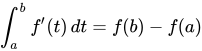
In mathematics, arithmetico-geometric sequence is the result of term-by-term multiplication of a geometric progression with the corresponding terms of an arithmetic progression. Put plainly, the nth term of an arithmetico-geometric sequence is the product of the nth term of an arithmetic sequence and the nth term of a geometric one.[1] Arithmetico-geometric sequences arise in various applications, such as the computation of expected values in probability theory. For instance, the sequence

is an arithmetico-geometric sequence. The arithmetic component appears in the numerator (in blue), and the geometric one in the denominator (in green).
The summation of this infinite sequence is known as an arithmetico-geometric series, and its most basic form has been called Gabriel's staircase:[2][3]

The denomination may also be applied to different objects presenting characteristics of both arithmetic and geometric sequences; for instance the French notion of arithmetico-geometric sequence refers to sequences of the form , which generalise both arithmetic and geometric sequences. Such sequences are a special case of linear difference equations.

Terms of the sequence[edit]
The first few terms of an arithmetico-geometric sequence composed of an arithmetic progression (in blue) with difference and initial value and a geometric progression (in green) with initial value and common ratio are given by:[4]


![{\displaystyle {\begin{aligned}t_{1}&=\color {blue}a\color {green}b\\t_{2}&=\color {blue}(a+d)\color {green}br\\t_{3}&=\color {blue}(a+2d)\color {green}br^{2}\\&\ \,\vdots \\t_{n}&=\color {blue}[a+(n-1)d]\color {green}br^{n-1}\end{aligned}}}](https://wikimedia.org/api/rest_v1/media/math/render/svg/528c2da02b4b0fb0277466a44162a1320a078ede)
Example[edit]
For instance, the sequence
is defined by , , and .


Sum of the terms[edit]
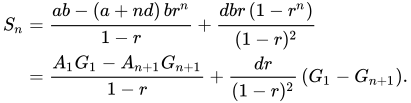
The sum of the first n terms of an arithmetico-geometric sequence has the form
![{\displaystyle {\begin{aligned}S_{n}&=\sum _{k=1}^{n}t_{k}=\sum _{k=1}^{n}\left[a+(k-1)d\right]br^{k-1}\\&=ab+[a+d]br+[a+2d]br^{2}+\cdots +[a+(n-1)d]br^{n-1}\\&=A_{1}G_{1}+A_{2}G_{2}+A_{3}G_{3}+\cdots +A_{n}G_{n},\end{aligned}}}](https://wikimedia.org/api/rest_v1/media/math/render/svg/e54d1f9fec578d07bf56c1534273e8de0a5b2818)
where and are the ith terms of the arithmetic and the geometric sequence, respectively.


This sum has the closed-form expression
Proof[edit]
Multiplying,[4]
![{\displaystyle S_{n}=a+[a+d]r+[a+2d]r^{2}+\cdots +[a+(n-1)d]r^{n-1}}](https://wikimedia.org/api/rest_v1/media/math/render/svg/ec6487b2b7e7afcfc84b0f5333dff170b47094d8)
by r, gives
![{\displaystyle rS_{n}=ar+[a+d]r^{2}+[a+2d]r^{3}+\cdots +[a+(n-1)d]r^{n}.}](https://wikimedia.org/api/rest_v1/media/math/render/svg/9d8cebff63b781422a21b619992141497245d0e4)
Subtracting rSn from Sn, and using the technique of telescoping series gives
![{\displaystyle {\begin{aligned}(1-r)S_{n}={}&\left[a+(a+d)r+(a+2d)r^{2}+\cdots +[a+(n-1)d]r^{n-1}\right]\\[5pt]&{}-\left[ar+(a+d)r^{2}+(a+2d)r^{3}+\cdots +[a+(n-1)d]r^{n}\right]\\[5pt]={}&a+d\left(r+r^{2}+\cdots +r^{n-1}\right)-\left[a+(n-1)d\right]r^{n}\\[5pt]={}&a+d\left(r+r^{2}+\cdots +r^{n-1}+r^{n}\right)-\left(a+nd\right)r^{n}\\[5pt]={}&a+dr\left(1+r+r^{2}+\cdots +r^{n-1}\right)-\left(a+nd\right)r^{n}\\[5pt]={}&a+{\frac {dr(1-r^{n})}{1-r}}-(a+nd)r^{n},\end{aligned}}}](https://wikimedia.org/api/rest_v1/media/math/render/svg/7ee736d0146177bd2f2ca5511ec4fe78d6bf654b)
where the last equality results of the expression for the sum of a geometric series. Finally dividing through by 1 − r gives the result.
Infinite series[edit]
If −1 < r < 1, then the sum S of the arithmetico-geometric series, that is to say, the sum of all the infinitely many terms of the progression, is given by[4]

If r is outside of the above range, the series either
- diverges (when r > 1, or when r = 1 where the series is arithmetic and a and d are not both zero; if both a and d are zero in the later case, all terms of the series are zero and the series is constant)
- or alternates (when r ≤ −1).
Example: application to expected values[edit]
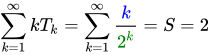
For instance, the sum
- ,

being the sum of an arithmetico-geometric series defined by , , and , converges to .


This sequence corresponds to the expected number of coin tosses before obtaining "tails". The probability of obtaining tails for the first time at the kth toss is as follows:

- .

Therefore, the expected number of tosses is given by
- .
References[edit]
- ^ "Arithmetic-Geometric Progression | Brilliant Math & Science Wiki". brilliant.org. Retrieved 2021-04-21.
- ^ Swain, Stuart G. (2018). "Proof Without Words: Gabriel's Staircase". Mathematics Magazine. 67 (3): 209. doi:10.1080/0025570X.1994.11996214. ISSN 0025-570X.
- ^ Edgar, Tom (2018). "Staircase Series". Mathematics Magazine. 91 (2): 92–95. doi:10.1080/0025570X.2017.1415584. ISSN 0025-570X. S2CID 218542483.
- ^ a b c K. F. Riley; M. P. Hobson; S. J. Bence (2010). Mathematical methods for physics and engineering (3rd ed.). Cambridge University Press. p. 118. ISBN 978-0-521-86153-3.
Further reading[edit]
- D. Khattar. The Pearson Guide to Mathematics for the IIT-JEE, 2/e (New ed.). Pearson Education India. p. 10.8. ISBN 81-317-2876-5.
- P. Gupta. Comprehensive Mathematics XI. Laxmi Publications. p. 380. ISBN 81-7008-597-7.