


Concave function
In mathematics, a concave function is one for which the value at any convex combination of elements in the domain is greater than or equal to the convex combination of the values at the endpoints. Equivalently, a concave function is any function for which the hypograph is convex. The class of concave functions is in a sense the opposite of the class of convex functions. A concave function is also synonymously called concave downwards, concave down, convex upwards, convex cap, or upper convex.
Definition[edit]
A real-valued function on an interval (or, more generally, a convex set in vector space) is said to be concave if, for any and in the interval and for any ,[1]


![{\displaystyle \alpha \in [0,1]}](https://wikimedia.org/api/rest_v1/media/math/render/svg/daf3c62599ea71319c85f715c9e590d2bab2d036)

A function is called strictly concave if

for any and .


For a function , this second definition merely states that for every strictly between and , the point on the graph of is above the straight line joining the points and .


A function is quasiconcave if the upper contour sets of the function are convex sets.[2]

Properties[edit]

Functions of a single variable[edit]
- A differentiable function f is (strictly) concave on an interval if and only if its derivative function f ′ is (strictly) monotonically decreasing on that interval, that is, a concave function has a non-increasing (decreasing) slope.[3][4]
- Points where concavity changes (between concave and convex) are inflection points.[5]
- If f is twice-differentiable, then f is concave if and only if f ′′ is non-positive (or, informally, if the "acceleration" is non-positive). If f ′′ is negative then f is strictly concave, but the converse is not true, as shown by f(x) = −x4.
- If f is concave and differentiable, then it is bounded above by its first-order Taylor approximation:[2]
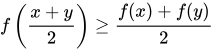
- A Lebesgue measurable function on an interval C is concave if and only if it is midpoint concave, that is, for any x and y in C
- If a function f is concave, and f(0) ≥ 0, then f is subadditive on . Proof:
- Since f is concave and 1 ≥ t ≥ 0, letting y = 0 we have
- For :
- Since f is concave and 1 ≥ t ≥ 0, letting y = 0 we have
![{\displaystyle f(y)\leq f(x)+f'(x)[y-x]}](https://wikimedia.org/api/rest_v1/media/math/render/svg/ad4b94b94e56ebbdad4a9badaa4412142b032c08)




Functions of n variables[edit]
- A function f is concave over a convex set if and only if the function −f is a convex function over the set.
- The sum of two concave functions is itself concave and so is the pointwise minimum of two concave functions, i.e. the set of concave functions on a given domain form a semifield.
- Near a strict local maximum in the interior of the domain of a function, the function must be concave; as a partial converse, if the derivative of a strictly concave function is zero at some point, then that point is a local maximum.
- Any local maximum of a concave function is also a global maximum. A strictly concave function will have at most one global maximum.
Examples[edit]
- The functions and are concave on their domains, as their second derivatives and are always negative.
- The logarithm function is concave on its domain , as its derivative is a strictly decreasing function.
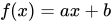
- Any affine function is both concave and convex, but neither strictly-concave nor strictly-convex.
- The sine function is concave on the interval .
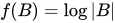
- The function , where is the determinant of a nonnegative-definite matrix B, is concave.[6]


![{\displaystyle [0,\pi ]}](https://wikimedia.org/api/rest_v1/media/math/render/svg/3e2a912eda6ef1afe46a81b518fe9da64a832751)

Applications[edit]
- Rays bending in the computation of radiowave attenuation in the atmosphere involve concave functions.
- In expected utility theory for choice under uncertainty, cardinal utility functions of risk averse decision makers are concave.
- In microeconomic theory, production functions are usually assumed to be concave over some or all of their domains, resulting in diminishing returns to input factors.[7]
See also[edit]
- Concave polygon
- Jensen's inequality
- Logarithmically concave function
- Quasiconcave function
- Concavification
References[edit]
- ^ Lenhart, S.; Workman, J. T. (2007). Optimal Control Applied to Biological Models. Mathematical and Computational Biology Series. Chapman & Hall/ CRC. ISBN 978-1-58488-640-2.
- ^ a b Varian, Hal R. (1992). Microeconomic analysis (3rd ed.). New York: Norton. p. 489. ISBN 0-393-95735-7. OCLC 24847759.
- ^ Rudin, Walter (1976). Analysis. p. 101.
- ^ Gradshteyn, I. S.; Ryzhik, I. M.; Hays, D. F. (1976-07-01). "Table of Integrals, Series, and Products". Journal of Lubrication Technology. 98 (3): 479. doi:10.1115/1.3452897. ISSN 0022-2305.
- ^ Hass, Joel (13 March 2017). Thomas' calculus. Heil, Christopher, 1960-, Weir, Maurice D.,, Thomas, George B. Jr. (George Brinton), 1914-2006. (Fourteenth ed.). [United States]. p. 203. ISBN 978-0-13-443898-6. OCLC 965446428.
{{cite book}}: CS1 maint: location missing publisher (link) - ^ Cover, Thomas M.; Thomas, J. A. (1988). "Determinant inequalities via information theory". SIAM Journal on Matrix Analysis and Applications. 9 (3): 384–392. doi:10.1137/0609033. S2CID 5491763.
- ^ Pemberton, Malcolm; Rau, Nicholas (2015). Mathematics for Economists: An Introductory Textbook. Oxford University Press. pp. 363–364. ISBN 978-1-78499-148-7.
Further References[edit]
- Crouzeix, J.-P. (2008). "Quasi-concavity". In Durlauf, Steven N.; Blume, Lawrence E (eds.). The New Palgrave Dictionary of Economics (Second ed.). Palgrave Macmillan. pp. 815–816. doi:10.1057/9780230226203.1375. ISBN 978-0-333-78676-5.
- Rao, Singiresu S. (2009). Engineering Optimization: Theory and Practice. John Wiley and Sons. p. 779. ISBN 978-0-470-18352-6.
