


Aztec Ruins National Monument
 | This article needs additional citations for verification. (December 2017) |
| Aztec Ruins National Monument | |
|---|---|
 | |
   | |
| Location | San Juan County, New Mexico, U.S. |
| Nearest city | Aztec |
| Coordinates | 36°50′09″N 107°59′53″W / 36.8358370°N 107.9981235°W[1] |
| Area | 318 acres (129 ha)[2] |
| Created | January 24, 1923 |
| Visitors | 52,756 (in 2017)[3] |
| Governing body | National Park Service |
| Website | Aztec Ruins National Monument |
| Part of | Chaco Culture National Historical Park |
| Type | U.S. historic district |
| Designated | October 18, 1966 |
| Reference no. | 66000484[4] |
| Designated | May 21, 1971 |
| Reference no. | 55 |
The Aztec Ruins National Monument in northwestern New Mexico, US, consists of preserved structures constructed by the Pueblo Indians. The national monument lies on the western bank of the Animas River in Aztec, New Mexico, about 12 miles (19 km) northeast of Farmington. Additional Puebloan structures can be found in Salmon Ruins and Heritage Park, 9.5 miles (15.3 km) south. Archaeological evidence puts the construction of the ruins in the 12th and 13th centuries. The Puebloan-built ruins were dubbed the "Aztec Ruins" by 19th century American settlers who misattributed their construction to the Aztecs.[5]
The site was declared "Aztec Ruin National Monument" on January 24, 1923. "Ruin" was changed to "Ruins" after a boundary change, on July 2, 1928. As a historical property of the National Park Service, the monument was administratively listed on the National Register of Historic Places on October 15, 1966. The United Nations Educational, Scientific and Cultural Organization (UNESCO) listed the Chaco Culture as a World Heritage Site on December 8, 1987. That listing specifically included the Aztec Ruins.[6]
The monument is on the Trail of the Ancients Scenic Byway, one of New Mexico's Scenic Byways.[7]
The property was part of a 160-acre (65 ha) homestead owned by H.D. Abrams, who supported the preservation of the ruins. The H.D. Abrams House in Aztec is listed on the National Register of Historic Places.[8]
Climate[edit]
The climate of Aztec Ruins National Monument is a typical semi-arid climate (Köppen: BSk).
| Climate data for Aztec Ruins National Monument (1991–2020 normals,[a] extremes 1895–present) | |||||||||||||
|---|---|---|---|---|---|---|---|---|---|---|---|---|---|
| Month | Jan | Feb | Mar | Apr | May | Jun | Jul | Aug | Sep | Oct | Nov | Dec | Year |
| Record high °F (°C) | 69 (21) |
78 (26) |
86 (30) |
89 (32) |
98 (37) |
105 (41) |
106 (41) |
105 (41) |
101 (38) |
92 (33) |
77 (25) |
69 (21) |
106 (41) |
| Mean maximum °F (°C) | 56.3 (13.5) |
62.7 (17.1) |
73.3 (22.9) |
80.7 (27.1) |
89.2 (31.8) |
96.8 (36.0) |
99.1 (37.3) |
95.8 (35.4) |
90.7 (32.6) |
81.8 (27.7) |
68.7 (20.4) |
57.2 (14.0) |
99.5 (37.5) |
| Mean daily maximum °F (°C) | 46.0 (7.8) |
52.5 (11.4) |
62.8 (17.1) |
70.6 (21.4) |
79.8 (26.6) |
90.3 (32.4) |
93.9 (34.4) |
91.2 (32.9) |
84.2 (29.0) |
71.7 (22.1) |
57.7 (14.3) |
46.4 (8.0) |
70.6 (21.4) |
| Daily mean °F (°C) | 31.6 (−0.2) |
37.0 (2.8) |
44.9 (7.2) |
51.7 (10.9) |
60.4 (15.8) |
70.0 (21.1) |
76.1 (24.5) |
74.0 (23.3) |
66.3 (19.1) |
53.7 (12.1) |
41.5 (5.3) |
32.1 (0.1) |
53.3 (11.8) |
| Mean daily minimum °F (°C) | 17.1 (−8.3) |
21.5 (−5.8) |
27.0 (−2.8) |
32.7 (0.4) |
41.0 (5.0) |
49.7 (9.8) |
58.2 (14.6) |
56.9 (13.8) |
48.5 (9.2) |
35.7 (2.1) |
25.3 (−3.7) |
17.8 (−7.9) |
35.9 (2.2) |
| Mean minimum °F (°C) | 2.8 (−16.2) |
8.1 (−13.3) |
14.1 (−9.9) |
19.9 (−6.7) |
29.7 (−1.3) |
38.2 (3.4) |
48.6 (9.2) |
49.5 (9.7) |
35.1 (1.7) |
21.6 (−5.8) |
11.7 (−11.3) |
3.2 (−16.0) |
−0.8 (−18.2) |
| Record low °F (°C) | −26 (−32) |
−27 (−33) |
−3 (−19) |
2 (−17) |
12 (−11) |
24 (−4) |
39 (4) |
36 (2) |
22 (−6) |
6 (−14) |
−7 (−22) |
−24 (−31) |
−27 (−33) |
| Average precipitation inches (mm) | 0.90 (23) |
0.75 (19) |
0.77 (20) |
0.69 (18) |
0.71 (18) |
0.28 (7.1) |
0.96 (24) |
1.32 (34) |
1.13 (29) |
0.94 (24) |
0.94 (24) |
0.67 (17) |
10.06 (256) |
| Average snowfall inches (cm) | 4.5 (11) |
2.3 (5.8) |
0.5 (1.3) |
0.2 (0.51) |
0.0 (0.0) |
0.0 (0.0) |
0.0 (0.0) |
0.0 (0.0) |
0.0 (0.0) |
0.3 (0.76) |
0.9 (2.3) |
2.2 (5.6) |
10.9 (28) |
| Average precipitation days (≥ 0.01 inch) | 5.6 | 5.1 | 4.4 | 3.7 | 3.8 | 2.1 | 5.1 | 7.0 | 5.7 | 4.7 | 4.2 | 5.1 | 56.5 |
| Average snowy days (≥ 0.1 inch) | 2.3 | 1.7 | 0.5 | 0.2 | 0.0 | 0.0 | 0.0 | 0.0 | 0.0 | 0.2 | 0.7 | 1.7 | 7.3 |
| Source: NOAA[9][10] | |||||||||||||
Notes[edit]
- ^ Mean monthly maxima and minima (i.e. the highest and lowest temperature readings during an entire month or year) calculated based on data at said location from 1991 to 2020.
Gallery[edit]
-
 The restored Great Kiva at Aztec Ruins
 -
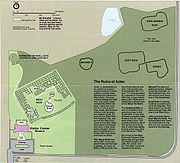 NPS Map
.jpg)


See also[edit]
- National Register of Historic Places listings in San Juan County, New Mexico
- List of National Monuments of the United States
- List of the oldest buildings in New Mexico
References[edit]
- ^ "Aztec Ruins National Monument". Geographic Names Information System. United States Geological Survey, United States Department of the Interior. Retrieved March 18, 2012.
- ^ "Listing of acreage – December 31, 2011" (XLSX). Land Resource Division, National Park Service. Retrieved March 18, 2012. (National Park Service Acreage Reports)
- ^ "NPS Annual Recreation Visits Report". National Park Service. Retrieved April 10, 2018.
- ^ "National Register Information System". National Register of Historic Places. National Park Service. July 9, 2010.
- ^ "National Park Service, Aztec Ruins, Frequently Asked Questions". Retrieved November 18, 2019.
- ^ "World Heritage List: Chaco Culture". United Nations Educational, Scientific and Cultural Organization. Retrieved December 31, 2017.
- ^ Trail of the Ancients. Archived August 21, 2014, at the Wayback Machine New Mexico Tourism Department. Retrieved August 14, 2014.
- ^ "National Register of Historic Places". NPS.gov. Retrieved April 10, 2018.
- ^ "Summary of Monthly Normals 1991–2020". National Weather Service. Archived from the original on July 15, 2023. Retrieved July 15, 2023.
- ^ "NOWData – NOAA Online Weather Data". National Weather Service. Retrieved July 15, 2023.
External links[edit]
- "The National Parks: Index 2001–2003". Washington, D. C., United States Department of the Interior
- National Park Service website
- American Southwest, a National Park Service Discover Our Shared Heritage Travel Itinerary
- UNESCO World Heritage site
 Aztec Ruins National Monument public domain audiobook at LibriVox
 Media related to Aztec Ruins National Monument at Wikimedia Commons


| Topics | |
|---|---|
| Lists by state |
|
| Lists by insular areas | |
| Lists by associated state | |
| Other areas | |
| Related | |


| International | |
|---|---|
| National | |
| Other | |

- IUCN Category III
- 1923 establishments in New Mexico
- Ancestral Puebloans
- Archaeological museums in New Mexico
- Archaeological sites on the National Register of Historic Places in New Mexico
- Former populated places in New Mexico
- History of San Juan County, New Mexico
- Museums in San Juan County, New Mexico
- National Register of Historic Places in San Juan County, New Mexico
- Native American history of New Mexico
- Native American museums in New Mexico
- National Park Service National Monuments in New Mexico
- Open-air museums in New Mexico
- Protected areas established in 1923
- Protected areas of San Juan County, New Mexico
- Pueblo great houses
- Ruins on the National Register of Historic Places
- World Heritage Sites in the United States
- Pueblos on the National Register of Historic Places in New Mexico
- Populated places on the National Register of Historic Places in New Mexico