


Heptagram
 | This article includes a list of general references, but it lacks sufficient corresponding inline citations. (April 2011) |
| Regular heptagram (7/2) | |
|---|---|
 A regular heptagram | |
| Type | Regular star polygon |
| Edges and vertices | 7 |
| Schläfli symbol | {7/2} |
| Coxeter–Dynkin diagrams |      |
| Symmetry group | Dihedral (D7) |
| Internal angle (degrees) | ≈77.143° |
| Properties | star, cyclic, equilateral, isogonal, isotoxal |
| Dual polygon | self |
| Regular heptagram (7/3) | |
|---|---|
 A regular heptagram | |
| Type | Regular star polygon |
| Edges and vertices | 7 |
| Schläfli symbol | {7/3} |
| Coxeter–Dynkin diagrams |  |
| Symmetry group | Dihedral (D7) |
| Internal angle (degrees) | ≈25.714° |
| Properties | star, cyclic, equilateral, isogonal, isotoxal |
| Dual polygon | self |
| Star polygons |
|---|
|
|
A heptagram, septagram, septegram or septogram is a seven-point star drawn with seven straight strokes.
The name heptagram combines a numeral prefix, hepta-, with the Greek suffix -gram. The -gram suffix derives from γραμμῆ (grammē) meaning a line.[1]
Geometry
[edit]In general, a heptagram is any self-intersecting heptagon (7-sided polygon).
There are two regular heptagrams, labeled as {7/2} and {7/3}, with the second number representing the vertex interval step from a regular heptagon, {7/1}.
This is the smallest star polygon that can be drawn in two forms, as irreducible fractions. The two heptagrams are sometimes called the heptagram (for {7/2}) and the great heptagram (for {7/3}).
The previous one, the regular hexagram {6/2}, is a compound of two triangles. The smallest star polygon is the {5/2} pentagram.
The next one is the {8/3} octagram and its related {8/2} star figure (a compound of two squares), followed by the regular enneagram, which also has two forms: {9/2} and {9/4}, as well as one compound of three triangles {9/3}.
 {7/2} |
 {7/3} |
 {7}+{7/2}+{7/3} |
 7-2 prism |
 7-3 prism |
 Complete graph |
 7-2 antiprism |
 7-3 antiprism |
 7-4 antiprism |
Uses
[edit] | This section needs additional citations for verification. (November 2016) |
Flags and heraldry
[edit]-
 Former Georgian coat of arms, 1918–1921, 1991–2004
 -
 Flag of Eastern Band Cherokee
 -
 The seven-pointed star of the Felibritge on the Occitan flag.
 -
 The Jordanian flag, bearing the star that symbolizes Al-Fatiha
 -
 Symbol of Hokkaido
 -
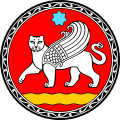 Coat of arms of Samarkand
 -
 Commonwealth Star as the crest of Coat of Arms of Australia
 -
 The flag of Cook County, Illinois, adopted in June 2022 and taking design cues from the Flag of Chicago, its county seat
 -
 The coat of arms and flag of Thun Switzerland
.svg)

.svg)


- The seven-pointed star is incorporated into the flags of various bands of Cherokee Indians and the badges of Navajo Nation Police (as well as other police).
- The Bennington flag, a historical American Flag, has thirteen seven-pointed stars along with the numerals "76" in the canton.
- The Flag of Jordan contains a seven-pointed star.
- The Flag of Australia employs five heptagrams and one pentagram to depict the Southern Cross constellation and the Commonwealth Star.
- Some old versions of the coat of arms of Georgia (country) including the Georgian Soviet Socialist Republic used the {7/2} heptagram as an element.
- A seven-pointed star is used as the badge in many sheriff's departments and some smaller-community police departments.
- A seven-pointed star is used in the otherkin pride flag.
Law enforcement
[edit]-
 Seal of the California Highway Patrol

Religious and occult symbolism
[edit]
- The heptagram became a traditional symbol for warding off evil in Catholicism.
- The symbol is also used in Kabbalist Judaism.
- In Islam, the heptagram is used to represent the first seven verses in the Quran.
- The heptagram is used in the symbol for Babalon in Aleister Crowley's occult system Thelema.
- The heptagram is known among neopagans as the Elven Star or Fairy Star. It is treated as a sacred symbol in various modern pagan and witchcraft traditions. Blue Star Wicca also uses the symbol, where it is referred to as a septegram. The second heptagram is a symbol of magical power in some pagan spiritualities.
- In alchemy, a seven-sided star can refer to the seven planets which were known to early alchemists, and also, the seven alchemical substances: fire, water, air, earth, sulphur, salt and mercury.
- In astrology. For example, the planetary hours, from which comes the names of the days of the week.
- In Polynesia, the seven-pointed star is used often in imagery, basket making, tattoos, and is considered to be a symbol of Kanaloa, the first Polynesian navigator.[2][3]
- The seven-sided star is an important symbol of the Cherokee people of southern Appalachia, representing the seven clans of the Cherokee and the sacred number seven.
In popular culture
[edit]
- The logo of American shoe brand DC Shoes features a 7/3 heptagram in the letter C.
- The seven-pointed star is used as the logo for the international Danish shipping company A.P. Moller–Maersk Group, sometimes known simply as Maersk.
- In George R. R. Martin's novel series A Song of Ice and Fire and its TV version Game of Thrones, a seven-pointed star serves as the symbol of the Faith of the Seven.
- In the manga series MeruPuri, a magical mirror/ portal is in the shape of a heptagram. The symbol is also seen during spellcasting.
- Finnish rock band HIM used a heptagram on the cover of their eighth studio album Tears on Tape.
- American heavy metal band Darkest Hour used a heptagram on the cover of their eighth studio album Darkest Hour.
- English Singer Damon Albarn uses a heptagram as a symbol in his solo performances and with his band Blur.
- The {7/3} heptagram is used by some members of the otherkin subculture as an identifier.
- The American Progressive Rock Metal Band “Tool” uses an ‘open’ seven pointed symbol for their fan group. It is ‘open’ to signify an invitation into the collective unconscious.
- An alternate logo of Chicago-based Children's Press from 1945 to 1970, having the slogan "Children's Books Are Important".
Variants
[edit]-
 Interlaced; equivalent to the 71 knot

See also
[edit]- Grünbaum–Rigby configuration
- Star polygon
- Stellated polygons
- Two-dimensional regular polytopes
- Major (United States) insignia of seven leaves
References
[edit]- ^ γραμμή, Henry George Liddell, Robert Scott, A Greek-English Lexicon, on Perseus
- ^ "HUNA INTERNATIONAL - Your best resource for Huna Knowledge and Practice". www.huna.org.
- ^ Melville, Leinani (1969). Children of the Rainbow: A Book Concerning the Religion, Legends, and Gods of the Natives of Pre-Christian Hawaii. ISBN 0835600025.
Bibliography
- Grünbaum, B. and G.C. Shephard; Tilings and patterns, New York: W. H. Freeman & Co., (1987), ISBN 0-7167-1193-1.
- Grünbaum, B.; Polyhedra with Hollow Faces, Proc of NATO-ASI Conference on Polytopes ... etc. (Toronto 1993), ed T. Bisztriczky et al., Kluwer Academic (1994) pp. 43–70.
- John H. Conway, Heidi Burgiel, Chaim Goodman-Strauss, The Symmetries of Things 2008, ISBN 978-1-56881-220-5 (Chapter 26. pp. 404: Regular star-polytopes Dimension 2)